Suspension System Red Flags: Why Support Systems Fail
Introduction
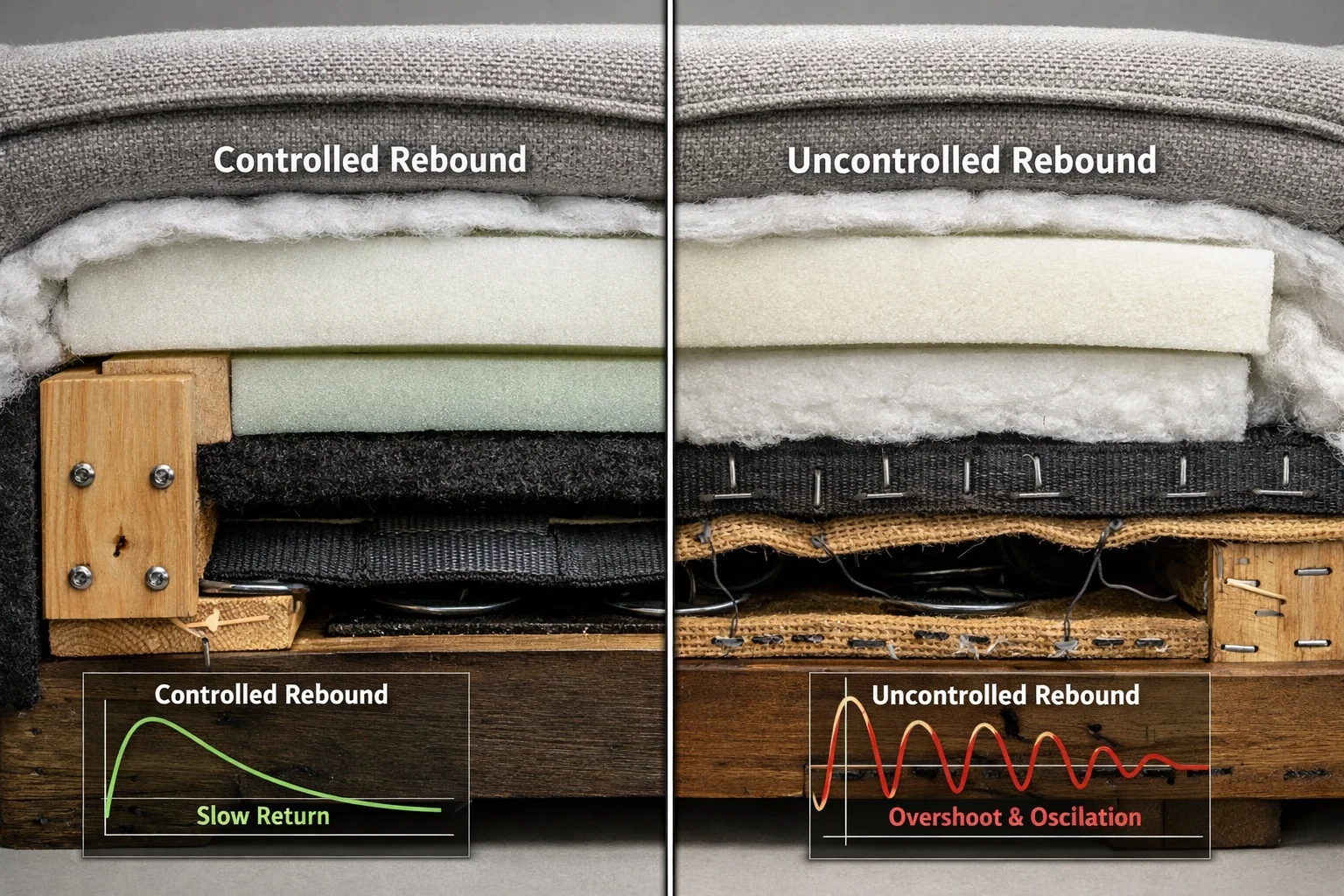
When you sit on a sofa in a showroom and it pops you back up, that is not comfort. I have learned the hard way that bounce feels impressive for about five seconds, then it turns into restlessness, sore legs, and a couch you never fully relax into.
Good suspension behaves the opposite way most people expect. Instead of pushing back, it quietly absorbs your weight and then stops moving. When I sit down on a well made sofa, I feel myself settle and stay put, not jiggle or rebound.
You can test this immediately in a store. Sit down normally, then stop moving and pay attention to what happens next. If the seat continues to oscillate under you, even a little, that energy is not being controlled.
I also press my hand straight down on the seat and let go. If the cushion and frame spring back fast and overshoot their original position, that is the same problem in miniature. A good sofa rises slowly and stops where it started.
This is where suspension type matters, but not in the way salespeople often explain it. Springs, including the kinds discussed on springs, are not supposed to feel lively. Their job is to manage force, not return it to your body.
I want you to think about a luxury car hitting a bump. You do not want to feel launched upward and then dropped. You want the motion to be absorbed and forgotten almost immediately.
If a sofa feels exciting when you first sit on it, I treat that as a warning sign. Calm, controlled, almost boring is what long term comfort actually feels like, and that is the feeling you should trust when you are spending your money.
The ‘Pogo Stick’ Test
The "Pogo Stick" Test
If sitting down launches you back up, the springs are widely spaced, thin wires. This "fun" bounce is actually a sign of structural weakness. Reliable suspension feels boring, stiff, and unwavering.I call this the pogo stick test because it feels like the sofa wants to turn you into a toy. You sit down and instead of settling, the seat pushes you back toward standing. That reaction tells me the suspension is storing energy and throwing it right back at you.
When you try this in a showroom, do not ease yourself down gently. Sit the way you would at home, with a normal amount of weight and speed. Then stop moving completely and notice if the sofa keeps responding after you are still.
If you feel even a small rebound that lifts your hips or thighs, that motion will never fully go away. Over time it turns into constant micro movement that makes you shift, fidget, and feel tired without knowing why.
I also watch how the seat behaves when I stand back up. On a weak suspension, the cushion snaps upward fast, sometimes even making a soft boing sound. A solid sofa comes back slowly and quietly, like it is exhaling.
Salespeople sometimes describe bounce as supportive or lively. I have learned to ignore that language and trust my body instead. Support feels like resistance, not propulsion.
If you are testing multiple sofas, this contrast becomes obvious fast. The good one will feel dull by comparison, almost disappointing at first touch. That dullness is exactly what keeps the sofa comfortable years later, when the excitement has worn off and only the structure remains.
Red Flag 1: The “Fist Gap” (Wide Spacing)
This is one of the easiest shortcuts to spot in a showroom, and one of the most expensive mistakes you can live with at home. I have owned sofas that felt fine at first and then collapsed into ripples because the springs were spaced too far apart.
Furniture makers save a lot of money by stretching sinuous springs wide instead of using more of them. On the surface you still see springs, so it sounds reassuring, but the spacing matters more than the fact that springs exist at all.
I check this by feeling underneath the seat. Most sofas have a thin dust cover stapled to the bottom, and you can usually press right through it with your hand. If the salesperson looks nervous, that already tells me something.
I slide my hand up and feel for the zigzag wires, then I pay attention to how much empty space is between them. If my entire fist fits comfortably between two springs, I walk away without debating it.
That wide gap is where your cushion foam will eventually sink. Foam is soft and patient, and over months it slowly pushes down into those openings like dough through a rack.
At first you just feel a vague unevenness. Later the seat develops visible waves, and you start favoring one spot without realizing why.
What finally kills the cushion is the springs themselves. Those hard wires act like a cheese grater from below, rubbing and cutting into the foam every time you sit down.
You cannot fix this later with better cushions. I have tried, and the new foam just gets eaten the same way because the structure underneath never changed.
In a store, do not rely on how thick the cushions look or how firm they feel. Thickness hides problems, and firmness fades, but spring spacing stays exactly what it was on day one.
If you cannot access the bottom, press straight down on the seat with your knuckles and move side to side. On widely spaced springs you will feel distinct soft valleys and harder ridges instead of a consistent platform.
When the suspension feels like one continuous surface instead of a grid of gaps, that is what you want. It is boring, uniform, and not impressive, and that is exactly why it lasts.
Red Flag 2: The Plastic Clip Creak
After I check how a sofa moves, I listen to it. I sit down with a bit of force, the way you would when you get home tired, and I pay attention to any sound that comes from underneath me.
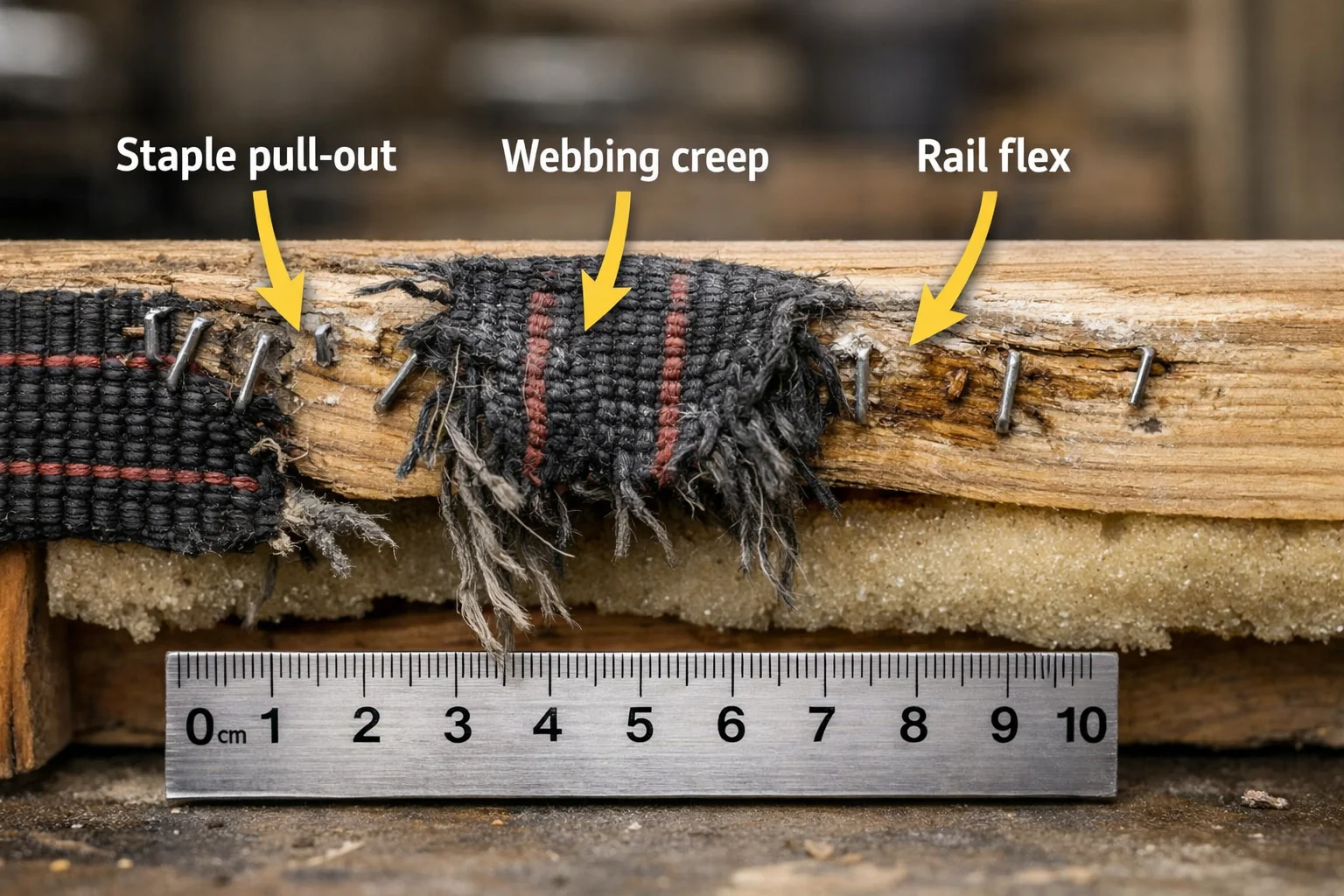
A sharp creak, click, or plastic pop is not harmless. In my experience that noise usually comes from plastic clips that hold the springs to the wood frame, rubbing or flexing under load.
This is different from a faint fabric rustle or cushion noise. The sound I am talking about feels structural, like it is coming from the bones of the sofa rather than the upholstery.
Plastic clips are cheap and fast to install, which is why they show up in so many sofas that look nice on the floor. The problem is that plastic hardens and becomes brittle with time, especially in a dry or warm home.
When one of those clips finally snaps, the spring does not politely fail. It releases all its stored tension at once and can punch straight through the thin fabric on the bottom of the sofa.
I have seen this happen, and once it does, the sofa is effectively done. Fixing a broken clip means stripping the upholstery off the entire piece to reach the frame, which costs more than the sofa is worth for most people.
In a showroom, you can test for this without tools or expertise. Sit down firmly in a few different spots and listen carefully, then stand up and do it again. Repeat it once or twice because some clips only complain when they are stressed just right.
If you hear that plastic sound, do not let anyone talk you out of it by saying it will break in or quiet down. That noise is friction or flex, and friction only gets worse as parts wear.
I also press down on the seat with my hand and gently rock it side to side. If I hear ticking or creaking in rhythm with that movement, I know something rigid and brittle is doing the work.
Better sofas use metal clips to attach the springs, usually with a thin layer that dampens noise. You do not need to know the material name, only that metal under load stays stable and quiet.
The key thing I have learned is that a good suspension does its job silently. When weight goes on and comes off, nothing announces it.
If a sofa talks back to you in the store, it will shout at you at home. I treat any plastic creak as an early warning and move on, no matter how good the fabric or cushions feel on top.
Red Flag 3: The Webbing Trap
After springs and clips, I always check what is actually holding the seat up. This is where a lot of sofas quietly cut corners, especially ones that look modern and clean underneath.
I press my hand straight down on the fabric deck beneath the cushions and pay attention to what I feel. If my hand sinks easily and the resistance feels stretchy and rubbery instead of firm, I know I am touching webbing.
Webbing feels comfortable in a showroom because it gives immediately and spreads your weight. The problem is that most of it is just rubber, and rubber does not age gracefully.
In normal home conditions, that rubber slowly dries out and loses its snap. After a few years it stops pushing back at all and turns into a permanent hammock.
When that happens, the cushions are no longer sitting on a stable platform. They start sagging no matter how good the foam is, and you end up feeling like you are sitting in a shallow bowl.
I have lived with this, and it sneaks up on you. One day you realize your hips are lower than your knees and you cannot get comfortable no matter how much you fluff or rotate the cushions.
There is one exception that salespeople love to mention, which is high end Italian Pirelli webbing. It is stronger, more elastic, and lasts much longer.
Here is how I handle that in real life. If the sofa is not clearly expensive, and I mean well above the impulse buy range, I assume the webbing is not the good kind.
On anything under about two thousand dollars, webbing is almost always a cost saving move. It is cheaper than proper spring systems and faster to install, and the failure shows up years later when the store is long out of the picture.
You can also feel the difference with a simple test. Press down hard with your palm and then release. If the surface snaps back quickly like a rubber band, that energy is going to fade with time.
A better suspension comes back slowly and then stops, even if it is webbing combined with other support. Pure rubber webbing feels lively at first and then lifeless later.
I also sit on the sofa and shift my weight forward and back. On webbing, I feel a gentle rolling motion under me, like the seat is breathing.
That movement is subtle in the store, but once the webbing stretches, it turns into a constant sag that you cannot fix without rebuilding the sofa.
If you are told that webbing is more comfortable or more modern, I would pause. Comfort that comes from stretch instead of structure does not last.
When I am standing in a showroom and I feel that soft, elastic give under the seat, I take it as a warning. No fabric, cushion, or warranty has ever made up for a seat that slowly turns into a rubber sling.
Red Flag 4: Thin Wire Gauge
This one took me years to understand because you cannot see it easily, and most salespeople either do not know or avoid talking about it. The thickness of the spring wire itself has a huge impact on how long a sofa stays supportive.
Thin wire springs feel friendly in a showroom. When I sit down, they compress easily and feel soft, almost welcoming, especially if I am comparing them to a stiffer sofa nearby.
That softness is exactly the problem. Thin wire stretches under repeated load, and once it stretches, it never fully returns to its original shape.
In practical terms, this is what people call spring fatigue. After a year or two of normal use, the seat stops holding you up and starts letting you sink deeper each time you sit.
Thicker wire behaves very differently. When I sit on a sofa with heavy gauge springs, it feels firm and even a little unyielding at first.
I used to think that meant it would be uncomfortable. What I learned is that this initial stiffness is what keeps the seat feeling the same five and ten years later.
In a store, you can feel wire gauge without knowing any numbers. Sit down and notice how much effort it takes to compress the seat.
If the seat gives way immediately under your weight and keeps sinking until you stop it, I assume the wire is thin. If it resists you and then settles only a small amount, that resistance is what you want.
I also press down hard with my hand and pay attention to how deep my palm travels. On thin wire springs, my hand drops quickly and far before it meets real resistance.
On thick wire springs, the surface pushes back early. It does not feel cushioned by the springs themselves, but supported by them.
Salespeople sometimes describe thin wire as more comfortable or more relaxed. I translate that in my head as more likely to stretch out.
When I am choosing between two sofas, I always favor the one that feels slightly too firm in the showroom. I know from experience that firmness from structure fades slowly, while softness from thin materials disappears fast.
You do not need to ask for gauge numbers to protect yourself. Most stores will not give a clear answer anyway.
Trust your body instead. If the seat feels stiff, calm, and a little boring when you first sit down, that is usually the thicker wire doing its job.
If it feels plush and easy before the cushions even have a chance to work, I assume the springs are doing too much bending and not enough holding.
I have never regretted buying a sofa that felt firmer than I expected on day one. I have regretted every sofa that felt perfect right away and then slowly sagged into a shape I could not fix.
Red Flag 5: The Cheese Grater Effect (Insulation)
This is the red flag most people never think to check, and it is one of the fastest ways a decent looking sofa gets destroyed from the inside out. Between the metal springs and the foam cushion there should be a thick, tough layer of felt or canvas that acts like armor.
I learned about this after cutting open an old sofa out of frustration. The foam looked fine from the top, but the bottom was shredded where it sat directly on the springs.
Metal under movement is not gentle. Every time you sit, shift, or stand up, those wires rub against the foam, and without protection they slowly saw through it.
In a showroom, I test this by pressing firmly straight down on the seat deck, not the loose cushion but the surface underneath it. I use my palm or knuckles and apply real pressure.
If I can feel the distinct zigzag shape of the springs through that layer, I know the insulation is too thin. It should feel dull and padded, not like I am tracing wires under a blanket.
What you want is a dead feeling surface between you and the springs. When I press down on a well insulated seat, the resistance feels uniform, like pushing on a dense mat.
On a poorly insulated one, my hand picks up sharp ridges and valleys. That sharpness is exactly what will chew up the foam over time.
Salespeople almost never mention this layer because you cannot see it, and it does not make the sofa feel softer in the store. It only shows its value years later when the cushions still hold their shape.
This is also why replacing cushions rarely fixes a sagging seat. If the insulation is thin, new foam just gets attacked the same way from below.
You do not need to know the name or thickness of the material to protect yourself. Your hand can tell you everything if you press with intention.
If the store will not let you remove the cushions or discourages you from pressing on the deck, that makes me more suspicious, not less. A solid build holds up to being touched.
When I find a sofa where I cannot feel the springs at all through the deck, I take that as a quiet green light. It tells me someone spent money on the parts you never see.
This layer does not add excitement or showroom comfort. It adds longevity.
I have learned to value that invisible protection more than plushness. A sofa that feels slightly plain on top but well shielded underneath will outlast one that feels luxurious for a year and then collapses.
If you remember one thing from this section, let it be this. Springs should never be able to announce their shape to your hand. If they can, they will eventually announce themselves to your body.
Technical Summary: The Suspension Audit Checklist
Before you commit to a sofa, I run a quick mental audit that takes less than two minutes and tells me almost everything I need to know about the suspension.I start with the bounce check. I sit down normally and then go completely still. If the seat keeps moving or pushes me back up, I know the suspension is storing energy instead of controlling it. What I want to feel is a quick settle and then nothing, like the sofa has already forgotten I sat down.
Next I do the gap check underneath or through the seat. I feel for the spring wires and pay attention to the empty space between them. If my fist can fit comfortably between two wires, I assume the spacing is too wide and the cushions will eventually sink into those gaps. Tight, consistent spacing feels boring to the hand, and boring is exactly what lasts.
Then I listen. I sit down with a little force and stand back up, repeating it in a couple of spots. If I hear creaking, clicking, or a plastic sounding complaint, I assume cheap clips are involved and that noise will only get worse with time. A solid suspension does its work quietly.
After that I do a feel check on the deck itself. I press firmly with my palm or knuckles on the surface under the cushions. If I can feel sharp wire shapes or ridges, I know there is not enough insulation protecting the foam. The surface should feel dull and padded, not like I am tracing hardware under fabric.
Finally, if the store can answer it clearly, I ask about spring thickness or construction. I am listening for heavy gauge steel or true eight way hand tied work. If the answer is vague or framed as not important, I fall back on what my body already told me. A seat that resists me slightly and settles calmly usually means thicker wire doing real work.
I do not need a salesperson to confirm any of this for me. My hands, my ears, and the way the seat behaves under my weight give me more reliable information than most spec sheets.
When a sofa passes all of these checks, it rarely feels exciting in the showroom. It feels steady, controlled, and almost plain. That plainness is what keeps it comfortable when the novelty is gone and daily life takes over.
I have learned to trust this audit even when it leads me away from a sofa I initially liked. Every time I ignored one of these signals, I paid for it later in sagging seats and regret.
If you walk into a store with nothing else in mind, carry this checklist in your body. Sit, press, listen, and feel. A good suspension does not try to impress you. It just holds you, quietly and consistently, year after year.
Diagram
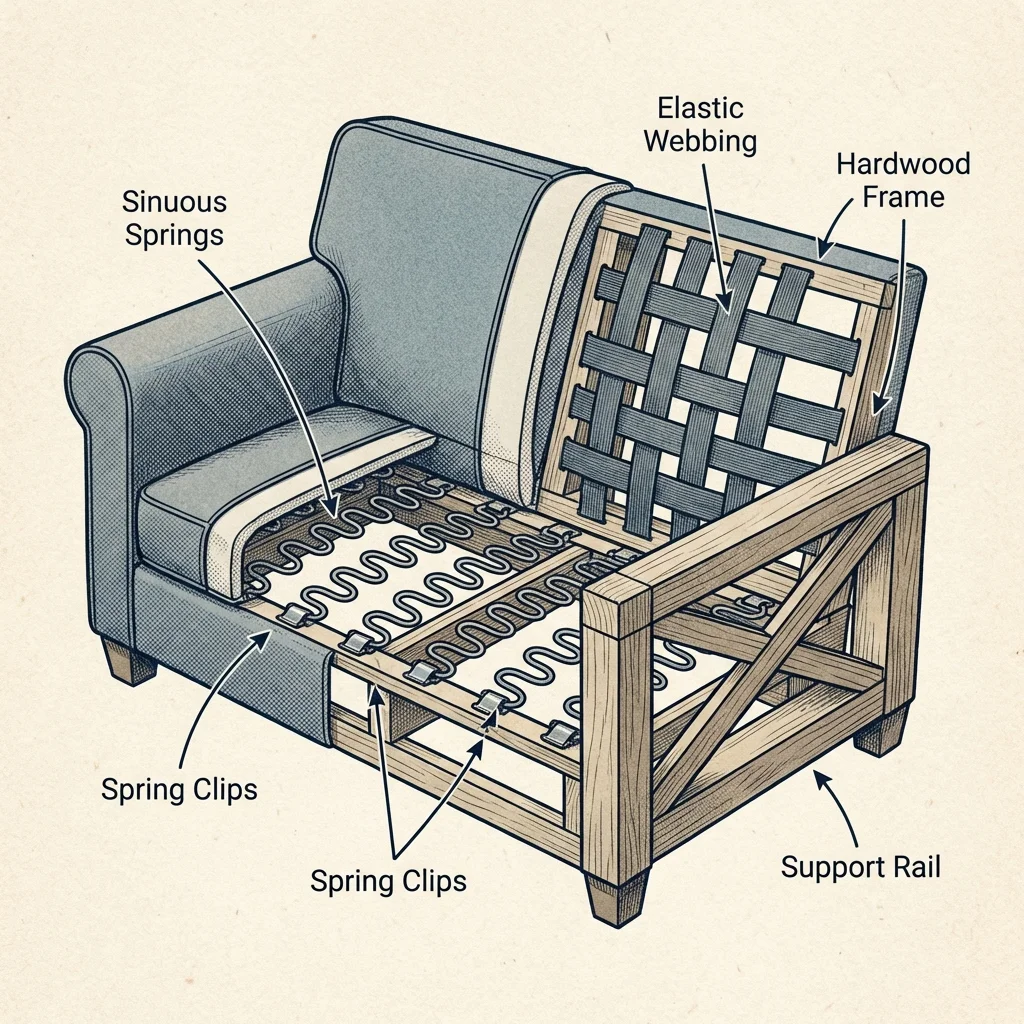
When I first saw diagrams like this, I dismissed them as marketing visuals. What changed my mind was realizing that this picture explains a feeling you can detect with your body in a showroom.
The thicker spring on the left is not about luxury or overbuilding. It is about how much the wire has to bend every time you sit down. Less bending means less stretching, and less stretching means the seat stays the same shape longer.
The thinner spring on the right looks almost identical at a glance, especially once it is hidden under fabric and foam. The difference only shows up after hundreds of sit downs, when that thinner wire has been flexed just a little too far, just a little too often.
I want you to use this diagram as a mental translation tool. When you sit on a sofa and it compresses easily and deeply before the cushions even engage, imagine the thinner wire. When you feel early resistance and a controlled stop, imagine the thicker one.
You cannot see gauge numbers in most stores, and I have stopped trying to chase them. What I do instead is connect what my body feels to what this diagram represents.
If the seat feels like it is doing a lot of work just to hold you up, the wire is probably doing a lot of bending. Bending is what leads to fatigue.
If the seat feels like a firm platform that lets the cushions do the comfort work, the springs are likely thicker and more stable. That division of labor is what lasts.
I also think about time when I look at this image. Thin wire does not usually fail all at once. It slowly relaxes, week by week, until one day you realize the sofa you bought is no longer the sofa you sit on.
This diagram is not something you need to memorize. It is something you should remember when a sofa feels suspiciously easy and welcoming on the first sit.
When I connect that easy feeling to the thinner wire in this image, it helps me walk away without second guessing myself.
The goal is not to buy the stiffest sofa in the store. The goal is to buy one where the structure is quietly strong enough that you never have to think about it again.
That is what the thicker wire represents to me. Less excitement up front, and far fewer regrets later.
Explore Technical Reference
Long-Term Durability: Why "Buy It for Life" is Dangerous Advice
The myth of maintenance-free furniture. Why good furniture still needs care, and why serviceability matters more than invincibility.
Analyze Details →
Online vs In-Store Furniture Buying: Understanding the Blind Bet
Why buying a sofa online is fundamentally different from buying shoes online. Understanding the sit test gap, color calibration problems, and the hybrid approach.
Analyze Details →