Online vs In-Store Furniture Buying: Understanding the Blind Bet
Introduction
Online shopping has conditioned us to expect that everything can be purchased from a screen. The sofa, however, is a fundamentally different class of object that defies the logic of Amazon Prime. The delivered sofa rarely matches the website’s professional photography, and the return process can cost hundreds of dollars.
If you take nothing else from this guide, take this: I treat a sofa like a long term relationship, not a quick checkout. Photos can hide a lot, like a frame that flexes, cushions that bottom out, and fabric that looks great in a studio but feels rough or pills fast in real life.
When you can, I want you in front of the sofa before you buy it, even if you plan to order online later. You are not just checking “comfort,” you are checking whether it is built to stay comfortable after months of sitting in the same spots.
In a showroom, I do three things that cost you nothing and reveal a lot. I sit the way you actually sit at home, I shift my weight hard into one corner and then the other, and I listen and feel for flex, creaks, or a loose, springy wobble that makes the whole piece feel uncertain.
I also stop trusting my eyes and start using my hands. I run my fingers along the front edge of the seat where wear shows up first, I press down to see if the cushion rebounds or stays dented, and I grab the arms and gently shake them to see if they feel like part of a solid box or like decorative pieces attached to a flimsy core.
If you are buying online because you have to, I want you to act like you are planning for a return even if you hope you will not need one. Before you click buy, you should confirm in writing what return shipping costs, whether you have to keep the packaging, how many days you have, and whether “delivery” means to your door or into your room, because those details are where people get trapped.
Finally, I want you to slow down and ask for the unglamorous information. Real seat depth, cushion fill type, frame materials, warranty coverage for the frame and cushions, and whether the covers are removable are not nerd details, they are the difference between a sofa that holds up and one that looks tired in a year.
The 50,000 Lumen Lie
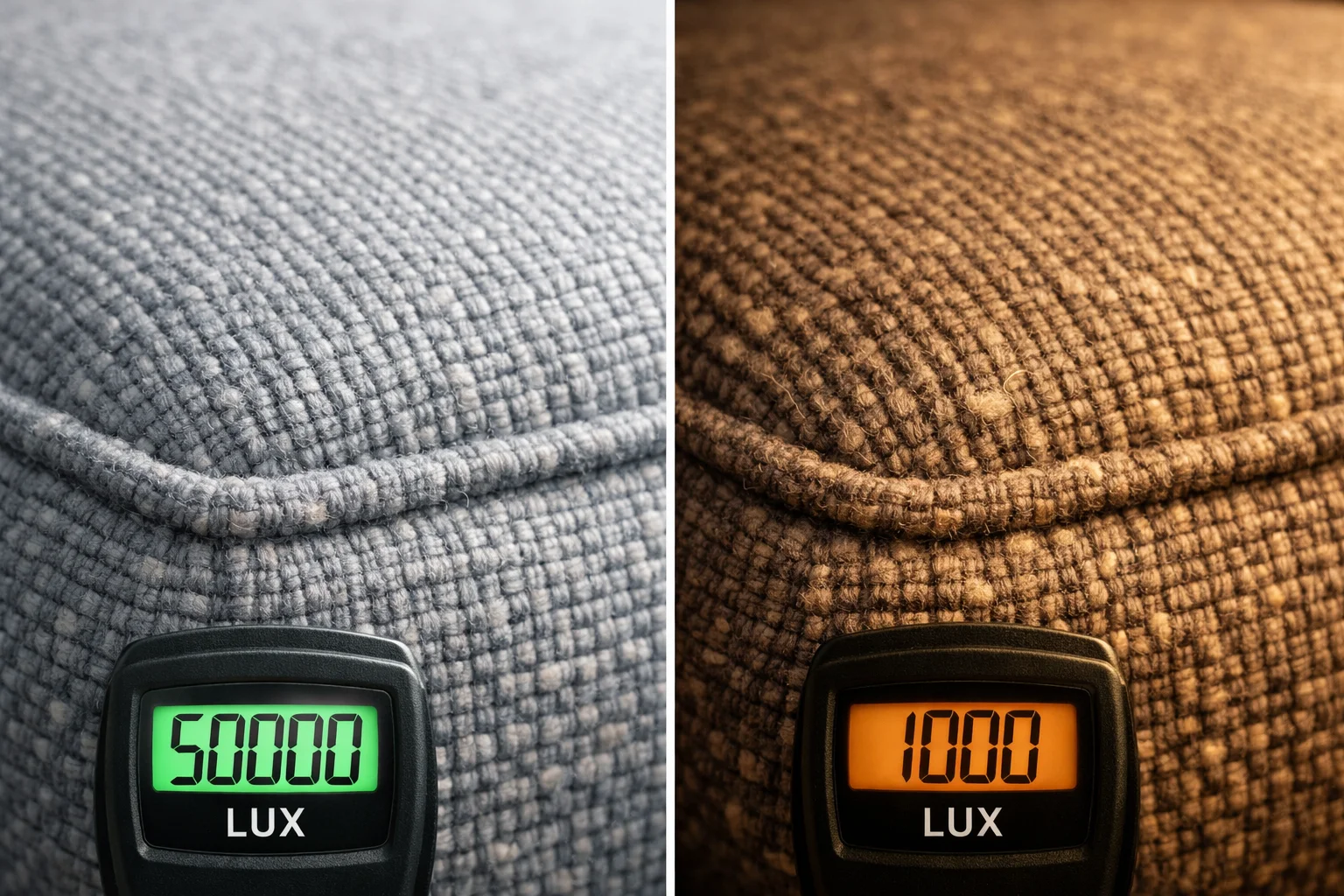
Product photos are shot in a studio with approximately 50,000 lumens of professional lighting. Your living room likely has 800 to 1,200 lumens. The color will look different. The “Slate Blue” on your screen may appear “Muddy Grey” in your home.The fastest way to get disappointed by a sofa is to fall in love with a photo. I have learned to assume every listing image is doing the fabric a favor, because bright, even studio light makes textures look cleaner, colors look richer, and shadows disappear.
If you can see the sofa in person, I want you to treat the showroom like a lighting test, not a beauty contest. Walk it over to the edge of the display if they will let you, or at least look at it from multiple angles, because overhead store lighting can still be very different from your home, and side light is where you will notice whether a color reads warm, cool, greenish, or washed out.
I also want you to do something that feels almost too simple, take out your phone and shine the flashlight across the fabric from the side. That raking light exaggerates texture and shows you what studio photos hide, like uneven nap, shiny spots, and how quickly the fabric goes from “smooth” to “every fingerprint and hair shows.”
Then do the opposite and dim it down. If the store has a darker corner, step into it and look again, because a lot of popular colors only look “special” in bright light and go flat in normal evening lamp light. If your home is mostly warm bulbs, that crisp gray can drift beige, and that deep blue can turn dull.
If you are ordering online, I would not trust “Slate Blue” or any other poetic color name. I want you to request actual swatches and look at them where the sofa will live, morning light, afternoon light, and at night with the lamps you actually use, because the same fabric can read like three different colors over a day.
When I look at swatches, I keep them vertical as well as flat. Upholstery fabric changes when it wraps over cushions, and a fabric with a nap, a velvet, a microfiber, even some weaves, can flip lighter or darker depending on direction, which is why the photo looks dramatic but your sofa ends up looking blotchy.
I also compare the swatch to the biggest surfaces near the sofa, not the throw pillows you can change later. Hold it next to your wall color and your floor, because those are the two things that will quietly tint everything, and they are the reason a “neutral” sofa sometimes clashes even when the swatch looked fine by itself.
One last thing I do is check how forgiving the color is. If you have kids, pets, or you eat on the sofa, I would rather you pick a slightly mottled weave or a color with some visual movement than a perfectly flat, inky solid, because real life creates crumbs, oil spots, and wear paths, and the most “perfect” fabrics are often the ones that show imperfection first.
The Physicality Problem: You Can’t “Download” Comfort
A sofa’s main job is to physically meet your body, and that is where shopping from a screen breaks down. I have sat on sofas that felt luxuriously soft to me, then watched a heavier friend sit down and immediately hit the hard layer underneath, and we were both telling the truth.
This is why I do not put much weight on comfort labels. When a tag says “medium firm,” “cloud soft,” or “supportive,” I treat it like a vibe, not a spec, because there is no agreed definition behind those words and no penalty for using them loosely.
In a showroom, your body gives you real information in seconds, especially about seat depth, back angle, and whether the cushion has real resistance or just a fluffy top that collapses. Online, you are basically wagering that your version of “soft” matches a copywriter’s version of “soft,” and that is a bad place to be with a $2,000 purchase.
If you can get to a showroom, I want you to do a comfort test that matches your real life, not the polite ten second perch people do in public. Sit all the way back, then sit the way you actually sit at home, feet up if that’s you, slightly sideways if that’s you, and stay there long enough to notice what starts to bug you, like pressure under your thighs, a back that pushes your shoulders forward, or a seat that feels fine until it slowly sinks.
Pay attention to where your weight ends up. If you feel your pelvis rolling backward and your lower back losing contact, that “plush” feeling can become a slouch trap after an hour, and I have regretted that kind of sofa more than almost any other.
I also want you to test the front edge of the seat, because that is where a lot of sofas feel comfortable for a minute and then punish you. If the front edge feels like a bar under your thighs, it can cut off circulation, and if it collapses too easily, you end up constantly bracing with your legs to keep from sliding forward.
If you are shopping with a partner or anyone else who will use the sofa a lot, sit together at the same time. I have learned that some sofas feel great solo but become a mess with two people, either because the middle dips, the cushions shove you toward each other, or the frame telegraphs movement so every shift travels across the seat.
If you cannot try the exact model in person, I still want you to try something from the same brand with the same cushion construction. Ask the salesperson what the seat core is, what the wrap is, and whether it is the same build across the line, because a “similar looking” sofa can feel completely different if the cushion recipe changes.
When you are forced to buy online, the best move I have found is to force specificity out of vague language. I ask for the actual seat depth and seat height, and I compare them to a sofa I already like, because “deep” and “standard” are used the way “large” is used in clothing, inconsistently and sometimes optimistically.
I also assume that showroom comfort is the best case, not the average case, because floor models get broken in. That can work both ways, since sometimes a sofa starts firm and improves, and sometimes it starts nice and turns into a hammock, but it means your first week at home might not match what you remember in the store.
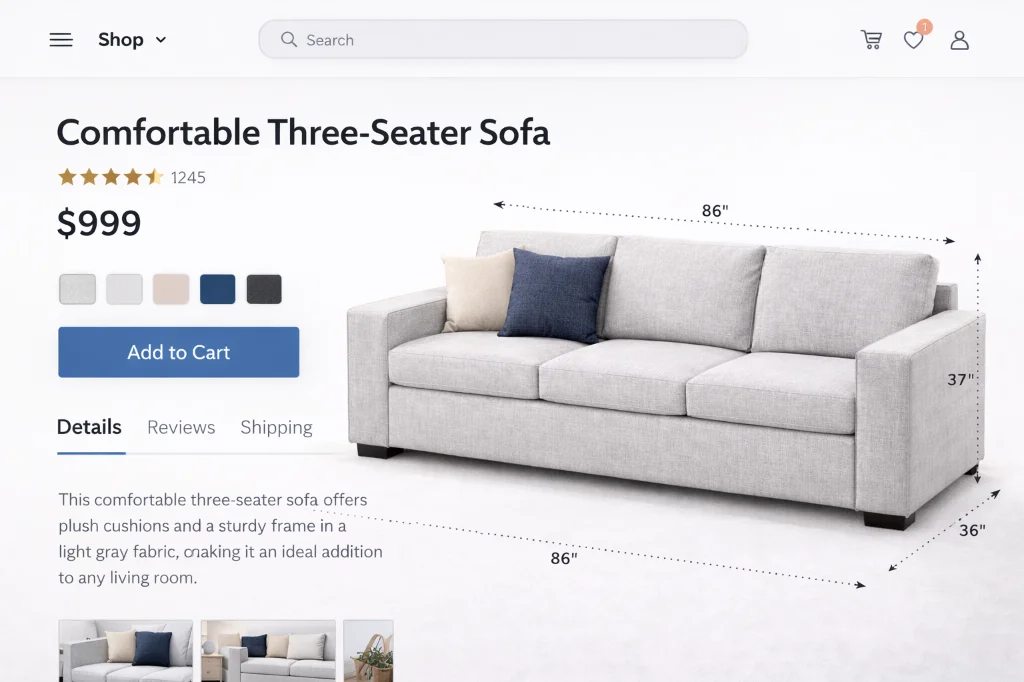
One more trap I want you to watch for is renderings and overly “perfect” product photos. If the listing images look like a video game, I assume the softness, the shape, and even the cushion fullness are being idealized, and I go hunting for unfiltered customer photos to see what shows up in real homes after real use.
If you do find yourself relying on reviews, I want you to filter them mentally by body type and use. A person who is light, short, and sits upright to read can honestly love a sofa that a taller, heavier person who lounges will find shallow, saggy, or unsupported, and neither review is wrong.
The goal here is not to find a sofa that is “comfortable” in the abstract. It is to find a sofa that is comfortable for you, for your household, in the positions you actually use, and that is exactly the part of the purchase you cannot download.
The Color Calibration Trap
Every screen lies to you in its own special way, and I learned that the hard way. My phone tends to punch up saturation so everything looks richer, and my laptop shifts color depending on ambient light, so the same “warm gray” can look cozy at night and weirdly green in daylight.
If you are shopping online, I want you to assume the listing photos are the best case version of that fabric. Even honest brands are fighting your device settings, your room lighting, and the fact that cameras compress subtle color and texture into something flatter and cleaner than real cloth.
A simple move that saves a lot of pain is to look at the same sofa on at least two different devices, ideally your phone and a computer. If the color looks meaningfully different between them, that is your warning sign that you are operating in the danger zone, and you should not “trust your gut” on color.
I also like to look at customer photos, but I treat them as evidence, not truth. One person’s photo might be shot in a sunny white room with cool LEDs, another might be in a dim warm apartment, so what I am really looking for is whether the fabric has a consistent undertone across many homes, or whether it shape shifts from blue to gray to green depending on light.
When a retailer offers “free returns” I still do not let that talk me into gambling on color. A sofa return is not a T shirt return, and the hassle, scheduling, and repacking pressure is often enough that people keep a color they quietly hate.
The Swatch Rule
Never, ever order a sofa without holding a fabric swatch in your hand. Tape the swatch to your wall or floor. Observe it in the morning, noon, and night. If you still like it after 72 hours of changing light conditions, only then is it safe to order.When I tape the swatch up, I put it near whatever will visually “pollute” it, like the rug, the floor, a big nearby wall, or a set of curtains. Your brain does color correction without asking you, so the swatch that looked perfect on a white desk can suddenly look pink next to red oak, or cold next to creamy paint.
I also make myself look at it under the exact lamps I use at night, not just daylight. If your evenings are warm bulbs, a lot of modern grays go taupe, some beiges go yellow, and some blues lose their depth and turn dusty, and those shifts matter because you live with the sofa mostly in normal, imperfect light.
If the fabric has any nap or sheen, I tilt the swatch and walk past it a few times. That is the moment you find out whether it is going to look even and calm, or whether it is going to flash light and dark every time someone sits down and brushes the surface.
Before I order, I like to do one last reality check by putting the swatch next to the most common clothing in my house, like denim, black leggings, or light knits. If a fabric is prone to picking up lint or looking chalky against dark clothes, this is where you notice, and it is a lot cheaper to be picky about that with a swatch than with a whole sofa.
The Return Reality: It’s Not Like Returning Shoes
When I see a return policies link on a sofa listing, I do not treat it like a safety net. I treat it like a cost worksheet, because furniture returns are logistically punitive in a way most people only discover after the delivery truck leaves.
The first thing I assume is that “free shipping” is a one way gift, not a two way promise. A lot of brands will happily eat the cost to get a sofa to you, then charge you a large pickup or return shipping fee to take it back, and it is not unusual for that number to be painful.
Then there is the restocking fee, which is the quiet multiplier. Once a sofa has been unboxed, it often cannot be sold as new, so many retailers charge a percentage to take it back, and that percentage is applied to the full item price, not what you wish you paid.
Packaging is where people get trapped, and I have been burned by this logic before. Some policies require the original packaging, and sofas tend to arrive in massive boxes with fitted corners, stapled seams, and protective layers you basically have to destroy to get the piece out safely, which means you can accidentally make a return impossible on day one.
Whenever I see a “100 day trial” or similar offer, I translate it into a simple question, what does it cost to exit. If return shipping plus restocking ends up being a few hundred dollars, that “trial” is not really a trial, it is a discounted mistake fee, and the brand is counting on you deciding it is not worth the hassle.
Before you buy, I want you to ask for the return math in writing, not just the headline. I ask what the pickup fee is from my zip code, whether there is a restocking fee, whether delivery fees are refundable, and whether the return window starts at order date or delivery date, because those details change the real risk.
I also confirm the physical process, because that is the part that turns an annoying return into a nightmare. I ask if they pick it up from inside my home or only from curbside, whether I need to disassemble it, and whether I need to rebox it, because “you can return it” can secretly mean “you can return it if you can stage a boxed sofa on the sidewalk.”
If you are in a showroom, I want you to use the salesperson for this instead of guessing. I ask them to show me the exact policy for the exact SKU, then I take a photo of it or have them email it to me, because I have seen return terms vary across collections even within the same store.
If you are buying online, I want you to plan your unboxing like you are renting the sofa until you are sure. I open it carefully, keep every piece of foam and cardboard for at least a couple of weeks, and I do not break down the box until I have sat on the sofa for a few normal evenings, because that is when discomfort and regret usually show up.
The last move I make is to time my decision around my calendar, not the marketing window. If I am traveling, busy, or waiting on a rug, I do not order yet, because a return window you do not actively use is not a return window, it is just a countdown you forgot about.
The Showroom Value Proposition
A physical showroom gives you something the internet cannot, verification. Pixels can sell you a story, but your hands and your body can tell you what is actually going to happen after six months of nightly use.
The first thing I use the showroom for is a tactile audit. I run my hand across the fabric and I do it in more than one direction, because some fabrics feel smooth one way and grabby the other way, and that grabby feeling is what turns into pilling, lint collection, and that always messy look.
Then I get close to the stitching instead of admiring the silhouette from ten feet away. I look for straight seams, even spacing, and corners that look neatly finished, because sloppy stitching is often a hint that the rest of the build is rushed too.
I also pinch and rub the fabric lightly between my fingers on the front edge of the seat and the inside of the arm. Those are the zones that see constant friction, and they will tell you fast whether the fabric feels like it can take real life or whether it already feels fragile and fuzzy.
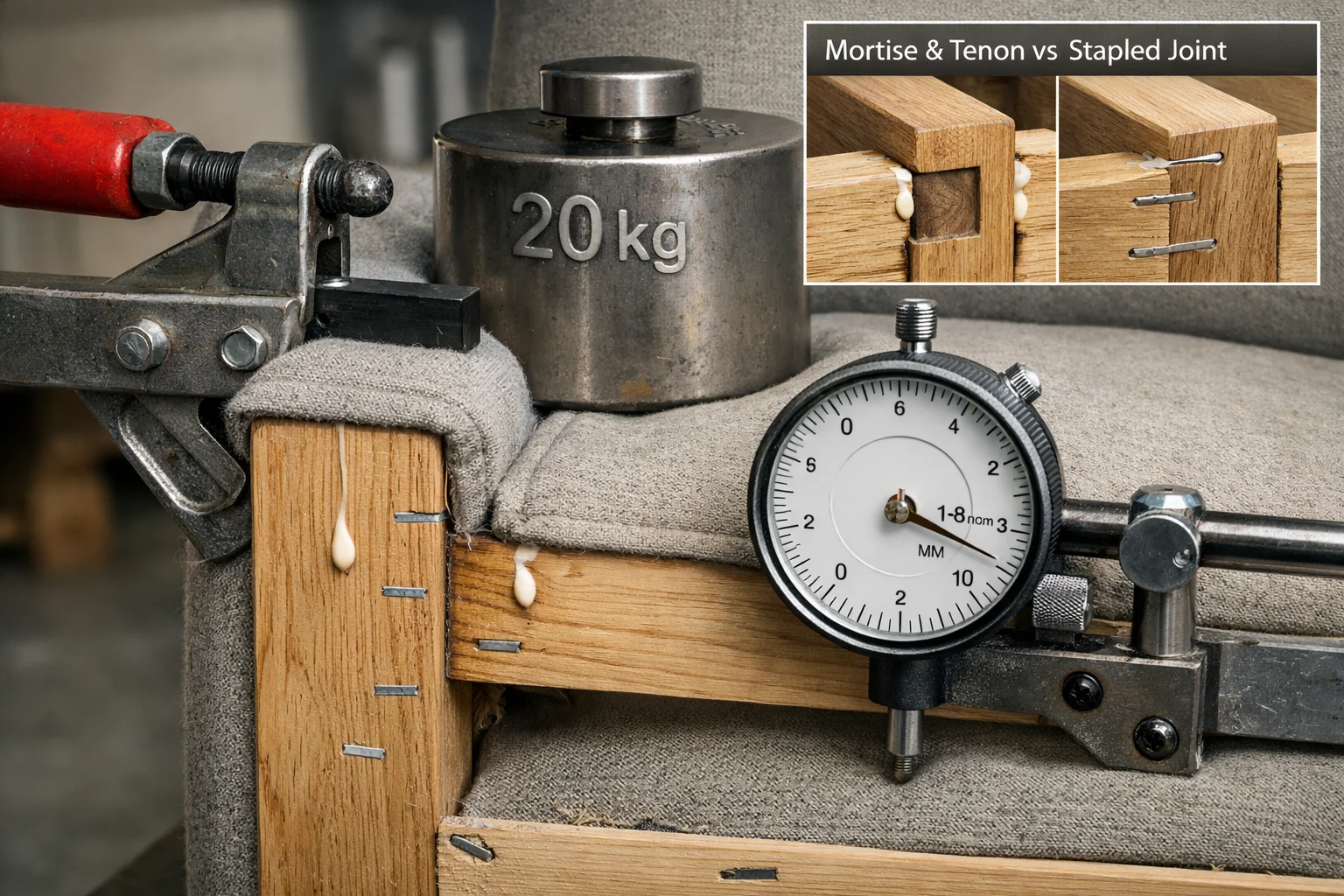
After that, I move to the frame check, because this is the part photos are best at hiding. If the sofa feels great but the structure is flexy, you are basically buying a comfort demo that will slowly loosen and creak as the joints work themselves tired.
I do the Lift Test from the frame quality checklist when the showroom allows it, and I do it carefully. I grab one front corner and lift just enough to see whether the opposite corner tries to come up with it, because a rigid frame behaves like a single unit and a weak one twists and lags.
While I am there, I pay attention to noise and movement. A little soft settling is normal, but repeated creaks, a wobble that travels through the whole sofa, or arms that feel like separate add ons are the kind of warnings that tend to get louder at home, not quieter.
The last showroom advantage is the service layer, and I have learned not to treat it as a perk. Many local retailers include white glove delivery, which usually means they bring it into the room, unpack it, and take the trash, and that can be the difference between an easy delivery day and a curbside disaster that you are stuck wrestling alone.
I want you to ask what delivery means in plain language before you assume anything. If they say “threshold” or “curbside,” that often means the sofa becomes your problem at the door, and if you live upstairs, have tight turns, or cannot lift heavy pieces, that matters as much as fabric choice.
A good showroom also gives you leverage for accountability. If something arrives wrong or damaged, it is easier to deal with a local place where you can call a person who remembers the sale, instead of an email chain with scripted replies and two week waits.
The Hybrid Strategy (The Best of Both Worlds)
I like to use the internet for what it is good at, narrowing the field by style, price, and dimensions, then I use a showroom to verify the parts that actually make or break the purchase. Even if the exact color is not on the floor, you can still test the comfort profile and the build feel if the frame and cushion construction are the same. Once I know the mechanics are right, I am comfortable ordering the exact color or configuration online, because at that point I am mostly choosing a finish, not gambling on the fundamentals.If you do the hybrid approach, I want you to be very specific with the salesperson about what must match between the floor model and what you order. I ask whether the seat cores, the cushion wrap, and the suspension under the seat are identical across the line, because brands will sometimes dress different builds in the same design language, and the showroom sit can mislead you if the internals change.
I also take a minute in the showroom to practice being a little annoying in a productive way. I ask to see the written warranty terms for the frame and the cushions, and I ask what they consider normal wear, because that is the phrase that decides whether sagging is “covered” or “expected.”
Finally, I treat the showroom like a chance to avoid the most expensive mistake, which is choosing a sofa that only feels good for five minutes. If you can spare it, sit there long enough to notice the slow problems, like a seat that keeps sinking, a back that forces your shoulders forward, or a front edge that starts to dig into your legs, because those are exactly the things that turn into daily regret once the novelty wears off.
Decision Framework: The Risk Assessment
Right before I click “Buy,” I force myself to do a small risk audit, because sofas punish wishful thinking. I want you to do the same, and I want you to treat any missing information as a real cost, not a minor inconvenience.The first question is whether you have actually sat on it, or at least sat on a model that is truly the same on the inside. I do not mean “it looks similar” or “it’s the same collection,” I mean identical seat construction and the same basic frame and suspension, because those are what decide whether you feel supported or slowly sink into a hammock.
If you cannot sit on it, I treat that as an active risk and I compensate by tightening everything else. I only proceed if the brand is unusually clear about seat depth and height, cushion materials, and what “soft” actually means in practice, and if the return terms are gentle enough that I am not paying a big fee to learn what my body could have told me in ten minutes.
The second question is whether you have seen a fabric swatch in your own home lighting. If you are relying on a screen, even with customer photos, you are still guessing about undertone and sheen, and those are the two things that make a sofa feel “wrong” in a room even when the color name sounds perfect.
I treat a swatch like a final exam, not a formality. I tape it up near the sofa’s future spot and I look at it when the room is bright, when it is gloomy, and when the lamps are on, because that is when the hidden green, purple, or muddy brown shows up and saves you from an expensive compromise.
The third question is whether you know your exit cost in plain dollars, not marketing language. I want you to know what return pickup costs from your address, whether there is a restocking fee, whether you are expected to keep packaging, and whether the return is inside pickup or curbside, because those details decide whether a return is realistic or just theoretically “allowed.”
When I say “exit cost,” I also mean hassle cost. If the sofa arrives in huge boxes, up stairs, and you would need help to move it again, your real exit cost includes time, coordination, and the fact that many people end up keeping a sofa they do not like simply because returning it feels like a second job.
If any one of these answers is no, I do not tell myself I am getting a deal. I tell myself I am placing a bet, and I only place that bet when the price and the return terms are good enough that I can live with losing. If that sounds too cautious, it is because I have paid the penalty for optimism before, and I would rather you feel slightly picky in a showroom than slightly trapped in your living room.
Explore Technical Reference

Understanding Furniture Return Policies: The Hidden Fees
Why easy returns are a myth for furniture. Understanding restocking fees, return shipping costs, and the original packaging trap that makes returns expensive.
Analyze Details →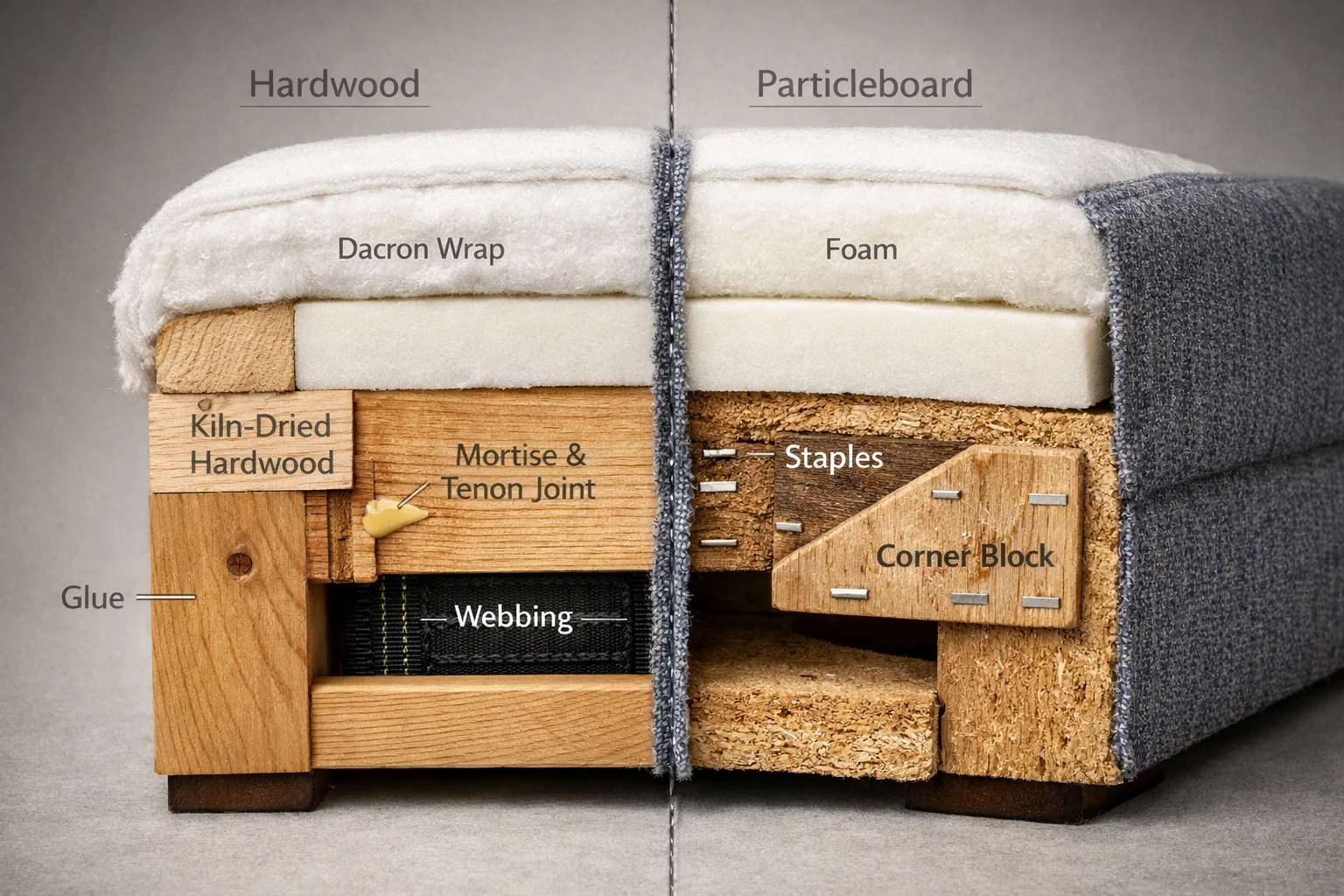
Cheap vs Expensive Furniture: The Invisible Differences
Why two sofas that look identical can behave completely differently. A deep examination of the internal components you cannot see that determine longevity.
Analyze Details →