Cheap vs Expensive Furniture: The Invisible Differences
Introduction
Visual similarity is the greatest lie in the furniture industry.
If you take one thing from my Tuesday night cushion ritual, let it be this, the stuff you cannot see is what you live with. A sofa can nail the catalog photo and still fall apart in normal use, because the inside is where the cost cutting happens and where your back, your posture, and your patience pay the price.
When I started paying attention, I realized how often I had shopped like a camera. I checked color, legs, tufting, and whether it matched my rug, then I sat down for ten seconds and called it good. That is exactly enough time to get tricked.
This guide is me trying to save you from that. I am not here to teach you furniture theory, I am here to give you simple tests and questions you can use in a showroom so you can spot the cheap shortcuts before they move into your living room.
You do not need a trained eye, you need a routine. You need to touch the arms, lift the cushions, feel the frame, and be a little annoying about details, because the salesperson is not the one who will be unzipping cushions on a Tuesday night.
I am going to focus on the few parts that actually decide whether a sofa still feels good after a year or two. If you learn how cushions are filled, how the seat is supported, how the frame is put together, and what fabrics pill or snag, you can ignore most of the marketing language and compare sofas on the things that matter.
The Knock-Off Trap
Looks deceive. A $800 copy of a $3000 sofa isn't a "shrewd purchase." It is a visual clone with zero structural integrity. You are paying for a JPEG's aesthetic, not a durable machine for sitting.The easiest way to get ripped off is to assume the pretty version is the same thing in a cheaper store. I have done that, and what I got was a sofa that photographed well and felt strangely tired within months, like it had already lived a hard life before it arrived.
A knock off usually copies the silhouette, not the engineering. The arms have the same curve, the back has the same height, the legs have the same angle, but the inside is a different species. If you remember one rule while shopping, make it this, if two sofas look nearly identical and one is dramatically cheaper, the savings came from somewhere you cannot see.
When I suspect a visual clone, I stop asking “does it look right” and start asking “what is it made of, and can I verify it.” In a showroom, I ask to see a spec sheet, not a brochure, and I listen for plain language about the frame material, the type of joinery, the seat support, and what is actually inside the cushions. If the salesperson cannot produce anything concrete, or they keep circling back to the style name and fabric color, I treat that as information too.
You can also catch a knock off with your hands. I put one hand on the arm and one on the back and give a firm twist, like I am trying to gently wring the corner of the sofa. A well built frame resists and feels like one piece, a cheap clone will flex, creak, or feel like the arm and back are negotiating with each other.
Then I check the seat the way it will be used. I sit in the same spot twice, then stand up and look for how quickly the cushions recover and whether the seat dips or ripples. A lot of clones use softer, cheaper foam that feels welcoming for the first ten seconds and then collapses into a hammock feeling, which is great for a nap and terrible for your back over time.
I also do a quick “edge test” because it reveals shortcuts fast. I sit right on the front edge like I am tying my shoes, and I notice whether it feels supported or like I am about to slide off. If the front rail and seat support are skimpy, that edge will feel weak, and that is exactly where the sofa gets punished every day.
The fabric is another trap because clones often use a convincing texture that does not behave like the original in real life. I rub the fabric briskly with my palm and then pinch it lightly like a cat would. If it fuzzes, pills, snags, or shows obvious marks instantly, I assume it will look worn fast in a real home.
If you are trying to buy the “same look,” I think your safest move is to treat the shape as inspiration and judge each sofa as its own object. Ask what the warranty actually covers and for how long, especially on the frame and seat support, because brands that cut corners tend to hide behind vague, fabric only warranties that do not protect you from sagging.
When I cannot verify construction and the price seems too good for the design, I do not tell myself I found a deal. I tell myself I found a sofa that will make me repeat the purchase sooner, and that is the most expensive outcome there is.
The Weight Difference
The first difference is something you cannot see in a photograph but you can feel instantly when you touch the thing. It is mass, and I have learned to treat it like a truth serum.
When I finally got rid of my cheap sofa, two people carried it down the stairs like it was a stage prop. It felt weirdly hollow in your hands, like the whole object was mostly air wearing upholstery.
When my next sofa showed up, the delivery people were sweating and moving slowly, even with a dolly. Nobody had hidden weights inside it, it was just built from denser, heavier parts that do not pretend to be structure, they are structure.
That extra weight usually comes from boring, expensive choices you cannot brag about on Instagram. A thicker solid wood frame tends to weigh more than thin plywood, and a real spring system tends to feel and weigh different than light webbing stretched like a trampoline.
You can use this in a showroom even if you are not allowed to lift anything. I put my hand under the front rail, right under the seat where your shins would be, and I gently try to raise the front edge an inch. If it pops up easily, I assume the internal frame is light duty, and I get suspicious about what else is being asked to do too much work.
I also pay attention to how the sofa reacts when I sit down hard, then shift my weight side to side. A heavier, sturdier build usually feels planted and quiet, while a lighter build often skitters, chatters, or feels like the seat and the arms are not one unit.
The Shove Test
Audit Procedure: In the showroom, I give the sofa a firm hip check, like I am trying to nudge it out of my way in a hallway. If it slides across the floor with almost no resistance, I treat that as a warning sign that the internal materials are light and the build is likely cost cut. When a sofa is engineered well, it tends to stay planted and it feels less like movable decor and more like a piece of the room.A quick caveat, flooring matters, and I do not want you to get fooled either way. A sofa can slide on slick tile even if it is decent, and a very light sofa can feel anchored if the store has thick carpet and rubber pads under the feet, so I use the shove test as a starting flag, not a final verdict.
If the sofa feels light, I immediately switch to verification mode and ask what the frame is made of and what the seat support is, in plain words, not brand names. If you hear vague answers like “engineered wood” and “a supportive platform,” I ask them to show me a spec sheet that actually states hardwood versus plywood, and springs versus webbing, because the weight you feel is usually telling you the same story the paperwork will, if the paperwork exists.
If the sofa feels heavy in a good way, I still do not assume it is automatically great. I take that as permission to look closer, because weight is often a sign of real materials, but it is not a guarantee of good design, good joinery, or cushions that will not collapse.
The Fabric Deception
Cheap fabric and expensive fabric can look identical on day one, especially under bright showroom lights where everything is steamed, fluffed, and staged. The difference shows up after a week of real sitting, when the fabric has to stretch, recover, and keep its shape instead of just posing for a sales floor.
On my cheap sofa the fabric started doing what I now call puddling. I would stand up and the seat would not snap back, it would stay wrinkled and a little baggy, like the upholstery had given up and decided it lived there now.
In a showroom I look for dimensional stability, even though you cannot time travel. I press my open palm firmly into the seat fabric, drag it an inch, then lift my hand and watch what the fabric does. If it stays rippled or forms a little ridge that you have to smooth out, I treat that as a warning that it is going to look tired fast.
Then I do a more annoying version, because it tells me more. I pinch a small bit of fabric on the seat, lift it slightly, and let it go, then I do the same on the inside arm where hands and sleeves rub. If the fabric feels spongy, shifts around, or seems like it is floating over the cushion instead of being anchored, you are more likely to see looseness and wrinkling as it warms up and relaxes with use.
Higher quality upholstery tends to feel more crisp and controlled because the weave is tighter and there is often a backing layer helping it hold its shape. I can usually feel this without any lab talk, the fabric feels like it has a backbone, and when I smooth it with my hand it behaves like it wants to return to flat.
I also pay attention to how the fabric handles friction, because that is what everyday life is. I rub the seat fabric briskly with the heel of my hand for ten seconds and look for fuzzing, tiny balls, or a change in texture, because early pilling is not subtle if the material is prone to it.
If you have pets, kids, or you wear jeans a lot, I take that rub test seriously. A fabric that starts to look cloudy or hairy in the showroom is basically telling you it will need constant maintenance at home, and even then it will still look worn.
When the salesperson tells you it is “performance fabric,” I do not let that end the conversation, because that phrase gets used like a magic spell. I ask what the fiber actually is and whether the cushions are removable so I can rotate them, because even a good fabric gets punished if you always sit in the same spot and cannot redistribute wear.
Fabric Physics: Filament vs. Staple
Cheap staple fibers are basically short little hairs twisted into yarn, and under rubbing they shed and tangle into pills surprisingly fast. When I am trying to avoid that, I look for fabrics made with long continuous filaments, which resist pilling because there are fewer short ends working their way to the surface.
You do not need to memorize fiber science to use this, you just need to ask one clear question and listen to the answer. I ask whether the upholstery uses filament yarns or mostly staple fibers, and if they cannot answer, I ask what the fabric content is and whether they have a sample card or spec sheet that names the fiber, not just the color.
If you are stuck choosing between two sofas that feel similar structurally, fabric is where I would slow down and be picky. You can live with a slightly less exciting color, but living with a seat that permanently wrinkles and pills is a daily annoyance, and it is one of those problems that makes a whole sofa feel cheap even if the frame is fine.
Before you commit, I would also look at the display model the store has been letting strangers sit on for months. I crouch and look at the seat fabric at an angle, because that is where you see puddling, shine, fuzz, and abrasion first, and it is the closest thing you get to a real world preview.
The Cushion Problem
Cushions are where I have been burned the most, because they can feel amazing for ten seconds and then quietly fail in a few months. The showroom “ahh” moment is often just softness, and softness is cheap to manufacture.
Foam is sold by weight, and that is exactly why it is such a tempting corner to cut. In my cheap sofa, the seat foam was around 1.2 pound density, and it didn’t take long for it to stop behaving like a cushion and start behaving like a sponge that had given up.
What I noticed first was not a dramatic collapse, it was a subtle loss of push back. I would stand up and the seat would stay a little dented, then a little more, and then one day I realized I was always sitting in the same shallow crater and my lower back was doing extra work.
Here is what I do now, I stop letting the cushion “feel” be the deciding factor and I make the store prove what is inside it. I ask, in plain words, what the foam density is in the seat cushions, not the back pillows, and I ask them to show it on a spec sheet or manufacturer tag because a confident answer without paperwork is still just a guess.
If you hear numbers in the 1.0 to 1.5 range for the seat, I treat that as short term foam, even if the sofa is expensive and even if it is wrapped in something fluffy. If you hear 2.0 or higher, I get more interested, and if you hear 2.5 or higher for the seat foam, that is the point where I start believing the sofa is meant to stay comfortable for years instead of months.
I also make sure we are talking about the actual seat core and not just marketing padding. A common trick is to wrap a cheap foam core in a thick layer of fiber or a down alternative so it feels plush at first, then the wrap packs down and you are left sitting on the low grade core anyway.
You can catch that with your hands if the store will let you unzip a cushion. I unzip and look for a distinct foam block inside versus a loose bag of fill, and I squeeze the foam at the edge because cheap foam often feels overly light and crushes too easily between my fingers.
If you cannot unzip, you can still do a useful test. I press my fist straight down into the seat until I feel the deeper resistance, then I release and watch the recovery, and I do it three times in the same spot because low density foam often “gives up” faster over repeated compressions.
Then I do the sit test the way real life works. I sit in my normal posture for a full minute, then I stand up and look at the cushion, and I sit again in the same spot and notice whether I bottom out sooner the second time.
I also pay attention to the front edge because that is where foam exposes itself. If the edge collapses under my thighs when I sit near the front, it usually means the foam is either too low density, too thin, or both, and that edge sag is one of the first things that makes a sofa feel old.
When a sofa uses better foam, the difference is boring in the best way. Even after years, the seat still pushes back instead of just accepting your weight and holding the shape of your body like wet sand.
If you like a softer seat, you do not have to give that up, but I would separate softness from durability in your mind. What I try to buy is a resilient foam core with a softer wrap on top, because the wrap provides the initial comfort and the foam provides the long term support, and you need both if you want it to feel good after the honeymoon period.
I also ask whether the seat cushions are reversible and whether the covers can be replaced. Reversible cushions let you spread the wear around, and replaceable covers matter because even good foam can be undermined by a cover that stretches and turns the cushion into a saggy bag.
If the salesperson cannot tell you anything concrete about the foam, I treat that as the answer. Cushions are not a mystery part, and a brand that is proud of what they put inside will usually say it plainly and put it in writing.
The Spring Difference
The seat support is the part I ignored for years because it is buried under fabric, and then I wondered why my sofa felt fine at first and oddly exhausted later. The suspension is basically the mattress under your cushions, and when it is cheap, everything on top of it has to work harder and fails faster.
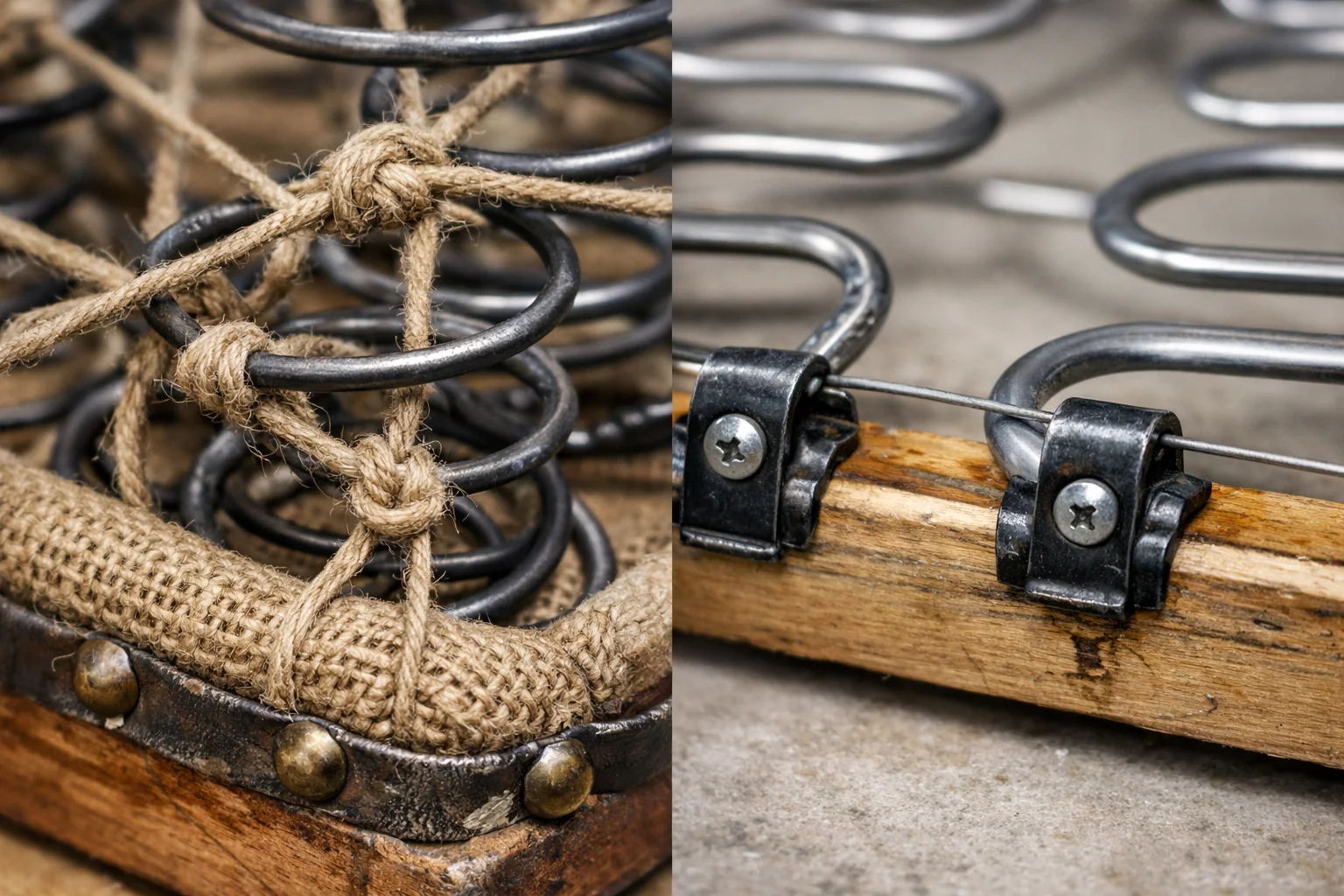
If you flip a low end sofa over, you will often see thin zigzag wires running across the frame, usually called sinuous springs, held on with plastic clips. The plastic clips are a small thing that becomes a daily thing, because as they loosen they tend to squeak, and once the thin wire starts to relax you get that slow motion sag that no amount of cushion fluffing can fix.
When I am shopping, I try to confirm whether I am looking at the light duty version or the sturdier version of the same idea. A better sofa will often use thicker sinuous springs or a different system entirely, like an eight way hand tied suspension, and you can sometimes feel the difference even if you cannot see it.
The easiest way to make this practical in a showroom is to stop thinking about comfort and start listening for control. I sit down and shift my weight around, then I pay attention to whether the seat feels like one stable surface or like a series of soft zones that ripple and bounce.
If the store will let you, I ask them to show me the underside of the sofa or at least a cutaway or build photo for that model. I am not looking for a perfect diagram, I just want to know whether the springs are actually clipped to the frame with plastic or with metal hardware, because metal attachments tend to stay quiet longer and they do a better job of keeping the springs doing the same job year after year.
If you cannot see the bottom, you can still pick up clues. I press down hard near the front edge and then near the back, and I notice whether the resistance feels consistent or whether one area drops more than the other, which often hints at a lighter suspension that is already acting like a hammock.
The Trampoline Test: Suspension Check
Audit Procedure: I sit on one end of the sofa and have you, or whoever came with you, sit down heavily on the other end. On a cheap suspension I feel a trampoline effect, where your arrival bounces through the whole seat and I bob up and down with you. On a better suspension the weight is absorbed mostly where you sat, and I barely feel your movement.If you do that test and you get the trampoline feeling, I treat it like an early warning of two future annoyances. One is comfort, because you will always feel people shifting around next to you. The other is durability, because a bouncy, under supported base lets cushions compress deeper and faster, which speeds up that cratered seat problem.
When a salesperson says “it has sinuous springs” I do not accept that as a quality claim, because it can mean thin wire and plastic clips or it can mean a more serious build. I ask one follow up in plain language, are the springs heavy gauge and are they attached with metal clips, and then I ask them to show me where that is documented, because the difference is not cosmetic and it is not something you can fix later without rebuilding the sofa.
If you are stuck choosing between two sofas you like, I would rather you buy the one that feels calmer when you and another person sit down at opposite ends. That quiet, local absorption is the closest thing I have found to a simple showroom sign that the sofa is built to feel the same after years of use, not just after a careful ten second sit.
The Pattern Matching Detail
Pattern matching is one of those details that has nothing to do with durability, but it tells you a lot about how the sofa was built and priced.
When a sofa has stripes, plaids, checks, herringbone, or a big floral, a higher end build usually makes that pattern flow across seams instead of restarting randomly on each panel. That does not happen by accident, somebody has to plan the cut so the design lands in the right place, and that usually wastes more fabric.
That waste is the point. If a brand is willing to throw away usable yardage just to keep the visuals clean, they are signalling they are not squeezing every penny out of materials, and that mindset often shows up elsewhere in the build.
I have also learned to treat obvious mismatches as a warning about control, not just taste. If a factory cannot be bothered to line up a bold stripe on the front of a seat cushion, I get skeptical that they were extra careful with the things you cannot see, like keeping seam allowances consistent, keeping the upholstery pulled evenly, or not cutting corners on the cushion inserts.
You can use this even if you do not care about patterns, because it is a fast showroom tell. If the sofa is solid colored, this section mostly does not apply, but if the fabric has any repeating structure, even a heavy weave, you can still look for continuity across panels.
When I am checking a patterned sofa, I stand in front of it and look straight at the seat cushions, the inside arms, and the front rail. Those are the most obvious planes, so any mismatch there is usually a deliberate cost saving decision, not an innocent mistake.
Then I look at the back cushions if they are removable. If the pattern looks like it was cut from random scraps with no attempt to align, that is not automatically a dealbreaker, but it is the kind of clue that makes me slow down and demand better answers on the frame, suspension, and foam.
The 10-Foot Quality Check
Look at the stripes or heavy weave on the seams. If they don't line up, the manufacturer optimized for "fabric yield" rather than "design integrity." This is the fastest way to spot a budget build.If you like the sofa anyway, I would use a mismatch as leverage to ask for specifics, because now you have a reason to probe. I ask whether pattern matching is expected on that model, and if they say no, I mentally reclassify the whole piece as a value build and I make sure the price matches that reality.
If they claim it is pattern matched, I do not argue, I just look closer at the most visible seams and decide whether their definition of “matched” is the same as yours. I have seen stores sell “matched” as “close enough,” and if you are sensitive to visual noise, that is the kind of annoyance you cannot unsee once it is in your living room.
One more practical tip, I check the display model for drift. Sometimes a pattern is aligned when the sofa is new, then the fabric relaxes and the cushions shift, and suddenly the stripes wander. If you see a floor model where the pattern looks like it has slid out of place, that tells you the upholstery might be prone to stretching or the cushion covers might be a little too loose, and that can show up later as puddling even if the fabric itself seemed decent.
The Resale Value Problem
When I was done with the cheap sofa, it was worthless. It sat on the curb until the garbage truck took it. My eight hundred dollar investment had depreciated to negative value.
A high quality sofa holds value in a way that surprised me the first time I saw it. Five years later, you can often sell a reputable piece for about half of what you paid, because buyers can feel the difference when they sit down, and they know what sagging and squeaking usually mean.
What changed my mindset was realizing resale value is not a bonus, it is a report card. If a sofa has no secondhand market, it is often because the common failure points are predictable, the cushions crater, the seat goes trampoline, the arms loosen, and the fabric looks tired even if it is clean.
In a showroom, I now do a quick thought experiment before I get attached to the look. I ask myself whether I would feel comfortable buying this same sofa used, sight unseen except for a couple photos, because that is how your future buyer is going to feel about it.
Then I ask one question that cuts through a lot of marketing. I ask whether the brand and model has a track record of being resold locally, and I ask the salesperson to tell me where people typically list them and what they tend to fetch when they are a few years old, because a reputable store has usually heard those conversations before.
If you want to sanity check without doing homework for days, pull up your local listings while you are still in the store and search for the brand name plus “sofa” or “sectional.” You are not trying to find the exact model, you are trying to see whether the brand shows up at all, and whether the prices look like “please haul this away” or like “serious piece, priced accordingly.”
What I look for is simple: a sofa that holds value tends to have owners who describe it with specific construction language, like hardwood frame, good springs, high density foam, and removable covers. A sofa that loses value fast tends to get described with apology language, like “barely used” paired with a very low price, because the seller knows how it sits.
You can also protect your future resale on day one by avoiding features that are hard to rehome. I am cautious with very low seats, extra deep loungy proportions, and ultra soft downy tops unless I have tried them for a long sit, because a lot of people test sit those once, then keep scrolling.
I also treat replaceability as resale insurance. If you can replace cushion inserts or order a new slipcover, you are not stuck trying to sell a sofa with a permanently tired seat or a stained fabric story, and that makes a used buyer far more confident.
Decision Framework: Budget vs. Investment
When choosing between price tags, I evaluate four invisible metrics that tell me whether a sofa is likely to become curb furniture or a piece somebody will actually pay for later.
I start with weight, because a three seater that feels like it takes real effort to move is often built from denser, more durable parts. In practice, I want a loveseat that does not feel like a one person lift and a sofa that feels like it would realistically take two adults to handle safely, because that usually means more frame, more hardware, and a sturdier base.
Next I look for foam density in writing, and I focus on the seat cushions, not the back pillows. If the spec sheet lists about 1.8 pounds per cubic foot or higher, I relax a little because that is the zone where cushions are more likely to keep their shape. If the density is unlisted, I treat that as a deliberate omission and I assume the foam is a cost saving choice until proven otherwise.
Then I try to confirm what the springs are clipped with, because that tiny part tends to predict future noise and sag. If the springs are attached with plastic clips, I consider it a budget build even if the sofa looks expensive. If the attachment is metal hardware, I am more confident the suspension will stay controlled and quiet over time.
Finally I check whether the fabric feels like it has structure behind it. I run my fingers over it and try to feel whether it is basically a single decorative sheet, or whether there is a backing layer that makes it feel more stable and less likely to stretch, puddle, or go baggy in the high use zones.
Explore Technical Reference
Long-Term Durability: Why "Buy It for Life" is Dangerous Advice
The myth of maintenance-free furniture. Why good furniture still needs care, and why serviceability matters more than invincibility.
Analyze Details →
Frame Quality Evaluation: Judging the Skeleton
How to inspect a sofa frame without opening it. The lift test, the squeeze test, and understanding why center legs and joinery matter.
Analyze Details →