Frame Quality Evaluation: Judging the Skeleton
Introduction
There is a specific feeling of disappointment when you sit on a sofa and the armrest wobbles. It is not a large movement, just a tiny, subtle shift. A vibration that should not exist.
I felt this on a sofa I had owned for less than a year. The frame was not a rigid structure, it was a glorified packing crate wrapped in nice linen.
That moment is what pushed me to stop shopping by looks and start shopping by behavior. If a sofa can move when it should be still, it is telling you something about what you cannot see, like weak joints, thin wood, or fast construction that depends on staples and hope.
This guide is for buying a sofa like you are buying something that has to survive real life. I am not trying to turn you into a carpenter. I am trying to help you do a few simple checks in a showroom so you can avoid paying for upholstery and marketing while the structure underneath quietly fails.
Most sofas do not die all at once. They get noisy, they get loose, the seat starts to slope, the arms start to feel like they are attached with a shrug, and you slowly adjust your body around the furniture until you realize you are the one compensating.
What I wish I had known is that you can catch a lot of this in five minutes if you know what to touch and what to listen for. When you test a sofa, you are not judging comfort in a perfect showroom pose, you are looking for rigidity, repeatability, and whether the sofa feels like one solid object or a set of parts pretending to be one.
You do not need permission to test a floor model like you mean it. If a salesperson looks nervous when you gently check an arm for wiggle, or when you shift your weight in the seat and listen for creaks, that is useful information. A well built sofa can handle normal human movement without acting like it is coming apart.
In the next sections I am going to show you how I approach a sofa in a store, what I touch first, what motions reveal weak frames, and what questions actually matter. My goal is that you leave with a sofa that stays quiet and steady years later, not one that starts whispering bad news after the return window closes.
The ‘Oil Can’ Effect
The "Oil Can" Effect
If you feel a side panel flex inward and then "pop" back out, you are witnessing the oil can effect. This indicates the frame is made of cardboard or thin Masonite rather than a solid box of plywood or hardwood. It has zero lateral strength.I learned to take that popping sensation personally, because it is the sofa telling you the side structure is basically a skin, not a wall. When a side panel can cave in and spring back, the frame is not acting like a rigid box. It is acting like a flimsy panel that only looks solid until you load it.
You cannot fix this later, because you cannot meaningfully rebuild a frame without rebuilding the entire sofa. That is why I treat the frame like the non negotiable part. Fabric, cushions, even legs can be replaced or worked around, but a weak skeleton just keeps getting worse.
In a showroom you usually cannot see the frame through the upholstery, so I use a simple test that does not require being rough. I stand next to the arm and press the outside panel inward with the flat of my hand, not a jab with my fingers, and I watch and feel for a sudden buckle and pop back.
A good side should feel boring. It can have a little give from padding, but underneath that it should stop, like your hand is meeting a solid box. If instead you feel a hollow flex, then a snap back, I assume there is thin sheet material doing the work, and I move on.
I also do this test while lightly twisting the arm. I put one hand on the top of the arm and one on the outside panel and I apply gentle opposing pressure, like I am trying to rack a cardboard box. If the arm and side panel move relative to the seat, even a little, that is the beginning of future looseness.
If you want a quick reality check, sit on the sofa near one arm and then shift your weight toward the center. If the arm area feels like it is breathing, or you hear a soft crackle or tick as the side panel flexes, you are feeling lateral weakness. In real life that becomes a sofa that squeaks when you turn, and slowly loses its square shape.
When I catch the oil can effect, I do not negotiate with myself about price or fabric. I remind myself that this is the type of structure that can feel fine in week one and feel tired in year two, because every sit is asking that thin panel to do a job it cannot do. If you want a sofa that stays steady, this is one of the fastest, most reliable reasons to walk away.
Step 1: The Lift Test (Rigidity Audit)
If I could do only one quick check for frame quality in a showroom, this is the one. It tells you whether the sofa behaves like a rigid box, or like a loose collection of parts that will slowly turn into squeaks and wobble.
I walk to the front corner of the sofa and I grab the actual corner by the leg area and lower frame, not the cushion and not the skirt. Then I lift that corner a few inches off the floor, not yanking, just enough that the weight shifts and the frame has to prove it is holding together.
While I am holding it up, I look straight across at the opposite front leg. In a good sofa, that far leg will start to rise almost immediately because the whole frame is moving as one piece. It feels like lifting a solid table, not like peeling up a corner of something floppy.
If the opposite front leg stays planted, or it hesitates and then creeps up late, I treat that as a red flag. What you are seeing is the frame twisting instead of transferring the lift across the structure, and that twisting is what turns into racking, loosened joints, and the kind of permanent squeaking that seems to appear right after the return window closes.
I also pay attention to what I hear and feel during the lift. A solid frame usually feels quiet and predictable, while a weak one often gives you little ticks, soft crackles, or a sensation that one corner is moving without the rest of the sofa agreeing to come along.
One note on being fair in a store, I do this with the sofa empty and on a flat spot of floor, and I lift smoothly rather than jerking. I am not trying to torture test it, I am trying to see whether normal handling reveals a frame that is already flexing.
If a salesperson tells you not to lift it at all, I take that information seriously. A well built sofa should tolerate being moved, vacuumed under, and bumped around a little without acting like the joints are fragile.
Step 2: The Arm Squeeze Test
I treat the arm of a sofa like a structural wall, because real life treats it that way. Movers grab it to steer the whole piece through doorways, kids perch on it, adults lean hard on it while talking, and sooner or later somebody drops their weight into it without meaning to.
In the showroom I stand next to the arm and I grip it the way a stressed mover would, with one hand on the top and the other on the outside face. Then I squeeze and wiggle the arm structure, not the loose pillow or the soft wrap, but the arm underneath the padding.
A good arm feels like a solid, unyielding block once you compress the upholstery. When I knock on the outside face with my knuckles, I want a dull thud that suggests there is real material behind the fabric, not a hollow drum sound.
A bad arm gives itself away fast. If I hear a creak, a tick, or a little crackle when I wiggle it, I assume joints are already moving against each other. If the outside face bows inward under my hand, that is not “soft,” that is the wall failing to act like a wall.
What worries me most is the combination of flex plus sound, because it usually means the arm is basically a hollow box skinned with thin sheet material. That kind of arm can look perfectly tailored, but one stumble into it can turn into a punched in panel and a torn upholstery job you cannot unsee.
I also pay attention to whether the arm moves relative to the seat. I keep one hand on the arm and put my other hand on the seat deck right next to it, then I wiggle again and feel for any independent motion. If the arm and seat do not feel like one locked unit, I assume the frame is relying on fasteners that will loosen with every lift, shove, and sit.
If a salesperson says, “All arms have a little give,” I agree that padding can feel plush, but I do not accept structural squish. You should be able to feel a firm stop under the upholstery, and you should not be able to rack the arm like you are twisting a cheap cabinet.
When an arm fails this test, I walk away even if the seat feels great. Comfort can hide a lot on day one, but a weak arm is a daily stress point, and it is one of the first places a sofa starts to feel tired and noisy once you actually live with it.
Step 3: The Center Leg Legality
Once I am satisfied the corners and arms are not doing anything weird, I look at what is happening in the middle. Long sofas are basically big spans, and spans sag when you put real people on them, especially over years.
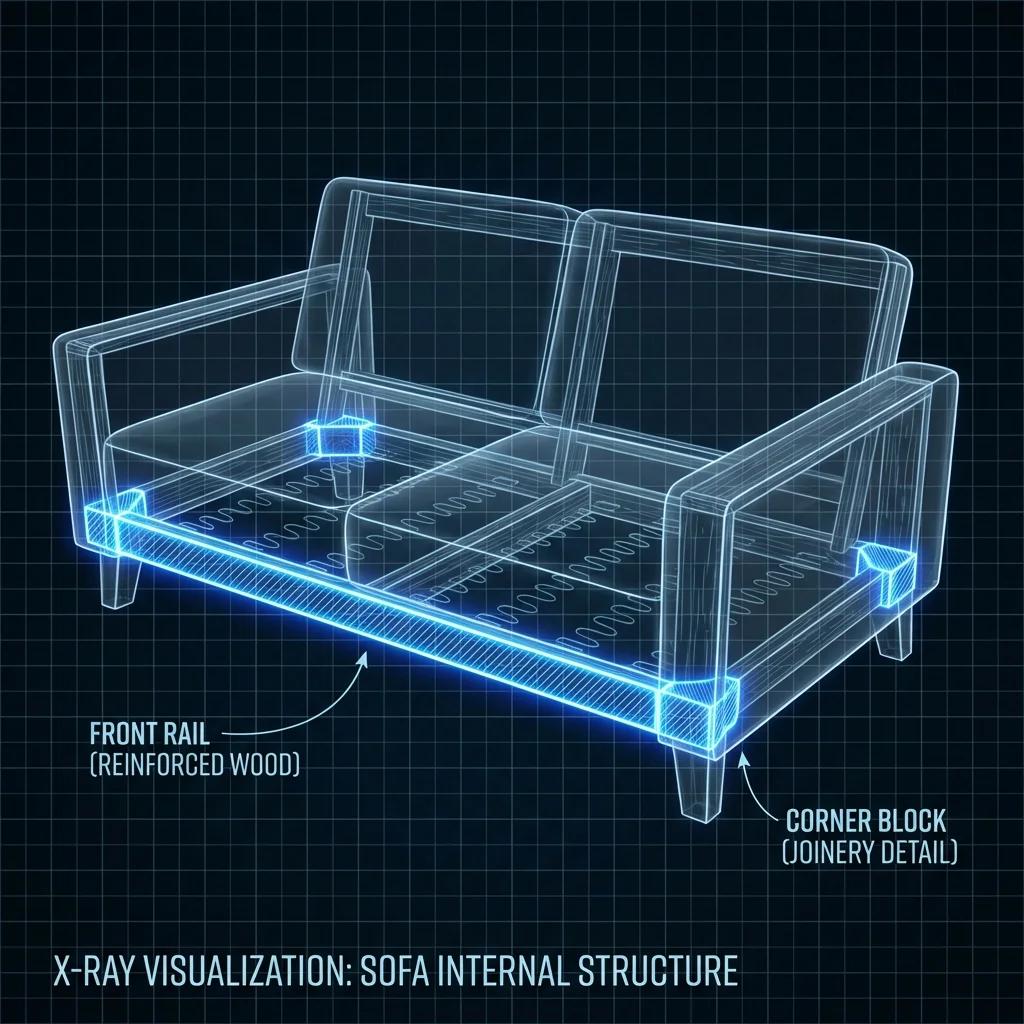
In plain terms, if a sofa is around 84 inches long or more, I expect to see a center support leg under the front rail at minimum, and ideally something supporting the middle of the seating structure, not just decorative legs at the corners. Without that, the frame is being asked to bridge too far, and it eventually starts to bow into a shallow smile.
In the showroom I do a simple audit. I crouch down and look under the front edge, right at the midpoint. I am not looking for a token piece of plastic tucked back in the shadows, I am looking for a real leg or post that is positioned where it would actually carry load.
Then I check whether that center leg makes firm contact with the floor. I have been fooled by sofas that technically have a center leg, but it is hovering a few millimeters above the tile because the leg is too short, the floor model is uneven, or the leg is adjustable and nobody bothered to set it.
If you can slide your fingers under the center leg easily, or you can rock it and feel it tapping the floor, I treat that as a fail in practice even if it looks good in a product photo. A center support that does not touch the floor does not support anything, and the middle of the sofa still takes the long term sag.
I also like to do a quick sit test that specifically loads the middle. I sit near the center and bounce once or twice the way a normal person settles in, then I stand and look at the front line of the sofa. If I can see the center dipping compared to the corners, or if the sofa suddenly feels like it is guiding me inward, I assume the span is already giving up.
When a long sofa has no center support at all, I do not talk myself into it by thinking I will be gentle with it. That missing support is not a minor detail, it is the reason some sofas slowly turn into a bowl where everyone drifts toward the middle, and it is usually paired with new squeaks because the frame is flexing every time someone sits down.
If the salesperson says the sofa does not need a center leg because it has a strong frame, I still ask to see what is actually doing the supporting underneath. If they cannot show you a real middle support system, I assume the promise is marketing, and I move on.
Materials Hierarchy: What to Ask the Salesperson
After I have done the hands on tests, I switch to questions, because upholstery can hide almost everything. If you cannot see the wood, the only way to avoid guessing is to ask for the frame material in plain language, then ask them to show you where that information is written down.
I start by asking, “What is the frame made of, specifically, and is it kiln dried hardwood, plywood, pine, or engineered board?” Then I pause and let them answer without helping them. If you get vague phrases like “hardwood components” or “engineered wood,” I treat that as a dodge and I ask, “Which parts are which, and what is the primary structure, meaning the rails and the arms?”
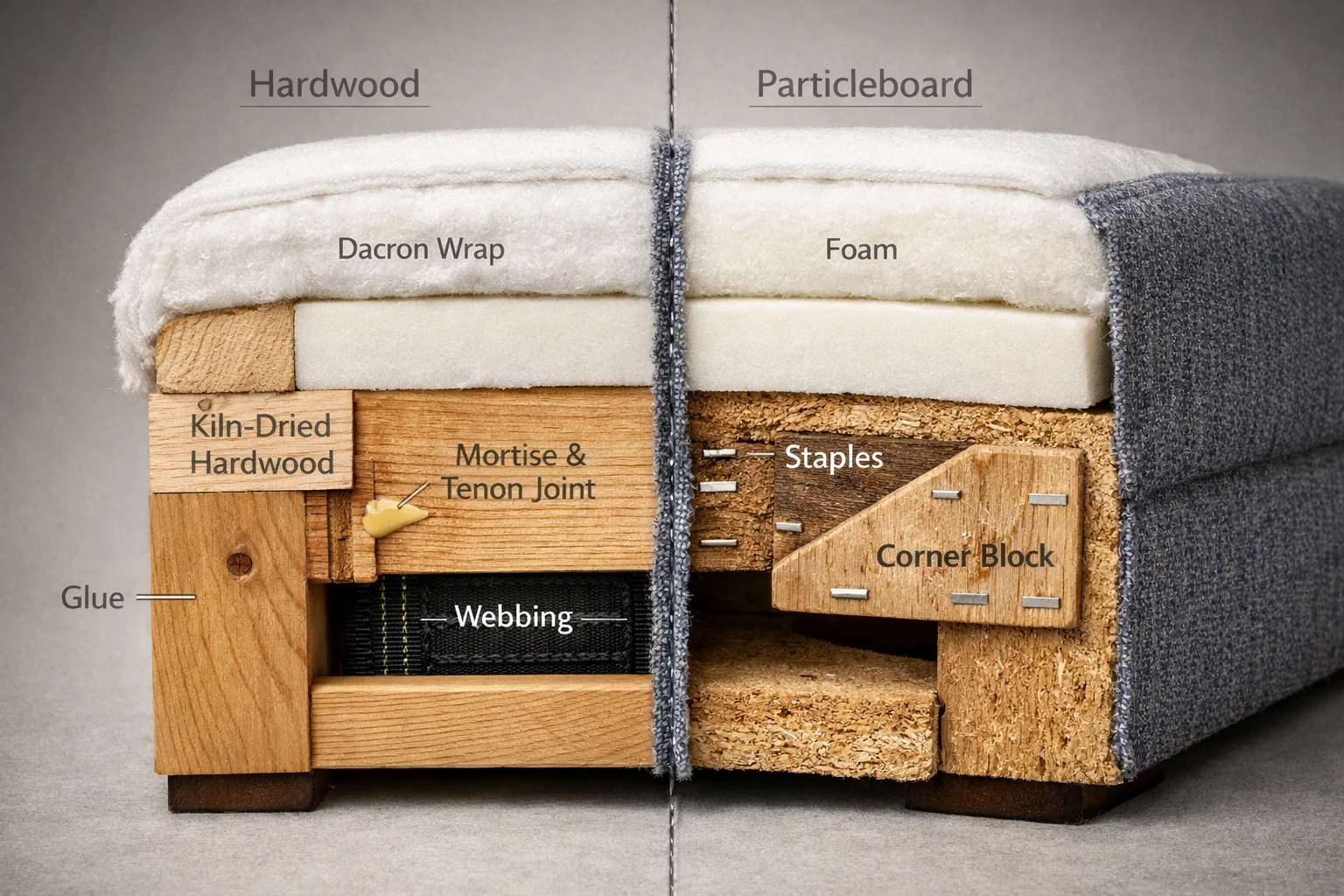
In my experience, kiln dried hardwood is the safest answer when you want a sofa that stays square. Kiln drying matters because it reduces the moisture in the wood before assembly, which lowers the odds of the frame slowly warping and loosening joints as it acclimates to your house.
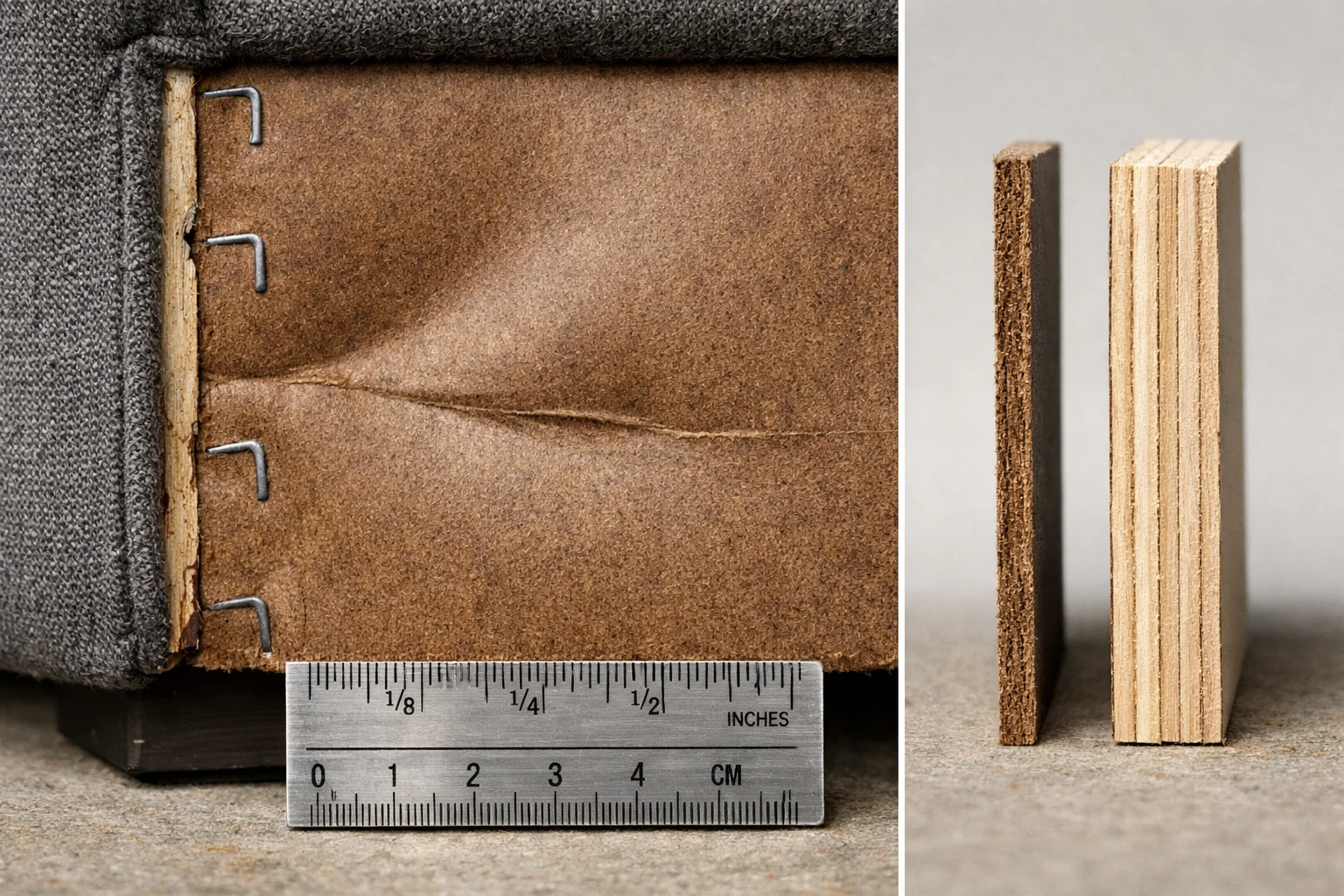
If they say “plywood,” I do not automatically reject it, because good furniture grade plywood can be very strong and stable. What I do ask is whether it is furniture grade and how many layers it has, because the cheap stuff tends to be thin, void filled, and easy to split at fasteners, which is exactly where you do not want weakness.
If they say “pine” or another softwood, I treat it as a budget choice that can be fine for light duty, but I get more demanding about the joinery, because softwood is easier to strip and loosen around screws over time. If your household is rough on furniture, or you expect the sofa to be moved a few times, I personally avoid making softwood my main frame material unless everything else about the build is unusually robust.
If they say particle board or MDF anywhere in the frame, I stop trying to talk myself into it. Those materials can be okay in a cabinet that just sits there, but a sofa is a dynamic object that gets racked, bounced, and dragged, and I have seen too many frames crumble at corners where the material had nothing solid to bite into.
One small trick I use is asking, “If I ever needed a leg bracket reattached, would it be screwing into solid wood or into composite board?” A salesperson who actually knows the build will answer clearly. Someone who is guessing will usually repeat a brochure phrase, and that tells me the brand is not proud of the skeleton.
I also ask for the warranty language that describes the frame. Not the marketing card on the cushion, the actual warranty or spec sheet, because good manufacturers tend to name materials precisely there. If they cannot produce anything written, I assume I am being asked to buy a story.
The Joinery Rule
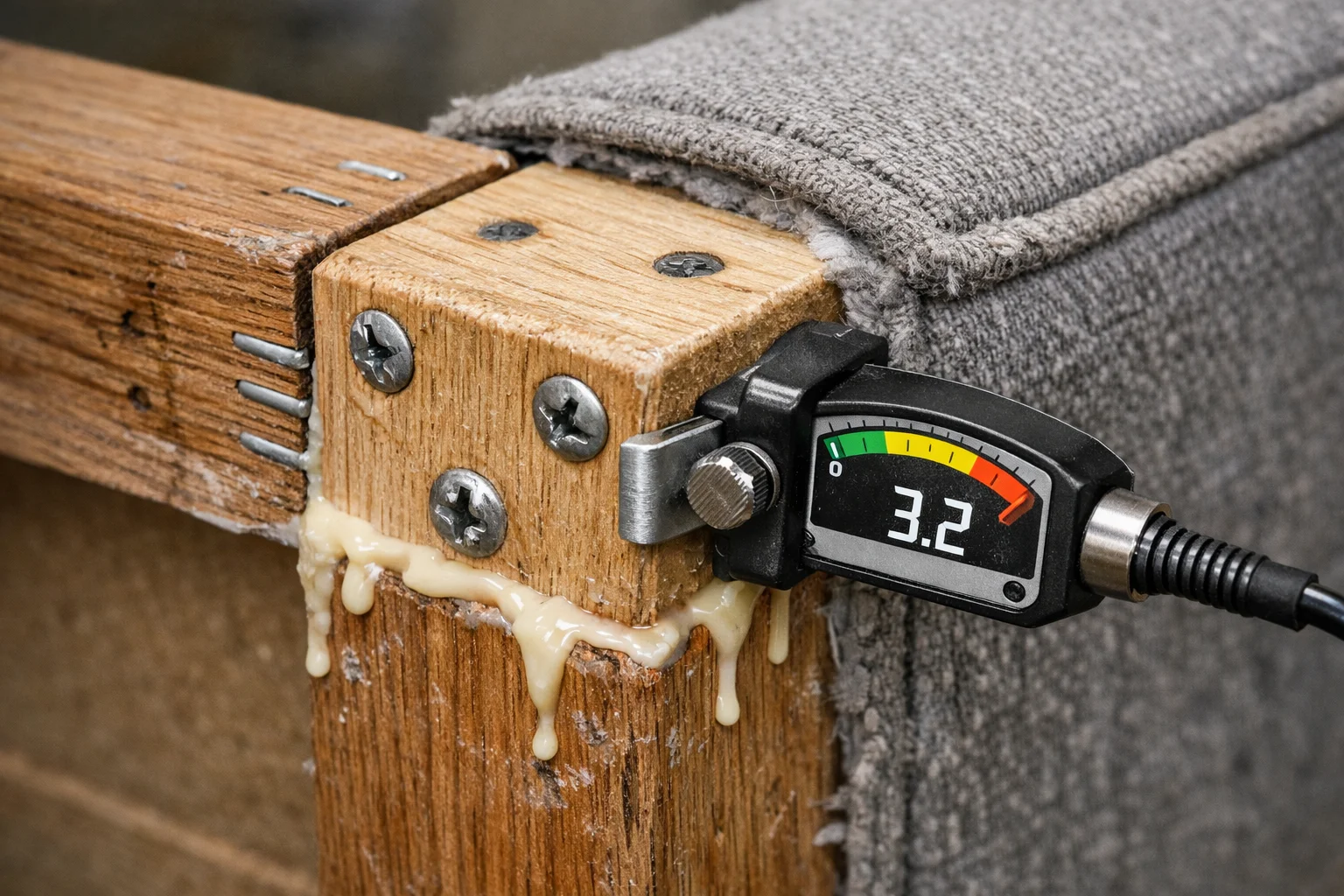
When I want the truth about a frame, I ask how it is joined at the corners. The answer I am listening for is double doweled and glued, plus corner blocks, because that combination fights the slow racking that turns a square sofa into a noisy parallelogram. Corner blocks are those triangular reinforcements in the inside corners, and I want to hear that they are glued and screwed, not just stapled in place. If the primary structure is stapled together, meaning staples are doing the real work instead of glue, dowels, or bolts, I treat it as a disqualifier for anything I expect to keep longer than a few years.If you feel awkward asking about joinery, I make it simple: “Are the corners blocked, and are the joints doweled and glued, or mostly stapled?” Then I watch the reaction. A confident answer usually comes with specifics, while an evasive answer often comes with reassurance.
If the salesperson says, “All sofas are stapled,” I do not argue, I just translate it. Staples are fine for holding fabric and some secondary parts, but when staples are the main structural solution, the sofa is relying on tiny fasteners to resist years of twisting forces, and that is exactly how you end up with the first creak that never goes away.
When they claim it is “solid wood,” I ask one more question: “Solid wood where, and what is the wood species?” A lot of sofas use a mix, and I am okay with a mix if the load bearing parts are strong and the weak stuff is truly non structural, but I want them to say that out loud.
I am not trying to win a debate in the showroom, I am trying to avoid buying the kind of sofa that feels great until the joints start moving. If you combine your hands on tests with these material and joinery questions, you get a much clearer picture of whether you are paying for a lasting structure or just a nice cover over a short term frame.
Technical Summary: The 60-Second Frame Audit
When I am standing in front of a sofa and I need the fast truth, I run one tight loop before I let myself think about fabric or cushions. I lift one front corner by grabbing near the leg and lower frame, and I watch the opposite front leg. If the far leg rises right away and the whole piece feels like one rigid unit, I keep going. If the sofa twists, hesitates, or makes ticking noises as the lift travels through the frame, I treat that as the structure telling on itself.Next I squeeze the arms the way a mover would, with one hand on top and one on the outside face, and I compress past the upholstery until I can feel what the arm is actually made of. I want a firm stop and a dead, boring solidity. If the side panel feels hollow, flexes inward like a drum, or gives me that oil can pop, I assume it is thin sheet material or cardboard doing fake wall duty and I move on.
Then I check the legs, specifically whether a longer sofa has real support in the middle. I crouch and look for a grounded center leg or center support under the span, and I make sure it is actually touching the floor instead of hovering. If the sofa is long and there is no middle support, or the support is present but not doing anything, I assume the middle will sag over time and I do not buy it on hope.
Finally I confirm the joinery, because the frame can feel decent today and still be built to loosen later. I ask directly whether the main joints are glued and doweled and whether the inside corners are reinforced with real corner blocks, ideally glued and screwed. If the answer is vague, or if it becomes clear the skeleton is mostly stapled together, I treat that as the difference between a sofa that stays square and quiet and one that slowly turns into a creaky, shifting compromise.
Explore Technical Reference
Cheap vs Expensive Furniture: The Invisible Differences
Why two sofas that look identical can behave completely differently. A deep examination of the internal components you cannot see that determine longevity.
Analyze Details →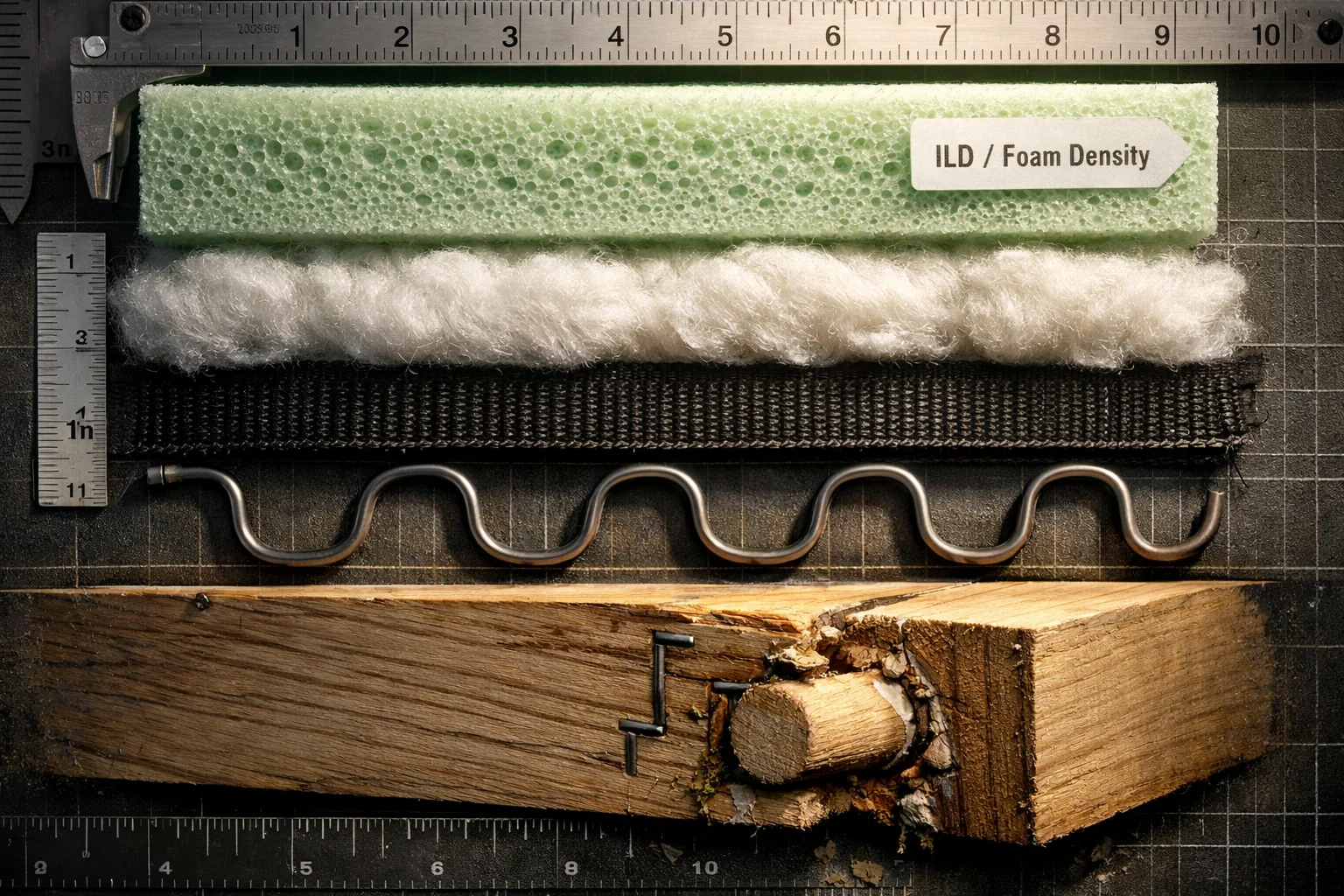
Long-Term Durability: Why "Buy It for Life" is Dangerous Advice
The myth of maintenance-free furniture. Why good furniture still needs care, and why serviceability matters more than invincibility.
Analyze Details →