Understanding Foam Density: The Specification That Determines Cushion Longevity
Introduction
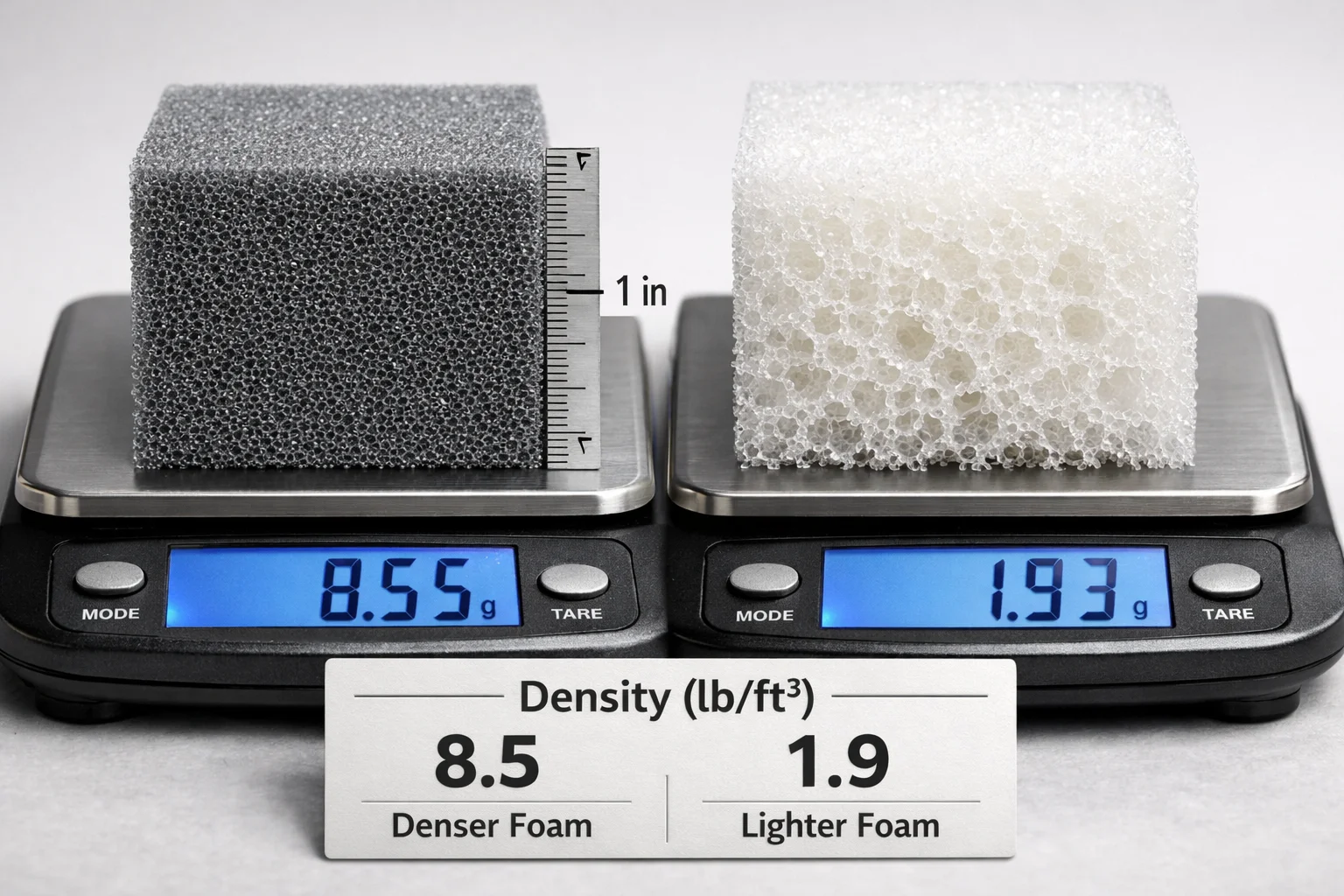
If someone offered to sell you a gold bar, you would weigh it. You would not just evaluate how shiny it appeared or how smooth it felt. You would put it on a scale because weight equals value. Foam works identically. Density is the weight of foam per cubic foot, and it is the single most important metric for determining how long your sofa will remain comfortable.
What I wish I had understood earlier is that comfort in a showroom is mostly a first impression, not a promise. Almost any cushion can feel great for five minutes, especially if it is overstuffed or topped with something soft. The slow disappointment usually comes from the foam core losing its structure, and that is where density matters.
When you are in a store, your job is to stop the conversation from floating around vague words like “high quality” and “premium.” You want a concrete density number for the seat foam, and you want it in writing on a spec sheet, a tag, or an email from the brand. If the salesperson cannot produce a density, I treat that like they are asking you to buy a gold bar by complimenting its shine.
You also want to be clear about which foam you are talking about. Seat cushions take the most abuse, so seat foam density is the number that predicts whether the sofa still feels supportive a couple of years in. Back cushions can be softer and still be fine, and arm padding is mostly about feel, so I do not let those distract me from the seat.
If you only remember one showroom move, it is this: ask, “What is the density of the seat cushion foam, and is it the same for every seat?” That second part matters because some sofas quietly use different foam in the center seats versus the ends, or they use a thinner layer of good foam on top of cheaper foam underneath. If they say it is “layered” or “multi density,” ask them to describe the thickness of each layer and the density of each one, because the cheapest layer usually dictates how it breaks down.
You can do a quick reality check without tools. I put my hand on the seat and press straight down near the front edge, where people slide in and out. If it bottoms out fast or feels like it collapses and then hits something firm, that can mean thin foam, low density foam, or a cushion design that is doing more marketing than supporting.
In the next parts of this guide, I am going to translate the foam talk into questions you can ask and red flags you can spot. I am not trying to turn you into an engineer, I am trying to help you buy a sofa that feels the same after a thousand sits as it did on day one.
The “Bag of Air” Problem
The "Bag of Air" Problem
Three years after buying a firm, supportive sectional, it became an unsupportive, shapeless mass. I had essentially purchased a large bag of air for $2,000. Under body weight, foam cells compress. If there is more air than plastic in that cubic foot, the cells experience permanent "cell fatigue" and collapse.This is the failure mode I watch for more than anything else, because it is the one that makes you feel like you are going crazy. The sofa still looks basically fine across the room, but when you sit, you sink, you slide, and you keep shifting because your body cannot find a stable platform.
In a showroom, the “bag of air” problem hides behind two tricks. One is puffiness, where the cushion looks thick and luxurious but the core has very little real substance. The other is initial firmness, where the cushion pushes back for a moment, then gives up quickly, like it was borrowing support from trapped air instead of real foam structure.
When I test for this, I do not just sit normally and declare it comfy. I sit down hard once, then I stay put for a full minute and pay attention to what changes as the air works its way out and the foam warms up. If I feel myself slowly settling lower and lower, or if my hips end up noticeably lower than my knees, I treat that as a preview of what it will feel like after a couple of years.
Then I stand up and look at the cushion like I am judging a bad mattress. If it takes a long time to rebound, or it rebounds but leaves a shallow dish where I sat, I assume the foam is relying on airiness instead of density. A good seat cushion can still show some evidence of sitting, especially with softer tops, but it should not look tired after one minute in a store.
I also press with my palm near the front edge and then again in the center, because low quality foam often collapses unevenly. If the front edge feels like it has no “reserve,” meaning it drops fast and stays dropped until I let go, that is the area that will go first at home. That is where people perch, slide in, and push off to stand up.
If the cushions are removable, I unzip one. I am not looking for perfection, I am looking for honesty. If the inner foam is wrapped in a thick layer of loose fiber that makes it look bigger than it is, I remind myself that fiber is mostly air and it is not what keeps you off the frame.
This is also where I get very literal with the salesperson. I ask for the seat foam density, in writing, and I ask whether the foam core is the same from the front edge to the back, or if there is a softer top layer over a cheaper base layer. If they cannot or will not answer beyond “high resilience” or “premium,” I assume I am paying for a nice first impression.
If you want one simple buying rule that protects you from the bag of air, it is this: do not let appearance, thickness, or showroom softness substitute for a density number. I have learned the hard way that a big, inviting cushion can still be mostly air, and air is the part you lose first.
The Weight-to-Lifespan Correlation: Density Defined
Density is usually expressed in pounds per cubic foot, and it is basically telling you how much actual foam material is inside that cushion versus how much is just air. I am not chasing a magic feel in the showroom, I am chasing enough material to resist compression for years, because that is what keeps a seat from turning into a hammock.
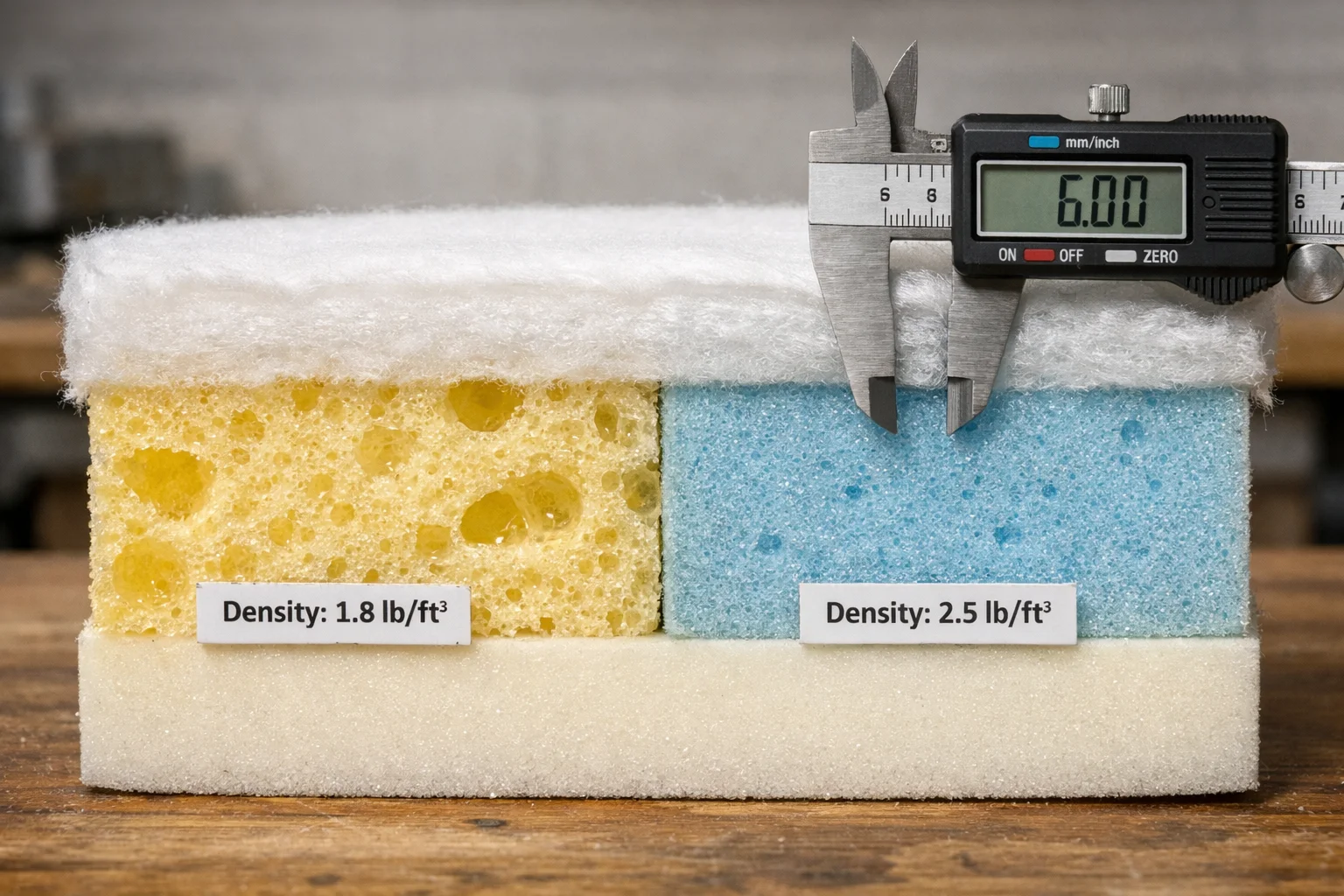
The simplest way I keep myself honest is to mentally sort seat foam into three buckets by density, then I decide whether that matches how long I need the sofa to last. When I see seat foam around 1.2 to 1.5 pounds per cubic foot, I assume it is promotional grade, the kind of foam that can feel fine upfront but is built for short service life, more like a couple of years than a decade. If you are buying something meant for a temporary space or a rarely used room, that might be acceptable, but I personally do not pay everyday sofa money for that number.
At about 1.8 pounds per cubic foot, I treat it as the minimum baseline for daily use in a normal household. If everything else about the build is decent, that density can hold up for a few years, but I go in with realistic expectations, because this is where a sofa can still disappoint if you have kids, pets, heavier sitters, or just a lot of hours on the cushions.
Once you get to roughly 2.5 pounds per cubic foot and up, you are usually in the zone where I start expecting long term resilience, meaning the cushion keeps its shape and support far longer. You will sometimes hear this called high resiliency foam, and it is the only category where I stop bracing myself for that slow, unavoidable sag.
In the store, what matters is getting the exact density for the seat core, not a vague label like “HR” or “premium.” I ask, “What is the density, in pounds per cubic foot, of the foam in these seat cushions?” and then I wait through the awkward pause until I get a number, not a story.
If they tell you the foam is “layered,” I do not let them stop there, because layered can mean honest comfort engineering or it can mean a thin cap of decent foam over a cheaper block. I ask what the density is for each layer and which layer is thickest, because the thickest, cheapest layer is often the one that determines how the cushion feels after the honeymoon period.
If you cannot get a density number anywhere, I treat that like a decision point, not a minor inconvenience. Either I move on, or I assume the density is low and I negotiate and buy accordingly, because I have learned that missing specs usually do not hide good news.
One last practical tip I use is to match the density to your real life, not the marketing. If this sofa is going to be the main landing spot every evening, or you know one seat will get used constantly, I push hard for the higher density category even if the showroom cushion already feels “supportive,” because feel is easy to fake for a month and structure is not.
The Firmness Confusion: Why the “Sit Test” Fails
The easiest way to get misled in a showroom is to confuse firmness with quality. Firmness is simply how much the cushion resists you when you sit down, and it is what you feel in the first ten seconds.
Density is different, and it is the one that decides whether the cushion keeps doing its job. Density is how much actual foam material is in there, and you cannot reliably feel it in a quick sit because a lot of low quality foam can be tuned to feel firm at first.
This is why the sit test fails when you use it like a verdict. If you sit and think, “This feels firm, so it must be supportive,” you are letting the store’s favorite trick do the selling for them.
What I do instead is separate “Do I like this feel today?” from “Will this feel survive two years?” I use the sit test only to judge the shape, the seat depth, and whether the back hits my shoulders where I want it to, then I use density and construction answers to judge longevity.
A cushion can be soft and still be durable if the foam is high density, and a cushion can be firm and still be junk if the foam is low density. When you remind yourself those two things are independent, a lot of showroom confidence suddenly starts sounding like guessing.
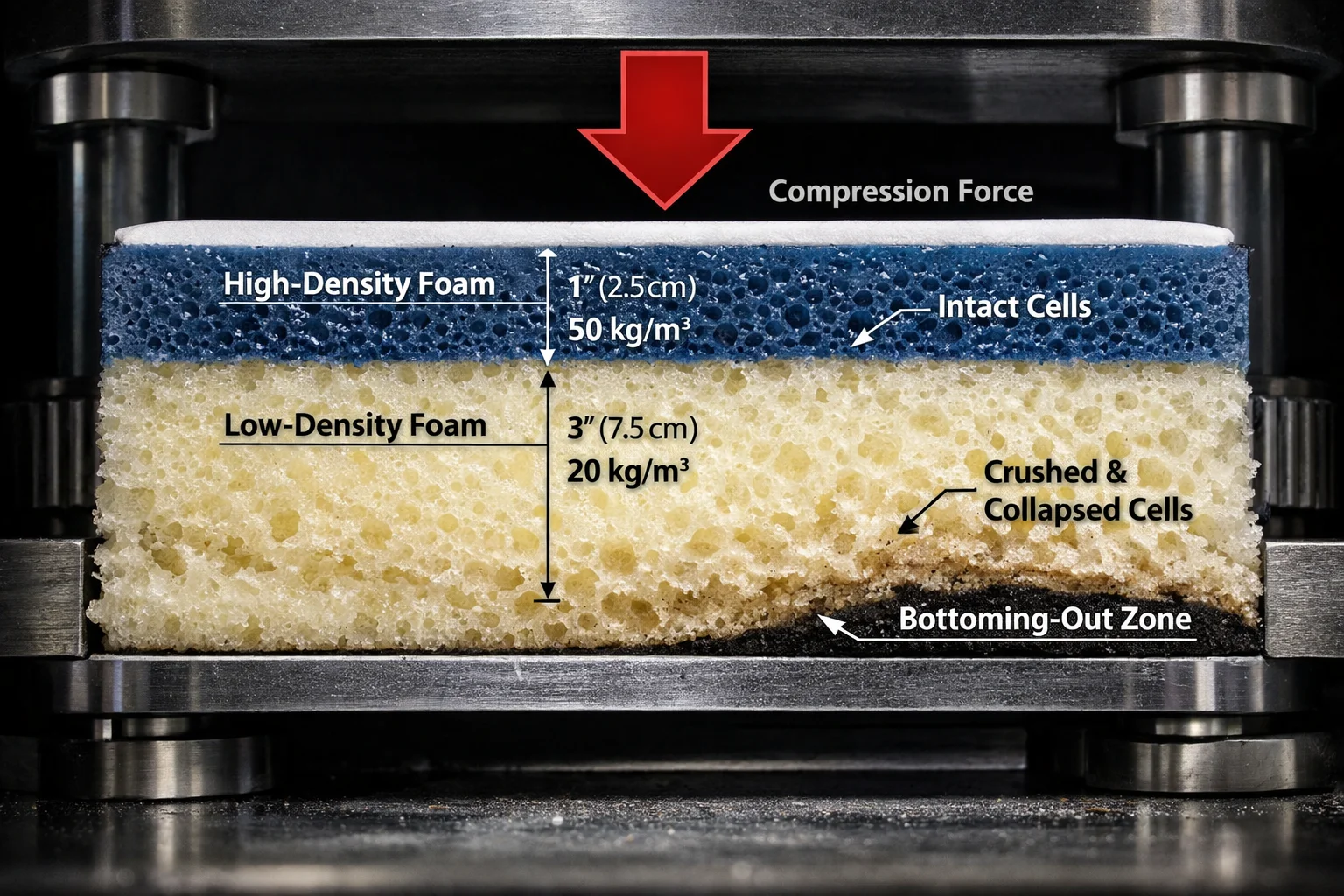
The other reason the sit test is unreliable is that many couches are designed to feel impressive for a short try, not honest over a long night. Fresh foam is always at its best, and a brand new floor model can hide problems that show up once the cushion has been sat on daily and warmed up a thousand times.
So when a salesperson tries to steer you back to “Just sit in it,” I stay polite but I bring it right back to specs. I say, “I believe you on the feel, I’m trying to confirm the seat foam density because that’s what decides how long it stays like this.”
The "Crust" Deception
Cheap sofas often use low-density foam, around 1.2 pounds per cubic foot, and then make it feel firm with chemical stiffeners. In the showroom it can feel surprisingly supportive, like it has a tight outer shell that holds you up. The problem is that this firm surface effect is fragile, and once that stiffness breaks down you are not left with “broken in comfort,” you are left with the real core, which can feel flat and unsupportive because there was not enough material there to begin with.If I suspect that crusty, artificially firm feeling, I do a slow press test with my palm, not a quick shove. I press down gradually and pay attention to whether there is an initial hard resistance that suddenly gives way, because that sharp change in resistance can be a clue that the cushion is relying on a stiff surface layer instead of a resilient core.
Then I do the one thing most people do not do in a showroom, I try to make the cushion tired. I sit in the exact same spot for a few minutes while I talk, and I notice whether the seat goes from “firm” to “squishy” during that short window, because that is the early version of what happens over months.
I also test the seat the way real life tests it, which is off center and near the front edge. If the middle feels fine but the front edge feels like it collapses too easily, that is the seat that will feel wrecked first at home, even if the showroom sit in the center felt great.
If the store will let you, I like to lift a seat cushion and judge it like a heavy winter coat. A cushion with some honest material in it tends to have a certain heft for its size, and a cushion that feels weirdly light for how thick it looks makes me suspicious that I am paying for puff, not substance.
The most actionable move, though, is still boring on purpose. You ask for the seat foam density in writing, and you treat firmness as your comfort preference, not as proof of durability. If you keep those two lanes separate, you stop rewarding the tricks that make a sofa feel amazing for five minutes and disappointing for five years.
The Economic Reality of Mass
Foam is a petroleum based product, and it is sold by weight. A cubic foot of 2.5 density foam has about twice as much actual material as a cubic foot of 1.25 density foam, and that is why the number matters even when two cushions feel similar on the floor.
Once I understood that, a lot of showroom behavior started making sense. If a brand can swap in lower density foam inside a nice looking cover, the sofa can look the same, feel good for a short sit, and cost less to build, which means more profit or more room for discounts that still leave them happy.
This is why I do not treat a pretty fabric, tidy welting, or a thick cushion profile as proof of anything. A great upholstery cover can hide a lot, and in the real world the cover usually outlives the foam core.
When you are shopping, the actionable move here is to assume there is always an incentive to underspec the foam unless the brand is willing to name it. I ask for the seat foam density in writing, then I ask one follow up that tends to expose shortcuts, which is whether the density is the same in every seat and whether the foam is a single piece or a layered stack.
If they say “layered,” I make them slow down and describe it like they would describe a sandwich. I want to know which layer is thickest and what its density is, because a thin cap of decent foam on top of a thick block of cheap foam still performs like cheap foam once the top layer compresses.
If the salesperson tries to steer me away from numbers and back toward how it feels, I bring it back to economics. I say, “I’m not doubting it feels good today, I’m trying to confirm how much foam is actually in there, because weight of material is what I’m paying for.”
One small thing you can do in a store, even without unzipping anything, is compare cushions across models by how heavy they feel relative to their size. I do not pretend this is scientific, but if two cushions look similarly thick and one feels suspiciously light when you lift it, I treat that as a hint that I should not accept vague answers about what is inside.
Technical Tip: The $150 Sofa Rescue
If your frame and fabric are still in good condition but the cushions have gone flat, you do not need a new sofa. You can order custom-cut 2.5lb High Resiliency foam from a specialist supplier. Replacing only the failed internal component often results in a sofa that is better than the factory-original version for a fraction of the cost.I have also learned to think about this when you are tempted to replace an entire sofa just because it feels dead. If the frame is solid and you still like the size and style, the foam is often the sacrificial part, and it is sometimes the only part that truly needs upgrading.
In practice, this means I pay attention to whether the seat cushions are removable and whether they have a zipper, because that is your future escape hatch. Even if you buy a sofa with “good enough” foam today, a zippered cushion cover gives you the option to revive it later instead of sending a whole piece of furniture to the curb.
How to Verify Density in the Showroom
When I’m standing in front of a sofa I like, I try to get out of “vibes” mode and into “numbers” mode as fast as possible. I ask a very specific question and I keep it boring on purpose: “What is the density of the seat foam, in pounds per cubic foot?” If they respond with “premium,” “high quality,” or “high resilience,” I treat that as a non answer and I repeat the request for the actual density number.
What I’m looking for is something I can point to later, not something that evaporates as soon as I leave the store. I ask if there’s a spec sheet, a law tag, a product page, or an email they can send from the brand that states the seat foam density, and I want to see whether it applies to every seat cushion or only certain sections.
If the salesperson does not know, that is not automatically a deal breaker, but how they handle it tells me a lot. If they say they can look it up, call the manufacturer, or pull the internal spec, I give them time and I wait. If they act like I’m being unreasonable, or they try to distract me back into “just sit in it,” I assume there is a reason the number is not being offered.
Some brands will reference certification programs like CertiPUR US, and that can be a good sign of basic chemical and emissions standards, but I do not let it replace the density question. I have learned to ask, “Great, what is the actual seat foam density on this model?” because a certification logo can be real while the foam spec is still mediocre.
If the cushions are loose, I ask permission to lift one, and I actually do it. This is not a perfect test, but I have found it to be one of the fastest honesty checks you can do with your own hands. A cushion with more material in it often feels surprisingly heavy for its size, and a cushion that looks big but feels weirdly light makes me suspect that a lot of what I’m paying for is puff, not substance.
If I’m allowed to unzip the cover, I look for a foam block that seems appropriately substantial for the thickness of the cushion, and I note how much of the apparent “thickness” is really just loose fiber wrap. Fiber can be fine as a comfort layer, but when I see a thin looking foam core dressed up with a lot of fluffy wrap, I take that as a warning that the cushion is being made to look expensive rather than built to stay supportive.
I also match the number I’m being told to the way the cushion feels in my hands. If they claim a high density seat core but the cushion feels like an empty gym mat when I lift it, I push for proof in writing, because either the number is wrong, the foam is not actually what’s in that cushion, or the cushion is a layered build where the good stuff is just a thin top slice.
By the time I leave the showroom, I want one clear takeaway for this model: either I have the seat foam density number in writing, or I am deciding to walk away, or I am buying it with the assumption that the foam is low spec and pricing it in my head accordingly. What I don’t do anymore is pay full price while hoping the unseen core is better than the salesperson’s willingness to describe it.
Decision Framework: Density Selection by Use Case
This is the part where I stop thinking about foam like a trivia question and start using it like a filter. I ask you to picture where the sofa will live, who will sit on it, and how many hours a week it will actually carry body weight, because that is what decides whether a density number is “fine” or a future regret.If this is your primary living room sofa, the one you will land on every evening, I personally push for high resilience foam in the 2.2 to 2.5 pounds per cubic foot range for the seat cores. In a showroom, I frame it plainly: “I’m buying this for daily use, so I’m looking for seat foam around 2.2 or higher, what is this model?” If the answer is below that and the price is not a steal, I assume I am paying for looks and stitching while budgeting for early cushion fatigue.
If you are looking at entry level budget seating, or you know this is a temporary sofa for a short lease, 1.8 pound density can be an acceptable compromise, but I only say yes when the price matches the reality. In my head, I treat it like a three year cushion, not a decade cushion, and I make sure the covers are removable and zippered so I have an exit plan when the foam gives up. If a salesperson is asking you to pay “forever sofa” money for 1.8, I would slow the whole deal down.
For a guest room, a rarely used den, or a place where people sit occasionally instead of melting into it every night, I can see 1.5 pound foam being enough, simply because it is not being compressed and warmed up constantly. The practical move here is to be honest about whether that room will stay occasional, because a guest room sofa has a habit of becoming the “extra TV” sofa once life changes.
If you are shopping for something that will be treated like public seating, meaning a waiting area, an office lounge, a short term rental that turns over constantly, or just a household with heavy daily use and little mercy, I would not mess around with midrange numbers. This is where I would ask for about 2.8 pound density in the seats if you want the best chance at truly long performance, and I would require that answer in writing because “commercial grade” gets tossed around loosely.
The way I use this framework in the store is simple: I decide which of these lives matches your reality, then I ask for the seat foam density and compare it to that target before I fall in love with the fabric. If the density is lower than your use case, you either negotiate like you are buying cushions with a short lifespan, or you keep shopping until the specs match the job.
Explore Technical Reference
Cushion Quality Evaluation: Understanding Foam Specifications
Why density is not firmness, why down feathers lie, and how to predict if your seat will collapse. Understanding the three numbers that define cushion longevity.
Analyze Details →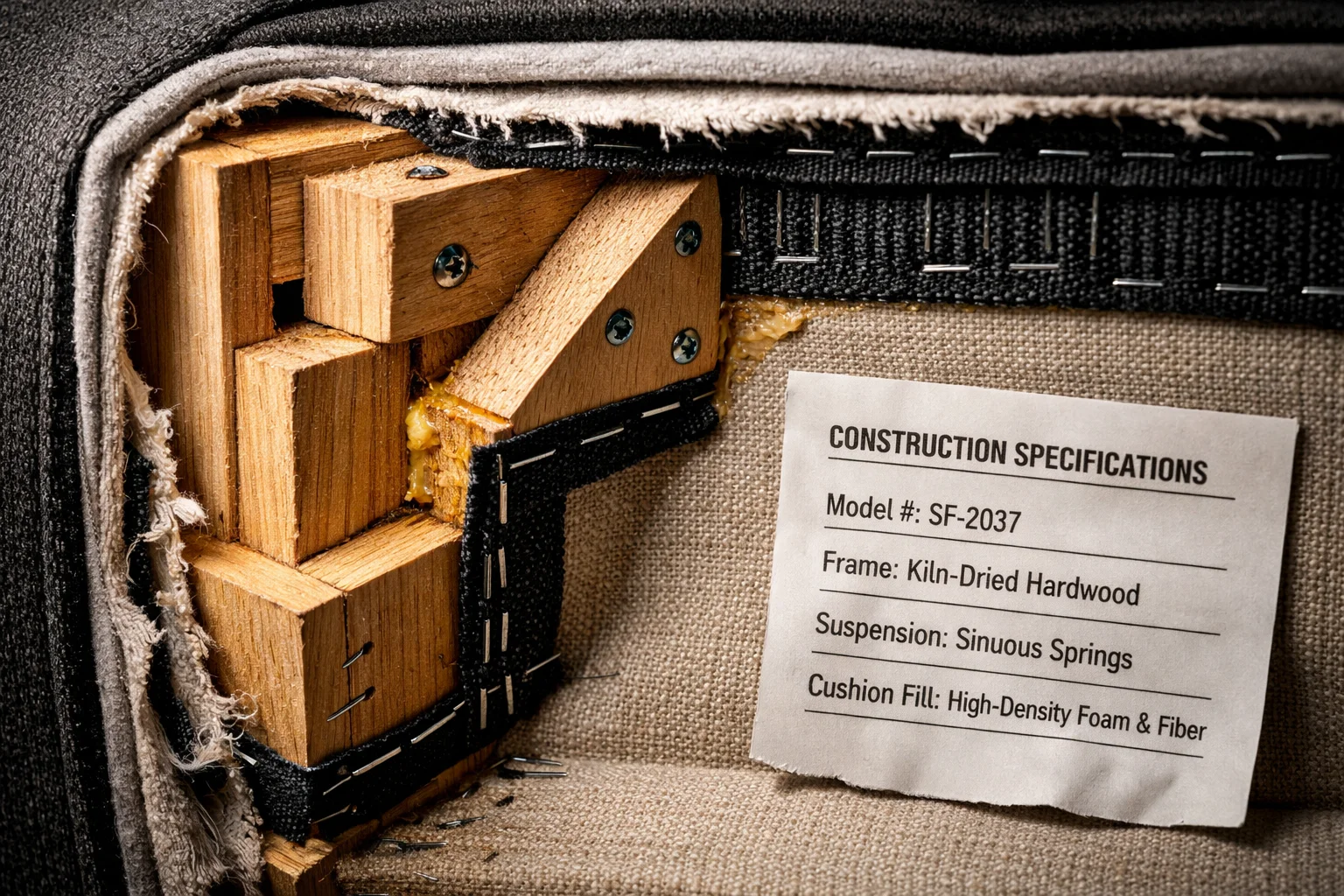
The Showroom Inspection Checklist: What to Verify Before Purchase
The physical and verbal inspection process for evaluating furniture quality in showrooms. How to examine floor models and interrogate specifications.
Analyze Details →