The Showroom Inspection Checklist: What to Verify Before Purchase
Introduction
The furniture industry profits from buyer ignorance, and they are not subtle about it. If you follow industry coverage like Furniture Today, you see the same pattern repeated, sellers lean on what you can see fast and what you can feel for five seconds, because that is what closes a sale before you start asking tougher questions.
When I walk into a showroom, I assume the fabric color and the “plush” feel are meant to distract me. You can change a throw blanket and you can add pillows, but you cannot easily fix a frame that flexes, a seat that bottoms out, or cushions that quit after a year.
So my goal in this guide is simple, I want you to leave the store knowing what you are actually buying under the upholstery. I am going to focus on the few checks you can do on the spot, the questions worth asking, and the dodges you will hear when the sofa is built to look good on day one and sag by day four hundred.
If you take nothing else from this introduction, take this mindset, you are not shopping for a color, you are shopping for a structure. When you test a sofa, I want you to behave like you already own it and you are trying to find what will annoy you six months from now, because that is exactly when the return window is long gone.
The Auditor Mindset
After the most recent “lifetime” sofa died in year three, the victim mindset ended. The auditor mindset began. A systematic inspection process now accompanies every showroom visit. It forces salespeople to retrieve specification sheets they did not know existed.But it works. The process eliminates ninety percent of junk products within five minutes.
When I say “auditor,” I do not mean I become rude or suspicious, I mean I stop accepting vibes as evidence. I assume every sofa is hiding its weakest link under the parts that photograph well, and my job is to find that link before it moves into my living room.
The first shift is that I do not start with fabric, I start with permission. I tell you to ask, calmly and early, “Can you show me the construction specs for this exact model, frame, suspension, cushion fill, and the warranty terms in writing?” If the salesperson can only talk and cannot show you anything, I treat that like a product problem, not a staffing problem.
A good showroom will have a spec sheet, sometimes in a binder, sometimes as a PDF they can email, sometimes tucked into a drawer. If they say it does not exist, I ask what the item number is and who the manufacturer is, because a real manufacturer tracks what they build, and you want that paper trail if something fails.
Then I physically verify what I can, right there, because paper does not stop corner cutting. I sit where you would actually sit, not just in the center, and I sit down normally, then I shift my weight like I am getting comfortable for an hour. If I feel a hard bar under my thighs, if the seat collapses fast and rebounds slowly, or if one side feels different than the other, I mentally flag it as a “day four hundred” problem.
I also do something that feels slightly awkward but saves me money, I lift and move the piece a little. I am not trying to deadlift a sofa in the store, I just want to feel whether it is rigid or rickety. A solid frame feels like one unit, a weak frame feels like the corners argue with each other.
Next, I get my hands where the showroom does not want them, under the front rail and along the sides. You are feeling for sharp edges, loose fabric stapling, exposed cardboard, and anything that sounds hollow when you tap it. Those are not always deal breakers, but they often correlate with the kind of build where the hidden parts are treated like they do not matter.
If the store will let you, I tell you to look under the cushions and under the sofa. You are not doing a full disassembly, you are looking for clues. If you see a thin black fabric stapled everywhere and nothing looks accessible, that can mean they are hiding messy work or using a lot of lightweight materials, and you should slow down and ask more questions.
The auditor mindset is also about how you handle vague language. When you hear “hardwood frame,” I want you to respond with, “Which hardwood, and is it kiln dried, and how are the joints built?” When you hear “high density foam,” I want you to ask, “What is the foam density and what is the cushion construction, and is the seat core wrapped in anything?” If they cannot answer, I do not argue, I just move on.
Finally, I keep the warranty in the same mental category as the frame, because it reveals what the maker expects to fail. If the frame is covered for years but the seats are covered for one year or excluded as “normal wear,” that tells you the cushions are the likely weak point, and the brand does not want to pay for it. I am not looking for a perfect warranty, I am looking for honesty and symmetry between the marketing and what they are willing to stand behind.

When you look at a showroom like the one in the photo, I want you to assume the layout is doing sales work on you. The lighting is flattering, the rug makes the sofa feel “cozy,” the pillows hide the back angle, and the styling keeps you from noticing what the seat actually does when you live on it.
I try to strip the stage away in my head by judging the sofa in the most boring, real way possible. I imagine it in normal light, with no throw pillows, and with you sitting in the same spot every night. That mental reset stops you from paying premium money for a vibe that vanishes the second it enters your home.
In the showroom, I also watch how the sofa holds its shape when it is not perfectly “posed.” If the cushions look great only when they are karate chopped, rotated just so, or fluffed like a hotel bed, that is a hint you will be managing it constantly. You want a seat and back that still look decent when you stand up and walk away without fixing anything.
This is where I use the room to my advantage. I sit on a few different models that are styled similarly, then I pay attention to which one still feels supportive after a couple of minutes, because almost anything can feel nice for ten seconds. If a sofa starts feeling like a hammock while you are still in the store, it is not going to improve at home.
If the salesperson keeps steering you back to color, trend names, or how it “anchors the space,” I gently pull the conversation back to what you cannot photograph. I will literally put my hand on the seat and say, “Before we talk fabric, I want to know what is supporting me under this cushion and what the cushion is made of.” Good products can answer that without getting defensive, and weak ones usually cannot.
One more thing I do in a staged room is check whether the sofa is sitting flat and stable on the floor. If it rocks even a little, do not let them tell you it is just the showroom’s uneven surface unless you can clearly see that is true, because a twisted frame can present the same way. I will press down on opposite corners and see if it teeters, then I will look underneath to make sure the legs are solid and the base is not already stressed.
Showrooms are designed to make everything look finished and final, but your inspection should feel unfinished on purpose. If you treat the stage like a movie set and keep your attention on structure, you will catch the models that are built to sell under spotlights instead of survive real life.
The Physical Inspection
Before you speak to anyone, I want you to put your hands on the sofa and let your body be the test equipment. You can disqualify a lot of models in sixty seconds without saying a word, and that is the point, because the fastest failures usually advertise themselves when you push and listen.
I start at the front corner and I try to twist the sofa very slightly, not violently, just enough to see whether it behaves like a single rigid box or like a loose rectangle. A good frame feels boring, it resists, it stays quiet, and the opposite corner does not lag behind.
Then I press down hard on one arm, near the front where people inevitably sit even if they swear they will not. If the arm dips, creaks, or feels hollow in a way that suggests thin material under padding, I assume it will loosen over time and the whole sofa will start feeling sloppy.
Next I sit down the way you actually sit at home, and I hold still for a few seconds instead of bouncing. I am paying attention to whether the seat stops me or whether it keeps sinking slowly, because that slow sink is what turns into the “why do I feel like I am falling forward” feeling after a few months.
After that, I slide forward and sit close to the very front edge. If the front rail feels like a hard bar under my thighs, or if I feel the support system as individual lines instead of an even platform, I treat that as a comfort problem now and a wear problem later.
I also sit in the spot people avoid in showrooms, right at the junction between two seat cushions. If I feel a ridge, a gap, or a hard transition that would bother you during a movie, you will not train yourself out of it at home, you will just resent it.
When I stand up, I watch what the cushions do without me fixing them. If the seat stays compressed, the corners wrinkle oddly, or the cushion looks like it needs to be fluffed back into shape after one sit, I assume you will be managing it every day.
Now I get my hands under the seat cushions and I do not do it delicately. I squeeze the cushion like I am checking a melon, then I pinch the edge and feel whether it is crisp and supportive or already soft and airy, because that airy feel is often the first step toward a flattened seat.
If there is a zipper, I unzip it and look inside, and I do it even if the salesperson is talking. I am looking for whether the cushion has a real inner liner and a neat build, or whether it is a loose pile of fill that will migrate and clump, and I want to see whether the foam core looks substantial or like the cheapest thing they could slide in there.
If you cannot open anything, you can still learn a lot by comparing cushions side to side. I press both front corners with the same hand pressure and I notice if one feels softer, thinner, or noisier, because inconsistency on the floor becomes a lopsided sofa after a year of use.
Then I kneel down and look under the sofa, because the underside is where shortcuts show up. If I see a thin dust cover stapled on, I do not panic, but I tap and feel around the edges and I listen for that papery, hollow sound that can suggest thin panels and light bracing.
I also look at the legs and how they meet the base. If the legs look like they are screwed into a small plate, or they wobble when you nudge them, I assume you will be tightening and re tightening them until the holes strip.
When I can see the support system, I try to identify what is actually holding you up. If it looks like wide webbing with lots of slack already, or a grid that is uneven and saggy in the middle, I take that as a warning that you will feel like you are sitting in a shallow bowl later.
Finally, I use my ears. I know it sounds petty, but squeaks and clicks in the showroom rarely get better at home, and quiet furniture usually stays quiet. If the sofa makes noise when you shift your weight, I assume the joints are moving, and movement is what turns into looseness.
If a model fails any of these checks, I do not negotiate with myself. I move on, because the whole point of the physical inspection is to avoid getting trapped in a long conversation about a sofa that is already telling you what it is.
The Lift Test
After I have done the basic sit and squeeze checks, this is the fastest way I know to find out whether the frame has real integrity or just good upholstery.
I walk to the front corner of the sofa and I make sure I am grabbing structure, not softness. I slide my fingers under the arm and feel for the hard frame member, then I grip that, not the cushion and not the skirt fabric.
Then I lift that corner about six inches off the floor. I do it smoothly, not yanking, because I am trying to see how the sofa behaves as a unit, not trying to shock it into making noise.
While that corner is up, I look straight across at the opposite front leg. If the opposite front leg lifts off the floor immediately, that is what I want, because it means the frame is rigid enough that the whole rectangle is moving together.
When the opposite front leg stays planted and the lifted corner twists up by itself, I treat that as a warning. It usually means the frame is flexing, the joints are not doing much, or the sofa is relying on thin panels and staples to act like structure.
I also pay attention to what I hear and feel during the lift. A solid sofa feels boring in my hands, and a weak one often gives you little cues like a faint creak, a tiny shiver in the corner, or a sense that the arm is bending before the rest of the frame follows.
If the salesperson tells you not to lift it because it might “stress the piece,” that is an answer in itself. A sofa that cannot tolerate being lifted a few inches by its frame is not going to enjoy years of people flopping on the arm, kids climbing on one side, or you dragging it an inch to vacuum.
There are a couple of caveats I keep in mind so I do not misread the result. If the sofa has very tall, thin legs, especially on carpet, sometimes a leg can stay down from grip alone even if the frame is decent, so I repeat the lift once from the other front corner and look for consistency.
I also avoid doing this test by grabbing a removable arm pillow, a loose arm cap, or any upholstered panel that feels like it is floating. If you cannot clearly find a solid frame edge to grab, that is not your failure as a shopper, it is the sofa telling you the structure is buried and you should slow down and inspect underneath more carefully.
When the lift test goes well, I do not automatically declare the sofa “good,” I just let it pass the frame rigidity gate. A rigid frame can still be paired with weak seat support or cheap cushions, but a flexy frame is almost never redeemed by anything else, because once the box is moving, everything attached to it wears faster.
If you only do one awkward, slightly conspicuous test in a showroom, I would rather you do this than fall in love with a fabric. A sofa that moves like one piece is the one that usually stays quieter, stays tighter, and feels the same from left to right after you have lived on it.
Structural Red Flag: Frame Racking
If the opposite leg stays on the floor while you lift your side, or if there is a delay before it rises, the frame is twisting. This is called racking. A brand new frame that racks in the showroom will squeak within six months and may break within three years.When I catch racking, I stop thinking about comfort and I start thinking about math. Every time you sit down, shift, or push off the arm to stand up, you are putting a twisting load into that rectangle, and the joints are either resisting it or slowly giving up.
In the showroom, I treat racking as a near automatic disqualifier because it is a structural behavior, not a minor defect. Upholstery can hide it, cushions can distract you from it, and a salesperson can talk around it, but the frame is already telling you it does not want to stay square.
I also do not let the store blame the floor until I verify it. I look at the legs first and make sure one is not obviously shorter or not fully installed, then I move the sofa an inch or two and repeat the lift. If the racking follows the sofa instead of the floor, that is the sofa.
If you want to be fair about the test, I like to do it twice, once lifting the front left corner and once lifting the front right corner. A solid frame will behave the same both ways, and a sloppy frame will often show a “good corner” and a “bad corner,” which usually means uneven joinery or thin rails that are already flexing.
Noise matters here, but silence does not rescue it. A lot of new sofas rack quietly at first because fabric, foam, and dust cover material dampen sound, then they start squeaking later once the joints loosen and the fasteners start rubbing. If I feel the twist in my hands, I do not wait around for the squeak to prove me right.
When a frame racks, I assume the sofa will age faster everywhere else. The seat support takes a beating because it is being pulled out of alignment, the cushions wear unevenly because you end up sitting slightly tilted, and the arms get wobbly because people brace on them and the corners keep working loose.
If you are tempted to negotiate with yourself because you love the look, this is where I tell you to demand specifics in writing before you even consider it. I ask what the frame material actually is, how the corners are joined, and what the frame warranty covers and for how long, because a vague “hardwood” claim does not help you when the box is twisting on day one.
If they try to stop you from doing the lift again, or they say “all sofas do that,” I treat it like they are training you to accept failure as normal wear. The whole point of a frame is to behave like one piece, and you are allowed to expect that on a brand new sofa sitting under showroom lights.
The Squeeze Test
After the lift test, I go straight to what I call the squeeze test, because it tells you whether the sofa is built like furniture or like a prop with upholstery stretched over filler.
I run my hand along the front rail, right under where your knees would be when you sit normally. Then I do the same along the arms, especially the front third where people perch, kids climb, and everyone pushes off to stand up.
When I squeeze, I am not trying to be gentle. I want you to squeeze firmly enough that you can tell the difference between a real wood rail with padding over it and a hollow, shaped panel that exists only to make the silhouette look nice from across the room.
What I want to feel is padded hardwood, meaning there is a solid, unyielding structure under there, and the softness you feel is just foam and batting on top. In plain terms, your hand should meet resistance quickly, and that resistance should feel like something that will not change shape just because you grabbed it.
If your fingers can compress the “structure,” or if it feels like the rail caves in and then stops, that is when I get suspicious. That feeling usually means the shape is being created with thin Masonite, thin plywood, or cardboard, then padded to hide it.
Hollow space is another tell. If you squeeze and it feels like there is a gap behind the upholstery before you hit anything solid, you are not grabbing a real frame member, you are grabbing a shell.
If you hear a crunch when you squeeze, treat that like an immediate answer. You just crushed a cardboard shaper, and it will not magically heal when it gets delivered to your house.
When that happens, I stop handling the piece, because there is nothing to debate. If a sofa uses crushable material in the front rail area or the arms, it is built to look finished on the floor, not to take years of people sitting, leaning, and dragging it an inch to vacuum.
If a salesperson tells you the softness is “just the padding,” I make them prove it by pointing to the exact construction on the spec sheet. I ask, calmly, what the front rail is made of, what the arm is framed with, and whether there are any cardboard or fiberboard shapers in those zones, because those are the zones that get punished in real life.
If you want one simple rule to keep you out of trouble, it is this. The parts you naturally grab, lean on, and push against should feel boringly solid under the upholstery, because those are the parts that turn a sofa into a squeaky mess when they are built like packaging instead of structure.
The Spring Feel
Now I want you to test the seat support in a way that feels a little impolite in a showroom, but it tells you more than ten minutes of polite sitting. I sit down hard, like I am dropping into the couch after a long day, because that is what real life does to the suspension.
Right after that drop, I pay attention to what pushes back. You are looking for a firm, even resistance that feels like a platform supporting you from below, not a bunch of separate parts doing their own thing.
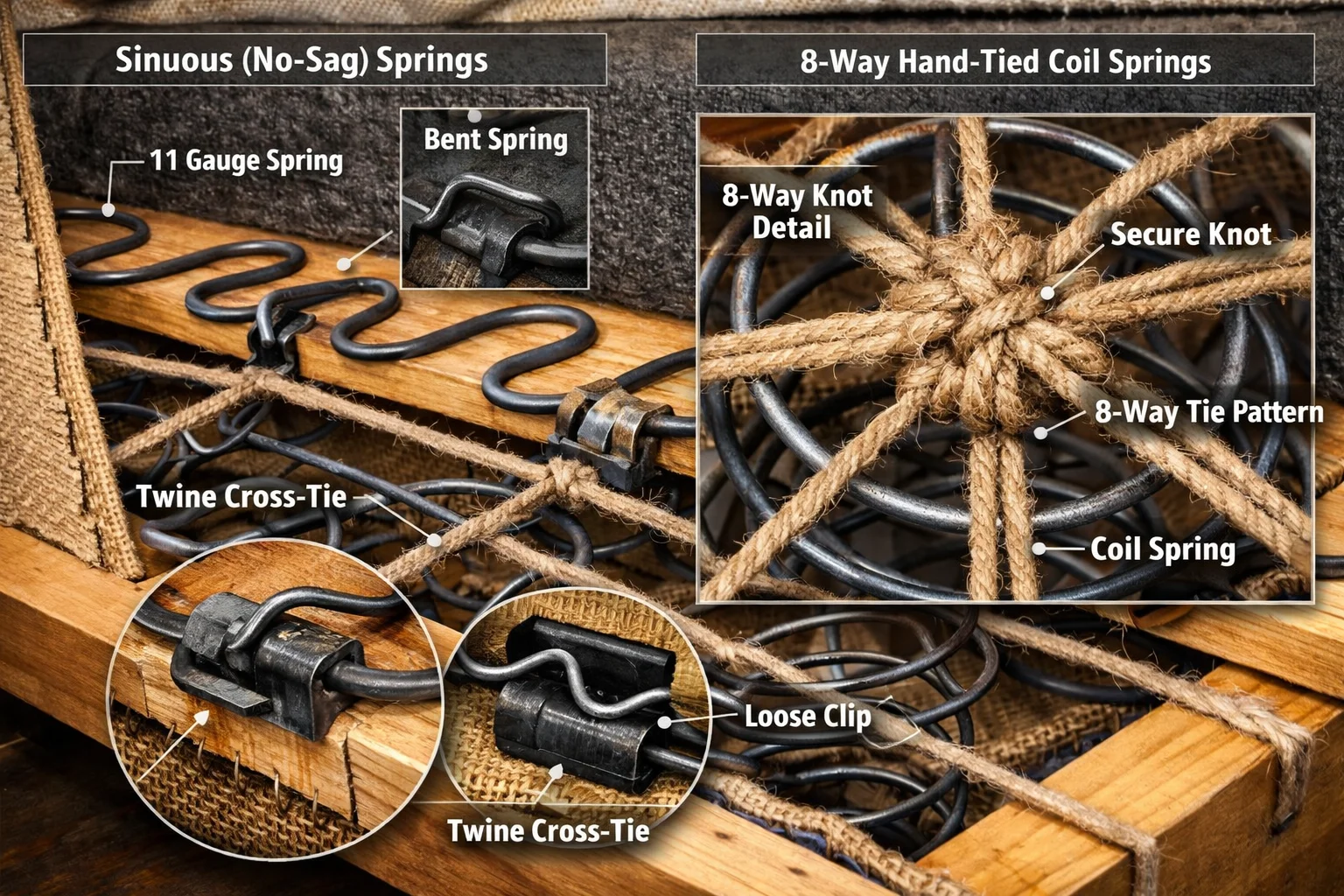
Then I do something very specific. I slide my hand under the seat cushion and press down on the deck fabric, the fabric layer that sits between the cushion and the springs. I am not trying to find the springs visually, I am trying to feel whether the support is uniform or whether I can “read” the spring pattern through the upholstery.
If you can feel individual zigzag wires as distinct lines, especially if they dig into your thighs near the front edge, I treat that as a bad sign even if the seat feels fine for the first minute. What you are feeling is not just “firm support,” it is the sofa failing to buffer you from the suspension, and that usually turns into discomfort and faster wear because the cushion is being asked to do all the work.
I also watch for the hammock sensation, where you sink into little valleys and feel like your body wants to roll into a gap between supports. If you feel that, the seat is not acting like one surface, it is acting like a series of spans, and those spans tend to loosen over time until the whole thing feels sloppy.
When I find either of those sensations, I assume the insulation layer over the springs is too thin. A lot of cheaper builds put a thin felt layer over the springs, which can be enough to hide the problem under a fresh cushion in a showroom, but it does not keep the wire feel from showing up later as the cushion softens and the felt compresses.
What I want instead is evidence that there is a real insulator between you and the metal, something that spreads load and masks the spring shape. You usually cannot see it, but you can feel it, because the pressure becomes more even and the seat stops announcing the exact location of every wire.
If you are unsure, do a simple comparison on the same sofa. Sit in the center, then sit closer to the front edge, then sit near the spot where you would normally sit every night. A well built suspension feels consistent in all those places, and a cut corner suspension often feels fine in the center and nasty at the front edge.
When a salesperson tells you “that’s just how firm support feels,” I do not argue, I just translate it into my body language. Firm support should feel like a solid push back across the whole seat, not like a few metal lines trying to introduce themselves through fabric.
If you find wire feel but you still love the sofa, this is where I slow down and ask for the spec sheet to name the suspension and the insulator layer, not just the springs. If they cannot tell you what sits between the springs and the deck, you are gambling that the thing you are already feeling in the showroom will somehow stop existing once it is in your house, and in my experience it does the opposite.
The Center Leg Check
Now I want you to crouch down and look at the underside, because long sofas fail in a really predictable way when they are under supported.
If the sofa is over about seventy inches long, I look for a center support leg, or some kind of solid center support that actually touches the floor. I am not looking for symmetry or style here, I am looking for a place where the load can travel straight down instead of asking the front rail to span the whole distance forever.
When there is no center support on a long span, the sofa is basically betting that the front rail will stay straight under years of gravity, people plopping down, and everyone sitting in the same two spots. Gravity always wins eventually, the rail bows, the seat deck follows it, and you end up with that annoying dip that makes the sofa feel like it is sagging in the middle.
In the showroom I do not just count legs, I check whether the center leg is real. I have seen “center legs” that are set back so far they barely do anything, and I have seen adjustable glides that are not adjusted, so the leg is hovering and the sofa is still spanning the whole length.
So I put my hand under the middle and I try to slide a finger between the center leg and the floor. If I can fit a finger under it, I assume it is not carrying load. If the leg is adjustable, I ask them to adjust it so it actually contacts the floor, because if it is not touching on day one, it will not magically start helping on day four hundred.
I also pay attention to what kind of floor the sofa is displayed on. A thick rug can hide a floating center leg, and carpet in your home can let a skinny center leg slowly sink until the middle starts dipping anyway, so I like a center support that looks substantial, not like an afterthought.
If the salesperson tells you a center leg is “not necessary because the frame is strong,” I treat that as marketing, not engineering. A strong frame is good, but long spans still benefit from support, and if the brand cut the center leg to keep the silhouette clean, you are the one who will live with the bow later.
When the sofa is long and there is no center support, this is where I stop getting emotionally attached and start asking for specifics in writing. I ask what the front rail is made of and how it is reinforced, because the whole middle of the sofa is hanging off that part over time.
If you remember one thing from this check, let it be this. Long sofas need help in the middle, and if you cannot see how the middle is supported when you crouch down and look, you should assume you will feel it later when the seat starts to sag right where you want to sprawl.

When you see a close up like this, I want you to remember the simplest truth about cushions, marketing describes how they feel today, your hands can tell you how they will age. I have sat on too many “plush” seats that were basically a soft top layer hiding a weak core.
I start by pressing straight down in the center of the seat cushion with the heel of my hand, slowly, and I pay attention to when the resistance shows up. If I can push down easily for a while and then hit a sudden hard stop, that usually means the cushion is thin or the foam core is cheap and collapsing until it bottoms out.
Then I do the same press near the front edge, right where your thighs live, because that area tells the truth faster than the middle. If the front edge collapses quicker, or it feels like it wants to roll you forward, I assume it will look and feel tired first, because that is where people slide in and out every day.
After that, I pinch the cushion edge between my fingers and thumb and I try to feel whether it has a crisp “wall” to it. When the edge already feels puffy and vague, like there is nothing structured inside holding the shape, that is when I expect the cushion to round off, flatten, and start looking sloppy even if you rotate it.
If the cushion is reversible, I flip it and repeat the same presses on the other side, because inconsistency is a big tell. If the same cushion feels firmer on one face than the other, or one corner is noticeably softer, I assume the build quality is uneven and you will chase comfort by constantly swapping cushions around.
When there is a zipper, I open it and I do not apologize for it. I am looking for a real inner liner and a foam core that looks like a single, clean piece, because loose scraps, lumpy fill, or a core that looks undersized for the cover usually means the cushion will migrate and never sit right again.
If the salesperson tells you “it will soften up,” I make them clarify what that means in practical terms. I ask whether it is a firm foam that will break in evenly, or a soft build that is expected to compress and be “lived in,” because those are two completely different futures, and only one of them still feels supportive in year three.
I also pay attention to how fast the cushion rebounds when I take my hand away. A good cushion does not need to snap back like a trampoline, but if it stays dented for a while after a single press, I assume it will telegraph every sit mark and start looking permanently tired.
The most useful comparison you can do is to test the cushion and the seat deck together. If the cushion feels okay in your hands but you can still feel the support system imprinting through it when you sit, that cushion is being asked to hide a structural problem, and it will lose that fight as soon as the top layer packs down.
The Verbal Inspection
Once the physical tests look decent, I go find a salesperson on purpose, because this is where a lot of “nice looking” sofas quietly fail. Most salespeople can tell you the price, lead time, and which fabrics are in stock, but they often cannot tell you what is actually inside the thing you are about to live on.
I pull out a notebook and I hold a pen like I mean it. You do not have to be aggressive, you just want to signal that this is not a vibes only purchase, and you want your future self to have a record when the story changes later.
Then I ask questions that force specificity, and I write down the answers as they say them. If you only remember one rule here, it is that vague claims are not information, and if it is not specific and repeatable, it is not real.
I start by asking for the item number and the manufacturer name for the exact sofa on the floor, not the “collection,” not something “very similar.” If they cannot identify the exact model in a way that shows up on a receipt, you are already at risk of getting a substitution build when it ships.
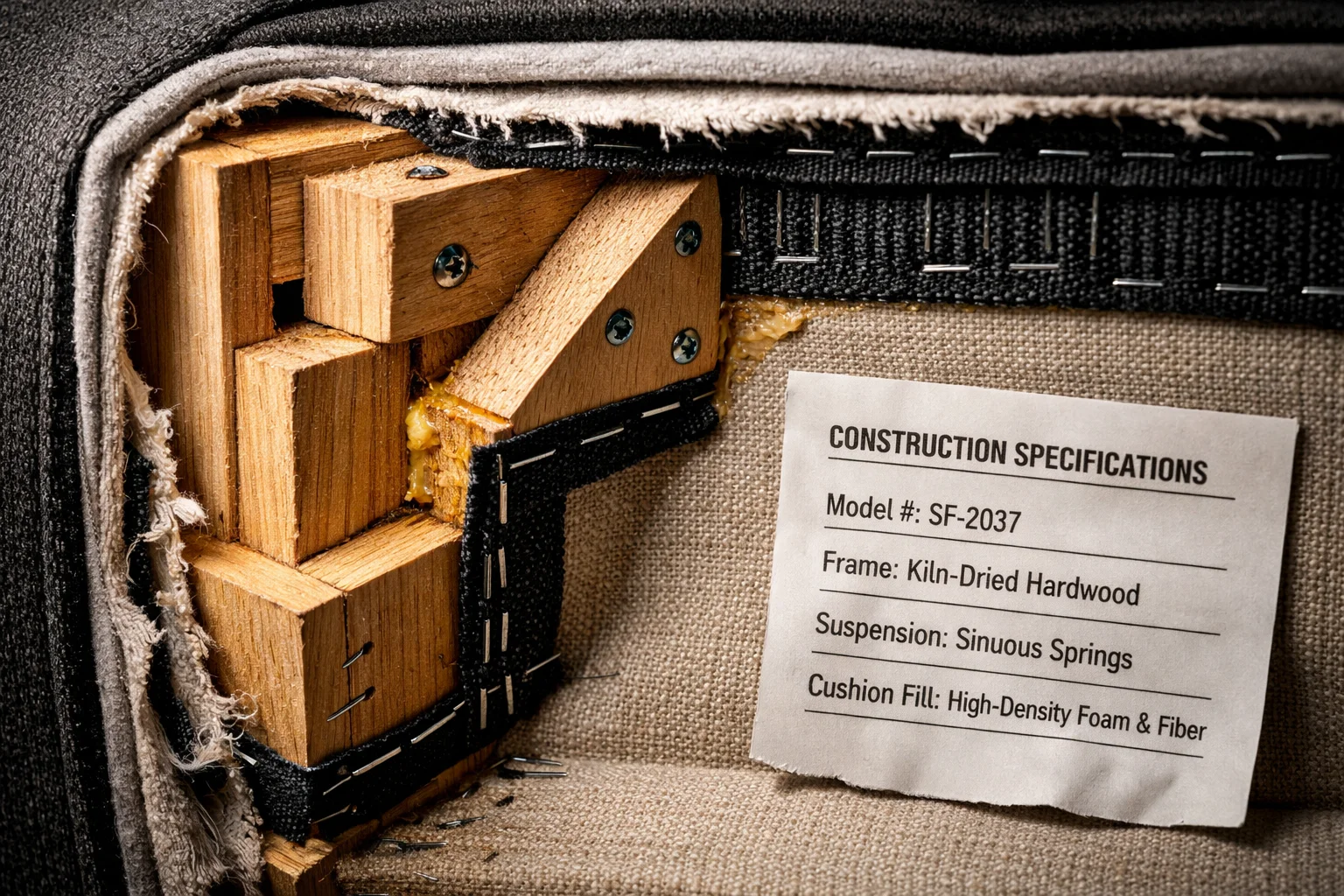
Next I ask for the construction specs in writing for this exact model, meaning the frame material, the joinery method, the suspension type, the cushion build, and the warranty terms. I am not trying to make their day harder, I am trying to find out whether the brand itself has defined what it builds, because a good maker can usually produce a spec sheet, even if the salesperson has to go get it.
If they say they do not have a spec sheet, I ask if they can email one, or if there is a manufacturer cut sheet, or even a page in a product binder, because something should exist somewhere. When nothing exists except a sales tag with a fabric name and a price, I treat that like a warning that the inside can change without anyone having to admit it.
When they tell you “hardwood frame,” I do not nod, I ask which wood, and whether it is kiln dried, because “hardwood” can be anything from a solid rail to a mix of soft wood and thin panels that just technically contain some hardwood somewhere. If they cannot answer, I ask them to show me where the claim comes from in writing, because if it is true, it should be written down by the manufacturer, not improvised.
Then I ask how the corners are joined, and I listen for a real method rather than a vibe. I am comfortable hearing “glued and screwed,” “dowelled,” “blocked,” or “mortise and tenon,” and I get nervous when the answer turns into “it’s very sturdy” or “it’s industry standard” without naming anything you could verify.
After that, I move to the suspension, because this is where a sofa can feel fine for a minute and then turn into a hammock. I ask what is supporting the seat, and I want them to say something like sinuous springs, webbing, or eight way hand tied, and I want them to tell me what sits between the springs and you, because the insulator layer is what keeps you from feeling wire lines later.
Then I ask about the seat cushions in a way that prevents the usual “high density” dodge. I ask what the seat core is made of, what the foam density is if they know it, and whether there is a wrap like fiber, down blend, or memory foam on top of the core, because that wrap is often what creates the showroom softness while the core determines whether it stays supportive.
If they do not know density numbers, I do not punish them for it, but I do keep pushing for a cushion description that is concrete. I ask whether the seat is a single foam core, a layered build, or a coil plus foam hybrid, and whether the cushions are removable and replaceable, because replaceable cushions are one of the few practical ways to extend a sofa’s life without replacing the whole thing.
I also ask whether the cushions are attached or loose, and whether the seat cushions are reversible. Loose, reversible cushions are not automatically better, but they at least give you the ability to rotate wear, and I have learned the hard way that a non reversible seat that goes flat is a long argument with gravity you cannot win.
Then I ask the question salespeople rarely expect, which is how to order the same sofa again and get the same build. I want to know whether the spec is fixed, or whether the manufacturer reserves the right to substitute materials, because a lot of disappointment comes from a great floor sample and a cheaper production run that looks identical but behaves differently.
When we get to fabric, I keep it practical and boring. I ask whether the cover is spot clean only, whether the cushion covers unzip, and whether the fabric has a performance rating I can recognize in writing on the swatch, because “kid friendly” and “pet proof” are just words until you have a stain you cannot remove.
Then I ask about the warranty, and I ask them to show me the warranty text, not summarize it. I want to know how long the frame is covered, how long the suspension is covered, and how long the cushions are covered, because a “long frame warranty” paired with a short cushion warranty tells you exactly where they expect problems.
I also ask what counts as a defect versus “normal wear,” and I make them explain sagging in plain language. If the warranty only covers dramatic failure like a broken spring, but excludes the slow loss of support that makes you hate the sofa, that is not protection, it is just paperwork.
If you get a lot of confident talk but no document, I slow everything down. I ask them to write the key claims on the quote, or email them to me from a store address, because a claim that cannot survive being written down is a claim that will not survive a warranty request.
The way I judge the verbal inspection is simple, I am looking for consistency between the physical evidence in front of me and the story I am being told. If the sofa felt rigid, even, and quiet, and the salesperson can back it up with a clear spec and a fair warranty, I keep going.
If the sofa felt borderline and the answers are vague, I do not argue, I just leave it. I have never talked a weak build into becoming a strong one, and you should not have to cross examine someone just to learn what your seat cushions are made of.
The Frame Construction Question
I do not ask whether the frame is good, because they will say yes, and the conversation ends right where you do not want it to end. I ask what the frame is actually made of, and I make them pick a material, not a compliment.
The cleanest way I have found to do this is to ask, “Is the frame solid hardwood, or is it engineered plywood, and which one exactly on the main rails?” Then I stop talking. If they answer with “hardwood frame” again, I repeat the question and add, “Solid hardwood like maple, oak, or ash, or plywood, and if it is plywood, how many layers?”
If they tell you it is kiln dried hardwood, I treat that as a real answer, because kiln drying at least suggests the maker is trying to control moisture and reduce later warping and joint loosening. In the showroom, you cannot verify kiln drying with your eyes, so I treat it as a paperwork issue, I want that claim in a spec sheet or manufacturer cut sheet, not as a verbal reassurance.
If they tell you it is plywood, I am fine with that, but I want a specific kind of plywood, not a vague “engineered wood” label. When I hear marine grade plywood, especially with a clear layer count that sounds substantial, I keep listening, because that is often stronger and more stable than the random mixed wood panels that show up in cheaper frames.
Where I start disqualifying sofas fast is when the answer slides into particle board, MDF, strand board, or anything that sounds like compressed crumbs glued into a shape. You can sometimes get away with those materials in non structural parts, but if they are used in the main frame rails, the parts that take racking forces and impacts, you are buying something that can crack when real life happens, like a kid jumping, someone dropping into the arm, or you dragging the sofa slightly while cleaning.
If you want a quick real world translation, I think of it like this. Solid kiln dried hardwood and quality plywood fail slowly and give you warning like looseness or squeaks, the crumbly boards can fail suddenly, and sudden failure is exactly what warranties love to call “misuse.”
I also watch for language tricks. “Hardwood solids and veneers” usually means some solid wood exists somewhere, and the rest could be whatever they could get away with. “Engineered wood” is not a material, it is a fog machine, so I treat it as a prompt to ask again, “Okay, but is that plywood, MDF, or particle board?”
If they cannot answer in material terms, I ask them to show me the tag, the spec sheet, or the manufacturer page that states the frame material for that exact model number. If there is no written spec anywhere, I assume the frame content can change from run to run, and the pretty floor sample is not a promise.
When they do give you a straight answer, I like to tie it back to what you already felt. If the sofa racked in the lift test or felt hollow in the squeeze test, and then they also admit to MDF or particle board, I take that as a complete story and I move on. If it felt rigid and quiet and they can back up a hardwood or quality plywood claim in writing, that is when I let the model stay on my shortlist.
The Joinery Method Question
The joints are where sofas die, because this is where all that daily twisting load concentrates. You can have decent fabric and decent cushions, but if the frame pieces are basically just held in place with fasteners that loosen, the whole sofa starts talking to you in squeaks, then it starts feeling wobbly, then something finally gives up.
When I ask about joinery, I keep it very plain, because I am trying to force a real construction answer. I will say, “How are the frame joints built at the corners, are they double doweled and glued, or are they corner blocked, and is that screwed and glued?” Then I stop and listen for those exact words or something equally specific.
If you hear “double doweled and glued,” that is meaningful because it tells you the pieces are aligned and bonded, not just pinned in place. If you hear “corner blocked,” I want it to mean triangular wood blocks added inside the corners, with glue and screws, because that is one of the simplest ways to resist racking over time.
I also pay attention to whether they can say this confidently and consistently for this exact model number, not “our frames in general.” A brand that actually builds this way will usually have it written on a cut sheet, and the salesperson can usually point to it once they know you are not going away.
Here is the part I do not let slide. If the answer turns into “stapled,” “stapled and glued,” or anything where staples are doing the structural work, I mentally move the sofa into the high risk pile. Staples are fine for holding fabric, but staples trying to hold a frame square are how you end up with a quiet sofa in month one and a chorus of noises by month six.
Sometimes you will get a foggy answer like “they use industrial staples, the strong kind.” I have learned to treat that like a tell, because if the joints were actually blocked or doweled, they would brag about it. When someone leads with staples, it usually means the joinery is a cost cutting story, not a durability story.
If the salesperson cannot tell you, I do not argue about what “should” be true. I just ask them to show me where the joinery method is stated in writing for that exact item number, and if nothing exists, I assume I am being asked to trust a build that might change without notice.
You can sometimes spot corner blocking without being a technician if the store lets you look underneath and the dust cover is loose enough to peek past, or if there is an opening around a leg mount. I am not trying to disassemble anything, I just want a glimpse of real wood reinforcement at the corners, not a bare joint line and a spray of staples.
I also connect this back to what you already felt. If the sofa even slightly racked in the lift test and they cannot clearly describe dowels, blocks, or another real joint method, I treat that combination as the whole story. A twisting frame plus vague joinery answers usually becomes a loose, noisy sofa no matter how nice it looks on the floor.
When the joinery answer is good, I still ask one more question that protects you later, which is whether those corner blocks are both glued and screwed, and whether that is consistent across the frame. I am not trying to win trivia night, I am trying to avoid the common trick where one corner is reinforced for show, and the rest are built fast.
If you want my personal rule here, it is simple. I do not buy a sofa when the person selling it cannot name how the corners are held together, because the corners are where you live, not the fabric swatch.
The Foam Density Question
When you hear “high density foam” in a showroom, I want you to assume it means nothing until you see a number. Foam density is one of the few cushion specs that actually predicts how fast a seat will collapse, and it is routinely hidden behind vague labels because the cheap stuff sells just fine on day one.
Here is the baseline I use for residential seating. If the seat foam is under 1.8 pounds per cubic foot, I treat it as a short term cushion no matter how good it feels in the store. If it is 1.8, I consider it the minimum for a sofa you expect to sit on daily without hating it in a year. If it is around 2.5 and described as high resiliency foam, that is when I start to relax, because that is the class of foam that tends to keep its shape instead of turning into a permanent butt print.
If you ever see 1.2 pound foam in a spec sheet, or you get a clue that the seat is built with that kind of foam, I would walk away. I have had cushions like that, they feel soft at first, then they collapse fast, and what you are left with is a sofa that looks fine across the room and feels terrible every time you sit down.
In the store, I ask a very specific question and I do not let it get answered with marketing. I say, “What is the foam density of the seat cores in pounds per cubic foot for this exact model number?” If they say “high density” or “premium foam,” I ask them to show me the spec sheet line where the density is stated, because if the manufacturer is proud of it, it is usually written down.
Sometimes the salesperson truly will not know, and that is not automatically their fault. What matters is whether the store can produce the information at all, even if it takes an email to the manufacturer. If nobody can get you a density number in writing, I assume the foam is whatever they can source cheaply this month, and you do not want to finance that kind of surprise.
I also want you to make sure you are talking about seat foam, not the soft wrap on top. A lot of cushions are built with a foam core and then wrapped in fiber, down blend, or another plush layer that makes it feel luxurious under your hand while the core does the real work. So I will literally clarify, “I am asking about the density of the core foam, not the wrap.”
When you cannot get the number, you can still pressure test the honesty of the build with your body. If the seat feels great for ten seconds but you keep sinking slowly, or you feel a hard stop like you are hitting the deck, that often matches low density foam or a thin core. If the cushion rebounds lazily and stays dented after a single sit, that is another hint that the foam is already giving up its structure.
I will also connect foam density to the warranty, because brands tell on themselves here. If the foam is truly decent, you often see longer, clearer cushion coverage, or at least a defined sagging threshold that sounds fair. If the cushions are barely covered, excluded as “normal wear,” or covered only for obvious defects, that often lines up with foam that was never meant to hold up.
If you want a simple way to keep yourself out of the worst deals, make this your line in the sand. I do not buy a sofa when the seller cannot tell me the seat foam density in writing, and I do not buy one with seat foam under 1.8 pounds per cubic foot, because I have learned that you cannot upholster your way out of collapsing foam.
The Edge Construction Question
Now I want you to walk to the very front of the sofa and test the one spot that gets punished every single day, the front edge of the seat.
I press down on the very front edge of the seat cushion, right where your thighs rest when you sit normally and right where you slide in and out. I am not pressing in the center, I am pressing within an inch or two of the piping, because that is where cheap construction shows itself fast.
When the edge is built as a sprung edge, you feel support extending all the way to the front. It feels like the seat is still holding you up at the lip instead of letting you tilt forward, and you do not feel a sudden hard bar under the foam.
When the edge is built as a hard edge, you usually feel a firm wooden rail right under the foam. I consider this acceptable structurally, but I treat it as a comfort tradeoff, because that hard line can press into the underside of your thighs during longer sits, and for me that is where numb legs and constant shifting begins.
Here is how I translate the test into a buying decision. If you plan to lounge for long stretches, or you are the kind of person who sits a little forward with feet on the floor, I would strongly prefer that sprung edge feel, because it spreads pressure instead of concentrating it on a single rail.
If you feel that hard rail, do not let the salesperson hand wave it as “extra support” and move on. I sit on the sofa with my hips back like a normal sit, then I slide forward an inch at a time until my thighs are right over that front edge, and I stay there for a full thirty seconds.
If your body immediately wants to scoot back or your legs start feeling pinched, that is your answer. You are not being picky, you are catching a design that will quietly irritate you every night, especially once the cushion top layer breaks in and you are sitting closer to the structure.
I also compare left seat to right seat on the same model, because edge support problems can be inconsistent. I have found sofas where the edge feels okay in one spot and harsh in another, which usually means the front rail, padding, or suspension is uneven, and that kind of unevenness becomes a permanent “good seat” and “bad seat” situation at home.
If you have the spec sheet in hand, I like to match what I felt to what they claim. If they describe a sprung edge or spring support to the front and I still feel a hard bar immediately, I treat that mismatch as a credibility problem, because it means either the floor model is not built the way the paperwork says, or the paperwork is written loosely enough to be meaningless.
If you are torn because you love everything else about the sofa, this is where I get very practical. I ask whether the seat cushions are thick enough that you will never feel the rail as they soften, and whether the edge construction is the same across the whole line or changes by size, because sometimes the long sofa and the loveseat are not built the same way even when they look identical.
What I will not do anymore is buy a sofa where the front edge already feels like a bar on day one and tell myself I will get used to it. I have never “gotten used to” poor edge comfort, I have only gotten annoyed that I paid for it.
The Fabric Inspection
Now we can talk about fabric, but I want you to treat it like the last gate, not the first one. Fabric is where sales talk gets the most poetic, and it is also where you can accidentally pay for a name, a texture, or a trend while the actual durability is average.
I start with the swatch, not the sofa body, because the swatch usually has the only honest data you will get. I ask to see the exact swatch for the exact SKU I am ordering, and I do not accept “this is basically the same” if the tag shows a different code.
When you have the swatch in your hand, look for an abrasion rating, usually listed as Wyzenbeek or Martindale. I am not trying to turn you into a lab tech, I just want you to know whether the fabric was tested for heavy use or whether you are gambling.
If the store cannot provide an abrasion rating at all, I treat “performance fabric” as a marketing phrase until proven otherwise. A real performance program almost always comes with a care code, a fiber content, and some kind of test data, even if the salesperson has to dig for it.
Then I check fiber content and I translate it into how it fails. I am generally wary of very high cotton content on the main seating surfaces because cotton can stain and it can wear into shiny, bald areas where you sit most, especially on arms and seat fronts.
Polyester gets mocked, but I have learned to judge it by feel and weave, not by snob value. A lot of polyester and poly blends are genuinely practical for families because they resist staining and clean up better, but the cheap versions pill and get that tired fuzz look fast, especially on loose back cushions.
Linen blends look great in a staged room, but I assume they will wrinkle, relax, and show every life decision you make on them. If you love that look, fine, but I want you to buy it on purpose, not because the showroom lighting made it look “elevated.”
If you have pets, I want you to run your fingernail lightly across the swatch and then rub the spot hard with your thumb. If the fabric immediately roughs up, blooms into fuzz, or shows a permanent mark, it is going to look trashed where claws, collars, and repetitive rubbing happen.
I also do the snag test in a very controlled way. I hook a dry finger very gently on the weave and pull sideways just a little, because loose weaves can grab and ladder. If you see the yarn shift easily or you can open the weave with minimal effort, I assume it will snag on jeans rivets, rings, and pet nails.
Then I check pilling potential the low tech way. I rub the swatch briskly against itself for ten seconds and look for little balls starting to form, because those are the pills you will shave off later while wondering why the sofa looks older than it is.
Now I look at color in a way that is not about taste. If the fabric is very light and the weave is textured, I assume it will trap grime in the texture and it will darken along the arm tops, cushion fronts, and head area if anyone lounges.
If you are choosing something dark, I check whether it looks like it will show lint, dust, and skin oil as shiny patches. A lot of dark, smooth fabrics look luxurious for a month, then they start showing every fingerprint and every place someone rests their head.
I also take the swatch to a window or a brighter part of the showroom if I can. Showroom lighting is designed to flatter, and I have seen “warm gray” turn into purple at home and “cream” turn into yellow once it is under normal bulbs.
Next I inspect the upholstery on the floor model like I am looking for how carefully they built it, not whether it is perfectly steamed. I look for pattern matching across cushions and along the front rail, because when a brand cheapens out, they often save labor there, and that labor choice usually shows up in other build choices too.
Then I check the seams and the welting, if it has it. I run a finger along the seam and I look for stitches that look even and tight, not wide, loose, or wavy, and I look for fabric that is already puckering around the seam because that often turns into seam stress later when the cushion is compressed every day.
I also pinch the fabric right next to a seam and pull very slightly, not yanking, just loading it a bit. If I can see the stitch holes open up immediately, or I hear little thread pops, that is a hard no for me on a main seat fabric.
If the sofa has removable cushion covers, I check the zipper quality because you will actually use it someday. I want a zipper that feels substantial and slides without catching, and I want the cover to come off without feeling like I am going to rip a seam just to remove it.
If the cushions are not removable and the fabric is spot clean only, I pause and imagine a real stain. You do not have to be messy to have a life, and if the care tag basically implies “do not live on this,” I treat that as the product telling you it is meant to be admired, not used.
I also ask one blunt question that saves time later, which is whether the fabric is railroaded or not on this exact model. I am not chasing jargon for fun, I am trying to predict whether you are going to get seams running across places you sit and whether the nap or texture direction will make panels look like different colors from different angles.
If the salesperson cannot answer, I fall back to what I can see. I look across the back and seat and see whether the fabric changes shade when I stand to one side, because strong nap fabrics can make cushions look mismatched even when they are “correct,” and that drives some people crazy after the novelty wears off.
Fabric Red Flag: “Performance” With No Paper
If the tag and the swatch book cannot give you a care code, fiber content, and some kind of abrasion testing info, I treat “performance” as a sales adjective. If you cannot verify it in writing, you cannot enforce it when it pills, snags, or stains.If you are ordering custom upholstery, I want you to do one more thing that feels fussy but prevents expensive regret. I ask you to request a larger cutting or a memo sample if they can provide it, because tiny swatches hide sheen, hide texture scale, and hide how the color shifts under different light.
Finally, I connect fabric back to the way the sofa is built. If the arms are very squared off and tightly tailored, I assume the fabric is under more tension there, so I want a tougher weave and I want seams placed where they are not constantly being loaded by people sitting on the arm.
If the sofa is very cushy and relaxed, I assume you will be rubbing the same spots constantly as you flop and shift, so I want something that resists pilling and that does not turn shiny. In plain terms, I want the fabric failure mode to be something you can live with, because every fabric fails somehow.
When you feel yourself falling in love with a texture, I want you to do the simplest reality check. Ask yourself whether you would be comfortable owning this fabric in your car seats, because that is about the closest daily wear comparison you can make, and it cuts through a lot of showroom fantasy.
The Double Rub Question
When you see “double rubs” on a fabric swatch, that number is an abrasion test, basically how much rubbing the fabric can take before it shows meaningful wear. The test itself is technical, but the way you use it as a shopper is simple, it is one of the few durability clues you can ask for that is not a pure marketing adjective.
In a showroom, I ask to see the rating in writing on the swatch tag or in the fabric book for the exact fabric code I am ordering. If they cannot show me the number for that exact code, I assume the “performance” story is doing all the work and I do not pay extra for it.
Here is how I translate the common ranges into a decision you can actually make. Around 25,000 double rubs is what I treat as a normal, reasonable baseline for a sofa that gets daily use by adults who live normally. If it is 50,000 or higher, that is where I start feeling comfortable calling it heavy duty, and this is the range I personally want if you have kids, pets, or you know this sofa is going to be the primary landing pad every night.
If the fabric is under 15,000, I treat it as decorative, meaning it might be fine for an occasional chair, a formal room, or a spot nobody really sits, but it is not what I want on the main family sofa. If you fall in love with a fabric in that range, I want you to do it with your eyes open and negotiate price like you are buying something that will show wear sooner, because you are.
I also want you to notice the most common sales trick around this number. A salesperson will sometimes talk like higher is always better, but in real life, the weave and finish matter too, and some very high rated fabrics can feel stiff or look a little flat compared to softer, more textured options. So I use double rubs like a minimum gate, not a beauty contest, and once it clears the gate I go back to your snag test, your pilling test, and how it feels on the cushions.
When you are comparing fabrics, make sure you are comparing the same test type. You will usually see Wyzenbeek double rubs in the US and Martindale cycles in other markets, and they are not a simple one to one match. I do not try to convert them in the store, I just make sure I am not being shown a high number in one system and a low number in another and being told they are “basically the same.”
If the sofa is in a store branded fabric program, I also ask one uncomfortable but useful question, which is whether that exact fabric has been tested on the fiber blend and finish they are selling today. Fabrics get renamed and re sourced all the time, and I have learned that a number printed on a generic marketing page is less valuable than the number on the actual current swatch tag you are holding.
If you want the shortest practical rule I can give you, it is this. For a main sofa, I personally do not bother with anything under about 25,000, and if your life includes pets, kids, or one favorite seat that gets hammered, I would rather you start around 50,000 and then pick the one that still passes your hands on tests.
The Zipper Inspection
If the cushion has a zipper, I treat it like a permission slip to stop guessing. I ask before I do it, but I am always trying to unzip at least one seat cushion and one back cushion, because what is inside predicts how the sofa will feel after the showroom break in period is long over.
When you open it, the first thing I look for is whether there is an inner liner, basically a thin inner “pillow case” holding the foam or fill. If the cover opens and it is just raw foam rubbing directly against the upholstery fabric, I assume the cover is going to wear from the inside, and I also assume the cushion will be harder to clean and live with because everything is built as one messy unit.
Next I look at the foam color, but I do not get hypnotized by it. White or pale yellow foam is the common polyurethane you see in most sofas, and that is not automatically bad. Blue or pink foam often shows up when there is some kind of gel infused layer or a specialty top layer, and I treat that as a comfort feature, not as a durability guarantee, because flashy layers still sit on top of whatever core is doing the real work.
What I actually care about is whether the cushion looks like a clean, intentional build or like a shortcut. A single, solid foam core that fits the cover well usually ages more predictably than a lumpy stack of scraps, loose sheets, or foam that looks undersized and is relying on the wrap to fill the corners.
Then I check for a wrap around the foam, because this is one of those quiet details that changes how the sofa wears. If the foam core is wrapped in Dacron, it is usually a thin batting layer that helps the cushion slide against the fabric without abrading it, and it softens the edges so you do not get that sharp, boxy feel. If there is no wrap at all and the foam edges feel bare, I assume you are more likely to see the upholstery looking tired where the cushion rubs, especially on the front edge and along piping.
If the cushion is supposed to feel plush, I look for how they created that plushness. A lot of sofas get their showroom feel from a thick fiber layer or a down blend wrap around a firmer foam core, and that can be totally fine if you are willing to fluff and rotate. If it is mostly loose fiber fill with no meaningful core, I assume it is going to migrate, clump, and give you that annoying “why is this cushion empty on one side” problem.
I also use the zipper moment to connect the inside to the warranty conversation. If the salesperson has been promising you premium foam, this is where I ask them to show me that promise in writing and point to the cushion certification if they claim it is low emission foam, because the label is easier to verify than a speech. If they mention CertiPUR US, I ask where that is documented for this model or this cushion, not because I am trying to be difficult, but because I do not want “low chemical emissions” to be another untraceable showroom story.
Before I zip it back up, I do one last check that sounds petty but has saved me future annoyance. I run the zipper a few inches closed, then open it again, because cheap zippers fail at the exact moment you finally need to wash a cover, and that is usually during a stressful week, not a calm one.
If the store will not let you unzip anything, I do not automatically walk out, but I treat it like lost information and I compensate by being stricter everywhere else. When I cannot see the cushion build, I rely more on how the cushion rebounds, whether the edges are already getting soft, and whether the warranty treats cushions as disposable, because in my experience those three clues usually line up with what the zipper would have shown you.
The Cleaning Code Check
Now I flip the fabric swatch over and look for the cleaning code, because this tiny letter quietly determines whether you can actually live with the fabric you are about to pay for.
If you have kids, pets, coffee, or you just exist like a normal person, I want you to treat the code like a lifestyle compatibility check, not a footnote. A beautiful fabric that you cannot clean without damage is not “luxury,” it is a trap.
When I see code S, I read it as solvent only. In plain terms, I assume water is risky, I assume DIY spot cleaning can leave rings or discoloration, and I assume you might end up paying for professional help more often than you expect if something nasty happens.
When I see code W, I read it as water based cleaning is acceptable. I still do a hidden spot test at home and I still use a gentle approach, but W at least tells me the fabric is not going to panic the moment water touches it.
When I see code X, I treat it as the highest friction option for real life. X means vacuum only, and for me that is basically the manufacturer telling you stains are your problem, so I only accept X if the sofa is truly low use or if you are the kind of person who will honestly keep food and drinks away from it forever.
In the store, I do not just read the code and move on. I ask myself where this sofa will be in your home and who will use it, then I decide whether the code is compatible with that reality, because it is easier to choose a cleanable fabric now than to argue with a stain later.
If you are worried about a tough stain or a big spill, I do not want you experimenting with random cleaners and hoping for the best, especially on S coded fabrics. When it is serious, I would rather you start with certified professional cleaning guidance than turn a fixable stain into permanent damage.
The Logistics Check
After you have cleared the structure, cushion, and fabric gates, I want you to switch mental modes and do a logistics check, because this is where a “good sofa” turns into a bad purchase. A lot of stores win by making the buying process feel simple, then the complications show up later in delivery fees, restocking rules, and the fine print around what happens if it arrives wrong or damaged.
The first thing I do is slow down the timeline conversation. If someone says “four to six weeks,” I ask what that means in plain terms, whether that is an estimate or a committed window, and whether the clock starts today or after the order is acknowledged by the manufacturer.
Then I ask who actually controls the delivery, the store’s own crew or a third party. I have had better outcomes when the delivery team is accountable to the store, because when something goes wrong you are not stuck between two companies pointing at each other.
I also ask what happens if the delivery window slips. If the answer is basically “that happens sometimes,” I ask whether I can cancel for a full refund if it misses a date that is important to you, because the only leverage you have is before you pay in full.
Now I get very literal about measurements, because most delivery failures are geometry, not bad luck. I measure your doorways, hallways, stair turns, elevator depth, and any tight interior corners at home, then I compare them to the sofa’s packaged dimensions, not just the sofa’s overall length.
In the store, I ask for the packaged dimensions in writing. A lot of people measure their door and compare it to the sofa width, then the sofa arrives in a huge carton and the delivery crew cannot make the turn, and suddenly you are negotiating a return you did not want.
If the sofa has removable legs, removable backs, or comes in modular pieces, I want that confirmed in writing too. I have seen salespeople casually promise “it comes apart,” then delivery shows up with a single rigid frame that was never going to make it upstairs.
If you live in an apartment or a building with rules, I would check them before you order. Freight elevator reservations, certificate of insurance requirements, delivery hour limits, and protection policies for walls and floors can turn delivery into a reschedule spiral that costs you time and sometimes money.
Then I get specific about who is responsible for damage, and I do not accept vague reassurance. I ask what happens if it arrives with a scuff, a tear, a broken leg, or a frame that rocks, and I ask whether the store repairs it, replaces it, or offers a partial refund, and I ask how long you have to report it.
This part matters more than people think because a lot of stores treat delivery like the finish line. If you sign and the crew leaves, the store may suddenly become very interested in how you can “work with the manufacturer,” which is exactly what you do not want when the problem is sitting in your living room.
So I ask about inspection at delivery in a very practical way. I ask whether the delivery team will wait while you do a quick check, and I ask what you should write on the delivery receipt if you see a problem, because “accepted” can quietly become “no claim.”
If you can, I like you to plan for a fast but thorough look while the crew is still there. I check the arms for crush damage, I look at the corners and the piping, I press on the seat to see if anything feels dramatically different than the floor model, and I make sure the legs are tight and the sofa sits flat.
I also ask whether they will take the packaging with them. Leaving it behind sounds minor until you are trying to move huge cardboard and foam down a hallway, and some stores charge for removal even when they are already there.
Next I get clear on returns, because return policies are one of the easiest places to get trapped. I ask whether the sofa is considered custom, even if you only changed the fabric, and whether “custom” means no returns, only repairs, or store credit only.
If there is any restocking fee, I ask for the exact percentage and what it is calculated on. I also ask whether the delivery fee is refundable, because a lot of stores advertise a return option that quietly excludes the biggest fees you paid.
Then I ask the uncomfortable question about comfort returns. Some brands offer a comfort trial, some do not, and many stores will tell you “you can always exchange,” but the paperwork says something very different once the sofa has been in your home.
If the policy is strict, I want you to treat your showroom sit like it is final. If you are not sure about seat depth, back angle, or firmness, this is where I would rather you walk away and come back than buy a maybe and hope you can fix it later.
I also ask about order accuracy in a way that prevents the classic “that’s close enough” delivery moment. I confirm the model number, the configuration, the arm style, the leg finish, the cushion type, and the fabric code on the written order, and I read it like I am looking for a mistake.
If anything is described in vague words like “as shown” or “standard,” I ask them to replace that with the actual option name or code. “Standard” has a way of changing when a manufacturer updates a line, and you want the receipt to describe what you paid for, not what someone remembers.
Now I do the maintenance reality check, because this is part logistics too. I ask whether the seat and back cushions can be reordered later, whether covers can be replaced, and whether the fabric is still likely to be available in a couple of years.
You are not trying to plan your whole life, you are just trying to avoid a sofa that becomes unserviceable the moment one cushion goes flat. If they cannot sell you replacement cushions or covers, I treat the cushions as a consumable that will eventually force a full replacement, and I price it in my head accordingly.
Finally, I match the logistics to your home and your patience. If the sofa is a long lead time custom order, no returns, and the store cannot tell you what happens if it arrives wrong, I only proceed if the specs are excellent and the paperwork is unusually clear.
If any part of this feels slippery, I do not try to out argue it. I just treat logistics confusion as a risk premium you do not need to pay, and I keep shopping until the physical sofa and the written process both feel solid.
The Leg Removal Question
This is the part that feels boring until it ruins your delivery day. Before you pay, I want you to measure your narrowest doorway at home, and I mean the true pinch point, not just the width of the front door.
If your doorway is narrower than the sofa’s overall height, you are already in a situation where the legs must come off, because you are not getting extra clearance by angling and praying. If the sofa is 34 inches high and your door is 32 inches, that is not a “maybe,” it is a guaranteed stop unless the legs are removable.
In the showroom, I do not accept a casual “the legs come off” as a verbal promise, because I have watched delivery crews discover that “removable” means “technically removable with tools, time, and risk of damage.” I ask you to get it confirmed in writing on the quote or spec sheet, and I want it to say the legs are removable for delivery, not just “wood legs” or “leg finish.”
Then I verify it with my eyes. I crouch down and look at how the leg meets the base, and I look for a clear bolt or hanger bolt setup that looks like it was designed to be removed and reinstalled, not a decorative leg that is glued, stapled, or integrated into a fragile corner block.
If the salesperson will allow it, I ask them to demonstrate removing one leg on the floor model or on a similar model from the same manufacturer. I am not trying to be difficult, I am trying to prevent the most common trap, which is you paying for a sofa that can only enter your home by removing a door, removing trim, or hiring a third party crew to disassemble something that was never meant to be disassembled.
I also want you to think one step past the front door. Even if your entry is wide, the real failure point is often an interior hallway, a stair turn, or a tight corner into the room, and legs buy you precious inches in those turns. If you have stairs, I care even more, because the angle changes and you lose clearance faster than you expect.
There is another detail I check that people skip, which is what happens after the legs come off. Some sofas still have little fixed glides, brackets, or a low hard edge that catches on door thresholds and scrapes floors, so I look for anything that protrudes below the frame line once the legs are removed.
When a store tells you they can “make it work,” I do not let that be the plan. I ask what the store’s delivery team is allowed to do, what tools they carry, and whether removing legs or backs is considered standard service or an extra paid service, because you do not want this turning into a negotiation at your doorway with a clock running.
If the sofa cannot fit unless legs come off, I also ask you to confirm the sofa can stand safely on its base during the move without crushing the dust cover, bending a skirt frame, or stressing the bottom rail. Some pieces are built in a way where the legs are part of the stability, and dragging them legless is exactly how corners get tweaked and frames start rocking later.
If you want my personal rule, it is simple. I do not buy a sofa until I know it can physically enter your home without heroics, and if the math says legs have to come off, I want that removability to be real, repeatable, and documented, not just a salesperson’s optimism.
The Warranty Detail Question
I read the warranty document before I let myself get excited about a sofa, because it is one of the only places the manufacturer accidentally tells you what they think will fail. Sales talk is hopeful, the warranty is defensive, and the gap between those two is where you get ripped off.
In most sofa warranties, the frame coverage is the longest, sometimes “lifetime,” sometimes a long multi year term. That sounds great until you notice what “frame” usually means in the fine print, which is often a break, not looseness, not squeaks, and not the slow wobble that makes a sofa feel cheap.
So when you see a long frame warranty, I want you to read the definition of defect. If the wording only covers structural failure like cracking or complete breakage, you should assume the brand expects you to live with a lot of annoying movement and noise that will be dismissed as normal settling.
Then I go straight to the cushion section, because that is where the truth usually shows up. Cushion coverage is commonly one year or less, and that timeline is not random, it is basically the manufacturer admitting how long they expect the foam to hold shape before it becomes “wear.”
If the seat cushions are only covered for a year, I treat it as a warning that the foam is a consumable, even if they called it premium on the floor. You can still choose it, but you should choose it like you are buying a sofa that you might be re cushioning out of pocket, not like you are buying something meant to feel supportive for many years.
I also look for how the warranty describes sagging, because this is where people get fooled. A lot of warranties only cover cushion “indentation” above a certain depth, and they often specify that the measurement excludes the soft top layers, excludes the wrap, or requires a very specific measuring method that is hard for you to prove at home.
In the showroom, I ask you to do something simple and slightly annoying, ask the salesperson to show you the exact cushion warranty paragraph on paper or on the manufacturer’s PDF. I do not accept “one year cushions” as a summary, because what matters is what is excluded, how sagging is defined, and whether the brand requires you to jump through hoops.
If you see language like “normal softening is not covered,” I slow down and translate it into your daily life. Foam softening is exactly what you feel as support disappearing, so if the warranty pre excuses it, you are being told up front that discomfort is your problem, not theirs.
I also pay attention to whether the warranty is prorated. A prorated cushion warranty can sound longer than it is, because it might only promise a small credit after the first year, and you can still end up paying most of the replacement cost while dealing with shipping and labor.
Another trap is the “component warranty” that does not match the way you experience failure. Springs might be covered longer than cushions, but a spring system can technically be intact while the seat feels awful because the foam packed down and you are feeling the wire lines you tested for in the showroom.
When I am standing there with the warranty text, I connect it back to the inspection you already did. If you felt slow sink, weak edge support, or wire feel, and then you see short cushion coverage or sagging exclusions, that is the whole story lining up, and I walk away instead of arguing with myself.
If the warranty is unusually generous on cushions, I do not just celebrate it, I verify it applies to the exact model and cushion option you are ordering. Some lines have different cushion grades, and the floor model can be upgraded while your quote silently defaults to the cheaper cushion with the weaker warranty.
I also want you to check who you are actually dealing with when you make a claim. Some warranties are technically manufacturer warranties, but the store is the gatekeeper, and some stores are helpful while others treat you like a problem once the sale is done, so I ask, “If I have a warranty issue, do I call you, or do I call the manufacturer, and what do you need from me?”
This is where I take notes like an annoying adult. I write down the warranty term for frame, suspension, and cushions, and I note any sagging thresholds or exclusions in plain words, because six months later you will not remember the phrasing, and the phrasing is what determines whether you get help.
If you want my bottom line, I use the warranty like a lie detector. Long frame coverage with tiny cushion coverage tells me the sofa is built to last as a box while the part you sit on is built to be replaced, and I only buy that on purpose, at the right price, with replacement cushion availability confirmed in writing.
The Walkaway Signal
I have learned that the real test of a sofa is not just what the frame does in the lift test or what the cushion does under my hand. The real test is what happens to the conversation the moment you ask for specifics.
Good brands, and good stores representing them, do not get weird when you ask for documentation. They might not have the answer memorized, but they know where to find it, and they are willing to show you the spec sheet, the cut sheet, and the warranty text without acting like you are committing a social crime.
The opposite is also true, and this is the signal I want you to trust. When the product is built to sell on looks and day one comfort, the conversation tends to slide away from construction and into lifestyle. Suddenly you are talking about how it “warms up a space,” how it is “so on trend,” how the fabric is “performance,” how the brand is “premium,” and none of it is attached to a model number and a document you can take home.
If I ask, calmly, “Can you show me the construction specs for this exact model, including the seat foam density and the suspension, in writing?” and I get defensiveness, I treat that as the answer. I am not asking for trade secrets, I am asking what I am paying for, and a brand that is proud of its build does not need to protect it with fog.
One thing I watch closely is redirection disguised as help. If you ask about foam density and they say, “Most customers don’t worry about that,” or “You can’t really compare that stuff,” they are trying to put you back into the emotional lane where the sale is easier.
I also treat the “trust me” posture as a walkaway signal. If the salesperson starts acting like you are insulting them by wanting the warranty text, or they get clipped, or they start talking faster, I assume they have been trained to close before you can verify. I do not argue, because arguing keeps you in the store and makes you invest emotionally.
Here is the practical line I use in my own head. If they cannot or will not provide written specs for the exact item number I would be ordering, then whatever I liked about the floor model is not a promise, it is a sample. I do not finance samples.
Sometimes the salesperson is genuinely nice and still cannot produce anything. I still walk. I am not punishing the person, I am protecting you from a system where the inside can be substituted, downgraded, or quietly changed, and you will only discover it when the seat goes dead after the return window.
I have also learned to notice when a store can produce paperwork, but tries to keep it out of your hands. If they will show you a binder from six feet away but will not let you photograph the page, or they keep summarizing instead of letting you read, I slow everything down. If the information is real, it can survive being looked at.
When I hit a walkaway moment, I do one last check to confirm I am not overreacting. I ask for the manufacturer name and the exact model number that will appear on the receipt, and I ask them to email me the spec sheet and warranty PDF to take home. If they cannot do that simple follow through, I leave, because you are going to get the same evasiveness if you ever need warranty help.
The emotional trick here is that you will be tempted to compromise because you already spent time sitting, imagining it in your room, and picking a fabric. I have done that, and it is how I ended up owning a sofa I was already defending before it even arrived. If you feel yourself starting to justify missing information, that is the moment to stand up.
I want you to remember this as a buyer. A sofa is not a mystery box, and you are not being difficult for asking what is inside. If the store acts like basic construction facts are inappropriate, that is not a customer problem, that is a product problem, and I have never regretted walking away from a product that needed secrecy to sell.
Decision Framework: 10-Minute Showroom Audit
When I am close to saying yes, I stop browsing and I run one last fast audit that forces the sofa to prove itself. You can do this in about ten minutes, and it keeps you from getting emotionally dragged into a fabric choice before the structure has earned it.
I start with the lift, because it is the quickest truth test for the whole box. You already know what you want to see, the sofa should move like one rigid unit, and the opposite front leg should come up without delay. If I feel twisting, lag, or a shiver in the frame, I treat it like a no and I do not negotiate with myself.
Then I check the rails, especially the front rail and the front third of the arms, because that is where cheap shaping materials get used to fake “solid” furniture. I put my hand under the upholstery and squeeze for that boring, immediate resistance that feels like real wood under padding. If it caves, feels hollow, or makes any papery crunch sound, I stop, because you are basically holding packaging, not structure.
Next I go straight to the center, because long spans need help in the middle even when the showroom styling hides it. I crouch down and look for a real center support leg or support system that actually touches the floor, not one hovering above a thick rug or set so far back it is decorative. If I can slide a finger under it, I assume it is not doing anything, and I assume the front rail is going to bow over time.
After that I confirm the foam, in writing if possible, because this is where “plush” turns into regret. I ask for the seat core density number for the exact model number and I wait for a real answer, not “high density.” If I cannot verify that the seat foam is at least 1.8 pounds per cubic foot, I treat the cushions as a consumable and I only proceed if I can reorder replacements later and the price reflects that reality.
Finally I check the rubs, because fabric durability is one of the few fabric facts you can actually use. I look for an abrasion rating on the swatch tag or fabric book for the exact fabric code, and for a main family sofa I personally want to see 30,000 double rubs or more before I stop worrying. If they cannot show a number in writing, I treat “performance” as an adjective and I do not pay a premium for it.
If the sofa passes all five gates, I take that as permission to spend time on comfort, dimensions, and whether you actually like living with it. If it fails even one gate in a way that points to structure or materials, I walk, because the only thing harder than doing this audit in public is living with the consequences in private.
Explore Technical Reference

Furniture Delivery Logistics: Understanding the Final Mile
Why free shipping rarely means free delivery. Understanding the difference between curbside, threshold, and white glove service and why the upgrade is worth the cost.
Analyze Details →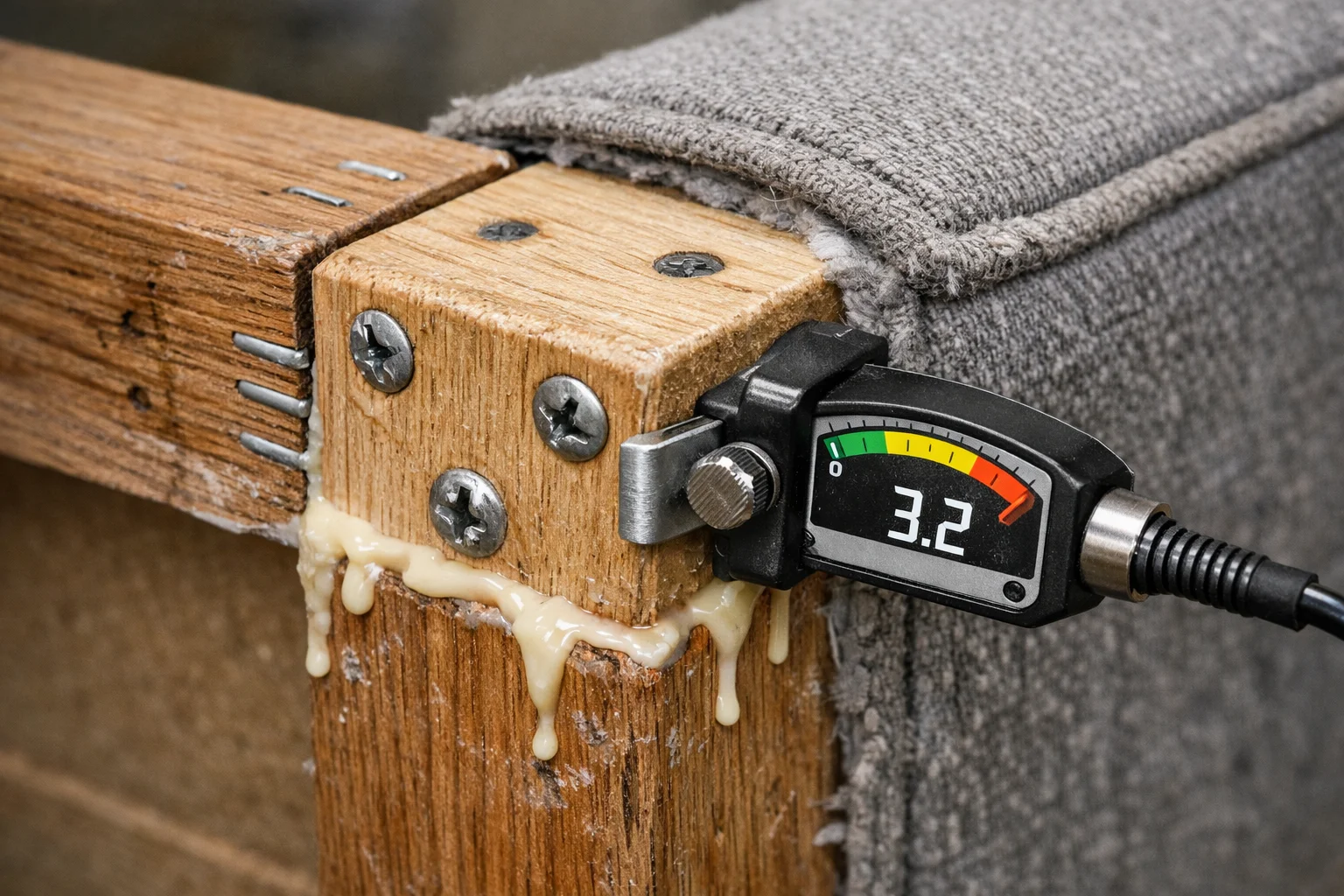
Frame Quality Evaluation: Judging the Skeleton
How to inspect a sofa frame without opening it. The lift test, the squeeze test, and understanding why center legs and joinery matter.
Analyze Details →