Storage Capacity: The Point-Load Limit
Introduction
When you buy a storage sofa, the hidden tradeoff is that the seat is no longer a solid platform, it is basically a big lid. In plain terms, that lid can be totally fine for normal sitting because your weight is spread out across a wider area.
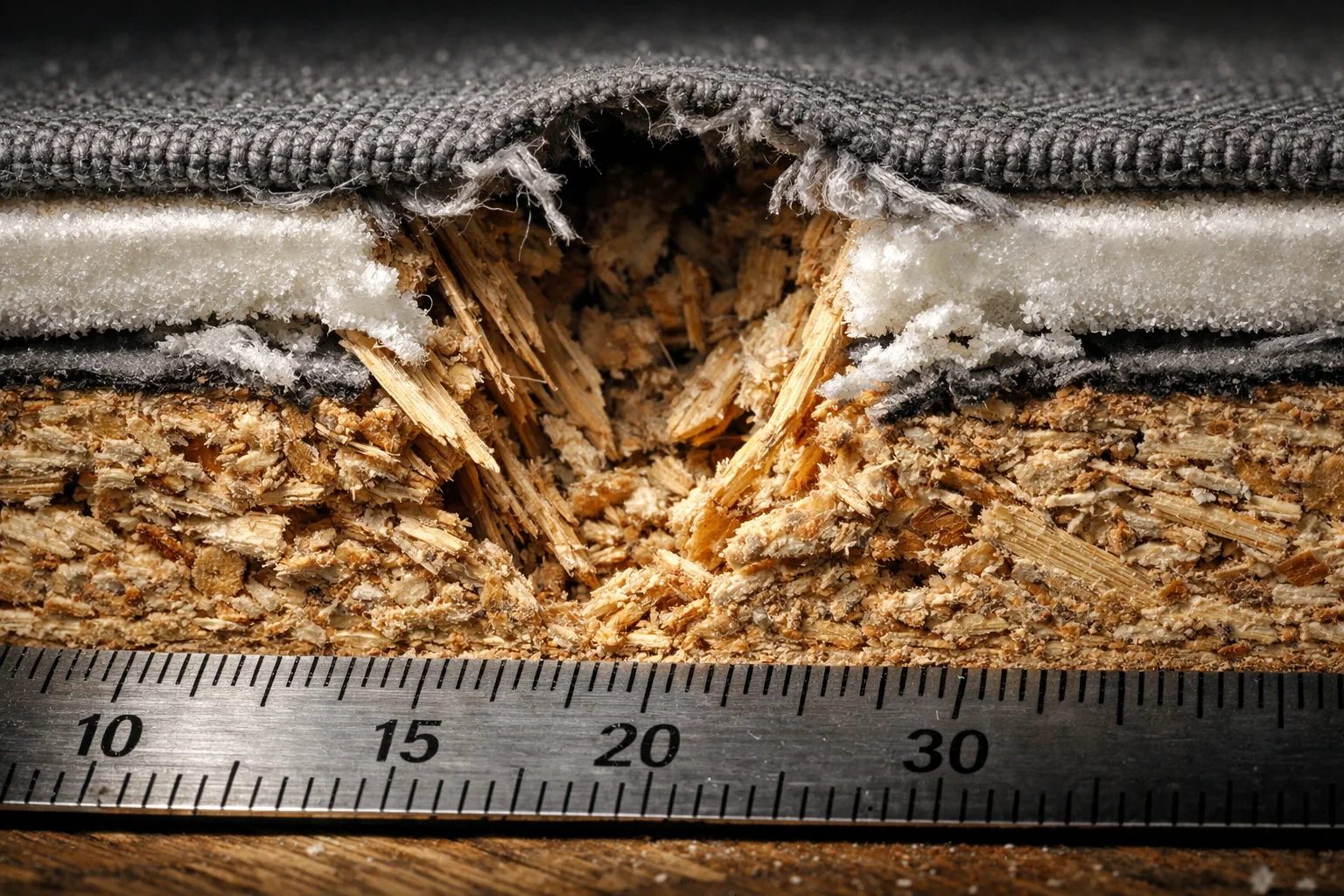
Where these fail, and I have seen it happen fast, is when someone steps on the lid, kneels on one spot to reach a shelf, or plants a knee while turning around. That kind of concentrated pressure is what snaps slats, cracks hinge mounts, or pulls fasteners out of particleboard, and once it starts, the lid rarely feels “right” again.
So my baseline rule when you are shopping is this, treat storage seating like you would treat a piano bench with a hinged top. Sit on it, sure, but do not ever assume it is safe to climb on. If you know your household has kids who hop on furniture, or adults who use the sofa as a step stool, you should either avoid storage lids entirely or commit to training everyone that the lid is a no step zone.
In the showroom, I want you to do one simple reality check before you fall in love with the fabric. Open the storage compartment and look at how the lid is built and where it is supported, because that tells you what will happen at home. If you see a big open span with thin panels and support only at the edges, you are looking at something that will tolerate sitting but will not tolerate a knee in the middle.
Then close it and sit down the way you actually sit, not the polite showroom sit. Shift your weight side to side and feel for flexing, creaking, or a hollow drumlike bounce. A little give is normal, but if the lid feels springy or you can feel it “bridge” across the opening, that is your warning that a single bad step could turn into the kind of break that is sudden, loud, and expensive.
The "Heel Punch" Physics
When you sit on a sofa, even if you are not being gentle, your weight is spread across a big patch of cushion. A 180 pound person sitting normally is putting roughly 0.9 PSI into the seat because that load is distributed over something like 200 square inches.When you stand on a sofa to change a bulb, reach a vent, or hang a picture, that same 180 pounds can land on one heel. A heel is closer to 4 square inches, which turns that pressure into about 45 PSI. In plain English, you can take a lid that felt totally fine for years of sitting and hit it with about a 5,000 percent jump in pressure in one careless step.
This is why storage lids fail in a way that feels unfair. Most thin particle board lids around 12mm do not bend gracefully at that kind of point load, they can shatter and punch through. If it punches through, your foot drops into the cavity and you go down with it, which is how people get cut up on broken panel edges or tweak an ankle, even when the sofa looked “sturdy” the day before.
If you take one practical thing from that, it is this: I never judge a storage sofa only by how it feels to sit on, I judge it by whether it can survive a single knee or heel in the wrong spot, because that is the real life accident that happens.
In the showroom, I want you to look under the lid and answer one question for yourself, what actually stops that lid from dropping if a load hits the middle. If the only “structure” you see is a big flat panel spanning open air, I treat it as sit only, never step, and I assume a kid’s jump or an adult’s heel could be the end of it.
If you see real help under there, like closely spaced slats, a metal frame, or a center support rail that breaks the span into smaller sections, that is a meaningful upgrade. I am still not telling you to stand on it, I am telling you it is less likely to catastrophically fail when somebody does something dumb once.
Then I check the edges where the lid is attached, because the hinge area is where a lot of these give up. If the hinges are screwed into crumbly particle board with tiny screws and no metal bracket or backing plate, I assume those fasteners will wallow out over time, and one “heel punch” moment will turn into a loose, crooked lid forever.
Finally, I do a quick “knee test” with my hands instead of my body. With the lid closed, I press down hard with the heel of my palm near the center and near the front edge, and I listen for cracking sounds and feel for a sudden drop or a crunchy give. If it feels solid under my hands, that is not a guarantee, but if it feels sketchy under my hands, I do not need to risk my knee to learn the lesson.
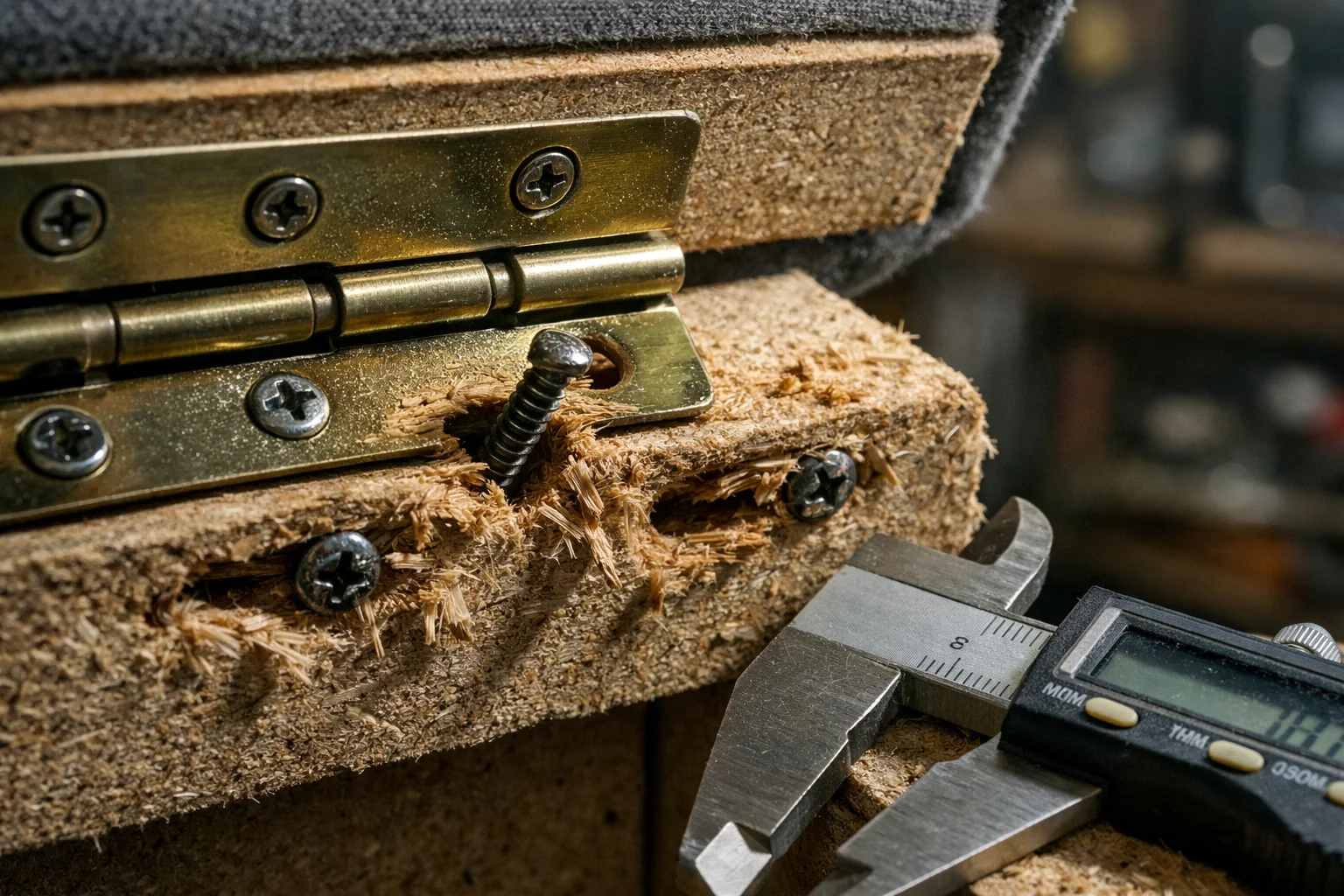
That photo is the exact failure I am trying to help you avoid, because it is not the lid panel that gives up first, it is often the connection points. When a lid gets hit with a sudden load, the hinge side takes a violent tug, and the screws act like little chisels that can chew their way through soft wood or particleboard.
In a showroom, I open the lid and stare at the hinge screws like I am buying a used car. If I see tiny screws, especially if they are short and skinny, driven straight into particleboard with no metal plate, no bracket, and no thick hardwood block behind them, I assume those holes will slowly get larger every time the lid is opened, closed, or flexed.
You can spot early warning signs even on a new floor model. I look for screw heads that are already sitting at an angle, screws that are not fully seated, hinge leaves that do not sit flat, or a hinge area that looks crushed like the surface is dimpled around the screws.
Then I do a simple feel test that does not require tools. With the lid open, I gently lift the lid up and down a half inch while watching the hinge side, and I am looking for the hinge to shift relative to the wood, not just the lid to move on the hinge.
If you can see the hinge plate wiggle on the substrate, that is the beginning of those ovaled holes in the photo. That is the moment where I either walk away, or I treat the sofa as a short term purchase and price it accordingly, because once the holes wall out, the lid starts to sit crooked, rub, squeak, and eventually slam.
If you want a storage sofa that will hold up better, I look for hinges that are through bolted with nuts and washers, or at least mounted into a substantial hardwood rail or a proper metal frame. Even if the lid panel is only average, good anchoring buys you time because the fasteners are not relying on crumbly material to resist repeated shock loads.
Before you commit, close the lid and check the alignment. If the gaps around the lid are already uneven, or the lid does not sit flush without you pushing it into place, I take that as a sign the hinge geometry is already fighting the build, and those screws are going to be asked to do more work than they should.
Weight Limits by Component
The tricky part about weight limits on storage seating is that the weak link is rarely “the whole sofa.” It is usually one component that is doing a job it was not built to do, and the lid is the most common one.
The Lid (The Sitting Surface)
When a brand says something like “250 pounds per seat,” what they usually mean in real life is a calm, normal sit where your weight is spread out through the cushion and into the lid frame. I treat that as a distributed weight number, not a promise that the lid can take anything you throw at it.
What they do not like to say out loud is that the dynamic limit is basically unforgiving. If you drop onto the seat from standing, or you flop down hard onto one corner, the impact load spikes fast, and that spike tends to go straight into the hinge screws and the hinge side rail.
In the showroom, I want you to sit down once like you mean it, not dangerously, just honestly. If you feel a sharp flex and then a little settle, or you hear a crack or pop, I take that seriously even if the fabric looks perfect, because the internal wood frame of the lid can snap while everything on the outside still looks brand new.
A real crack sound is different from harmless creaking. Creaking is usually rubbing, crack is usually wood fibers letting go, and once that happens the lid can keep working for a while but it will never feel quite square again, and it often starts to sag or twist so the lid no longer closes cleanly.
If you want one practical move that saves you from a bad surprise, do this after you sit. Open the lid and look along the hinge side and the front edge, then close it and watch the seam line. If the gap suddenly looks less even than it did a minute ago, or the lid now needs a little shove to sit flush, I assume something shifted inside and I do not talk myself out of that red flag.
I also ask the salesperson where the 250 per seat number actually comes from, because sometimes it is a real spec and sometimes it is just a generic answer. If they cannot point you to a written capacity statement in the product sheet or manual, I treat the limit as marketing, and I shop the build, not the claim.
The Floor (The Storage Panel)
The floor of the storage box is the weakest part of the entire sofa, and it is the part most people never think about until it starts scraping the ground. I treat it like the cardboard bottom of a cheap dresser drawer, it is there to close off the space, not to carry real weight.
In a lot of storage sofas it is basically a very thin hardboard sheet, around 3mm, held up with staples and hope. That construction can be totally fine for light stuff spread out, but it does not like a heavy pile sitting in the middle.
What you need to know as a buyer is that the real limit is surprisingly low, often in the ballpark of 30 to 50 pounds total in the compartment. That is not a hard rule across all sofas, it is a reality check for how these are commonly built.
In the showroom, I open the storage and look down at the bottom panel edges where it meets the side walls. If I see a thin brown board that looks like the back of a cheap bookcase, and it is just stapled along the perimeter with no center support rail or thicker plywood, I assume that panel will eventually belly out if you use the storage like a trunk.
I also press down on the center of the floor panel with my hand, not to break it, just to feel whether it is already flexy. If it bows with light hand pressure, it is going to bow a lot more with real items, especially if you tend to toss things in the middle.
The failure mode is simple and annoying. People store heavy things like dumbbells, stacks of magazines, bulk pet food, or anything dense, and the panel gradually sags until it touches the floor underneath the sofa.
Once it touches, the sofa stops being a piece of furniture that sits on its feet and becomes a piece of furniture that drags. That is when you get friction that can chew up carpet, snag rug fibers, or scratch wood and laminate when you slide the sofa to clean.
If you want a quick sanity check before you buy, crouch and look at the clearance under the sofa, especially under the storage cavity area. If there is not much air gap to begin with, even a small amount of sag can turn into contact with the floor, and then you are living with a problem you cannot see until the damage is done.
If you already know you want to actually use the storage, not just hide a throw blanket, I ask you to look for any sign that the bottom panel is supported in the middle. A center rail, thicker panel material, or a base that is framed like a shallow box instead of a single sheet makes a big difference, because it shortens the span that can bow.
At home, my rule is to store light, bulky stuff in these compartments and keep the dense items elsewhere. If you have to store heavier things, I spread them out to the edges near the side walls instead of stacking them in a neat tower in the center, because the center is where that panel is most likely to belly out first.
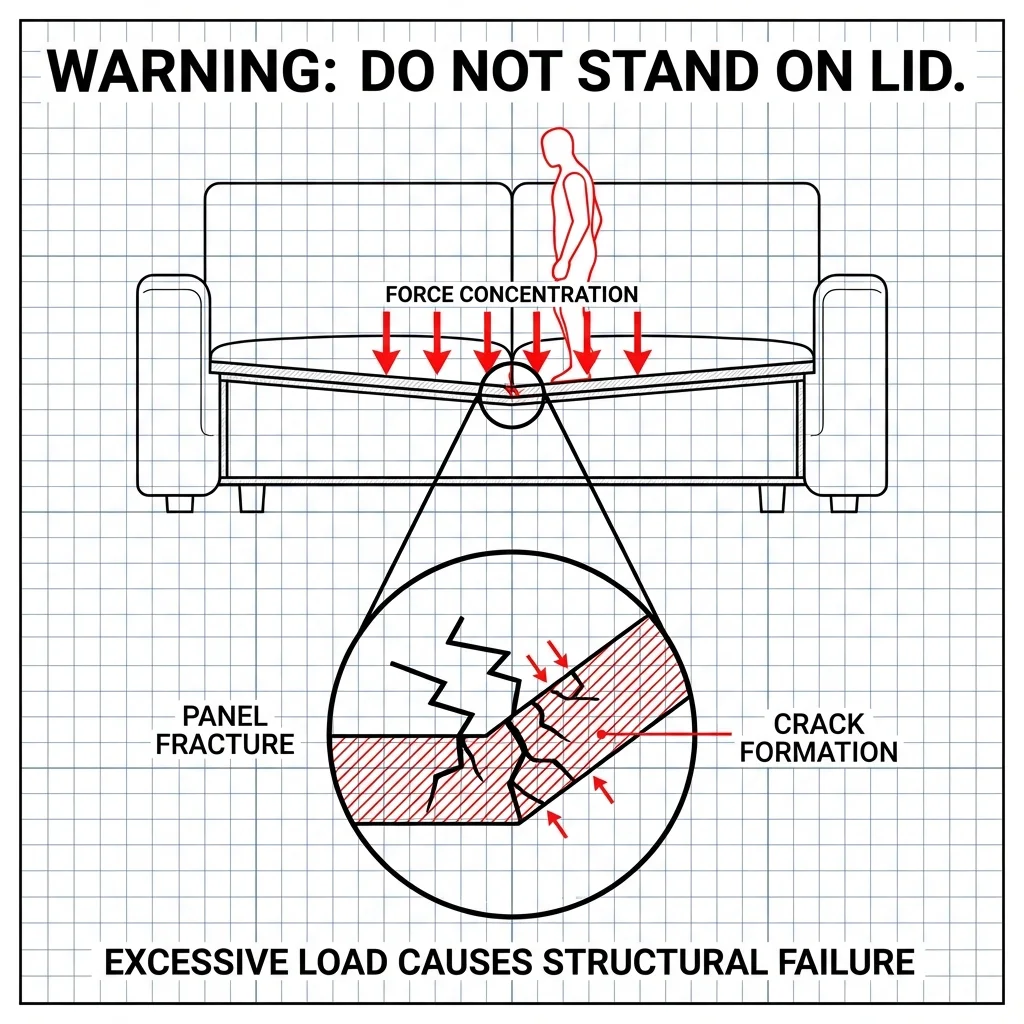
When you look at that diagram, I want you to picture the worst real life moment, not the normal one. The worst moment is a heel, a knee, or a kid landing in the dead center of the lid, where there is the most open air under the panel and the least help from the frame.
In the showroom, I translate this into one simple check: I open the storage and I visually map where the lid is actually supported. If the only solid support is at the perimeter, then the middle is basically a bridge span, and I assume any point load in that area is asking the panel to do something it was not built to do.
Then I close the lid and do a “center span” press test with my hands, because my hands can tell me a lot without risking damage or embarrassment. I press straight down in the middle with the heel of my palm, then I press again a few inches forward toward the front edge, because people tend to step and kneel near the front when they are getting in and out of the compartment. If the lid suddenly dips, feels crunchy, or makes a sharp tick sound, I treat it as a no.
What I am watching for is not just flex, it is how the flex behaves. A sturdy lid feels like a firm platform with a little cushion give on top, while a weak lid feels like it is hinging downward into empty space, which is the exact setup that leads to cracking and screw pull out later.
If you want a quick way to spot a safer design without knowing construction terms, look for anything that breaks up the open span. When I see a center support running left to right, closely spaced slats, or a metal subframe under the lid, I relax a little because the lid is not being asked to carry the whole load by itself across one big gap.
If you are shopping with kids, this diagram is also why I ask you to be brutally honest about how your house works. If you already know someone will stand on it at least once, you either need a storage sofa that has obvious mid span support, or you need to skip the lid style entirely, because a thin panel can be fine for years and still fail instantly in one bad landing.
When a salesperson says “it can hold weight,” I do not argue, I just bring the conversation back to where the weight lands. I ask whether the published capacity refers to sitting only, and whether the brand specifically warns against standing or kneeling on the lid. If they cannot answer, I assume the safe use case is sitting only, and I buy based on how much support I can actually see when that lid is open.
Safety Check: The "Spring Back"
If you want one quick check that tells you whether a storage lid is already on its way to failure, I do what I call the spring back test. I remove the seat cushion so I am not fooled by soft foam, then I press firmly with my palm right in the center of the lid, straight down, and I let go.What I want is a dead, confident feel, where the panel resists and returns without drama. If it feels spongy in a weird way, like the panel is flexing more than it should and not snapping back cleanly, or if I hear a creak that seems to come from inside the lid instead of from fabric rubbing, I treat that as a warning that the wood fibers have already started to fracture or the internal joints are already moving.
I am careful with how I interpret sound here. A little squeak from upholstery is normal, but a creak that repeats in the same spot every time I press, especially if it is paired with that soft, springy drop, tells me the lid is acting like a tired plank. In a showroom, that is enough for me to either pick a different model or at least stop believing any “sturdy” talk, because this is the exact feeling that turns into a sudden crack later when somebody kneels or steps in the wrong place.
If you already own the sofa and you are noticing this springy feel at home, the practical reinforcement I have seen work is adding a wooden rib under the lid. The simple version is gluing and screwing a two inch wide wooden batten to the underside of the lid so the span is stiffer, and the lid is less likely to bow into the empty opening.
This is not a magic fix if the hinge mounts are already tearing out or the panel is already split, but it can buy you real stiffness if the lid is just too flexible for how your household uses it. If you are shopping, I use this as a decision filter, because I would rather pay for a lid that already has that kind of support built in than plan a reinforcement project after the fact.
Storage Sofa Loading Limits (Typical)
I keep a rough set of “typical safe use” limits in my head when I shop storage sofas, because it helps me translate vague showroom talk into real behavior. These are not universal engineering numbers, they are the kind of common sense boundaries that match how these lids and thin bottom panels are usually built.
For normal sitting with your weight spread out, I treat about 250 pounds as the kind of load many storage seats can handle without drama, as long as the lid feels firm and the hinge side is well anchored. In the showroom, that is the scenario where I sit normally, shift around a bit, and check that the lid does not feel like it is bridging over a hollow opening.
Where I get strict is kneeling. Even though kneeling feels gentle, it concentrates your weight into a smaller patch, and I treat around 50 pounds on one knee as the point where a lot of lids start to deflect in the middle, especially if the support is only around the edges. If you know you are the kind of person who kneels to dig through storage, I want you to choose a model with visible mid span support, or accept that you need to keep a hand on the frame and avoid planting a knee on the center of the lid.
Standing on the lid is the one I consider a hard no, effectively zero pounds, because the failure mode is not “it gets a little saggy,” it is punch through. In a showroom, I never test this with my body, I just assume that if the design is a big flat panel over open air, a heel can end it in one bad moment, even if the sofa feels perfectly sturdy for sitting.
Inside the compartment, I separate soft bulky storage from dense storage. If you are storing soft things like blankets, pillows, or extra throws, I am comfortable with something like 50 pounds total because those loads spread out and do not create a single sag point. If you are storing dense things like books, tool kits, free weights, or bulk pet supplies, I get conservative fast, closer to 20 pounds total, because dense items tend to sit in a compact pile and that is how the thin floor panel starts to belly down.
In the showroom, I want you to look at the storage floor and ask yourself whether it looks like it was meant to carry weight, or just close off the cavity. If it looks like thin hardboard stapled around the edges, I would rather you treat the compartment as “linen closet storage,” not “garage shelf storage,” no matter what the salesperson says.
The lid lift force matters too, and this is one people overlook until it pinches fingers or starts ripping hardware out. If the lid feels heavy, or it takes a real tug to start it moving, I assume the hinges and mounting points are being stressed every single time you open it, and I treat about 40 pounds of lift effort as the upper end of what I want to deal with. In practice, I open the lid with one hand and watch the hinge mounts, and if I can feel the hinge side binding or see the hardware flexing the wood, I walk away because that is how hinge screws shear or wallow out over time.
If you take one actionable takeaway from these “typical” limits, it is this: I buy storage sofas assuming sitting is fine, kneeling is risky, standing is forbidden, soft storage is fine, and dense storage is a trap. Then I choose the build quality that matches the reality of how you will live with it, not how it looks under perfect use.
Explore Technical Reference
Foldable Floor Sofas: The Physics of Frameless Seating
How floor sofas, foam blocks, and origami-style seating work. Understanding the trade-offs of purely foam-based seating without traditional frame construction.
Analyze Details →
Pull-Out vs. Fold-Down: The Physics of Sleep
Choosing your compromise. The 'Bar in the Back' torture of pull-outs
Analyze Details →