Sectional Problems: The Large-Format Failure

Introduction
When I say sectionals have a “complexity tax,” I mean you are buying more opportunities for a normal living room habit to turn into a real annoyance. A regular sofa is basically one box you sit on. A sectional is several boxes that have to stay aligned, stay level, and stay tight at the seams while you and your family constantly push, drag, flop down, and sprawl across it.
None of that automatically makes a sectional “bad,” but it changes what you should look for in a showroom. I have learned the hard way that most long term problems with sectionals are not dramatic breakages, they are slow creep problems. The corner starts to gap, one piece sits a little higher, the chaise drifts away from the main seat, or you feel a ridge where two cushions meet and you keep shifting to avoid it.
The core idea is large format furniture engineering. Once a sofa gets split into multiple connected frames, the connectors become part of the structure, not just a convenience. If the connection hardware is flimsy, if the pieces rely on the floor to “self align,” or if the frames flex differently, you can end up with a sectional that feels fine for five minutes and irritating for five years.
So in this guide I am not going to tell you to obsess over brand names or buzzwords. I am going to focus on what you can physically check in person, with your hands and your weight, before you pay for a huge set of parts that has to behave like one piece of furniture. If you take nothing else from this intro, take this: when you test a sectional, you are not only judging comfort, you are stress testing the joints between modules and the way the whole system holds its shape.
The Dye-Lot "Ghost"
If you buy an L shaped sectional and tell yourself you will add an armless chair module later, this is the trap I see people fall into all the time. Six months later you finally order the add on piece, it arrives, and you swear the color is off even though the label says it is the same fabric.What is happening is not your imagination, it is dye lot variation. Upholstery fabric gets dyed in huge batches, and even with modern controls a batch made on Monday can come out slightly different than a batch made on Friday because little things like temperature and chemistry drift. Those tiny shifts usually look like a subtle warmth or coolness difference indoors, then a shaft of daylight hits it and suddenly the mismatch is all you can see.
So my practical rule is simple. If you think you might want that extra module, buy the whole configuration in one order so all the pieces get cut from the same bolt of fabric from the same dye lot. In a showroom, I also ask the salesperson, in plain language, what happens if I add pieces later and the color does not match, and I make them show me the policy in writing on the invoice or order form.
If you truly cannot buy it all at once, I try to stack the deck in my favor. I avoid fabrics where small dye shifts are obvious, like flat, solid colors in smooth weaves, and I lean toward heathered, speckled, or textured fabrics where the eye has more visual noise to hide a slight change. I also ask for a large swatch from the exact fabric I am ordering, then when the new piece arrives I compare it in natural light before the delivery crew leaves, because once it is in your house and accepted, getting a fix can turn into a long argument.
The last thing I watch out for is “same name, new version.” A fabric called Charcoal today might be a slightly different run, or even a different mill, a year from now, and the store will still call it Charcoal. If you are planning phased purchases, I ask them to write down the internal fabric code, not just the marketing name, and I keep that paperwork like it is part of the sofa.
Common Operational Failures
The operational failures I see most often are not “the couch snapped in half” events, they are small mechanical annoyances that build up into a sectional that constantly needs babysitting. In a showroom you can catch a lot of these by doing a few slightly awkward tests on purpose, because the problems show up when the pieces are loaded unevenly, twisted, or nudged out of perfect alignment.
The first failure is module drift, where the chaise or corner slowly walks away from the main section and you keep shoving it back. I test for this by standing beside the sectional and giving one module a firm sideways shove with my hip, not a violent kick, just the kind of push a real living room produces when someone flops down or a kid climbs over the arm.
If the module slides easily on the floor, I assume it will slide in your home too unless your rug and pad create a lot of friction. I ask the salesperson what the store expects you to rely on for stability, meaning interlocking hardware, legs that “key” into position, a continuous base, or simply gravity and a rug.
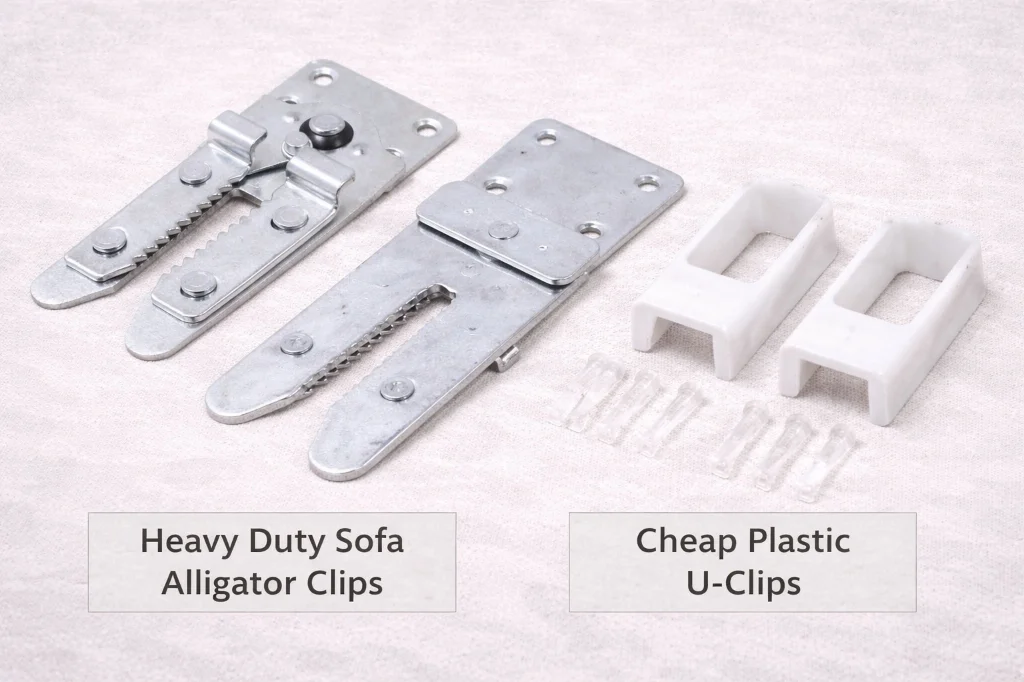
The second failure is connector looseness, where the pieces technically latch but still move against each other under load, creating a gap at the seam and a little clunk feeling when you shift your weight. I check this by locking the modules together, then sitting right on the seam and rocking my weight left and right while watching the joint.
If I can see the seam opening and closing, or if I can feel the modules rubbing each other, I treat it like a warning sign. In my experience that motion does not get better with time, it gets worse as the hardware and the wood around it get worked.
The third failure is a height mismatch that makes you feel like you are sitting on a shallow step. This one can be subtle in a showroom because the floor is flat and the pieces are new, but it shows up in real rooms with slightly uneven floors and a lot of use.
I put my hand flat across the seam and press down on each side, then I sit half on one module and half on the other and notice whether my hips tilt. If one piece feels higher now, I assume it will feel even more uneven later, because the softer module will compress faster and exaggerate the difference.
The fourth failure is seam ridge discomfort, where the cushions meet in a way that creates a hard line you keep avoiding. You can miss this if you only sit centered on a cushion, so I deliberately sit where a real person would, near the corner, right at the junction between two seats, and on the inside edge of a chaise.
If you feel a ridge now, it will not magically disappear at home. I ask whether the cushions are one continuous bench on that section or separate cushions, and if they are separate I look for whether the covers and foam shapes are doing any real work to hide the joint, or if it is just two blunt edges pushed together.
The fifth failure is frame racking, which is the fancy way of saying the module twists instead of staying square. This is what makes some sectionals feel fine when you sit gently, then weird and loose when you drop into them at an angle.
I test for racking by putting one hand on the arm or back, then sitting down hard on the front corner of the same module, like the way you would when you are putting on shoes. If the whole module flexes diagonally and the connected seam shifts, I know the frame and connectors are not acting like one rigid unit.
The sixth failure is leg and leveler problems, especially on modular pieces with lots of small legs or hidden supports. One slightly short leg can create a constant rocking motion that you will only notice after you live with it, because it shows up when the piece is loaded and the padding compresses.
In the showroom I press down on the front corners and the middle front edge of each module and see if anything teeters. If it rocks, I ask whether the legs have levelers, and I look underneath to see if those levelers are accessible without flipping the piece upside down, because you are the one who will be stuck fixing it.
The seventh failure is “floating back” wobble, where the back cushions and the back frame do not support each other well, so the whole back feels like it is flexing away when you lean. This is common on deep sectionals that encourage lounging, because people put a lot of leverage on the back when they sprawl.
I lean back firmly and then shift side to side without getting up. If the back feels like it is hinging, or if I hear any creak right at the connection between the back and the seat frame, I treat it as a durability clue, not just a noise.
Reclining sectionals and sleeper sectionals add their own failure modes, mostly because you are stacking mechanisms on top of modular connections. If a store floor model has a recliner module, I open and close it repeatedly and pay attention to whether the neighboring modules jiggle or separate when the footrest moves.
If one mechanism action makes the whole sectional react, that tells me the modules are not staying isolated the way they should. I also check that the recliner has clearance from the next piece, because tight clearances can turn into fabric scuffing at the seams.
When I find any of these issues in a showroom, I do not let a salesperson wave it away as “just because it’s the floor model.” Floor models do get abused, but a solid design usually still feels mechanically confident.
What I ask instead is simple and specific. I ask what exactly keeps the modules aligned over time, what the connectors are made of, and whether replacement connectors or legs are available if something loosens. If the only answer is “it’s fine” or “most people put it on a rug,” I assume you will be the one pushing your sectional back together for the next several years.
1. The “Apartment Trap” (Dimensions)
A sectional can be wider than a standard sofa in a way that does not look scary on a spec sheet, because the corner module is basically a big square box with upholstery on it. The trap is that you can measure your wall space perfectly, buy the “apartment sized” configuration, and still fail at the front door.
The most common failure I see is a three piece layout that includes an L shaped corner with a rigid 45 inch by 45 inch frame. If that piece does not come apart and the back is not removable, you can end up with a module that simply cannot make the turns that real buildings require.
The physics is not subtle. A typical apartment door is about 34 inches wide, and hallways, elevator doors, and stair landings are usually tighter than you remember. A rigid corner unit that is wider than the narrowest pinch point is not “hard to move,” it is impossible to move, no matter how many delivery people show up.
In a showroom, I do not rely on the tag that says “small space” or “condo.” I ask the salesperson to show me, right there, whether the backs come off. If they say it does, I ask how it comes off, because there is a big difference between a back that is designed to remove with bolts or latches and a back that is technically removable only if you partially dismantle upholstery.
What I look for is language like “removable back” or “KD,” meaning knock down. Then I confirm what that actually applies to, because sometimes only the straight pieces are KD and the corner is still one rigid block. If the corner is not KD, I treat that as the piece that will decide whether the sectional lives in your home or lives in a warehouse while you fight about restocking fees.
Before you order, I measure the narrowest hard constraint from the street to the room, not just your front door. That means the building entry door, the elevator door, the elevator depth, the hallway turn into your unit, and any stairwell turns if the elevator is off limits. Then I compare those measurements to the biggest single rigid piece in the configuration, which is usually the corner, sometimes a chaise with a tall fixed back.
If you want to be extra sure, I do one low tech test that has saved me from mistakes. I use painter’s tape at home to mark a rectangle on the floor that matches the corner module’s footprint, then I walk that “box” through the route in my head, focusing on turns, not straight lines. The problem is rarely the width of a doorway in isolation, it is the turn into it.
I also ask who is responsible if it does not fit, and I get the answer in writing on the invoice. If the store says the delivery team will evaluate the path, I ask whether they do that before the truck is loaded, or only when they arrive, because those are very different outcomes when the corner piece gets stuck in the lobby.
If you are buying for a high rise, I personally consider removable backs and true KD frames a requirement, not a nice bonus. Comfort does not matter if the corner cannot physically enter the room, and this is one of the few sectional problems you can completely prevent by checking the right thing before you pay.
2. Uneven Suspension Fatigue
A sectional almost never gets used evenly, and that uneven use is what quietly wrecks the “one big comfy lounge” feeling people think they are buying. In most homes there is a “TV seat,” usually an end seat or the chaise spot closest to the arm, and that one position gets hammered day after day while the middle transition seat stays oddly fresh.
What that means in real life is not that the fabric suddenly tears, it is that the support under you starts to feel different depending on where you sit. The favorite seat gets softer and lower, the rarely used seat stays taller and firmer, and the whole sectional starts to feel like it leans toward the most used end.
The sensation you notice first is what I call the step down. When you lie across the sectional or slide over a seam, your body crosses from the broken in seat into the newer seat and you feel a little drop, like your hips fall into a shallow dip and then climb back up onto a firmer pad.
In a showroom, I try to predict this by looking for signs the design can tolerate uneven wear. I sit in the obvious TV seat first, then I sit in the seat right next to it, and I pay attention to whether I am being held up by the suspension under the cushion or whether I am mostly relying on thick foam to do all the work.
If it feels like a big soft pillow on top of a vague hammock, I assume that favorite spot is going to “pack down” faster and the step down will show up sooner. If it feels like there is a consistent springiness underneath, meaning the cushion is not doing everything by itself, I trust it more because the support is shared between the cushion and the base.
I also do a seam test that mimics real fatigue. I sit with one hip on one module and one hip on the next module, right on the junction, then I bounce my weight gently a few times and notice whether one side gives more than the other even when the sectional is brand new.
If one module already feels a touch softer or more flexible, I treat that like a preview of the future because the differences get amplified with use. It is especially common when the “end unit” and the “middle unit” are built differently under the same fabric and cushion style.
Then I get practical about maintenance, because this is one of those issues you can actually manage if you are honest about how you live. If the modules are truly interchangeable, I plan on rotating the most used unit with a less used unit about twice a year, the same basic idea as rotating tires, so the support compression gets shared instead of concentrated.
Before you buy, I would confirm that rotation is realistic, not theoretical. I look at whether the arms or chaise make the pieces non swappable, whether the connector locations only line up one way, and whether the legs and floor contact points are the same so you are not trading comfort for a wobble problem.
If the configuration includes a chaise, I assume the chaise seat will be the fatigue hotspot because people sprawl there and load it in weird ways. In that case I ask whether the chaise cushion is replaceable by itself, and whether the store can order that single cushion later, because sometimes the only “solution” they offer is replacing an entire upholstered unit, which is the expensive way to learn this lesson.
The main buying move here is simple. If you already know one spot is going to be used five times more than the others, you should only buy a sectional that either lets you rotate modules without drama, or feels supportive enough underneath that it will not turn into a lopsided lounge when real life hits it.
This picture is what I think of as the visual seam, the moment you realize two “matching” pieces do not read as one sofa because light hits them differently. It is not always a dye problem, sometimes the color is technically the same but the fabric surface is laying in opposite directions, so one piece looks lighter and the other looks darker from the same spot.
In a showroom, I check for this by standing at one end of the sectional and looking down the length of it, then walking to the other end and looking back. If the panels flip from light to dark when I move, I know the fabric has a nap or pile that is going to make direction matter.
Then I do the most practical test, I rub my hand across the seat and back in one direction, then in the opposite direction, and I watch whether it “writes” like suede. If it does, I assume any future add on module, any replaced cushion cover, or any repair panel has a real chance of showing up as a different shade just because it is cut or installed with the nap running the other way.
If you are ordering a sectional that comes in multiple boxes, I ask the salesperson to note on the order that the nap direction must be consistent across all modules, and that the pieces must come from the same production run if possible. Some stores will act like this is too fussy, but I have seen enough mismatched sectionals in daylight to know it is worth saying out loud before you sign.
When the delivery arrives, I would not wait a week to notice it. I stand where you will normally view the sectional, usually the doorway into the room and the main TV viewing spot, and I look at the seams in natural light before the crew leaves, because once it is set up and “accepted,” it can become your problem instead of theirs.
The “Creep” Effect
The "Creep" Effect
Sectionals on hardwood floors can create a slow, sneaky problem that I think of as creep. The sectional does not look like it is moving, but every time you sit down hard, shift your weight, or flop into the corner, the modules can slide a hair. Over months, that tiny movement acts like sandpaper on your floor finish, and it also makes the sectional start to live slightly out of square so you keep nudging it back into place.The problem is not a dramatic skid across the room, it is the repeated micro movement. If you have hardwood, or any floor with a finish you care about, I assume this is happening unless the sectional is truly locked together and truly planted.
The fix I trust is simple. I use non slip EVA rubber grippers under every leg and every support point that touches the floor. Felt pads are great when you want to move furniture without scratching, but they are the wrong tool when you want the furniture to stay put, because felt is designed to slide.
In a showroom, I test for creep in a way that feels a little silly but tells me a lot. I sit down firmly, then I stand up and look at the leg positions relative to a grout line, a floorboard seam, or any visual reference on the floor, because your eye can catch even a tiny shift when you have a reference.
If the store has the sectional on a rug, I still try to peek at how it behaves at the edge where rug meets floor. Rugs can hide the problem, and then you get it home and discover the legs are basically on little sleds.
I also look underneath, because sectionals often have more floor contact points than you think. Some have a hidden center leg or a mid span support that is doing a lot of the work, and if that one point is sitting on bare wood without grip, it can become the pivot that lets the whole module inch around.
When you shop, I would ask a blunt question that forces a real answer: what is this sectional supposed to use to resist sliding, the connector hardware between modules, the legs, or a rug? If the answer is basically “a rug,” then I treat rubber grippers as part of the real cost of owning it on hardwood.
At delivery, I do not let the crew place it and leave if I see bare legs on a finished floor. I either have the grippers ready, or I tell them to set it down gently in the right spot and wait while I put the rubber under every leg before anyone starts “scooting it just a little.” That is the moment a lot of floor damage happens, and it is also when a modular sectional starts its life slightly misaligned.
Sectional Problem Troubleshooting
The most common “something is off” complaint I hear is a visible gap between sections, even though the connectors are technically latched. In my experience that usually comes from hardware play, meaning the clips or brackets allow a little wiggle that turns into a real seam once people start using the sofa. In the showroom I lock the pieces together, then I grab one module and try to pull it straight back and push it forward, if I can make it click or shift without unlocking anything, I assume you will see gaps at home.If you already own it and you are staring at that gap, I start with the simplest fix: I re-seat and tighten the alligator style clips, because sometimes they are not fully engaged even when they look aligned. Then I deal with the floor, because a lot of gaps are really drift that keeps re-opening the seam, and rubber floor grippers under every leg often do more than people expect because the connector hardware cannot fight gravity and a slippery floor forever.
Color mismatch between pieces is the kind of problem that makes you feel crazy because it can come and go depending on time of day. If two modules look slightly different, I move the lighting variables before I panic, meaning I check the seam in daylight and at night, and I look at it from both ends of the room since directional fabric can flip light and dark. If it still bothers you, the most practical “don’t let it ruin the room” move is to intentionally break up the seam with a throw blanket draped across the junction, because it reads as styling instead of a mistake, and it keeps your eye from comparing the two panels directly.
A loud clunk when you sit down is almost never “normal settling” to me, it is usually a loose leg or a loose bracket transferring load with a snap. In a showroom I listen right at the front corners and at the seam between modules, because that is where loose hardware announces itself. If you already have the clunk at home, I would check the accessible bolts first, many frames use half inch hardware on the chassis, and tightening a slightly backed-out bolt can turn an annoying noise into a non-issue, but I only trust this fix if the clunk does not return a week later.
One seat sitting lower than the others is often localized bagging, meaning one cushion core has compressed faster than its neighbors, usually in the favorite seat. I confirm it by swapping where I sit for a day or two, because if the “dip” stays with the cushion rather than the frame, you have your answer. If the cushions have removable foam cores and the covers are the same shape, swapping foam between units can equalize wear and buy you time, and it also tells you whether you are dealing with cushion fatigue or a structural issue underneath.
If a chair section tips when you lean back, I treat it as a connector problem until proven otherwise. In the showroom I lean back hard on an end seat and watch the seam, because a module that is not fully locked will act like a lever and lift. At home the fix is usually not complicated, you re-engage the locking pins or latches and then you re-check that the modules are truly pulled tight together before locking, because a lot of connectors will “lock” while still sitting one notch short of fully seated.
The through line with all of these is that I do not accept “sectionals just do that” as an answer. When you test in a showroom, you are trying to catch whether the design stays quiet, tight, and level when you load it like a real person, because the little issues, gaps, clicks, and unevenness are the things that turn into daily irritation long before anything actually breaks.
Explore Technical Reference
The Daybed: Engineering the Hybrid
A technical breakdown of the daybed category. Why it uses standard twin mattresses and the engineering challenges of seating depth.
Analyze Details →
Foldable Floor Sofas: The Physics of Frameless Seating
How floor sofas, foam blocks, and origami-style seating work. Understanding the trade-offs of purely foam-based seating without traditional frame construction.
Analyze Details →