Recliner vs. Sofa: The Complexity Premium
Introduction
When choosing between a recliner and a standard sofa, you aren’t just choosing a vibe, you are choosing between a static structure and a dynamic machine. That difference changes what will wear out first, what will start squeaking, what will loosen up, and what will quietly chew up your floor.
I have learned the hard way that a sofa is mostly a fixed frame with cushions on top. A recliner adds moving joints, a locking mechanism, a handle or motor, and usually a footrest that works like a lever. In the showroom both can feel solid, but over time the dynamic parts are where you pay for every shortcut.
If you only take one practical idea into the store with you, take this: the more something moves, the more you need to verify it is built to keep moving without getting sloppy. That means you should treat a recliner less like a couch and more like a piece of equipment you are going to cycle thousands of times.
When you sit on a standard sofa, you are mostly testing comfort and basic sturdiness. When you sit on a recliner, you are also testing the mechanism under load, the stability of the base as your weight shifts, and how the chair behaves when you are not sitting perfectly centered. I always try to recreate the little real life abuses, like sitting down a bit off to one side, leaning hard on one arm, or pushing back into the recline with my heels.
You can also predict floor wear from this same static versus dynamic split. A normal sofa tends to stay planted, so floor damage is usually about leg pads and weight. A recliner tends to creep, twist, and concentrate force when the footrest hits the floor or when the base rocks during reclining, so you should assume you will need better floor protection and that the chair may slowly migrate unless the feet and glides are decent.
This guide is going to keep coming back to one question I now ask myself before I fall in love with any seat: what are the likely failure points, and can I see evidence that they are overbuilt instead of barely adequate. If you approach it that way, you can still buy the comfortable thing you want, but you are less likely to end up with a chair that feels great for six months and then turns into a noisy, wobbly regret.
Structural Continuity vs. Segmented Geometry
When I look at a normal sofa frame, what I am really paying for is continuity. The long rails and the unbroken deck act like one stiff platform, so when you sit down, the load spreads out and the suspension works together instead of fighting itself.
A recliner cannot do that, because it has to break the sitting surface into a foot section, a seat section, and a back section that all move relative to each other. That segmentation is the whole point of a recliner, but it also means there are literal transition lines under the upholstery where movement happens and where wear concentrates.
In a showroom, I test this by slowly sliding my body forward and back across the seat as if I am repositioning for a nap. On a unified sofa deck, that usually feels consistent. On a recliner, you can sometimes feel a hinge line or a subtle step where the geometry changes, and if you can feel it on day one, it rarely gets better after a year.
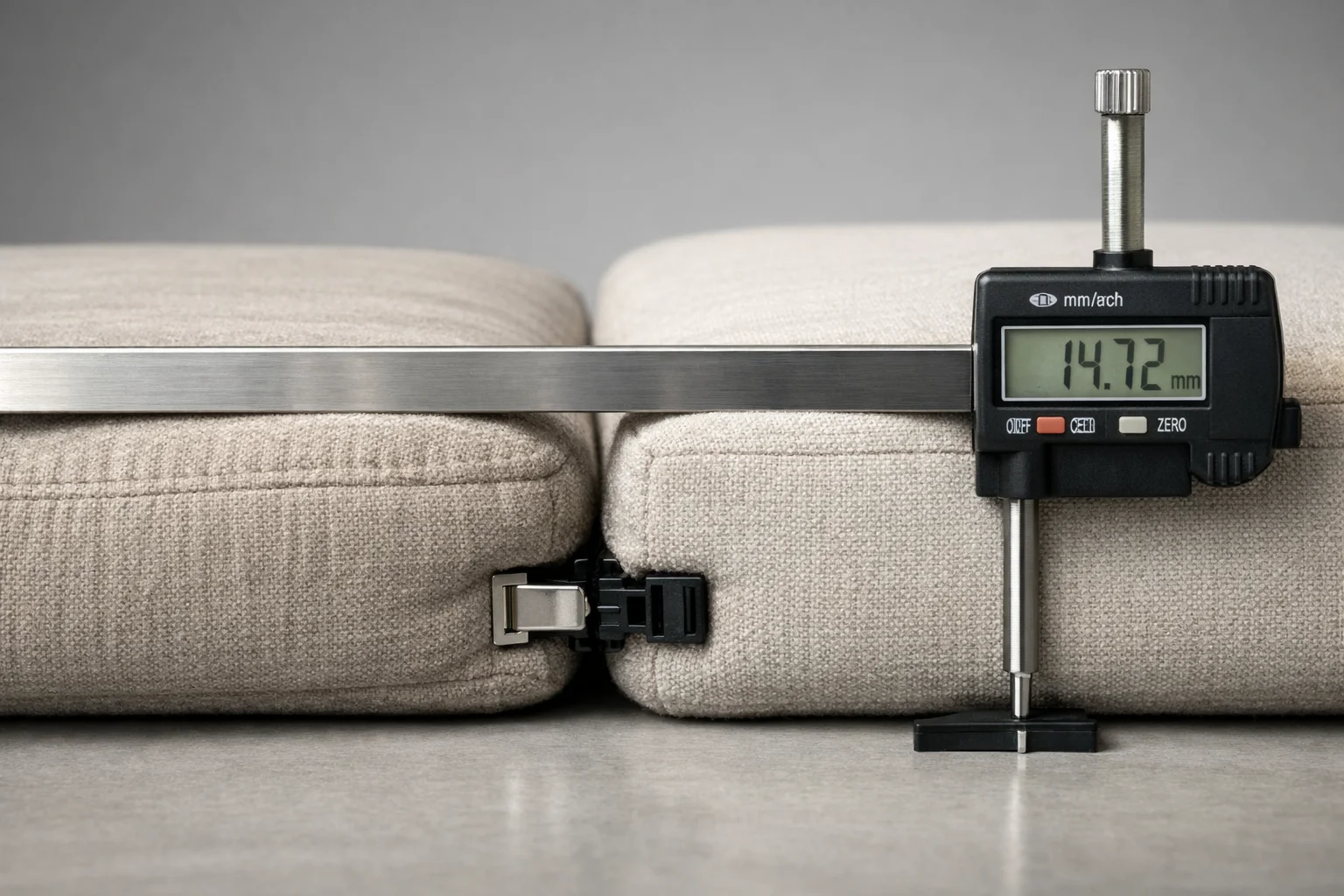
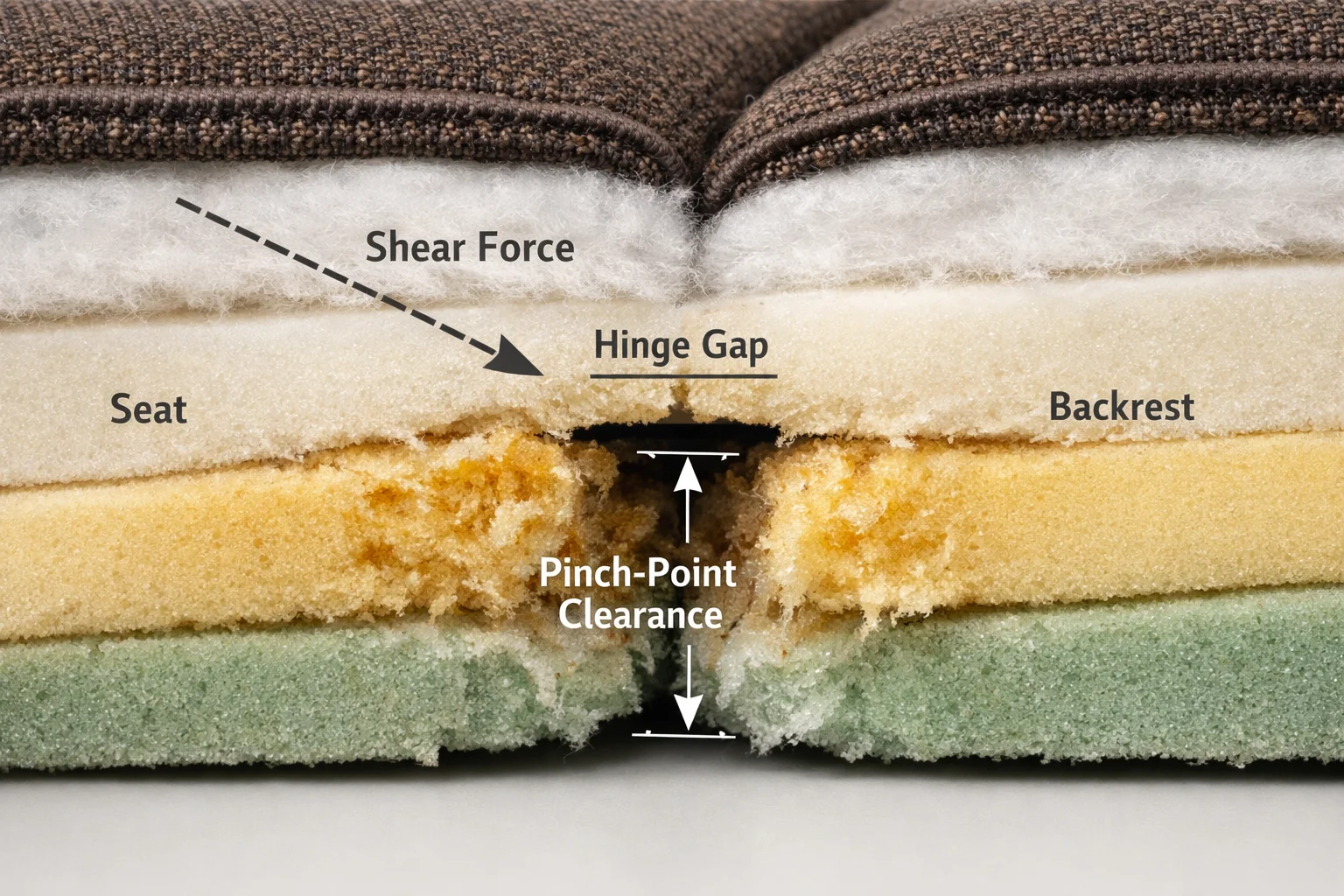
The first practical risk at those segment breaks is foam shearing, which is just the cushion layers being flexed and rubbed in one spot over and over until they start to split internally or develop a permanent ridge. I press down firmly right at the transition where the seat meets the back, then I press an inch forward and an inch back, because inconsistent resistance around that line is a clue the foam is already being asked to do too much bridging.
The second risk is mechanical interference, which is when the moving parts below start to touch, scrape, or pinch the materials above. I always recline it fully and then return it to upright slowly, with my hands feeling along the sides of the seat and down near the gaps, because the early warning signs are light rubbing noises, a momentary catch, or a spot where the upholstery gets tugged instead of gliding.
You can also learn a lot by checking whether the recliner still feels like one piece when you shift your weight off center. I sit with one hip closer to the arm, then I gently rock my shoulders, because a segmented deck will telegraph looseness fast. If you feel the seat pan twist independently of the back, or you hear a click when your weight moves diagonally, that is the geometry reminding you it is a machine.
This is where I decide what I actually want the furniture to be good at. If you want a broad, uninterrupted napping surface that stays even over time, the unified sofa structure is naturally advantaged. If you want ergonomic positioning, a recliner can be worth it, but I treat the segment breaks as the area that must feel overbuilt, quiet, and smooth before I even start thinking about fabric or color.
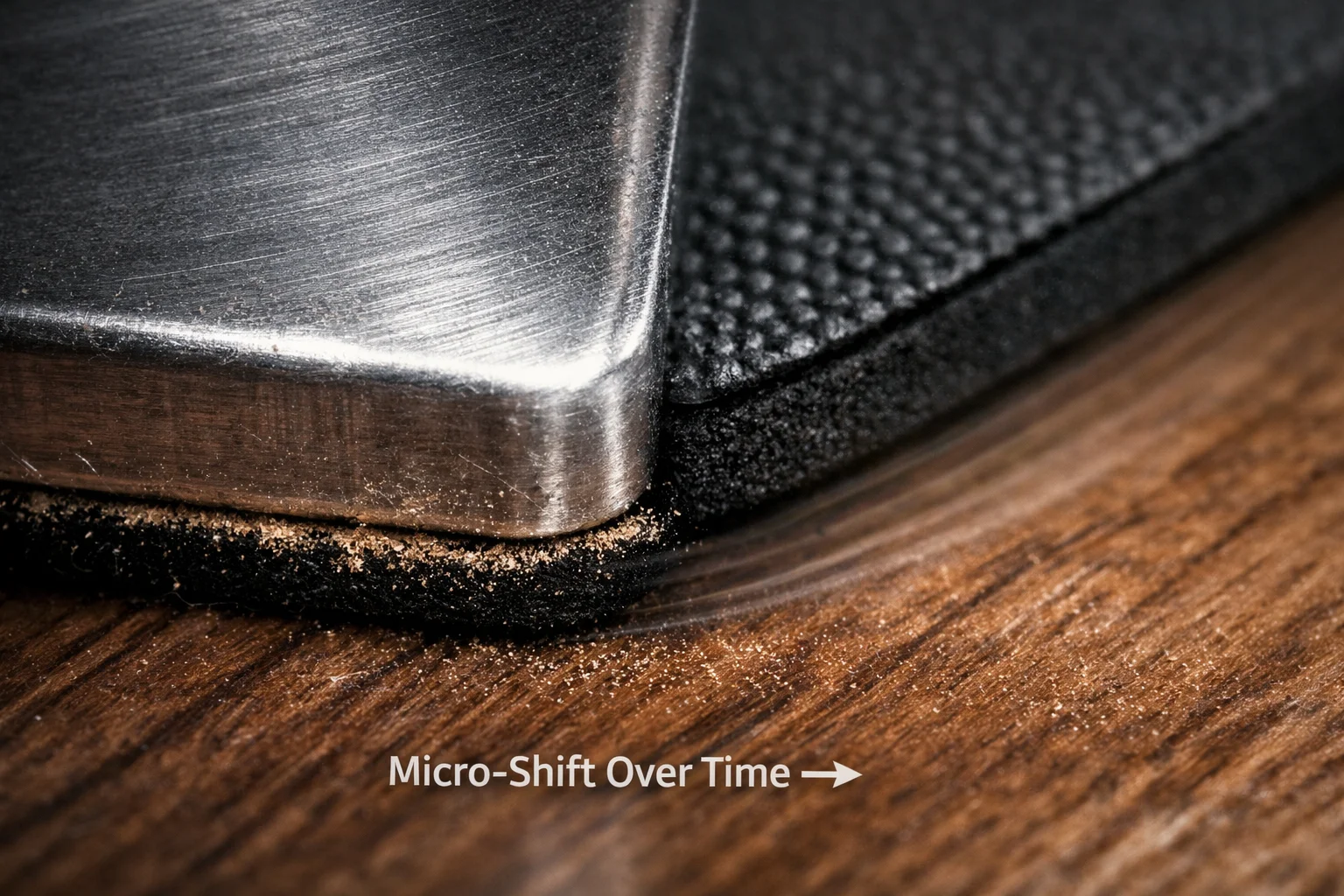
That little scuff in the photo is the kind of damage that surprises people, because it is not from dragging the chair across the room. It is from tiny movements that happen every time you recline, return upright, shift your weight, or push off the arm to stand up.
In a showroom I treat the floor contact points like part of the mechanism. I kneel down and actually look under the front and rear of the recliner, because sharp metal edges, thin stamped brackets, and small hard plastic glides are exactly what will act like sandpaper on hardwood over time.
You can do a quick reality check by reclining while watching the feet, or the base plate if it has one, and looking for any sideways creep or twisting. If you see the chair subtly walk, or if one corner lifts and recontacts the floor as you move, assume it will leave a trail on a real wood finish unless you isolate it.
I do not rely on the salesperson saying it is “floor safe.” I bring it back to what I can see and feel, which is whether the contact area is wide, flat, and padded, and whether the chair stays planted when the footrest hits its stop and when the back locks into position.
If you are buying a recliner for hardwood or a nice finish you care about, I plan for protection up front instead of waiting for the first scratch. A simple rubber pad under each contact point can help because it adds grip and acts like a sacrificial layer, and a thin, dense floor protector can be even better if the chair tends to shift.
The other thing I watch for is concentrated pressure at the front edge when the footrest is extended, because that is when the leverage is highest and the chair wants to dig in. If the front contact is a narrow metal edge or a tiny glide, that is a warning sign that you will be fighting both creeping and scuffing at home.
If you want a fast test you can do discreetly, place your hands on the arms and gently try to nudge the recliner sideways while it is upright, then again while it is partially reclined. If it slides easily on the showroom floor, it will definitely slide on your floor, and you should plan on rubber isolation or a proper protector as part of the purchase, not as an afterthought.
The Performance Metrics
When I say “performance” on seating, I mean what it feels like after thousands of sits, not what it feels like in the first five minutes. In a showroom, almost everything feels acceptable, because foam is fresh, joints are tight, and nothing has had time to loosen. What I do instead is look for a few simple behaviors that predict whether the seat will stay quiet, level, and supportive, or whether it will turn into a saggy, clicky nuisance.
The first metric I care about is whether the seat holds its shape under a shifting load. I sit down normally, then I scoot forward like I am about to stand, then I slide back like I am settling in for a long watch, and I pay attention to whether the seat height and firmness feel consistent. If it feels like I am falling into a pocket in one spot, or if the front edge collapses when I move forward, I assume the support system is already close to its limit.
On a standard sofa, that inconsistency usually points to the suspension and how it is attached to the frame. On a recliner, it often points to the seat pan and linkage taking the load in a more concentrated way. If you feel a soft spot on a recliner, especially near the inner edges by the mechanism, I treat that as a red flag because that area tends to get worse as clearances open up and the seat structure flexes more.
The second metric is stability when you load one side. Real people do not sit perfectly centered forever, so I test the sofa by sitting near one arm and then leaning my shoulder into the armrest like I am reading. What I want is a calm, damped feel, not a little see-saw motion where the frame reacts. If the arm area feels like it is moving independently, you are not just buying a weak arm, you are buying racking, and racking is what turns into squeaks, loose joints, and a sofa that feels older than it is.
With a recliner, I do the same off center test, but I also do it while partially reclined, because that is when the mechanism is most likely to show slop. I keep my hands lightly on both arms and shift my hips left and right. If I feel a click, a delayed settling, or a tiny lateral shift like something is taking up slack, I assume the tolerances are not great and the chair will get noisier over time.
The third metric is return behavior, which is my polite way of asking if the thing comes back to neutral cleanly. I recline slowly, then I return upright slowly, and I listen for any rubbing or ticking that repeats at the same point in the travel. A smooth, consistent motion is what I want, and any point where it catches and then releases is usually a sign that parts are flexing or misaligning under load.
I also watch what the cushions do when the chair cycles. On a good sofa, the seat cushion might compress, but it should not migrate. On a recliner, the upholstery and padding have to bridge moving sections, so I look for fabric that gets tugged, wrinkled, or pulled toward a gap every time I recline. If it is already trying to “walk” on day one, you are likely to see premature wrinkles, edge wear, or a stretched out look in the exact spots your eyes will always land.
Another metric I use is pressure distribution at the front edge, because that is where a lot of furniture quietly fails. I sit with my thighs supported and check whether the front edge feels like a comfortable ramp or like a hard bar. If you feel a sharp line of pressure under your legs, you are not just noticing comfort, you are noticing that the cushioning is thin or the edge support is harsh, and that area tends to get worse as foam packs down.
If you are heavier, or you know you tend to perch on the front edge, I would be extra picky here. I press down with my palm at the very front center, then near the front corners, and I compare how quickly it bottoms out. Big differences from spot to spot usually mean the structure is uneven underneath, and that is the kind of thing you feel more with time, not less.
I also treat noise as a performance metric, even though showrooms are loud. I put my ear closer to one side and do a slow rock forward and back, then I shift my weight diagonally. A faint squeak in a loud store can turn into an annoying soundtrack at home. If it is powered, I listen for motor strain or a labored sound near the end of travel, because that is where the load spikes and where cheap systems tend to complain first.
Finally, I judge whether the seat is forgiving of imperfect use. I am not trying to abuse it, I am trying to simulate normal life, so I do things like push up on one arm as if I am standing, then sit down a little off target, then readjust. A good piece feels like it absorbs that without protest. A marginal piece feels like it punishes you with wobble, creaks, and little alignment shifts that tell you the frame and mechanism are working too hard.
If you only remember one way to use these metrics in the store, make it this: stop treating comfort as the pass fail test, and start treating consistency as the pass fail test. Comfort is easy to fake with thick foam. Consistency, under shifting real body loads and repeated motion, is what usually separates a sofa you will still like in five years from one you will start avoiding.
Ergonomic Variance (The Zero-G Win)
A standard sofa is ergonomically fixed, which means the back angle, seat depth, and the way your pelvis tilts are basically decided for you. If it does not match your body, you end up doing little workarounds with pillows, slouching, or perching, and that is fine for an hour but it gets old when you are trying to actually recover at the end of the day.
This is where a good recliner can genuinely beat a sofa, because it lets you change your angles instead of forcing your body to adapt. The specific position I care about is the so called zero gravity posture, where your knees end up a bit higher than your heart and your weight feels spread out instead of stacked straight down through your spine.
I do not get hung up on the marketing name, I focus on the sensation. When a recliner hits that sweet spot, I feel my lower back stop “bracing,” my shoulders drop, and the pressure points under my sit bones and mid back get less sharp.
In the showroom, I check for it in a very practical way by reclining slowly and paying attention to when my lower back finally feels supported without me having to scoot, arch, or shove myself into the corner. If I have to constantly reposition to keep lumbar contact, the chair might still be comfortable, but it is not giving me that weight distribution win that makes reclining worth the extra moving parts.
Then I check what my legs are doing, because a lot of recliners cheat here. If the footrest lifts but leaves my thighs unsupported, my knees feel like they are hanging off a bar and I get pressure right under the hamstrings, which is not “zero gravity,” it is just feet up.
What I want is a continuous ramp of support under my thighs, with no hard hinge line cutting into the back of my legs. If you are in the chair and you can slide two fingers under your thigh near the knee because there is a gap, that usually means the footrest geometry is not matching the seat, and you will end up feeling like you are always searching for a comfortable spot.
The other check I always do is breathing and head position. If the back angle forces my chin toward my chest, or if I need to crank my neck forward to watch a TV, that chair is going to feel relaxing for ten minutes and then quietly irritate you every night.
I also test whether the chair can hold a micro-adjustment without drifting. I move it a tiny bit more reclined, then a tiny bit less, and I see if it stays put and feels stable, because a recliner that only feels good in one exact notch is a recliner you will fight.
There is a real comfort reason behind this, beyond preference. When your weight is distributed better and you are not loading your spine in a straight upright stack, you can feel less compressed and less “jammed,” especially in the lower back. Some sources claim reclining can reduce spinal compression a lot versus upright sitting, but I treat the number as a bonus and the body feedback as the truth, because what matters is whether you actually feel decompressed and supported.
If you want one simple pass fail test, sit upright on the recliner first and notice any pressure points, then recline to the position that feels most neutral and wait a full minute without fidgeting. If your body immediately tries to fix something, like sliding your hips forward, tucking a pillow behind you, or craning your neck, that is your signal that the geometry is not really working for you, even if the foam feels plush.
A final thing I watch is whether the “zero gravity” feeling depends on the footrest pressing into the floor. Some designs stabilize by loading the front edge hard when extended, and that can mean more floor scuffing and more creeping over time. If the chair only feels stable when the footrest is bearing down and you can see the base shift as you settle in, I assume you will need serious floor protection and that the mechanism is going to take higher stress every cycle.
Failure Probability (The Friction Factor)
A standard sofa is boring in a good way. Nothing is supposed to move, so the usual long term failures are pretty limited, the frame can loosen or crack, the suspension can give up, and the foam can pack down until you feel the deck underneath.
A recliner is a different animal because it is a little machine you sit on. Even if you never count the parts, you can feel what that implies: lots of pivot points that have to stay aligned, lots of fasteners that can loosen, and if it is powered, a motor and wiring that add their own ways to fail.
When I read that recliners have something like a ten times higher chance of needing a mechanical service call in the first five years than a stationary sofa, it matches my lived experience. It is not that every recliner is doomed, it is that the risk is simply multiplied because you are depending on many more parts staying tight and true.
So in the store, I stop asking myself “does it recline,” and I start asking “does it still feel tight after thousands of cycles.” You cannot actually run thousands of cycles in a showroom, but you can look for the shortcuts that usually show up later as wobble, clicking, or a footrest that will not latch cleanly.
I do a slow, full cycle several times and I pay attention to the very start and the very end of travel. That is where cheap mechanisms tend to clunk, hesitate, or twist, and that is also where you tend to put the highest stress on the linkage when you flop back or kick the rest closed.
Then I check for side to side independence, because it is a quiet predictor of future slop. With the chair upright, I grip both arms and gently try to twist my torso like I am reaching for a remote, and I watch whether the seat pan and back stay acting like one unit. If the back lags, or the seat feels like it shifts a fraction and then catches up, I assume those pivot points are going to wear into noise.
If it is a manual recliner, I treat the handle and latch like a car door, it should feel positive, not crunchy or vague. I pull the handle slowly and listen for scraping, then I let it return and make sure it does not feel loose in its housing, because a floppy handle is usually telling you the tolerances are already sloppy.
If it is powered, I listen the way I would listen to a garage door opener. A healthy motor sounds steady, and it does not dramatically change pitch as the chair approaches the end of travel. If it sounds strained right at the limit, I assume the motor and gearbox are working too hard, and that is the kind of thing that becomes a failure right after the warranty ends.
The other practical move I make is to ask one specific question instead of letting the salesperson keep it vague. I ask, “If the mechanism starts clicking or the footrest will not stay latched, who actually comes out, and what does a service call cost after the warranty.” If the answer is fuzzy, or they push you toward a generic protection plan without explaining what it covers, I treat that as part of the risk calculation.
This is also where I decide whether I want to pay for complexity at all. If you know you will recline multiple times a day, the comfort can be worth it, but I would only buy one that feels overbuilt, cycles quietly, and stays square when you load it off center. If you mostly want a comfortable place to sit and occasionally put your feet up, I have found that a solid stationary sofa plus a separate ottoman often gets you most of the benefit with far fewer ways for the furniture to turn into a repair project.
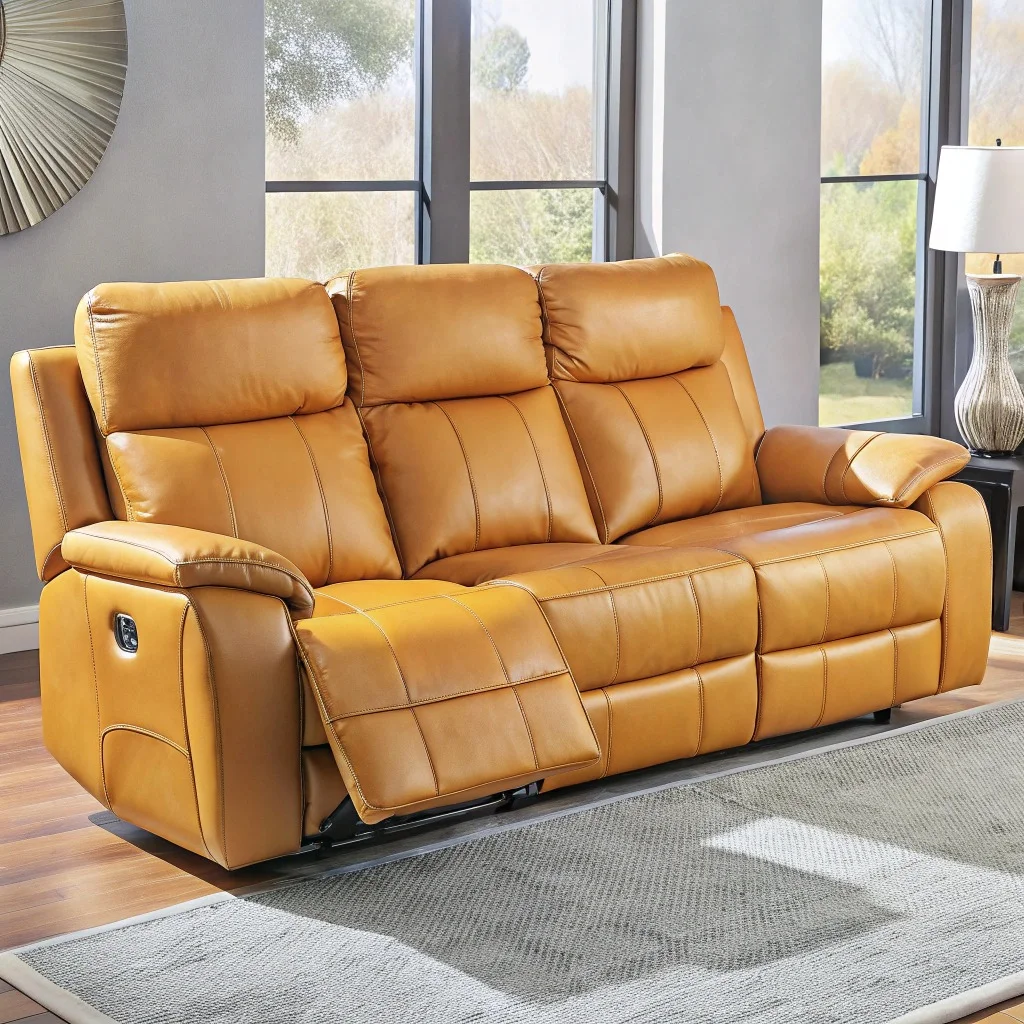
When you look at that side by side, what jumps out to me is not just “more parts,” it is that the recliner packs a whole machine into the same space where a sofa mostly has air, wood, and springs. That is why recliners can cost so much more even when the upholstery looks similar, you are paying for hardware density and the labor to assemble and align it.
Here is the catch I want you to keep in your head in the showroom: more hardware does not automatically mean more durability. More hardware means more places for tolerance stack up, more pivots to wear, more fasteners to loosen, and more spots where a tiny misalignment turns into rubbing and noise after a year of daily cycles.
So when you see the “complexity premium” on the price tag, I try to verify you are getting a premium mechanism, not just a premium bill. I do that by making the store let me interact with the moving system like it is the product, because it is.
I put my hands on the arms and I run the chair through its full range slowly, then I do it again a little faster like I would at home. What I am listening for is repeatable noise at the same point in travel, and what I am feeling for is any moment where the chair binds, bumps, or shifts sideways before it continues, because those are the tells that the hardware is fighting itself.
Then I look under it, even if it feels awkward, because the undercarriage is where the money is supposed to be. I am looking for whether everything looks squared up and intentionally routed, or whether it looks like a crowded tangle of thin steel, staples, and dangling fabric that could get pinched the first time somebody reclines with a blanket hanging over the side.
If it is a powered recliner, I also pay attention to how the motion starts and stops. A good one feels controlled and consistent, and it does not jerk at the beginning or slam to a stop at the end, because abrupt starts and hard stops are basically shock loads that get repeated for years.
If you want one practical way to decide whether the mechanism is worth the complexity, I use the “off axis” test. I recline halfway, shift my hips toward one arm, and then return upright, because cheap systems often behave fine when you are perfectly centered and start complaining when you are not.
I also treat this photo as permission to negotiate and to ask better questions. When a salesperson says two recliners are “basically the same,” I point to the reality that one might have a denser, better supported mechanism and one might just have more parts, and I ask what is actually different about the mechanism and who supplies it.
If they cannot answer that, I fall back to what I can verify: how it cycles, how it sounds, how stable it stays when I load it imperfectly, and how much slop I can feel when I gently push side to side while it is partially reclined. If it does not feel tight and controlled in the showroom, I assume it will not magically become tight and controlled once it has been used every day.
The "Motion Creep" Warning
Because a recliner moves, it exerts force on your floor in a way a normal sofa usually does not. Every time you rock, recline, or snap back upright, the steel base plate and the contact points under the chair can micro shift, even when it looks like the chair stayed put.What that turns into over real life use is the chair slowly “walking” across the room over months, and those tiny shifts can act like grinding if the base has sharp edges or hard plastic glides. On hardwood, that is how you get a weird scuffed patch that seems to appear out of nowhere, even if you swear you never dragged the recliner.
The fix I trust is simple and boring, I treat non slip rubber pads as part of the recliner, not an optional accessory. I want rubber between the moving machine and my floor so the little vibrations and shifts get absorbed, and so the chair has grip instead of skating a fraction of an inch at a time.
I also make myself do one more check before I buy, because creep is not only about scratches, it is about whether the chair is stable in daily use. I recline it, return it upright, then I stand up using the arm the way I would at home, and I watch whether one side “steps” or twists as the load changes.
If you are on hardwood, I would not let the store talk you into tiny stick on felt dots for a recliner base plate. Felt can help a stationary sofa slide without scratching, but on a recliner it can make creeping easier, which means the chair moves more and the edges get more chances to abrade the finish.
What I do instead is plan a floor solution before delivery, not after the first mark. If you want the simplest approach, rubber pads under every contact point are my baseline. If the recliner has a wide metal base ring or a plate that looks like it could still grind, I would seriously consider a thin hard protector panel under the whole footprint, because it spreads the load and gives the chair a sacrificial surface to misbehave on.
In the showroom, I decide how aggressive I need to be by looking at the underside like I am inspecting the bottom of a ladder. If I see a proud metal edge that could touch the floor when the chair rocks, or I see a base plate that is close enough to the ground that a little flex could make it kiss the finish, I assume you will get motion creep marks unless you isolate it.
If the salesperson says the recliner is “safe for wood,” I ask them to show me what actually touches the floor and what it is made of. If they cannot, or if they act annoyed that you are looking underneath, I take that as a hint that floor protection is on you, and you should price it in like you would price in delivery.
Decision Matrix: Which Architecture Wins?
If you want the quick truth, a static sofa usually wins when you care most about long term sturdiness per dollar, and a motion recliner can win when you care most about repeatable body positioning and recovery comfort. I treat it less like “which is better,” and more like “which set of compromises are you actually willing to live with for years.”
On durability, I give the edge to a stationary sofa because it has the chance to be just a strong frame plus a suspension system that does not move relative to itself. In the store, you can make that advantage real by focusing on whether the frame feels calm when you sit near the arms and lean, and whether the seat support feels even across the whole width instead of having a soft lane where people always sit.
On a recliner, I assume the frame can still be fine, but the mechanism becomes the clock you are living with. When I hear “ten to fifteen years” for mechanisms, I translate that into, “This will probably start needing attention while the rest of the chair still looks decent,” so I only buy one that cycles quietly, stays square when I load it off center, and has a service story I can understand without guessing.
On comfort type, I think a normal sofa is more versatile in real life because it lets you sprawl, nap sideways, sit perched, or host people without forcing everyone into one posture. When I am in the showroom, I test that versatility by doing one weird thing on purpose, I sit diagonally with my shoulder in the corner and see if the back cushions and arms feel supportive or if they collapse and push me into an awkward slouch.
A recliner is more targeted comfort, and when it is good, it is very good, especially if you know you want that “legs supported, spine decompressed” feeling most nights. Your job in the store is to confirm it is not a one position trick, so I would not just find the best notch and stop, I would spend a minute finding your second best position too, because that is the one you will use when you are tired, distracted, or sharing the chair with a blanket and a pet.
On maintenance, the stationary sofa wins because there is basically nothing to do except rotate cushions if they are reversible and keep it clean. With motion seating, I assume you are signing up for light ongoing ownership, which means you should be comfortable occasionally tightening a loose feeling fastener or dealing with a squeak, and you should only buy it if you can access the underside without feeling like you need to disassemble half the chair.
On aesthetics, I have learned to be honest about the silhouette you want to live with. Motion furniture often looks taller and puffier because it is hiding clearances and mechanisms, so if you want a low profile living room where the sofa does not visually dominate, I would steer you toward a stationary sofa or at least a recliner that still looks composed in the upright position without a big headrest bulge pushing your space into “home theater mode.”
On footprint, I treat recliner clearance as a deal breaker category, not a minor detail. In the store, I always ask them to show me the chair fully reclined and then I imagine that same shape in my room with a coffee table, a wall, and a walkway, because a recliner that technically fits can still be annoying if you have to keep the area in front of it empty forever.
Move-ability is one of the few practical points where many recliners can be easier than a big one piece sofa, because a lot of them have removable backs. If you have tight stairs, narrow doors, or sharp turns, I would ask the salesperson to demonstrate how the back comes off, and I would also ask what parts become exposed during moving, because I have seen people grab a mechanism area like a handle and bend something that was never meant to be lifted.
On price, I force myself to remember where the money is going. A stationary sofa often puts more of your budget into the stuff you feel every day, like the seat construction, the foam, and the fabric, while a recliner is often diverting a big chunk into hardware you may not notice until it fails. The practical way I use this is simple, if two pieces cost the same, I expect the stationary sofa to feel “more sofa” in the cushions and upholstery, and I expect the recliner to justify itself by feeling unusually tight, controlled, and quiet in motion.
So here is how I decide in real life. If you want the best odds of being happy in five to ten years with minimal drama, I would bias toward a well built stationary sofa and add an ottoman if you need feet up. If you know you will actually use reclining daily for back comfort or recovery, then the recliner can be the right tool, but only if it passes your consistency tests, your off center tests, and your floor contact inspection, because that is where the long term story gets written.