Modular vs. Fixed: The Agility Tax

Agility Tax
When you compare a $1,500 fixed sofa to a $2,200 modular equivalent, you are staring at what I think of as the Agility Tax. Modular almost always costs more for the same amount of usable seating, and in my experience the premium often lands in that 30 to 50 percent range because you are buying extra structure, extra upholstery work, and extra hardware, not “better comfort.”
The practical takeaway is that you should treat flexibility as an add on you are paying for on purpose. If you are not genuinely going to reconfigure it, move it through tight doors, or split it across rooms later, I would push you toward a fixed sofa at the same budget because your money tends to go into fewer, larger parts instead of duplicated ones.
Physical Redundancy
The higher price usually comes down to component count. A fixed sofa is typically one frame sitting on four legs, with no connector brackets and no need to make the inside faces look showroom finished. A three piece modular is usually three separate frames, often sitting on about a dozen legs total, tied together with several connector brackets, and it also needs the interior sides upholstered and finished because those faces can end up exposed depending on how you arrange it. The technical result is simple in real life terms, you are paying for the duplication of structure, so modular is not more expensive because of hype, it is more expensive because it is physically three pieces of furniture instead of one.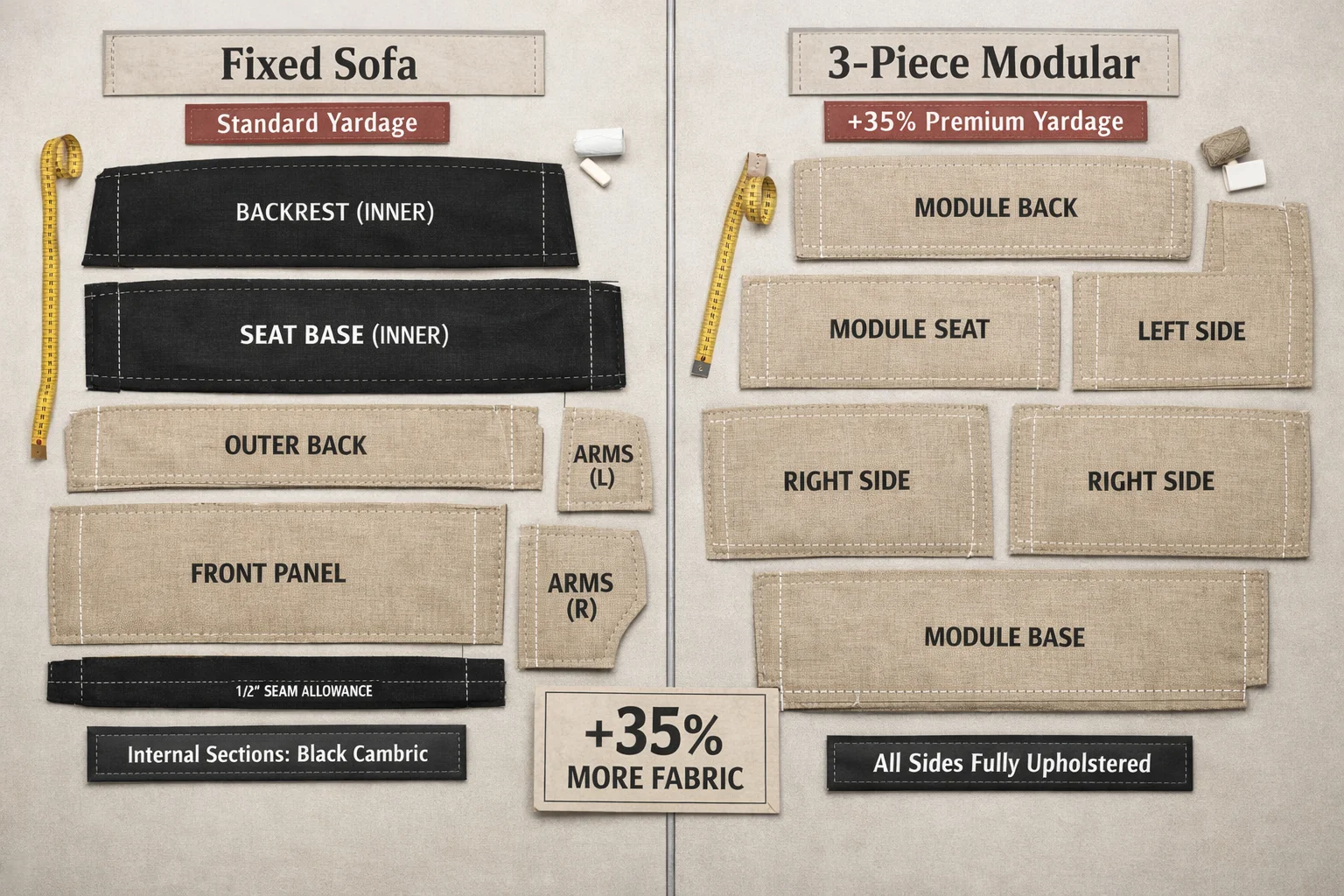
In a showroom, I want you to sanity check whether the extra money is buying real build, or just buying the privilege of “modular.” Ask the salesperson to show you the connector system, then kneel down and look at it yourself. If it is a couple of flimsy clips that barely grab, or if the sections can shift sideways with a modest shove, you are paying the Agility Tax without actually getting the stability that should come with it.
I also like to do a quick lift test at the front corner. With modular, you are trying to learn whether each unit behaves like a solid little sofa on its own, or like a hollow box that needs the other pieces to feel sturdy. If one section twists easily when you lift a corner a few inches, that is a red flag because it usually means the frame is doing the minimum and the connectors are being asked to compensate.
Then pay attention to the “finished on all sides” promise, because that is one of the hidden costs you are funding. Run your hand along the interior side panels and the back panels of each module, and look for thin fabric, loose pulling, or wavy padding. If the store model already looks stressed on those surfaces, imagine what it looks like after years of kids, pets, and vacuum bumps.
The last part of the Agility Tax is legs. Modular often has more legs, more contact points, and more chances for wobble if your floor is imperfect or the legs are cheap. Put your hand on the arm and gently rock the seat, and if you feel a click, a tap, or a little seesaw motion, I would ask whether there are adjustable levelers, and whether replacements are easy to get if one bends or strips out.
If you do want modular, I think the right mindset is to demand that each piece earns its keep. You are paying for redundancy, so the redundancy should feel like strength, not like extra seams and extra movement. If it does not feel locked together and confidence inspiring in the showroom, it rarely improves once it is in your house.
The Performance Trade-off
What modular gives you in agility, it often takes back in something I care about more day to day, which is structural continuity. A fixed sofa is basically one long system, and modular is a set of smaller systems trying to behave like one.
On a traditional fixed sofa, the long rails let the suspension act like a single platform. When you sit in the middle, sprawl diagonally, or lie down for a nap, your weight is being shared across a bigger uninterrupted structure, so the “feel” tends to be more even.
In a showroom, I test this by sitting in the dead center seat and then slowly shifting my weight left and right. On a good fixed sofa, the change is gradual and predictable, and I do not feel like I am stepping from one zone into another.
With modular, each unit sits on its own independent base, so the comfort is more cellular. Even if the cushions look identical, the support underneath is broken into chunks, and that often creates hard spots where frames meet.
You can catch this fast if you do the “seam sit.” Sit right on the join between two modules, not politely centered on a cushion, but right where your body will end up when guests squeeze in. If you feel a ridge, a firmer band, or a weird teetering sensation, that is the structural break showing through.
Then there is the seam factor on top of the structure. On a fixed sofa, upholstery usually spans the whole deck, so the surface under you is continuous, but on modular each unit is wrapped separately, which creates a little valley between seats.
I want you to run your hand across that valley and press down with your palm. If it is deep enough to feel distinct under light pressure in the showroom, it is deep enough to collect crumbs, grit, and pet hair at home, and it is deep enough that some people feel it under a hip when they lounge across sections.
The practical decision is about how you actually use a sofa. If you picture napping, movie sprawl, kids building forts across cushions, or three people sharing one long lounge zone, I think fixed frames usually deliver a calmer, more “one piece” feel for the same money.
If you picture frequent rearranging, separating pieces for parties, or you simply need the logistics of getting it into your space, modular can still be the right call, but I would treat the seams as part of the comfort package. I would not let a salesperson tell you it will “disappear,” because the best case is that you stop noticing it, not that it stops existing.
If you are on the fence in the showroom, I would pick the model that feels better at the seam, not the one that looks better online. The seam is where modular sofas either prove they were engineered well, or remind you, every day, that you bought a collection of boxes instead of one long, unified seat.
Upholstery and Waste
The part that surprised me when I started paying attention is how much of the modular premium is literally fabric. A modular piece cannot assume it will always have a neighbor hiding its side, so it gets wrapped like a standalone chair, which means the inside faces and the back faces have to be finished in the same “main” fabric you are paying for.
A fixed sofa can be more efficient because there are surfaces you never see once it is assembled, like the interior faces between seats or parts of the frame under the deck. On a lot of fixed sofas, those hidden zones get covered with cheaper lining fabric, or they are simply handled with less expensive upholstery work because nobody is meant to look there.
In real shopping terms, this is why a modular three seater can quietly use about a third more of the premium fabric than a fixed frame sofa that seats the same number of people. Even if the fabric itself is identical, the modular version can burn through more of it because every module needs to look “done” on all sides.
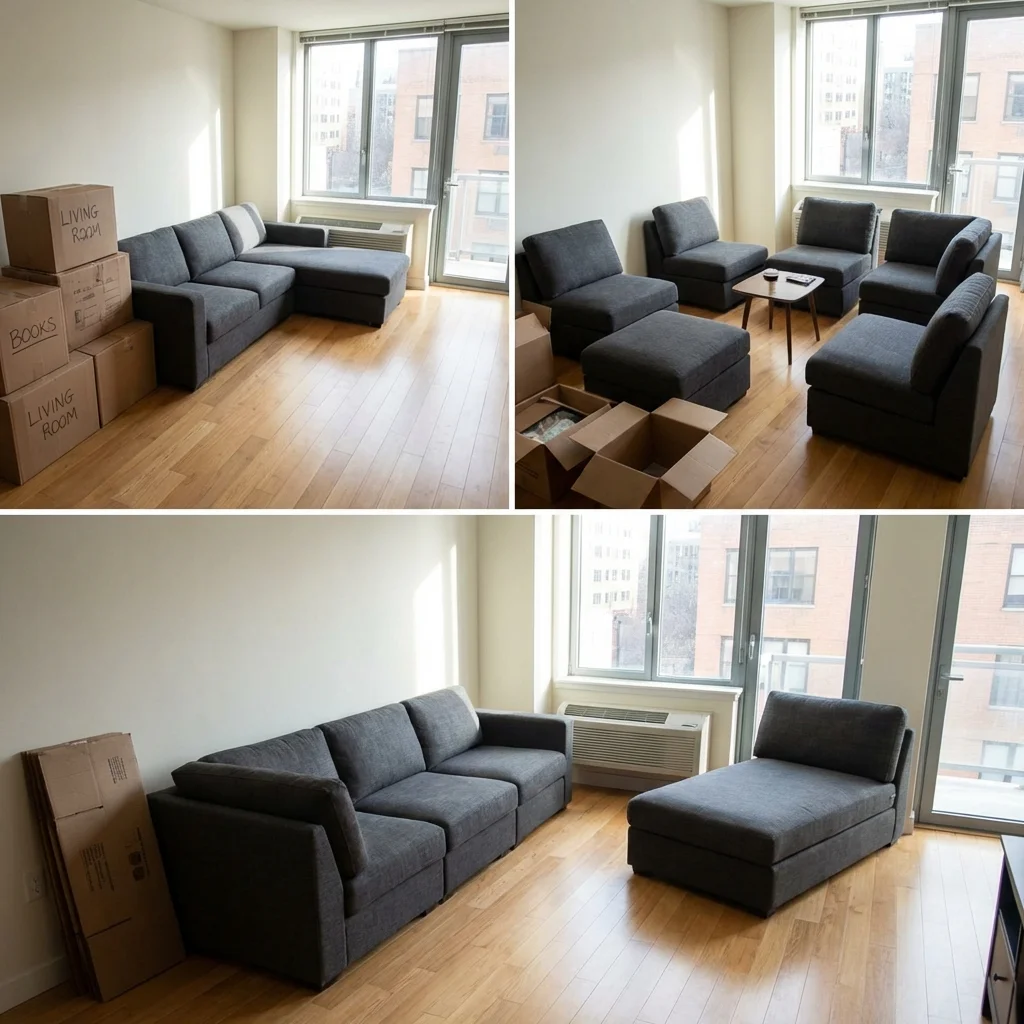
In the showroom, I use this as a simple honesty test. I ask to see a fully separated configuration, not the pretty staged setup, and I walk around to the interior sides that would normally be hidden. If those faces look wrinkly, under padded, or slightly “off,” that is the first hint that the brand is trying to hit a price point while still claiming full wrap upholstery.
Then I look for where they saved money to afford the extra yardage. If the module sides look fine but the seat deck feels thin, the cushions feel underfilled, or the frame feels light when you do that corner lift, I assume the fabric requirement forced a compromise somewhere else.
You can also learn a lot by touching the inside panels with your fingertips and gently rubbing the fabric. If it pills quickly on the floor model, feels loose over the padding, or you can feel hard edges right under the cloth, that “fully upholstered” promise is going to age poorly because those interior faces take a beating from hands, hips, kids climbing, and vacuum brushes.
If you are buying modular in a light color or a textured weave, I would be extra strict here because you are effectively buying more square footage of vulnerable surface area. More surface means more chances for snags, stains, sun fade, and abrasion, especially on the sides that people slide past when they sit down.
I also want you to zoom out and think about waste, not as a moral lecture, but as a clue about value. A modular system needing more premium fabric is not automatically bad, but it does mean you should be getting something concrete for it, like a fabric you truly love, a weave that feels durable, and upholstery work that looks tight and intentional on every face.
When a salesperson tells you the modular price is higher because it is “more customizable,” I would steer the conversation back to materials. Ask whether the inside faces are the same fabric and the same grade as the front, then actually confirm it with your eyes and hands. If they dodge, or if you can see that the interior panels are subtly different in texture or sheen, you are not getting the full wrap you are paying for.
The last thing I do is check the seams on those extra upholstered sides. Modular creates more edges and more corners, so there are more seam lines that can ripple or split over time. Look closely at the piping and the corner joins, and if they already look slightly twisted or puckered on a new floor model, I take that as a warning that the upholstery is being asked to do a lot, and it may not stay crisp once the fabric relaxes with use.
The “False Savings” Warning
In the showroom, I treat an unusually low modular price like a clue, not a bargain. It can still be a decent purchase, but only if you can see where the value is coming from, like a simpler fabric, a simpler silhouette, or a direct to consumer model that is clearly saving on retail overhead, not quietly saving inside the seat.
The fastest place brands cut is the seat foam, because you cannot judge foam quality by looking at it. I sit in the same spot for a full minute, then I stand up and look at the cushion, and I press with my palm where my sit bones were. If the cushion stays visibly depressed, feels “dead” instead of springy, or rebounds slowly on a brand new floor model, I assume it is going to pack down fast at home.
Then I check whether the cushions are doing too much of the work because the base is underbuilt. I put one hand on the seat near a connector seam and push down and forward, like I am trying to shove the cushion into the gap. If I feel the whole deck flexing, or I hear light clicking from underneath, that is usually the joints and connector points complaining, and those are exactly the parts that get tortured over time in a modular.
If the salesperson will let you, ask them to separate two modules by a few inches so you can see the connector hardware and the frame edges. I am looking for clean, substantial attachment points that look like they were designed to take repeated load, not thin stamped metal clips screwed into soft wood, and not brackets that rely on a tiny screw bite right near the edge of a board.
Here is a small move that has saved me a lot of regret, I gently lift the front of one module while the neighboring module stays on the floor. A well built piece will feel like it is lifting a rigid box, and a cheap one will feel like it is twisting, racking, or “opening” slightly, which usually means the joinery is basic and the wood is light.
I also want you to pay attention to how the modules behave when they are connected. I stand at the end and give the whole arrangement a careful sideways nudge, like the kind of accidental bump you would get from vacuuming or kids flopping down. If the sections drift, scissor, or need constant re straightening, you are not saving money, you are buying an ongoing annoyance that often turns into damaged connectors and wall scuffs.
When the price is suspiciously low, I assume the manufacturer had to “pay for modular” by hollowing out the invisible parts. The uncomfortable truth is that modular has more failure points by design, so the only way a cheap modular works long term is if the basics are upgraded enough to handle that complexity, and upgrades cost money.
If you are trying to stay on budget, I would rather you buy a simpler fixed sofa that feels boring but solid than a bargain modular that feels great for three months and then turns into a saggy, shifting puzzle. The savings is false because the first time you are annoyed by the gaps, or the first time a cushion bottoms out, you start shopping again, and the second purchase is the one that really hurts.
Investment ROI: When is the Tax Worth It?
This is where I try to make the modular premium feel less emotional and more like a math problem. The question I ask myself is whether I am paying the Agility Tax to solve a real problem I will definitely have, or whether I am paying it for a “someday” flexibility that never actually gets used.
If you are in a forever home, meaning you can realistically picture this sofa staying put for years, I would usually put my money into a fixed frame. In practice, the same budget tends to buy you a more continuous seat, fewer seams to feel and clean, and less hardware to loosen, which is exactly what I wish I had prioritized on a couple of past buys.
If you rent and you move every couple of years, modular can pay for itself faster than people think, but only if you are the kind of person who actually hires movers or ends up paying friends with a truck. I have watched moving costs balloon when a one piece sofa becomes a “special handling” item, and modular is one of the few times paying more upfront can reduce the pain later because each piece is lighter, easier to pivot, and less likely to gouge walls on the way out.
If your place has narrow doors, tight hall turns, or spiral stairs, I stop treating modular as a luxury and start treating it as damage control. I have been in that situation where a normal sofa does not make the turn and suddenly you are negotiating with a delivery crew in a hallway, so if access is questionable, I want you to measure your tightest turn and then ask the store for the exact box dimensions of each module, not the overall sofa width, and not a “it should fit.”
If you nap a lot, lounge across the full length, or you are buying the sofa mainly for that long, uninterrupted sprawl, I would lean fixed frame again. Those module joins are where I most often feel a firmer band or a subtle ridge, and even when it is not painful, it is the kind of thing that can quietly make a sofa feel less restful over time.
If you already know you will resell, modular often holds up better in the used market for one simple reason, it fits more rooms. A buyer can make a sectional smaller, flip the chaise, or split it into separate seating, so more people can say yes, and in my experience that tends to translate into a cleaner sale and less haggling, even if the fabric is not perfect.
The way I would use this in a showroom is to decide which of these scenarios is truly yours, then test for the downside that comes with it. If you are buying modular for moving and stairs, I would obsess over connector strength and module rigidity because you will assemble and reassemble it, and the hardware needs to tolerate that. If you are buying fixed for comfort and naps, I would spend extra time seam sitting and lying across the cushions because comfort continuity is what you are paying to protect.
The point is not that one type is “better,” it is that the tax is only worth it when it replaces a real cost or a real risk you can name. If the best argument for modular in your case is “maybe someday I will rearrange it,” I would keep your money and buy the most solid fixed sofa you can afford.
Explore Technical Reference
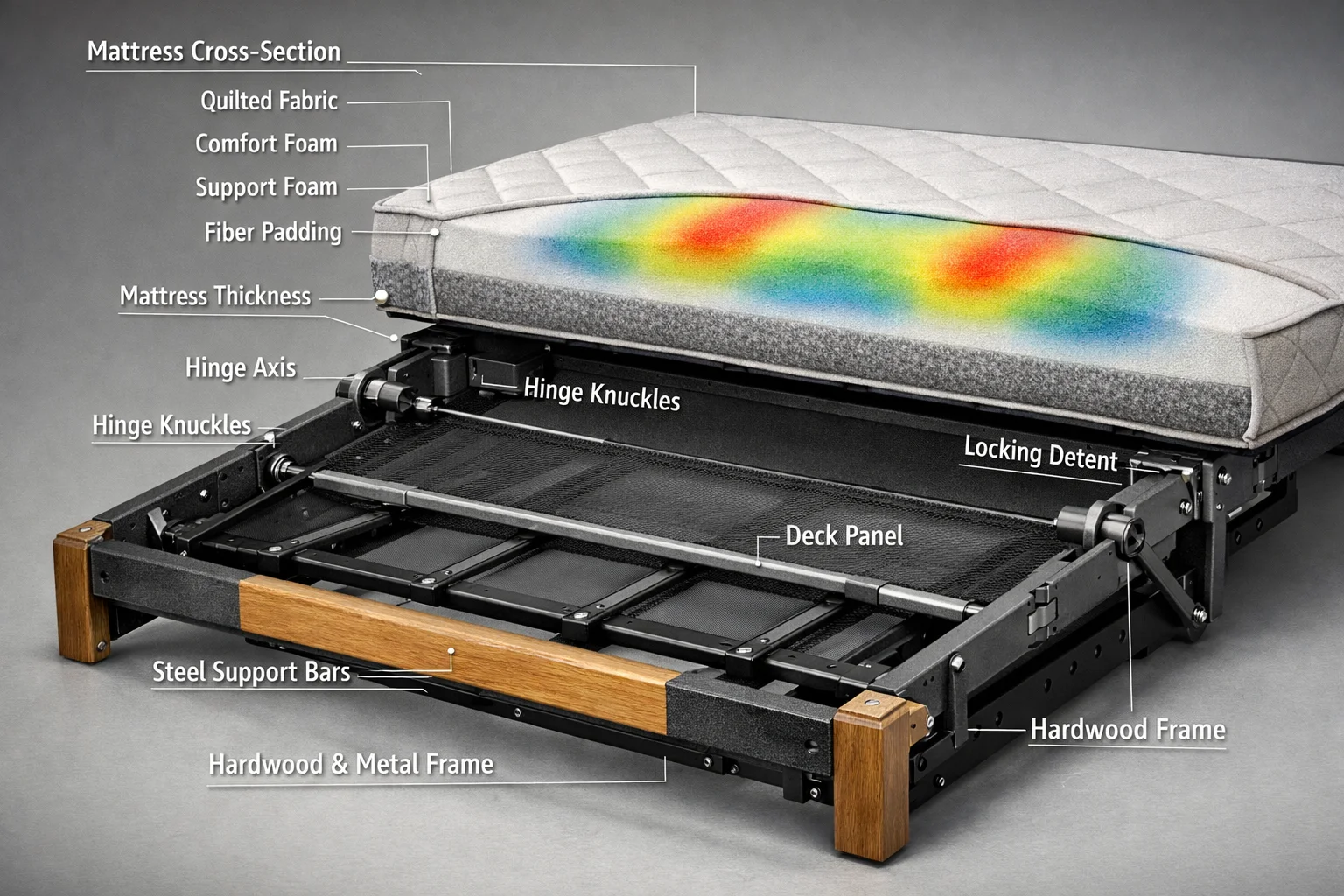
Sofa Beds: The Dual-Function Compromise
How sofa bed mechanisms balance sitting and sleeping functions. Understanding pull-out systems, click-clacks, and why engineering has improved but compromise remains inevitable.
Analyze Details →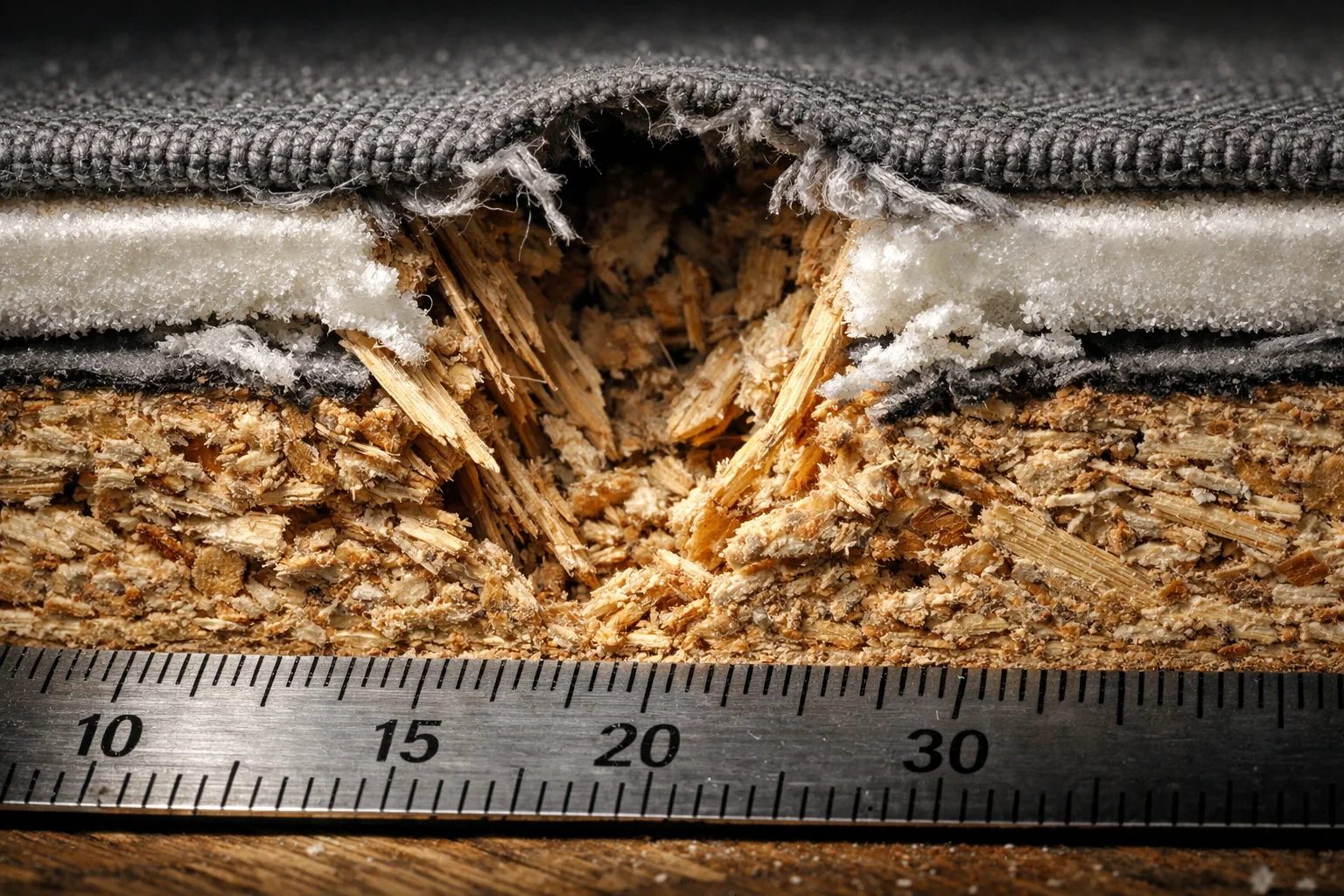
Storage Capacity: The Point-Load Limit
Why storage sofa lids can fail under concentrated loads. Understanding
Analyze Details →