Recliner Mechanisms: The Geometry of Failure
Introduction
When a recliner fails, I almost never see a single dramatic break that “explains everything.” What I usually see is a bunch of tiny looseness adding up, and the thing that ties it all together is the linkage geometry.
A recliner is basically a chain of pivot points that all have to move in sync, in a very specific path. If one joint develops even a little slop, the rest of the mechanism is forced to travel slightly off its intended path, and that is when you start getting sticking, lopsided footrests, loud clunks, or that scary feeling that it might suddenly drop.
This is why I do not trust simple explanations like “the motor died” without context. The motor, the handle, and the springs can be fine, but the geometry is already compromised because the pins, rivets, brackets, and holes have worn into a slightly different shape than the one the recliner was built around.
When you are shopping, what matters is not the marketing label, like “heavy duty” or “300 lb rated.” What matters is whether the mechanism is built and supported in a way that keeps those pivot points tight and aligned after thousands of cycles, with real people sitting slightly off center, pushing the footrest down with their heels, and using the arms to stand up.
In the next sections, I am going to keep coming back to one practical idea you can use in a showroom: you are not just testing comfort, you are testing alignment. If you can feel twist, uneven travel, grinding, or a footrest that does not rise evenly on both sides, you are catching early signs of geometry problems before you pay for them.
The "Asymmetric Load" Killer
The number one way people quietly kill a recliner is what I call The Lean. It is when you sit a little sideways, perch on the edge, or load one arm hard while you reach for something or push yourself up.
Most recliner mechanisms are happiest when your weight is centered and shared evenly by the two side rails. The linkage on the left and the linkage on the right are meant to travel together, and they stay well behaved when the load is symmetric.
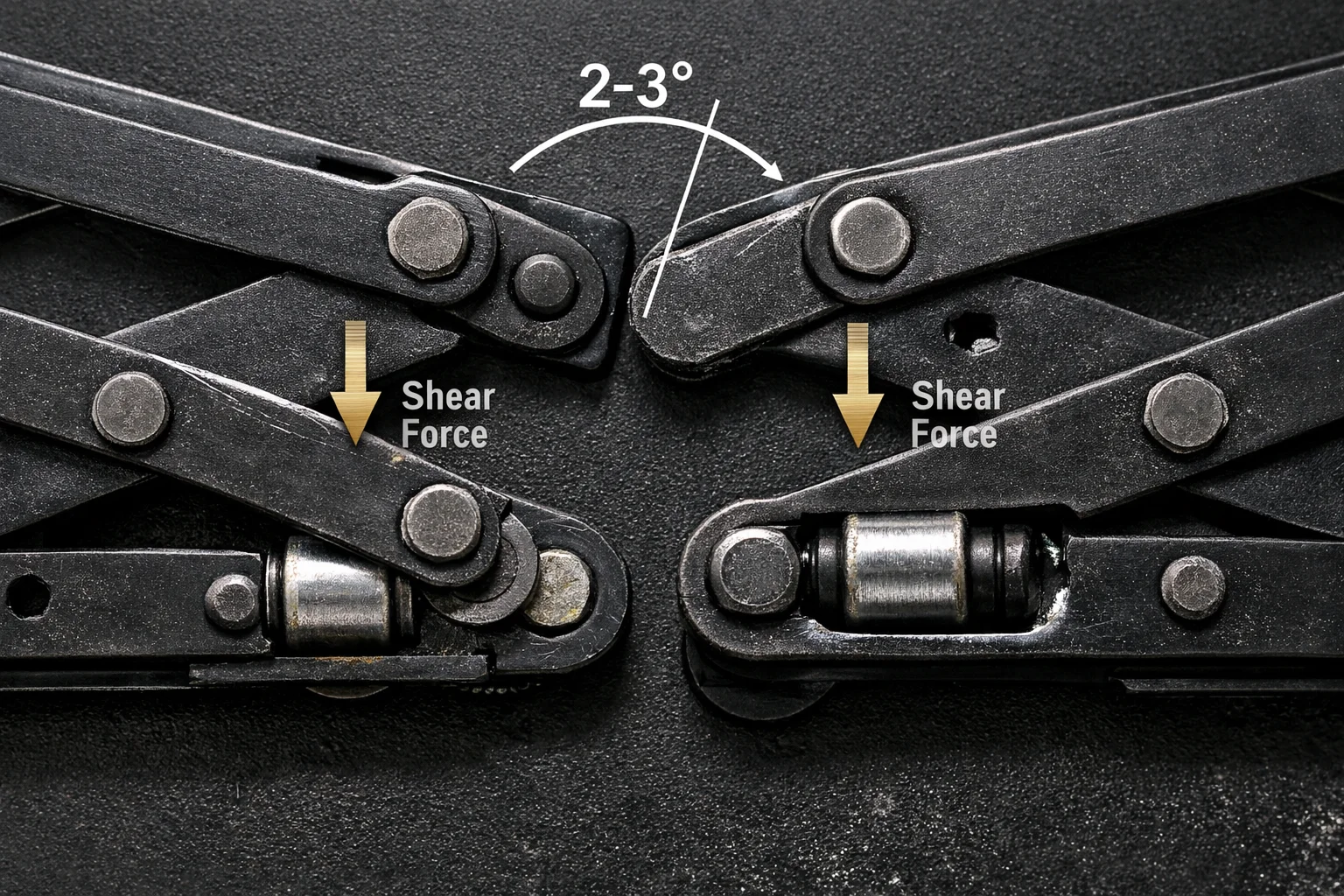
When you lean on one side, the scissor style linkage is no longer just carrying weight, it is also being twisted. That sideways twist is what makes metal links start to bend just a little, and it does not take much. Once a link is even slightly out of plane, it stops tracking cleanly in the grooves and guides it was designed to ride in, and that is when you get the classic early symptoms like a footrest that rises unevenly, rubs the side, or needs a little nudge to close.
In a showroom, I try to simulate real life, because perfect posture is not real life. I sit normally and run the recline in and out a few times, then I deliberately shift my weight toward one arm the way I would at home when grabbing a remote. What I am feeling for is whether the chair still moves with the same smoothness, the same sound, and the same timing on both sides.
Pay close attention to the footrest when it comes up. If one side pops first, if the gap to the arm looks tighter on one side than the other, or if you feel a slight corkscrew twist through the seat as you extend it, I treat that as an alignment warning, even if the salesperson tells you it will break in.
I also put one hand on each arm and gently rock my weight left then right with the footrest out, not violently, just enough to feel if the frame and mechanism resist twisting as a single unit. A good recliner will feel boringly solid and symmetric. A vulnerable one will feel like it has a little diagonal give, like the left and right sides are not truly tied together.
If you love to lean, or you know your household uses the arms to stand up, you should shop with that in mind. I would rather you buy a recliner that feels slightly firmer but stays aligned than one that feels plush for five minutes and starts rubbing and sticking after a year of off center sitting.
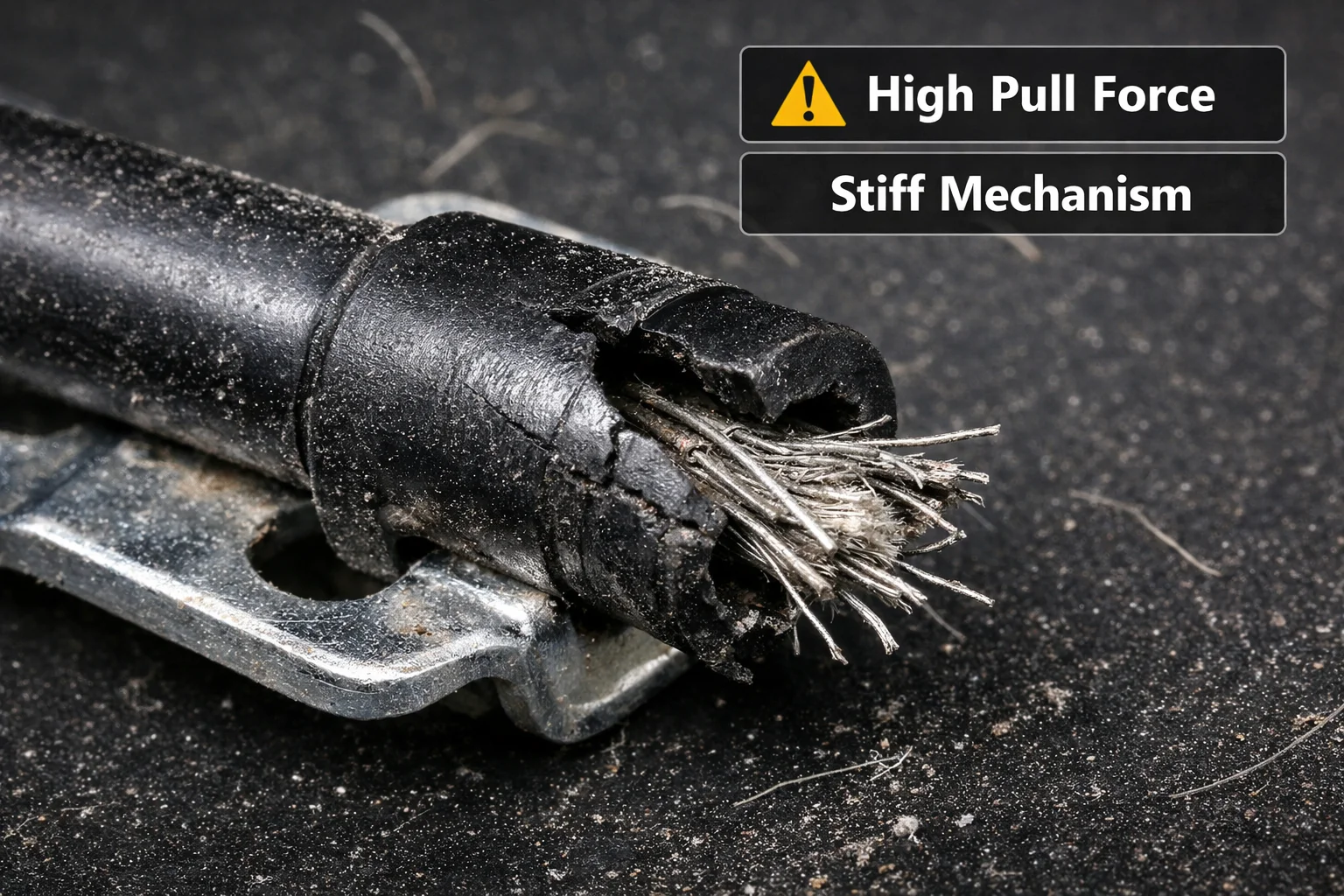
When you see a recliner handle go loose, this is the failure pattern I think about. It is rarely “a bad cable” out of nowhere, it is usually a stiff, slightly misaligned mechanism that slowly demands more and more force until the weakest part gives, and that weak part is often the cable end or the little housing anchor that holds the cable jacket in place.
In a showroom, I want you to treat the release handle like a gauge. Pull it slowly the first time and pay attention to whether it feels smooth and progressive, or whether it feels sticky and then suddenly lets go, like it is overcoming a bind.
If you have to yank it, if you feel a gritty catch, or if the handle feels like it is bending sideways instead of pulling cleanly, I assume the mechanism is already operating with higher friction than it should. That extra friction is what makes people reef on the handle at home, and that is how the inner wire strands start snapping one by one until it finally lets go and the handle flops.
I also look for handle travel that feels inconsistent from cycle to cycle. If you open and close the footrest a few times and the handle pull length changes, or the release point “moves around,” that usually means something is flexing or shifting in the linkage, and the cable is having to compensate.
There is one quick check I always do after extending the footrest. I put the footrest back down using my legs and an even push, then I release it again and see if the handle effort is about the same as the first time, because a mechanism that binds under load often feels fine when it is empty and gets stubborn the moment it is carrying weight.
If the salesperson tells you a stiff handle will “break in,” I do not buy that as a comfort issue. Cables and anchors do not get stronger with time, and if the recliner needs excessive force brand new, you are basically starting the clock early on the exact kind of crack and wire break you see in the photo.
Common Mechanical Failure Modes
Most recliner problems I run into fall into a few repeatable mechanical patterns, and the annoying part is that they usually start as “minor” symptoms you can absolutely feel in a showroom if you know what you are listening and looking for.
The first big one is pivot slop, which is just wear at the joints. The holes in the links slowly oval out, the pins or rivets loosen, and the whole linkage stops moving as a precise shape and starts moving like a slightly sloppy hinge.
In a showroom, I check for this by putting the chair halfway out, not fully closed and not fully extended, because that is where geometry problems show up. I gently lift the footrest up and down a tiny amount with my hands, not to force it, just to feel whether it has dead travel before the mechanism responds. If you feel a little clunk before anything actually moves, that is the mechanism taking up slack, and slack only grows.
The second common failure mode is side to side misalignment, which is when the left and right linkages stop traveling in sync. You will see it as a footrest that rises crooked, a gap that tightens on one side, or a scissor link that looks like it is trying to climb instead of fold.
I like to stand in front of the recliner and watch the footrest come up while I operate it. If one side leads the other, or if the footrest looks like it is rotating slightly as it extends, I assume you are seeing a twist that will get worse once someone sits off center at home.
Another one I see a lot is binding from frame flex. The mechanism can be decent, but the way it is mounted to the wood, or the way the base ties the two sides together, is not stiff enough, so the whole chair racks diagonally under load.
You can feel this by putting the footrest out and then putting your hands on the arms and applying gentle alternating pressure, like you are testing whether the chair resists twisting as one unit. If it feels like the left and right sides are taking turns moving, or you hear little ticks and pops as it shifts, I treat that as a structure problem, not a lubrication problem.
Then there is the track and roller wear pattern, which shows up on wall huggers and mechanisms that use glides, rollers, or guided slots. When those surfaces wear or get slightly out of line, the chair starts to feel rough, you get a repeating scrape at the same point in travel, or it will hesitate and then jump forward.
In the showroom, I run it slowly through the whole range and pay attention to whether the resistance is even. A healthy mechanism feels boring, it takes about the same effort the whole way. If it gets harder at one specific spot every time, that is the spot that is going to get forced through at home, and forcing is what bends thin links and loosens fasteners.
A very common “sudden” failure that is not actually sudden is spring fatigue or spring anchor damage. Extension springs and torsion assists get weaker, but the bigger issue is the little holes, tabs, or brackets they hook into, because once those deform, the spring no longer pulls in the correct line.
What you can do in a showroom is notice whether the recliner wants to close cleanly or whether it feels like it is giving up near the end and needs a shove. If closing the footrest feels like it is fighting you the whole way and then still does not want to latch without a kick, I assume either the assist is underpowered or the alignment is already off, and both lead to people slamming it shut, which is how anchors get bent.
I also watch for latch and pawl issues, which are the little parts that hold positions and release them. When those edges round off or the alignment changes, you get the classic symptoms like it will not stay latched, it will unlatch with a bump, or it makes a sharp bang when it finally catches.
In a showroom, I test this by finding a mid position and then shifting my weight like I would in real life, scooting my hips, leaning back, then leaning forward. If it feels like the position is drifting or you hear a faint clicking like it is trying to re engage, I assume the lock surfaces are marginal.
Finally, I pay attention to fasteners backing out, because recliners vibrate and cycle, and anything that is not well secured eventually loosens. The giveaway is noise that sounds like metal tapping metal, or a new rattle that appears only when the footrest is out.
If the store will let you, I kneel down and look underneath with my phone flashlight and just observe whether things look square and mirrored left to right. I am not trying to diagnose every part, I just want to see whether one side looks “busier” than the other, with shiny rub marks, fresh bare metal at a slot, or a bracket that looks slightly cocked.
The thread that connects all of these is simple: anything that feels inconsistent, asymmetric, or position dependent in the showroom is not going to magically become more consistent in your living room. I will take a recliner that feels smooth and identical on both sides over one that feels plush but already has little catches, pops, or crooked travel, because those are the early tells of the failure modes that show up after the return window is long gone.
1. The D-Handle Cable Snap
On a manual recliner, that little D handle is usually pulling a Bowden cable, basically the same idea as a bike brake cable. Your hand pulls the handle, the inner steel wire slides inside a housing, and the far end trips the latch so the footrest can come up or go down.
What goes wrong is not mysterious, it is usually friction. When the mechanism is stiff because of poor factory lubrication, dust, or slight misalignment, you start needing more force at the handle to get the same result. The cable housing then takes a lot of tension at the anchor points, and something gives first, either the inner wire strands snap or the plastic housing anchor cracks and lets the jacket pull through.
When it finally fails, the symptom is very consistent. The handle suddenly feels loose and floppy, and you get zero resistance when you pull it, like you are tugging on nothing. People describe it as “the handle broke,” but most of the time the handle is fine, it is the cable end or the housing stop that quit.
In the showroom, I treat the D handle as a feel test for the whole mechanism, not as a disposable part. I pull it slowly at first and I pay attention to whether the resistance ramps up smoothly, or whether it feels sticky and then releases in a jump. That sticky, then jump feeling is the chair telling you it is binding somewhere, and a binding chair trains you to yank.
I also watch the handle while I pull it, because it should pull in the direction it was designed to pull. If it twists, cocks to the side, rubs the upholstery, or looks like it is bending the escutcheon plate instead of moving freely, I assume the cable routing is marginal or the mounting is flexing, and that extra flex is another way the cable gets overstressed over time.
Then I cycle it a few times in a row, because inconsistency is the giveaway. If one pull is light and the next pull is heavy, or the release point seems to move around, something is shifting under load. A good manual recliner will feel boringly repeatable, with the same pull effort and the same release point every time.
I like to do one specific real life check that catches a lot. I sit in it, put the footrest up, then I press it back down with my legs evenly and latch it, then I immediately pull the handle again while still seated. If the handle effort spikes when the chair is carrying my weight, that is exactly the scenario that makes cables and anchors fail at home, because you will be tempted to pull harder instead of getting up and resetting your weight.
If the salesperson tells you the stiff handle will break in, I push back politely and ask to try another floor model of the same sofa or the same mechanism, because two examples often tell the truth. If the other one feels smooth and this one feels grabby, it is not a break in issue, it is tolerance, alignment, or friction, and those do not usually improve with use.
If you are close to buying, I also recommend you ask one direct question that cuts through the noise. I ask whether the release cable is considered a wear item and whether it is covered under the mechanism warranty, because some warranties treat cables like consumables even when the root cause is a stiff mechanism. If they cannot answer clearly, I assume you will be on your own when the handle goes loose.
The bottom line is simple: you do not want a manual recliner that requires a “confident yank” on day one. If it is already asking you for extra force in a showroom, it is not going to get kinder after months of off center sitting, kids hopping the footrest, and the occasional slam shut, and that is how you end up with the classic loose handle and a recliner that will not release.
2. Rivet Shearing
Inside most recliners, the scissor style linkages are held together with rivets at the pivot points. Those rivets are happiest when the joint is just rotating smoothly, because that is what a rivet style pivot is really meant to do.
What hurts them is shock loading, especially the kind you get when someone “flops” into the chair or drops their weight into it while it is partway reclined. In that moment the linkage is not just rotating, it is getting hammered sideways, and that side hit can shear the head off a rivet even if the metal looks thick and “steel” on a spec sheet.
When a rivet lets go, the failure has a very specific personality. The recliner starts leaning to one side, the footrest may come up a little crooked, and you often get a metallic clunk during recline as the loose joint shifts and re seats under load.
In a showroom, I try to catch the early version of this before it becomes a full shear. I put the chair in a mid position and I focus on whether the left and right sides stay synchronized, because a stressed rivet joint usually shows up as asymmetry long before it turns into a dramatic problem.
I also listen for a sharp, distinctly metallic knock instead of a dull upholstery thump. A soft thump can just be padding settling, but a bright clunk that happens at the same point in travel, especially if it seems to come from one side, makes me think a pivot is already taking impact instead of rotating cleanly.
If the store will let you, I do a very controlled “bad owner” simulation without being abusive. I sit down a little more firmly than normal once or twice, then I recline in and out again and see if anything changes, because a mechanism that is right on the edge will often start talking after a little extra load. What I want is boring consistency, the same smoothness and the same sounds every cycle.
I also watch your gap lines. With the footrest out, look at the spacing between the footrest and the arms on both sides. If one side is noticeably tighter, or the footrest looks like it is yawing slightly instead of coming straight out, I assume the structure is already tolerating twist, and twist is what turns a rotating rivet into a shearing rivet over time.
When I suspect this, I do not let a salesperson steer me into “it is just the floor model.” I ask to try the same model again, and if possible a different unit, because rivet and linkage alignment problems feel similar across examples, but a truly abused floor sample will usually also show other obvious wear. If the second chair feels different, I trust the smoother, quieter one, and I treat the noisy one as a warning about quality variation.
The most practical buying advice I can give you here is to shop like you live. If your household has kids who launch themselves into seats, or adults who drop into a recliner at the end of the day, you want a chair that stays square and quiet even when you sit down firmly. If it already clunks or leans in the showroom, you are not buying comfort, you are buying a rivet joint that is already being asked to do the wrong job.
3. Actuator “Drift” (Power Recliners)
When a power recliner starts acting like it is “weak,” I do not assume the motor is dying first. A lot of the time it is the linear actuator, the little electric motor driving a worm gear, getting bogged down by the exact stuff that lives in real homes, dust, lint, and pet hair.
The failure pattern is frustratingly consistent. That debris works its way into the grease around the worm gear, the grease turns into a gritty paste, friction goes up, and the motor has to pull more electrical current to do the same work. The control box is watching for that, and when it sees the amperage climb, it shuts the motor down to protect itself.
To you, it looks like the recliner “drifts” or stalls. You tap the button, it moves an inch or two, then stops like it hit an invisible wall, and you have to release the button and try again.
In a showroom, I try to catch any hint of this behavior by running the mechanism slowly and continuously, not just doing a quick up and down. I hold the button and listen for whether the motor tone stays steady, because a healthy actuator sounds smooth and consistent, while a struggling one often changes pitch like it is laboring, even if it still completes the travel.
I also watch for stop and go motion that is not tied to the end of travel. If it hesitates in the middle, stops early, then works again after a pause, that is the same “safety shutoff” personality you see when the actuator is drawing too much current under load.
Then I do the most important real life test. I sit all the way back, put my feet up, and recline while I am actually in the chair, because some power units will look fine empty but stall once they are moving your weight. If it cannot lift and recline smoothly with a normal adult in it, I treat that as a day one red flag, not something that will improve at home.
If you want a quick way to separate a simple control issue from a strain issue, pay attention to what happens when you release the button and immediately press it again. When the control box is doing an over current shutdown, the chair often behaves like it needs a moment to “reset,” and the next press gives you another short burst before it cuts out again.
When I suspect actuator drift, I ask a pointed question that protects you later. I ask whether the actuator, control box, and handset are covered as electrical components for the full mechanism warranty term, and whether in home service is included, because power recliners can be expensive and annoying to haul in for what is essentially a stuck drive unit.
I also look at the environment the sofa is likely to live in. If you have pets or a lot of fiber shedding throws and rugs, you should assume the actuator will be dealing with more debris than the average showroom model, so I want the chair to feel overpowered and unbothered in the store, not barely adequate.
If a salesperson tells you the stop and go is “normal” or “just a breaker,” I take that as a cue to try a different unit of the same model right then. Power recline should feel boringly continuous, and if it is already moving in two inch chunks on a clean floor model, you are not buying a minor quirk, you are buying a mechanism that is already operating close to its safety cutoff.
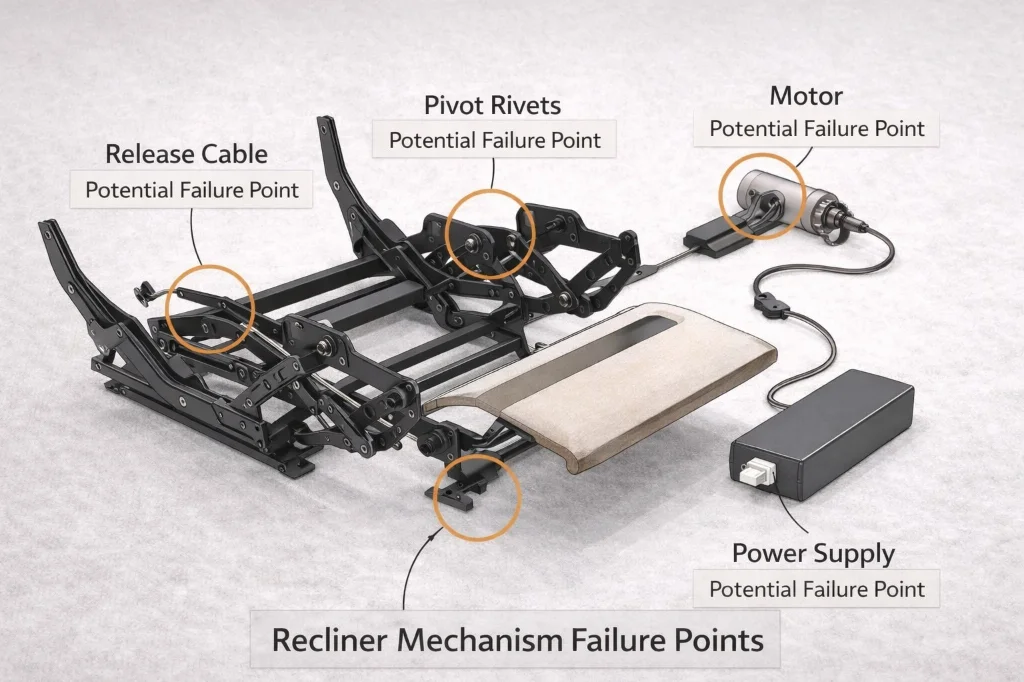
When I look at an exploded recliner mechanism like this, what jumps out is not one “big” part, it is the sheer count of joints. Every pivot is a place where tiny motion can turn into wear, then wear turns into slop, and slop turns into that crooked, clunky travel you can feel long before anything actually breaks.
What I want you to take from the caption is the nylon bushing idea, not as a spec to memorize, but as a practical signal of whether the maker expected these joints to survive years of cycling. Metal on metal pivots can work, but they are far less forgiving when the chair is used off center, or when dust and grit get involved, and that is basically normal life.
In a showroom you usually cannot see bushings directly, so I use feel and sound as my proxy. I extend the footrest to a middle position and I do a slow, small lift and lower with my hands, just a few millimeters, because that is where a dry, wearing joint reveals itself as a click, a tick, or a little dead zone before the linkage responds.
Then I listen for the difference between sliding fabric noise and joint noise. Fabric makes a soft shush, a pivot that is wearing tends to make a sharper, more localized tap or creak that repeats at the same point in travel, and once you notice that repeatability you cannot unhear it.
I also watch for “mirroring” because the mechanism is basically two machines working together, one on the left and one on the right. When the chair is healthy, both sides move like they are tied to the same spine, and when a pivot is starting to loosen on one side you often see it as a tiny timing difference, one side hesitates, then catches up with a little snap.
If you are allowed to look underneath, I do not need you to identify parts, I just want you to look for shiny crescents and polished edges near joints and slots. Shiny rub marks are evidence of metal moving where it was not meant to, and that usually correlates with the exact “one tight spot” or “one clunk” you can feel when you run the recline slowly.
If you get any of those tells, I would rather you switch to a different model than talk yourself into it. A mechanism with lots of pivots has to be boringly smooth when it is new, because it is only going to get less precise as those joints wear, and the whole chair will start to behave like the sloppiest pivot in the chain.
Lubrication: The "Dry" Rule
I have learned this the hard way, never use heavy grease and never use WD-40 on a recliner mechanism. Those products feel like a quick win because the chair goes quiet for a little while, but they stay wet and they turn the underside of your recliner into a dirt magnet.What happens next is predictable in a normal home. Dust, lint, and pet hair stick to that wet film, then the mechanism keeps cycling and that mix turns into a gritty sludge. That grit does not just make noise, it acts like sandpaper on the pivot surfaces, and once those pivots start wearing you get more slop, more crooked travel, and more force needed at the handle or the motor.
If you need lubrication, the “technical fix” I trust is a dry silicone spray or a Teflon based dry lubricant, because it is meant to leave a slick film without staying tacky. I still use it sparingly, because the goal is to reduce friction without creating a paste trap for debris, and more product is not better.
In a showroom, you cannot see what someone sprayed under there last month, so I treat certain cues as a warning. If the chair smells like solvent, feels oily under the front rail, or has dark sticky grime around the joints and slots, I assume somebody tried to quiet a problem instead of fixing alignment, and I move on to a different unit or a different model.
If a salesperson suggests WD-40 as “maintenance,” I take that as a knowledge red flag and I start asking harder questions about parts support and warranty. A recliner that is built well should not need a wet lubricant band aid to feel smooth when it is brand new.
Fault-to-Fix Diagnostic Table
I keep a little fault to fix map in my head when I am in a showroom, not because I expect you to repair anything, but because the symptom tells you what kind of design or build quality you are gambling on. If you can trigger even a mild version of these symptoms on a clean floor model, I treat it like the chair is showing you its future.
If the footrest will not stay closed, or it closes but pops back open unless you really kick it in, the common story is tired kick out springs or a spring anchor that is already letting the geometry drift. In a showroom you can test this without tools by closing it gently and seeing if it latches with a clean, confident catch, then doing it again after you have sat in it and shifted your weight a bit. If the latch feels fussy or you have to add a last second stomp to make it stay, I assume you will end up slamming it at home, and slamming is what beats up springs, tabs, and latches.
If the chair leans left or right, or you feel a diagonal wobble when you are reclined, I think bent scissor linkage or a frame that is not keeping the two sides square. I will stand in front of the chair and look at the footrest as it comes out, because a bend often reveals itself as one side leading, rubbing, or sitting closer to one arm. If it looks a little cockeyed now, it usually gets worse once somebody in your house starts doing the everyday lean and arm push to stand.
If you hear clicking when moving, especially a repeatable click at the same point in travel, I think worn pivot bushings or metal on metal joints that are already dry. In the showroom I run it slowly and listen for a sharp little tick that sounds like it is coming from one side, then I put it in a mid position and do that tiny lift and lower test to feel for dead play. If the chair is already clicking brand new, you are basically buying a future rattle, even if someone sprays something under it to hush it temporarily.
If a power recliner will not move at all, I do not let anyone wave it off as a dead outlet until I see a different power source tried right there. The likely boring culprit is the transformer brick or a loose connection, and the buyer facing takeaway is that you should not accept “it works at the warehouse” as proof, because you are looking at the exact unit you would be taking home. If the store cannot demonstrate consistent motion on the sales floor, I treat that like a support and service warning, even if the fix could be as simple as replacing the power supply.
If the handle moves but nothing happens, and it feels like it is pulling air, I assume a snapped release cable or a cable housing that pulled out of its anchor. My showroom test is simple, the handle should have a repeatable resistance and a clear release point. If it flops, feels mushy, or changes effort from pull to pull, I treat it like you are already on the path toward a cable replacement, and I start asking warranty questions before I get emotionally attached to the upholstery.
Explore Technical Reference

Daybed vs. Sofa Bed: Choose Your Sacrifice
A daybed is a bed pretending to be a couch. A sofa bed is a couch pretending to be a bed. Understanding when each approach produces better results.
Analyze Details →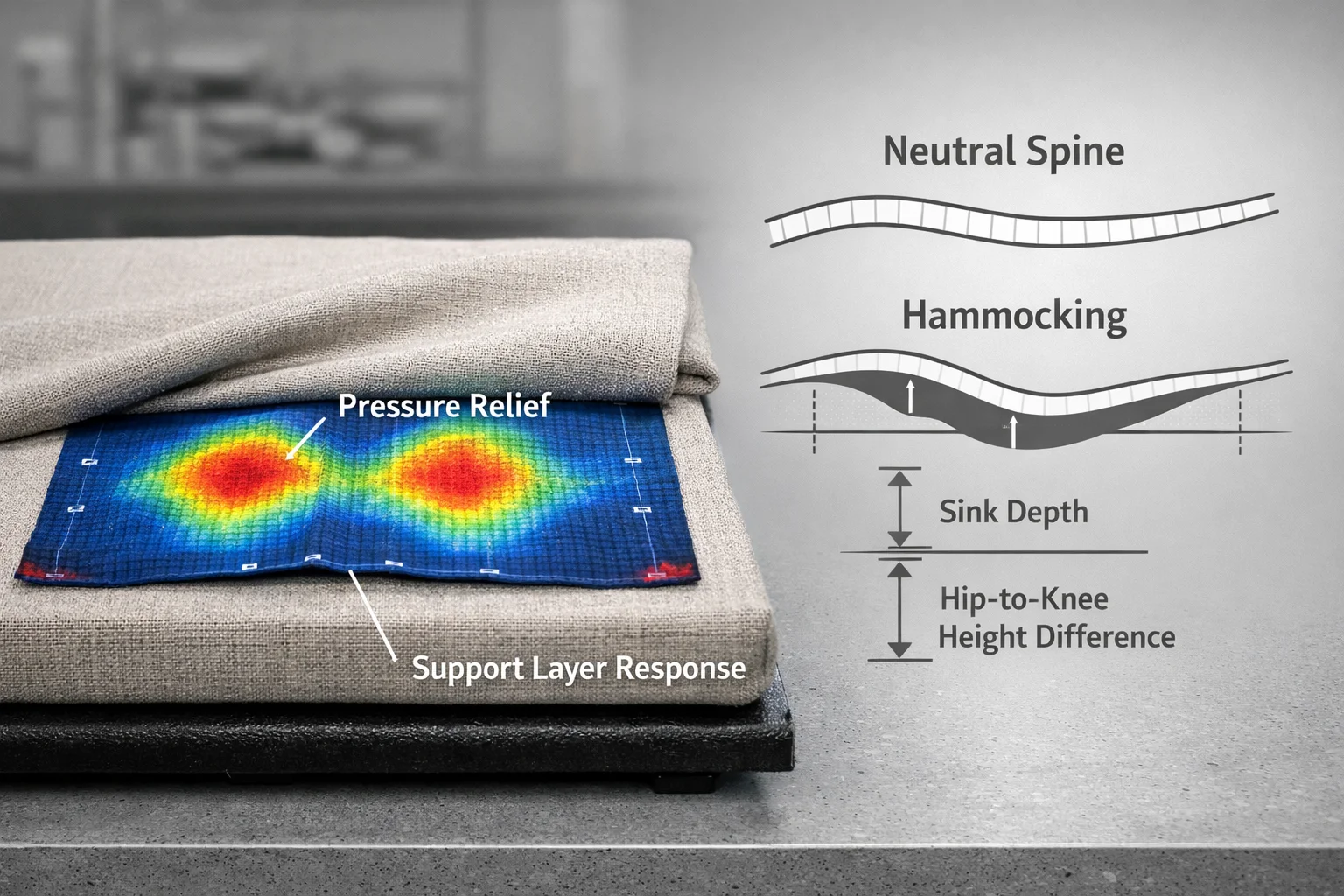
Futon Comfort: The Density/Flexibility Paradox
Why most futons feel terrible and what construction features separate comfortable futons from disappointing ones. The material and design choices that determine daily comfort.
Analyze Details →