Futon Comfort: The Density/Flexibility Paradox
Introduction
I used to tell myself that my back wanted a firm surface, because that is what salespeople kept saying and what I wanted to believe. After enough uncomfortable sofas and futons, I realized I was confusing firm with hard. A hard surface just pushes back against you, and over time that pressure adds up in your hips, shoulders, and lower back.
This misunderstanding is what I think of as the Spartan Fallacy. People imagine that if something feels tough and unyielding, it must be better for posture. In reality, comfort comes from two different jobs happening at the same time, and most bad seating fails because it only does one of them.
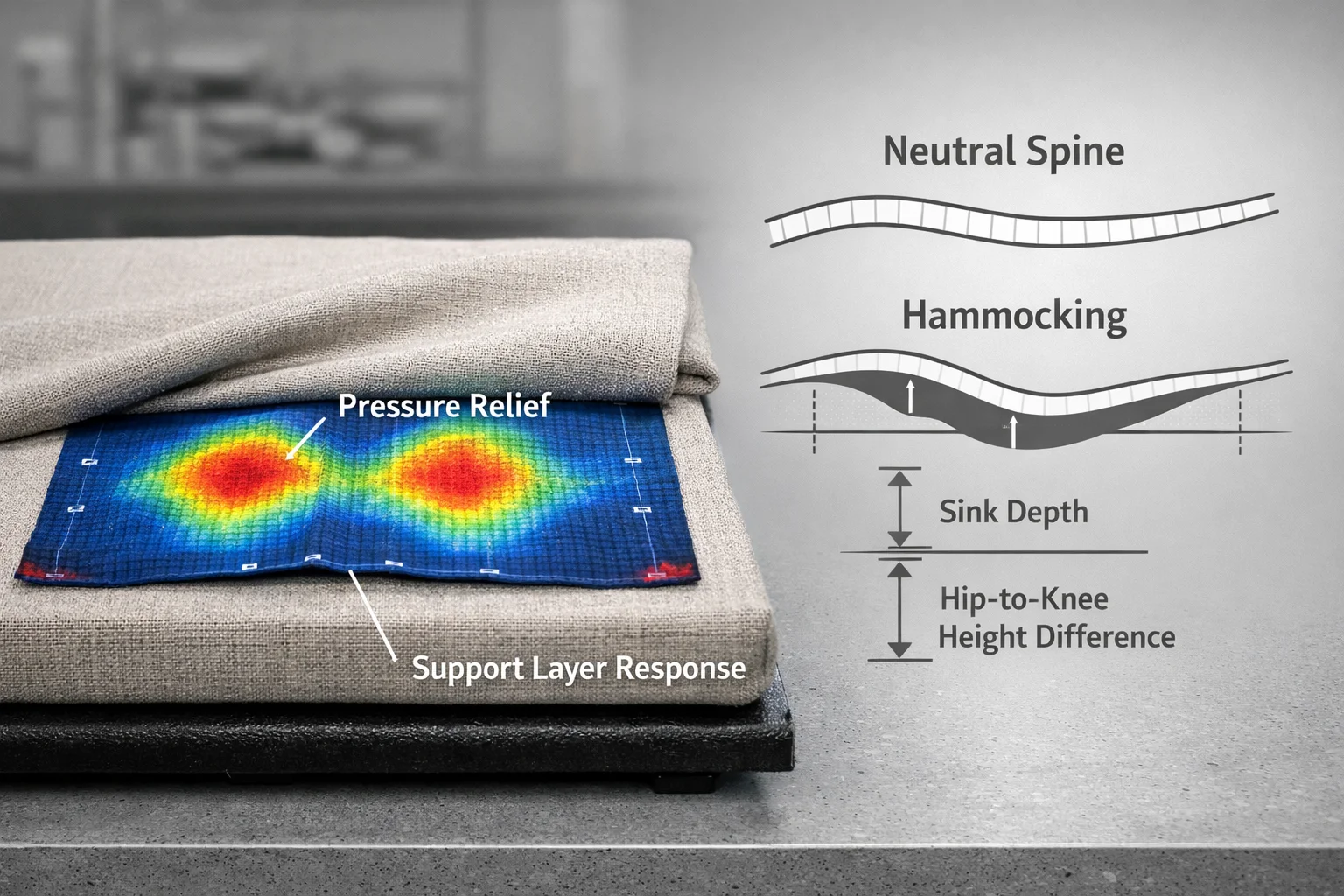
The first job is pressure relief. When you sit down, the surface should soften enough to spread your weight instead of concentrating it on a few bony points. If you feel sharp pressure under your sit bones or shoulders within a minute in the showroom, that is not your body needing time to adjust, it is the furniture failing at pressure relief.
The second job is support. After the surface softens, something underneath still has to hold you up and keep your spine in a neutral position. If you sink until your hips are lower than your knees or you feel like you are sitting in a hole, the support is not doing its job, even if the top feels plush.
When you test a futon or sofa, I want you to sit still for a few minutes and pay attention to both sensations. Notice whether the surface eases pressure without letting you collapse. That balance, not raw firmness, is what your back is actually asking for, even if it has been trained to complain loudly on bad furniture.
The “Pancake Effect”
The "Pancake Effect"
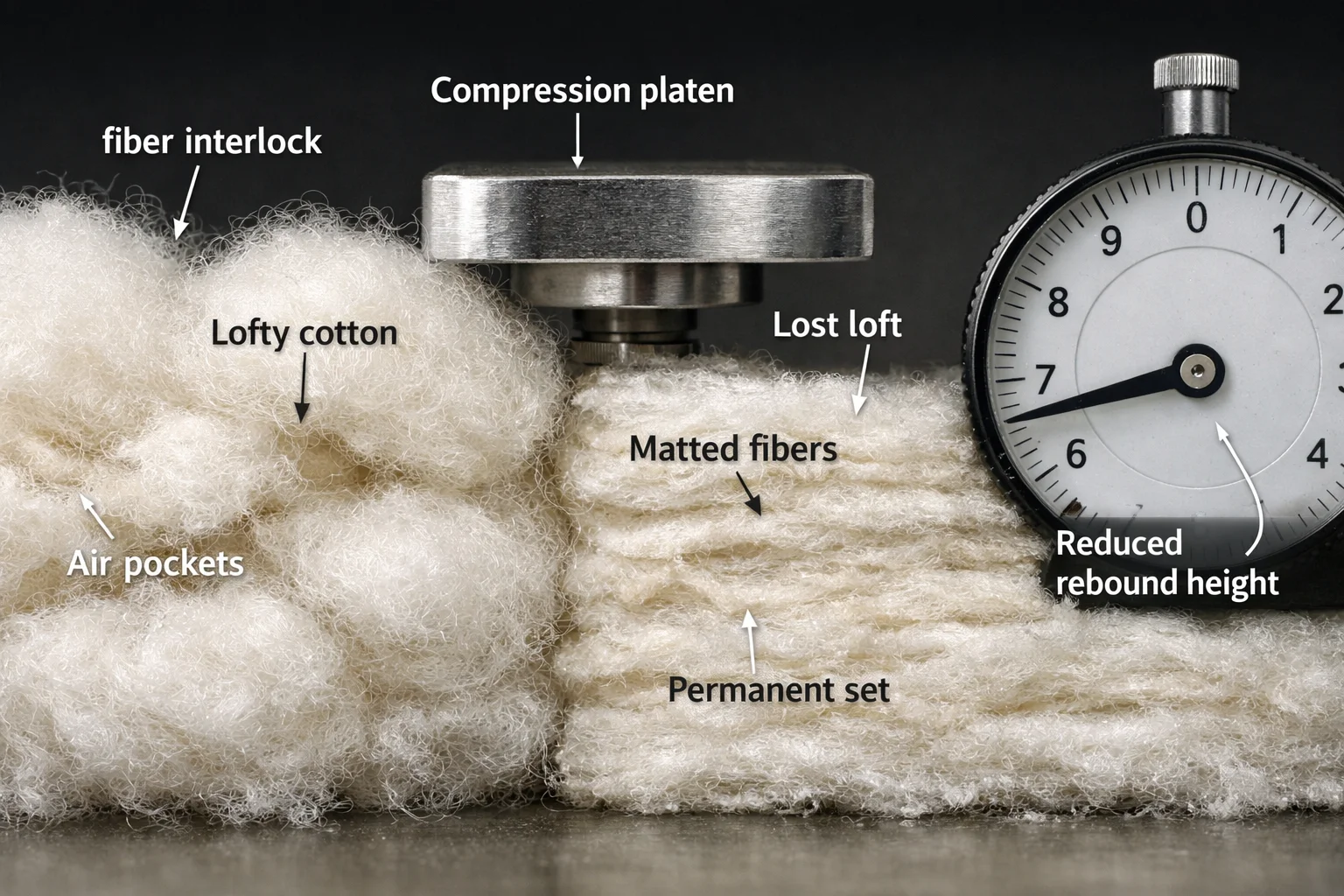
Traditional 100 percent cotton futons fail because of physics. Cotton is a natural fiber with tiny air pockets, and under your body heat and weight those fibers slowly grab onto each other. Once that happens the compression is permanent, so the padding never springs back. After a few months the mattress feels like a flat board, and the pressure gets so concentrated that you can feel your own heartbeat in your hip.I have owned cotton futons that felt fine on day one and miserable by month six, and this is why. At first the trapped air gives a soft impression, but nothing inside the mattress is trying to push back once the fibers lock together. What you end up sitting on is not firm support, it is dead weight that has nowhere left to go.
The key thing I want you to understand is that this flattening is not a defect or bad luck. It is the expected outcome of using a material that cannot recover after repeated compression. Rotating it, flipping it, or beating it with your hands does not fix the problem, it just rearranges the same packed fibers.
When you are in a showroom and you see a futon or sofa advertised as all cotton, I want you to think ahead six months. Sit on it and notice how quickly it stops responding under your weight. If it feels good only because it is dense and unmoving, you are feeling the beginning of the pancake effect, not real support.
You can also do a simple test with your hand. Press down hard for a few seconds and then lift your hand away. If the surface barely rises back or stays dented, that is a warning sign that your body will eventually flatten it the same way.
This does not mean every firm seat is bad, but it does mean firmness has to come from something resilient underneath. If a salesperson tells you cotton is better because it is natural, I ignore the word natural and focus on behavior. What matters is whether the material can repeatedly soften and recover, day after day, without turning into a slab.
The Hybrid Engineering Solution
After a few bad futons, I started paying attention to the ones that did not collapse or turn into boards. What they had in common was a layered build that let softness and support do their jobs separately instead of asking one material to do everything.
The most reliable designs use what is often called a sandwich construction, even if the tag does not say it out loud. At the center there is a slab of high resiliency foam that is a few inches thick, usually somewhere between two and four. This is the part that actually supports you, because it pushes back consistently instead of packing down and giving up.
When you sit on a futon like this, you should feel a gentle resistance building as you settle in. I am not talking about hardness, but a sense that something underneath is catching you before you sink too far. If you can feel that support even after sitting for a few minutes, the core is doing its job.
On either side of that foam core there is typically cotton batting. This cotton is not there to hold you up, and that is the crucial difference. Its role is to soften the first contact so your hips and shoulders are not hitting foam directly, which can feel abrupt and uncomfortable.
In a showroom, this shows up as a surface that feels welcoming right away but does not keep collapsing as you stay seated. I press down with my hand and notice whether I hit a point where the resistance increases instead of disappearing. That change in resistance is the transition from cotton to foam, and it is exactly what you want.
The final layer, which most people never think to ask about, is a thin wrap of polyester fiberfill around the whole thing. This layer does not add comfort in a dramatic way, but it keeps the cotton from shifting and clumping over time. Without it, even a well designed futon can start to feel lumpy as the cotton migrates.
You can sometimes feel this by rubbing your hand across the surface. If it already feels uneven or ropey when new, it will only get worse with use. A smooth, consistent surface usually means the internal layers are being held in place.
When I ask a salesperson what is inside and they cannot describe layers or mention a foam core at all, I take that as a warning. You do not need to memorize densities or brand names, but you do need confirmation that there is a resilient core doing the supporting, with softer materials above and below it.
This hybrid approach is not about luxury or gimmicks. It is about respecting how bodies actually interact with furniture over time. If you can identify these layers with your own body and hands in the store, you are far less likely to end up with another seat that feels fine today and punishes you six months from now.
ILD and the “Fold Factor”
When I finally asked why some futons kept fighting their own frames, I kept hearing the term ILD. That stands for how much force it takes to compress foam, but you do not need to remember the acronym to use the idea.
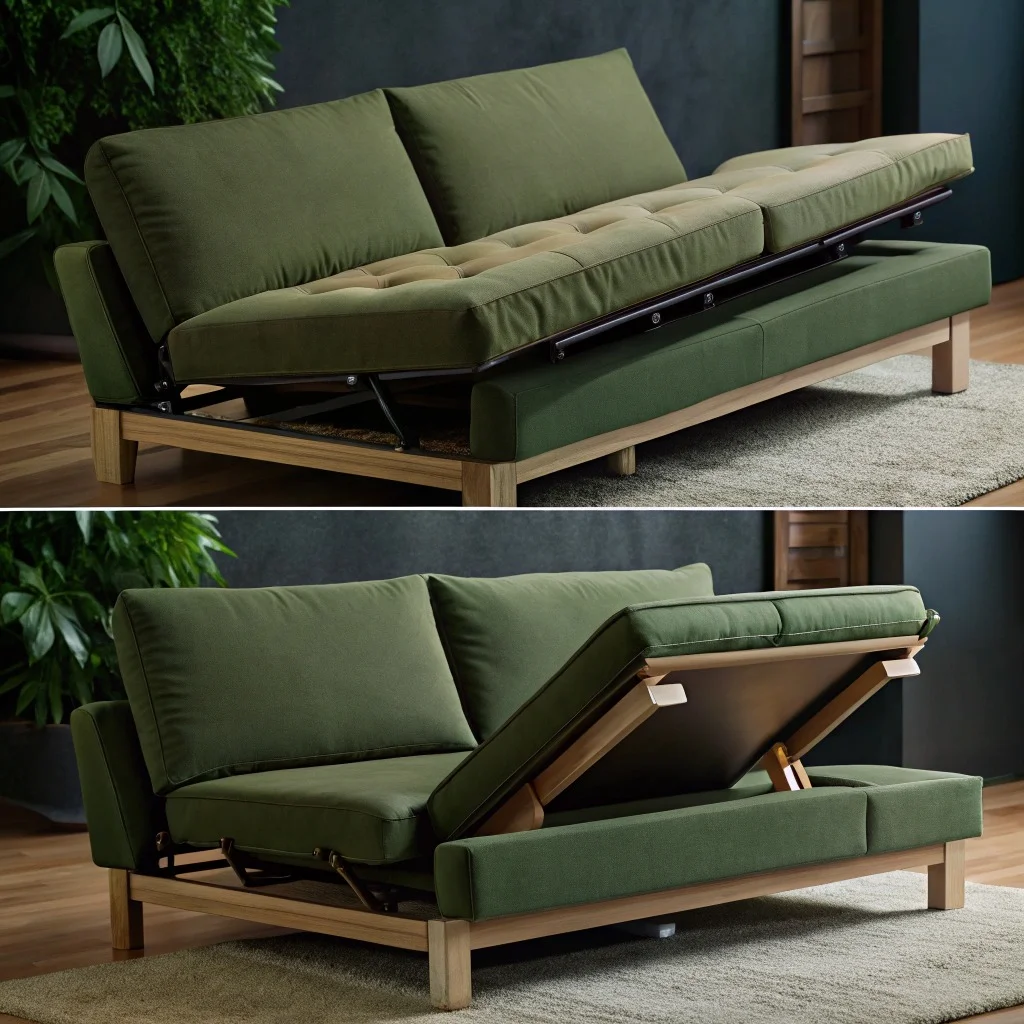
What matters is that sofas and futons want different kinds of firmness. A fixed sofa can get away with firmer foam, because it never has to bend. A futon mattress has to fold, and if the foam is too stiff it behaves like a spring that is always trying to straighten itself out.
In practical terms, sofa foam usually sits in a firmness range that feels supportive but resists bending. Futons need slightly softer foam so the mattress can fold without constantly pushing back against the frame. When the foam is too firm, the mattress does not want to stay folded, and all that stored tension gets transferred into the hinges and bolts.
I have owned futons where you could feel this battle happening. You sit down and everything feels fine, but when you convert it to a sofa it never quite wants to stay closed. Over time the hardware loosens, the frame creaks, and eventually something bends or strips out.
In a showroom, you can spot this problem without knowing any numbers. Ask the salesperson to fold the futon into sofa position, or do it yourself if they let you. Pay attention to how cooperative the mattress feels. If it snaps back aggressively or needs force to stay tucked in, the foam is probably too firm for the job.
I also push down near the fold while it is in sofa mode. If the mattress immediately tries to spring back open instead of settling, that stored energy has to go somewhere. It usually goes into the frame every single time you sit down.
When a salesperson tells me firmer is better, I ask better for what. If they cannot explain how the mattress handles folding without stressing the frame, I assume they have not thought about it. Firmness that works against the structure is not durability, it is a slow failure.
If you are choosing between two futons that feel similar when you sit, pick the one that folds more calmly. A mattress that cooperates with the frame will usually last longer, feel quieter, and stay aligned instead of slowly tearing its own hardware apart.
ILD is just the technical name for this behavior. What you are really shopping for is balance. You want foam that supports your body when you sit, but relaxes enough to bend when the furniture asks it to. When those two needs are in conflict, the furniture always loses in the end.
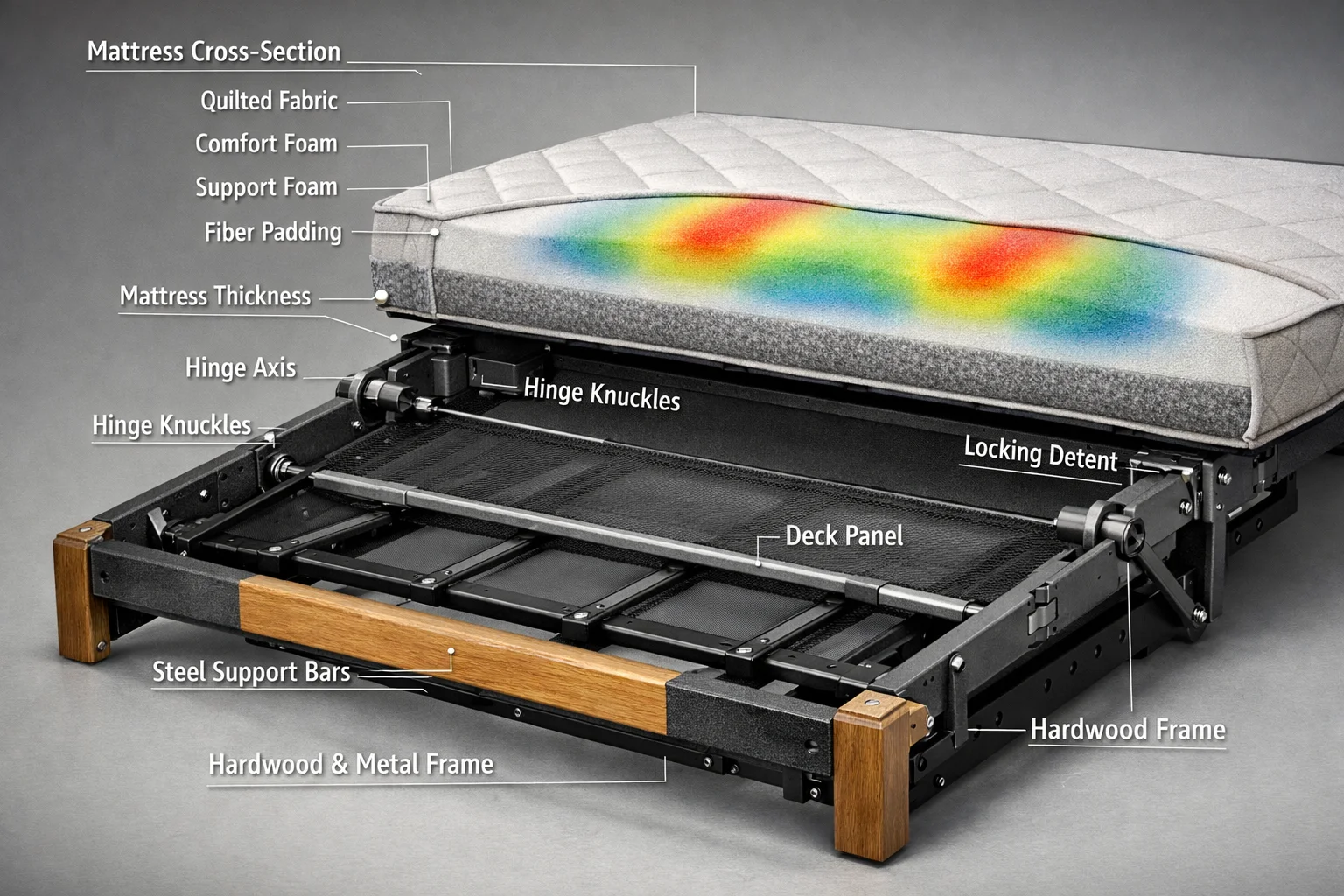
When I look at a cutaway like this, I am not thinking about materials in an abstract way. I am thinking about where my body will stop sinking and what is going to take the load after the surface gives way.
The blue center layer is the part I care about most, because that is what decides whether the seat keeps supporting you after the first minute. In a showroom, I try to recreate this picture with my own weight by sitting down slowly and noticing when the resistance changes. If I never feel that deeper layer engage, the mattress is relying too much on soft fibers to do a job they cannot sustain.
The white cotton layers are there for a very specific reason, and I treat them with healthy suspicion. I want just enough softness that my hips and shoulders are not hitting a hard slab, but not so much that all I feel is compression with no bottom. If the surface feels thick and pillowy yet my spine starts to sag, the balance in this diagram is off in real life.
I also use this mental image when I press with my hand near the edge. I push until I feel a firm stop, then I release and watch how quickly it recovers. A good build will rebound smoothly because the foam core is doing the work and the cotton is just along for the ride.
If a salesperson talks only about how many layers there are, I bring the conversation back to this picture. I ask where the actual support lives and how thick that layer is relative to the soft stuff. I do not need exact numbers, but I do need to hear that the structure is intentional and not just a pile of padding.
This image is useful because it reminds you that comfort is not a single material. It is a sequence. When you are in the store, your job is to feel that sequence happening in the right order, surface softness first and steady support right after. If you can feel both, you are much closer to a seat that will still feel good long after the showroom glow wears off.
Micro-Spring Technology
Micro-Spring Technology
Modern luxury futons often include micro pocketed coils. These are short springs, usually around two inches tall, that can bend fully without snapping. Their job is to respond locally to your weight instead of compressing as one flat mass, which gives better pressure relief than foam and cotton alone.The first time I sat on a futon with micro springs, the difference was not dramatic in a soft plush way. What I noticed was that my hips stopped feeling crowded, even though the seat was not thick or squishy. My weight felt distributed instead of stacked on two points.
What micro springs do well is solve a problem that foam alone struggles with over time. Foam pushes back as a single piece, so heavier parts of your body tend to win that battle first. Micro springs react individually, which means your hips can sink a little without dragging your lower back down with them.
In a showroom, I test this by sitting normally and then shifting slightly side to side. On a good micro spring seat, the pressure changes smoothly and locally. It should feel like the surface is adjusting under you instead of forcing your whole body to move as one unit.
I also pay attention to how quickly discomfort shows up. With basic foam and cotton, I usually feel pressure building under my sit bones within a minute or two. With micro springs, that sharp pressure takes much longer to appear, if it appears at all.
These springs are not there to replace support, and that is where people get confused. They are too short to hold you up on their own. They still need a foam core or a solid base underneath them to stop your body from sinking too far.
When a salesperson talks about micro springs as if they are the main support, I get cautious. I ask what is under them. If the answer is vague or sounds like more soft material, the springs may just be floating in padding, which limits their benefit.
You can also use your hand to feel how they behave. Press down with your palm and move it in a small circle. If the resistance feels even and responsive instead of mushy or dead, you are probably feeling the springs doing their job.
One thing I always check is edge behavior. I sit near the edge and see if the surface still feels responsive or if it collapses. Micro springs that are well integrated tend to keep the edge from feeling like a cliff, even without heavy edge rails.
For futons in particular, I pay attention to how the mattress folds with micro springs inside. A good design will bend smoothly without feeling like it is fighting itself. If the fold feels stiff or uneven, the springs may not be designed for repeated bending, no matter what the tag says.
I do not treat micro spring technology as a guarantee of quality. I treat it as a tool that can improve pressure relief when it is layered correctly. If you feel better weight distribution without losing support, that is when the technology is actually helping you.
If you are choosing between two futons that both feel supportive, I lean toward the one with micro springs when everything else is equal. Not because it is fancy, but because it gives your body more ways to settle comfortably without forcing the foam to do all the work.
Technical Comfort Upgrade Path
If you already own a futon that is letting you down, I do not think the only answer is throwing it out. I have made a few targeted changes over the years that meaningfully improved comfort, and you can evaluate each one with simple checks at home or in a store.The first thing I deal with is sag, because nothing else matters if the base is failing. I flip the mattress off and look at the slats with my own eyes. If any are cracked, missing, or spaced far enough apart that I can easily slide my hand between them, the mattress is being asked to bridge gaps it was never designed to handle. I have found that tightening those gaps to about the width of two fingers makes a noticeable difference, because the mattress stops bowing into empty space every time you sit.
Once the base is doing its job, I think about surface conformity. If the futon feels hard on top but supportive underneath, I do not replace the whole mattress right away. I add a thin latex topper, usually around two inches, and put it inside the futon cover so it does not slide. Latex matters here because it pushes back immediately instead of letting you sink until you hit something solid, which is what cheap memory foam tends to do.
You can test whether this will help you before buying anything. Press your hand into the futon and notice whether the pressure feels sharp right at the surface or if it builds gradually. If the discomfort is immediate, a responsive surface layer can help. If you are already sinking deep and bottoming out, a topper will not fix the problem, because the support underneath is already gone.
If your futon is made of pure cotton and feels flat but not completely dead, there is one small trick that can buy you time. I have put cotton futons in direct sunlight for a few hours on a warm day, usually about half a day. The heat causes the fibers to relax and expand slightly, which temporarily restores a bit of loft.
I want to be clear about expectations here. This does not reverse the pancake effect or make an old futon new again. What it does is soften the surface and reduce that board like feel for a short while, which can be helpful if you are not ready to replace the mattress yet.
The way I decide whether these upgrades are worth it is simple. After fixing slats or adding a topper, I sit still for several minutes and see if pressure builds more slowly than before. If my hips and lower back feel calmer instead of tense, the intervention is working. If the discomfort feels the same or just delayed by a few seconds, I stop investing in patches and start planning a replacement.
I include this upgrade path because I know not everyone is shopping from scratch. Even when you are in a showroom, understanding these steps helps you see where comfort is really coming from. A futon that needs a pile of fixes to feel decent is showing you its limits. A good one should already be doing most of this work on its own, before you ever think about upgrades.
Explore Technical Reference
Sofa Beds: The Dual-Function Compromise
How sofa bed mechanisms balance sitting and sleeping functions. Understanding pull-out systems, click-clacks, and why engineering has improved but compromise remains inevitable.
Analyze Details →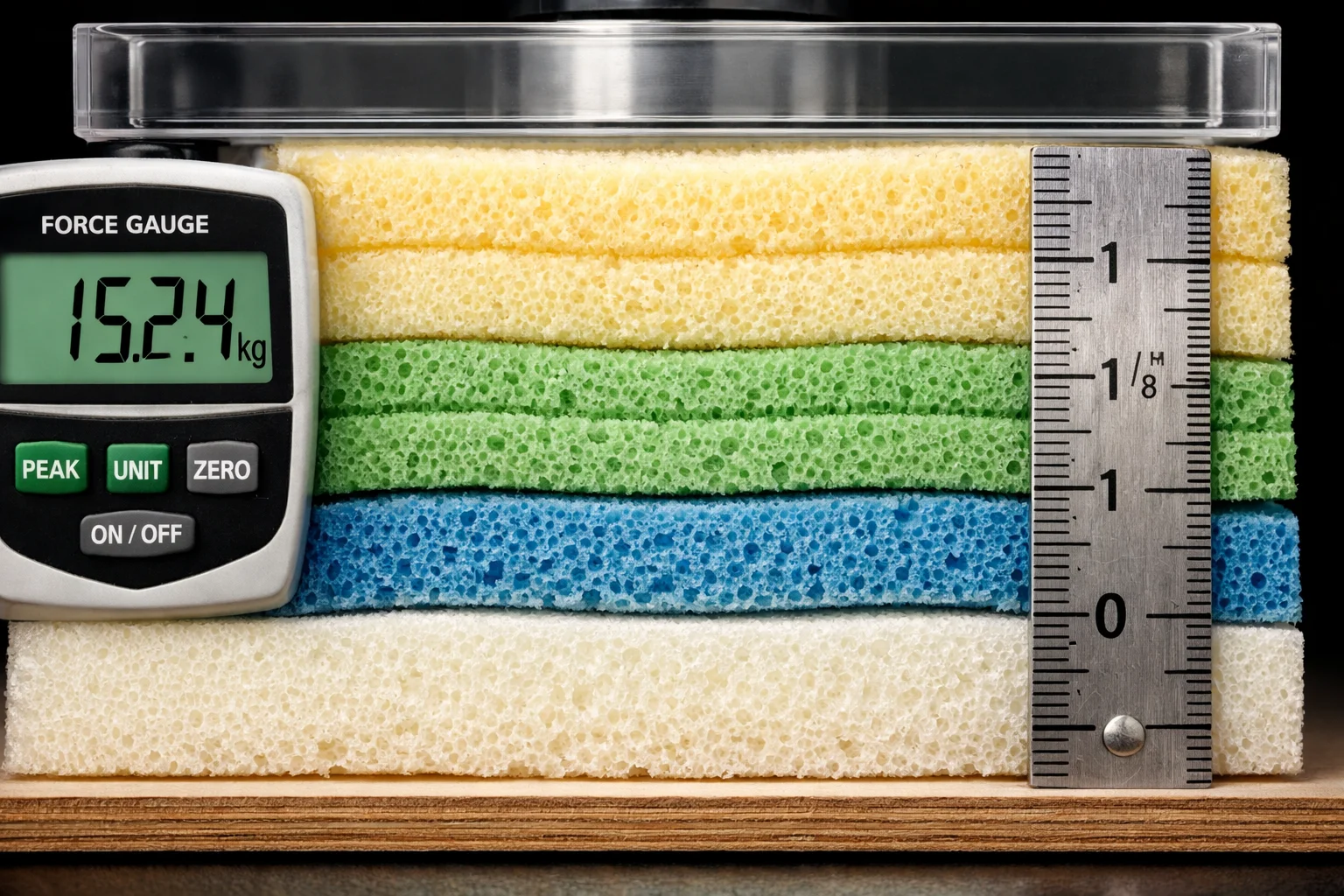
Foldable Floor Sofas: The Physics of Frameless Seating
How floor sofas, foam blocks, and origami-style seating work. Understanding the trade-offs of purely foam-based seating without traditional frame construction.
Analyze Details →