Daybed vs. Sofa Bed: Choose Your Sacrifice
Introduction
I learned the hard way that “daybed” and “sofa bed” sound like twins, but they age like opposites. A daybed is a bed pretending to be a sofa, and a sofa bed is a sofa pretending to be a bed. Once you see that, the shopping process gets a lot simpler because you stop expecting one piece to excel at two jobs.
When you’re standing in a showroom, I want you to decide which job is non negotiable for your home. If you need a real sleeping surface that won’t make a guest hate you by morning, you should treat it like you’re buying a bed first, then accept that the sitting experience will be more upright and less loungey. If you need a comfortable everyday sofa that happens to save you in a pinch, treat it like you’re buying a sofa first, then accept that the bed mode will involve compromises like seams, a bar you might feel, or a thinner mattress than you would ever choose for a primary bed.
I also want you to be honest about frequency, because frequency is where people get ripped off. “Occasional guest” means something like a few nights a year, not a month of someone staying over or you working from it daily. If you are going to sleep on it regularly, that pushes you toward bed first thinking, even if the store is trying to sell you on how “sofa like” it feels.
Here’s the mental trick I use: I picture the worst case moment, not the best case moment. For a daybed, that’s you and a friend trying to sit and talk for an hour without perching on the edge. For a sofa bed, that’s someone opening it late at night and then trying to sleep through the middle seam and the support structure underneath.
As you read the rest of this guide, I’m going to keep coming back to one question, what is the sacrificed function. Once you label the sacrifice up front, you can judge every feature in the store with clear eyes instead of marketing words.
The "Bar-in-the-Back" Problem
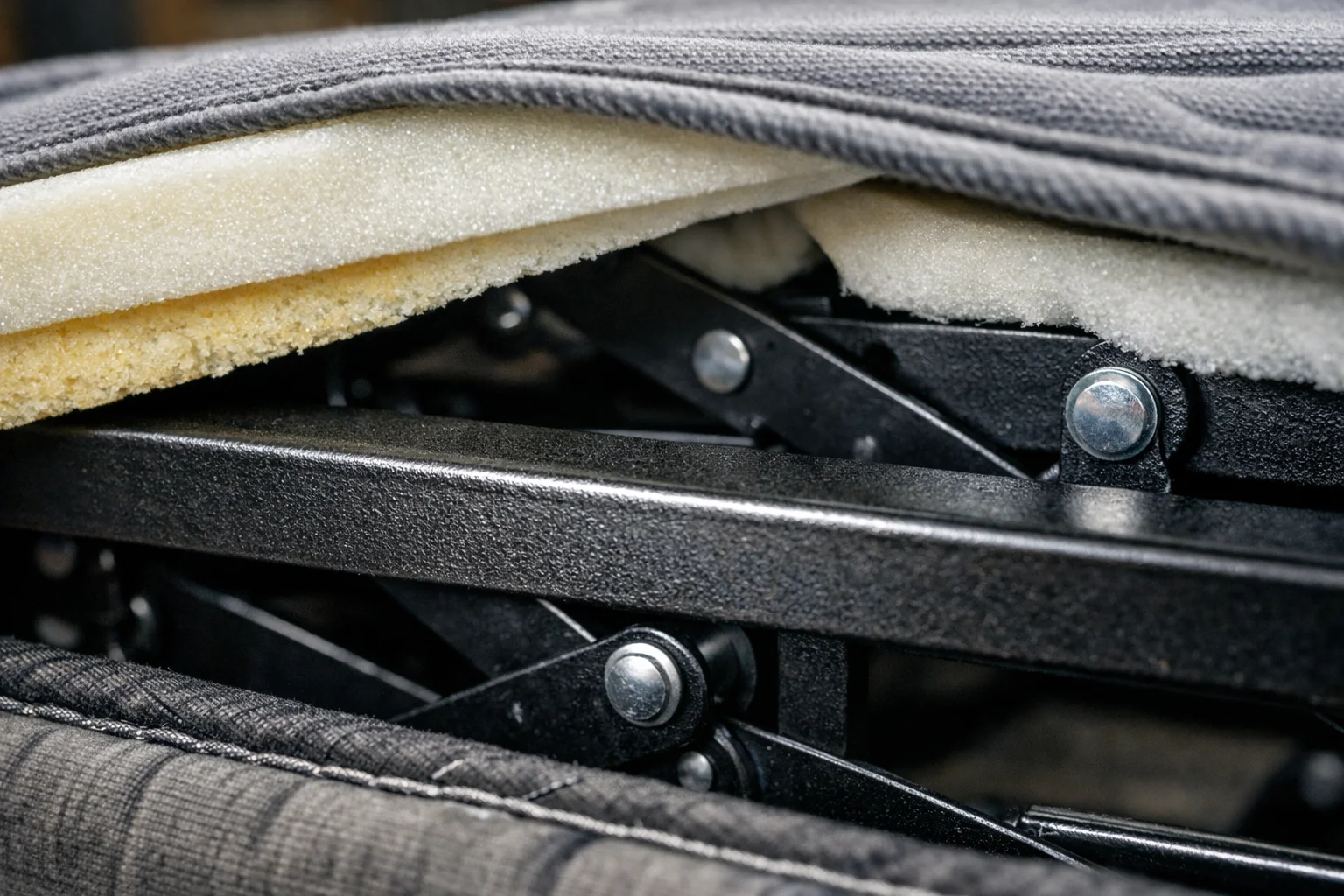
This is the complaint I hear most from people who thought they were buying a “real bed” hidden inside a sofa. A pull out sofa bed has to fold up into a metal frame, so the mattress is usually thin enough that it can bend and disappear into the chassis.The part that causes the misery is the scissor like metal mechanism underneath, especially the cross bars that span side to side to hold you up. In the showroom, a thin mattress can feel fine for thirty seconds, but when someone actually sleeps on it their hips and shoulders sink, the foam compresses, and suddenly their spine is resting on a bar that was never meant to be felt.
When I want to know if a pull out is going to do this, I do not just lie down and call it good. I press my palm and then my forearm straight down through the mattress in the middle third of the bed, because that is where a lot of bodies end up. If I can easily find a hard ridge with my hand, your guest will definitely find it at 2 a.m. with their back.
If the store will let you, I also sit on the opened bed right where a sleeper’s hips would land and gently bounce once or twice. If you feel a sharp firmness that seems to come from a narrow line instead of a broad platform, that is the bar. A better pull out can reduce this with a different deck design or a thicker, better mattress, but there is only so much you can cheat when the bed has to fold.
This is where a daybed has a quiet advantage that salespeople rarely spell out. Because a daybed does not fold into a mechanism, you can put a real, thick mattress on it, something closer to what you would choose for a normal bed. That extra depth means you are resting on mattress materials, not on the frame, and in my experience that is the difference between “they slept fine” and “they woke up angry.”
If you are choosing between the two and sleeping comfort matters, I would treat any pull out as guilty until proven innocent. Make them open it fully, take your shoes off, and actually test for that bar with your own weight and your own hands, because the mattress cover and showroom lighting can hide a lot.
Technical Comparison
Mechanism vs. Static
When you compare these two in person, I start with one simple question, what is going to wear out first. A daybed is basically a static frame that just sits there, and the “conversion” is you moving pillows around. In my experience that kind of simplicity ages well, because nothing is cycling through the same hinge points and nothing can get out of alignment and start fighting you.
A sofa bed is the opposite, it is a piece of furniture with a mechanical system hiding inside it. Even if it feels fine on day one, you are trusting latches, pivots, springs, and lots of fasteners to keep working smoothly. What I see over time is not usually one dramatic break, it is the slow creep of squeaks, a slight twist that makes it harder to open, or a bend that makes the bed sit unevenly.
In the showroom, I want you to open and close the sofa bed more than once, slowly, and listen for rubbing or popping that sounds like metal shifting under load. I also put my hand on the front rail and gently wiggle it side to side with the bed both closed and open, because sloppy play is often a preview of future rattles.
I also watch how the staff handles it, because if the salesperson has a “trick” or has to lift at an odd angle, that is a clue the mechanism is finicky. If it already needs special handling in a quiet showroom, it is not going to get nicer after years of late night guest setups and people forcing it when they are tired.
With a daybed, my check is more basic but still important. I put my hands on the frame and try to rack it gently corner to corner, because a flimsy daybed can wobble and start squeaking even without moving parts. If it feels solid and the joints do not complain when I shift my weight on it, that is usually as complicated as it gets, and that is a good thing.
Sitting Depth (The Ergonomic Gap)
The biggest comfort difference I notice has nothing to do with softness, it is geometry. A typical sofa bed is built to be a sofa first, so the seat depth and back angle usually let your legs fall naturally and your lower back find the back cushion. When you sit on one, you can tell pretty quickly whether it supports you or whether you immediately start scooting and adjusting.
A daybed is where people get surprised, because the “seat” is really a mattress, and that mattress is much deeper front to back than a normal sofa seat. If you sit back against the wall or the back rail, your feet often cannot plant on the floor comfortably, and that turns hanging out into a perch. This is not a minor detail if you will use it as everyday seating.
If you are testing a daybed in a store, I want you to sit the way you will actually sit at home, with your back against whatever will be behind you, and then check whether your feet can rest flat without you sliding forward. If you end up needing to brace yourself with your core or you feel pressure building behind your knees, that is the depth problem showing itself.
The honest fix is to plan for bolsters and back pillows that effectively steal depth and bring the “back” forward. I look for a setup where, after you add the pillows you would really live with, you can still sit for ten minutes without constantly readjusting, and you can still get up without doing that awkward rock forward.
If you are leaning sofa bed because you care about sitting, do not let the bed function distract you from the seat itself. I sit all the way back, check thigh support, and then notice whether the back cushion lets my lower back relax or whether it forces a slouch. If the sofa part is not comfortable in the position you naturally sit, the fact that it opens into a bed will not make you like it any more after the novelty wears off.
Internal Logic Comparison
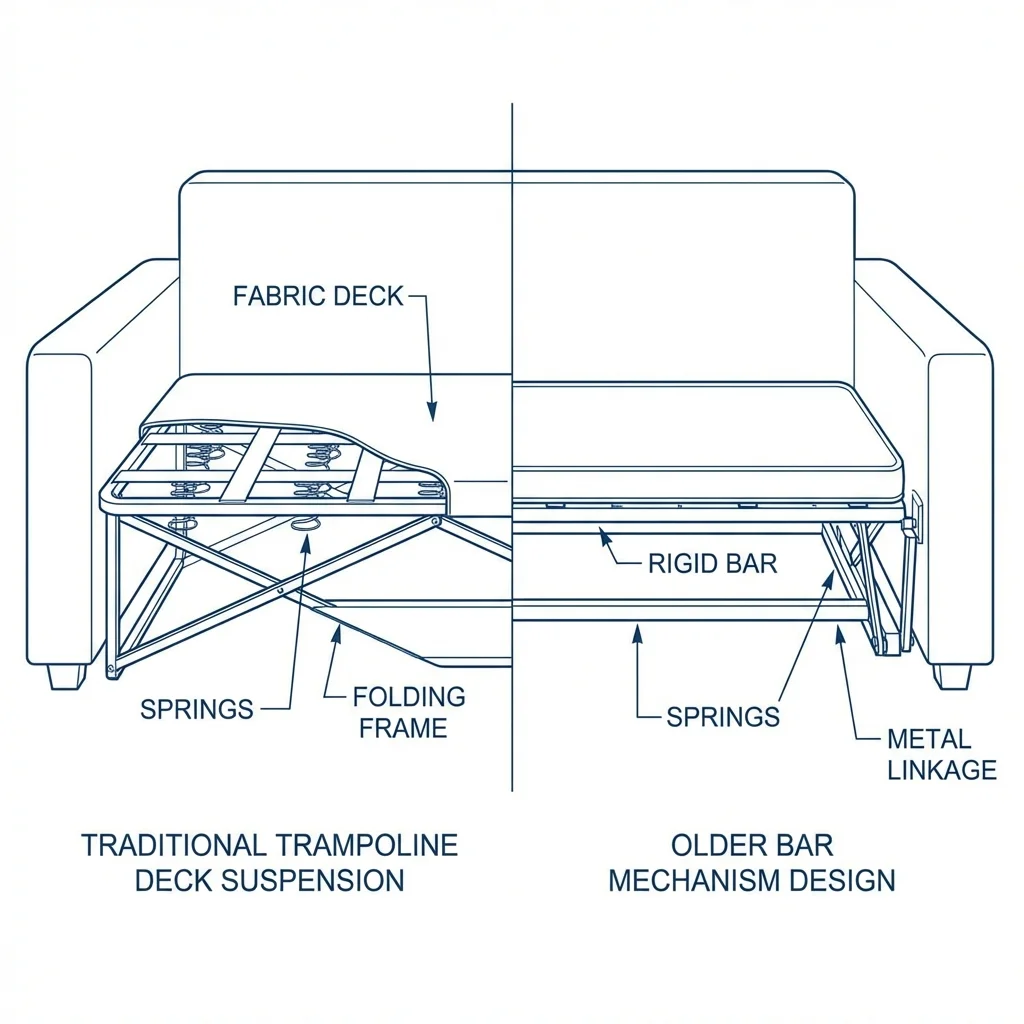
When I compare these in my head, I stop thinking “which is more comfortable” and start thinking “what is the inside space being used for.” A daybed spends its interior volume on mattress, which is why it can feel like a real bed. A sofa bed spends that same interior volume on folded steel, which is why the bed part is always fighting for leftover thickness.
In a showroom, you can actually see this if you look at the piece from the side. On a daybed, the “thickness” you see is mostly sleep surface, so your money is going into something you feel every night. On a sofa bed, a lot of that thickness is the hidden hardware and clearance it needs to fold, so you are paying for complexity that does not directly make the mattress nicer.
This is why I do a specific test on the sofa bed when it is closed. I sit in the middle and pay attention to whether the seat feels oddly high or oddly firm in a way that does not match the cushions, because sometimes you are feeling the packaged mechanism below. If you already feel like you are perched instead of settled, that is often the frame and folded bed dictating the sofa’s proportions.
Then I open it and look at what is doing the supporting. If I see a lot of widely spaced metal members under the sleep area, I assume I will feel them unless the mattress is genuinely substantial. If the deck looks more like a continuous platform, or at least a tighter support surface, I take that as a good sign because it gives the mattress a fighting chance.
On the daybed side, the internal logic is simpler but it still matters. I look at how the mattress will be held in place, because a slick platform or widely spaced slats can let a mattress creep and shift over time. If I can grab the mattress in the showroom model and easily slide it, I assume I will be re-centering it at home after people sit and scoot.
I also want you to notice something stores rarely say out loud, bedding has to live somewhere. With a daybed, you usually end up storing sheets and a blanket separately, but the bed is always “ready” because nothing needs to unfold. With a sofa bed, the promise is hidden bed, but the reality is that many of them cannot store much bedding inside without making the close-up awkward or stressing the mechanism, so you still need a plan for where the linens go.
If sleeping comfort is your priority, this internal logic check keeps you from being hypnotized by upholstery and sales talk. I basically ask, “Is this object mostly mattress, or mostly machine,” then I decide whether the tradeoff fits how you will actually use it on a tired, normal night.
The "Trundle" Secret
Daybeds have one expansion trick that sofa beds basically cannot copy, and it is the trundle.In plain terms, it is a second steel frame on wheels that lives underneath the main daybed and rolls out when you need it. Instead of one fold out mattress that forces two people to share, you can end up with two separate twin sleep spots in the exact same footprint as the daybed when it is “sofa mode.”
What I like about this, as a buyer, is that it changes the social math. Two kids, two friends, or a parent and child can sleep without negotiating one shared surface, and each person gets their own blanket situation without someone stealing the covers all night.
In the showroom, I pull the trundle all the way out and I pay attention to the feel of the rollout. If it wobbles, binds, or feels like one wheel is lagging behind the others, I assume it will get worse on carpet at home, especially after the frame gets a little racked from real use.
Then I check the height and the “gap reality.” Some trundles pop up to near the same height as the main mattress, and some stay low like a true underbed. If it stays low, I picture an adult using it, because getting up from a low mattress in the morning is where a lot of people suddenly hate the setup.
I also look underneath for how the trundle is supported. If I see a lot of thin, widely spaced metal slats or a saggy fabric deck, I assume the sleep will feel hammocked unless the mattress is unusually good. If it looks more like a solid, evenly supported platform, I take that as a sign it will feel less like a temporary cot.
One more practical check, I ask where the trundle mattress goes when you stow it. If the salesperson says you have to use a very thin mattress or it will not roll back under, that is not a small detail, it is the whole comfort equation. I would rather hear “it fits an actual mattress” than “it fits our special trundle mattress,” because special often means thin.
Finally, I measure it with my eyes the way it will be used, not the way it is staged. I make sure there is room to fully pull it out with your coffee table, rug, or radiator where it will actually live, because a trundle that can only come out halfway is not a second bed, it is a storage drawer with disappointment attached.
Which should you choose?
I choose a daybed when I actually care about sleep quality, meaning someone is going to be on it for more than a couple of one off nights a year, or the guest is the kind of person who will remember a bad mattress. The simple reason is that a daybed lets you buy a real mattress, and in the long run the mattress is what your body is negotiating with, not a folding mechanism.
If you are shopping this way, I treat the daybed frame like a holder and I put most of my effort into mattress selection and support. In the showroom I focus on whether the frame feels rigid, whether the slats look like they will support evenly without bouncing, and whether the back and arms will make sitting tolerable once you add the pillows you will actually live with.
I choose a sofa bed when I need a good everyday sofa first, and the bed is there for rare emergencies. If you spend hours a day on it watching TV, hosting friends, or working, the seating comfort and the way the cushions wear are the main event, and it is easy to regret buying a “bed first” piece that you sit on constantly.
When I go this route, I judge it like a sofa with a risky bonus feature. I sit the way I sit at home, I pay attention to whether the seat feels high or stiff because the folded bed is underneath, and then I only consider the bed function acceptable if the open bed passes my “no bar” test and the mechanism does not feel like it needs babying.
The easiest way to keep yourself from getting talked into the wrong category is to decide what failure would annoy you more. If it would drive you crazy to own a living room sofa that you never truly relax on, I would stay in sofa bed territory and keep your expectations for sleeping realistic. If it would embarrass you or cost you sleep to host people on a bad pull out, I would go daybed and plan the pillows and layout so sitting is good enough.
Technical Decision Matrix
I use this matrix when I am standing in front of two pieces that both look “fine” and I need a fast reality check. You are not trying to crown a winner, you are trying to predict which compromise will bother you six months in.
Primary use is the first fork in the road. A daybed is honest about being a sleeping surface that you sometimes sit on, so I judge it like a bed plus a backrest plan. A sofa bed is honest about being a sofa that sometimes turns into a bed, so I judge it like a sofa first, then I demand the bed mode be “not awful,” not “as good as a real bed.”
Mattress thickness is where the marketing gets slippery, so I translate it into a simple showroom action. With a daybed, you can usually use a normal mattress, which means you can shop for comfort the same way you would for any bed. With a pull out sofa bed, the mattress is often limited to something much thinner so it can fold, so I assume comfort will be more sensitive to bars, seams, and the support deck, and I physically test for those things instead of trusting the label.
Conversion effort matters more than you think when it is late and you are tired. With a daybed, “conversion” usually means you move pillows and maybe pull a blanket from a closet, so the friction is low and you are more likely to actually use it as intended. With a sofa bed, you are betting on hardware, clearance, and your willingness to wrestle it open, so I make you open and close it in the store and I pay attention to whether it feels smooth or like a chore you will eventually avoid.
Footprint is where people get surprised after delivery. A daybed tends to claim its full bed sized space all the time, so you need to be comfortable with that permanent rectangle in the room. A sofa bed lies a little in the nicest way, it looks compact until you open it, so in the showroom I pace out the open length in my head and I picture your coffee table, rug edge, radiator, or wall ledge, because the bed only “works” if it can fully open without rearranging your whole room.
Repairability is my long term sanity check. A daybed is usually a frame plus a standard size mattress, so if something annoys you later you can swap the mattress, replace slats, tighten hardware, or even change the whole mattress without trashing the furniture. A sofa bed’s weak point is the custom mechanism, so if the opening action gets rough or something bends, you are often stuck with proprietary parts and a repair that costs enough that people give up and live with a squeak, or replace the whole thing.
When you are torn, I suggest you decide which kind of failure you can live with. If you can accept “not the best sofa” but you cannot accept a bad night’s sleep for guests, I would lean daybed and spend the energy on the mattress and pillow setup. If you cannot accept a living room sofa you never love sitting on, I would lean sofa bed and treat the bed mode like a bonus that must pass your bar and mechanism tests before you pay for it.
Explore Technical Reference
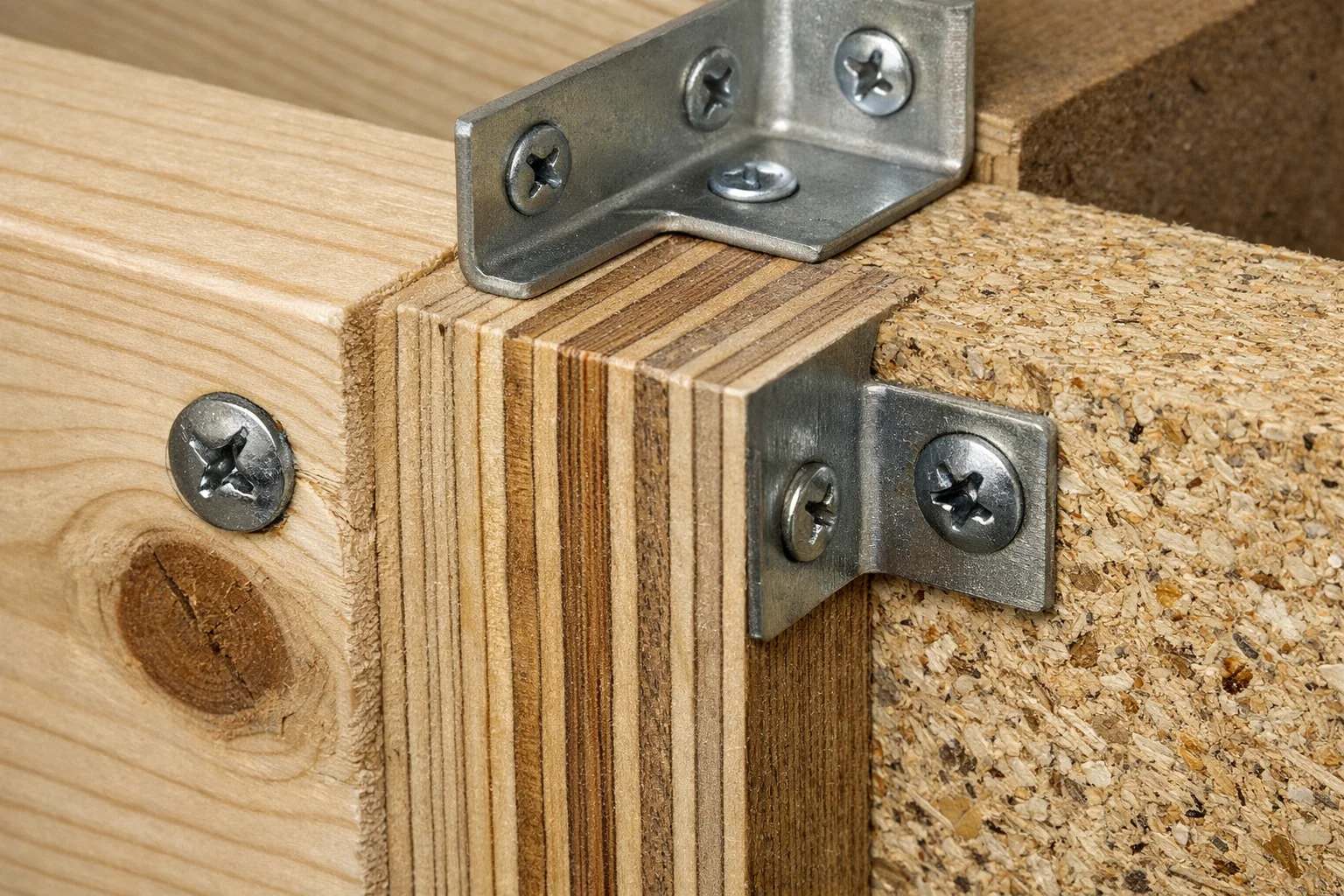
Sleeper Frames: The Torque Conflict
Understanding why sleeper sofa frames require heavy-duty construction
Analyze Details →
Foldable Floor Sofas: The Physics of Frameless Seating
How floor sofas, foam blocks, and origami-style seating work. Understanding the trade-offs of purely foam-based seating without traditional frame construction.
Analyze Details →