Sleeper Frames: The Torque Conflict
Introduction
When I finally understood this, my expectations changed overnight. A sleeper sofa is not just a couch that happens to open. It is a steel mechanism that twists and pulls against the frame every single time you open or close it, and that force never goes away.
That mechanical torque is the reason sleeper sofas fail in predictable ways. The arms loosen, the frame creaks, the seat sinks, and the whole thing starts to feel tired long before a normal sofa would. If the wooden chassis is not built to handle that stress, it does not matter how nice the fabric looks or how good the mattress feels in the showroom.
What this means for you as a buyer is simple. You cannot judge a sleeper sofa the same way you judge a regular sofa. Sitting on it and saying it feels comfortable tells you almost nothing about how it will hold up once that mechanism has been opened a few dozen times.
When I shop for one now, I mentally separate the soft parts from the hard reality underneath. Cushions can be replaced and fabrics can be reupholstered, but a frame that is slowly tearing itself apart cannot be fixed without major surgery. Your goal in the showroom is to figure out whether the structure was designed for punishment or just dressed up to look convincing.
In the next sections, I will walk you through what I physically touch, push, and listen for when I am standing in front of a sleeper sofa. None of it requires tools or technical knowledge. It just requires slowing down and refusing to be rushed by sales talk.
The "Shear Point" Failure
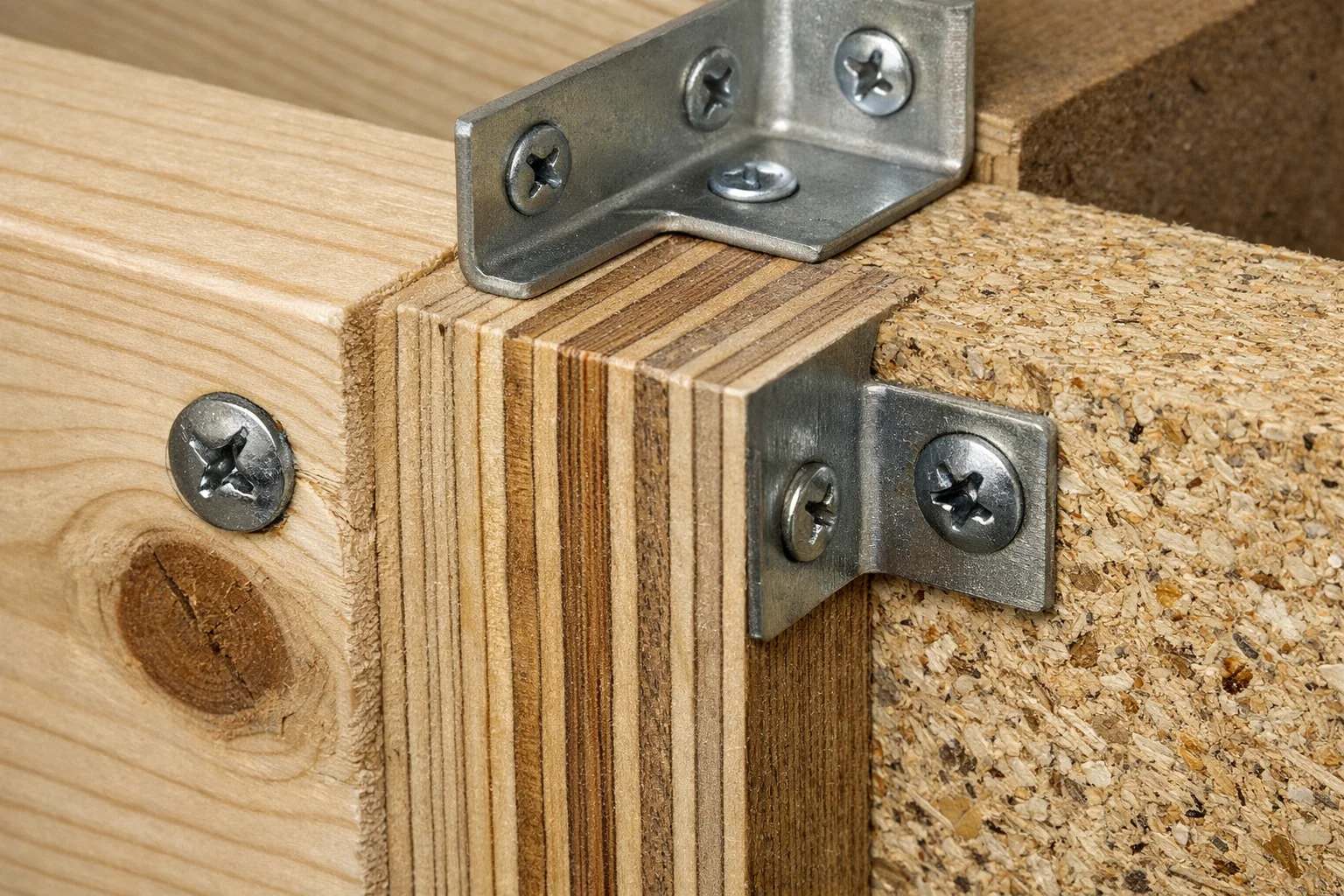
The most common structural failure in a sleeper sofa happens where the steel bed mechanism is fastened to the wooden frame. This is the spot that quietly determines whether the sofa feels solid for a decade or starts falling apart in two years.I have learned that many budget models use ordinary wood screws to hold that heavy steel assembly in place. It looks fine when it is new, but every time you open the bed you are yanking that mechanism outward and slightly upward. That motion does not pull straight out, it scrapes sideways against the screws.
Over time those screws grind away the wood fibers around them. The holes slowly get bigger, the screws loosen, and one day the mechanism shifts or drops with a loud crack. When that happens, the frame is usually done for.
The fix is surprisingly simple but rarely advertised. What I look for are machine bolts that pass completely through the wood and lock into steel T nuts on the opposite side. A T nut is a metal sleeve with teeth that bite into the wood, so the steel mechanism ends up clamped between steel on both sides. That connection does not chew itself loose because the wood is no longer taking the sideways abuse.
When I am in a showroom, I do not ask the salesperson about shear stress or fastener types. I ask if I can see the mechanism attachment point, and I crouch down and look underneath. If I see smooth bolt heads with washers instead of pointed wood screws, that gets my attention.
I also grab the front rail of the sleeper mechanism and gently tug it side to side while it is closed. I am not trying to break it, I am listening and feeling. If I feel a clunk or see the whole frame flex near the arms, I assume those screws are already working the wood.
If the store will not let you open the bed fully, that is a red flag for me. Opening and closing it once tells you a lot. A solid attachment feels dead and controlled, while a screwed in mechanism often feels loose or rattly even when new.
This is one of those details that never shows up in marketing photos. Once you know to look for it, you realize how many sleeper sofas are built to fail quietly after the warranty ends.
Frame Material Hierarchy
Kiln-Dried Hardwood (Maple or Birch)
This is the point where I slow way down in a showroom. The frame material matters more to me than any fabric or mattress option, because it decides whether everything else stays tight over time.
When a salesperson says the frame is hardwood, I do not stop there. I ask which hardwood, and I listen for maple or birch. Those woods hold fasteners firmly, which matters because the sleeper mechanism is constantly trying to wiggle itself loose.
What I actually do next is put my hand underneath the sofa and feel the side rail where the mechanism attaches. I am looking for a rail that feels substantial, not a thin strip hidden behind fabric. If it feels narrow or flimsy when I pinch it between my fingers, I move on.
I also press inward on the arm from the outside while watching the inside edge near the mattress. A good hardwood rail barely moves. If I see the arm bow or feel a soft flex, I assume the wood is either too thin or not dense enough to handle years of stress.
Thickness matters here more than people realize. I have learned that rails need to be around an inch and a quarter thick to resist bending from the steel mechanism. You do not need to measure it. Your hands can tell the difference once you start paying attention.
If the sofa feels heavy when you lift one corner slightly, that is usually a good sign. Dense hardwood adds weight, and weight in a sleeper sofa frame is your friend. Lightweight frames tend to rely on thinner wood that fatigues faster.
I do not get distracted by claims about engineered strength or reinforced composites at this stage. For a sleeper sofa, I trust dense, kiln dried hardwood because it behaves predictably. It stays straight, it holds bolts, and it does not slowly crumble around fasteners the way cheaper materials do.
If a model checks these boxes, I keep looking deeper. If it does not, I do not care how comfortable it feels for five minutes. I have learned the hard way that comfort without structure is just a short trial period before disappointment.
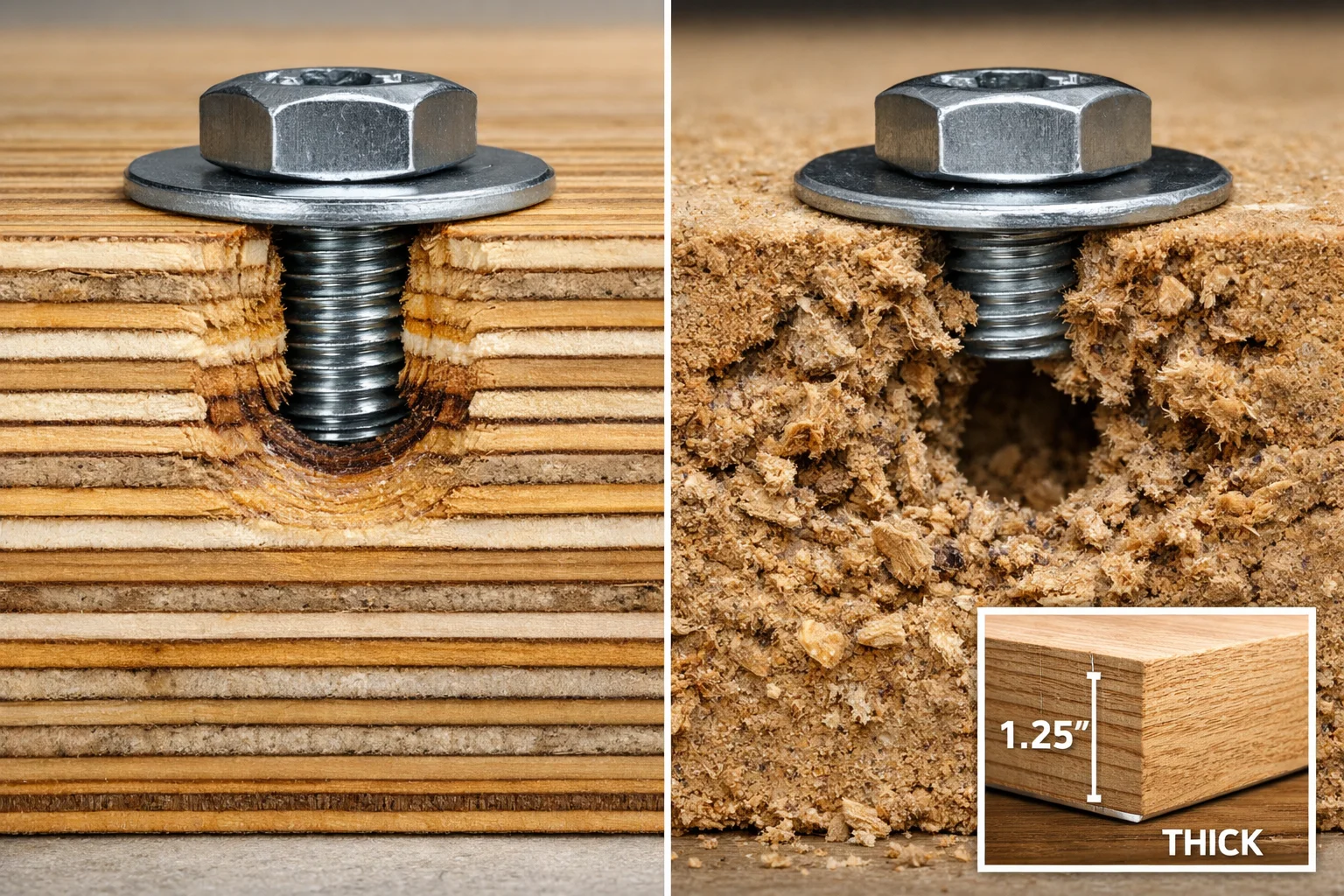
When I look at an image like this, I am not thinking about materials science. I am thinking about what happens after a few hundred openings when the steel bed keeps yanking on the same spots.
This picture explains why some frames stay tight and others slowly fall apart. Plywood is made of thin layers glued with the grain crossing each time, so when a bolt tries to move sideways the layers resist tearing. MDF is basically compressed dust, and once a bolt starts moving, the hole just grows.
In a showroom, you cannot see this cross section, but you can still protect yourself. I ask what the side rails and front rails are made of, and if I hear MDF or fiberboard anywhere near the mechanism, I walk away. It does not matter if it is reinforced or high density, repeated stress wins.
If the salesperson says plywood, I ask a follow up question about thickness and layers. I am listening for confidence and detail, not buzzwords. Someone who knows the frame is usually comfortable saying it is multi ply and used where the mechanism mounts.
I also use my fingers as a test tool. I press around the area where the mechanism bolts in and feel for a hard, crisp edge under the fabric. Plywood and hardwood feel sharp and defined, while MDF feels dull and slightly spongy even when wrapped.
What this image really changed for me is how I judge value. A sleeper sofa with a good mattress but MDF rails is a short term deal that turns expensive later. A less exciting mattress on a plywood or hardwood frame can be upgraded, while a wallowed out frame cannot.
When you are standing in front of a model and deciding whether to keep looking, this is the quiet question I ask myself. Is the wood around those bolts going to fight back, or is it going to slowly give up. Once you start thinking that way, a lot of options eliminate themselves very quickly.
2. Multi-Ply Furniture Plywood
This is where my thinking shifted from chasing solid wood to understanding where solid wood actually fails. Around a sleeper mechanism, plywood often outperforms a single piece of hardwood, and once you see why, you cannot unsee it.
Plywood is built from many thin layers glued together with the grain running in different directions. That crossing grain matters because the steel bed is always trying to twist and pull sideways, not just straight out. Solid wood has a grain that can split along a line, while plywood forces that stress to fight through layer after layer.
What this means for you in a showroom is practical. When bolts clamp a steel mechanism to multi ply plywood, the wood does not crack or tear as easily around the holes. The bolts stay tight longer, and the frame keeps its shape instead of slowly loosening one corner at a time.
I used to assume plywood was a downgrade because it was not a single piece of wood. Now I see it as the right material in the right place. Large mounting plates, front rails, and side rails near the mechanism benefit from plywood because splitting is the main enemy there.
When I ask about plywood, I am listening for multi ply furniture grade, not vague references to engineered wood. Thirteen ply is common in better frames, but I do not fixate on the number. I care that it is thick, layered, and used intentionally where the steel attaches.
I also pay attention to how the salesperson reacts. Someone who says yes, the mechanism mounts into multi ply rails and can point out where, usually knows what is inside the frame. Someone who just repeats engineered for strength without specifics usually does not.
Just as important is what I actively avoid. If I hear MDF or particle board anywhere near the sleeper mechanism, I am done. Those materials feel dense at first, but they are essentially glued dust, and repeated motion destroys them from the inside out.
You can sometimes feel this difference with your hands. I press near the bolt locations and gently knock with my knuckles. Plywood feels hard and crisp, while MDF sounds dull and feels slightly dead, even through fabric.
I have owned furniture where the mechanism was bolted into MDF, and it always ended the same way. The holes slowly enlarged, the bolts loosened, and tightening them only bought a little time before the wood gave up completely.
This is why I would rather buy a sleeper sofa with a boring mattress on a plywood frame than an amazing mattress on an MDF frame. Mattresses can be replaced. A frame that has lost its grip on the mechanism cannot.
When you are deciding whether a sleeper sofa is built for the long haul, ask yourself one simple question. Is the wood around the bolts designed to resist tearing and splitting, or is it going to crumble once the steel starts working on it. That answer usually tells you whether the sofa is a deal or a disappointment waiting to happen.
3. Tubular Steel Chassis
This is the point where I stop thinking about wood altogether and start looking for steel. In better sleeper sofas, there is a full perimeter steel frame that sits inside the wooden shell, and once you know to look for it, it changes how you judge everything else.
What that steel chassis does is simple in practice. Instead of the opening mechanism twisting against the wood every time you use it, the forces loop back into steel. The wood becomes a housing, not the thing fighting the motion.
When a sleeper does not have this internal steel loop, the sofa itself becomes part of the mechanism. Every open and close slowly racks the frame, pulling one arm forward and pushing the other back. That is how you end up with a couch that looks straight but feels crooked when you sit on it.
In a showroom, I do not ask if it has a steel frame. That question almost always gets a vague yes. I ask where the steel runs, and then I look underneath with my own eyes.
What I am hoping to see is steel tubing running along the inside of the arms and across the front and back, not just a few brackets around the bed. A true chassis looks like a rectangular loop nested inside the wood, not scattered pieces screwed on where needed.
I also pay attention to how the sofa feels when I lift one front corner an inch off the floor. A sleeper with a steel chassis tends to lift as a unit. One without it often twists, with one arm coming up before the other.
Another thing I do is push on the arm from the side while watching the opposite arm. If the far side moves or the whole sofa wrings slightly, I assume the wood is doing all the work. When there is a steel loop inside, that motion feels muted and controlled.
Salespeople rarely talk about this because it is not visible from across the room. But this is one of the biggest differences between a sleeper that ages gracefully and one that feels loose after a few years.
I have owned sleepers where the wood frame was technically hardwood and the fasteners were decent, but there was no steel chassis tying everything together. They still loosened over time because the forces had nowhere else to go.
When the steel loop is there, the wood stops being a structural hero and becomes a partner. The mechanism pulls on steel, the steel distributes the load, and the wood just has to stay intact, which it is much better at doing.
If you are deciding between two models that feel similar to sit on, this is the hidden separator for me. The one with a true tubular steel chassis will usually feel boring in the showroom and solid years later. The one without it often feels fine now and slowly turns into a squeaky, shifting mess.
I know this sounds like an internal detail you should not have to worry about, but sleeper sofas are mechanical devices pretending to be furniture. Once I accepted that, I stopped being surprised by failures and started spotting them before I bought.
If you can confirm that the sleeper has a continuous steel frame inside the wood, not just steel parts attached to it, you are looking at a design that understands the problem. If the steel is only there where you can see it, the wood is still the one taking the beating.
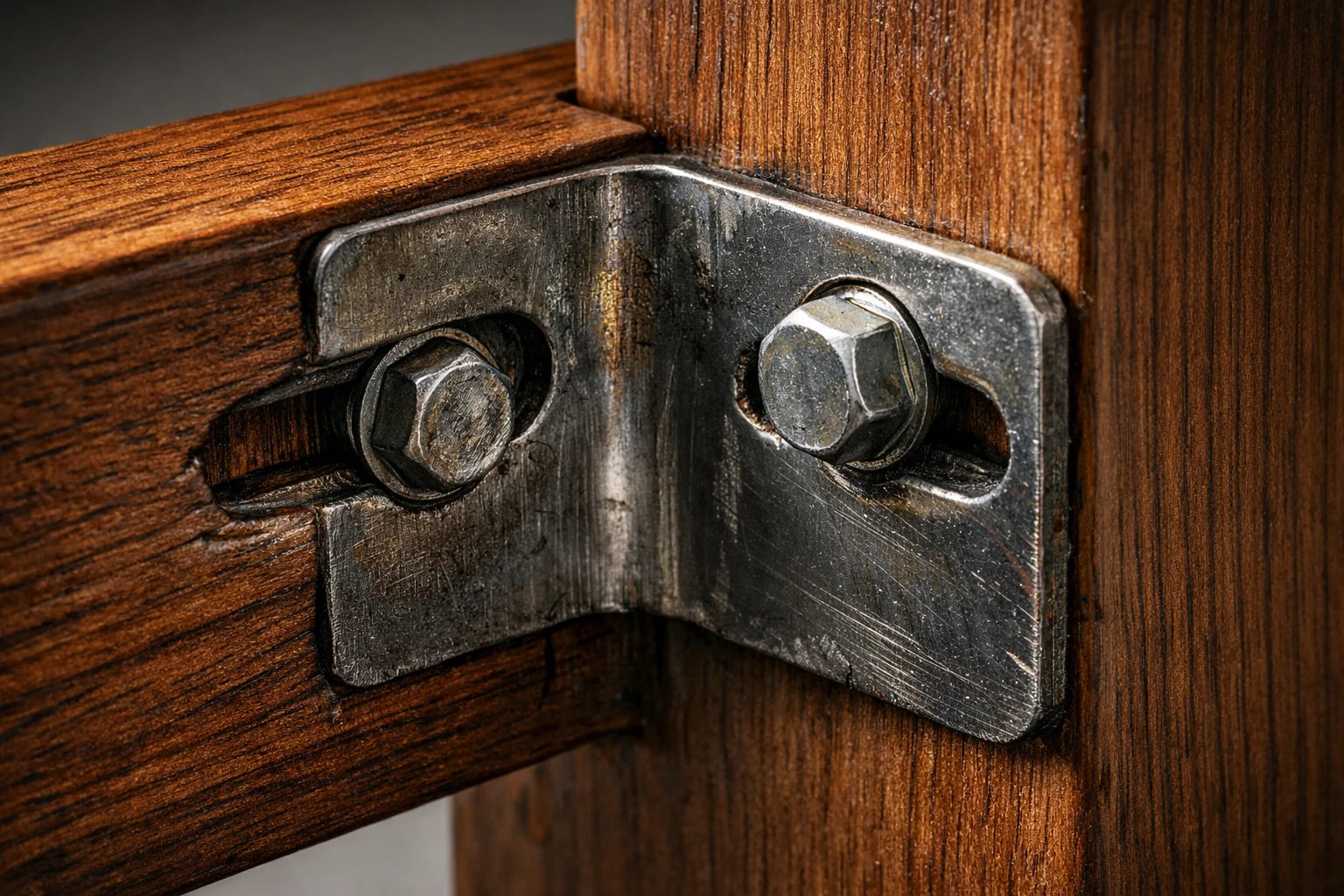
When I look at this image, I am not admiring the hardware. I am thinking about what happens the hundredth time you open the bed when you are tired, distracted, and not being gentle.
This picture shows the difference between a fastener that slowly eats the frame and one that locks everything together. A wood screw relies on the wood fibers to stay intact forever, while a T nut turns the joint into steel clamping steel with wood just sitting in between.
What matters for you is that this kind of connection does not loosen quietly. The bolt tightens against the T nut and stays tight, because the threads are not cutting into wood every time the mechanism shifts.
In a showroom, you will almost never see a cutaway like this, but you can still hunt for the clues. I look underneath for bolt heads with washers, not sharp screw tips buried straight into wood.
If you can see the back side of the rail where the mechanism mounts, sometimes you can even spot the flat, round face of a T nut pressed into the wood. That is an immediate positive signal for me.
I also pay attention to how confident the connection feels when I open the bed. With a bolted, T nut connection, the movement feels controlled and heavy, like a door on good hinges. With wood screws, there is often a faint scrape or shudder as the mechanism shifts against the frame.
If you ask a salesperson how the mechanism is attached and they say bolted through the frame, that is worth following up on. I ask whether it uses threaded inserts or T nuts, and I watch their reaction more than the answer itself.
Someone who actually knows will usually say yes without hesitation and may even show you. Someone who does not will pivot back to fabric or mattress features, which tells me enough.
This image also changed how I think about repairs. Once a screwed joint has chewed up the wood, there is no real fix. A T nut joint can be retightened years later and still be solid because the wood was never the thing holding the threads.
When you are deciding whether a sleeper sofa is built to survive real use, this detail matters more than it should. A proper mechanical interlock costs a little more to build and saves you from a frame failure that no warranty conversation ever really makes painless.
If the mechanism is clamped between steel on both sides, the frame is not the weakest link anymore. That is the moment I start trusting the rest of the sofa enough to keep looking.
The “Pick-Up” Test for Frame Rigidity
The "Pick-Up" Test for Frame Rigidity
How do you know if the frame can handle the mechanism?When I want a fast read on whether a sleeper sofa has real structural integrity, I do something very simple. I walk to the front corner and lift it about three inches off the floor, just enough that I am clearly taking weight.
While I am holding that corner, I look diagonally across the sofa at the back corner on the opposite side. I am not guessing or shaking it. I am just watching how the rest of the sofa reacts to that small lift.
If the frame has good torsional strength, the sofa behaves like a single unit. The opposite back leg starts to rise almost immediately, and the whole chassis stays square without any visible twist.
When that happens, it tells me the frame is resisting being wrung like a towel. The steel mechanism and the wooden structure are working together instead of fighting each other.
The warning sign is very obvious once you know to look for it. If I lift one front corner and the opposite back corner stays planted for a moment, the frame is twisting instead of transferring the load.
Sometimes you can even see the arm you are lifting move independently, like it is peeling away from the rest of the sofa. That delay means the structure is flexing before it engages, and that flex is exactly what causes squeaks, binding, and loose joints later.
I am not trying to stress the sofa or embarrass the salesperson. This is a gentle test that any well built sleeper should pass without drama.
What matters here is not how heavy the sofa is, but how it reacts. A heavy sofa can still twist if the internal structure is weak, and a lighter one can feel rock solid if the frame and chassis are doing their job.
If you feel uncomfortable lifting it, you can get a similar read by pressing down hard on one arm while lightly pulling up on the opposite front corner. I watch for the same thing, which is whether the sofa moves as a whole or deforms locally.
When a frame fails this test, I do not argue with it or try to rationalize it away. I have owned sleepers that twisted like this when new, and every single one of them developed noises and alignment issues within a few years.
This test matters because opening a sleeper bed applies the same kind of diagonal stress, just over and over again. Every time the mechanism pulls out, it tries to rack the frame from corner to corner.
If the frame cannot resist that motion when you lift one corner in a showroom, it will not magically get better after hundreds of openings at home. Wood loosens, joints fatigue, and small flex turns into permanent distortion.
When a sofa passes this test cleanly, I relax a little. It tells me the designer expected twisting forces and built the structure to resist them.
When it fails, I do not care how good the mattress feels or how attractive the fabric is. I have learned that torsional weakness is not a cosmetic issue. It is the beginning of the end.
This is one of the few tests you can do in under ten seconds that predicts years of ownership. Once you try it a few times, you will start to feel the difference immediately, and you will wonder why you ever trusted a sleeper sofa that wrung itself apart before you even bought it.
Frame Specification Audit
When I see a spec table like this, I do not treat it as marketing. I treat it as a checklist for what I need to confirm with my eyes and hands while I am standing in the showroom.
The first thing I translate is wood type. When I read maple, birch, or oak, I expect dense wood that resists crushing around bolts. When I read pine or poplar, I assume softness and faster loosening under a sleeper mechanism. In person, I verify this by feeling the exposed rails underneath and by how much the arms flex when I press inward. Softer woods almost always announce themselves through movement.
Joinery is the next quiet separator. Double doweled and glued joints behave like one piece of wood over time. Stapled or simply screwed joints behave like individual parts that slowly work against each other. I cannot see the dowels, but I can feel the result by rocking the arm gently front to back. A frame with good joinery feels dead and calm, not springy or clicky.
Fasteners matter more than most people realize. Machine bolts with T nuts tell me the builder expected movement and planned for it. Wood screws tell me they hoped friction would be enough. Underneath the sofa, I look for bolt heads with washers where the steel meets the wood. If all I see are screw tips disappearing into the frame, I assume that connection will loosen long before the fabric wears out.
Rail thickness is something I judge with my hands, not a ruler. A rail around an inch and a quarter thick feels substantial when I pinch it through the fabric. A three quarter inch rail feels narrow and easy to flex. Thinner rails can work on a regular sofa, but on a sleeper they are constantly being bent by the mechanism.
The front rail deserves special attention because it takes the most abuse. A steel reinforced front rail tells me the load is being shared with metal instead of asking wood to do everything. A cut away wooden front rail usually means clearance was prioritized over strength. In the showroom, I grab the front edge and tug gently. Reinforced rails feel solid. Cut away rails often feel hollow or springy.
Vibration dampening sounds abstract until you have lived with a noisy sleeper. Rubber washers at joints keep metal from grinding directly on wood. Metal to wood contact transfers every vibration into the frame. When I open and close the bed, I listen for scraping or ringing sounds. Quiet, dull movement usually means something is isolating those parts. Sharp metallic noise usually means nothing is.
What I have learned is that you do not need to memorize specs to use this table. You just need to know what behavior each choice creates over time. Dense wood stays tight. Proper joinery stays square. Bolts stay tight. Thick rails resist bending. Steel reinforcement carries load. Rubber isolation prevents noise and fatigue.
If a salesperson cannot answer these questions clearly, I do not argue. I just assume the budget column applies and move on. Sleeper sofas fail slowly and quietly, and this audit is how I protect myself before that process ever starts.
Once you start translating specs into physical checks like this, the table stops being technical. It becomes a way to predict whether the sofa you are standing in front of will feel the same after a hundred openings as it does today.
Explore Technical Reference
Daybed Durability: Squeaks, Cracks, and Slats
Why metal daybeds develop squeaks and wood daybeds develop cracks. Understanding slat systems, joint construction, and longevity factors.
Analyze Details →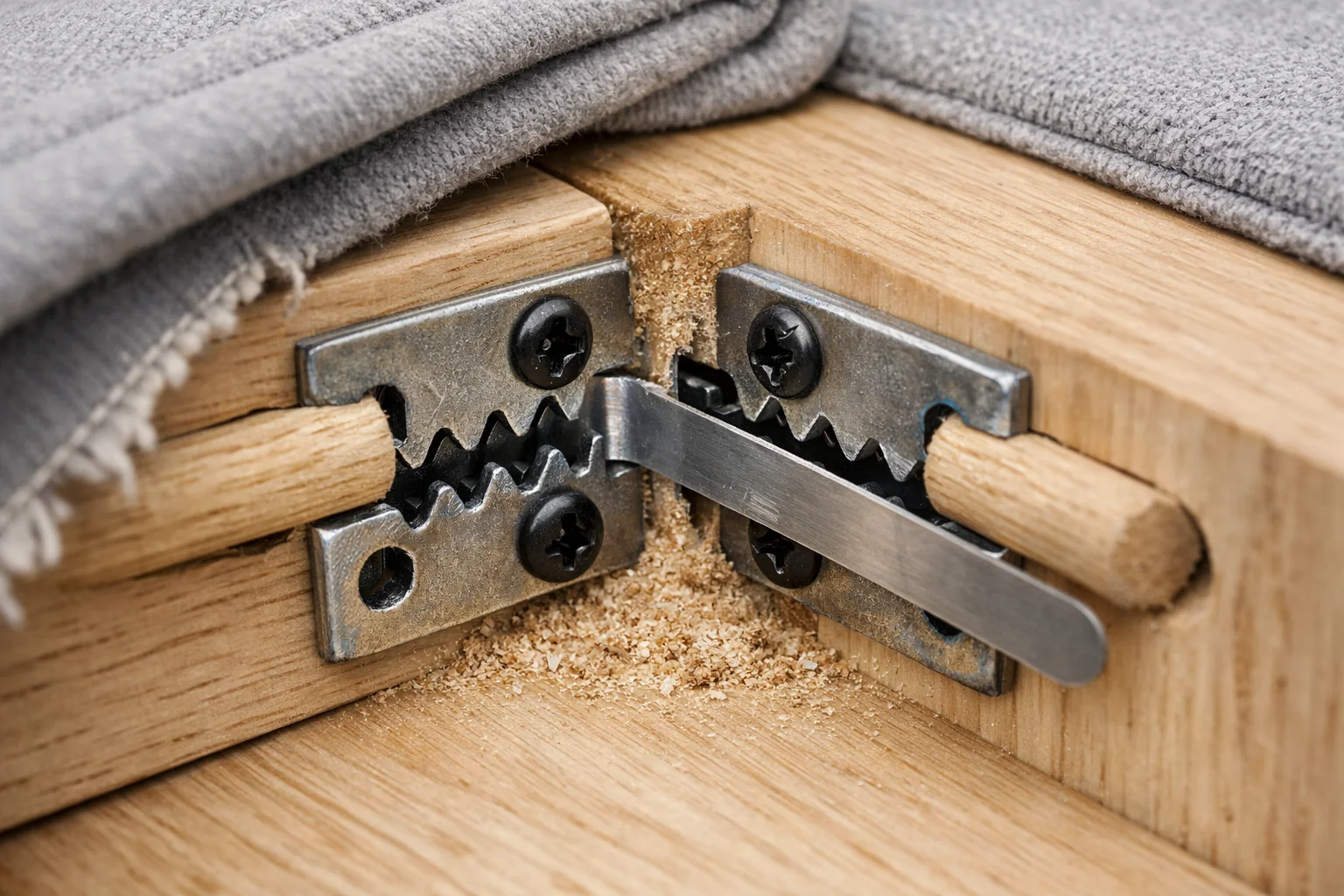
Sectionals: The Architecture of the Corner
Before purchasing a large sectional, understand the corner seat problem, connection hardware, and why 'Right Arm Facing' confuses nearly everyone ordering furniture.
Analyze Details →