Daybed Durability: Squeaks, Cracks, and Slats
Introduction
Daybeds look simple, and that is exactly why they fool people. I have owned seating that squeaked itself loose over time, and daybeds often do the same thing even though nothing “moves” on them.
A normal bed is basically a rectangle, so when you roll over, the load spreads through four corners that can flex a little and still settle back. A daybed is three sided, and that missing side changes how the whole frame reacts when you sit down on the edge or lean back into a side.
What tends to go wrong is not the mattress, it is the joints. When you push on one side rail or the back rail, you are twisting the frame, and that twist tries to turn the corners into little hinges. That is the racking force that makes a daybed start clicking, then screeching, then feeling wobbly, even if it looked rock solid in the showroom.
If you take one thing from this guide, let it be this. You are not shopping for “pretty wood” or “nice fabric” first, you are shopping for a frame that resists twisting and joints that stay tight after thousands of sits.
As you read, I want you to imagine two real life moments. One is you sitting on the front edge to put on shoes. The other is you leaning your shoulder into the back while talking or scrolling. Those are the exact forces that expose a weak daybed, and they are the forces I will keep coming back to when I tell you what to press on, what to listen for, and what questions to ask before you buy.
The "Squeak Creep"
If you have ever heard a metal daybed “start quiet” and then get noisier week by week, this is usually not the metal failing. What is failing is the tightness of the fasteners, and once that starts, the sound tends to spread from one corner to the whole frame.
Here is what is actually happening. Every time you sit, the long rails flex a tiny amount, and that flexing makes microscopic movement where the bolts pass through the holes. Metal rubbing on metal at those joints is what creates the sharp squeak, and the reason it creeps in over time is that the rubbing also encourages bolts to back out a little more each month.
In a showroom, I do two quick checks that tell me a lot. I put my weight on the front edge like I am tying my shoes, then I shift side to side without standing up, and I listen at the corners instead of the middle. Then I lean my shoulder into the back rail like I am lounging, and I watch whether the frame “ticks” and rebounds, or whether it feels like the joint is sliding and settling.
If you hear any squeak on a floor model, I assume it will be worse at home, not better. The only exception is a display that is clearly assembled loosely by staff, which is why I also ask one direct question: “When I assemble this at home, are these bolts meant to be tightened again after a week of use?” If they look at you like that idea is weird, you are buying something that will likely annoy you.
If you already own the daybed or you are comfortable doing one extra step during assembly, the practical fix is to stop the bolt from slowly backing out and to stop metal from rubbing directly on metal. I use a medium strength threadlocker, specifically Loctite Blue, on the bolt threads so vibration does not walk them loose. I also add nylon washers anywhere a metal part clamps against another metal part, because that little plastic layer acts like a quiet buffer instead of a squeaky friction point.
You do not need to overthink it, but you do need to do it everywhere the frame pinches together. If you only treat one or two corners, the noise usually just relocates to the untreated joints.
If you want to look up the exact product so you buy the right strength, I mean the removable “blue” threadlocker like this one: Loctite Blue threadlocker. The key idea is removable, because the permanent high strength stuff can turn a simple retightening job into broken hardware later.
The reason I am putting this in a buying guide is simple. A metal daybed that is otherwise sturdy can be made livable if you plan for fasteners and friction from day one. A metal daybed that is already squeaky in the store, or one that uses flimsy hardware you cannot properly tighten, is telling you upfront that the squeak creep is going to win.
Frame Engineering: Wood vs. Metal
When you compare wood and metal daybeds, I do not start by asking which material is “stronger.” I start by asking how the corners are built, because a daybed is a three sided frame and those two front corners take a twisting load that a normal bed does not.
On a standard bed, the rails make a rectangle, so the forces have a way to circulate around the frame. On a daybed, the open front means the side rails and the back rail are constantly trying to wring those front corners like you are twisting a shoebox lid.
In a showroom, I test this in a way that feels slightly silly but tells the truth fast. I sit on the front edge near one corner, then I shift my weight a few inches left and right and listen for clicking or creaking right where the side rail meets the front post.
If the corner feels like it is working as a single solid block, that is a good sign. If it feels like two pieces taking turns moving, or you can sense a tiny delay before it settles, that is the beginning of a joint that will loosen.
With wood frames, the failure I have seen most often is not the wood “snapping.” It is the joint tearing out because the hardware is asking weak material to hold a twisting load, especially when particleboard or MDF is involved.
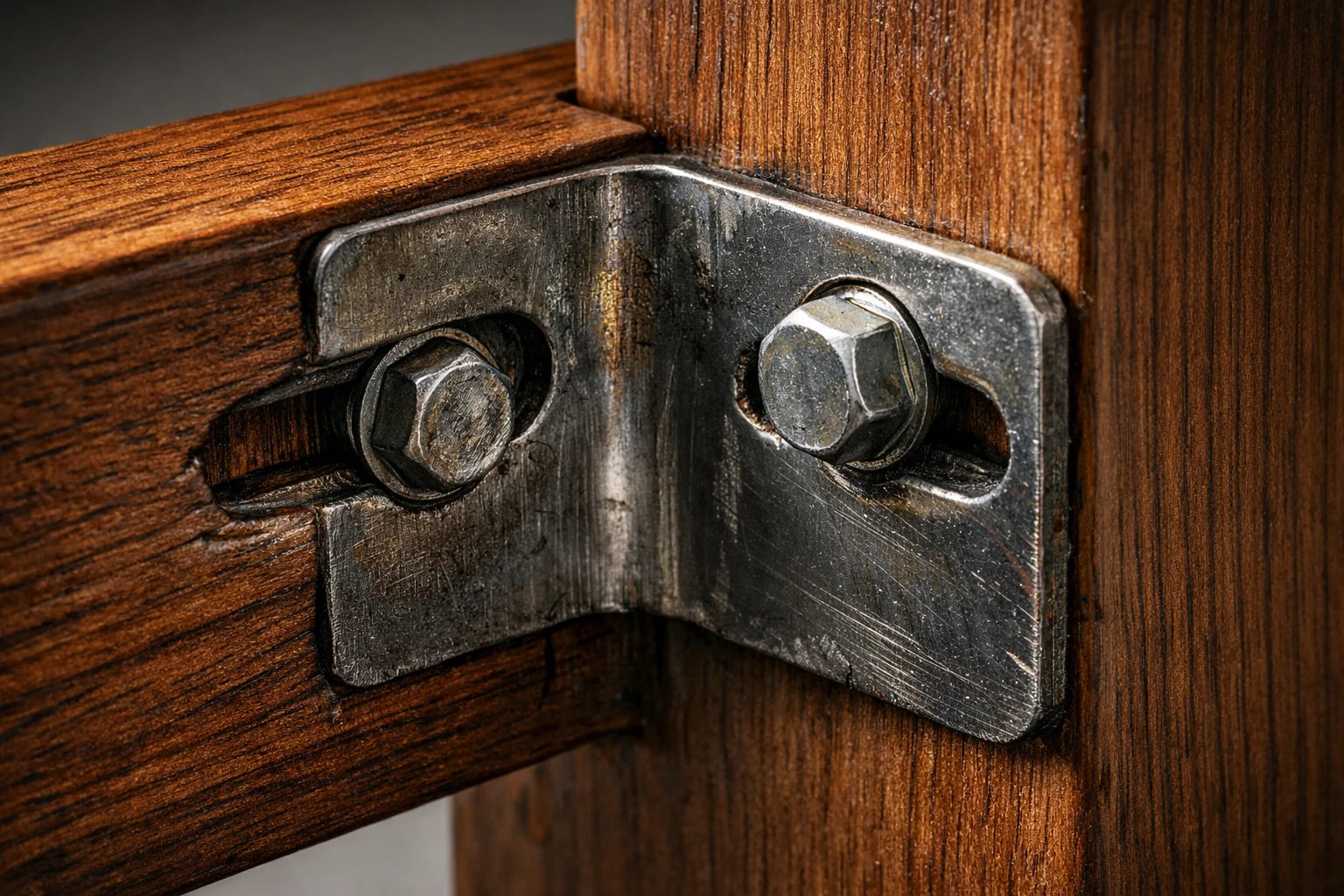
You want to see steel corner reinforcement doing real work. I look for a proper corner bracket or a heavy plate that ties the rails and post together, and I look for bolts that pass through and clamp, not just wood screws that bite into crumbly composite.
If the salesperson cannot show you metal reinforcement at the corners, ask them to point to exactly what is keeping the rail from twisting at that front post. If the honest answer is “just screws into the wood,” I assume an adult sitting on the edge repeatedly will eventually crack it, even if it feels fine on day one.
Metal frames can be great, but they live or die by how the joints are made. If the frame is thin tube with small bolts and oversized holes, it can feel rigid in the middle and still work itself loose at the corners over time, which is where the noise and wobble start.
I also pay attention to how the daybed supports the mattress, because a lot of daybeds ruin a mattress long before the frame collapses. The culprit is usually the slats.
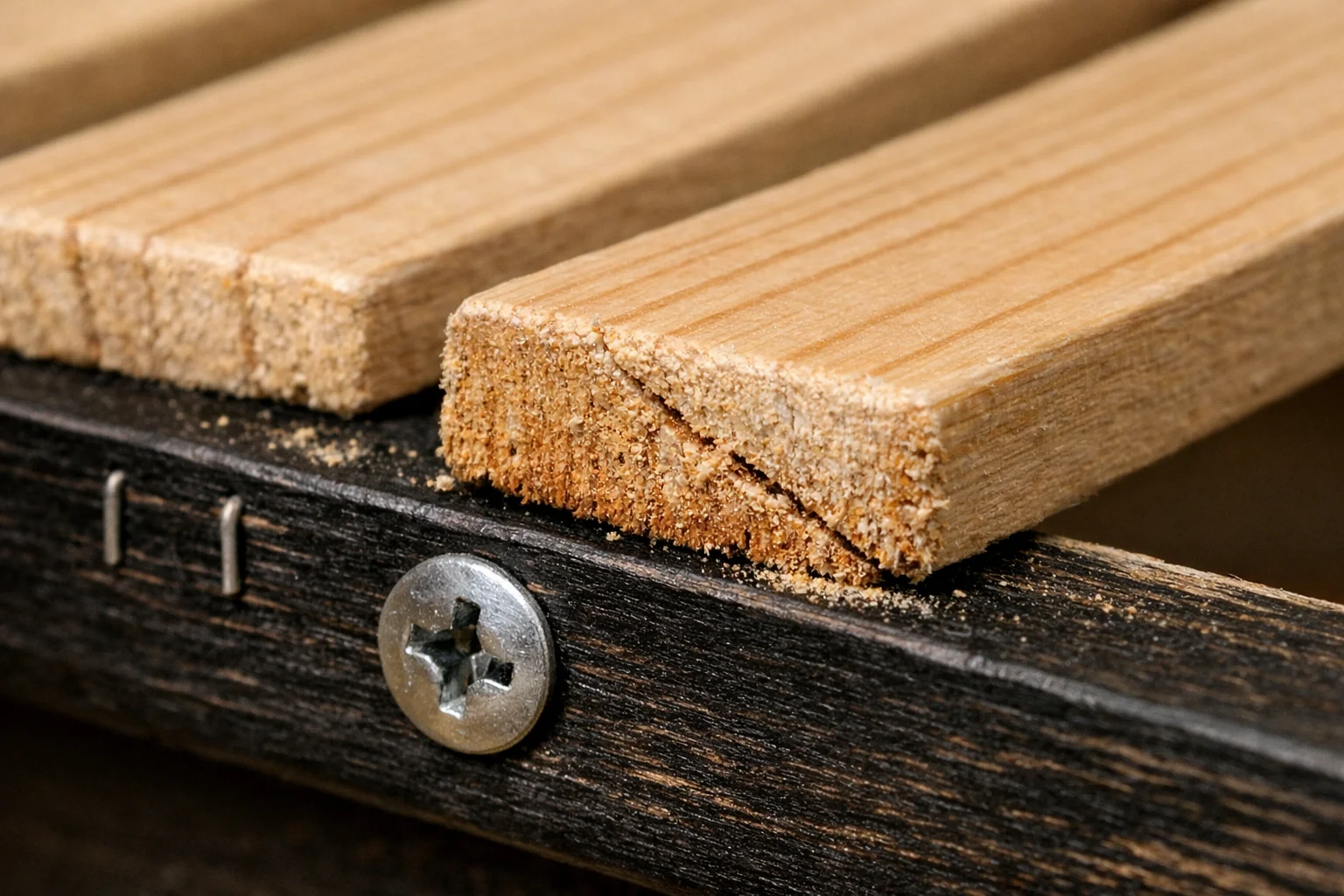
Slats have to handle quiet weight while you sleep and sudden impact when you drop onto the edge to put on shoes. If they are too far apart, the mattress will sag between them like dough pushing through a grate, and that creates permanent ridges and soft spots you cannot undo.
The practical rule I use is simple. I look for slat gaps that are under three inches, and I do not guess from across the room.
I bring a tape measure, or I use my hand as a quick filter, because most adult fingers are close to three quarters of an inch wide. If four fingers fit comfortably in the gap, I slow down and measure, because that is often already too wide.
If the gaps are bigger than three inches, I treat it as a mattress problem waiting to happen even if the slats themselves feel sturdy. This matters even more with foam mattresses, since foam is eager to bulge into space and stay there.
If you are in love with a daybed that has wider spacing, the only way I get comfortable is if the brand explicitly includes a solid bunkie board, a closely spaced metal grid, or some other continuous support that makes the effective gaps small. If they imply you can “just add plywood,” I take that as a warning that the design did not start with mattress support in mind, and plywood can introduce its own issues like trapped moisture and squeaks.
Before you buy, physically lift one slat if you can, or at least press down hard with your palm between two slats to see if they flex independently. I prefer slats that feel like part of a system, secured so they cannot wander, rather than loose boards that can shift and start making noise.
When you combine these checks, you end up with a simple way to choose between wood and metal without getting tricked by looks. I trust the frame, whichever material it is, when the corners are visibly reinforced and clamped together, and when the mattress support is tight enough that the mattress is not being asked to bridge big gaps every single night.

When you look at that close up joint, I want you to notice what is not happening. Metal is not grinding directly on metal at the contact point, because a thin nylon washer is sitting between the parts like a quiet little buffer.
In a showroom, I use this as a quick tell for whether the brand has thought about noise over time. I crouch and look at the corner hardware, and I am specifically checking whether the joint has any kind of “soft interface,” like a nylon washer, a plastic bushing, or a rubber spacer, anywhere a bolt is clamping two metal pieces together.
If you cannot see the joint clearly, ask the salesperson to show you the assembly diagram or parts list and point to the washers. I am not asking because I love accessories, I am asking because metal daybeds often fail as a relationship, not a structure. They survive, but they complain loudly.
I also put my fingers on the hardware and try a tiny motion test without actually loosening anything. I press the rail sideways with one hand and rest my other hand on the bolt head area to feel for a micro shift, because that shift is what becomes a squeak once dust, paint wear, and loosening fasteners enter the chat.
If the daybed is already assembled on the floor, you can do a simpler version. Put your ear near the corner and gently rock the back rail with your hands like you are trying to move it one millimeter, and listen for a high pitched chirp instead of a dull flex. A chirp usually means friction at a tight joint, and friction at a tight joint usually turns into friction at a loose joint later.
If you are ordering online and you cannot inspect anything, I treat the presence of nylon washers as a question worth emailing about before I buy. I ask, “Do the rail to post bolts include nylon washers or bushings where metal clamps against metal?” If the answer is vague, or they say it is metal on metal “but you can tighten it,” I assume you will be the one solving squeaks later.
This is also where I get picky about paint and plating. When two painted metal surfaces clamp together without a washer, the paint slowly powders and disappears at the contact patch, and that is when the joint starts to talk. The washer is not magic, it just prevents the two surfaces from acting like brake pads every time you shift your weight.
If you do end up with a frame that does not include washers, I do not automatically walk away, but I mentally file it under “assembly matters.” I would rather buy a daybed that is quiet by design than one that depends on me to upgrade the joint after the fact, because the whole point is to not get surprised six months in.
Pro Tip: The Bunkie Board
If I see a daybed I otherwise like but the slats are thin and springy, I do not start hunting for “better slats.” I plan to put a bunkie board on top and move on.A bunkie board is basically a thin, firm foundation, usually around two inches thick, wrapped in fabric. The point is not comfort, it is support, because it gives the mattress continuous contact instead of forcing it to bridge gaps and dip between slats.
In a showroom, here is how I decide if you actually need one. I press down hard with my palm directly between two slats, right where your hips would land when you sit to put on shoes. If the slats flex independently, or you can feel the space between them give easily, I assume your mattress will start telegraphing those gaps over time, especially if you use foam.
The other tell is movement and noise. If you tap a slat and it rattles, or you can slide it side to side even a little, that is the kind of small shift that becomes a squeak later. A bunkie board helps here too, because it spreads load across many slats at once instead of letting one slat take a sudden hit.
I like the bunkie board solution because it turns a mediocre support system into a platform without you doing anything permanent to the frame. It also avoids the common plywood idea, which can trap moisture under a mattress and can squeak against the frame unless you fuss with padding.
When you are shopping, ask one specific question before you pay. Ask whether adding a bunkie board affects the maximum mattress thickness they recommend for that model, because it raises the mattress height and can make the back rail feel lower than you expected.
If the daybed has a trundle, also check clearance. I have seen people buy a bunkie board and then discover the trundle mattress no longer clears, or the trundle rubs because the main mattress now sits lower and bulges differently.
You do not have to buy the bunkie board from the same brand. I just make sure you buy the right size, and I check that it is actually rigid when you hold it at one end, because some “bunkie boards” are basically thin flexible panels that do not solve the problem you are trying to solve.
If you want the simplest rule, this is it. If the slats look like an afterthought, a bunkie board is the cheapest way I know to make the daybed feel like it was designed as a real bed instead of a decorative frame.
Technical Maintenance Checklist
I treat a daybed like I treat a dining chair that gets used hard. If you want it to stay quiet and square, you have to assume vibration and little shifts are always trying to loosen it, even if it feels solid today.
Once a year, I go around the whole frame and put a wrench on every bolt I can reach, especially at the three corners and anywhere the back rail meets a post. The reason is simple, seasonal temperature changes and normal use encourage tiny movements, and those movements can slowly chew the bolt holes into an oval so the joint never feels tight again. When I tighten, I aim for snug and secure, not heroic force, because over tightening can strip hardware or crush softer materials.
I also inspect the slats like I am looking for the beginning of a crack in a phone screen. I run my fingers along each slat, look closely near the ends where they sit in holders, and I watch for hairline cracks or crushed spots. One slat failing is rarely a one slat problem, because once it breaks the neighboring slats suddenly carry more weight, and that is how you get the domino effect where you lose several in a row and it feels like the whole bed “gave up” overnight.
Then I do a quick level check, because an uneven daybed acts like a frame that is constantly being twisted. I press down on each corner and see if any corner lifts or if the frame teeters, and I do this with the daybed in the exact spot you use it, not in the middle of the room. If it rocks, I fix the floor contact right away with a proper furniture pad or leveler, because a frame that is always rocking is quietly punishing its corner joints every time you sit, and I have seen that turn into snapped joints much faster than people expect.