Disposable vs. Investment: The "Cost of Ownership" Math
Introduction
I used to tell myself the same thing a lot of renters say, “I’m not staying long, so it’s not worth investing.” Then I watched cheap sofas fall apart, get left on the curb, and become instantly worthless the moment I tried to resell them.
What finally clicked for me is that “cheap” is not just a lower price, it is usually a one way transaction. When you buy the cheapest seating you can tolerate, you are often paying for something that has essentially zero resale value, because it sags, creaks, pills, or looks beat up long before you are ready to move.
A better sofa behaves more like an asset you get to use. If you choose something that holds its shape and still looks respectable after a couple years, you can often sell it for a meaningful chunk of what you paid, sometimes around half if it is from a recognizable brand and you kept it clean. That resale reality is the difference between “throwaway furniture” and “furniture you can move, keep, or cash out of.”
So when you are shopping, I want you to stop thinking in terms of sticker price only and start thinking in terms of cost to own. If a sofa costs more but you can live on it comfortably for years and then sell it when you move, it can easily be the cheaper choice in practice.
In this guide I’m going to focus on what you can actually do in a showroom to avoid getting ripped off. I will keep it practical, like how to spot a frame that will loosen up, cushions that will pancake, and fabrics that will look worn fast, because those are the things that destroy comfort and resale value.
The "Total Cost of Ownership" (TCO) Formula
TCO = (Purchase Price - Resale Value) / Years of UseWhen I’m trying to talk myself into a “deal,” this is the little reality check I run. I’m not asking whether the sofa is cheap today, I’m asking what it costs me per year once I account for what I can get back out of it.
Here is what the dumpster route looks like in real life. You buy a $500 sofa, you use it for two years, and by the time you move it is sagging, stained, wobbly, or just looks tired enough that nobody wants it. Your resale value is basically $0, so you just paid about $250 per year to sit on something you probably never loved.
Now compare that to the resale route. You buy a $1,500 sofa from a recognizable, midrange brand, you use it for two years, and it still looks presentable because it kept its shape and the fabric did not get destroyed. If you can resell it for $800, your cost is about $350 per year.
The result is the part that surprised me the first time I did the math. For roughly an extra $8 a month, you could have spent those two years sitting on a sofa that felt nicer every single day, and you did not end the relationship by dragging it to the curb.
What I want you to do in a showroom is stop treating resale like a mystery. Before you buy, pull up your local resale marketplace search results for the exact brand and a similar size sofa, and look at what actually sells, not just what is listed. If you see lots of “free if you haul” listings for that brand or that style, that is your warning that the market has decided it does not age well.
Then look at your own situation and be honest about your likely years of use. If you move every couple of years, resale matters a lot more than if you stay put for a decade, because your exit is coming sooner and your sofa has less time to justify its price.
Finally, when you are comparing two sofas, try to translate your gut feelings into the TCO pieces. If one sofa feels like it is already losing a fight with gravity in the showroom, that is the one that ends up with a $0 resale value later, even if the sticker price looks friendly today.
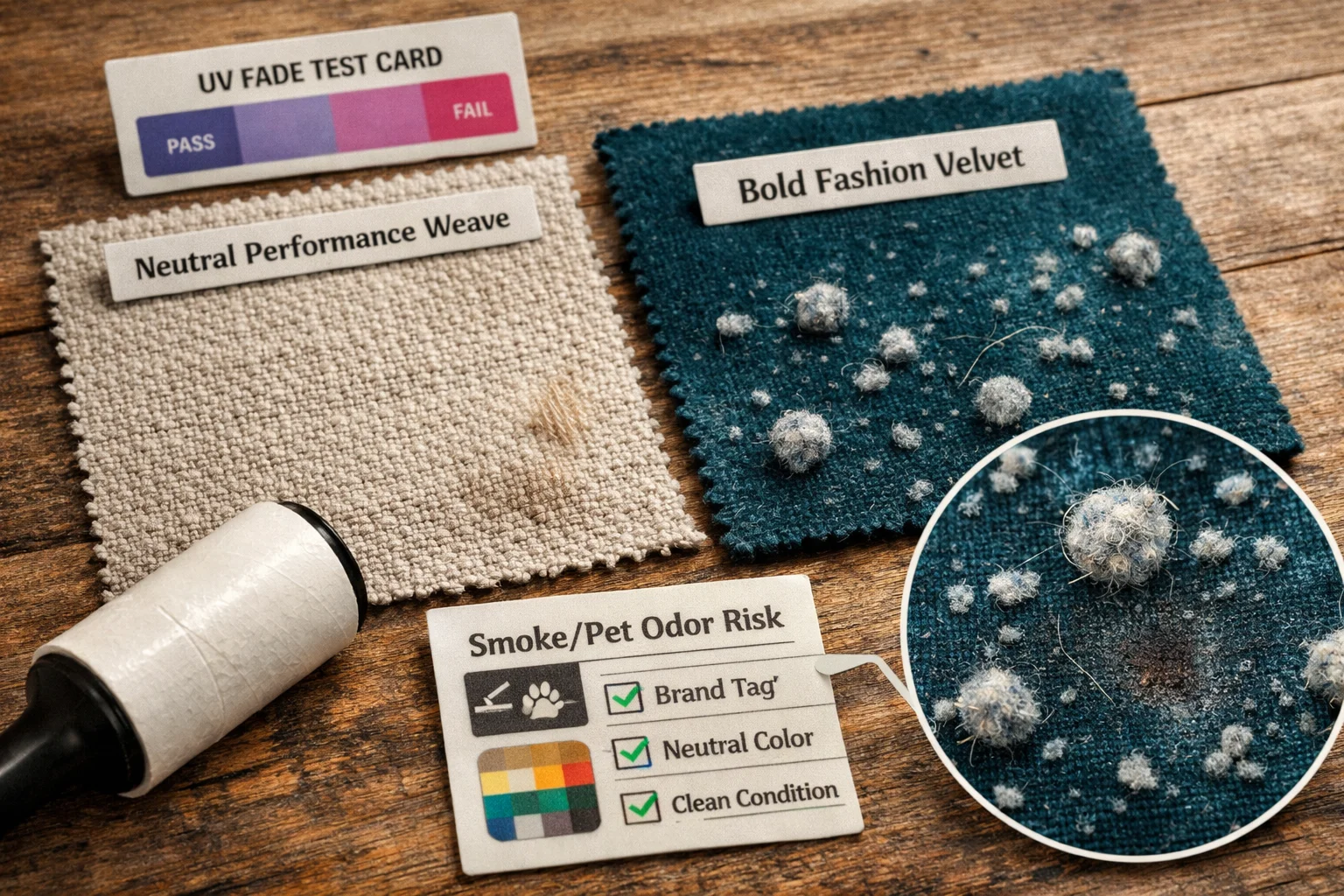
When I’m thinking about resale, I stop looking at the sofa like a big shape and start looking at it like a close up photo, because that is how buyers will judge you later. Most resale listings live or die on a few zoomed in shots of the seat cushions, the arms, and the front edge where people’s legs rub every day.
In a showroom, I do a quick “fabric reality check” with my hands and eyes. I rub the fabric on a high wear area like the front lip of the seat or the outside arm, because some fabrics start to fuzz and pill fast, and you can sometimes see the fibers lift even from a short, firm rub.
Then I look at the weave and the surface, not the color story. If the weave looks loose, snaggy, or overly nubby, I assume it will catch on jeans rivets, pet nails, and zippers, and that becomes visible damage that photos love to exaggerate.
Stains are the other resale killer, and it is not just big spills. I look for fabrics that will show body oil and head grease where people lounge, especially on light colors and on anything with a velvety nap that changes when you brush it.
If you want the safest resale path, I have learned to pick a color that hides normal life without being “so specific” that only one person would want it. In practice that usually means a mid tone neutral or heathered fabric that can disguise tiny marks and uneven wear, because the goal is not perfection, it is “still looks clean in photos.”
Smell matters more than people admit, and it is hard to fix once it is in the cushions. If the showroom lets you get close, I literally put my face near the fabric and take a quick sniff, because if you smoke, cook heavily, have pets, or use strong fragrances at home, you are going to be fighting odor absorption later, and buyers walk away fast when they suspect that problem.
I also think about what you will have to disclose honestly in your listing. If the fabric is delicate, light, or high maintenance, you are basically choosing a future where you either discount heavily or spend time stress cleaning before every showing.
The last thing I do is imagine your resale photos, taken in bad apartment lighting, from a phone, with no flattering staging. If you can already see pilling, shading, or staining risk under perfect store lights, it will look worse at home, and it will absolutely look worse in the listing that decides what you can sell it for.
The “Used Market” Arbitrage
If you are renting and you know a move is coming, the smartest play I have found is to avoid the ugly part of sofa pricing entirely, which is depreciation in the first couple years. I think of it like this, I am not trying to “own” a sofa forever, I am trying to borrow a good one for a while without paying the new sofa penalty.
Here is the version that actually works in real life. You find a genuinely high end sofa that retailed around $3,000, you buy it used for around $800, you live on it for two years, then you sell it for around $700 if you kept it presentable and you did not pick a weird size or polarizing color. When you do the math, that is roughly $50 a year to sit on something that was built to survive real use.
The reason it works is simple, the first owner already paid for the moment the sofa became “not new.” If you buy after that drop, your value does not have far to fall as long as condition stays steady, which is why I call it arbitrage, you are taking advantage of how irrationally the market prices newness.
The trick is that you have to shop used like a picky inspector, not like someone hunting for a cute bargain photo. When I look at a used listing, I am trying to confirm three things before I even consider the drive, it has to be a recognizable make that people search for, it has to look structurally honest in photos, and it has to be something I can later resell to a normal person without a complicated story.
Brand matters more on the used market than it does in a showroom, because used buyers need a shortcut to trust. I am not saying you need a designer logo, I am saying you want a name that signals “this was expensive and repairable,” because random import sofas tend to turn into “free if you haul” the second they get a little tired.
I also avoid anything that is hard to photograph well when it is no longer perfect. Big sectional arrangements, ultra deep loungers, and very specific silhouettes can be amazing to live with, but they shrink your future buyer pool, and that is what kills resale when you are trying to exit quickly.
When you go to see the sofa in person, I want you to spend your courage on the unglamorous checks. I press down hard on the arms and the front rail and I listen for creaks, because a lot of “looks fine” sofas are already loosening up where the frame takes stress.
Then I sit in the same spot and shift my weight side to side. If the seat feels like it is dipping into a soft trench, or if you feel the frame line under the cushion, you are not just buying discomfort, you are buying a future listing that buyers will talk themselves out of the moment they sit down.
Cushions are where a used deal often goes bad. I unzip if I am allowed, because if the cushion insert looks lumpy, shredded, or permanently compressed, you should assume you will either live with it or pay to replace it, and cushion replacement can erase the whole arbitrage.
Odor is the other deal breaker I do not negotiate with. If it smells like smoke, heavy fragrance, or pet urine anywhere near the seating area, I walk, because smells live inside foam and batting, and the “I will clean it later” plan rarely works well enough to protect resale.
I also ask one blunt question that saves me time, “Why are you selling it?” If the answer is a move, a redecorate, or downsizing, that is normal, but if you hear “it started sagging” or “the cushions never fluffed back up,” believe them, because you are about to inherit the problem.
Before you buy, I like to check the local market for that exact brand and roughly that size so I know my exit is realistic. I am not looking for the highest asking price, I am looking for how long similar sofas sit unsold, and whether the sold prices cluster around a number that makes my TCO work.
And I treat transport as part of the cost, not an afterthought. A cheap used sofa stops being cheap when it gets gouged in a stairwell or soaked in the rain on the way home, so I either budget for a careful pickup or I do not buy that day.
If you want the simplest rule I follow, it is this. I only do used market arbitrage when the sofa is nice enough that I would be proud to list it later, and boring enough that plenty of other people would want it too. That combination is what turns “used” into “almost free to own.”
This chart is the mental model I keep in my pocket when a salesperson tries to make a cheap sofa feel “good enough.” The red line is what I have lived through, the sofa looks fine on day one, then comfort and appearance fall off fast, and by the time you are ready to move it is basically unsellable.
What I want you to notice is not the exact months, it is the shape. Cheap seating tends to lose value because it visibly changes, cushions pancake, fabric pills, seams stretch, arms loosen, and those are the kinds of changes you cannot hide in listing photos or explain away to a buyer.
The blue line is the whole reason I push you to think about cost to own. A sofa that stays structurally tight and visually presentable stops bleeding value after the early drop, and that is when you get leverage, you can keep it longer without feeling trapped, or you can sell without taking a total loss.
In a showroom, you can use this idea as a simple filter. I ask myself, “What will this look and feel like after two years of the same person sitting in the same spot?” If I can already feel the seat giving up, or I can already see the fabric getting shiny or fuzzy, I assume the red line is coming for it.
I also use the value curve to keep myself from overpaying for features that do not help resale. Fancy gadgets, ultra specific silhouettes, and trendy colors can be fun, but if they make the sofa harder to photograph, harder to fit in a normal apartment, or harder to describe without qualifiers, they shrink your buyer pool and your resale price drops even if the sofa is technically “nice.”
When you are comparing two sofas that look similar, this is where I get very literal. I choose the one that feels like it will stay boring in the best way, tight frame, predictable fabric, standard proportions, cushions that recover when you stand up. Boring is what holds value, because it is what strangers feel safe buying from you later.
If you want one concrete thing to do today, open your notes app and write two numbers for each sofa you are considering, the price you pay and the price you honestly think you could get in two years if you list it with decent photos. When you force yourself to name that future resale number, you stop shopping like a person being sold to, and you start shopping like a person who plans to get their money back.
When to Buy “Disposable”
Sometimes, cheap is the right choice, and I do not mean “buy something bad and hope.” I mean there are situations where the most rational plan is to treat the sofa like a consumable and stop paying for durability you will not get to enjoy.
If you live with roommates and your place is the default hangout, I would not bring in a sofa you would be upset to see abused. Even well made fabric can get wrecked by constant traffic, spilled drinks, and people who plop down hard, so I would rather you buy something inexpensive, keep it clean enough to live with, and accept that it might be a curb sofa later.
If you have pets, the key detail is whether you are in the high risk phase. A puppy that is not potty trained, or a pet that is still chewing, scratching, or having accidents, can turn any upholstery into a loss fast, and the smell problem can end the sofa’s resale life overnight. In that window I would buy cheap on purpose, or I would buy used and already “depreciated” so you are not watching a new sofa get ruined in real time.
Short term living is the other time I stop trying to be a hero about quality. If you are only going to be in a city for a few months, it is hard to make the math work on a new sofa, because you are paying delivery, setup, and then immediately paying the hassle cost of getting rid of it. In that case, I would either rent, or I would buy the simplest, cheapest thing that meets your comfort minimum, then plan your exit the same day you buy it by saving the receipt, keeping the packaging if it is a flat pack, and choosing a size you can move without hiring help.
What I want you to avoid is the worst of both worlds, which is paying “midrange money” for a sofa you are still going to treat as disposable. If you already know your household is going to destroy it or abandon it quickly, commit to the disposable plan and spend the saved money on a washable cover, a decent rug, or anything else that makes daily life nicer without pretending the sofa is an investment.
Technical Summary: The "Resale" Checklist
If resale is part of your plan, I buy like I am already writing the future listing, and I want you to do the same while you are still in the showroom.First, I want a name people actually type into the search bar. When you are scrolling Marketplace you will notice it instantly, buyers search brands and model names because it is the fastest way to filter out mystery couches. In the store, I take a photo of the tag, the law label, or the product card and I make sure I can accurately describe it later, because “similar to” is not the same as being searchable.
Second, I keep the color boring on purpose. Neutral does not mean you have to live in a gray box, it means you avoid anything so specific that it shrinks your buyer pool. In practice, when I am choosing between two fabrics, I picture a stranger’s apartment and ask myself if this would look normal in it, because that is what keeps your listing from sitting for weeks.
Third, I protect condition like it is the whole game, because it usually is. If the sofa smells like smoke or pet urine, or it has obvious stains and greasy head spots, people either walk away or they treat it as a “free if you haul” situation no matter what you paid. In the showroom I pick fabrics that forgive real life, and at home I treat odor and stains like emergencies, because once that smell is in the cushions you cannot reliably sell your way out of it.
If you only remember one thing from this checklist, let it be this. Resale is less about what you paid and more about whether a stranger can trust what they see and smell in five seconds.