The Pivot Problem: Geometry for Movers
Introduction
We’ve all seen it: A perfectly good sofa abandoned on the sidewalk on the 1st of that month. It didn’t break; it just didn’t fit.
When I see that, I assume the problem started on day one, not years later. The sofa looked fine in a big showroom, it felt fine for the five minutes it took to decide, and then it arrived home and turned into a daily annoyance because it blocked a doorway, swallowed a small room, or made the TV angle awkward.
I have learned to treat “fit” as two separate things you have to get right at the same time. One is physical fit, meaning it literally gets through your home and lands where you need it without forcing the rest of your room to work around it. The other is lifestyle fit, meaning it matches how you actually sit, lounge, nap, host, eat, and clean, not how you imagine you will.
Before you get attached to any particular look, I want you to do one unglamorous check at home. You measure the narrowest point from the outside to the final spot, which is usually a door opening, a hallway pinch, a stair turn, or an elevator door. Then you measure the sofa you are considering at its widest and deepest points, and you ask the salesperson what comes off or folds down for delivery, like legs or removable backs, because that can be the difference between an easy move and a return you pay for.
In the showroom, I want you to sit like you will at home, not like you are posing. If you sprawl, slide into the corner, put your feet up, or sit with a laptop for an hour, do that for a minute and notice what your body complains about first, whether it is your lower back, your neck, or the front edge digging into your thighs. If the sofa only feels “nice” in one perfect upright position, it is probably going to feel wrong in your living room, where nobody sits perfectly.
This guide is about avoiding the most common traps I have personally regretted, especially the ones you cannot see until the return window is gone. I am going to keep it practical, focused on what you can ask, what you can test with your own hands, and what you can verify before you hand over your money.
The "Elevator Diagonal"
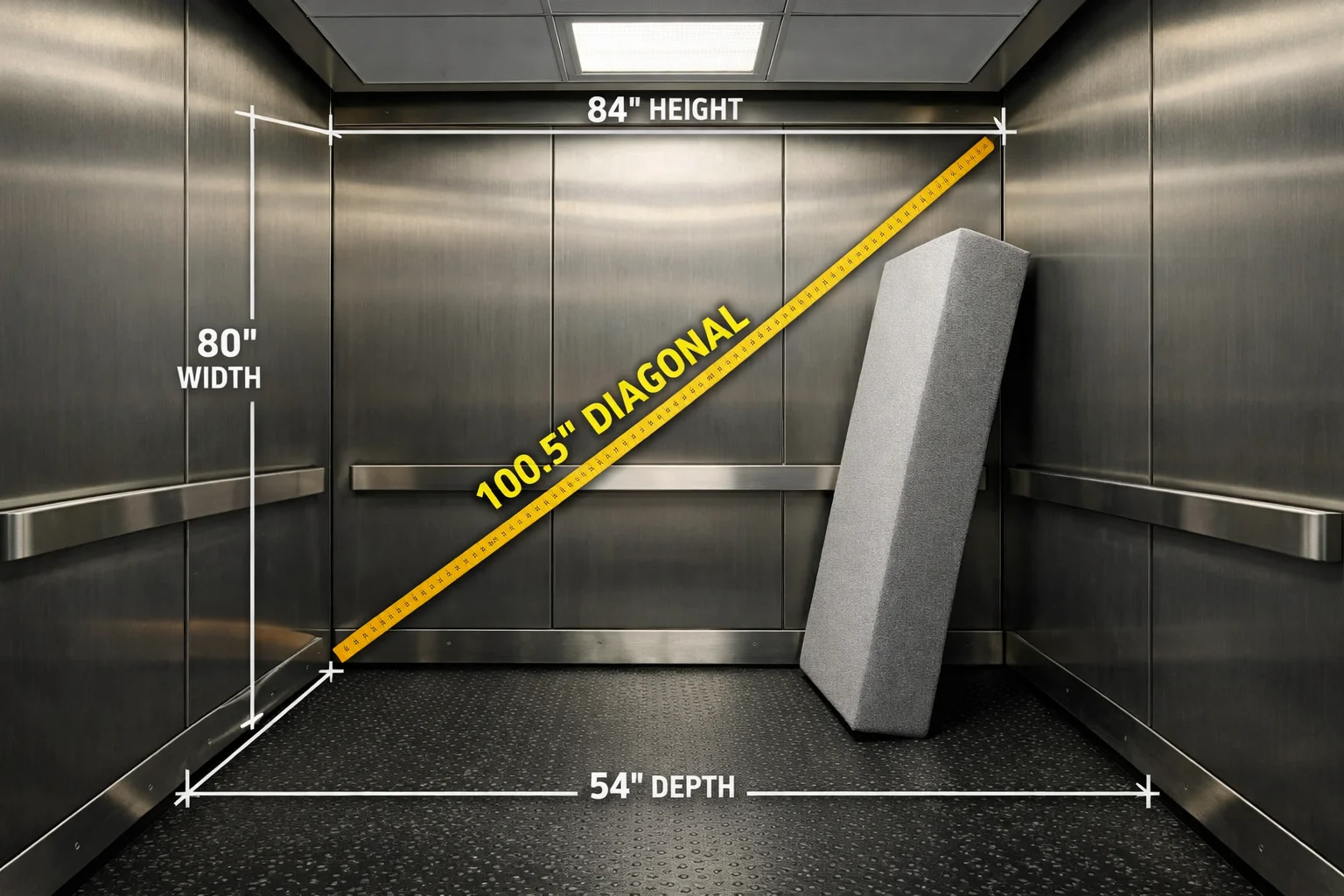
If you live in an elevator building, the measurement that ruins sofa deliveries is usually not the door width, it is the elevator’s internal diagonal. I learned the hard way that a sofa that will not go in flat can sometimes go in standing up, but only if the inside of the cab gives you enough corner to corner room and enough real height to tilt.In the showroom, when you are looking at an 84 inch sofa and thinking “it will fit, the elevator is tall,” I want you to pause and picture the move: the crew turns the sofa on end, then pivots it into the cab on a diagonal. That move needs both a long diagonal across the elevator floor and enough usable height inside the cab for the sofa to stand without hitting anything.
The trap is the false ceiling. Some elevator cabs look tall because the walls go up, but a drop ceiling, light box, vent housing, or decorative panel steals inches you cannot see until you are trying to angle furniture and it suddenly stops. The result is exactly the kind of ridiculous stuck moment people laugh about later, your sofa is almost in, then it hits the ceiling fixture or the lowered panel and wedges.
What I do now is treat the elevator like a box I have to measure, not a space I have to guess. You can bring a small tape measure and check the cab height from the finished floor to the lowest obstruction, not to the highest point you can see. If you do not want to measure in public, ask your building staff for the cab’s interior dimensions and specifically ask if there is a drop ceiling or any low fixtures that reduce the effective height.
When you are getting sofa specs from the store, do not just ask for the overall width. Ask for the tallest dimension of the piece as it would be carried, which is often the height from the floor to the top of the back with the legs on, and then ask what can be removed. If the legs come off or the back comes off, that can turn a near miss into a clean fit, and it is something you want confirmed in writing on your invoice or delivery notes so it is not a surprise on delivery day.
If you are on the edge, I would rather you choose a sofa that is a little smaller on paper than gamble on “the movers will figure it out.” Movers cannot negotiate with physics, and if the building says no stair carry and the elevator says no, you are the one paying for the failed attempt, the return, or the storage while you scramble.
Image Block
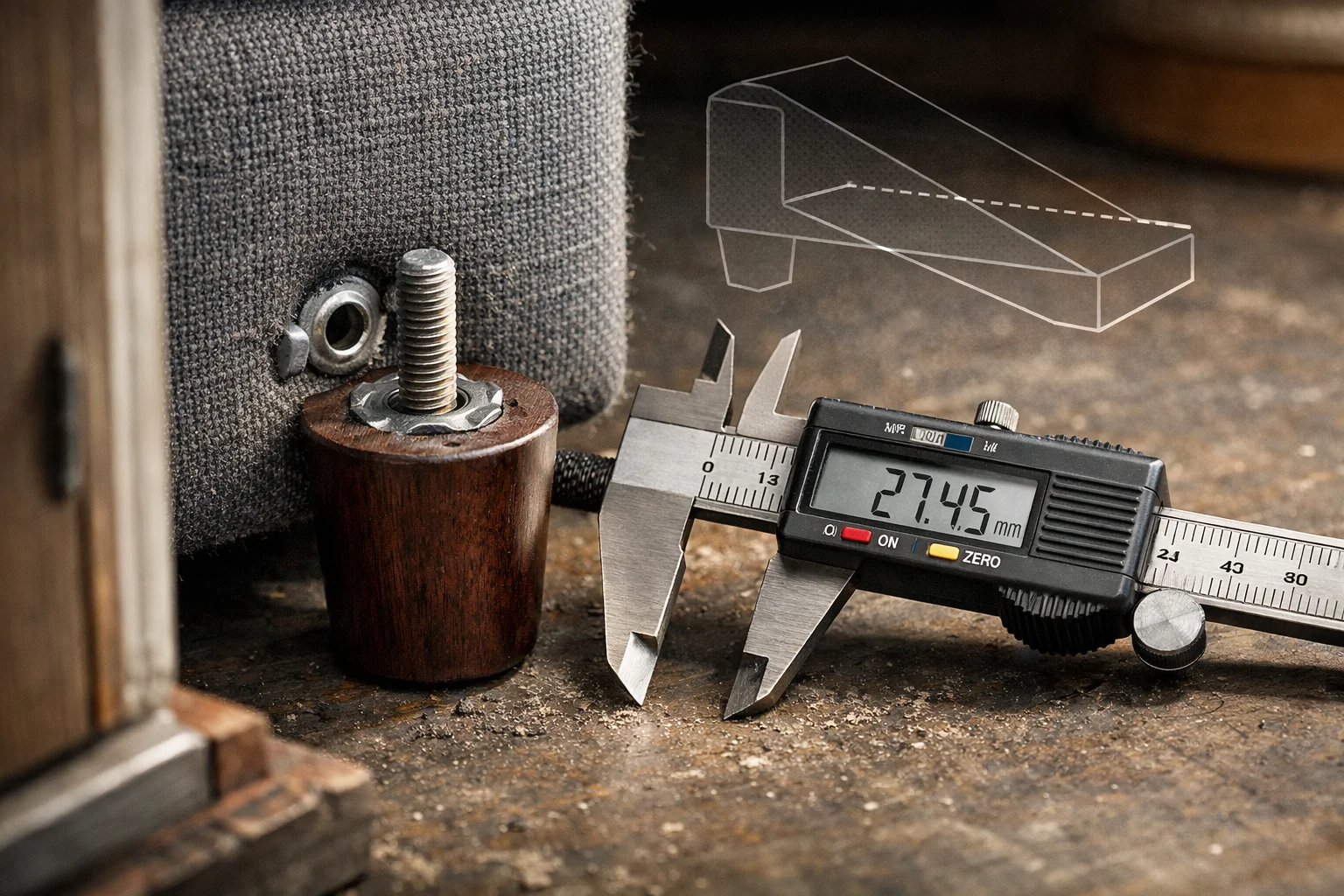
When you are worried about a sofa fitting through a door, I want you to stop thinking only about width and start thinking about the diagonal it has to swing through. That is the moment where a deep sofa gets “hooked” and stuck, even if the door opening looks wide enough on paper.
This is why I always ask, in plain words, “Do the legs come off, and how much height does that remove?” Fixed legs can add just enough overall height to make the diagonal too big for a tight doorway or a hall turn, and removing them can be the difference between a clean pass and a scratched frame or a failed delivery.
In the showroom, I look under the front edge and actually confirm what kind of leg attachment it uses. If you see a threaded insert and a leg that screws in, that is usually a good sign because it is meant to come off without drama. If the leg looks integrated into a continuous base, or you cannot see a clear connection point, I assume it is not realistically removable until someone proves otherwise.
I also ask who removes them and whether they are reinstalled as part of delivery, because “removable” can still turn into a problem if the delivery crew is not allowed to do it, or if it voids the warranty, or if it requires tools they will not use in your building. If you are buying from a store that outsources delivery, I want you to get the answer written into the order notes so you are not arguing at your doorway.
There is one more detail I watch for, because it has bitten me before. Some sofas have legs that come off, but they leave behind a hardware nub or a mounting plate that still catches on thresholds and tight turns, so you do not get the full clearance you expected. If you can, ask the salesperson to tell you the height with legs on and the height with legs off, not just “yes, they come off.”
If you are measuring at home, I have found it helps to measure your tightest doorway both at the obvious point and also a few inches above the floor, because door trim, hinges, and baseboard radiators steal space right where the sofa wants to pivot. That is exactly where removing legs helps most, because it lets the sofa ride lower as you tilt and rotate it.
Finally, do not let a salesperson wave this away with “the movers will angle it.” Angling is exactly the problem, and you are trying to control the dimensions that matter during the angle, not just the final footprint once it is sitting pretty in your room.
The 3 “Hard Limits” of Moving
There are a few choke points in real homes where “close enough” turns into “it is not happening.” I think of these as hard limits because no amount of optimism, pivoting, or bargaining makes the geometry change.
Limit 1: The Stairwell Landing
The classic killer is the stairwell landing where you have to make a 180 degree turn, usually with a banister on one side and a wall on the other. This is where long, rigid sofas, especially anything around 80 inches and up, love to wedge, because you run out of room to rotate the length before the corners hit.
If you have stairs like that, I stop shopping as if a sofa is one object. I start shopping as if it is a set of manageable chunks that can be carried like boxes. What helps most is a true modular sectional where the pieces separate into compact sections, ideally close to cube like in size, because you are no longer trying to swing a long lever around a tight corner.
In the showroom, I ask the salesperson to show me exactly where the pieces disconnect and how they reconnect. If they tell you it is “modular,” make them prove it by pointing to the actual connectors and by telling you the width of the largest single section, because some “sectionals” are still basically two huge rigid pieces that are only slightly easier than a full sofa.
What I personally want to hear is that each section can be moved independently without special tools and without partially dismantling the frame. If the only way to separate it is removing upholstery panels or digging into hidden screws, I assume the delivery crew will not do it, and you will be the one stuck at the landing.
Limit 2: The Doorway Width
Most interior doors you deal with day to day are in the 30 to 32 inch range, and the door itself is not the whole story. The hinges, the trim, and the angle you have to take while you rotate the sofa matter just as much, especially with deeper sofas.
This is where deep sofas, roughly 40 inches and beyond, cause trouble when they also have fixed legs. The depth forces you to “hook” the sofa through the opening on a diagonal, and fixed legs add height right where you need clearance while you are tilting and turning.
The most reliable fix I have found is genuinely removable legs, because dropping the sofa closer to the floor shrinks the diagonal profile enough to get you through a doorway that otherwise looks impossible. In practice, that leg removal can buy you several inches of real clearance during the pivot, which is why I treat “legs come off” as a delivery feature, not a nice to have design detail.
In the showroom, I would not settle for “yes, removable.” I want the height with legs on and the height with legs off, and I want to know if anything still protrudes once the legs are removed, like a mounting plate or a stubborn hardware nub that can catch on a threshold.
Limit 3: The Hallway Corner
A narrow hallway that makes a 90 degree turn into the living room is its own special problem, because you can get the sofa through the front door and still fail at the last corner. The failure mode is simple, the sofa is too long to begin the turn without its far end slamming into the opposite wall or doorframe, so you never get the angle you need.
When I am dealing with that layout, I stop chasing the longest sofa that “should fit in the room” and I start respecting the path it has to travel. This is where so called apartment size sofas, roughly in the 72 to 80 inch range, are not about living small, they are about getting around the corner without damage and without a failed delivery fee.
If you are unsure, you can do a quick reality check at home by measuring the hallway width and then picturing the sofa as a stiff rectangle that has to rotate. If your hallway is narrow and the corner is tight, those last few inches of sofa length matter more than you think, and I would rather you buy something slightly shorter than bet your money on a perfect pivot.
In the store, I ask for the overall length, but I also look at how “boxy” the ends are. A sofa with thick, square arms can behave longer than its stated seating width because those bulky ends hit the corner sooner, while a slimmer arm can sometimes buy you just a bit more turning room even at the same listed length.

When you look at that diagram, I want you to notice what is actually stopping the sofa. It is not the doorway, it is the moment you try to rotate a long, rigid rectangle and the far corner runs out of air before the near corner has cleared the turn.
In a showroom, a 90 inch sofa reads like a normal, even modest, three seater. In a real stairwell or a tight hall corner, that length behaves like a crowbar, you need extra space out in front of the turn that most homes simply do not have.
This is where modular really earns its keep, but only if it is truly modular. I have learned to ignore the marketing words and focus on the largest single piece you will actually have to carry, because that one piece is what has to make the turn.
If you are standing in the store, I would ask to see a floor model disconnected, not just described. I want you to watch whether it separates cleanly into manageable sections that can be carried upright and steered around corners, or whether it is basically still a big sofa that happens to split once into two awkward slabs.
At home, the practical check is to stop measuring just the final wall where the sofa will sit and measure the corner that feeds into it. If you have a 90 degree turn, measure the hallway width, then measure from the inside corner to the first hard obstruction on each leg of the L, like a wall, a radiator, a built in, or a railing, because those are the surfaces the sofa will smack before it can swing.
If those numbers are tight, I personally stop gambling on a long one piece frame. I either choose a shorter sofa that gives me slack during the pivot, or I choose a modular where each section can “walk” around the corner the way a person can, even if the full assembled sofa is the size you want once it is in the room.
One last thing I do is think about damage and blame. Corners are where movers scrape drywall and crack trim, and it becomes a messy argument about whether your house is “too tight” or their crew was careless, so I would rather buy something that makes the move boring than something that makes it a stunt.
Flat Pack vs. Modular
When you are shopping with moving in mind, I see two broad strategies that actually work in real life. One is flat pack, where the sofa is designed to be taken apart into panels so it can fit in a car and get through almost any doorway. The other is modular, where the sofa stays in chunky sections that lock together without relying on wood screws biting into the same holes forever.
With flat pack brands like IKEA or Floyd, the main advantage is obvious the first day you own it. You can usually get it home without paying for delivery, and you can get it into a tight apartment without playing elevator roulette.
The downside tends to show up later, especially if you move more than once. The joints are often doing a lot of work through bolts and screws pulling parts tight, and each time you disassemble and reassemble, those connections get a little less crisp. The first move is fine, the second move is a little squeakier, and by the third move I have seen the same sofa start to feel like it has a loose tooth, not catastrophic, just permanently wobbly.
In a showroom, what I do with a flat pack sofa is treat the connectors like they are the sofa. I get my hands under the front rail and I gently rack the frame side to side, not violently, just enough to see if the corners shift or if I hear clicking. Then I sit hard, lean back, and pay attention to whether the back feels like one solid plane or like it is flexing around the fasteners.
The question I ask the salesperson is not “Is it sturdy,” because you will always hear yes. I ask how many times it is realistically designed to be disassembled and reassembled, and whether any wear parts are replaceable, like a cam lock, a bolt, or a bracket kit, because that tells me whether the company expects repeat moves or expects you to replace the sofa when it loosens up.
Modular sofas like Lovesac or Burrow solve the moving problem in a different way. Instead of asking you to repeatedly tighten screws into wood, they usually rely on clamps, clips, or latches that pull one finished section against another, so you can break it down and rebuild it over and over without chewing up the structure.
In the showroom, I want you to look for a connector you can understand in ten seconds. I ask them to separate two sections and reconnect them while I watch, because what matters is whether it goes together cleanly and locks with a confident, repeatable feel, not whether it looks clever in a brochure.
Then I test the thing modular owners complain about most, which is creep. I push the seat sections sideways with my legs and I do a sloppy flop into the corner seat, because if the modules want to drift apart on a smooth floor, you will find out fast. If the salesperson says “just use a rug pad” or “you can add grips,” I treat that as a real cost and a real hassle, not a free fix.
The main con with modular is usually price, and I think the honest way to judge it is to tie it to your future, not your living room today. If you expect to move, change roommates, go from an apartment to a house, or reconfigure a room around a new TV setup, paying more for something that can change shape and survive multiple moves can be cheaper than buying a new cheap sofa every time the stairs win.
If you are deciding between the two, I would anchor it on one practical question. Are you trying to solve “I need to get a sofa into this home once,” or are you trying to solve “I need this sofa to behave after several take aparts and rebuilds.” Flat pack often wins the first problem, modular often wins the second, and the showroom tests I just described will usually tell you which category the specific model actually belongs in, regardless of the label on the tag.
Technical Summary: The "Safety" Measurement
Before you buy, I want you to do a quick set of measurements at home that saves you from the most expensive kind of mistake, the kind where the sofa is fine but your hallway is not. Start with your door height, because most standard interior doors are around 80 inches, and that number matters when movers try to stand a sofa up to pivot it through a tight spot.Next, I measure the narrowest point of the route the sofa has to take, not the average width. I look for the real pinch point, which is usually a hallway section where trim, a radiator, a handrail, or an open door steals a couple inches right where the sofa has to rotate.
Here is the simple rule I use when I am deciding whether I am about to gamble. If your hallway width is less than the sofa’s depth, you are likely in trouble, because a deep sofa needs room to swing its diagonal through a corner, and a skinny hallway takes that swing away. When those numbers are close, I stop relying on “it will probably angle,” and I start choosing a shallower sofa, a shorter sofa, or something modular that breaks down into smaller pieces that can walk around the corner.
Explore Technical Reference

Agnostic Furniture: Buying for Your NEXT Apartment
Understanding how to select furniture when you do not know what your next space will look like. Strategies for versatility, portability, and avoiding costly mistakes.
Analyze Details →
Office Seating: The Art of "Professional Theater"
Why office sofas face unique challenges of irregular use patterns, image
Analyze Details →