Heavy Duty Seating: Furniture for Big & Tall
Introduction
I learned the hard way that most sofas are built around an imaginary person who weighs about 180 pounds and sits politely in the middle. If you or someone in your household is closer to 250 pounds or more, that assumption matters a lot more than salespeople admit.
When furniture is engineered for a lighter body, it does not just feel a little softer over time. The frame flexes, the springs overstress, and the cushions collapse in ways that cannot be fixed with fluffing or rotation. What feels comfortable on a showroom floor can turn into a sagging, creaking mess in a year.
I am not saying heavier people break furniture through misuse. I am saying the furniture was never designed with you in mind. Once I understood that, I stopped blaming myself and started paying attention to how sofas are actually built.
This guide is written so you can spot those limits before you buy. I will walk you through what I now press on, sit on, and ask about in a showroom, especially if weight capacity is a real concern in your home.
The "Standard" Limit
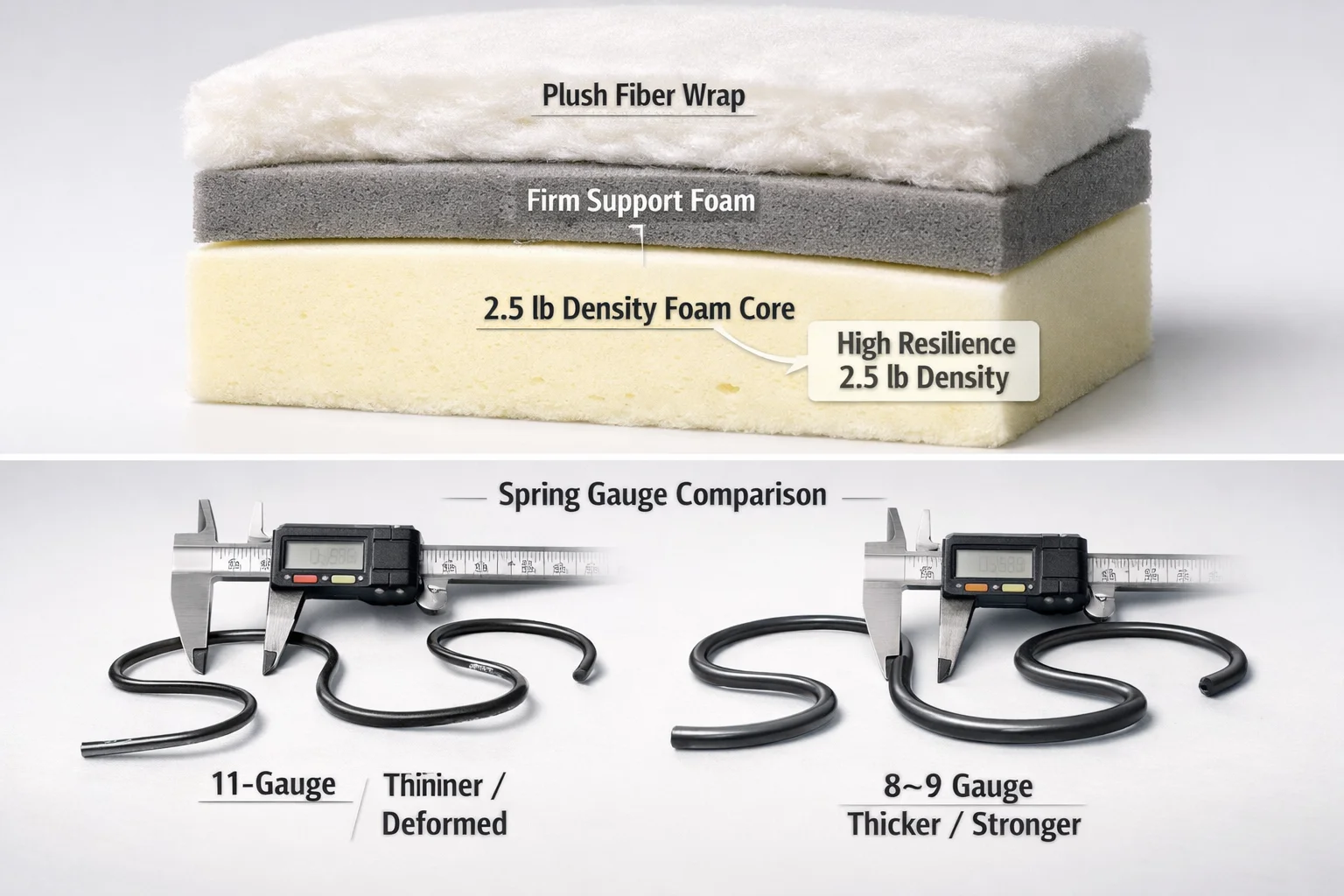
When a sofa is built to standard specs, I have learned that it quietly assumes a lighter load than many real households put on it. The most common setup uses about 1.8 pound foam over thin, 11 gauge springs, and that combination has a very predictable failure pattern once it is asked to do more than it was designed for.The first thing that goes is the foam. Under higher weight, it compresses and does not rebound, losing a huge amount of its original thickness in a surprisingly short time. What you feel is not softness breaking in but the cushion flattening into something closer to a pancake, usually within months.
As the foam collapses, the springs underneath start to stretch and stay stretched. This is when the seat develops that scooped out bucket shape that pulls you into one spot and makes standing up harder every week. At that point, rotating cushions does nothing because the support system underneath has already changed shape.
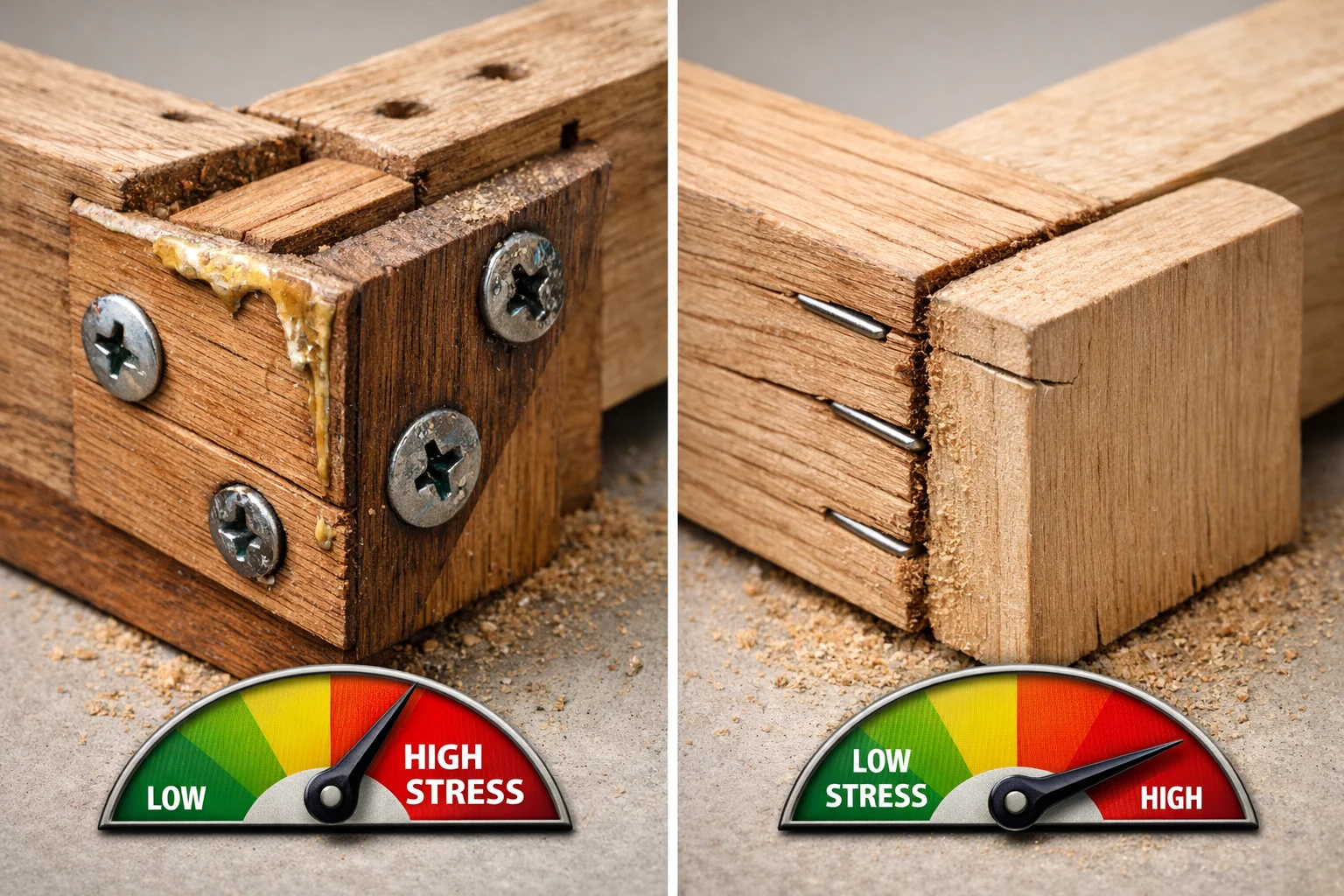
Meanwhile the frame is taking stresses it was never meant to handle. I listen for creaks and pops because those sounds usually come from glued joints flexing and slowly separating. Once a frame starts talking to you like that, cracking is only a matter of time.
This is why buying a physically bigger sofa does not solve the problem. I have made that mistake myself. What you actually need is heavier duty construction throughout, not more surface area. If the internal specs stay standard, the lifespan will stay short no matter how wide the seat looks.
The Heavy Duty Build Sheet
When I talk about a heavy duty sofa, I am not talking about branding or how thick it looks. I am talking about a short internal checklist that I now run every single time I sit down in a showroom.
The first thing I look for is what I call the fifth leg. Most sofas only have legs at the corners, and that means the entire front rail is spanning the middle with nothing underneath it. I learned to crouch down and actually look under the sofa, because a real center support leg should touch the floor, not just the frame.
If that center leg is missing, I know the middle seat is relying on wood and glue to hold up the most stressed part of the sofa. That is exactly where people tend to sit, and exactly where frames start to sag or crack. When there is a solid center leg transferring weight straight to the floor, the whole sofa feels calmer and more stable when you sit down.
Next I pay attention to what is under the cushions. Most salespeople will say the sofa has steel springs, which sounds reassuring but means almost nothing by itself. What I want to know is whether those springs are thin and bendy or thick and stubborn.
If you press down on the seat and feel a soft bounce that keeps moving after you stop, that usually means thinner wire that will stretch over time. When the springs are heavier gauge, the seat pushes back with a firmer, more controlled resistance. If a salesperson mentions drop in coil suspension, I take that seriously because it behaves more like a mattress and spreads weight across many points instead of a few wires.
Then there is the foam, which is where I see the most confusion. Density is not firmness, even though those words get mixed up constantly on the sales floor. I always ask directly about foam density, and I listen for numbers closer to the high twos rather than the high ones.
High density foam can feel soft or firm depending on how it is tuned, but what matters to me is that it does not disappear under load. When you sit and stand up, the cushion should return to its original shape quickly and fully. If it looks a little tired even after a single sit, it will not improve once it is in your living room.
I have learned not to be shy about asking these questions, even if it feels awkward. A sofa that is truly built heavier will have answers, and a sofa that is not will rely on vague comfort language instead. This build sheet is not about perfection, but if I can get a center leg, thicker springs, and higher density foam in the same piece, I know I am finally shopping in the right category.
Dimensions for Tall Users
Weight is only half the comfort problem. Height quietly decides whether a sofa supports you or slowly wrecks your knees and lower back.
I am tall enough that standard sofas have never really fit me, even when they felt fine for five minutes in a showroom. The issue is not overall size but where the seat hits your body once you actually relax.
Seat depth is the first thing I check. Most sofas are built around a depth of about twenty one inches, which leaves a tall person with thighs hanging off the front edge.
When that happens, your legs are doing extra work just to stay comfortable, and your lower back ends up slouching to compensate. In the showroom, I slide my hips all the way back and see whether the front edge supports most of my thigh or just the back half.
If you are around six foot two or taller, I have found that you want something closer to twenty four to twenty five inches of usable depth. The key word is usable, meaning after the back cushions are in place, not the bare frame measurement a salesperson might quote.
Seat height matters just as much, especially if your knees are not great. The standard height of around eighteen inches puts a taller person into a deeper bend than their joints like.
I test this by standing up without rocking forward or using my hands. If I feel like I have to climb out of the sofa, that seat is too low for daily life.
A seat height closer to twenty to twenty one inches lets your legs do the work instead of your knees. This is one of those things that feels slightly odd at first but saves you a lot of discomfort over years of use.
What I have learned is that tall friendly dimensions are rarely advertised. You have to sit, scoot, stand, and pay attention to your own body instead of trusting the tag.
If a sofa fits your height properly, it will feel boringly natural. If it does not, no amount of good foam or heavy springs will make up for fighting gravity every time you sit down or get back up.
Technical Summary: The Bariatric Checklist
When I get to the end of a showroom conversation, this is the point where I stop talking about comfort and start asking for specifics. I do not ask if the sofa is strong. I ask what it is actually made of, because the answers tell me more than any sit test.
For the frame, I want to hear kiln dried hardwood and I want to see a real center leg. Kiln dried wood matters because it is more stable over time and less likely to twist or crack under constant load. The center leg matters because it takes weight off the longest, weakest span of the frame and sends it straight into the floor where it belongs.
For the suspension, I am listening for heavier wire, not just the word steel. Eight gauge sinuous springs or a drop in coil unit tell me the seat was designed to resist stretching and sagging. If the salesperson cannot tell me the gauge or the type, I assume it is lighter duty and move on.
For the cushions, I ask directly about foam density and I wait for a number. Anything around two and a half pounds per cubic foot or higher tells me the foam was chosen for durability, not just initial softness. I do not care if it feels plush or firm in the moment as long as it rebounds fully when I stand up.
Finally, I look at the warranty, especially the fine print. I want to know whether frame failure is actually covered for people over two hundred fifty pounds. Many warranties quietly exclude heavier use, which tells me the manufacturer knows the limits even if the sales pitch does not.
I treat this checklist as a filter, not a guarantee. If a sofa cannot meet these basics on paper, it will not magically hold up better in my living room. When it can, I know I am at least shopping among pieces that were designed for real bodies instead of showroom fantasies.
Diagram
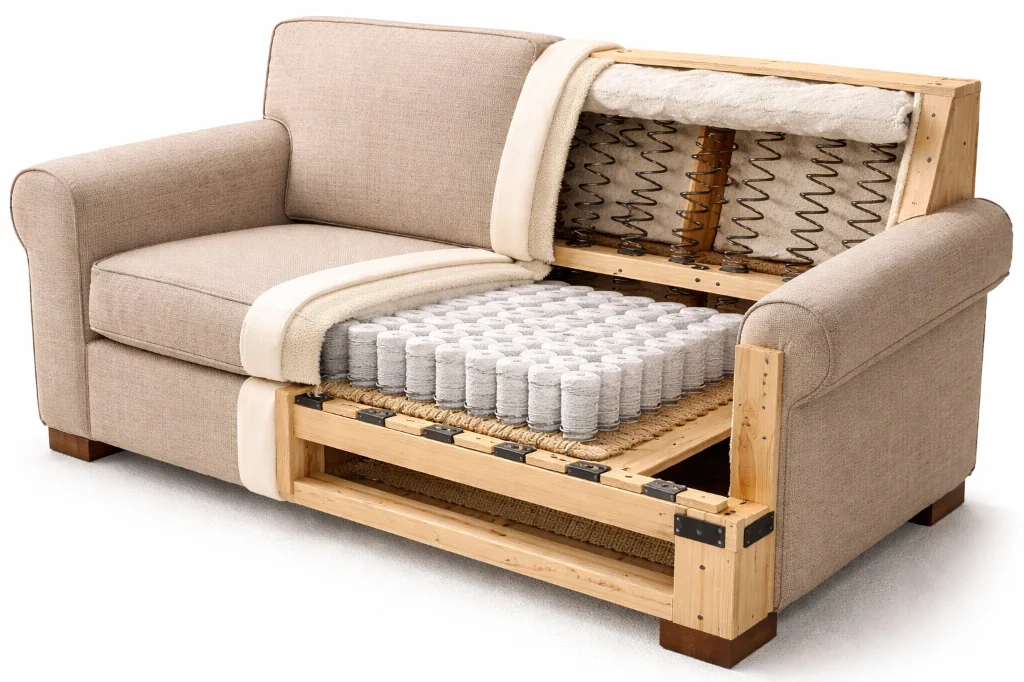
When I look at a diagram like this, I stop thinking about comfort and start thinking about gravity. Weight always wants to go straight down, and the only question is whether the sofa gives it a clear path to the floor or asks the frame to act like a suspension bridge.
On the standard frame side, what jumps out to me is the long, unsupported span across the front. That is where people sit, and that is where wood slowly bows even if it looks thick on day one. In a showroom, I press down in the middle seat and watch the front rail, because if it moves now, it will move a lot more later.
The reinforced frame tells a different story. The extra cross members break that long span into shorter sections, which means each piece of wood carries less stress. When there is a center leg directly under that middle seat, the weight goes straight into the floor instead of flexing the frame every time you sit down.
You do not need to understand joinery or load calculations to use this. I simply get down low enough to see whether there is real structure under the sofa or just empty space. If I can see daylight across the middle with no leg and no cross brace, I know exactly how that sofa will age.
I also pay attention to how the sofa behaves when I shift my weight side to side. A frame like the reinforced one in the diagram feels dead calm, almost boring. A lighter frame twists slightly, and you can feel one side react when you sit on the other.
That twisting is what loosens joints and starts the creaks I mentioned earlier. Once I learned to feel for it, I could not unfeel it. A sofa that stays quiet and still under uneven weight is telling you it has enough structure to last.
What this diagram really taught me is that strength is not about thicker arms or taller backs. It is about what you never see, and whether the frame treats your weight as a problem to resist or a load it was designed to carry.
Explore Technical Reference
Living Alone: Stop Buying "Future" Furniture
Why the sectional that looks cozy often wastes space for single occupants. Strategies for furniture that serves actual solo living patterns.
Analyze Details →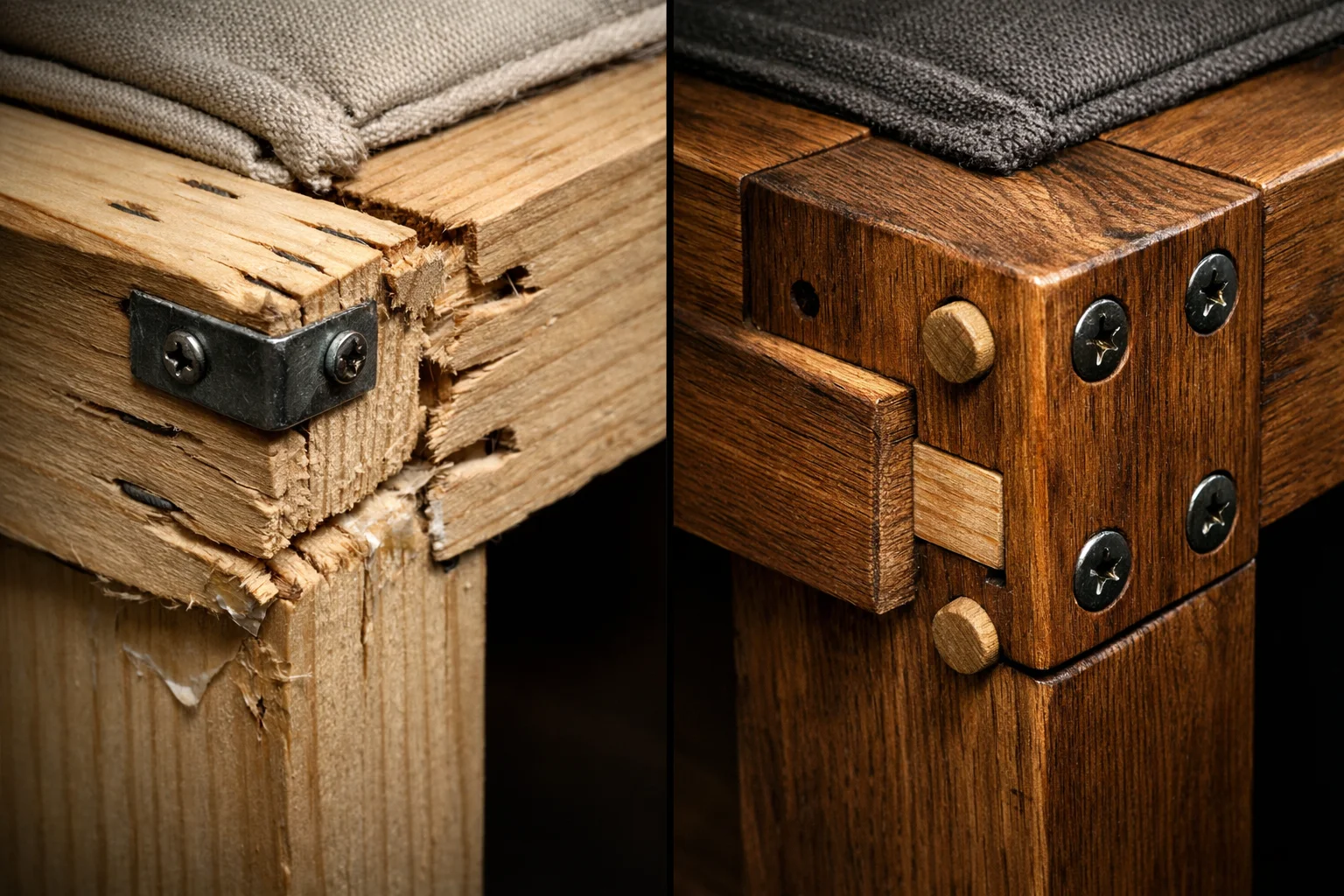
Residential vs. Commercial: The Safety Gap
Understanding why furniture warranties void when residential products are used commercially. The structural, safety, and legal differences between categories.
Analyze Details →