Heavy Use: When "Standard" Furniture Isn''t Enough
Introduction
I replaced my first family sofa after 3 years. The second one lasted 5 years. My third one is now 7 years old and looks brand new. The difference was not the price, it was the “Heavy Use” rating.
What finally clicked for me is that most sofas fail the same few ways, and you can predict a lot of it in the showroom. Cushions get soft and lumpy, the seat starts to sag into a hammock, and the frame develops little creaks that turn into full-on wobble.
The “Heavy Use” label is usually a clue that the maker at least thought about daily sitting, kids flopping, and someone sleeping on it now and then. It is not magic, and it is not a guarantee, but it pushed me to ask better questions and check the parts that actually wear out.
When you are shopping, I want you to treat the floor model like a test tool, not a pretty display. You are going to sit like you live, press where it hurts, and ask for specifics instead of accepting vague promises like “premium comfort” or “high quality materials.”
If the salesperson cannot explain what “Heavy Use” means for that exact model, I take that as a warning sign. You do not need a lecture on engineering, you just need a straight answer about what is inside the seat cushions, what the seat is supported by underneath, and how the frame is joined.
In the rest of this guide, I am going to walk you through the checks I do every time, in plain language, right there in the store. My goal is to help you spend your money on the parts that keep a sofa feeling good after year five, not the parts that look good on day one.
What is “Heavy Use”?
What is "Heavy Use"?
When a tag says “Standard Residential Use,” I read it as “this was tested for polite sitting,” not for real life. The standard assumption is usually adults sitting quietly a couple hours a day, no shoes grinding into the fabric, and no one dropping their full weight into the seat.“Heavy Use” is what a lot of homes actually do to a sofa. It means kids bouncing and launching themselves onto cushions, teenagers sprawling across the full length, bigger bodies putting more load on the same springs and foam, pets digging in with claws, and the sofa being occupied for much of the day, not just after dinner.
Here is the uncomfortable part I wish someone had told me earlier. If you put heavy use life on a standard build, it is common to see structural problems fast, sometimes in under two years. That usually shows up as a seat that starts to sag into a hammock, cushions that lose their shape, and a frame that starts talking back with creaks and little shifts when you sit down.
When I am standing in a showroom, I try to classify my own household honestly before I fall in love with a shape or a fabric. If your sofa is going into the main room where everyone collapses after school and work, if someone regularly naps on it, if you have a big dog that treats it like a launch pad, or if you have one seat that always gets used, you are shopping for heavy use even if you live in a small apartment.
The simplest way to use this idea while buying is to stop asking, “Is this good quality?” and start asking, “Is this built for standard or heavy use, and what is different inside because of that?” I want the salesperson to point to the seat support under the cushions, describe what the seat cushions are made of, and explain how the frame is joined, because those are the things heavy use punishes first.
I also treat vague answers as data. If all you get is “It’s durable,” or “It’s commercial grade,” but they cannot tell you what makes it durable, I assume it is standard residential wearing a tough sounding label. If they can name the cushion fill, explain the support system, and tell you how the corners are held together, you are at least talking to someone who knows what heavy use actually demands.
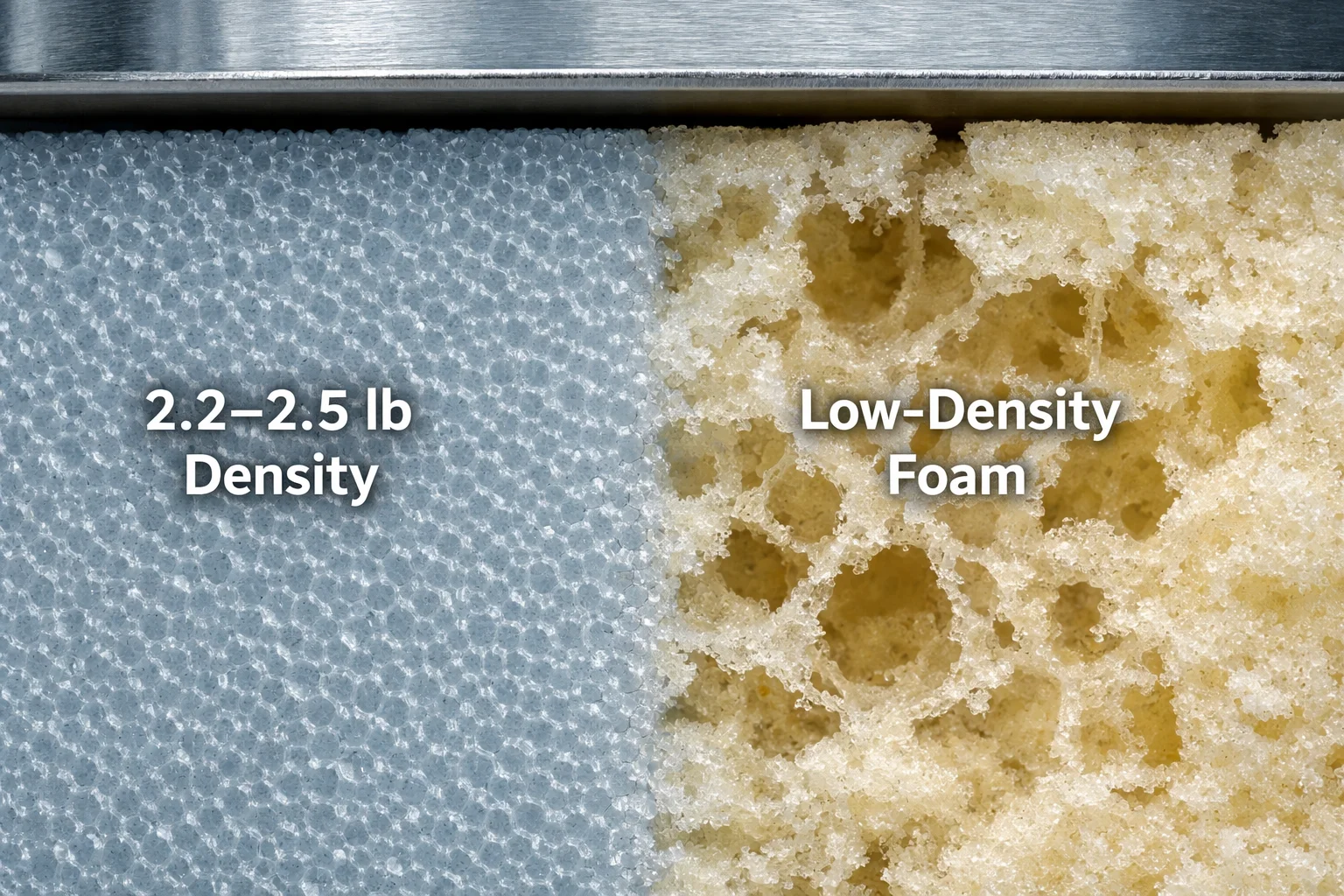
When you look at that image, I want you to translate it into a simple showroom test. You are trying to figure out whether the cushion you are about to buy will stay springy and supportive, or whether it will “crush” and never fully come back.
I do a slow, hard press with my palm right in the center of the seat cushion and hold it for a second, then release. If the foam rebounds quickly and evenly and the surface smooths back out without a lingering dent, that is a good sign. If it comes back lazily, or you can still see and feel the compressed spot, I assume it will be the first thing to go soft in your favorite seat.
Then I sit down like I mean it and pay attention to where my weight ends up. If I immediately feel like I am sinking until my body is being held up by the support system underneath, not by the cushion itself, that usually means the foam is doing less work than it should. A good cushion for heavy use feels supportive early in the sit, not just comfy for the first ten seconds.
What I ask the salesperson is straightforward: “What is the seat cushion made of, and is it high-density foam?” If they cannot answer beyond “foam” or “standard,” I treat that as a yellow flag, because the whole point is that not all foam behaves the same after thousands of sits.
If you can unzip a cushion cover on the floor model, do it, and if you cannot, ask permission. I am not trying to be nosy, I just want to see whether the cushion is a solid foam core, a foam core with a softer wrap, or mostly loose fill. A thin soft wrap can be fine for comfort, but if the whole cushion is built like a pillow, it is much more likely to get lumpy and develop that permanent butt groove.
I also pay attention to the edges, because that is where cheap foam gives itself away. When you sit near the front edge, a weak cushion collapses and you feel like you are sliding off. On a better build, the edge still compresses, but it does not fold, and you do not feel the seat frame trying to announce itself through the padding.
If you remember nothing else from this section, remember this: cushions usually do not “wear in” for years, they wear out. In the showroom, you are looking for foam that bounces back and keeps your body supported before you hit the springs or webbing, because that is the difference between a sofa that still feels good after year five and one that turns into a slump after year two.
The “Heavy Use” Build Sheet
If your household is active, you need to ignore the style for a minute and look for what I call the build sheet, even if it is not printed as a neat list. I am looking for three things I can confirm in the store, the seat support under the cushions, the cushion construction itself, and the way the frame is put together.
The fastest way I know to waste money is to buy based on fabric and silhouette, then hope the inside is “probably fine.” Heavy use is basically a stress test, and it always finds the weakest internal part first.
When I ask about the seat support, I am trying to learn what is actually holding you up after the foam relaxes a bit. If the salesperson says “springs,” I ask what kind, because that word can mean a strong, tied system or a few cheap zigzags that get bendy and noisy over time.
If you can lift the seat cushions off the floor model, do it. I look down and press on the support with both hands, because a good support system feels firm and elastic, and a weak one feels like it is already tired.
Sinuous springs, the common S-shaped wires, can be fine if they are heavy gauge and closely spaced, but I have sat on plenty where they feel bouncy in a bad way and start to sag in the main seat lane. In the showroom, that shows up as a little trampoline effect, then a slight dip that pulls you toward the center of the cushion.
Eight-way hand tied springs are often a good sign for heavy use, mostly because the goal is stable support that does not shift sideways as you move around. If a salesperson mentions them, I still do the sit test, because I care less about the phrase and more about whether the seat feels even across the width, with no one spot that drops faster than the rest.
Webbing is where I get cautious. Some webbing systems are strong, but a lot of mass market webbing feels supportive for five minutes and then you notice your hips sinking lower than your knees, especially if you sit in the same place. If you sit down and feel your weight settling into a sling, that is the hammock effect starting early.
Then I move to the frame, because heavy use turns tiny looseness into squeaks, and squeaks into wobble. I grab the sofa by the arm and try to gently twist it, not violently, just enough to feel whether the whole thing moves as one solid unit or whether the arm and back feel like separate pieces negotiating with each other.
I also do the corner test. I press down hard on the front corner of the seat, then the opposite corner, and I listen. A little fabric noise is normal, but clicking, creaking, or a shifting sensation is usually a joinery issue that will only get louder once the sofa dries out in your home and sees daily movement.
What I want to hear about construction is boring words like corner blocks, glued and screwed joints, and a frame that is more than stapled together. If the only thing holding the story together is “hardwood frame,” I ask what hardwood, because I have learned the hard way that “hardwood” can still be thin pieces, soft species, or a frame that relies on staples in the stress zones.
There is one more practical check I always do for heavy use, and it is not glamorous. I kneel down and look at the legs and the center support, because a long sofa without good center support is a sag machine, especially if someone sleeps on it.
If the sofa is wide and I do not see a solid center leg or some kind of middle support making contact with the floor, I assume the span is going to flex over time. That flex shows up as the seat slowly dipping in the middle, even if the cushions are decent.
When it comes to cushions, I also want you to ask one specific question that forces a real answer: “Is the seat cushion a replaceable insert, and can I order one later?” A heavy use sofa is one where you can keep the frame and refresh the seat, and if the brand cannot supply inserts, you are more likely to be stuck living with a saggy seat or replacing the whole thing.
If you feel awkward asking for specs, I get it, I used to. What changed for me is realizing that the showroom is the one time you have leverage, and “I do not know” is useful information.
If you want a simple rule while you are standing there, treat anything the salesperson cannot clearly describe as standard use, no matter how expensive it looks. Heavy use is not a vibe, it is specific choices inside the sofa, and you can usually confirm those choices with your hands, your ears, and two minutes of honest sitting.
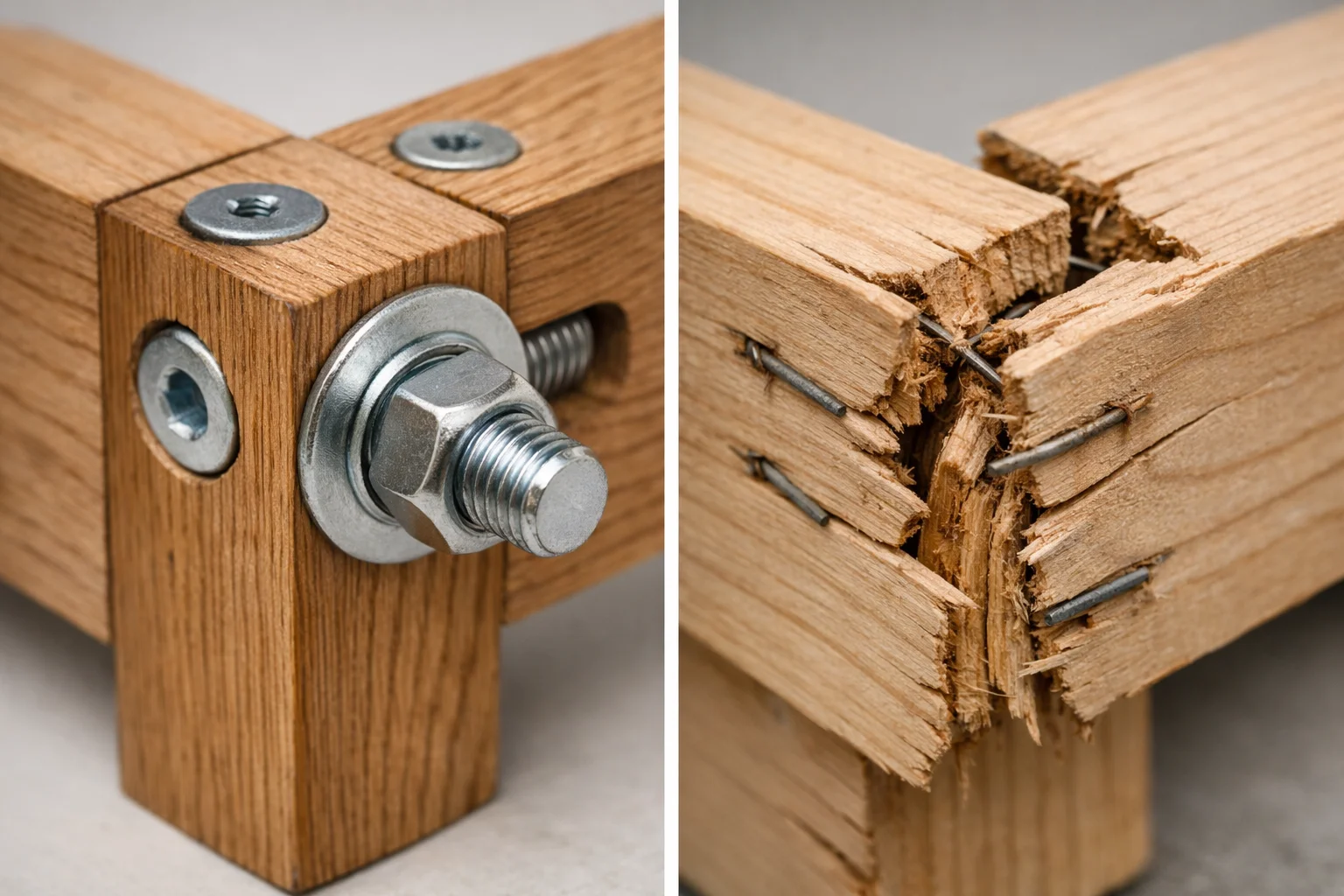
1. The Frame (Bolted, Not Glued)
If cushions are the first thing you feel, the frame is the first thing that quietly betrays you over time. My early sofas did not “break” dramatically, they slowly loosened up until every sit came with a little shift, then a creak, then that annoying wobble you cannot un-notice.
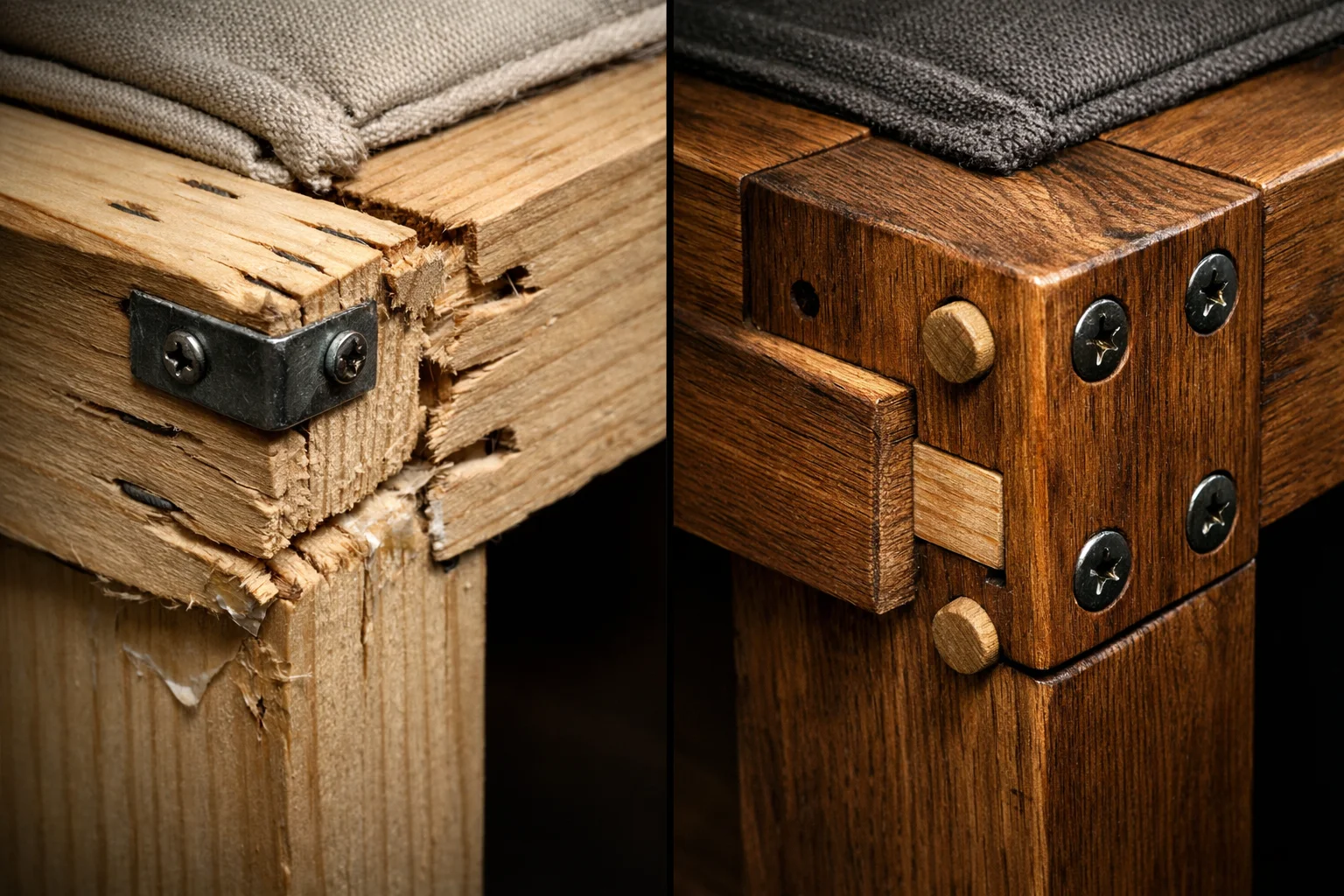
Most standard sofas are stapled together at key joints, especially where the arms and back meet the base. Staples are fast and cheap, and they can hold fine at first, but heavy use is basically repeated shock loads, like when a teenager drops into the corner seat or someone flops onto the arm like it is a chaise.
Here is what I do in the showroom to sniff out a stapled-joint frame without taking anything apart. I grab the sofa by one arm and give it a firm, controlled shake side to side, then I brace one hand on the back and one on the arm and try a gentle twist. If I feel the arm and back move out of sync, or I hear a sharp tick instead of a dull fabric rustle, I assume the joints are already working loose.
Then I do a sit-drop test, carefully. I sit down with a little momentum, not trying to be destructive, just mimicking real life, and I listen for a crackle or pop that happens right at impact. A solid frame tends to sound quiet and dead, and a stapled frame often sounds like it is flexing at the corners.
When you ask about the frame, I would not accept “hardwood” as the whole answer, because that word does not tell you how the pieces are actually held together. What I want you to ask, plainly, is “Are the stress joints stapled, or are they through-bolted or double-doweled?”
If the salesperson knows what they are talking about, they can usually tell you whether the arms are through-bolted to the base, or whether key joints are reinforced with dowels plus mechanical fasteners. I have found that “I think it’s glued” is usually code for “it’s stapled and maybe has some glue,” and glue alone is not what keeps a sofa tight after years of people dropping into it.
Through-bolting is the boring answer I like for heavy use because a bolt does not slowly let go the way staples can. Even if the wood expands and contracts a bit with seasons, a bolted joint can stay clamped, which is exactly what you want at the arm and back corners where all that leverage happens.
Double dowels are also a good sign, not because dowels are magical, but because it usually means the maker cared about alignment and long-term shear strength, not just holding two pieces together for shipping. In the store, you probably will not see the dowels, but you can often feel the result, which is a frame that resists twisting and does not “talk” when you load one corner.
If you are allowed to look underneath, do it, because sometimes the bottom edge tells the truth. I look for clean, deliberate hardware at stress points and I look for evidence of rushed assembly, like lots of staples in a line where you would expect a bracket, a bolt, or a substantial block.
One more thing I do is lift a front corner of the sofa slightly off the floor, just an inch, then set it back down. A good frame feels like one rigid box, and a weak one feels like it is racking, where the rectangle turns into a parallelogram for a moment and you can feel the joints protesting.
If the model you love is stapled at the joints, I am not saying you must walk away, but I would treat it as standard use no matter how nice the fabric feels. If you are buying for a main living room with kids, pets, frequent guests, or regular naps, I would personally hold out for a frame that is mechanically fastened, because that is what keeps the sofa feeling tight after year five, when the showroom comfort has long stopped being the point.
2. The Foam (2.2lb Minimum)
If there is one spec I now push for in a main living room sofa, it is the seat foam density. I have learned the hard way that “comfortable in the showroom” and “still supportive after a couple years” are two different things, and foam is usually where the shortcut happens.
Most standard sofas use around 1.8 lb density foam in the seat cores. In real life that tends to collapse faster than people expect, especially in the one favorite spot, and once that foam crushes it does not truly bounce back, it just keeps getting flatter.
When a sofa is labeled for heavy use, I want to hear 2.2 lb density as a minimum for the seat foam, and I am happiest when it is somewhere in the 2.2 to 2.5 range. The point is not that higher numbers feel fancy, it is that higher density foam usually survives a lot more sit down cycles before it gives up and turns into that dead, pancake cushion you cannot fluff back to life.
This is where I tell you something that can feel counterintuitive in the store. Better foam often feels firmer at first, and that can scare people off because it is not instantly sinky. What I care about is whether it stays supportive, because a sofa that starts slightly firm and settles a little is usually a better long term outcome than a sofa that starts plush and then keeps sliding downhill.
You can check this without any tools. I press down hard with my palm in the middle of the cushion, then I do the same near the front edge where people perch, and I watch how fast and how evenly it rebounds. If it pops back cleanly and the surface looks smooth again, I relax a bit, but if it leaves a lazy dent or feels like it is already tired, I assume it will be worse in six months in your home.
Then I do a body check that tells me more than the hand press. I sit down and make sure my hips are being held up by the cushion itself, not by the support system underneath, because when low density foam starts to go, you begin to feel the seat platform doing the work. If you feel a hard, flat “bottoming out” sensation quickly, that is the experience you will be living with once the foam breaks down.
The most useful question I have found is blunt and specific: “What is the seat foam density in pounds, and is it 2.2 or higher?” If you get an answer like “high density” without a number, I treat it as unknown and I keep pushing, because the number is the whole point.
If the salesperson cannot or will not tell you, I ask them to show me the written spec sheet for that exact model, not a general brand brochure. If there is no spec sheet, I assume it is standard foam until proven otherwise, and I price it in my head like a sofa I may be re cushioning sooner than I want.
One more thing I watch for is how the brand talks about the cushion build. A solid foam core with a softer wrap can be great, because you get support from the core and initial softness from the wrap, but a seat that is mostly fiber fill tends to migrate and go lumpy. If the description sounds like pillow language instead of support language, I get cautious and I sit in it longer, especially in the spot you know you will claim as yours.
If you are buying online and you cannot do these checks in person, I would still use the same rule. I look for a published seat foam density of at least 2.2 lb, and if it is not listed, I act like it is 1.8 and decide whether I am comfortable with that risk.
3. The Fabric (Synthetic Only)
Fabric is where I see a lot of people get talked into the wrong thing, because “soft” and “luxury” sells, even when it is a bad match for daily sitting. If you want a sofa that still looks decent after years of sliding, lounging, and spot cleaning, I would rather see you in a synthetic upholstery than most natural fiber weaves.
In plain terms, I trust synthetics for heavy use because they are harder to tear and slower to wear thin from rubbing. Natural fibers like cotton, linen, and rayon can feel great in the showroom, but I have watched them go shiny on the arms, fade in the sunny seat, and wear through on the front edge where your legs constantly brush the fabric.
When I am buying for real life, I ask the most basic question first and I make them answer it clearly: “What is the upholstery content by percentage?” I want to hear “100% polyester” or “nylon,” or at least that the face fabric you touch is mostly synthetic, not just the backing.
If the tag says something like “linen look” or “cotton feel,” I do not treat that as content, I treat it as marketing. I ask them to show me the law label or the fabric spec card that lists the actual fiber percentages, because that is where the truth usually is.
Polyester is the default “won’t baby it” choice in my house. It tends to handle constant contact, it resists pilling better than a lot of soft natural blends, and it usually cleans up without turning into a permanent water ring festival if you catch spills quickly and follow the care code.
Nylon is the other synthetic I like to hear for heavy use, especially when you have kids or pets. In my experience it is tough and it holds up well to abrasion, but it can feel a little less cozy depending on the weave, so I rely on touch plus the rub test, not the name alone.
In the showroom I do a simple fingernail drag across an inconspicuous spot, like the back corner or the inside of the arm. I am not trying to damage it, I just want to see whether the surface fuzzes up immediately, because fast fuzzing in the store often turns into pilling at home where you are rubbing it with jeans and blankets every day.
Then I do a pinch and pull test on a seam, again gently. If the fabric seems to spread open around the stitches with a small tug, that tells me it may snag or split where you sit and shift, even if the overall fabric feels thick.
I also pay attention to the weave and texture, not just the fiber. A very nubby, open weave can be a magnet for pet claws and snagged jewelry even if it is polyester, and a super smooth weave can show sheen and pressure marks on the main seats. I run my hand back and forth on the arm and think, “Would this look bad if it got rubbed here every day for five years?”
If you are trying to decide between “standard” fabrics and heavy use synthetics, I want you to think about your cleaning reality. If you know you will spot clean, wipe, and occasionally scrub a little, synthetics usually forgive you more, while some natural fibers punish you for every imperfect cleaning attempt by looking blotchy or going dull.
The wording that helps me most is simple: if a model is offered in a heavy use fabric option and it is 100% polyester or nylon, I treat that as the safer long term pick even if the natural fiber option feels nicer for the first ten minutes. Comfort you can add with throws and pillows, but worn through arms and shiny seat lanes are hard to unsee.
If you want one quick way to keep a salesperson honest, ask, “Is this considered a heavy use upholstery for this model, and if so, is it polyester or nylon?” If they cannot answer without deflecting into color talk, I assume the fabric is chosen for looks first, and I decide whether I am willing to live with the wear that usually comes with that.
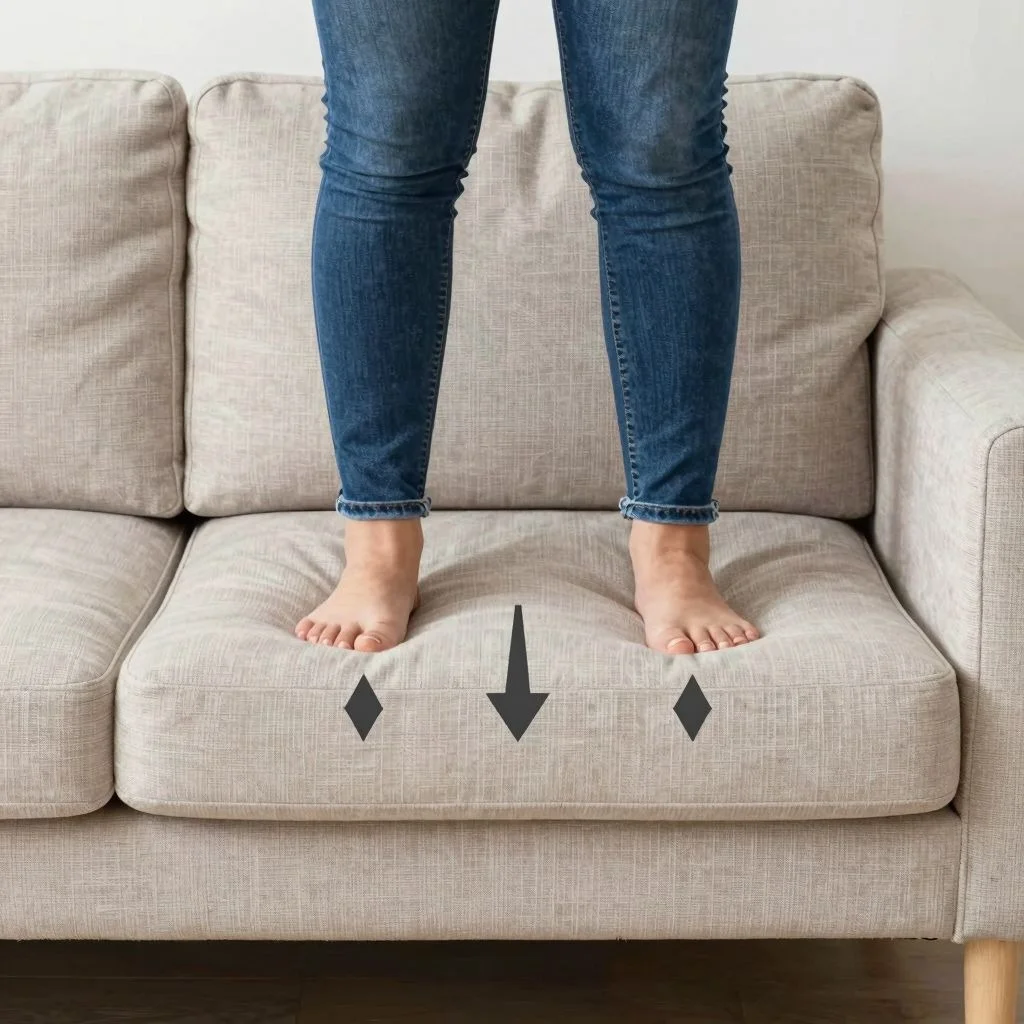
When you are staring at fabrics on a wall, it is easy to get seduced by softness and color and completely miss the one thing that predicts how it will look after a few years. I now care less about whether a fabric feels “luxury” and more about whether the weave is tight enough to resist stretching, snagging, and that slow baggy look on the seat and arms.
The fastest test I know is exactly what the caption says, the fingernail test. I pick a discreet spot on the floor model or a swatch, press my fingernail into the fabric, and drag lightly across the surface.
What I am watching for is whether the threads shift and stay shifted. If the weave opens up, or you can see the yarns separating like a tiny ladder run, I assume real life will do the same thing with jeans seams, belt rivets, pet paws, and constant sliding in and out of the seat.
A tight weave behaves differently. When I do the same drag on a good heavy use fabric, the surface might show a temporary mark from the direction of the nap, but the threads do not migrate, and it does not look “disturbed” once I rub it with my hand.
I also do a pinch test because loose weaves like to spread. I pinch the fabric next to a seam or piping and give it a small tug in opposite directions, and if the stitch holes widen and the fabric gaps, I treat that as a warning for seam failure in the exact places you always sit and shift.
If you have pets, this weave check matters more than the fiber name. I have seen polyester that still snags badly because it is a chunky, open basket weave, and I have seen tighter synthetics that shrug off claws because there is nothing for a nail to hook into.
When you are talking to the salesperson, I would ask one plain question that forces them out of vague “durable” language. I ask, “Is this a tight weave upholstery meant for heavy use, and can you show me a swatch so I can do a nail drag test on it?” If they hesitate or act like you are being difficult, that is information, because you are the one who has to live with the wear.
The Slipcover Strategy
Sometimes I stop trying to win the durability game at the fabric level and I just add a sacrificial layer. If you have kids, pets, or you actually eat on the sofa, a machine washable slipcover can be the difference between a sofa you keep and a sofa you resent.
The basic idea is simple. Instead of paying extra for an upholstery fabric that is supposed to survive everything, you buy a standard sofa you like for comfort and shape, then you put a washable cover over it and treat the cover as the thing that takes the hits.
The real benefit shows up the first time something gross happens, because it always does. When the dog vomits, or a kid spills grape juice, or you get that mystery sticky spot from a guest, you can pull the cover off and wash it, instead of trying to spot clean a stain that keeps blooming back every time it dries.
In a showroom, I try to confirm two practical things before I commit to this strategy. I want to know whether the slipcover is actually designed for that sofa, and whether you can remove it without disassembling half the furniture, because a “slipcovered look” sofa is not the same as a sofa you will happily strip and wash on a Tuesday night.
I also ask about the care reality in plain words, not just “it’s washable.” I ask whether it is machine washable at home, whether it has to be line dried, and whether the brand expects noticeable shrinkage, because nothing kills this plan faster than a cover you cannot get back on after the first wash.
Then I look at how the cover is held in place. If it has ties, Velcro, zippers, or a tucked in panel system, I check whether it looks like it will stay put when you stand up and sit down a lot, because a cover that constantly creeps and wrinkles becomes a daily annoyance.
You also need to be honest about the one big downside. Slipcovers almost always look a bit rumpled, especially in the main seat and on the arms, and they can develop that “lived in” looseness even when they are clean.
If you are the kind of person who straightens pillows every time you walk past the sofa, this might drive you nuts. I have learned that it is not a moral failing to want a sofa that stays crisp, it just means you should not pick a solution that requires you to tolerate wrinkles as the cost of easy cleaning.
There is another small trap I watch for. Some slipcovered sofas feel great at first, but the cover fabric itself can be a lint magnet, and pet hair can weave into it in a way that makes it feel permanently dusty, even when it is freshly washed.
So I do a quick lint check right in the store. I rub the slipcover with my hand, then I look at it from an angle under the showroom lights, and I ask myself if it is the kind of fabric that will show every hair and crumb in your house.
If you want to use slipcovers as a strategy without regretting it, I would focus less on the marketing word “washable” and more on whether you would realistically remove and wash it as often as life demands. If the cover feels like a hassle, you will stop using the one feature you are paying for, and then you are back to living with stains on a standard sofa.
Technical Summary: The "Cost Per Year" Math
When I am torn between a cheaper sofa that looks fine today and a sturdier one that costs more, I do one quick piece of math that keeps me from buying another “two year sofa.” I take the price and divide it by the number of years I realistically expect it to stay supportive and tight, not just “usable,” and that is the cost per year.Here is the simple example that matches what I have actually lived through. A cheap sofa that costs $1,000 and lasts about 2 years is effectively $500 per year. A heavy duty sofa that costs $2,500 and lasts about 10 years comes out to $250 per year, even though it hurts more at the register.
This only works if you are honest about lifespan, so I base the years on what you can verify in the showroom. If you cannot confirm the seat foam density, the support system under the cushions, and the way the frame is fastened at the stress joints, I do not “assume 10 years” just because the price is higher, I assume it is a standard build and I shorten the lifespan in my head.
What changed my buying habits is realizing that an expensive sofa can still be disposable if the inside is built like a cheap one. The point is not “spend more,” it is “pay for years,” and the only way I know to do that is to make the salesperson give you real specs and to make the floor model earn your trust with your hands, your ears, and a long sit.
My conclusion is blunt because I learned it the slow way. If your sofa is in a main room and it sees daily sitting, a cheap build is usually the most expensive option over time, because you will pay again and again in replacements, frustration, and that constant low grade annoyance of a saggy seat.
Explore Technical Reference
Residential vs. Commercial: The Safety Gap
Understanding why furniture warranties void when residential products are used commercially. The structural, safety, and legal differences between categories.
Analyze Details →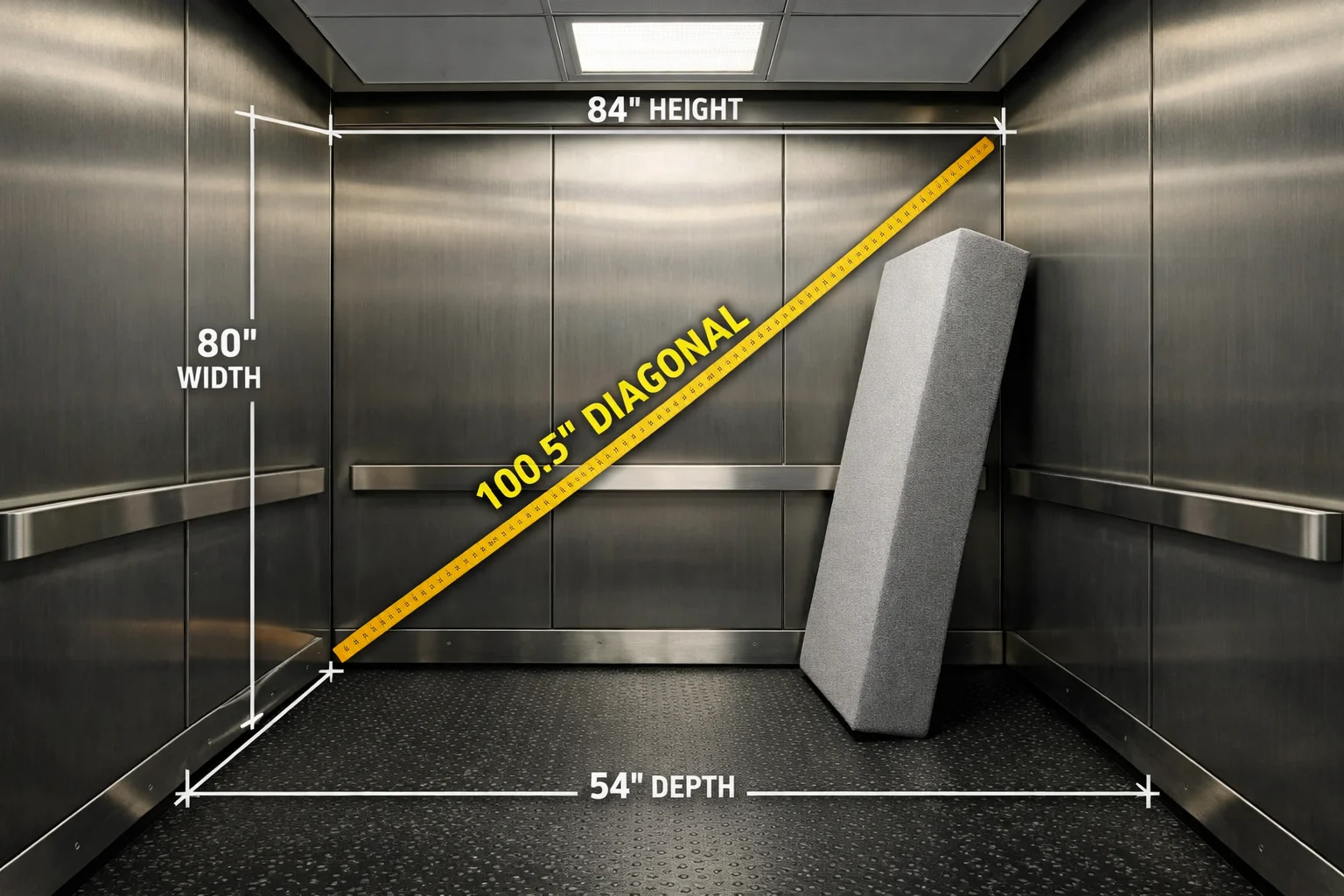
The Pivot Problem: Geometry for Movers
Why renters should never buy an 84-inch sofa. The geometry of stairwells,
Analyze Details →