Office Seating: The Art of "Professional Theater"
Introduction
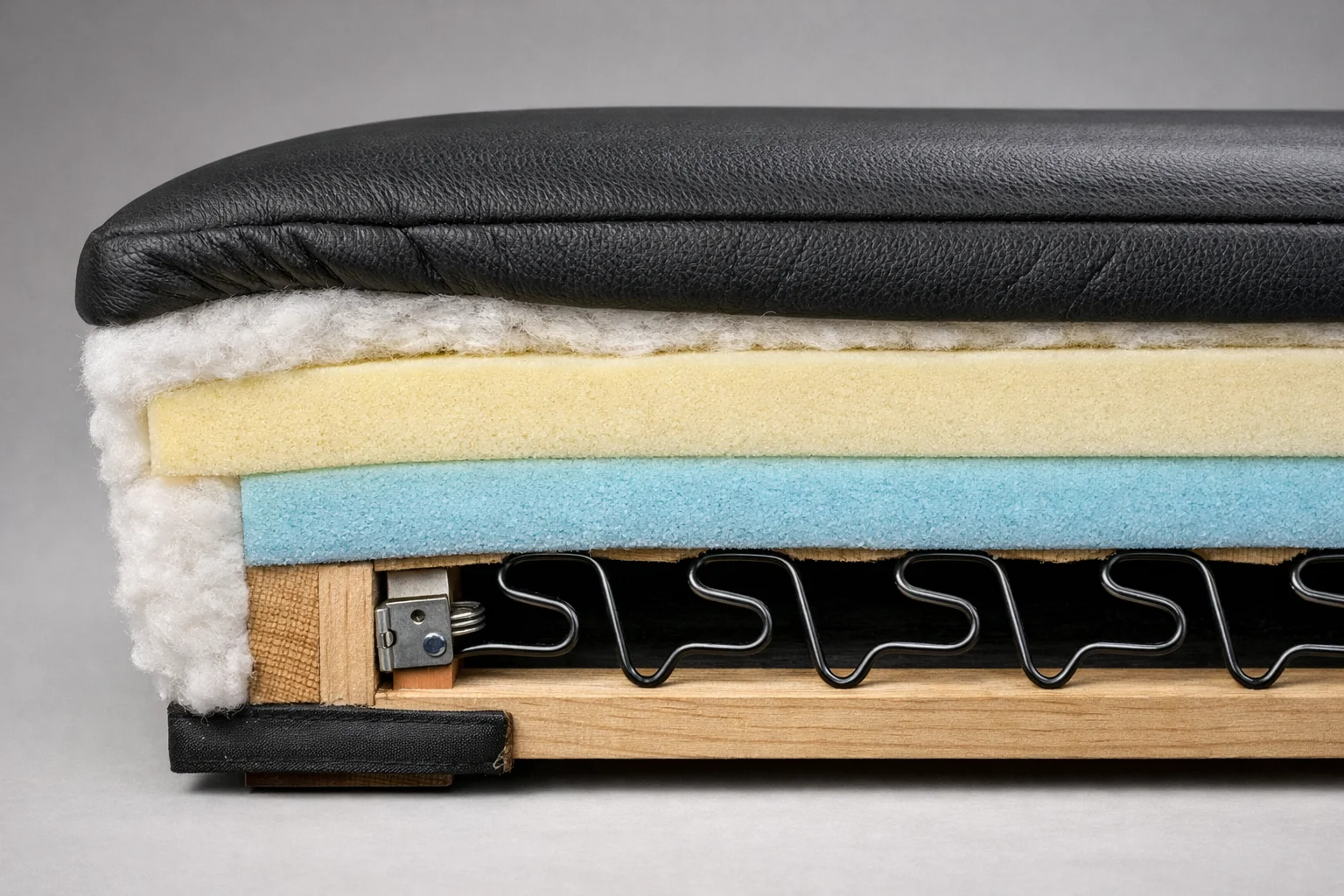
Office furniture is weird. It looks expensive, with leather, chrome, and confident mid-century lines, but it often sits untouched for days and then gets punished in a long, stressful burst. I think of it as theater furniture, built to impress someone for five minutes, not to support you for eight hours.
That mindset matters because it changes how I shop. I do not let the “executive” look convince me it is durable, and I do not assume a high price means it will feel good a year from now. When you sit on it in a showroom, everything is new, the foam has not taken a set, the gas lift has not sagged, and the fabric has not been polished smooth by daily friction.
So in this guide I am going to keep bringing you back to one question: what happens after the honeymoon? If you only do one thing while shopping, I want you to stop “perching politely” and sit the way you actually work. Put your weight back, shift side to side a bit, rest your elbows where you tend to rest them, and notice what flexes, what creaks, and what feels like it is already trying to push you out of a comfortable position.
I also want you to treat looks as a bonus, not the foundation. The goal is not to win an office photo shoot, it is to buy something that still feels stable after thousands of sit downs, and that you can adjust, clean, and live with without babying it.
The "Image vs. Comfort" Paradox
I have learned to be suspicious of seating that is clearly trying to project stability, success, and modernity before it tries to take care of your body. The “executive lobby” look usually means a low back, hard lines, and tight, minimal cushions that read clean on camera and in a quick walk through.
The problem is that the same styling cues that photograph well often fight you the second you settle in. Low backs do not give your shoulder blades anything to lean into, and shallow seats make you feel like you are hovering instead of sitting. Slick leather and a reclined, low profile posture is a bad combo because your hips start to drift forward as soon as you relax.
When you see one of these low profile leather sofas in a showroom or a lobby, I want you to actually test the failure mode. Sit the way you would when you are tired, with your back trying to rest, not your core trying to hold you up. If you feel yourself sliding forward, if your feet have to brace to keep you in place, or if you end up perched on the edge because the back is not doing anything for you, that is the reality you will live with at home.
I also watch for the “hard line” trap, where the arm looks crisp but it is the exact height and shape that puts pressure on your forearm, or forces your shoulder up. Put your elbow where you naturally would, then relax your hand and see if your shoulder drops or stays tense. If the sofa only feels good when you sit perfectly upright like you are waiting in an interview, it is selling you an image, not comfort.
If you love the style anyway, you can still protect yourself by demanding real lounging proof in the store. I sit all the way back for at least a minute, then I shift my hips side to side, cross one leg, and then uncross it, because that is when slippery upholstery and shallow geometry give themselves away. A sofa that is truly comfortable will let you change positions without you constantly scooting back into place.
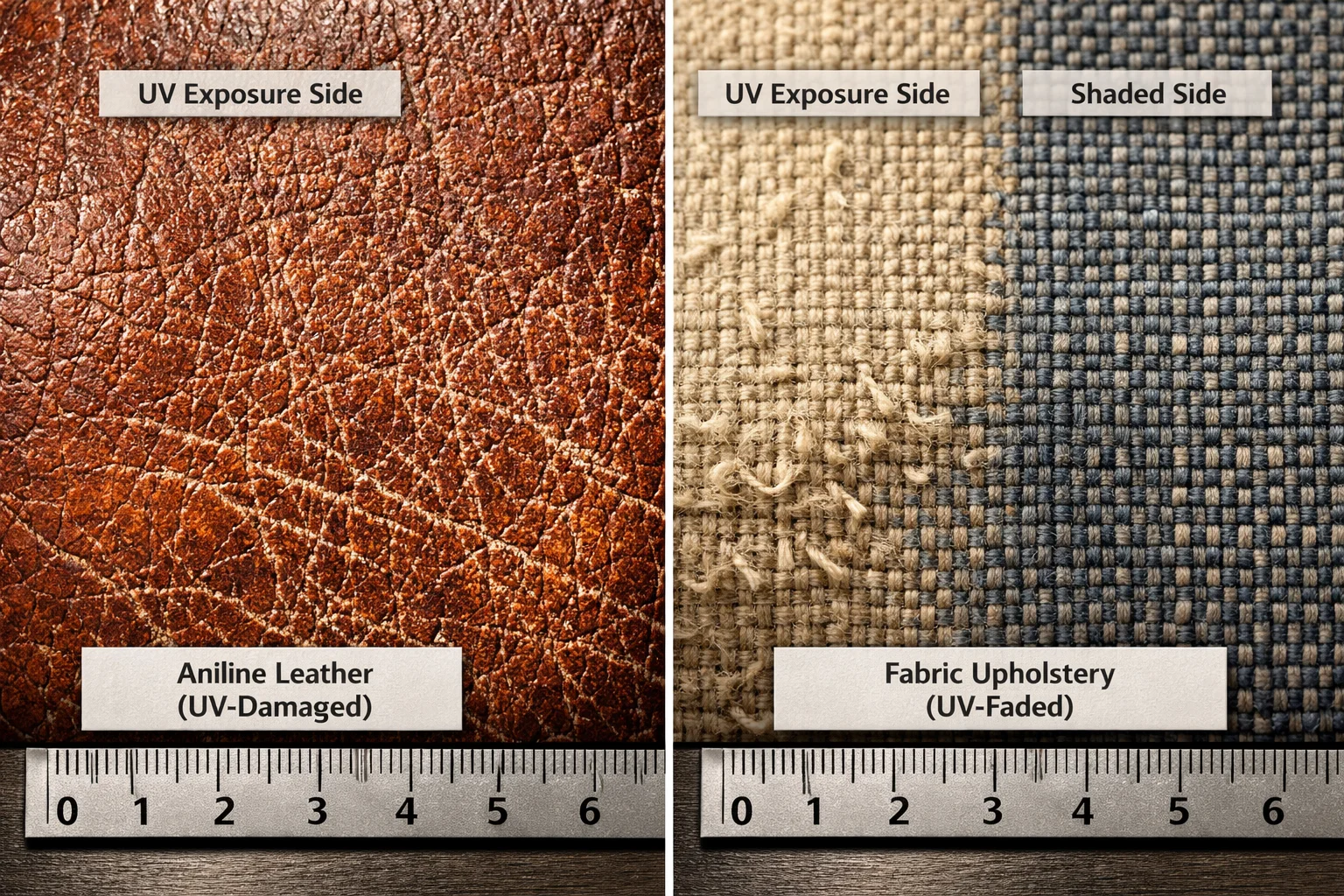
This is the kind of damage I almost never notice until it is too late, because it starts as a slight dryness on leather or a “maybe I am imagining it” light patch on fabric. Then one day you realize the window facing side of the sofa looks older than the rest, and it never really comes back.
When you are in a showroom, I want you to stop thinking only about the sofa and start thinking about where it will live. If your room has strong daily sun on one side, especially afternoon sun, assume the sofa will age unevenly unless you actively prevent it.
I do a simple check: I rub my fingertips lightly across the leather or faux leather on the seat and arm and I pay attention to whether it already feels a bit dry or papery instead of waxy and resilient. If it feels dry when it is brand new under store lighting, it is the exact material that tends to micro crack once heat and sun get involved, and those tiny cracks love to show up first on the top edges of cushions and the window side arm.
On fabric, I look for prints, tweeds, and heathered colors that can hide slight fading, because the clean, solid colors that look “architectural” also make uneven sun fade look obvious. If you are choosing between two similar sofas and one has a little more texture in the weave, I usually take that as a practical win, not a style compromise.
You can also test how forgiving the upholstery is by tilting your head and looking across the surface at a low angle. If you can already see sheen differences from nap direction or from light scuffing, that same surface is going to show a one sided “sun story” fast, and you will be stuck rotating cushions and rearranging your room to disguise it.
If you know the sofa will be near windows, I would rather you solve it up front than regret it later. I plan for curtains, UV film, or simply placing a side table or plant as a sacrificial blocker on the sunniest edge, because it is cheaper than reupholstery and it prevents the lopsided aging that makes a sofa look tired even when it is structurally fine.
If a salesperson tells you the material is “sun resistant,” I ask you to get that in writing in the warranty or care documentation. If they cannot point to anything concrete, I assume it is marketing language and I buy as if the sun will win.
The 3 Types of Office Wear
Office furniture dies differently than home furniture, because the “use pattern” is different. At home, you tend to sit in the same few spots, but you also sprawl, nap, and distribute wear across the whole piece over time. In offices, I see long stretches of nobody touching the sofa, then sudden heavy use by people in work clothes, with keys, badge clips, phone corners, belt hardware, and laptops all doing quiet damage.
When I shop, I mentally sort office wear into three buckets, because each one has a different tell in the showroom and a different fix you can choose up front.
The first is friction polish, where fabric or faux leather gets shinier and flatter exactly where people slide in and out. You see it first on the front edge of the seat, the outside arm cap, and the spot where someone’s shoulder rubs when they turn to talk. In a showroom, I run my hand across those high-contact areas and I look for materials that already have a mixed sheen, because that usually means the surface is going to “track” and go glossy fast once it meets daily pants fabric.
If you want a sofa that stays visually even, I push you toward upholstery that has texture built in, like a woven fabric with a bit of irregularity, or a leather that is already pebbled and not trying to look like a perfectly smooth sheet. Smooth faux leather can look incredible on day one, but it tends to advertise every little polish change and then it starts to look permanently dirty even when it is clean.
The second is compression set, where the cushions stop springing back and the seat develops a memory of the most common sit spot. This is the office classic, because people perch on the same “meeting edge” again and again, and nobody lies down to spread the load. In the showroom, I do not just sit, I stand up and immediately look at the cushion profile from the side, because good foam and a good build will rebound quickly, and weak foam will already look a little delayed even when it is brand new.
You can also feel for this by doing a slow sink test with your hand near the front edge of the seat, then closer to the back. If the front edge collapses easily, that is a warning that you will get that uncomfortable “roll forward” feeling later, where you are constantly bracing with your legs because the seat no longer supports you at the edge.
If the salesperson says the cushions are “high density” or “commercial grade,” I ask what is actually inside the seat, not in a confrontational way, just plainly. I want to know if it is a single block of foam, foam over springs, or a softer wrap over a firmer core, because the more the comfort depends on fluffy top layers, the more it tends to pack down into a sad pancake in the exact spots people use most.
The third is joint loosening, the kind of wear you hear before you see. Offices are full of tiny sideways stresses, people scooting a sofa by the arm, dropping into one corner, or twisting their body while the base stays planted. In the showroom, I try to create gentle torsion on purpose, I sit in one corner, shift my weight side to side, then stand and lightly push on the arm as if I am using it to get up, because that is what real life does to it.
What I want is a sofa that feels like one object, not a collection of parts. If I feel a delay where the arm moves a hair after the seat, or I hear a small click when I shift, I treat that like an early warning, because those little movements are what turn into the permanent creak and wobble you cannot un-notice later.
This is also where “looks expensive” can fool you the hardest. Chrome legs, thin arms, and tight upholstery can hide a base that is doing too much work with too little structure. I get down and look underneath if I can, not because I expect you to decode construction like a factory, but because you can still notice whether it looks like a solid platform or a bunch of lightweight pieces stapled together.
If you keep these three wear types in your head while you test, the shopping gets simpler. You are not trying to predict the future perfectly, you are just trying to catch the most common office failures while the sofa is still new and honest, before your room and your habits start doing their slow work.
1. The “Sunlight Death” (Lobbies)
The pattern I see over and over is a sofa that basically lives in a glass box for years, looking perfect from ten feet away while the sun quietly works on it every day. It is not “wear” in the normal sense, it is slow cosmetic decay from UV and heat, and it hits one side harder than the other.
The result is predictable once you know to look for it. Leather and faux leather gradually dry out, then you get those little surface cracks that start on the top edges and high points, and eventually turn into real splits you cannot condition away. Fabric does not crack, it just fades, and it usually fades in a way that makes the sofa look mismatched, like one arm and one cushion lived a different life.
What makes it worse is that most offices almost never do the one thing leather actually needs, which is regular conditioning. So you end up judging “leather quality” when what you are really seeing is neglect plus sunlight, and that same combo can happen in a home if your sofa sits in a bright window and you are not the type who will keep up with care.
In a showroom, I want you to act like the sun is part of the purchase decision. If you already know where the sofa will go, picture the brightest window in that room and imagine one arm getting baked at the same time every day, then choose upholstery that will age gracefully under that kind of unfair treatment.
If you are leaning leather, I would rather you pick a leather that already has some texture and a little visual variation, because it tends to hide early dryness and minor cracking better than a perfectly smooth, glossy finish. I also ask you to touch the leather on a flat area and then on a tight edge, like the top of the arm, because edges are where drying shows up first, and if the edge already feels a bit stiff or plasticky when new, it usually does not get better with time.
If you are leaning fabric, I would rather you avoid fragile, flat, solid colors if the sofa will be in direct sun. When a fabric is smooth and uniform, any fade reads like damage, but a weave with some texture, a heather, or a subtle pattern can make gradual change look like normal character instead of a hard “window side versus room side” split.
You can also protect yourself by choosing a sofa with loose, reversible back cushions and a seat setup you can rotate. I know rotation sounds like something only fussy people do, but even flipping one cushion every month or two is the difference between “my sofa aged” and “my sofa aged sideways.”
When a salesperson says “it is sun resistant,” I ask to see the care and warranty language and I look for plain statements about fading or UV, not vibes. If it is not written down, I assume the sun will win, and I make the decision as if I will be the one managing the exposure with curtains, blinds, UV window film, or simply moving that sofa a few inches out of the blast zone.
If you take nothing else from this section, take this: sunlight damage is not a defect you can return, it is a slow stain on the purchase you made. I treat placement and upholstery choice as a pair, because a sofa that looks amazing under soft showroom lighting can look weirdly old on one side in your real room long before anything “breaks.”
2. The “Conference Crush” (Meeting Rooms)
The pattern in meeting rooms is not lounging, it is bored people fidgeting for a long stretch, then resetting their posture, then doing it again. That creates a very specific kind of wear, and if you know where to look you can predict it in the showroom.
The first hotspot is the arms, because people lean on them while they talk, scroll, or sit half turned toward the group. When I am testing a sofa for this, I plant my forearm on the arm cap the way you actually would in a meeting, then I shift a little pressure forward and back to mimic that mindless leaning. If the arm feels like it has a sharp edge under the upholstery, or the padding feels thin enough that you are already finding the frame, I assume the upholstery will abrade there and the arm will look tired long before the rest of the sofa does.
I also watch the arm height and width, because the “conference lean” is unforgiving. If the arm is too high, you end up hiking your shoulder, and people will unconsciously press harder into it, which accelerates flattening and seam stress. If it is too narrow and crisp, the upholstery takes all the abuse on one tight radius, and that is where I see early cracking on faux leather and early fuzzing and seam wear on fabric.
The second hotspot is the front edge of the seat, because conference seating creates perching. People do not sit all the way back, they sit on the first few inches, feet planted, ready to stand up, and that repeatedly crushes the same strip of foam. In the showroom I do a deliberate perch test by sitting only on the front third of the cushion for a bit, then I stand up and immediately look at that front edge from the side to see how fast it springs back.
If the front edge stays a little flattened, or if it feels like it collapses and rolls you forward when you perch, I treat that as a “meeting room future” problem even if you are buying it for home. You might not host two hour meetings, but you will have the same wear pattern any time you sit forward to work on a laptop, eat, talk to someone, or get up and down frequently.
This is one place where cushion construction matters in a way you can actually feel without decoding specs. I prefer a seat that has some real pushback at the front edge, not just soft initial squish, because that is what keeps perching from turning into a permanent ramp. If a sofa feels amazing when you sink in the middle but feels weak right at the front lip, that is the exact shape that turns into a “why do I feel like I am sliding off?” seat after enough edge sitting.
I also pay attention to the upholstery right on that front edge, because it is a friction strip. I rub my hand across the front edge and then across the center of the seat and I compare the drag and the sheen. If the front edge already looks like it catches light differently, or it feels like a surface that will go glossy where jeans rub, I assume it will telegraph wear there first and you will always notice it when you walk into the room.
Meeting room sofas also have a very boring enemy that still matters, crumbs. Working lunches turn into grit, and grit turns into abrasion because it sits in seams and gets ground in by movement. In the showroom, I look closely at the gaps where the seat meets the arms and where back cushions meet the deck, because some designs basically create crumb traps you cannot reach without disassembling the whole seating area.
If you want the low effort version of cleanable, I look for fewer deep creases, fewer tight channels, and a layout where you can realistically get a vacuum nozzle into the cracks. If the sofa has fixed seat cushions and a deep, narrow canyon at the back where the seat meets the backrest, I assume you will never truly clean it, and those trapped crumbs will eventually make the fabric look dingy and feel rough in the exact spots people touch.
If you are choosing between a tight, tailored sofa and one with more accessible cushion separations, I usually pick the one you can actually clean. I have owned enough “beautiful but fussy” seating to know that the one you can maintain is the one that still looks expensive later, even if it looks less showroom perfect on day one.
3. The “Lounge Life” (Break Rooms)
Break rooms are where seating stops being “occasionally sat on” furniture and starts being real life furniture. People eat over it, nap on it, drop their bag on it, and balance a laptop or a takeout container on the cushion like it is a desk.
The result is not subtle wear, it is stains. Coffee rings, salad dressing, soda, greasy fingerprints on the arms, pen marks, and that grayish grime that builds up where people rest their head or shoulder.
This is the one zone where I stop entertaining fancy upholstery fantasies and get strict. If the sofa is going into a break room, I treat commercial performance fabric, specifically the kind that is actually bleach cleanable, as mandatory, not “nice to have,” because it is the only realistic way to recover from the inevitable stain that would otherwise become permanent.
In a showroom, I do not accept “performance” as a meaningful word on its own because it gets used loosely. I ask you to look for the actual cleaning code or care sheet and find the plain language that says you can use a diluted bleach solution, and that the manufacturer still considers that normal care, not warranty voiding abuse.
Then I would do a simple reality test with the cushions and seams. I press a napkin or my palm lightly against the seat and arms and imagine it is oily food, not clean skin, because oils are what make fabrics look permanently dark even when the stain is gone. If the fabric already feels like it grabs and holds onto everything, or it has a soft fuzzy surface that seems like it would trap grime, I assume it is going to look dirty quickly in a break room even if it technically survives cleaning.
I also pay attention to color and texture in a more practical way here. Mid tones and heathered weaves are my safe zone because they hide both “one time accidents” and slow grime. Bright solid colors and very light neutrals can work, but only if you are truly willing to clean on schedule, not just when someone complains.
If the sofa has loose cushion covers, I check whether they come off without a fight and whether the zipper looks sturdy enough to survive repeated removals. If it is fixed upholstery, I get even more demanding about the fabric’s cleanability, because you are signing up to clean it in place, with no second chances.
I also want you to look at the shape like a janitor would. Deep channels, tufting, and tight inside corners are where coffee and dressing go to hide, and where crumbs turn into permanent grit. If you cannot realistically get a vacuum nozzle and a cloth into the cracks, you are not buying “low maintenance,” you are buying a future that always looks a little stained.
Finally, I would sit on it like someone who is killing time. Lean your head back, put your feet up if that is how people use it, and then look at where your shoes would land and where your elbows naturally grind into the arms. Those are the spots that will need aggressive cleaning, so those are the spots where a bleach cleanable performance fabric earns its keep.
If a salesperson pushes leather or faux leather for break rooms because it “wipes clean,” I slow down and think about the long term. Wiping handles fresh spills, but break rooms create repeated oils and disinfectant wipes, and that combo is how surfaces get shiny, sticky, and cracked looking even if nobody is being rough. I would rather you buy the fabric that is designed to be cleaned hard than the surface that only looks easy to clean until it has been cleaned a hundred times.

When I see a sofa like this, I stop thinking about the upholstery and start thinking about geometry, because this is where “beautiful” quietly becomes “annoying” over time. A very low seat height feels relaxed for about ten seconds, then it starts asking your knees, hips, and lower back to do extra work every single time you sit down and stand up.
In a showroom, I do a stand up test that is deliberately ungraceful. I sit all the way back like I would when I am tired, plant my feet where they naturally land, then I stand up without using my hands, and I pay attention to whether I have to rock forward and “launch” myself to get out.
If you feel that rock forward is mandatory, that is not a small thing, it is the daily tax you will pay, especially if you ever wear stiffer clothes, have a bad back day, or simply want to get up while holding a laptop or a coffee. The sofa does not get easier to exit as it ages, it usually gets harder because the foam softens and the seat effectively gets even lower.
I also check what happens to my posture once I am down there. Low seats often pair with a reclined back angle, and that combination can feel loungey until you realize your head and shoulders have nowhere to go, so your neck becomes the support. If you find yourself sliding forward or tucking your feet back under you to feel stable, I treat that as the sofa telling you it wants you to leave.
There is a second trap in these “architectural” pieces, and it is that the arms are often too low, too thin, or too crisp to be useful. I rest my forearm where I would naturally put it, then I relax my shoulder and notice whether the arm actually supports me or just creates a pressure line that makes me tense up.
If you love the look and still want to make it work, I would rather you choose it with a clear plan instead of hoping it will magically become comfortable. In real life, people compensate with a firm seat cushion topper, a lumbar pillow that pulls you forward a bit, or simply placing it where it is used for short waits rather than long hangs, and that is a valid choice if you are honest about how you will use it.
The simplest way to protect yourself is to compare it to one other sofa in the same visit that has a more normal seat height and depth, then repeat the same sit and stand routine. When the difference is obvious in your body, not just in your eyes, it is much harder to get talked into buying a photo shoot piece for a room where you actually intend to sit.
Acoustic Furniture: The New Trend
Open offices are loud, and the “fix” I keep seeing is seating that tries to do two jobs at once, it gives you a place to sit and it tries to carve out a little bubble of privacy. When you see it labeled as acoustic seating, I want you to treat it less like a normal sofa and more like a soft room divider that you also happen to sit on.
The most obvious feature is the high back, sometimes tall enough that when you sit down your head is below the top edge and the sides wrap in a bit. In a showroom, I stand next to it and look at where that back actually lands relative to a real person, because a tall back only helps if it blocks the line of sight and catches some of the direct sound between you and the room.
Then I do a simple reality check from the seat. I sit where I would actually sit and I turn my head left and right, and I notice whether I still feel visually exposed, because if you can easily make eye contact with the whole room while seated, it is not going to feel private later no matter what the spec sheet says.
A lot of the acoustic effect comes from the upholstery choice, and this is where marketing language gets slippery. Thick, felt like wool or similar dense fabrics can absorb some of the higher, sharper noise, but in practice what you feel most is whether it reduces the “edge” of chatter and keyboard clatter, not whether it makes the room quiet.
In a showroom, I rub the fabric between my fingers and press my palm into it, and I am looking for density and body, not fuzz. If it feels like a lofty blanket that pills easily, you might get some softness but you are also buying a surface that can look tired fast in the exact areas people touch and rub, especially on the outside corners and along the top edge where hands grab when people stand.
The part that surprises people is that these pieces can backfire if the build is flimsy, because a tall back is a lever. I push gently on the top of the backrest, not hard, just enough to see if the whole sofa feels like one rigid object or if the back sways independently of the seat, and if it sways now it will almost always sway more once it has been sat in for a year.
I also pay attention to the seam work and piping at the top edge and the front corners, because acoustic seating often has larger panels of fabric pulled tight over foam. If you see ripples, loose wrinkles that do not smooth out when you run your hand over them, or seams that look strained right out of the gate, I assume the fabric will drift and bag in a way that makes the whole “quiet pod” look sloppy.
There is a comfort trap with high backs, and I have fallen for it before. The tall back makes you think you are going to lounge, but some of these designs have a shallow seat or an upright angle meant to keep you in a “meeting posture,” so you get privacy without real comfort.
In the showroom I lean back fully for a full minute and let my shoulders relax, then I notice where my shoulder blades land and whether the top edge pushes my head forward. If your head feels nudged down or your neck starts doing work, that tall back is going to feel like a wall, not support.
Finally, I want you to be honest about what acoustic seating can and cannot do. It can make a space feel less exposed and it can take the sting out of noise, but it will not magically create silence, and it will not replace real acoustic treatment in a hard room with lots of glass and bare walls.
If you like the concept, I would rather you ask the salesperson to let you try it in the noisiest part of the showroom, or at least while other people are talking nearby. If it only “works” in a quiet showroom, it is not really proving anything, and you are paying for a trend shape instead of a real improvement you can feel day to day.
Technical Summary: The 5-Year Cycle
A lot of the “why does this furniture get replaced so fast?” question has nothing to do with the sofa physically failing. It is often driven by corporate accounting, specifically depreciation rules that treat furniture like an asset with a planned lifespan on paper.
In practice, years one through five are when the company is steadily depreciating that sofa, even if it still looks fine and sits fine. Around year five, that asset is commonly considered fully written off, and that is when you see the big refresh decisions happen, not because the frame snapped, but because the spreadsheet says the furniture has already “paid for itself.”
The consequence is that companies often replace perfectly usable seating somewhere in the five to seven year range just to reset the look of a space or align with a renovation cycle. This is exactly why office liquidation can be such a good deal for you at home, you are sometimes buying something that was swapped out for optics, not because it was worn out.
If you use this to your advantage, I want you to shop liquidation with one simple mindset: assume the upholstery tells the truth and the story tells lies. I do not care if they call it “like new,” I sit on it, I check the front edge for that conference perch collapse, I listen for joint noise when I shift in a corner, and I look hard at the arms where friction polish shows up first.
I also ask one question that matters more than brand names, which is where it lived. If it came out of a sunny lobby, I treat one sided fading and leather dryness as likely, and I inspect the window facing arm and cushion tops like I am looking for early sun damage. If it came out of a conference room, I assume the front edge got crushed and I test that edge support on purpose.
The part that protects you is remembering that a five year old office sofa can be either a bargain or a headache, and the difference is usually visible in the wear pattern. If the wear looks even, the cushion rebound is still quick, and the frame feels like one solid object, I am comfortable paying for it. If you see uneven sun aging, a glossy friction strip on the seat front, or a tiny click when you twist your weight, I treat the low price as a warning, not a gift.
Explore Technical Reference
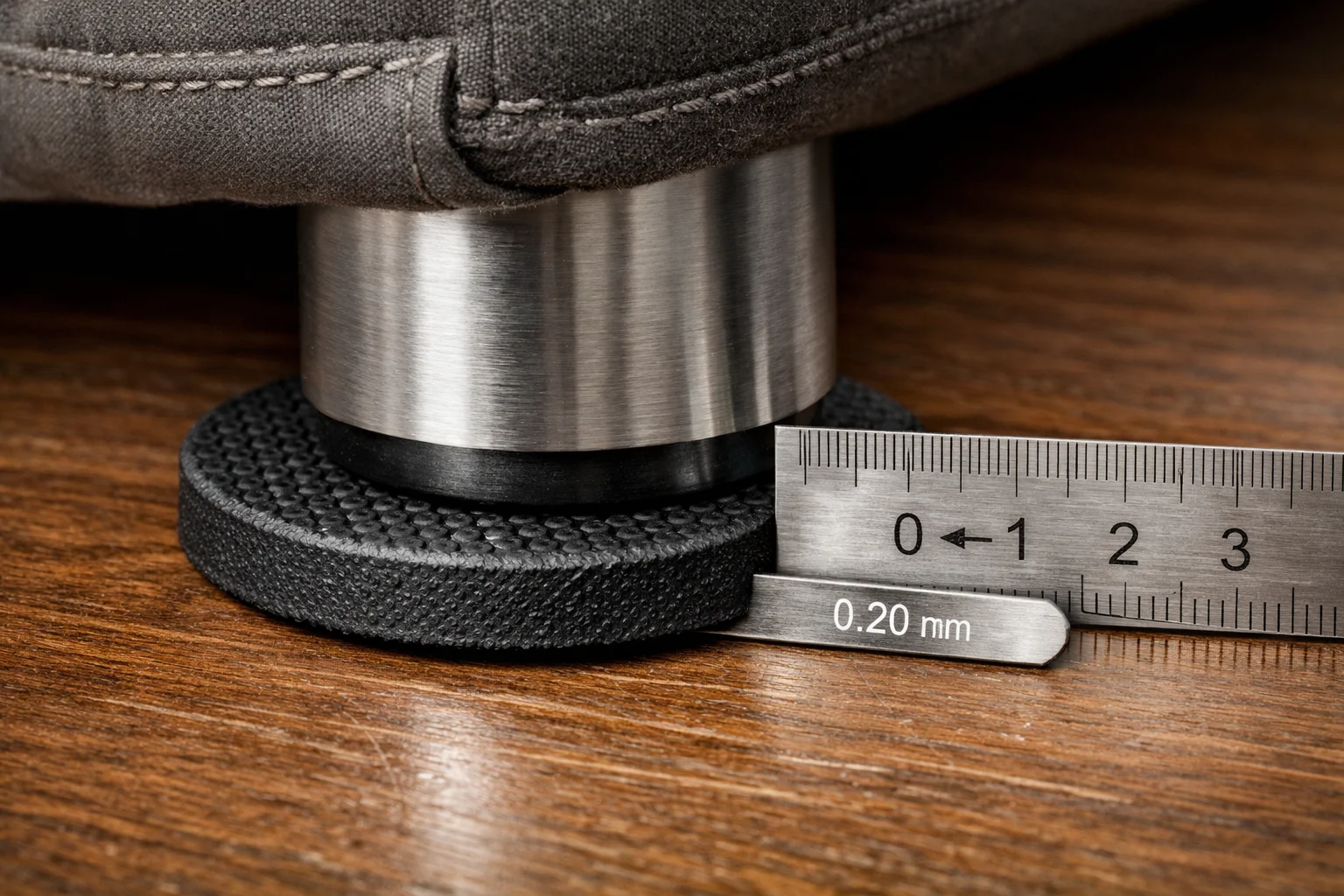
The Weight Paradox: Stability vs. Mobility
Understanding the trade-off between furniture weight that provides sitting
Analyze Details →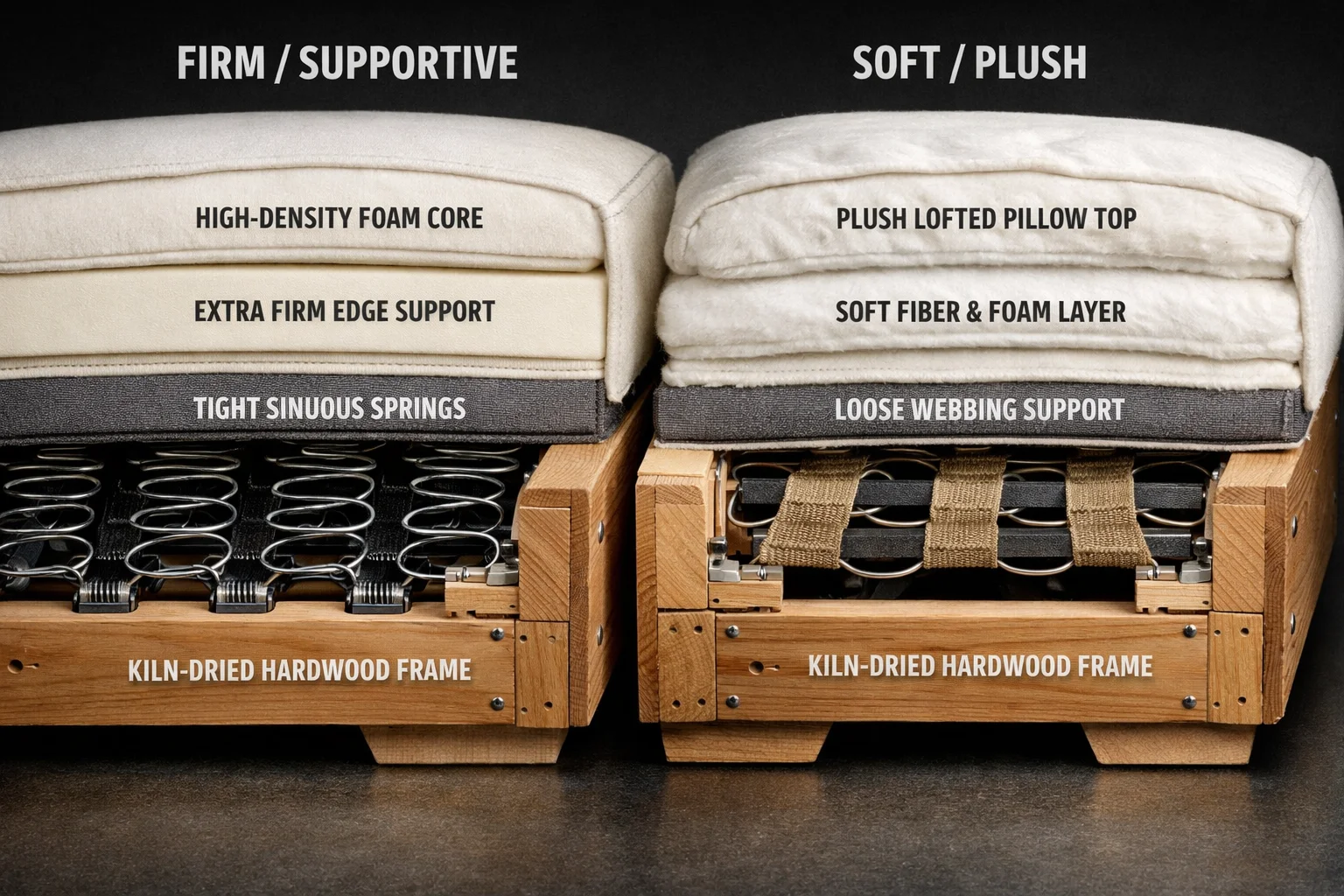
The "Goldilocks" Paradox: Furniture For Couples
Understanding how to select furniture when two people have significantly different body weights or comfort preferences. Why compromise foam often fails everyone.
Analyze Details →