The "Goldilocks" Paradox: Furniture For Couples
Introduction
The most common fight I see in furniture showrooms: He wants it Firm. She wants it Soft. They compromise on “Medium.” And they both hate it.
I used to think that argument was just about comfort, like picking a mattress. After watching too many sofas sag, pill, wobble, and flatten out long before they should, I now think that “firm versus soft” is usually a hidden argument about construction, cushion fill, and how fast the feel will change once you live on it.
When you sit on a brand new floor model, you are not testing the sofa you will own in six months. You are testing a fresh version, often with cushions that have not been broken in, fabric that has not relaxed, and a frame that has not been stressed by thousands of sit downs in the same spots.
What I want for you is a sofa you still like after the honeymoon, not the one that feels impressive for thirty seconds under showroom lights. That means you need a simple way to judge comfort and durability separately, because a sofa can feel amazing today and still be built to quit on you.
In this guide I am going to help you look past the word “medium” and ask better questions, do a few quick physical checks in the showroom, and make choices that match how you actually sit. If you lounge, nap, perch, or have kids who treat cushions like trampolines, the right build for you is different, and it has nothing to do with what the tag says.
I am also going to be honest about the tradeoffs. Deep, sink in comfort usually comes with more maintenance and faster visible wear. Crisp, tailored firmness usually holds its shape longer but can feel unforgiving if you curl up or sprawl. The goal is not to find a magical perfect, it is to pick the compromises you can live with.
If you are shopping with someone else, I have learned the quickest way to avoid the “medium” trap is to stop arguing over one shared seat feel and start deciding what each of you needs to be comfortable. Sometimes that means separate cushion types on the same sofa, sometimes it means different seating depths, and sometimes it means accepting that your “sofa” is really a sofa plus a chair that fits the other person.
By the time you finish this, you should be able to walk into a showroom and tell the difference between a sofa that is genuinely supportive and one that is just stiff because the foam is cheap. You should also be able to spot the early signs of future sagging, and you will know what to ask for in writing so the sofa you receive matches what you tested.
The “Bench Cushion” Disaster
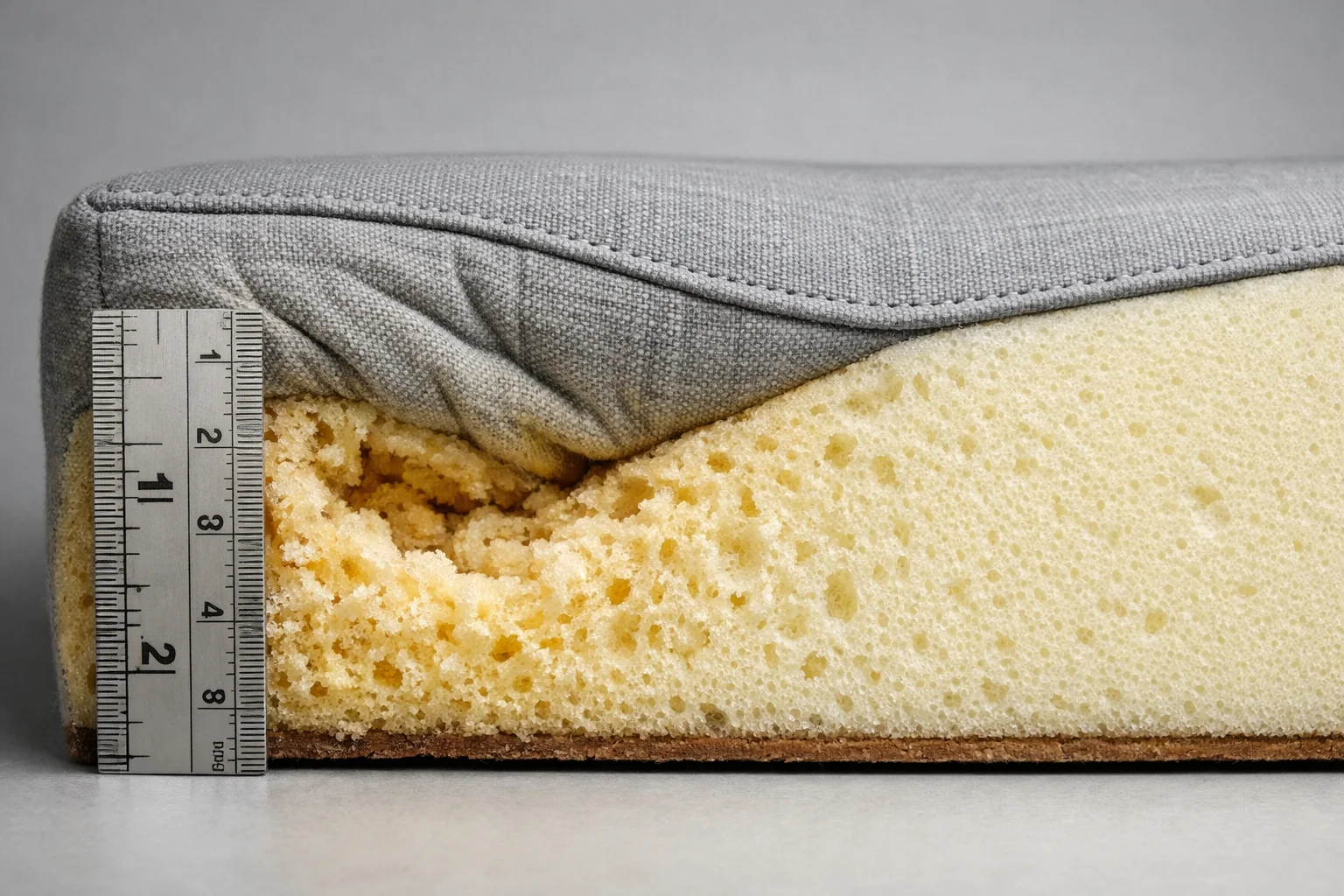
What happens is simple physics. The heavier person compresses the foam more and faster, so the bench turns into a permanent crater on their side. Then the cushion becomes a gentle ramp, and the lighter person slowly slides toward the low spot. You end up bracing with your core, twisting your hips, or constantly scooting back to your side, and it becomes weirdly hard to sit straight even though nothing looks “broken” at first.
The fix is boring but effective. You want individual seat cushions because they isolate the wear, so one person’s compression does not drag the other person downhill. If one cushion softens, you can rotate it, swap it side to side, or in some cases replace a single insert instead of the entire seating surface.
If you are standing in a showroom trying to decide, I would do one test that tells the truth fast. Sit together where you actually will sit at home, stay there for a couple minutes, then stand up and look at the cushion from the side. If you can already see one side sitting lower or you felt yourself leaning toward the other person, that is your future, just sped up.
If you love the look of a bench cushion and you are determined, the only time I personally consider it is when the sofa is mostly used by one person at a time, or when your weights are close enough that you are not creating two different compression profiles. Otherwise you are basically paying extra for a cleaner look that makes daily sitting more annoying over time, which is a trade I regret every time I see it in someone’s living room.
The “His & Hers” Foam Strategy
You do not wear the same size shoes, and you probably do not need the same seat feel either. The part most people miss is that you can keep the sofa looking perfectly matched while changing what is inside each cushion.
What I ask for, when a brand or salesperson will allow it, is identical cushion covers with different foam inserts. One side can be built for firm support, the other can be built for more sink and pressure relief, and nobody can tell by looking at it.
In plain English, I think of it like this. A higher density, higher firmness foam tends to hold you up and keep its shape longer, which is great if you are heavier, you sit upright a lot, or you hate that “hammock” feeling. A lower density, lower firmness foam tends to feel plusher right away, which can be great if you are lighter, you curl up, or firm seating makes your hips and tailbone complain.
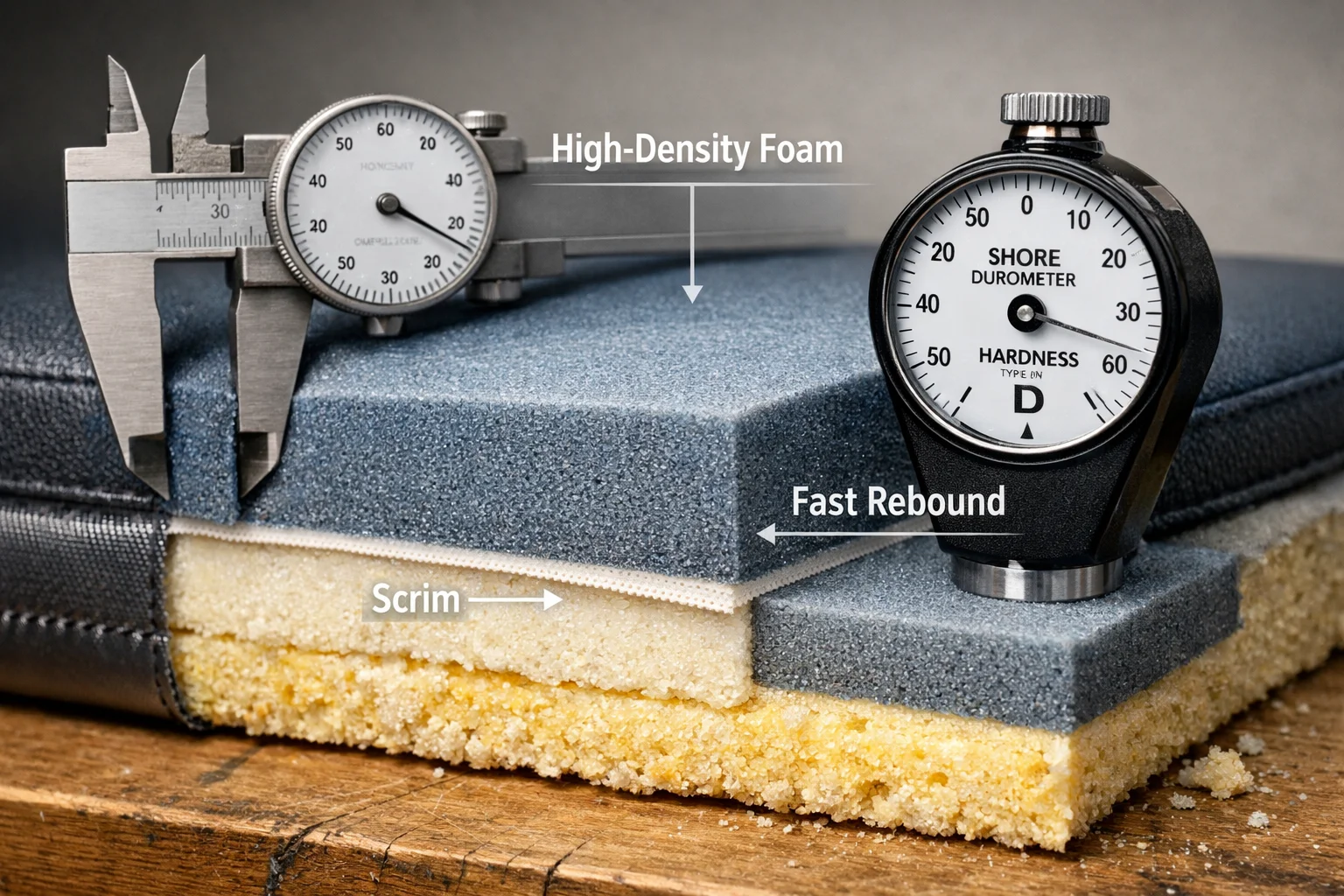
If you see specs, what you are usually looking at is foam density and something called ILD, which is basically how hard it is to compress the foam. A common “his” style build is around 2.8 lb density with a firmer ILD around 40, and a common “hers” style build is around 1.8 lb density with a softer ILD around 28. I do not treat those as magic numbers, I treat them as a map, denser and firmer usually ages better, softer usually feels nicer on minute one.
Here is the showroom move that keeps you from guessing. You sit on the exact seat you would claim at home, and your partner sits on theirs, and you stay put long enough for your body to stop “posing” and start relaxing. If you feel your pelvis tilting, your knees lifting higher than you like, or your shoulders rounding because you are fighting the seat, that is a comfort mismatch, not something you should “get used to.”
Then you ask a very specific question, and you ask it like you expect a real answer. “Can this sofa be ordered with different seat inserts left and right, while keeping the covers identical, and can you write that on the order?” If they say yes but it sounds informal, I would not proceed until it is printed on your invoice or order confirmation, because the warehouse will build whatever the paperwork tells it to build.
If the salesperson claims it cannot be done, I ask one follow up that often reveals the truth. “Are the seat cushions zippered with removable inserts, and do you sell replacement inserts by cushion?” If the cover zips and the insert comes out, it is often possible to do a split feel now, or later, even if it is not advertised as a menu option.
You can also protect yourself from the classic bait and switch feel, where the floor model is one foam and the delivered sofa is another. I always ask to see the cushion tag or the spec sheet for the exact model number I am ordering, and I take a photo of it. If there is no tag and no spec sheet, I assume I am buying a mystery cushion, and mystery cushions are how people end up with “it felt different in the store” regret.
The best part of this strategy is that it reduces fighting without forcing you into “medium,” which is usually just “nobody is happy, but we are both tolerating it.” The sofa still looks perfectly uniform, but each side can actually suit the person sitting there, and that is one of the few customization moves I have seen pay off in daily life.
Motion Transfer (The “Waterbed Effect”)
If you sit down and your partner pops up like they are on a waterbed, I take that as a warning sign, not a cute quirk. In real life it means every plop, scoot, and leg tuck travels through the whole seating line, and over time it tends to make a sofa feel looser and more “wavy” than you expected.
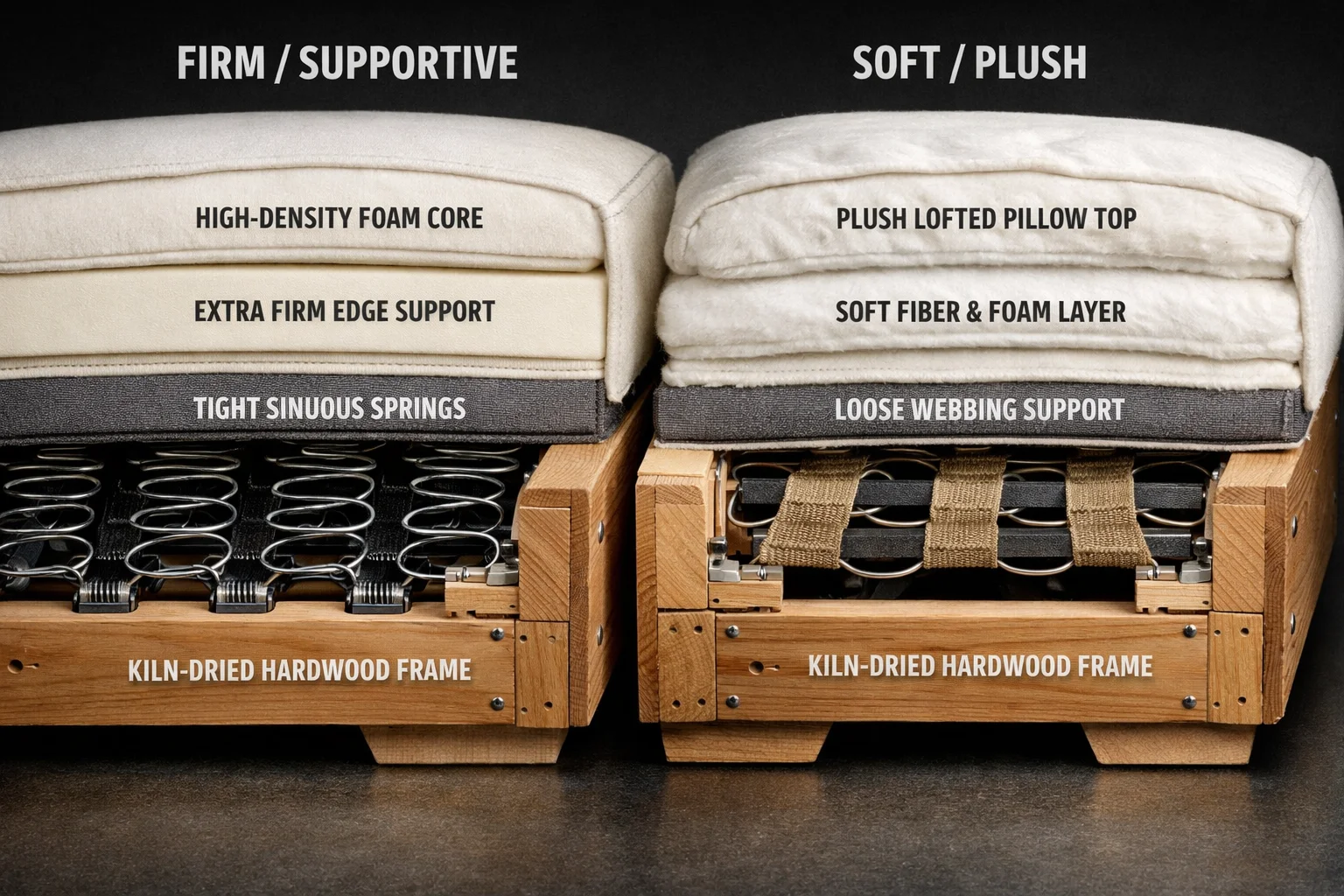
What usually causes it is the most common suspension system in mid priced sofas, sinuous springs. They run front to back, but they are also tied together side to side, so when one spot gets loaded, the energy spreads across the grid. That is why you can feel your partner shifting even when you are on a different cushion, and why a sofa can start to feel like it is gently rocking even if the frame is not obviously broken.
When I want less motion transfer, I look for a suspension where each support point can act more independently. The two constructions that tend to do that are drop in coil units and 8 way hand tied springs, because the support is made up of many separate spring points instead of long connected wires. In your body you feel it as “my seat stays my seat,” especially when someone sits down hard next to you.
You do not have to become a springs expert to screen for this in a showroom. I do a simple partner test: you sit in your normal spot, then have the other person sit down firmly in the neighboring seat and shift their weight a couple times. If your head and shoulders bob, or if you feel a rolling wave under you, that is the waterbed effect, and it will usually annoy you more at home than it does for the five seconds you are testing it.
If you are shopping alone, I do a version that still tells the truth. I sit on one seat, then I thump the cushion next to me with my hand and watch what my own body feels. A little vibration is normal, but if it feels like the whole sofa is acting like one shared trampoline, I assume it is a sinuous spring build, or a very flexy platform, and I keep looking if shared motion bothers me.
The salesperson question I ask is plain and specific: “What is the seat suspension, sinuous springs, drop in coils, webbing, or 8 way hand tied, and can you show me in the cut sheet?” If they cannot answer, I treat that like they do not know what they are selling, because suspension is one of the few things that changes the feel for the entire life of the sofa.
I also pay attention to how the sofa behaves at the edges, because that is where motion and sagging often show up first. I sit near the arm like I am putting on shoes, and if it feels like the seat is tipping or rolling me inward, I assume the suspension is spreading load across the span instead of holding its shape locally. That is not always a deal breaker, but it is a good clue that the sofa may feel less stable once it is broken in.
If you have kids, pets, or a partner who drops into the sofa like it is a beanbag, this is one of those comfort issues that turns into a daily irritation fast. I have learned to prioritize independent support in that case, even if the cushion foam is not my perfect dream spec, because a stable base makes almost every cushion feel better and wear more predictably.
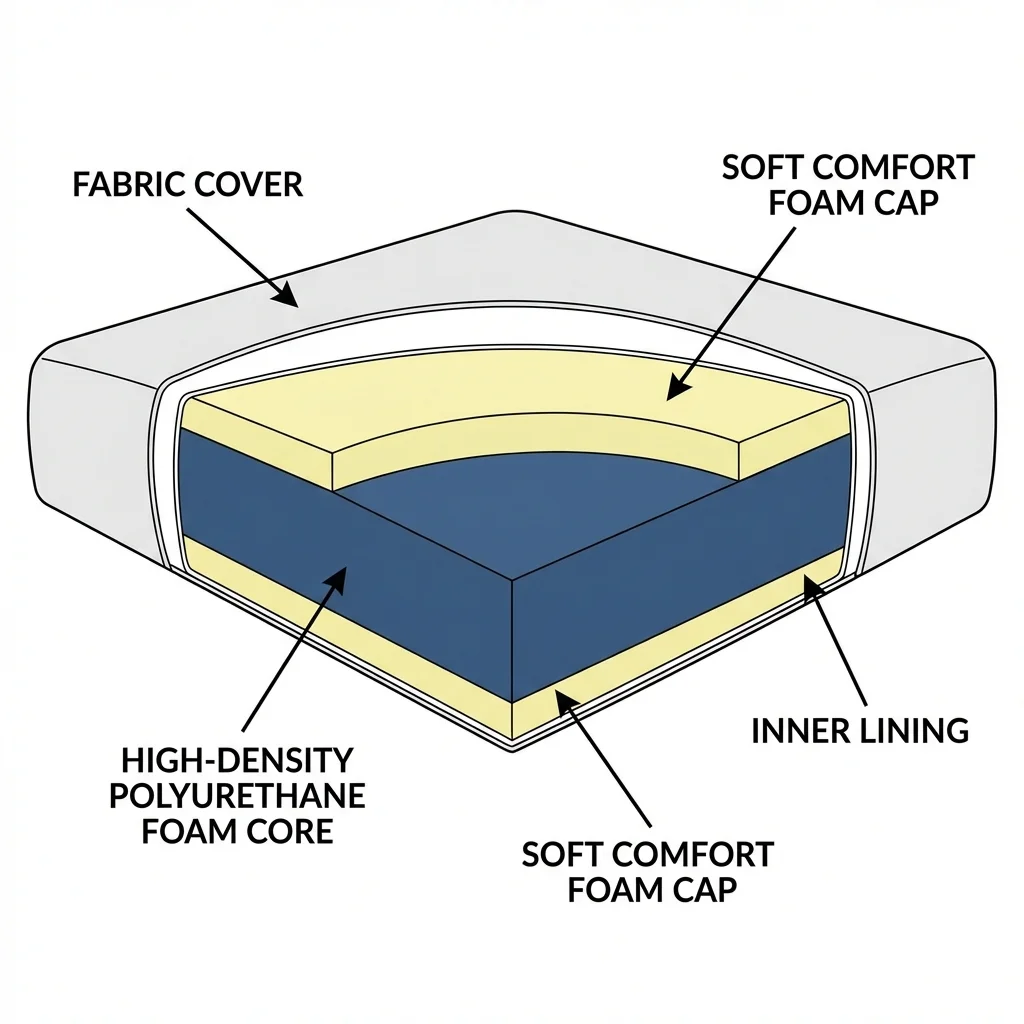
The reason I care about motion transfer even when the cushions feel great is that the suspension and the foam work together. A “progressive” cushion build like the one shown above can let a lighter person feel softness while a heavier person still hits supportive material, but if the base under it is transmitting motion across the sofa, you can still end up feeling every shift your partner makes. When you test, try to separate those two sensations in your mind, the cushion feel right under your hips and the sofa wide behavior when someone moves nearby.
If you find a sofa you love but it has noticeable waterbed behavior, I would rather you know what you are agreeing to. Some people genuinely do not care, and some people only notice once they live with it and start getting annoyed during movies, naps, or late night scrolling. The showroom tests above are my way of making that decision on purpose, instead of discovering it after delivery.
The “Depth” Dilemma
Seat depth is where I see couples accidentally buy a “nice looking” sofa that quietly fails them every single night. One person is tall and wants to sit back with thigh support, the other person is shorter and wants their feet on the floor without feeling like they are perched on the edge.
When a sofa is genuinely deep, roughly 40 inches or more in overall seat depth, a shorter person often cannot sit all the way back and still touch the floor. Their feet dangle, their lower back floats, and they end up either slouching into a C shape or scooting forward and never using the back cushion the way it was intended.
When a sofa is genuinely shallow, roughly mid 30s in depth, a taller person often feels like their knees are in their chest. The seat does not support enough thigh, so they slide forward or they sprawl sideways, and “upright sitting” starts to feel like punishment.
If you have one tall lounger and one shorter upright sitter, the most reliable solution I have found is to choose the deeper sofa for the tall person and then fix the shorter person’s position with a structured lumbar pillow. The right pillow is not a floppy decorative one, it is firm enough to hold its shape and thick enough to push their hips forward so their feet can reach the floor, while still letting the tall person pull it off and enjoy the full depth.
In a showroom, I would not guess at this, I would stage it. You sit the shorter person all the way back like they would during a movie, then you place a firm pillow behind their lower back and see if they can get feet contact without losing shoulder support, because some pillows fix the feet problem but shove your shoulders too far forward.
Then I would do the opposite test for the tall person. You have them sit back without the pillow and check whether the front edge supports their thighs without cutting behind the knees, because a deep seat that hits the wrong spot can still feel uncomfortable even if the depth number sounds right.
One more thing I watch for is how the back cushions behave when you add that lumbar pillow. If the back cushion is so overstuffed or so soft that it collapses and eats the pillow, you will be constantly re fluffing and re positioning, and the “fix” turns into daily fiddling.
If the salesperson tries to steer you toward a medium depth as a compromise, I would slow down and be honest about how you actually live. A compromise depth often means the tall person still feels shortchanged and the short person still cannot plant their feet, so you end up buying a problem that never quite goes away.
If you already own a deep sofa you like but it never fit the shorter person, I would not rush to replace it. I would try one genuinely firm lumbar pillow first, and if that helps, you just saved yourself thousands of dollars and a lot of disposal hassle, and you turned depth from a deal breaker into a controllable variable.
Technical Summary: The Compromise Checklist
If you remember nothing else from all the “firm versus soft” debating, I would rather you remember this: you can stop trying to make one shared seating surface satisfy two different bodies, and you can stop pretending a depth mismatch will magically feel fine later.
First, I would not compromise on split seat cushions if two people use the sofa regularly. I want separate seat cores because it contains wear to one zone, it reduces that slow slide toward the heavier person, and it gives you leverage later if one spot softens faster. In the showroom, I look for individual seat cushions with zippers, then I ask the salesperson to confirm in plain language that each cushion has its own removable insert, not a sewn shut pillow top that cannot be serviced.
Second, I would treat custom foam as a normal request, not a special favor. If the brand allows it, I ask them to build the left and right seat with different inserts, firm on one side and soft on the other, while keeping the covers identical. The practical move is making them write it into the order, because a verbal “sure” does not survive the handoff to the factory or warehouse, and you are the one who lives with the mistake.
Third, I use lumbar pillows as the cleanest fix for height and depth differences, because they change your hip position without forcing you to buy a different sofa. When you are testing, do not use a floppy decorative pillow to judge this, it will lie to you for about thirty seconds and then collapse. I bring the idea of a firm, structured lumbar pillow into the decision on purpose, and I literally test whether the shorter person can get feet contact and lower back support at the same time, without shoving their shoulders awkwardly forward.
If you do those three things, separate the seat cores, get the foam you each need in writing, and use a real lumbar pillow to tune depth, you are no longer buying “medium.” You are buying a sofa that can handle two different humans without turning daily sitting into a quiet, ongoing annoyance.