The "Waiting Room" Effect: Why Your Sofa Hurts
Introduction
My new sofa is gorgeous. It is sleek, tailored, and modern. But I cannot sit on it for more than 20 minutes, and I realized I traded comfort for style.
I am telling you this because I do not want you to repeat my mistake. I assumed that an expensive sofa from a respected brand would naturally be comfortable over time. What I learned is that comfort is not guaranteed, and it rarely improves after you bring the sofa home.
Most showroom sofas feel fine for a few minutes. That is exactly how they are designed to be tested. The real problems show up after weeks of normal sitting, when cushions stop bouncing back, frames flex, and support disappears.
I am not a designer or a repair expert. I am just someone who has owned enough disappointing sofas to start paying attention to what actually fails and why. Once you know what to look for, you can spot warning signs in the store instead of discovering them in your living room.
This guide is about protecting yourself as a buyer. I am going to walk you through the things I now check every single time, using simple tests you can do in a showroom without tools or technical knowledge.
If you want a sofa that still feels good after a year, not just on delivery day, you need to shop differently. I will show you how to do that, one practical observation at a time.
The "Slump" Trap
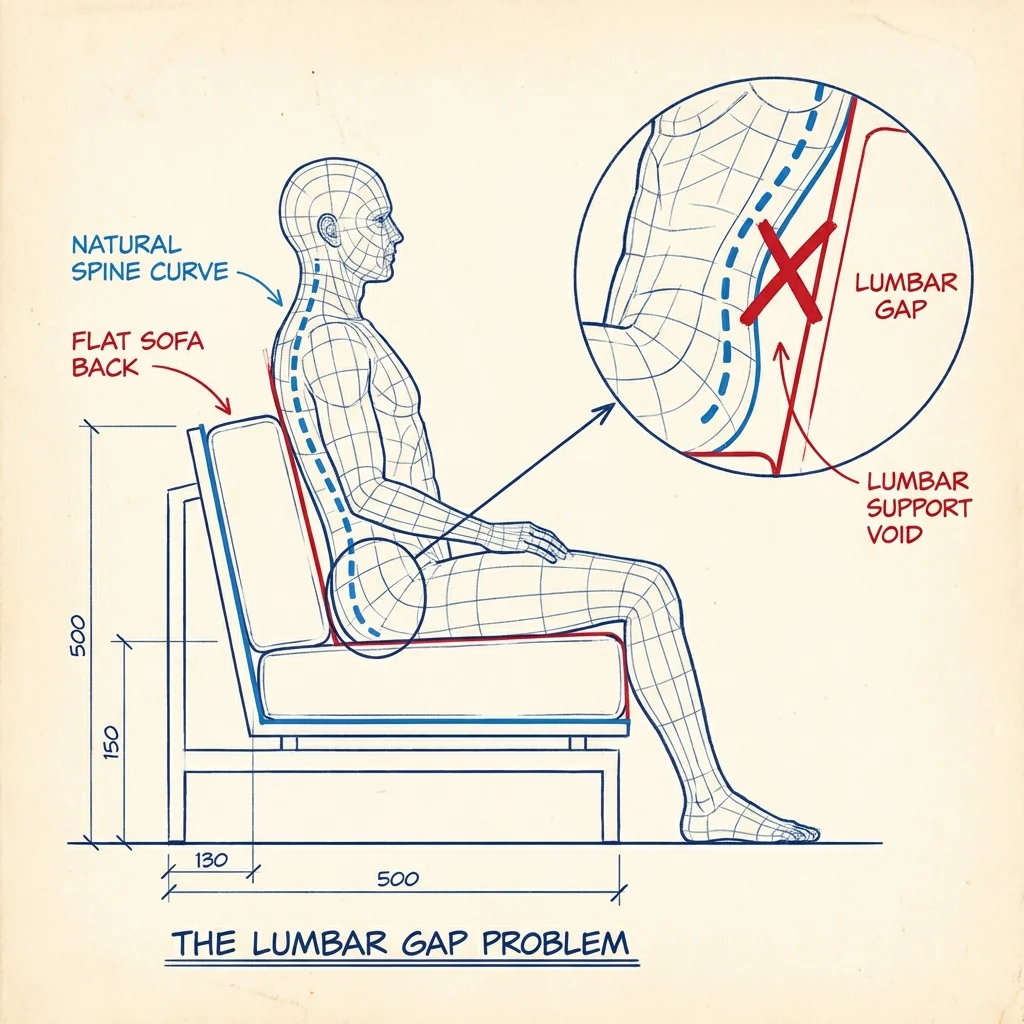
Why does your back hurt? The most common cause I see is a deep lounging design where the seat depth is over about 24 inches. The physics are simple and unforgiving. Your legs are not long enough to let your feet rest on the floor while your back stays against the cushion, so you slide forward. That creates an empty space behind your lower back, often several inches, and your spine collapses into a rounded C shape. That position creates lower back strain almost immediately.This is one of the easiest comfort traps to miss in a showroom because it feels relaxed for the first minute. I have made this mistake myself, sitting back and thinking the sofa felt luxurious, only to realize later that my body was doing all the work to stay upright.
When you test a sofa, do not perch on the edge and do not recline like you are posing for a catalog photo. Sit the way you would at home with your hips all the way back and your feet flat on the floor. Pay attention to whether your lower back is supported without effort or if you feel yourself sliding forward to get your feet down.
If you notice a gap forming behind your lower back, that sofa is asking your spine to bend unnaturally. I used to think I could fix this with throw pillows, but that only works temporarily and usually turns into constant pillow rearranging. A sofa that needs a prop to support your back is not actually supportive.
Seat depth is especially critical if you are average height or shorter. Deep seats are often marketed as modern or lounge oriented, but unless your legs are long enough, you will pay for that look with daily discomfort. I now assume that any sofa advertised as deep or extra deep is guilty until proven otherwise.
The quickest reality check is time. Stay seated for at least five minutes without shifting or bracing yourself with your legs. If your lower back starts to complain or you feel pressure building, that is the slump trap revealing itself. When that happens in a showroom, it will be worse at home, not better.
The 3 Ergonomic Crimes of Modern Design
When I started paying attention, I realized most modern sofas fail in the same three ways. They look intentional and refined, but they quietly work against your body. Once you know these patterns, you can spot them in seconds on a showroom floor.
Excessive Depth, the lounge look
For decades, seat depth roughly matched the length of an average thigh. Modern sofas push much deeper because it photographs well and signals relaxation.
If you are not very tall or if you plan to sit normally with your feet on the floor, that extra depth creates problems fast. Your legs cannot reach the ground while your back stays against the cushion, so you slide forward without realizing it.
In the store, sit all the way back and plant your feet flat. If your heels float or you feel pressure behind your knees, the seat is too deep for daily use. I no longer trust any sofa described as lounge style until it passes this test.
Zero pitch, the flat look
Older sofas quietly tilted the seat back just enough to keep you settled. Many modern designs remove that angle to keep the silhouette sharp and geometric.
A flat seat feels fine at first, but your body never stops working. You subtly brace with your legs and core because gravity keeps nudging you forward.
You can feel this in under a minute. Sit still and relax your stomach muscles. If you immediately feel like you might slide or need to push with your feet, the seat has no pitch. I walk away from sofas that cannot hold me in place without effort.
Hard edges, the crisp look
Modern cushions often use firm foam cut into perfect rectangles. They look tailored, but the front edge can be unforgiving.
That sharp edge presses into the back of your thighs and restricts circulation. After a short time your legs feel tense or slightly numb, even if the cushion feels firm in a good way at first.
Run your hand along the front edge and then sit with your weight evenly distributed. If you feel a distinct pressure line under your legs, the cushion is too square. A supportive seat should feel gently rounded where your body meets it.
These three issues often appear together, which is why some beautiful sofas become exhausting to use. When I test for depth, pitch, and edge softness in the store, I am really asking one question. Can this sofa support me without my body compensating all day.
If the answer is no in a showroom, it will never become yes at home.
Can You Fix It?
At some point you might wonder if a sofa that fails these tests can be saved. I have tried, and sometimes you can make a bad situation tolerable, but you should understand what is actually fixable and what is not before you buy.
The most common workaround I use is what I think of as the big pillow fix for excessive depth. Regular throw pillows are too small and too soft, so they collapse and migrate. What has worked for me is using a large square Euro sham, around twenty four inches, with a firm insert, placed directly against the backrest. When you sit down, this pushes your body forward and shortens the effective seat depth to something your legs can handle.
This does help if the sofa is only slightly too deep, but it is a compromise. You lose usable seat width and you are relying on an accessory to correct a design flaw. If you are testing a sofa and already imagining where the big pillows will go, I take that as a warning sign rather than a solution.
The other fix I have used is addressing flat pitch by raising the front legs slightly. A small one inch lift under the front legs tilts the entire sofa back just enough to create a natural pocket that keeps you from sliding forward. When this works, you immediately feel more settled and your legs stop bracing.
This trick can make a surprising difference, but it only works if the frame is solid and the pitch problem is mild. If the sofa already feels unstable or flexy, changing the angle can make it worse. I also would not do this with a brand new sofa that I am not sure I am keeping, because modifying leg height can complicate returns.
What I have learned is that these fixes are band aids, not cures. They can rescue a sofa you already own, but they are not reasons to buy one that fails basic comfort tests. If a sofa needs intervention on day one, it is telling you something important about how it was designed.
When I am in a showroom now, I ask myself a simple question. Would I be happy with this sofa exactly as it sits here, with no added pillows and no adjustments. If the honest answer is no, I keep walking.
Technical Summary: The Shopping Rule
Before you buy, I always run one final check that pulls everything together. I sit all the way back with my hips against the backrest and my feet flat on the floor, and if my feet dangle or my heels cannot settle, I know the seat is too deep for real life use.Then I relax my core completely and stop holding myself upright. If I feel myself sliding forward or instinctively pushing with my legs, the seat is too flat and my body is being asked to do the work the sofa should be doing.
Finally, I sit right on the edge the way people actually do when tying shoes or leaning forward. If the front of the cushion cuts into the back of my thighs or creates a sharp pressure line, that cushion will become uncomfortable fast, no matter how good it looks on day one.
Explore Technical Reference
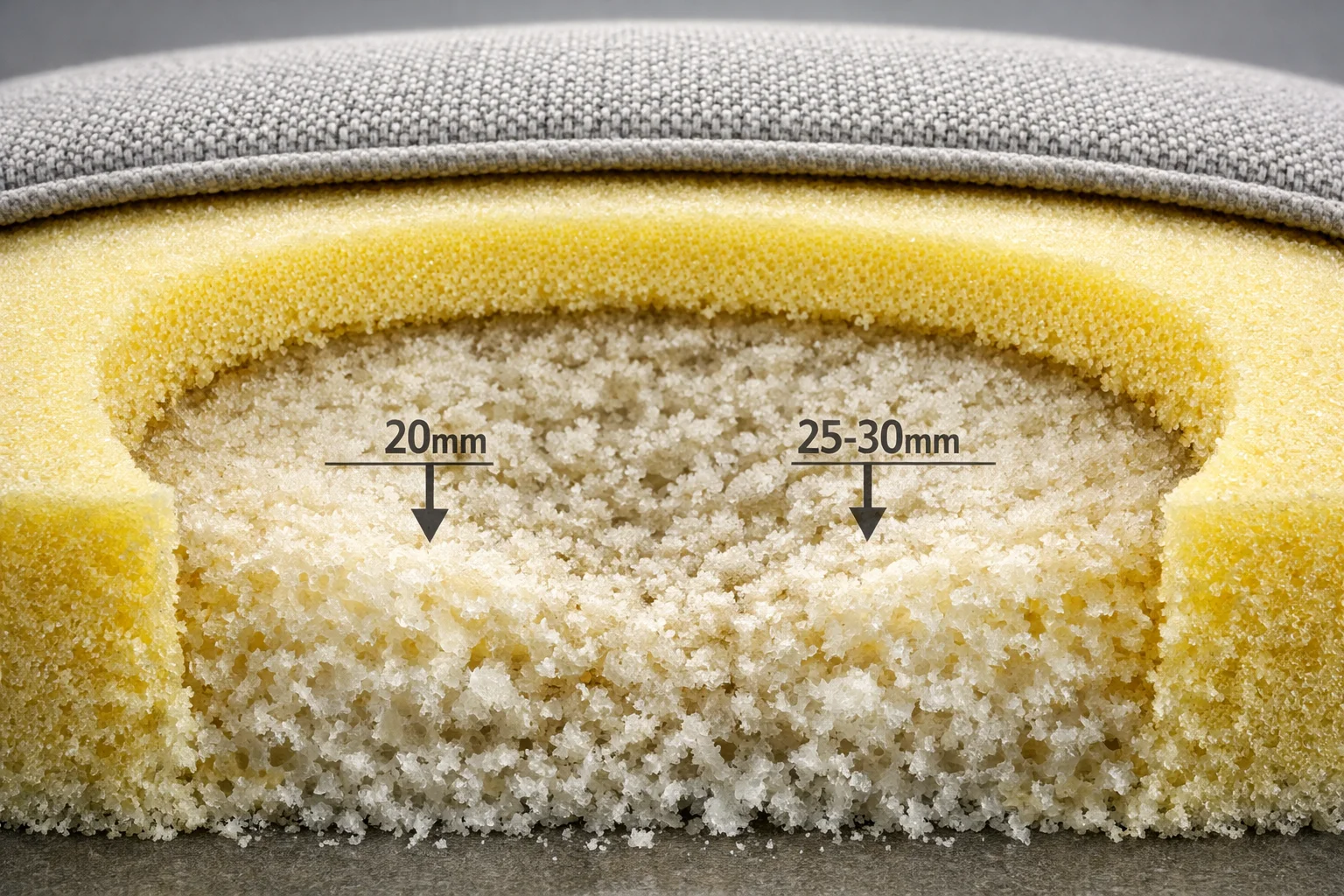
Cushion Collapse: Why the Center Fails First
Why the front of your cushion looks fine but the center is a crater. The mechanics of point-load failure.
Analyze Details →
The Quicksand Effect: Why You Sink & Can't Get Up
Why sinking isn't always relaxing. The ergonomics of hip-drop and how it destroys your lumbar curve.
Analyze Details →