Cushion Collapse: Why the Center Fails First
Introduction
I bought a vintage velvet sofa that looked perfect. The fabric was tight. The shape was square. But the moment I sat down, I slid backward into a hole. The cushion looked fine from the outside, but the inside had disintegrated.
That was the moment I realized how little the showroom experience tells you. You see fabric and shape, but you rarely see what actually holds you up. By the time a sofa reveals its weaknesses, you usually own it and the return window is long gone.
I am not a designer or a repair expert. I am just someone who got tired of sinking, sagging, and replacing seating that should have lasted much longer. I started paying attention in showrooms, not to trends or brand names, but to the small physical clues that predict how a sofa will feel after a year of real use.
This guide is about those clues. I am going to show you what I now touch, press, lift, and question before I consider buying. If you are willing to be a little nosy in the store, you can avoid most of the expensive disappointments I have already paid for.
The “Toilet Seat” Effect
The "Toilet Seat" Effect
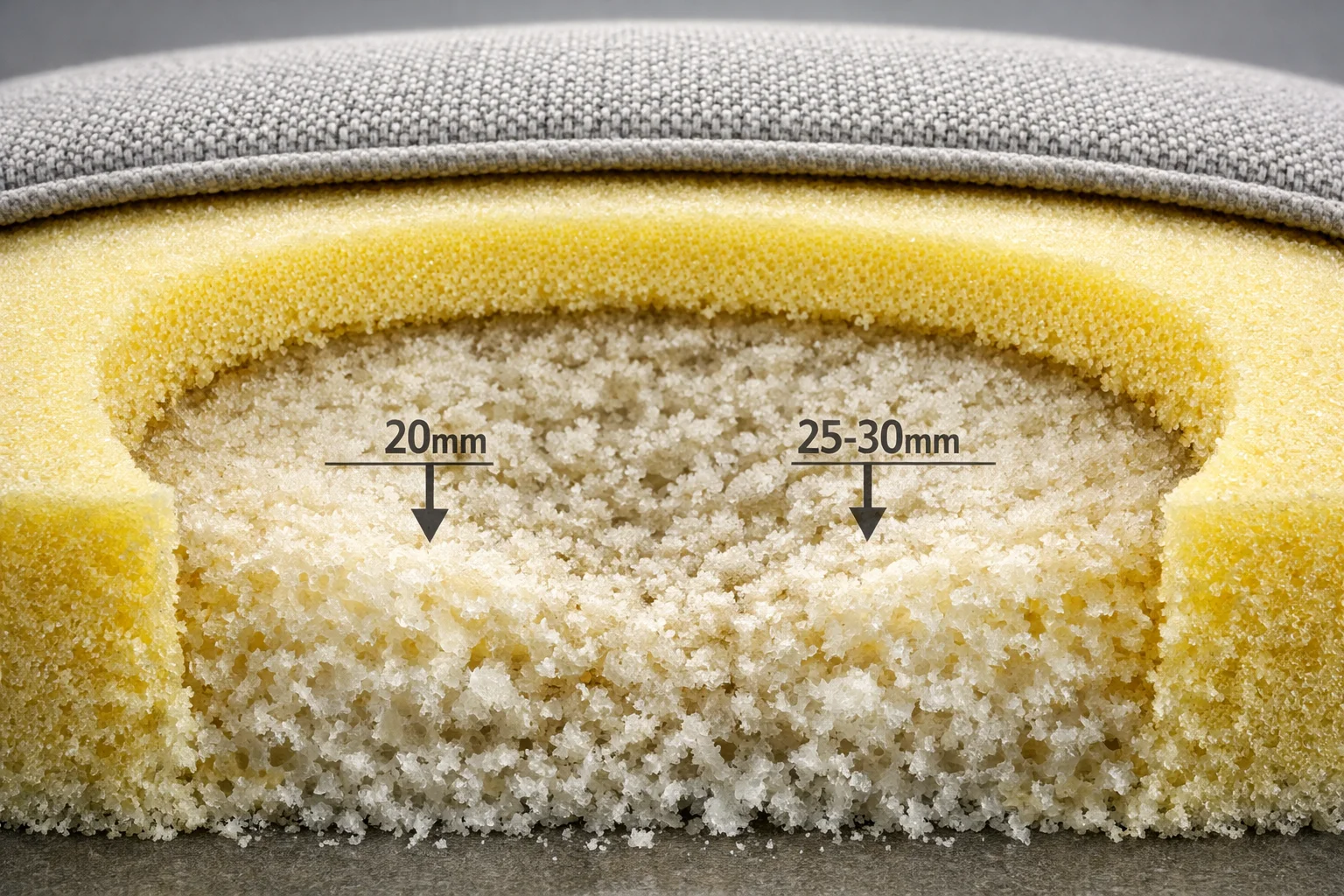
This is a specific type of failure where the perimeter of the cushion stays firm and upright while the center quietly collapses. The edges still feel supportive to the touch, which is why the problem hides so well in photos and quick sit tests.The center is where the damage happens. The foam or fill in the middle breaks down first, often turning crumbly or hollow, while the outer ring keeps its shape.
The result is that you sit in the cushion instead of on it. Your hips drop into the middle, the edges press into your thighs, and you feel locked in place even though nothing looks wrong.
I see this failure pattern constantly now, especially on sofas that look structured and tailored. It happens because the cushion is built with just enough density around the edges to pass a showroom squeeze, but not enough integrity in the center to survive daily use.
When you are in a store, I want you to ignore how the cushion looks and focus on how it reacts to uneven pressure. I sit slightly forward instead of centered, then shift my weight side to side. If the middle sinks noticeably lower than the edges or if I feel a rim forming around my legs, I know that cushion is already telling on itself.
I also press straight down with my palm in the center, then near the edge. If the edge pushes back quickly but the center feels dead or slow to recover, that is a red flag. Good cushions resist you evenly and rebound at roughly the same speed no matter where you press.
Another thing I do is stand up and watch the cushion recover. If the edges stay puffed while the center takes its time or never fully comes back, you are looking at an early stage of the toilet seat effect. That gap only gets deeper with time.
If a salesperson tells you the cushion will break in, be careful. Breaking in should feel like softening, not hollowing. A cushion that collapses in the middle is not breaking in, it is breaking down.
This is one of those problems you cannot fix with fluffing or rotating. Once the center loses its structure, the cushion is on a countdown. Catching this in the showroom has saved me from buying sofas that would have annoyed me every single day.
Why Cushions Implode (The Physics)
When a cushion fails, it is not random. It is physics doing exactly what it always does when soft material is asked to carry the same load in the same spot, day after day.
Your body weight does not spread out evenly. Most of it goes through your sit bones, which land in roughly the same place every time you sit. That means the center of the cushion takes far more stress than the edges, even if the cushion looks uniform.
Foam does not wear by getting thinner first. It wears by losing its ability to push back. Inside the cushion, the tiny air pockets and cell walls fatigue, collapse, and stop rebounding. Once that happens, the material still fills space but it no longer supports you.
This is why a cushion can look full and still feel dead. The cover is holding the shape, but the foam underneath has lost its spring. You feel like you are sinking into a hole because, functionally, you are.
The edges often survive longer because they are reinforced by seams, piping, and tighter upholstery. Those details act like a belt around the cushion, keeping the perimeter upright even as the center gives up. That mismatch is what creates the rimmed, trapped feeling when you sit.
I have learned to pay attention to how fast a cushion responds, not just how soft it feels. Good foam compresses and rebounds almost immediately. Tired foam compresses easily and comes back slowly, or not all the way.
In the store, I press down hard and release quickly. If the cushion hesitates before rising, that tells me the foam is already accumulating compression set. That is the technical term for foam that remembers being squashed, and it never forgets in a good way.
Another factor is how thick the cushion is relative to how soft it feels. Very soft cushions that are not very thick have less material to absorb stress. They feel great for five minutes and terrible after five months.
I also think about how the cushion is expected to be used. If the sofa has one long seat cushion instead of multiple smaller ones, the center will take all the abuse. If the cushions are not reversible, the same spot will get crushed over and over with no chance to recover.
None of this requires you to know foam densities or manufacturing specs. I do not ask for those anymore because they are rarely disclosed clearly and often misunderstood. I focus on how the cushion behaves under real pressure, because physics does not lie and sales language often does.
When you understand that cushions implode because their internal structure gives up before their outer shape does, the warning signs become obvious. You stop being impressed by tailored seams and start caring about resistance, recovery, and balance.
That shift alone has changed how I sit in showrooms. I am no longer testing comfort for the next ten minutes. I am testing whether the cushion has a future.
1. Point Loading (The “habit” Factor)
This is the failure I see most often, and it has nothing to do with defects. It happens because you are a creature of habit, and sofas are rarely built to forgive that.
Most nights, you sit in the same spot, lean the same way, and put your weight down at the same angle. Your body does not spread out like a blanket. Almost all of your weight lands in a small circle right under your hips.
That means the foam directly under your sit bones is doing all the work, while the foam just a few inches away is barely touched. One part of the cushion is being crushed thousands of times, and the rest is basically on vacation.
Over time, that difference creates a fault line inside the cushion. The worked foam loses its spring and starts to crumble or compact, while the untouched foam stays healthy. Eventually the damaged area pulls away from the rest, and that is when the hole appears.
You usually feel this before you see it. One spot starts to feel lower or looser, even though the cushion still looks fine. You adjust how you sit without realizing it, then one day you notice you are always fighting the sofa instead of relaxing into it.
In a showroom, I try to mimic real life instead of sitting politely in the center. I sit where I would actually sit at home, usually slightly off center, and I stay there for a minute. If the cushion starts to feel unstable or sloped, that tells me the foam does not distribute stress well.
I also press hard with my hand in one concentrated spot, not spread out fingers. I am trying to imitate point loading, not a gentle pat. If the foam collapses deeply right under my palm and does not push back evenly around it, I walk away.
Another thing I pay attention to is whether the cushion encourages rotation. If it is one large cushion or fixed in place, the same zone will take the hit every day. That does not mean it will fail immediately, but it means it has no margin for bad habits, and most of us have those.
Salespeople sometimes tell me the foam is designed to contour to my body. I am careful with that language. Contouring feels nice at first, but if it relies on permanent compression instead of elastic rebound, it is just accelerated wear with better marketing.
What I want is not a cushion that remembers me. I want one that forgets me completely every time I stand up.
If you remember nothing else from this section, remember this. A sofa does not wear out evenly. It fails where you live on it. Your job in the store is to find out whether the cushion can survive that reality, not a perfectly balanced sit that will never happen at home.
2. Delamination (The Glue Failure)
This is a quieter failure than foam collapse, and it took me a long time to recognize it. The cushion can feel supportive at first, but something about it feels unstable, like the surface is drifting under you.
Many seat cushions are built from layers, usually a softer foam on top glued to a firmer base. In better cushions those layers are bonded securely or mechanically joined, but in cheaper ones they are simply sprayed together with adhesive that is not meant to last for years of flexing.
When that glue dries out or cracks, the layers stop behaving like a single piece. The top layer starts to move independently from the bottom, and your body can feel that even if your eyes cannot.
The sensation is strange and very specific. When you sit down, the top of the cushion slides slightly forward while the base pushes back. It feels like your hips are drifting even though the sofa frame is solid. I describe it as sitting on loose plates that shift in opposite directions.
In the showroom, I look for this by sitting down and then subtly scooting my weight forward and back without standing up. I am not trying to test comfort, I am trying to see if the cushion surface moves separately from what is underneath it.
I also press down with my palm and then drag my hand lightly across the fabric while maintaining pressure. If I feel the top compress and smear forward instead of pushing straight back, that tells me the layers are not acting as one unit.
Another thing I do is grab the cushion at the front edge and squeeze upward while it is still on the sofa. If the top layer feels like it wants to peel away or wrinkle independently of the bottom, I stop considering it. A good cushion resists as a single block.
Delamination often hides during quick sit tests because the cushion can still feel soft and supportive in a neutral position. The problem shows up when you shift, slouch, or adjust, which is exactly what you do at home without thinking.
This kind of failure does not usually announce itself with sagging right away. Instead, you start feeling restless because you cannot quite settle into a stable position. You keep adjusting your posture, not because you are uncomfortable, but because the seat never feels anchored.
I have learned to be skeptical of cushions that advertise multiple layers without explaining how they are bonded. Layering is not automatically bad, but it relies completely on the integrity of the connection between those layers.
Salespeople sometimes describe this as a plush top over a supportive core. That can be great when it is done well. When it is done cheaply, the plush top becomes a sliding mat instead of a comfort feature.
One warning sign I watch for is a cushion that feels dramatically softer on top but abruptly firm underneath. That sharp transition can mean you are feeling the interface between layers, not a gradual change in material. Over time, that interface is exactly where separation starts.
This is not something you can fix later with fluffing, rotating, or adding batting. Once the glue bond fails, the cushion will always feel unstable, even if the foam itself is still in decent shape.
I have passed on sofas that felt luxurious for the first thirty seconds because I could feel that subtle internal slip. It is hard to explain to someone else, but once you notice it, you cannot unfeel it.
If a cushion makes you feel like you are sliding even when the floor is level and the frame is solid, trust that instinct. That is not comfort breaking in. That is structure breaking apart, just slowly enough to fool you in the store.
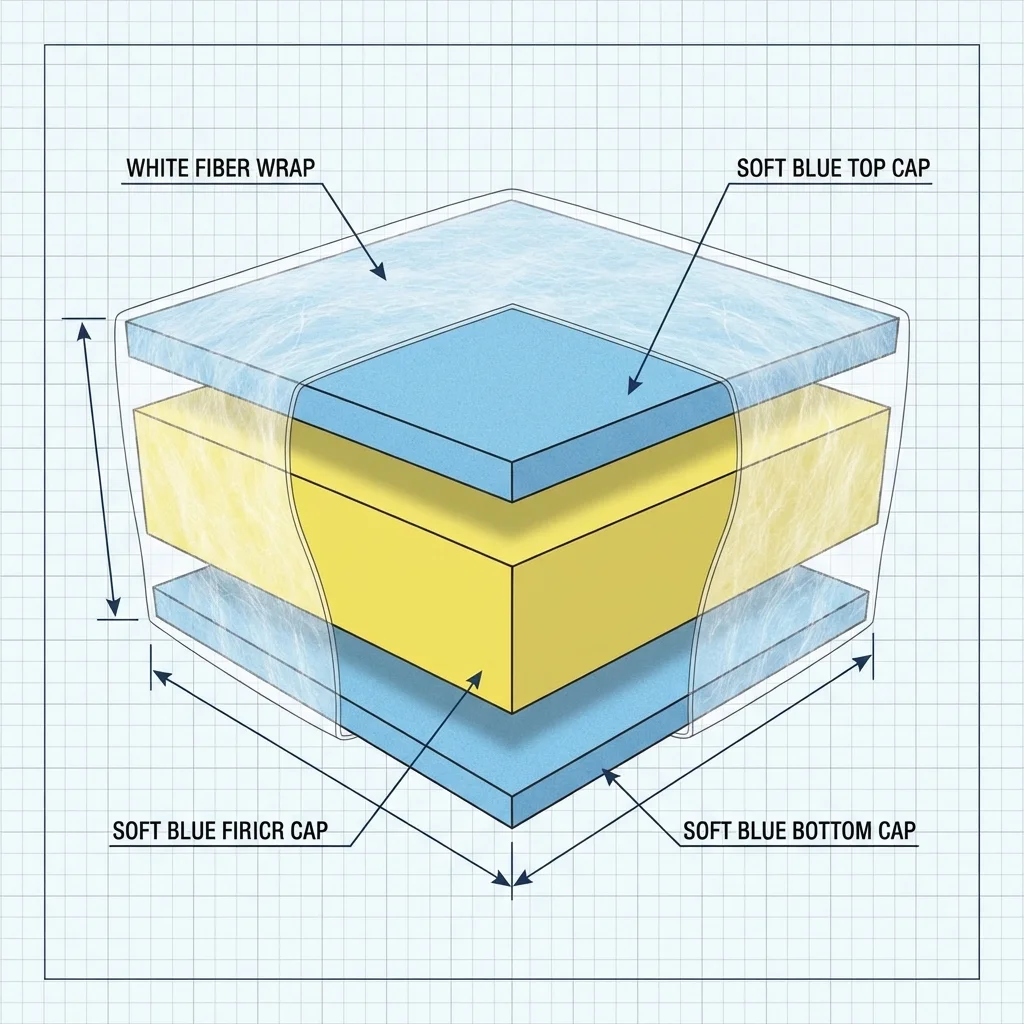
When I first saw a diagram like this, it finally explained a feeling I could never quite describe. The cushion was not sagging in a simple way. It was separating internally, and my body could tell before my eyes could.
What this image shows is a cushion that looks thick and intact from the outside, but is no longer behaving like a single piece. The top layer compresses and slides, the bottom layer resists, and the connection between them is no longer trustworthy.
When you are in a showroom, you obviously cannot see inside the cushion. What you can do is use this image as a mental model for what you are feeling when something seems off but still looks fine.
If you sit down and feel like the surface gives way before the support kicks in, imagine that top layer shearing forward in the picture. That delay between sinking and stopping is often the layers arguing with each other instead of working together.
I pay close attention to whether my body feels centered or slightly adrift. A delaminating cushion often makes me feel like I am constantly correcting my position, even though I am not consciously moving.
I also watch how the cushion behaves when I stand up. If it regains height unevenly or looks momentarily wrinkled before smoothing out, that can be the layers settling back into place rather than rebounding as one unit.
This image also explains why rotating or flipping a cushion rarely solves this problem. Once the bond between layers is compromised, the entire cushion is affected. You cannot rotate your way out of a failed connection.
When a salesperson talks about a cushion having multiple comfort layers, I picture this diagram and listen carefully to my hands and hips. If I can feel where one layer ends and another begins, that seam is already a stress point.
I am not against layered cushions. Some of the best seats I have used are built that way. What I am against is buying a cushion where the layers rely on glue that cannot survive years of flexing and body heat.
If this image matches a sensation you feel in the store, even faintly, I would take that seriously. That quiet internal shift is usually the beginning of a long, annoying decline, not a phase that magically resolves itself at home.
Once I learned to connect this picture to that slippery, unsettled feeling, I stopped second guessing myself. The image gave me permission to trust my body over the upholstery.
The “Dacron Matting” Issue
Sometimes the foam is not the real problem. The wrap around it is what quietly fails first, and it can make a healthy cushion feel old long before it should.
Most seat cushions are wrapped in polyester batting, often called Dacron, to soften the edges and give the cushion that full, rounded look. When it is new, it makes the seat look inviting and hides the hard outline of the foam underneath.
Over time, body heat, moisture, and repeated pressure change that fluffy layer into something closer to felt. It stops acting like a cushion and starts acting like a thin, compressed pad that cannot spring back.
When this happens, the cushion loses height without the foam actually disintegrating. What used to be a thick, soft wrap collapses down to almost nothing, and because the wrap exists on the top and bottom, the total loss adds up fast.
The result is a seat that suddenly feels much lower, even though the foam core might still be intact. The fabric also starts to look loose because the structure it was stretched over has shrunk.
I have owned cushions that looked baggy and tired, but when I unzipped them years later, the foam inside was surprisingly fine. The problem was that the wrap had turned into a dead, matted shell that no longer did its job.
In a showroom, this is hard to spot if you are only looking. You need to use your hands and your weight to feel whether the surface softness is real or just cosmetic.
When I press down on a cushion with Dacron that is already matting, the first inch or two feels soft and then I hit firmness very abruptly. That initial softness does not push back, it just disappears under my hand.
I also pinch the cushion fabric between my fingers and lift slightly. If the fabric lifts easily but feels disconnected from any spring underneath, that often means the wrap is doing all the visual work and the foam is sitting lower than it should.
Another thing I do is look at the cushion from the side after standing up. If the top looks a little deflated or wrinkled even though the foam has rebounded, that is a sign the wrap is no longer holding volume.
This issue is especially common on sofas that look plush but feel surprisingly firm once you sink past the surface. That contrast can be intentional, but it can also mean the comfort you are feeling is mostly coming from the wrap, not the foam.
I ask salespeople whether the cushions are wrapped in polyester batting and whether that wrap is replaceable. I am not expecting a technical answer, but hesitation or vague reassurances tell me this is not something they expect to last.
If a cushion relies heavily on Dacron for its initial comfort and shape, I assume it will look worse faster. That does not always make it a bad sofa, but it does mean you are paying for an appearance that has an expiration date.
What I prefer is a cushion where the foam itself provides most of the resistance and height, and the wrap is just a finishing layer. When the wrap mats down on those, the seat still feels basically the same.
You cannot really test long term Dacron durability in a few minutes, but you can notice whether the cushion feels honest. If most of the comfort vanishes the moment you apply real pressure, that softness is borrowed time.
This is one of those failures that makes people say a sofa suddenly aged overnight. In reality, it was aging quietly every time someone sat down.
Now, when a sofa looks great but feels lower or flatter than its shape suggests, I trust that feeling. That mismatch between appearance and support is often the wrap giving up before anything else, and once it does, the sofa never quite looks or feels right again.
The "Steam" Hack (Temporary Fix)
If a cushion looks deflated but still feels firm underneath, there is a short term trick that can make it look better for a while. I have done this myself when a sofa was annoying me but not bad enough to replace.You take the cushion cover off, pull out the foam core, and focus on the white polyester batting wrapped around it. Using a garment steamer, you gently steam that batting until it warms up and relaxes. The heat allows the crushed plastic fibers to loosen and puff back up, which makes the cushion look fuller again once everything cools.
When it works, the change is immediate. The cushion regains height, the fabric looks tighter, and the seat can feel closer to how it did when it was new. It can be oddly satisfying, especially if the sofa was starting to look tired but did not feel completely dead.
Here is the part I want you to be very clear about. This does not fix the underlying problem. In my experience, the improvement usually lasts a couple of months, maybe three if the sofa is lightly used, and then the batting compresses again because nothing structural has changed.
I mention this hack not because I think you should rely on it, but because it teaches you something useful as a buyer. If steaming the wrap makes a cushion look dramatically better, that tells you the sofa was relying heavily on that batting for its shape in the first place.
In a showroom, I mentally file this away when a cushion looks plush but feels suspiciously firm underneath. I assume that what I am seeing is partly a cosmetic layer that will not age well, even if it looks great under bright lights.
If a salesperson suggests steaming or fluffing as a maintenance solution, I hear that as a warning, not a benefit. Long term comfort should come from the foam and structure, not from a layer that needs periodic heat therapy to look acceptable.
At home, I see the steam trick as a stopgap. It can buy you time if you are not ready to replace a sofa, or if you want it to look decent for guests. I do not see it as evidence that the cushion is still healthy.
As a buyer, the takeaway is simple. A cushion that needs tricks to look right is already telling you how it will age. I would rather choose a sofa that never needs this hack than one that looks good only after I intervene.
Once you have steamed a cushion and watched it deflate again a few months later, it is very hard to unlearn that lesson. I now try to buy seating that will never tempt me to pull out a steamer in the first place.
The Density Timeline (When Will It Die?)
At some point I got tired of guessing how long a cushion would last and started paying attention to density. Even if you never hear the number in a store, the behavior of the foam usually matches a predictable lifespan.
Low density foam, around 1.2 pounds, is what I associate with sofas that feel fine for a few months and then suddenly do not. These are the cushions that collapse within the first year, sometimes in half that time, and they usually do it quietly until one day you realize you are sitting in a dent that never comes back.
When I encounter this foam in a showroom, the giveaway is how easily my hand bottoms out. I press down and feel almost no resistance until I hit something firm underneath, often the seat deck or a harder base layer. That tells me there is not much material there to fatigue before it gives up.
Standard foam, around 1.8 pounds, is what most mid range sofas use, and it can be fine if everything else is done well. In my experience, this density tends to last three to five years before it starts losing its spring in the spots you sit on most.
In a store, this foam usually feels comfortable and responsive at first, but I watch how fast it recovers. If it comes back a little slower than I expect or never quite reaches its original height, I assume I am feeling the early version of what will be permanent later.
High resiliency foam, often around 2.5 pounds, behaves differently. These are the cushions that still push back after years of use and tend to last a decade or more if the sofa frame and covers hold up.
When I press on this kind of foam, it resists me more evenly and rebounds almost immediately when I let go. It does not feel dead or spongy, and it does not rely on a thick wrap to feel substantial.
Here is the part that matters if you are standing in a showroom. You do not need to know the number to make a good call. You need to notice whether the cushion feels like it has reserves.
If a cushion feels great but also feels like it is using everything it has just to support you, that is usually lower density foam. If it feels like it could handle more weight or more time without panicking, that usually means higher density.
I also think about how forgiving the cushion will be of bad habits. Lower density foam does not forgive point loading, delamination, or skipped rotation. Higher density foam gives you more margin before those problems become permanent.
Salespeople sometimes say all foam eventually softens and that is true. What they do not always say is that cheap foam softens into nothing, while better foam softens into comfort.
When I hear that a cushion will break in over time, I ask myself a simple question. Is it breaking in because the material is relaxing, or is it breaking down because it cannot handle the job?
If you want a practical shortcut, pay attention to whether the cushion still feels supportive after you have been sitting for a few minutes. Low density foam often feels great in the first thirty seconds and noticeably worse after two or three minutes. Higher density foam tends to feel the same at the end of the sit as it did at the beginning.
I have learned to think of density as a timeline rather than a spec. Every cushion is on a countdown the moment you start using it. Your goal in the store is to buy the longest clock you can afford, not the nicest first impression.
Once you see foam this way, a lot of showroom magic loses its power. You stop chasing softness and start paying attention to stamina. That shift alone has kept me from bringing home sofas that would have quietly died before I finished paying them off.
Technical Summary: The Repair Guide
When a seat cushion has already failed, there are a few common suggestions that sound helpful but rarely solve the real problem. I want to be very clear about what I have tried and what actually worked, because this is where a lot of people waste time and money.
I would not bother flipping the cushion if the core is crushed. When foam has lost its structure, turning it over just moves you to the bottom of the same hole. The damage is not a surface issue, it runs through the foam, so flipping only delays the disappointment by a week or two at most.
I also do not rely on adding a throw pillow for support. I have done that, and it feels like a temporary fix because it is one. The pillow props you up, but it does nothing to restore the seat itself, and over time you end up perched awkwardly instead of actually sitting on the sofa you paid for.
What did work for me, and what I now see as the only real fix, was replacing the foam core entirely. I bought a new block of high resiliency foam at about 2.5 pounds density and cut it to size. It cost me roughly sixty dollars, and it permanently changed how that sofa felt.
The difference was immediate and honestly a little frustrating, because it showed me how good the sofa could have been from the start. The frame was fine, the fabric was fine, and all along the weak link was the foam inside the cushion.
I share this not because I expect you to reupholster cushions as a hobby, but because it gives you leverage as a buyer. When you know that a truly supportive seat comes from the foam core, you stop being distracted by surface softness and styling tricks.
In a showroom, I now ask myself a simple repair question. If this cushion fails, can it be fixed by replacing the core, or is it built in a way that makes even that difficult. Removable covers and simple cushion construction suddenly matter a lot more when you think this way.
The bigger takeaway is this. If a sofa would only feel right to you after a foam replacement, you are better off not buying it in the first place. That sixty dollar fix feels reasonable after the fact, but it is not a consolation prize when you just spent thousands.
Understanding how cushions fail also teaches you how to avoid the failure entirely. When I press, sit, shift, and wait in a showroom, I am essentially trying to predict whether I will be pricing foam replacements in a few years.
If you remember nothing else from this guide, remember this repair lesson. Cushions do not fail mysteriously, and they do not heal themselves with flipping or pillows. Either the core can do the job or it cannot, and your body can usually tell which one it is long before your eyes do.
Once I accepted that, buying a sofa stopped feeling like a gamble and started feeling like a test I could actually pass.
Fix a Collapsed Cushion
- High resiliency foam (2.5 lb density) — the correct foam for a permanent cushion core replacement that won't pack down quickly.
- Dacron batting wrap — to restore loft and shape around the new foam core before replacing the cover.
Explore Technical Reference
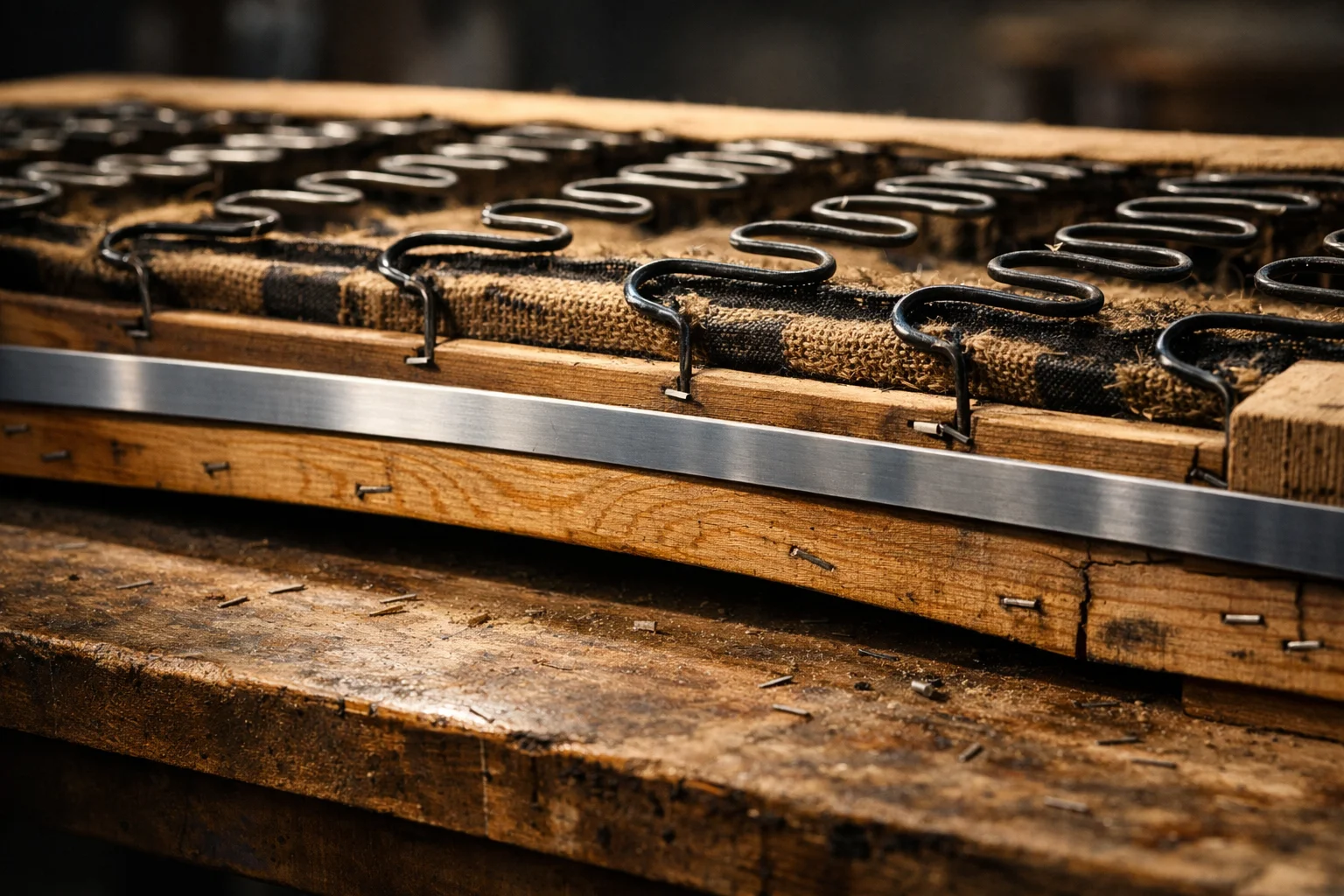
The Smile Effect: Why You Roll to the Middle
Why long sofas bow in the center. The physics of span limits and the importance of the fifth leg.
Analyze Details →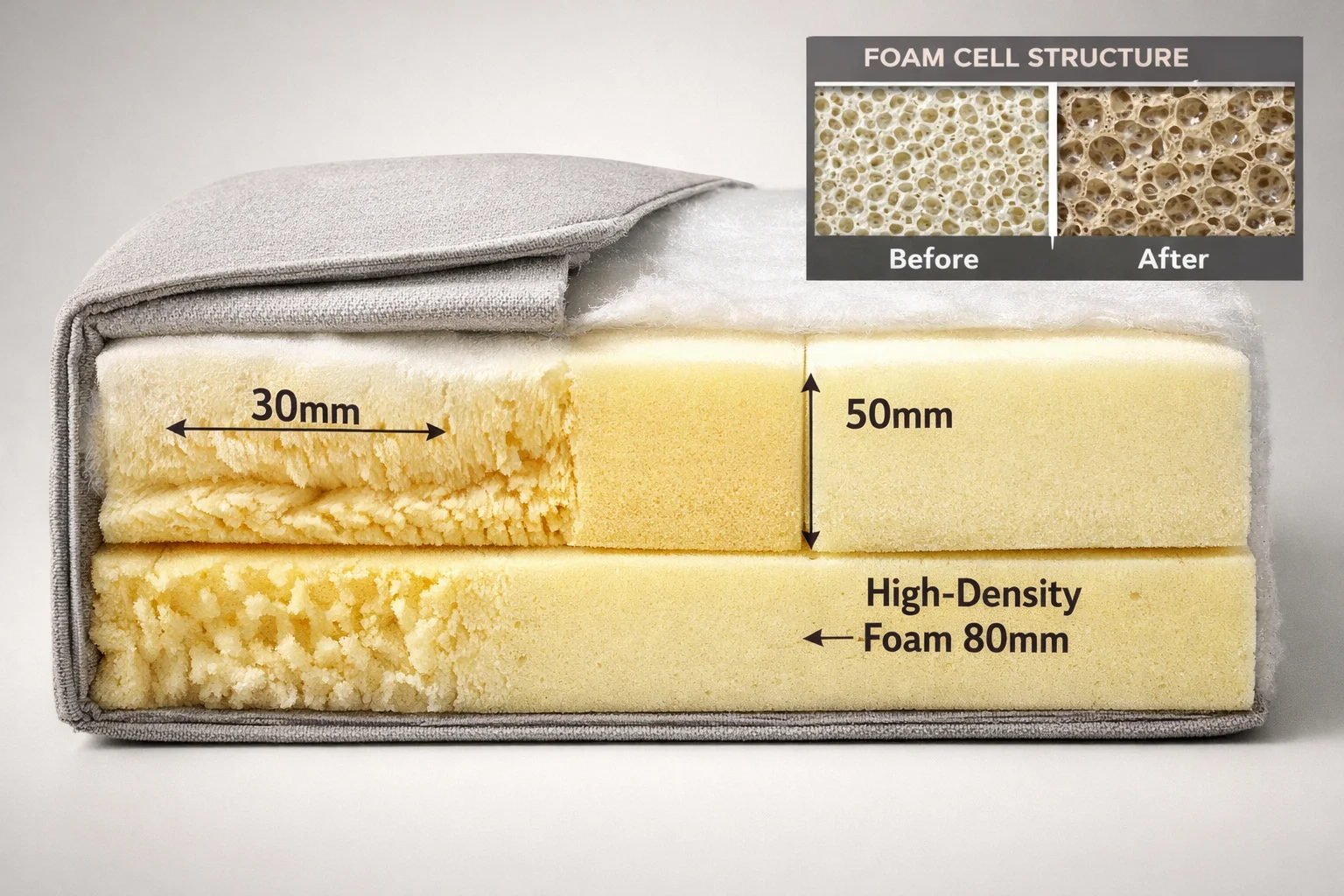
The "Favorite Spot" Syndrome: Why One Seat Dies First
Understanding why concentrated use creates dramatic wear differences across sofa seats. The physics of differential wear and why cushion rotation matters.
Analyze Details →