The "Favorite Spot" Syndrome: Why One Seat Dies First
Introduction
My dad warned me, “Don’t sit in the same spot every day.” I ignored him. Three years later, the left side of my sofa was a bucket, and the right side was brand new. The sofa wasn’t broken, it was just unevenly tired.
That one stupid habit taught me something I wish I had learned before I spent the money, most sofas do not fail all at once, they wear out in the exact places you use them. If you buy a sofa that feels fine in the showroom but has weak support, soft foam, or loose cushions, your body will find the weak point and then you will live in it every evening.
I am writing this because I got tired of hearing vague promises like “high quality” and “premium comfort,” then watching the seat turn into a hammock while the store acted surprised. When you are shopping, you need simple checks you can do in two minutes, without tools, without taking anything apart, and without needing to trust a sales pitch.
This guide is about spotting the stuff that actually decides whether a sofa stays supportive or becomes a sagging rut. I am going to focus on what you can feel with your hands and your weight, what you can see if you crouch down and look underneath, and what you should ask for in plain language so you can compare one sofa to another.
If you only remember one idea from the start, remember this, comfort on day one is cheap, support over years is what you are paying for. The rest of the guide is me showing you how I try to buy support on purpose, instead of accidentally buying a sofa that only works until my favorite seat gets “unevenly tired.”
The Math of Wear
If you are the daily sitter, meaning you drop into the same seat about two hours a day, that is roughly 730 hours a year grinding on the exact same foam, fabric, and support points. If you are more of a guest sitter, meaning a couple hours a week spread across the sofa, that is closer to about 100 hours a year.This is why the “favorite spot” ages so much faster than the rest of the sofa. In real life that one cushion and that one section of the frame can see around seven times the wear, even though you paid for the whole sofa.
I use this math in the showroom to stop myself from being fooled by “pretty good.” When you test a sofa, do not just sit once and call it comfortable, because one sit is not the problem you are buying. You are buying how it behaves after hundreds of hours in the same place.
So I sit in the exact spot I know I will claim at home, and I stay there long enough to notice what the support is doing. I pay attention to whether I slowly sink, whether my hips end up lower than my knees, and whether I feel a firm “floor” under the cushion that tells me the foam is thin or the support under it is giving up.
Then I move one seat over and do the same thing, because I want to feel whether the sofa is consistent across the width. If one position feels different, softer, tippier, or less supportive, that is the spot that will turn into the rut first, because your body will keep choosing it.
If the sofa has loose seat cushions, I also do a simple reality check for rotation. I look at the cushions and ask myself if I could swap them left to right every month without it being a hassle. If the cushions are odd shapes, attached, or obviously “assigned” to one location, you should assume the favorite spot will stay the favorite spot, and all that wear will stay concentrated.
If you live with another person, this is the moment I try to be honest about how you actually use a sofa. If you both crash in the same corner every night, you are effectively stress testing one small zone of the sofa, and you should shop like that zone is the product.
If you want one takeaway to remember while you are still in the store, it is this. Any small weakness you can feel on day one, even if it seems minor, is going to be multiplied by hundreds of hours in your favorite seat.
The Mechanics of Uneven Aging
Uneven aging is not random, it is the predictable result of the same load hitting the same materials in the same place. Your body weight compresses the foam, flexes the support under it, and tugs the upholstery a little every time you sit, then all of that relaxes when you get up. The “favorite spot” is simply the area that gets that cycle over and over until it behaves differently than the rest.
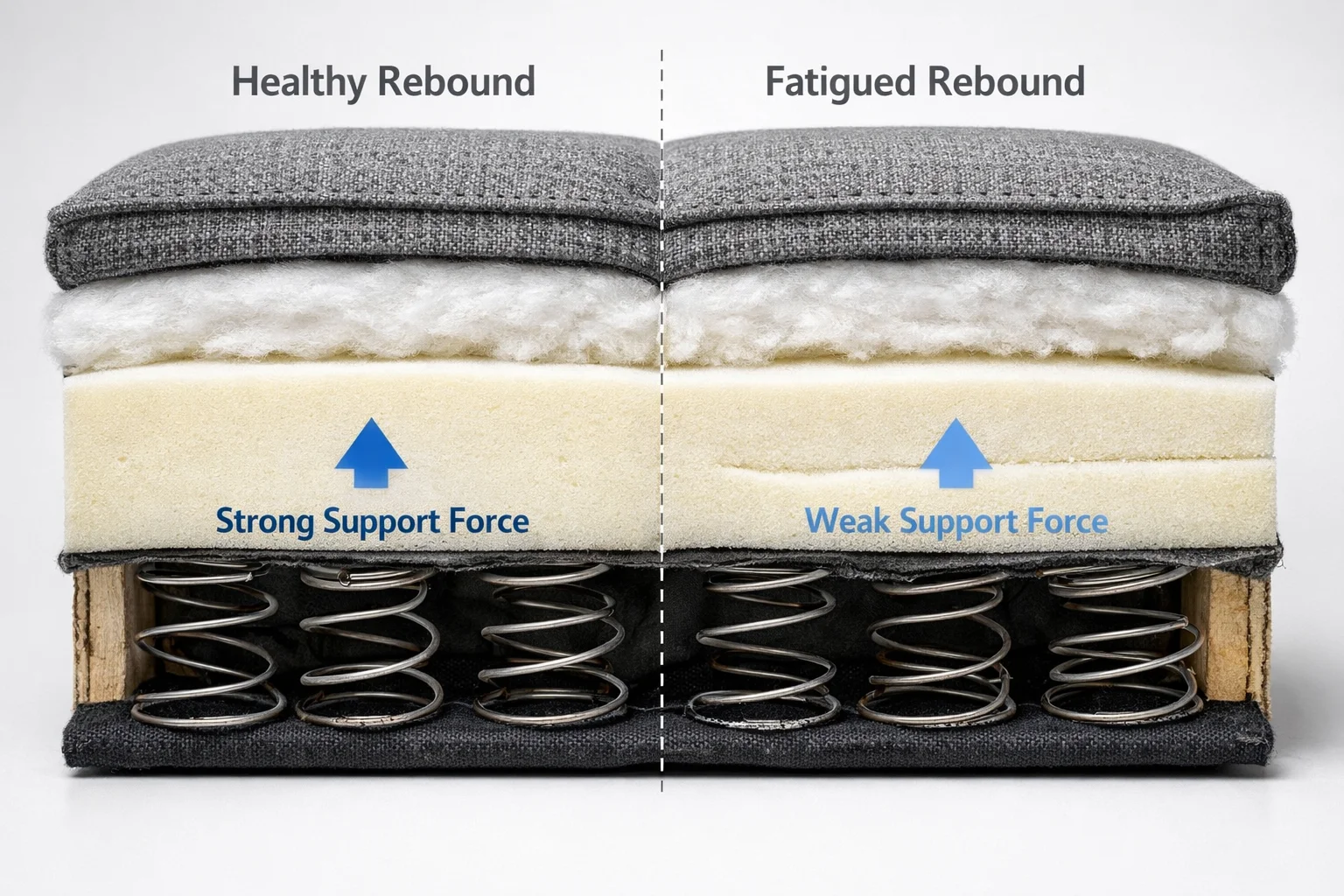
What surprises most people, including me the first time I noticed it, is that the seat can look fine while it feels wrong. Foam can lose its spring long before it looks crushed, and support systems can loosen up without anything visibly “breaking.” That is why in a showroom I care less about how plush the first sit feels, and more about whether the seat pushes back in a way that feels consistent and controlled.
The first driver of uneven aging is uneven compression in the cushion itself. Softer foam and fiber fills feel great fast, but they also take a set faster, especially where your hips land. When you sit, pay attention to whether you sink mostly at your hips while your thighs feel less supported, because that is the early shape of the rut you will get at home.
I do a simple check that tells me a lot, I stand up and immediately press the seat with my palm where my hips were. If it feels slow to rebound, or it feels like it “stays low” for a moment compared to the area right next to it, I assume that spot will pack down first. Then I press a few inches away and compare, because I am looking for a cushion that behaves the same across its surface, not one that has a soft pocket waiting to happen.
The second driver is the support layer under the cushion, which is what actually determines whether you end up sitting “in” the sofa or “on” it after a year. Springs, webbing, and even solid platforms all fatigue in their own way, but the buying check is the same. I sit down, then I shift my weight forward, back, and slightly side to side, and I notice whether the seat follows me with even resistance or whether it suddenly gives more in one direction.
If you feel a hinge point, like the seat dips harder near the front edge or near one arm, that is a red flag for uneven aging. That is the kind of soft zone your body will subconsciously seek out because it feels cozy at first, then it becomes the permanent crater. In the store, I treat that feeling like a warning label, even if the sofa is expensive and looks perfect.
The third driver is the frame and how it spreads load. A stronger frame does not stop cushions from wearing, but it can prevent the “one seat only” problem where the structure itself starts to flex more on one side. I crouch and look under the front edge and I watch what moves when I sit and when I stand up, because excessive flex is basically the sofa rehearsing how it will loosen over time.
You do not need to know woodworking to do this. If the front rail looks thin, or you can see the seat support stapled into narrow strips that look like they could split, I get cautious. If you can feel or hear little shifts, clicks, or creaks when you plant your weight into the same spot twice, I assume that spot will age faster than the rest.
The fourth driver is how the upholstery and cushion cover manage friction. Every time you slide into the same seat, the fabric and the cushion casing rub and stretch, which is why the favorite spot often looks wrinklier or shinier even before it sags. In the showroom I run my hand across the seat fabric and imagine doing that in the same direction for years, and I look for fabrics that already show pressure marks, nap changes, or quick shine from a few rubs.
This is also where loose versus attached cushions changes the story. Loose cushions at least give you a fighting chance, because you can rotate them and spread the compression and fabric wear. Attached cushions can be totally fine, but only if the seat support is strong and the cushion is resilient enough that one zone will not permanently lose height.
If the cushions are loose, I do one more habit check, I pick one up and see if it is genuinely reversible and realistic to swap. If it has a top and bottom that are clearly different, or if piping and shape make it obvious where it “belongs,” then rotation will not happen in real life, and the mechanics of uneven aging will do their thing in your favorite spot.
What I want you to take from this section is simple. Uneven aging comes from a cushion that compresses too easily, a support layer that gives more in one area, or a structure that flexes unevenly, and you can feel all of that in a showroom if you test on purpose. If one seat position feels even slightly easier to sink into than the one next to it, assume that difference will get bigger every month you own it.
1. Spring Fatigue (Localized)
Sinuous springs are basically a row of separate steel wires running left to right under the seat. They are not one solid sheet of support, so they do not automatically “average out” your weight across the whole sofa.
Here is the part that burned me. If you sit in the same spot every night, you are not wearing out “the seat,” you are mostly wearing out a couple specific wires directly under your sit bones. Those few springs flex over and over, while the springs a few inches away barely get used, so the sofa slowly becomes supportive in some lanes and tired in others.
When those overused springs lose their snap, they stretch a little and stop returning to the same height. The rest of the springs, the ones you do not sit on, can still feel firm and almost new. That mismatch is what creates the classic crater, not because everything collapsed, but because only one small zone got exhausted.
The symptom is not just a dip. It is the way you “roll” into the dip. You sit down and your body drifts toward the tired spot, then if you sit beside it you can feel the opposite problem, the fresher springs push you back toward the sag so you end up feeling tilted, like you are sitting on a shallow slope.
In a showroom, I try to detect this kind of uneven support before it has a chance to develop at home. I sit in one spot and then I scoot sideways a few inches at a time without standing up, because that keeps my weight similar while I sample different springs. If the resistance changes in little stripes, like one position feels noticeably easier to sink than the next, I assume the sofa is going to telegraph your habits and turn your favorite stripe into the trench.
I also do a front edge check, because that is where sinuous spring setups often give away how close you are to the metal. I sit normally, then I slide forward until my thighs are closer to the edge, like I am about to stand up. If I suddenly feel a firmer bar-like pushback, or the seat feels like it hinges down more in that zone, I take that as a sign the spring grid is not distributing load very smoothly.
If the sofa has removable seat cushions, I unzip one if the store allows it and look for a thick, tough layer between the foam and the springs. I am not hunting for a specific brand of material, I just want to see something that acts like a buffer so you are not directly “printing” your body into the same two springs every night.
If it is a sofa with attached seat cushions, I get stricter with the feel test, because you cannot rotate away from spring fatigue. In that case I sit in my real life spot for a full minute, then I stand up and sit in the neighboring spot and ask myself if the second spot feels like it is pushing me sideways. Even a small tilt in a brand new floor model tells me the support system is sensitive to localized loading, and that is exactly the recipe for the crater later.
When a salesperson says sinuous springs are “standard” or “just as good,” I do not argue. I just ask what is done to prevent the favorite spot from turning into its own little hammock, because that is the real failure mode. If the answer is vague, or they pivot to fabric and color, I treat that as my cue to keep shopping.
2. Foam Compression Set
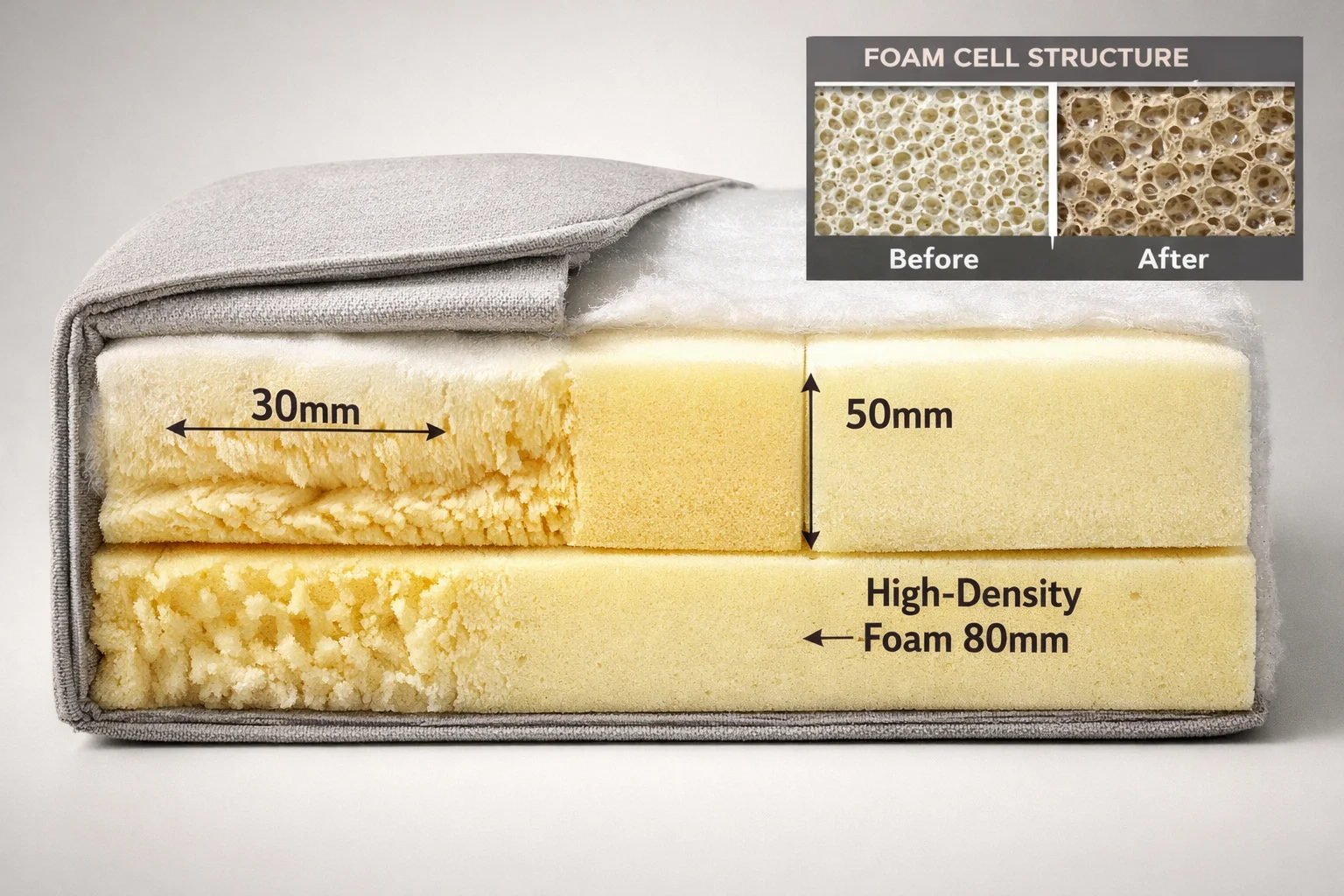
Foam has a finite life, and this is one of the most common ways a sofa quietly goes bad without anything “breaking.” The basic problem is simple, every time you sit, you crush millions of tiny air pockets, and over time some of those pockets stop bouncing back.
What you feel at home is that your favorite spot becomes both thinner and softer at the same time. It is not just that you sink more, it is that you sink faster, then you keep sinking a little as the minutes pass, until your hips end up lower than you expected.
In the showroom I try to separate “plush” from “already willing to take a set.” I sit in the exact spot I would claim at home and I stay still for a full minute, because foam that is going to give up tends to keep giving. If I notice that slow downward drift, I assume the foam is going to lose height in that zone first.
Then I do the rebound check the moment I stand up. I press down hard with my palm where my hips were, then I press the same way a few inches to the side. If the hip zone feels lazier, slower, or easier to bottom out even on a floor model, I treat that like an early warning that the foam is not going to age evenly.
I also pay attention to whether I can feel a “floor” under me. If the seat feels comfy on top but I can sense something firm underneath when I rock forward and back, that usually means the foam is either thin, too soft for the design, or both. That is the feeling that turns into the classic complaint later, where the cushion looks okay but you feel the support layer and your body starts avoiding that seat.
If the cushions are loose, I make myself do a quick reality check, because rotation is your main defense against compression set. If the cushions are heavy, awkward, or shaped so they clearly belong in one position, you are probably not going to swap them around, and you will wear one core into a permanent low spot.
If the store will let you, I ask to see the cushion tag or any spec sheet and I focus on the foam description in plain language. I am looking for whether the seat uses a real foam core versus mostly fiber fill, and whether there is anything resilient on top of the core or if it is just soft stuff meant to feel good under showroom lighting.
When a salesperson tells me, “The foam will bounce back,” I ask a more concrete question, like whether the seat cores are replaceable and whether they can be purchased later. I am not asking because I want a future project, I ask because the answer tells me whether the brand expects foam to be a consumable part of the sofa, or whether they are pretending it will last forever.
Here is the hard truth that saves you money later. You cannot un crush foam, flipping and fluffing can help fiber wraps, and rotation can spread wear, but once the core has taken a set, it is done. The real fix is replacing the core or swapping the cushion with another one, which is exactly why I care so much about whether the sofa is designed to let you do that without a fight.
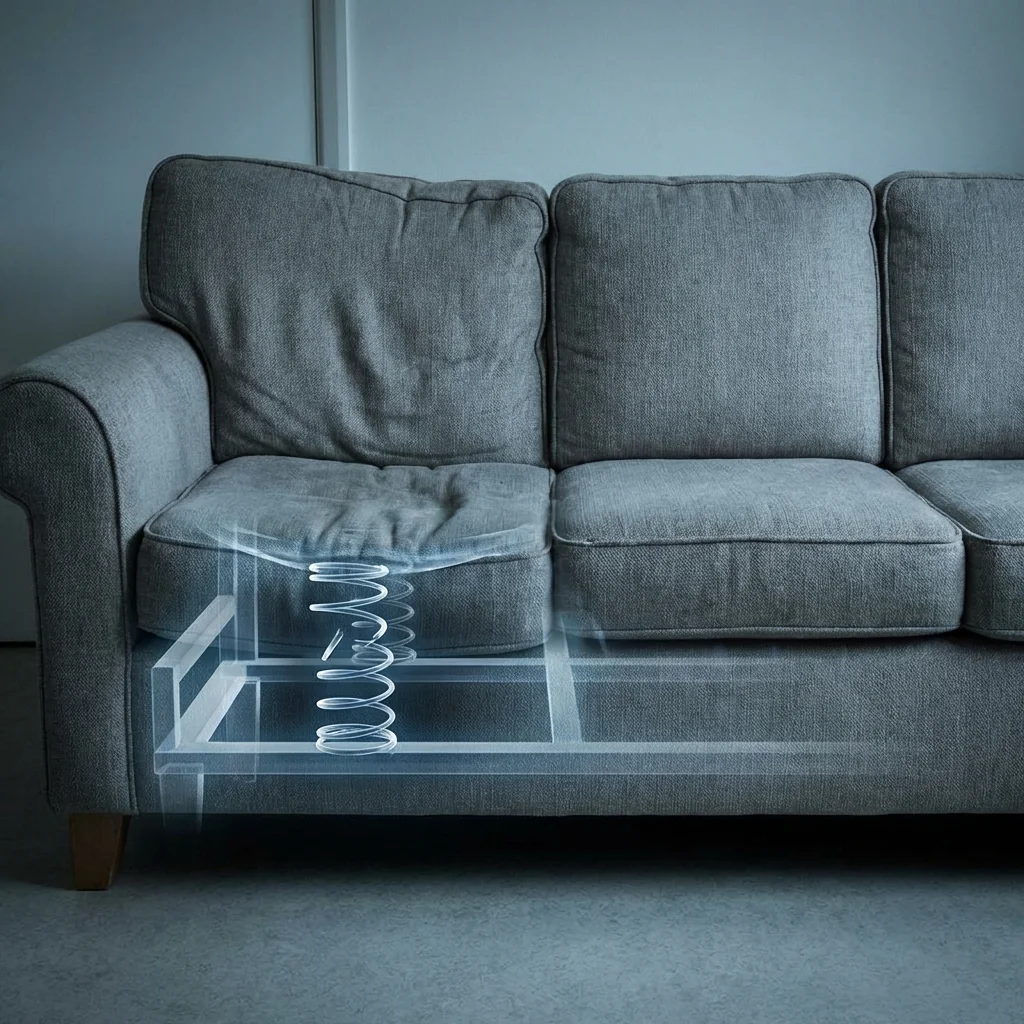
When I say “bucket,” I mean this exact shape, a crater right where you land, with higher, firmer areas around it. The annoying part is that a sofa can still look tidy from across the room, but your body feels that crater every time because you are subtly sliding into the same low point.
In the showroom, I try to picture this diagram happening in slow motion, then I test for whether the sofa encourages it. I sit in one spot, then I scoot a few inches left and right without standing, and I pay attention to whether I feel my hips being guided back toward a softer pocket.
If you feel that, do not brush it off as “comfy.” What you are feeling is the sofa admitting it has a preferred low zone, and real life will make that preference stronger, not weaker.
I also use this image to remind myself to test the area just outside my favorite spot. A sofa that stays level over time does not just have a decent cushion, it has support underneath that resists turning one seat into a crater while the surrounding area stays proud and firm.
If you want a quick, practical tell, stand up and look at the seat surface from an angle, not straight on. If the cushion cover is already showing a faint dish shape where you sat, or if the seams and piping look like they are being pulled inward toward one point, I assume the bucket effect will show up early at home.
This is also where I get honest about whether I can and will rotate cushions. If the cushions are attached, or if they are shaped so swapping them is unrealistic, then whatever you are testing in that one spot is basically your long term experience, because you are not going to spread the wear around later.
If you are stuck choosing between two sofas that both feel good, I would rather you choose the one that feels boringly consistent across the whole seating area. In my experience, the sofas that feel “special” in one spot are the same ones that punish you for loving that spot.
The “Clip Failure” (Sudden Drop)
Sometimes a sofa does not fade into a sag, it drops out from under you in one moment. I have had this happen on a sofa that felt totally normal the day before, then one sit later it was like a pothole opened up under one hip.
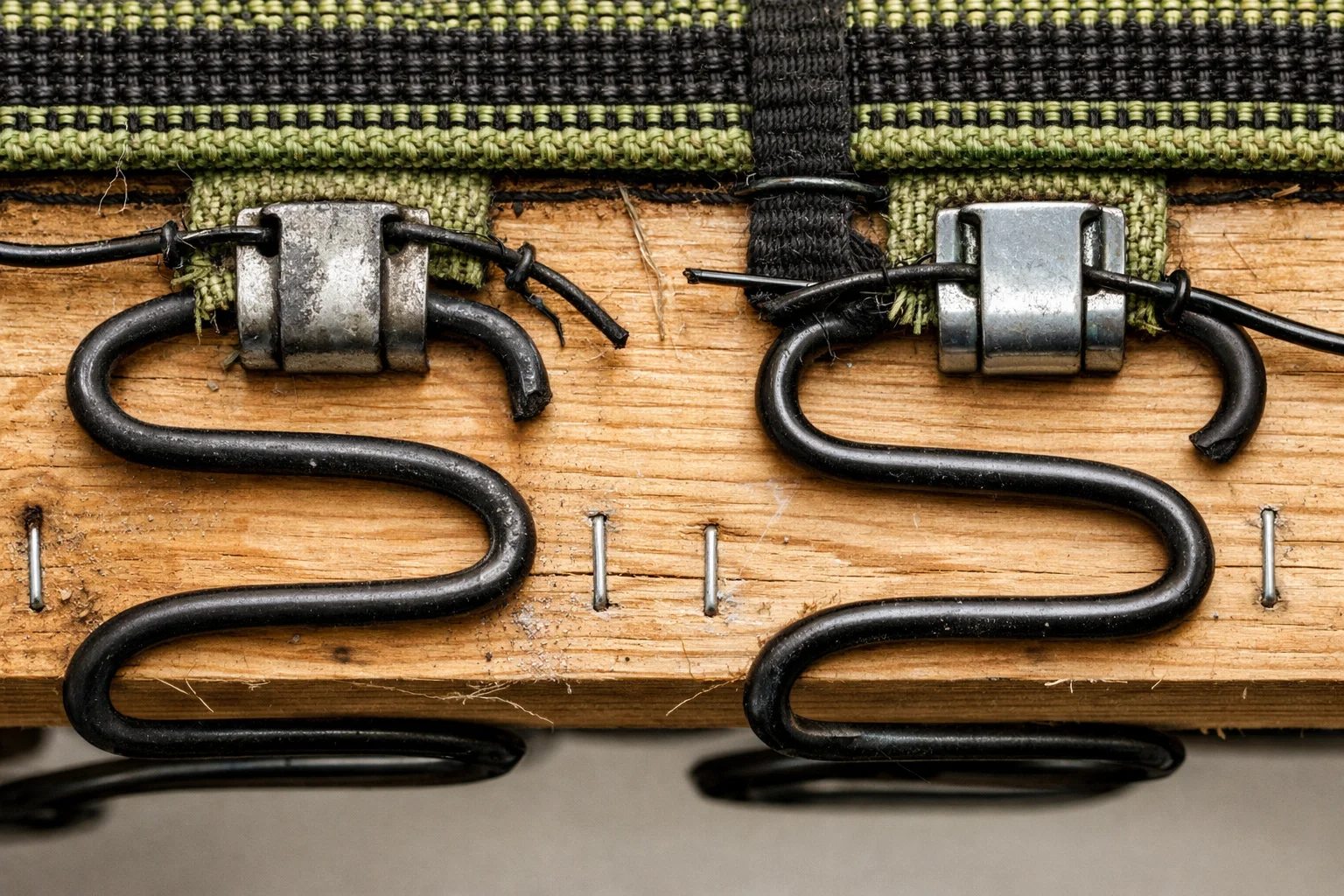
What usually causes that “pop” feeling is not the spring itself wearing out, it is the little clip that holds the spring wire to the frame letting go. If that clip breaks, or if it was stapled on and the staple works loose, the spring can fall instantly and you suddenly lose support in one exact spot.
The key thing to notice is the sensation. Spring fatigue and foam set feel like a slow drift you adapt to, clip failure feels like a step down, sharp, localized, and immediately wrong.
In a showroom, I cannot predict a clip snapping tomorrow, but I can look for the kind of build that makes it more likely. I crouch at the front edge and look underneath, and I am looking for whether the spring attachments look like serious hardware or like they are mostly trusting a few staples to hold tension for years.
If the underside is covered, I still do a sound and movement check. I plant my weight into one seat, then I do it again, and I listen for a crisp click or a metallic tick that happens at the same point in the motion both times, because that can be a hint something down there is shifting instead of flexing smoothly.
I also do a “targeted stomp,” gently, with my hands and body weight, not my foot. I press down hard with both hands near the front third of the seat where a lot of spring strain lives, then I move a few inches left and right and repeat, because a weak attachment often shows up as one zone that feels and sounds different, even when the cushions are the same.
When you are talking to the salesperson, I would not ask “does it have good springs,” because you will always hear yes. I ask what the springs are attached with and whether it is staples, nails, or screws, and I ask it like I am trying to understand, not like I am trying to win. If the answer is vague, or they cannot describe the attachment at all, I take that as a sign the store is not used to customers caring about the one part that can turn a normal sofa into a sudden drop.
If this failure ever happens at home, the feel will tell you where to look. The “bad spot” will feel like it has no support under it, not like it is just softer, and if you press around it you will often find the edge of the hole, like the seat deck is fine and then suddenly gone.
I am not a repair tech, but the practical fix I have seen work is simple in concept. You flip the sofa, find the detached clip or broken fastener, and re attach it in a way that will not just pull out again, which usually means using screws instead of staples if the frame will take them.
If you are still in the buying stage, the takeaway is that I trust a sofa more when the under seat build looks like it expects tension and movement for years, not like it was assembled fast and counted on the upholstery to hide it. Your job in the showroom is not to predict every failure, it is to avoid the designs where one tiny cheap attachment can turn into an instant crater.
The Prevention Strategy (Rotation)
If your seat cushions are removable, rotation is the cheapest “upgrade” you will ever do, because you are making sure that one favorite spot does not eat 730 hours of wear all by itself every year.What I do in real life is simple. About once a week, I swap the left and right seat cushions so the cushion that normally takes my weight gets a break and the other cushion takes a turn. About once a month, I flip each cushion upside down so the same top surface is not getting compressed in the same pattern forever.
The point is not being perfect or setting calendar reminders, it is just refusing to let one cushion live its whole life under your hips. When you spread your sitting across more surface area, the foam and the support underneath have a chance to age more evenly, and you dramatically reduce the odds of ending up with one “bucket” seat and one seat that still looks new.
In the showroom, I treat “can I realistically rotate this” as a buying requirement, not a nice bonus. I pick up a cushion and check whether it is the same shape front to back and top to bottom, because if it only fits one way, you will not rotate it. I also check whether the fabric and piping look the same on both sides, because if one side is clearly the “pretty side,” the cushion will stay pretty side up forever and your rotation plan dies on day two.
If the cushions are attached or they are shaped so each one is assigned to a specific spot, I assume you will not be able to spread wear later. In that case I get stricter about how consistent the seat feels across positions right now, because whatever spot you choose at home is the spot that will have to survive on its own.
Technical Summary: The Triage
If a sofa has fixed seat cushions, meaning the seats are attached and you cannot swap or flip them, I treat that as a serious risk for uneven aging. You can baby it, you can sit carefully, but you cannot rotate wear, so your favorite spot is going to be the first spot to fail because it is forced to carry the same load pattern for years.If the sofa has loose seat cushions, you have leverage, but only if you actually use it. I rotate them like it is basic maintenance, because it is the only simple thing you can do that directly interrupts the bucket effect, and it costs nothing. In the showroom, I make this decision like a realist, if the cushions are heavy, oddly shaped, or clearly meant to “live” in one exact position, then loose cushions are not really loose in the way that matters.
If the damage is already done at home and you have one bucket cushion, I stop trying to make it perfect and I start managing it. I move the bucket cushion to the least used seat, the guest spot, and I put the freshest cushion in your daily spot, because you are trying to keep your body from spending hours a day sinking into the same crater. It is not elegant, but it is a practical way to make the sofa feel better immediately while you decide whether you are going to replace cushion cores or replace the sofa.
Explore Technical Reference
Lost Support: When "Healthy" Sofas Hurt
Understanding the invisible failure of support systems that still look intact. Why sofas that appear healthy can cause back pain and discomfort.
Analyze Details →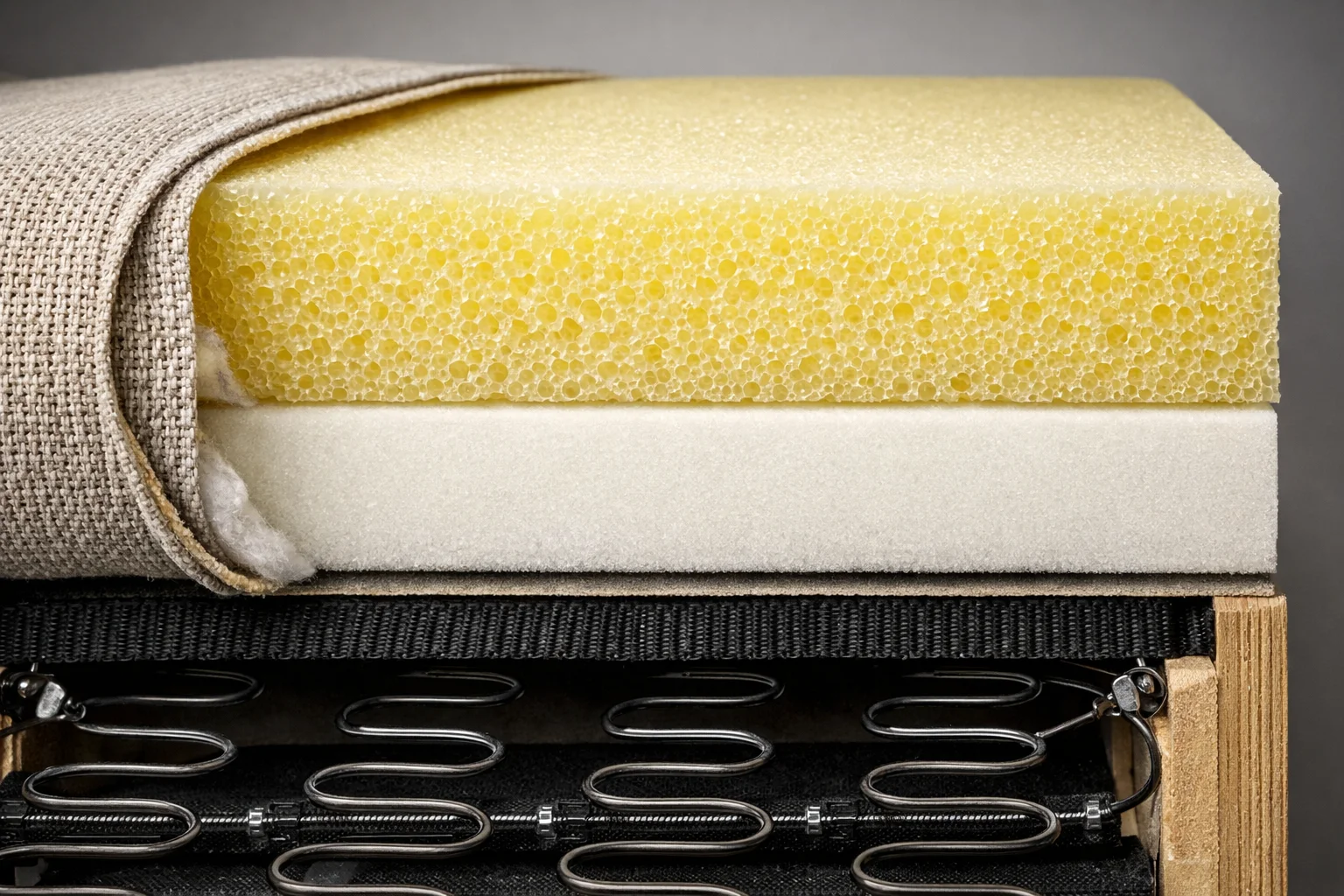
New Sofa Pain: Break-In Period or Bad Ergonomics?
Understanding whether new furniture stiffness will resolve with use or indicates fundamental problems. How to decide whether to wait or return.
Analyze Details →