New Sofa Pain: Break-In Period or Bad Ergonomics?
Introduction
I waited 30 days for my $3,000 sofa to “break in.” The salesperson promised it would soften up. It didn’t. On Day 31, I was stuck with a concrete bench. The “Break-In Period” is real, but it is also the most abused excuse in the furniture industry.
What I learned the hard way is that break in only works within the limits of the materials you are sitting on. If the seat is built from very firm foam, tight webbing, or a stiff spring setup, it might relax a little, but it is not going to transform from hard to plush just because time passed.
When someone tells you to wait a month, I want you to hear what they are not saying. They are telling you to accept the sofa as is today, because you are likely past the point where you can easily return it once you realize it is not changing.
So in this guide I am going to keep bringing you back to one simple idea. You should judge the sofa you are sitting on in the showroom as close to the real thing as possible, and you should only gamble on break in when you have a clear, written return option that protects you.
If you only remember one move from me, it is this: sit like you actually live. Put your feet on the floor, slide your hips back, and stay there long enough for the pressure points to show up. If you feel your tailbone, or your thighs go numb, or the front rail digs into the back of your legs, that is not something a magical break in will reliably fix.
I also want you to treat “it will soften” the same way you would treat “it will stop making that noise.” It might, but you should not pay thousands based on a promise you cannot enforce. You can absolutely ask for comfort guidance, but I only trust what I can feel and what I can get in writing.
The 15% Rule
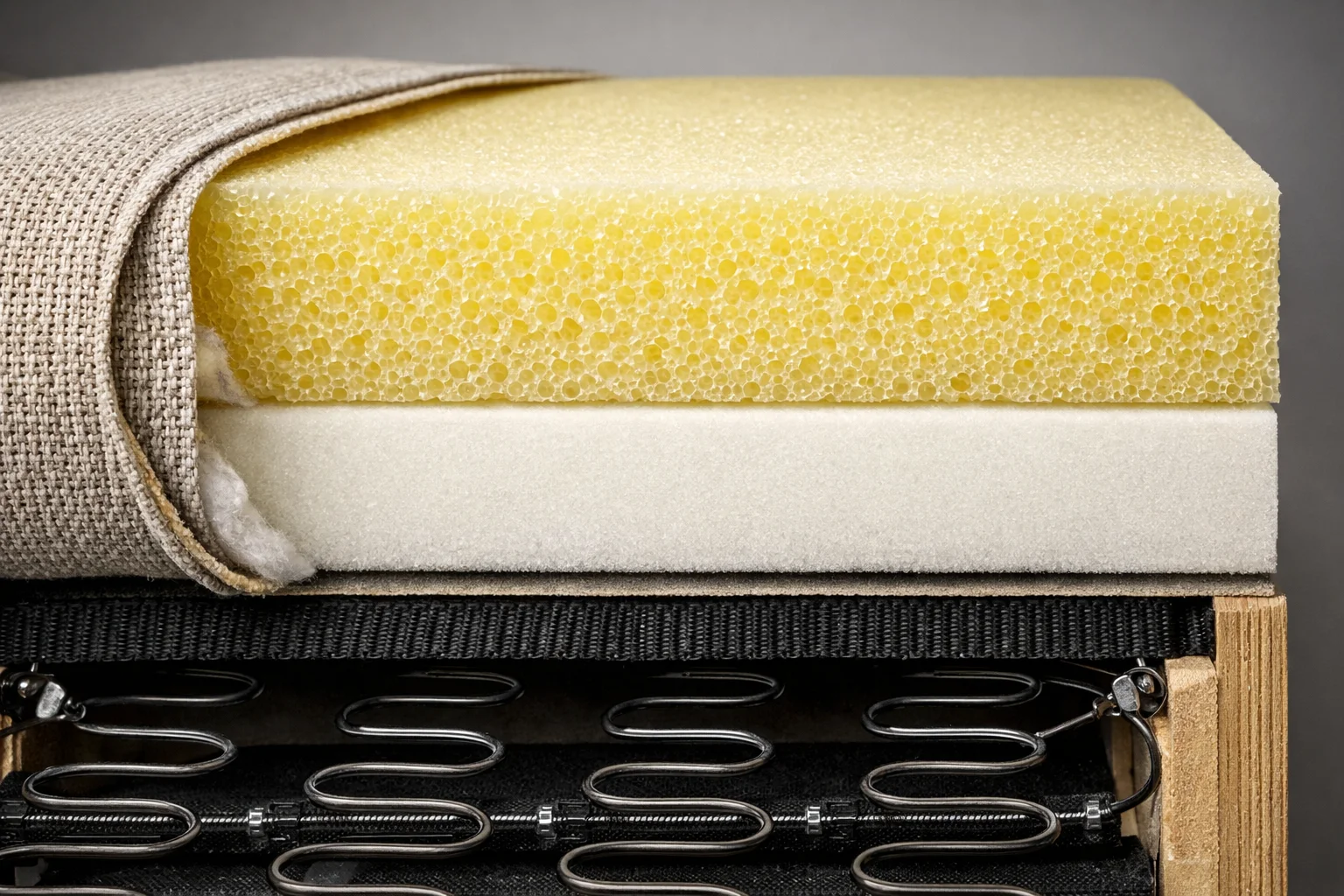
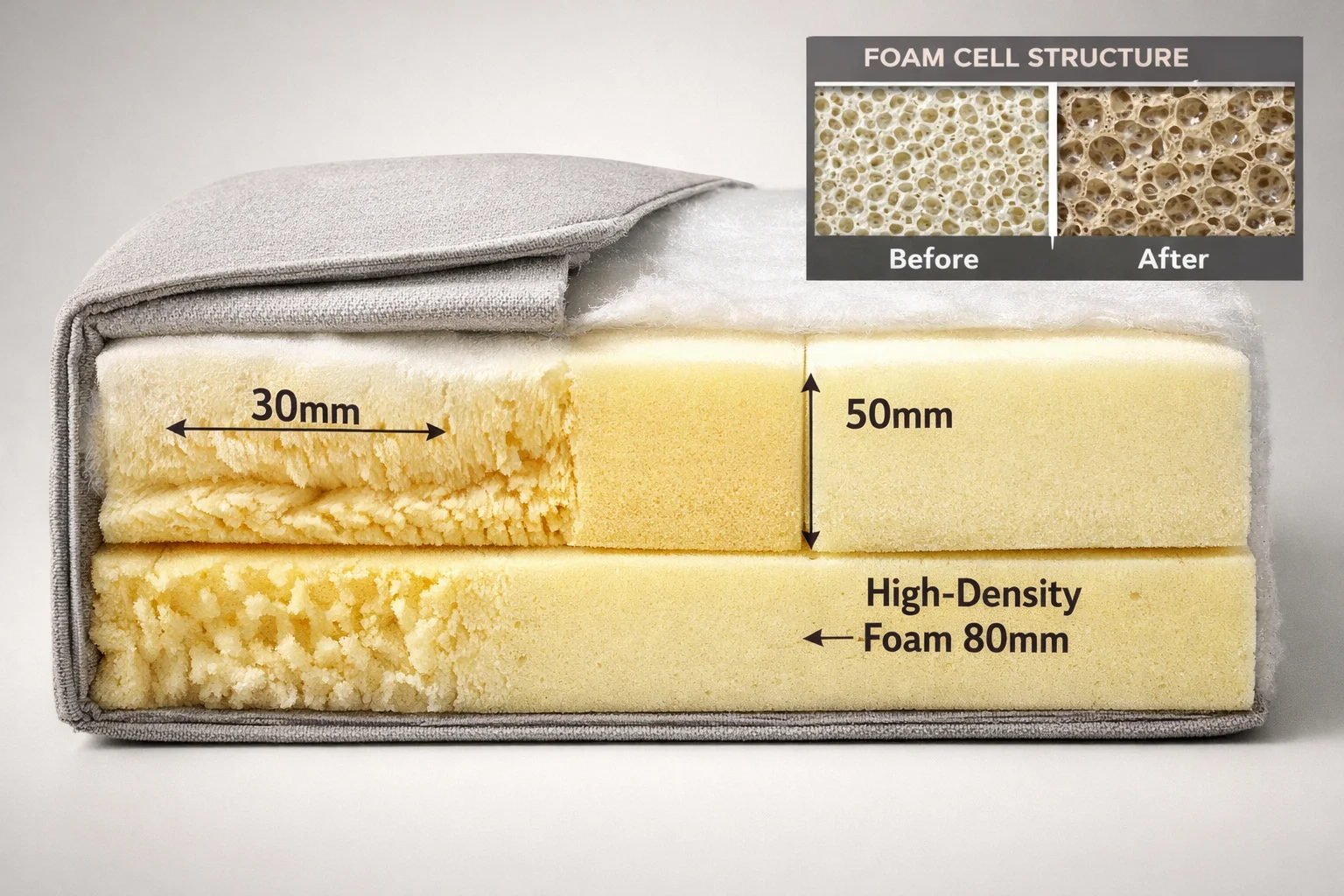
When a salesperson tells you a sofa will “soften a lot,” I translate that into a much smaller, more predictable change. Most polyurethane foam does relax early on as you use it, because the tiny cell structure inside it breaks in. In plain terms, the seat you try in the showroom is close to what you are buying, and the biggest comfort shift usually happens in the first couple of months.Here is the part I want you to use in a showroom. If the sofa feels like a 10 out of 10 on the hard scale today, expect it to feel more like an 8.5 out of 10 after a typical break in. That can be enough to take the edge off, but it is not a personality change.
This is why I do not buy a sofa that feels like a church pew and hope it will become plush. It will become a slightly softer church pew, and then it will basically stay that way. The “it will be a 5 later” promise is the one that burned me.
So when you sit down in the store, I want you to do a quick mental adjustment. If the seat already feels comfortable but just a touch firm, that is a good sign, because it will likely land in a nicer spot after it relaxes. If it feels uncomfortably hard, presses into your tailbone, or makes you shift around to escape pressure points, I assume that discomfort will still be there later, just muted.
If you are shopping with a partner, this is also the moment to be honest about your preferences. If you like a supportive seat, buying slightly firmer than you want can work, because that early softening is real. If you like a sink in feel, do not let anyone talk you into firm foam with the idea that time will do the work, because time does not change the underlying design, it only takes the edge off.
Before you leave the showroom, ask the one question that makes the 15% rule useful. You want to know what is actually providing the comfort, and whether it is foam, a fiber wrap, down blend, springs, or webbing under the foam. If the softness you like is mostly a fluffy top layer, that can compress quickly and make the sofa feel firmer than it did on Day 1, which is the opposite of the promise you usually hear.
And if the salesperson leans hard on “break in” to close the sale, I treat that as a cue to slow down and ask about the return window in writing. Break in is not a warranty, and it is not a guarantee. It is a small, predictable change, and you should only gamble on it when you can undo the purchase if your body says no after a couple of real evenings at home.

When to RETURN Immediately (Do Not Wait)
There are a few comfort problems that are not “break in” problems. They are your body telling you the sofa’s materials or geometry are wrong for you, and no amount of waiting will turn wrong into right.
If you notice any of these in the first week or two at home, I would start the return process immediately, even if you feel awkward about it. You are not being picky, you are protecting yourself from being stuck with something you avoid sitting on.
Numbness or “Hot Spots”
If your legs fall asleep, the backs of your thighs tingle, or your tailbone feels like it is burning after about twenty minutes, I treat that as a dealbreaker. This is not the normal “new foam is a little firm” feeling, it is a pressure point problem.
In practice, it usually means the seat is too hard for your body, so it is concentrating your weight into a small area and squeezing blood flow or nerves. You can test this in a simple way at home by sitting with your feet flat on the floor, knees about 90 degrees, and not shifting around for twenty minutes. If you are counting minutes until you can get up, I would not wait for a miracle.
This is where the 15% rule matters. A slightly too firm seat can become comfortable. A seat that makes you numb does not become safe just because it relaxes a little. If I hit numbness or a sharp tailbone hot spot early, I return, because the underlying firmness is wrong for me.
Back Pain or Slumping
If you feel like you have to slouch, cross your legs, or scoot forward just to get comfortable, I assume the sofa’s shape does not fit your body. I am talking about that feeling where you cannot find a neutral, relaxed posture, and you end up perching or collapsing.
This is usually about geometry, not cushioning. The seat may be too deep so the front edge hits the back of your knees and forces you to round your back, or the back angle may be too upright so you cannot relax without sliding forward. You can add pillows, but notice what you are doing when you add them. If you are rebuilding the sofa into a different shape just to make it tolerable, that is your sign.
I do not “break in” a geometry mismatch, because the frame and angles are not going to change. If the sofa only works when you contort yourself, I return it while the return window is still open.
The “Salesman’s Trap”
I have learned to treat “give it 60 days to break in” as a potential trap, not advice. The reason is simple, a lot of return policies are 30 days, sometimes less, and the clock runs out while you are dutifully waiting.
If you are in pain on Day 10, or you are already avoiding the sofa, I would not gamble on Day 60. I would email or message the store right then so there is a written record that you reported a comfort issue inside the return period, and I would ask them to confirm, in writing, whether comfort returns are allowed and what the deadline is.
The move I use is boring but effective. I pick a date on the calendar that is comfortably before the return cutoff, and I make my decision by that date, not by whatever “break in” timeline someone says out loud. If the sofa is not trending clearly toward comfortable within your protected window, I would return immediately and keep shopping.
The "Zipper" Surgery (For Back Cushions)
If you sit down and immediately feel like the back cushions are shoving you off the sofa, I do not assume the whole sofa is wrong yet. A lot of backs are overstuffed on purpose so they look full on a showroom floor, and that can push your shoulders forward and make you perch.What I do, if the cushion has a zipper, is treat it like a reversible test instead of a months long break in gamble. I unzip the back cushion casing and look at what is actually inside. If I see loose fiber fill that looks like white fluff, not a solid foam slab, that is the kind of stuffing you can tune at home in minutes.
The move is simple. I pull out a small amount first, about what fits in two cupped hands, then I zip it back up and sit again the way I actually sit. If the “pushed forward” feeling is gone or noticeably better, you just learned something important, the sofa’s frame and angles might be fine, it was the overstuffed back fighting you.
I also want you to pay attention to whether the improvement feels like better support or just less pressure. If removing a little fiber lets your shoulders settle back and your head feels more naturally stacked over your spine, that is a real comfort win. If it suddenly feels like there is nothing behind you and you start slumping, you took out too much, and you can put some back.
In a showroom, you might not be allowed to do this, and that is fine. What you can do is ask, “Are the back cushions zippered, and is the fill loose fiber that can be adjusted?” If the answer is yes, I take a forward pushing back cushion less seriously because I know I can fine tune it fast at home without tools or a repair person.
I treat this like surgery with a paper trail. Before I remove anything at home, I take a quick photo of the cushion tag and the original shape so I can recreate it if I need to, and I store the extra stuffing in a clean bag in a closet. If you end up returning the sofa, you will be glad you can put it back exactly the way it arrived.
This trick only applies to cushions with loose fill, and it will not save you from a truly wrong frame angle or a seat that gives you numbness. But when the main problem is that the back feels like an overinflated life jacket, this is one of the rare comfort fixes that is immediate, reversible, and completely under your control.
Quick Comfort Fixes Worth Trying Before You Return
- Seat cushion topper — adds a layer of support over compressed or too-firm foam without replacing the whole cushion.
- Lumbar support cushion — corrects the slumping and back pain caused by poor back angle geometry.
Technical Summary: The Decision Matrix
When I am sitting on a sofa in a showroom, or during the first week at home, I run it through a simple filter so I do not get talked into waiting past the return window. I am not trying to be dramatic, I am trying to separate normal newness from problems that do not change.
If it feels stiff in that “new shoe” way, where it is firm but not hurting you, I am willing to wait. In my head I apply the 15% rule and assume the edge will come off, especially if I like the posture and I am not getting pressure points. This is the kind of firmness where you can tell the materials are resisting a bit, but your body is not protesting.
If it feels wrong in the geometry, I return it. By “wrong,” I mean the seat depth, back angle, or arm height makes you sit in a way you would not choose, like your feet do not plant, the front rail catches the backs of your legs, or you cannot rest your head and shoulders without sliding forward. Foam can relax, but the dimensions do not change, so I do not waste weeks trying to adapt my body to a shape that is not built for it.
If it feels painful, especially numbness, tingling, or a sharp tailbone hot spot, I return it even faster. That is usually a sign the foam is too hard for your weight, or the cushioning stack is concentrating pressure instead of spreading it out. I do not gamble that away, because even if it softens a little, it is still the same basic firmness profile, and you only get one spine.
Explore Technical Reference
The "Favorite Spot" Syndrome: Why One Seat Dies First
Understanding why concentrated use creates dramatic wear differences across sofa seats. The physics of differential wear and why cushion rotation matters.
Analyze Details →
The Smile Effect: Why You Roll to the Middle
Why long sofas bow in the center. The physics of span limits and the importance of the fifth leg.
Analyze Details →