Solid Wood Frames: When "Natural" Means Weak
The Marketing Lie Behind “Solid Wood Frames”
When I see “solid wood frame” on a tag, I treat it like a vague compliment, not a spec. In the U.S., there is no rule that says what wood it has to be, how dense it has to be, or how strong the frame has to test to before a brand can print that phrase.
What “solid wood” really tells you is just that some piece is not particleboard or plywood. That still includes cheap, light softwoods that dent easily and let screws work loose over time, which is why “solid” can still feel wobbly a year later even if it sounded reassuring in the showroom.
If you want that phrase to mean something, you have to force it to get specific. I ask, politely and directly, what species the frame rails are, and I listen for a real answer like maple, oak, ash, or beech, not “hardwood” as a blanket word. If they cannot or will not tell you species, I assume they are buying whatever is cheapest this quarter and they do not want you to notice.
Then I stop focusing on the wood label and start checking the parts that actually fail. I kneel down and look under the sofa with my phone flashlight, because the underside tells the truth faster than the showroom pitch.
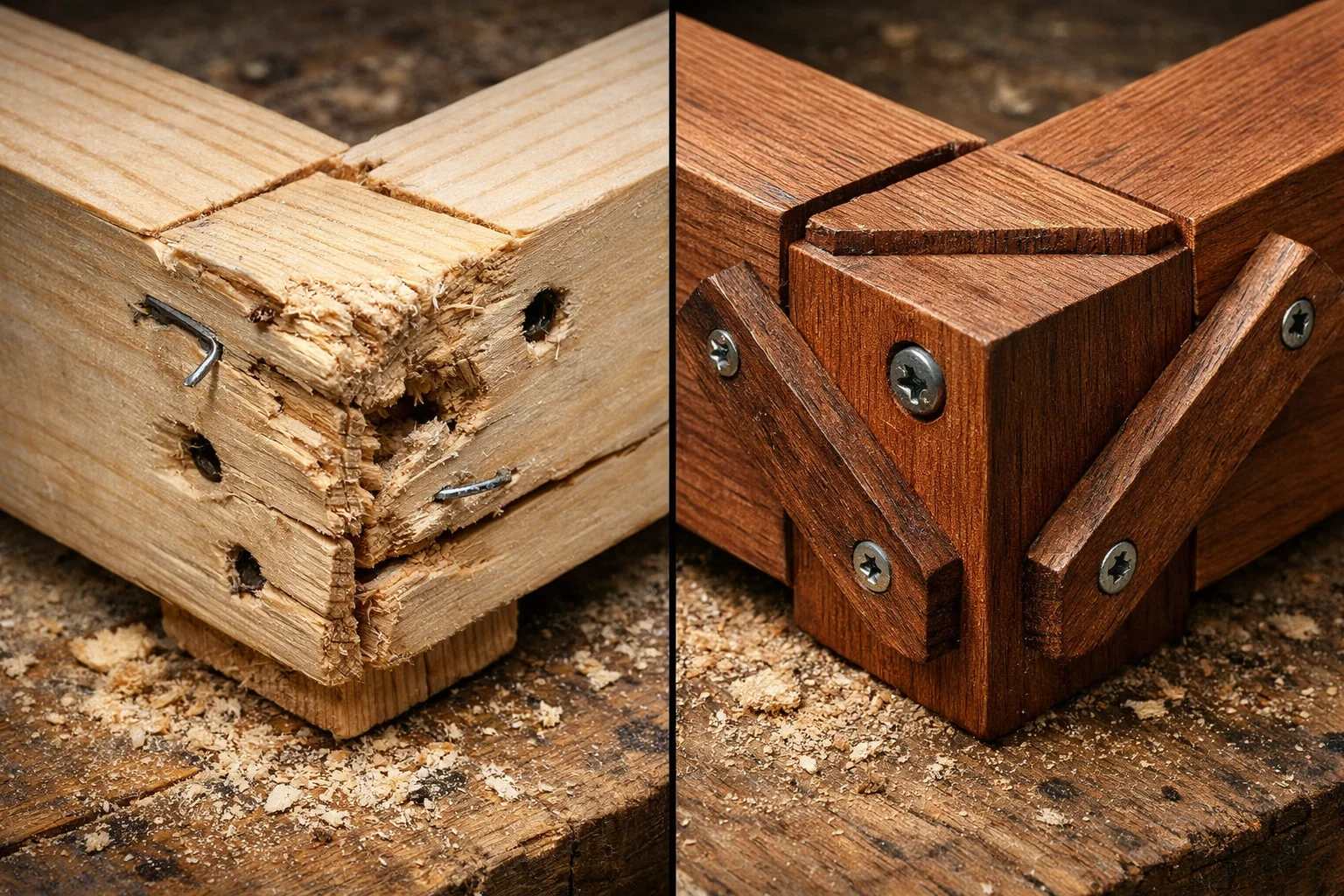
At the corners, I look for joints that have real structure to them, like blocks and braces that are screwed and glued, not just stapled. If all I see are thin rails meeting at a corner with a couple staples, “solid wood” is basically decoration, because the joint is what takes the repeated load of you sitting down thousands of times.
I also push and twist the frame on purpose. I grab the arm and the opposite back corner and give it a firm, controlled racking motion. A good frame feels like one piece and resists that twist, a weak frame creaks, shifts, or feels like the corners are taking turns moving.
When a salesperson leans hard on “solid wood,” I ask one more question that usually ends the script. I ask whether the model has been tested to any recognized durability standard and whether they can show me the test information, because material words alone do not mean performance. If they hand wave, I mentally downgrade the claim to marketing.
I do not automatically distrust engineered wood, either. A well made laminated component can be more stable than a single softwood rail, because stability and joint design are what keep a sofa square. What I distrust is vague language paired with a high price and no details.
The simplest way I keep myself from getting ripped off is this. I treat “solid wood frame” as a starting point for questions, not an answer, and I buy based on what I can see and feel at the joints, the corner reinforcement, and the frame’s resistance to twisting.
Hardwood vs Softwood: Density Is Destiny
When you hear “hardwood frame” versus “softwood frame,” it sounds like a class snob thing. What I have learned is that it is usually a density thing, and density is where real-world frame durability starts.
People love to throw around Janka hardness numbers like they settle the argument. I treat Janka as a first filter at best, because it mostly tracks dent resistance, not whether a rail will slowly sag, or whether staples and screws will keep their grip after years of people dropping onto the same front edge.
What actually shows up in your living room is creep, which is just wood slowly changing shape under a constant load. When a frame wood is low density, the rails can gradually dish, joints stop pulling tight, and the fasteners that used to feel locked in start to “walk” as the crushed fibers never really rebound.
This is why I do not relax when a tag says “solid wood” but won’t name the species. If they will not say maple, oak, ash, or beech, I assume it might be a low-density substitute that is technically solid wood but still bad at staying clamped up at joints.
The easiest way you can use this in a showroom is to make the salesperson commit to specifics. I ask, “What species are the main rails and the corner blocks, and are they the same wood as the arms?” If the answer turns into “mixed hardwoods” or “select woods,” I treat it as “we do not want to tell you.”
Here is the part most people miss: even within a piece of wood, the structure matters where the sofa actually fails. Dense hardwoods tend to spread pressure under staples, dowels, and corner blocks more evenly, so the fibers crush less at the exact points that are holding your frame together.
Softwoods are often built with a strong-weak pattern across each growth ring, and the weak part gives first. In sofa terms, that means the first failure is not usually a dramatic crack you can point to, it is the joint line starting to microslip because the wood around a fastener has compressed and turned into fine dust.
Once that starts, the sofa can still look fine, but you feel it as a tiny clunk when you sit down, or a little squirm when you shift your weight. If you have ever owned a couch that got “mysteriously loose” after a couple years, this is one of the unglamorous ways it happens.
So when I am standing in front of a sofa, I stop thinking about “hardwood versus softwood” as a label and start thinking about what the fasteners are biting into. I flip up the dust cover if I can, or I look through any openings and hunt for the staple lines, screw heads, and corner blocks, because those spots tell you whether the frame is relying on strong bearing wood or on hope.
If you want a simple, physical check you can do without tools, put one hand on the front rail under the cushions and the other on the arm, then lean your weight in and out like you are trying to make the rectangle rack slightly. On a frame made from denser wood with decent joints, that motion feels stubborn and quiet, and on a light softwood frame you often get a little creak, a little give, or the feeling that the corner is taking the stress instead of the whole frame sharing it.
I also pay attention to how the underside is fastened. If I see long staple runs into thin, pale, soft-looking rails with no real blocking behind them, I assume those staples will loosen sooner than I want, because fastener holding power is heavily tied to density, not to the word “solid.” If you want a readable technical reference for why density drives fastener performance, the American Wood Council has a practical summary here: American Wood Council, fasteners and wood density.
None of this means you should refuse any sofa that contains softwood. What it means is that if the frame relies on softwood in the high-stress rails, then I want to see the design compensate with better joinery and real reinforcement, because you are basically asking the joint system to do more work.
If the store cannot tell you the wood species, cannot show you meaningful corner reinforcement, and the frame feels at all twisty when you rack it gently, I walk away even if the fabric and cushions feel great today. I have bought that story before, and it is always the frame that makes you regret it later.
Southern Yellow Pine vs Radiata Pine: Not All Softwoods Are Equal
When a tag says “solid pine,” I do not let it end the conversation, because pine is not one thing. Two sofas can both honestly claim “pine frame” and still behave completely differently after a couple years of real sitting.
If you take nothing else from this section, take this: strength is species-specific, and pine varies a lot. Southern Yellow Pine tends to be one of the tougher, denser softwoods you will run into in U.S. furniture, and Radiata pine is often much lighter and easier to crush at joints, which is exactly where sofas usually start to get loose.
Most frame failures I have seen are not a dramatic rail snapping in half like a movie prop. They start with fasteners slowly losing their grip because the wood fibers right under a staple or screw get crushed, and once that crushed zone forms, the joint stops staying clamped tight.
That is why I care less about whether a wood can theoretically “handle bending” in a lab and more about whether it holds up under concentrated pressure at corners, along front rails, and anywhere the upholstery shop shot staples into end grain. Radiata is the kind of wood that can feel fine at first, then gradually turns those fastener pockets into soft dust, and the sofa starts talking back with squeaks and little shifts.
Southern Yellow Pine is not magic, but it usually holds fasteners better simply because there is more dense wood there to resist that crushing. If a brand insists on using softwood in major rails, SYP is one of the few answers that makes me less nervous, especially when the corners are also blocked and properly glued, not just stapled.
The part that trips people up is that “plantation grown” can quietly mean “fast grown,” and fast growth often shows up as wide, obvious growth rings and a lot of very soft earlywood. In plain terms, that is wood that dents with a fingernail and compresses easily under a staple line, and that is a recipe for a frame that loosens up before the fabric looks worn.
In a showroom, I cannot run tests, so I look for clues. When I can see an unfinished rail on the underside, I angle my phone flashlight along it and look at the grain, because really wide ring spacing usually goes along with a softer feel and easier crushing at joints.
I also bring a small magnet, because it tells me when the maker knows the wood is weak and is quietly band-aiding it with steel. If I feel a hidden corner plate or strap under the upholstery, I do not automatically reject the sofa, but I do treat it as a sign that the frame might be relying on hardware to survive racking that better wood and better joinery would have handled more gracefully.
Then I check whether the reinforcement looks like real structure or like panic. A well-reinforced corner usually has a solid block that is glued and screwed into both rails, and it looks intentional and symmetrical on both sides, not like a thin metal bit slapped on wherever there was room.
If the salesperson tells you “it’s solid pine,” I would ask one calm follow-up that forces clarity: “Is it Southern Yellow Pine, Radiata pine, or something else?” If they cannot answer, I assume it is the cheaper, lighter option, because sellers who have the better material usually say so.
If they do answer Radiata, I shift my standards immediately. At that point I want to see more than staples, I want to see corner blocks that are actually doing work, I want to see screws going into something substantial, and I want the frame to feel stubborn when you do that gentle rack test from the earlier section.
If they answer Southern Yellow Pine, I still do not relax, because softwood is still softwood. I just treat it as a better starting point, and I keep hunting for the real make-or-break details, which are whether the joints stay tight after years of load, humidity swings, and people dropping onto the same front edge of the seat.
If you want a technical source that backs up the idea that pine is not one uniform “strength,” the USDA’s Wood Handbook tables lay out how different species compare on bending and compression properties, and it is why I do not treat “pine” as a meaningful spec by itself: USDA Forest Products Laboratory, Wood Handbook publications.
Poplar: The Sleeper Hardwood Manufacturers Don’t Advertise
Poplar is one of those woods I almost never see advertised, and that is exactly why I pay attention when I hear it. It does not fit the luxury script, because people associate “hard” with “good,” and poplar is not especially dent resistant, so it sounds cheap if you only think in terms of hardness.
What I care about in a sofa frame is not whether the wood resists a key scratch, it is whether it stays tight at the joints after years of sitting, humidity swings, and little impacts on the front rail. Poplar can be surprisingly good at the unglamorous job of holding a frame together because it is usually straight grained and uniform, which helps at dowel holes, screws, and glued joints where so many sofas eventually start to loosen.
In plain showroom terms, poplar is a “quietly competent” frame wood when it is used in the right places. If a salesperson tells you the rails or corner blocks are poplar, I do not hear “cheap,” I hear “they might have chosen something that machines cleanly and stays predictable at joints.”
The trick is that you cannot verify “poplar” by looking at a covered frame, so you have to use it as a prompt for better questions. If they claim poplar, I ask whether the main seat rails and the arm posts are also poplar, or if it is just “some internal parts,” because that phrasing is often how lower-grade brands sprinkle in a decent wood while leaving the high stress rails as whatever softwood was cheapest.
Then I look underneath for the joinery signals that poplar actually gets to benefit from. If the corners have real blocks that are glued and screwed into both rails, poplar can be a very rational choice because it tends to behave consistently where fasteners bite and where glue lines need the wood to stay stable instead of splitting.
If the construction is still just thin rails with long staple runs and minimal blocking, poplar does not magically save it. Even good wood cannot fix a corner that was never designed to share load properly, it just fails a little later and a little more politely.
I also treat poplar as a clue about what the brand is optimizing for. Poplar is common in factories because it is a cost sweet spot and it runs well in automated production, which means it can show up in both good and bad sofas, depending on whether the factory pairs it with real joint structure or uses it as a quiet downgrade behind nice fabric.
Here is the biggest practical reason I like poplar when it is done right, and it is the kind of thing you only notice years later. Some lighter softwoods slowly sag and relax under constant load, especially in warm homes or humid climates, and that shows up as a front rail that feels a little “dished,” arms that start to rack, and joints that stop feeling clamped. Poplar often holds its shape better than you would guess from its reputation, so cushions stay supported and the frame stays square longer, which is exactly what you want if you keep sofas beyond the warranty window.
If you are trying to decide in a showroom, I would not overthink the wood science, I would use poplar as a green flag only if the rest of the evidence agrees. If the model is solid under that racking test, the corners look intentionally reinforced, and the store can clearly tell you where poplar is used in the frame, I consider it a sensible buy even if the brand does not brag about it.
If they will only say “hardwood,” or they say “poplar” but cannot say where, and the underside shows staple-only corners or skinny rails doing all the work, I treat the poplar mention as a distraction. In that case, I assume I am being sold a comforting word instead of a frame that will still feel tight when you have owned it long enough to stop being careful with it.
Moisture Content: The Invisible Failure Clock
Moisture content is one of those unsexy specs that decides whether a sofa frame stays tight for years or starts talking back with creaks and clicks. I have learned the hard way that you can buy a frame that looks straight today, but if it was assembled while the wood was still too wet, the shrinkage happens later in your living room and the joints pay the price.
When wood dries, it does not just get lighter, it changes shape. The important part for you is that once the moisture level drops past a certain point, the wood starts shrinking across the grain, and that is what quietly pulls a rectangular frame out of square.
For indoor furniture, I treat kiln dried to about 6 to 8 percent moisture content as non negotiable. If a frame was built at 12 to 16 percent and then moves into a heated or air conditioned home, it is basically on a timer, because the wood will keep shrinking after the joints are already glued and stapled.
This is where the failure feels “mysterious” to most people. The sofa does not explode, it just starts developing tiny gaps at joints, corner blocks stop feeling clamped tight, and what used to be a solid seat starts making little noises when you shift your weight.
The reason is simple in practical terms. As the rails shrink, the joint that was supposed to stay in compression stops bearing evenly, and now every sit is more like a tiny prying motion, over and over, until the joint loosens.
I also watch for twisting and cupping, not just shrinkage. Wood shrinks more in one direction than the other, so a rail can dry and subtly warp, and once one rail is no longer straight, the corner joints are forced to compensate, which is when you get racking, squeaks, and that slight feeling that the sofa is never completely settled.
The worst part is how profitable this can be for a cheap build. Wet wood machines quickly, takes staples easily, and looks straight on the assembly line, then it finishes drying at your house for free, after the sale is long done.
If the wood was dried unevenly, it can be even nastier. The outside can dry first and “lock in” stress while the core stays wetter, and then months later the internal stress releases as a delayed split near a staple line, a crack at a screw, or a sudden joint gap that you swear was not there when it was delivered.
Moisture also messes with glue in ways you cannot see in a showroom. When the wood is too wet, glue lines can end up inconsistent, either too thin because the glue soaks in strangely, or too brittle because the chemistry did not cure the way it should, and then the joint becomes a hinge point that gets flexed every time you sit down.
Even if the frame was dried correctly, wood still moves with seasons because it chases humidity. What I care about is whether the construction looks like it can tolerate that movement without turning every glue line into a fatigue test.
Here is what you can actually do in a store if you want to stop guessing. I bring a small two pin moisture meter in my bag, and I ask if I can take a reading on an unfinished, hidden surface under the sofa, like the inside face of a rail or a corner block, not a lacquered show surface that can throw the reading off.
If you do this, I treat anything over 10 percent as a serious warning sign, not a harmless detail. I am not buying a science project, and I am not paying for the privilege of letting their frame finish drying in my house.
If the salesperson looks surprised by the question, I stay polite and matter of fact. I just say I have owned frames that loosened after the first winter heating season, and I am trying to avoid that again.
If they refuse to let you measure, I take that as information too. A confident manufacturer and retailer usually does not mind you verifying a basic quality control detail on a hidden surface.
If you want a neutral technical reference that explains why wood starts shrinking in a damaging way as it dries and why that matters for furniture geometry, the USDA Forest Products Laboratory’s Wood Handbook is the best single source I have found, and it is free to access here: USDA Forest Products Laboratory, Wood Handbook.
The way I tie this back to the rest of my showroom checks is simple. If the frame already feels slightly creaky or willing to rack when you do that controlled twist test, and then you also see signs of rushed construction like lots of staples into end grain and minimal blocking, I assume moisture and movement are going to make that weakness show up faster.
If the frame feels stubbornly square, the corners are properly blocked and screwed, and the store can tell you the wood is kiln dried and does not dodge the topic, I relax a little. Moisture content is invisible, but the brands that take it seriously usually show that seriousness in the rest of the build too.
The Squeak Test
If you are standing in a showroom and hear a "click" or a "tick" when you sit down, that isn't the fabric settling. It is usually the sound of a metal fastener (like a staple) rubbing against wood because the joint is already loose. In a solid wood frame with properly glued and screwed joints, that sound should be non-existent.Wood Movement Physics: Why Frames Rack and Twist
If you have ever sat on a sofa that slowly turned into a squeaky parallelogram, this is usually the real reason. Wood is always trading moisture with the air, and once it is in your home it keeps swelling and shrinking with seasons, heating, AC, and even how damp your basement gets.
What matters is that wood does not change size evenly. It moves more across the growth rings than it does from the center of the tree outward, so a rail that looks straight today can quietly cup or push sideways later, and that side pressure ends up concentrated at the joints.
In a sofa frame, that uneven movement tries to turn a rectangle into something slightly skewed. The corners feel it first, because each rail is trying to move its own way, and the joint is the compromise point where all that stress goes.
This is why I do not just look for “wood,” I look for how the wood was used. In the showroom, I get my phone light under the piece and look at any exposed rail faces, because sometimes you can actually see the growth rings on an unfinished edge, and you can spot when rails were cut with wildly different ring patterns right next to each other.
When one rail wants to cup up and the rail it is attached to wants to cup down, the corner is forced to twist instead of just breathing. If the construction locks those parts together rigidly, the wood still moves anyway, it just converts the movement into stress that works the joint loose a little bit at a time.
I also watch for a common “looks fine in the store” trap, which is cross grain construction in the wrong places. When boards are oriented so they fight each other’s natural movement, the frame can stay square for a while, then one heating season later the stored stress shows up as a tiny gap at a corner block, a new creak, or a frame that suddenly racks more easily than it did on day one.
Softwoods tend to make this worse in real life, even when they are technically strong enough on paper. In my experience they crush more easily under the concentrated pressure of fasteners, and once those fibers compress they do not fully spring back, so the joint that used to be clamped tight becomes a little hinge.
Upholstered furniture has another built in disadvantage that most people never notice. All the stapled webbing, decking fabric, and tack strips are basically a clamp across parts that would otherwise move a little more freely, so seasonal swelling and shrinkage gets forced into the corners and joints instead of being spread out.
Staples also do damage in a way you can actually use as a buying signal. When I see long, dense staple lines shot into thin rails, especially near corners, I assume the maker has created a row of weak points right where sitting loads reverse direction over and over, and that is exactly where I do not want the frame to fatigue.
Here is how I turn this physics into a simple showroom reality check. I rack the frame the same way I described earlier, then I pause and listen. If I hear crisp little ticks or creaks that sound like two pieces rubbing or releasing, I assume the joints are already moving against each other, and wood movement at home will amplify that.
Then I look for whether the builder expected wood to move. If the corners have substantial blocks that are glued and screwed, and the rails look wide enough to resist twisting, the whole frame can tolerate seasonal change without letting that change concentrate into one failing corner.
When the marketing line is “solid wood,” but the underside shows lots of stapled upholstery materials pulling members tight with no meaningful corner structure, I treat it as a warning. Wood is going to do what wood does, and the only question is whether the frame was built to accommodate that, or built as if wood were plastic and you were the durability test lab.
Joint Engineering: Where Frames Actually Fail
Most frame failures I have seen start at the joints, not because the wood itself “snaps.” Even cheap solid wood usually survives normal sitting loads, but the connection points get worked back and forth for years until they loosen.
In a showroom, I try to stop thinking of the frame as “wood” and start thinking of it as “corners.” Every time you sit down off-center, flop into one side, or drag the sofa to vacuum, you are trying to twist the frame into a parallelogram, and the joints are where that twisting concentrates.
The cheapest joint you will run into is a butt joint, which is just two square cut pieces meeting like a simple T or L with fasteners holding the marriage together. When I see a corner where two rails just meet and the only obvious “engineering” is a couple staples or a screw, I assume the joint has no built-in strength and is living on borrowed time.
The reason butt joints are so risky is that one of the pieces often presents end grain to the fastener. End grain is basically a bundle of tiny tubes, and it does not hold staples and screws the way side grain does, so that fastener can feel tight today and still slowly lose grip as the fibers compress and relax. If you want to understand that difference from a neutral source, the USDA Forest Products Laboratory has extensive material on wood and fastener behavior, but you do not need the tables to use the idea in a store, you just need to notice when hardware is driven into the end of a rail instead of into the side of one.
When a brand uses better joinery, the joint shape carries load before the fasteners have to. I like seeing signs of joints that force long grain to meet long grain, because that gives glue and wood a chance to work in their best direction instead of asking a few staples to do everything.
In real life, racking is the killer. A sofa does not fail because you gently compress it straight down, it fails because you load it unevenly and keep doing that for years, and the corners get “pumped” back and forth. Once a joint starts microslipping, it is like a tiny hinge that gets looser with every cycle.
This is where I get very skeptical of staple-only construction. Staples are great for upholstery fabric and dust covers, but when I see a structural corner that is basically held by staple lines, I assume those staple legs are going to wallow out the wood fibers over time. The joint does not need to fully fall apart to ruin the sofa, it just needs to get a little floaty, and then you feel it as a clunk, a shimmy, or a new squeak you cannot un-hear.
I also do not let “we use glue too” lull me to sleep. Glue helps when the joint geometry gives it real surface area and good grain contact, but glue is not a magic spell that turns a weak joint into a strong one. If the joint is poorly shaped and the fasteners are doing the locating and clamping, the glue is often along for the ride, and over years of load and humidity swings, that bond can creep and the joint can start moving anyway.
What I actually do in the showroom is a joint audit that takes about a minute. I put one hand on the arm and the other on the opposite back corner, then I give the frame a firm, controlled diagonal rock like I am trying to gently twist it out of square. I am not trying to be destructive, I am trying to see if the corners act like one rigid box or four separate corners negotiating with each other.
Then I listen, because the sounds tell you what your eyes cannot. Crisp ticking, popping, or a dull grinding sound usually means wood surfaces or fasteners are shifting at a joint, and once I hear that, I assume the sofa is already starting its loosening process even if it looks perfect.
After that, I get my light under the sofa and look specifically at how the corners are reinforced. I want to see corner blocks that look substantial, not little decorative triangles, and I want them to be both glued and mechanically fastened into both rails in a way that looks intentional. If I only see thin rails meeting with a few staples and no real blocking, I do not care what the fabric costs, because the corner is where the truth lives.
One detail I pay attention to is whether the frame flexes at the joints or across the rails. A good frame might have a tiny bit of overall give because upholstery is not a concrete bench, but it should not feel like the corner itself is hinging. If your twisting motion makes one corner “take a turn” moving, that is a joint problem, not a comfort feature.
If you want to make a salesperson useful here, I ask a question that forces them to talk about construction instead of materials. I ask how the corners are joined, and whether they use dowels, mortise and tenon, or any other joinery that is more than a butt joint with staples. If they cannot explain it, or they default back to “solid wood frame” as the answer, I assume the joints are not something they are proud of.
If you are the kind of person who likes a technical reference for why end grain holding power is weak and why joints are the critical failure point, the USDA Forest Products Laboratory is the best neutral rabbit hole I know. I use it for understanding, but in the store I just translate it into one rule that has saved me money, which is that I do not buy a sofa that already shows corner movement, because joints do not tighten up with age, they only get looser.
Dowel Geometry: Diameter, Depth, and Grain Alignment
When a salesperson says “dowel construction” like it is automatically premium, I slow down. I have owned enough seating that loosened up to know that a dowel joint can be either solid or basically decorative, and the difference is usually geometry and execution, not the mere fact that a dowel exists.
The first quiet failure mode is tiny dowels. In plain terms, if the dowel is skinny, it has less wood to share the load, and the surrounding frame wood gets crushed and wallowed out faster when the sofa racks.
This is especially true when the frame rails are softwood, which many are even when the tag says “hardwood parts.” Softwood can compress around a dowel like a constant bruise, and once the hole gets even slightly oval, the joint stops feeling clamped and starts feeling like a hinge.
The annoying part is that undersized dowels are often a factory choice, not an accident. Small dowels are more forgiving when the drilling is sloppy, so pieces go together quickly on an assembly line even if the holes are not perfectly straight or perfectly matched.
That is where glue becomes the cover story. I hear “it’s glued and doweled” a lot, but glue only helps when the fit is tight enough that wood is actually touching wood over most of the surface.
If the dowel fit is loose, the factory can still smear in a lot of glue and make it look convincing, but you are no longer buying a clean wood-to-wood joint. You are buying a gap that got filled, and fillers do not behave like solid bearing contact once the joint gets cycled thousands of times.
Here is how I try to make this actionable in a showroom, even though I cannot pull a joint apart. I use dowels as a reason to get more specific and I ask, “What diameter dowels do you use in the frame corners and seat rails, and how deep are they set?” If they cannot answer anything beyond “industry standard,” I assume the dowels are chosen for assembly speed, not long-term tightness.
If you can see any exposed joinery on a floor model, I look for clues of slop. I angle my phone light at the joint line and look for uneven gaps, glue squeeze-out that looks like it was used as caulk, or any splitting around the dowel area, because those are all hints the dowel was not a tight, clean fit.
Depth matters as much as diameter, and shallow dowels are one of the easiest ways to get a sofa that feels fine at first and then loosens. When a dowel barely bites into the wood, the joint is more likely to start pulling and peeling at the mouth of the hole as the frame racks, and once that mouth gets damaged the joint starts working like a tiny pry bar with every sit.
In the store, I cannot measure embedment depth directly, so I treat it as a construction transparency test. If the brand has a real engineering spec, they often have a cutaway sample, a build sheet, or at least a trained person who can tell you how they proportion their joints instead of repeating “glued and doweled” like a spell.
Grain alignment is the last part people never hear about, but I have felt the result in old creaky frames. A dowel is usually hardwood with its grain running along its length, and the rail it goes into might be softwood with uneven growth bands, so the joint is trying to bond two materials that move and crush differently.
When humidity swings, that mismatch can pump the glue line, especially if the drilled hole is not perfectly round and straight. That is why I care more about accurate drilling and tight slip fit than about a braggy dowel count.
If you ever hear “we use multiple dowels at every joint,” I treat it as a yellow flag until I can confirm they are not just multiplying weak joints. Three small dowels in wobbly holes can still loosen faster than one correctly sized dowel in a clean, coaxial hole, because the load only transfers well when the dowel is actually bearing evenly instead of rattling inside a glue pocket.
If you want a simple, no-tools check that often correlates with bad dowel execution, do the same controlled racking test you already did for the corners, then immediately put your hand under the arm where it meets the side rail and feel for a delayed little click or shift. That delayed movement often means the joint is taking up slack, and dowel joints that were drilled loose are a common reason.
When I am on the fence between two similar sofas, I choose the one that is willing to be specific about dowel size and joint design, and that stays silent and stubborn under that diagonal twist. I have learned that if a doweled frame is going to get loose, it usually tells you early with tiny sounds and tiny movements, and I do not talk myself out of what my hands can already feel.
Corner Block Triangulation: Cheap Insurance Done Wrong
When I hear “corner blocked” as a selling point, I do not assume it means strength. I have learned to look at the shape and placement, because a real corner block is basically a triangle that turns a wobbly rectangle into something that resists that side shove that slowly racks a frame out of square.
In plain terms, the block is supposed to create a structural triangle, not just fill space. If the block is actually doing its job, it spreads the racking load across a wide glued area and pushes the stress into compression along the wood, which wood handles better than it handles being pried apart.
What I see a lot, especially on mid-priced sofas trying to look “well built,” is a tiny cube or a cute little chunk of wood glued into the inside of a corner like a garnish. That kind of block photographs well, but it does not change the geometry in a meaningful way, and it often ends up glued to end grain, which is the worst place to rely on glue for long-term strength.
If you remember one thing for the showroom, let it be this. I want the corner reinforcement to look like it is trying to brace the corner diagonally, not just sit there, and I want it to have real contact along the length of both rails.
I get on my knees, use my phone flashlight, and look at the corner from more than one angle. A useful block usually looks like a triangular gusset that spans the inside of the L and reaches far enough along each rail that you could imagine it resisting a shove, not just reducing squeaks for a few weeks.
Then I look at how it is attached, because “block present” is not the same as “block working.” I want to see glue evidence that makes sense and fasteners that look like they are pulling the block tight into both rails, not a couple staples shot wherever the gun happened to land.
I am not impressed by a bunch of screws if the block is tiny or if it looks like the screws are doing all the work. When the geometry and glue surface are right, the screws are mostly there to clamp the parts while the glue cures, and a well-glued, long-grain-to-long-grain block can do more for racking resistance than a frantic pattern of hardware.
I also watch for a specific red flag: a block that is screwed into the end of one rail, or a block that sits against ragged, dusty wood. End grain does not bond the same way and dusty machining residue can quietly sabotage the glue line, so that joint might feel okay now, then start microslipping later, and once a corner starts microslipping it does not get better with age.
If the block wood looks very soft, like cheap pine scraps, I get wary even if the block is big. Soft blocks can crush at the contact points, and that tiny crushing lets the joint move just enough to pump the glue line over and over under normal sitting, which is how a sofa slowly turns creaky without ever suffering one dramatic break.
Here is the simple physical test I pair with the visual check. After I spot the blocks, I do my controlled racking twist again, arm to opposite back corner, and then I immediately put my fingers on the corner area underneath and feel for any delayed shift, like the corner is taking up slack after the frame moves. If I feel that little take-up, the block is either too small, poorly bonded, or attached in a way that is letting the joint behave like a hinge.
If you are talking to a salesperson, I would ask one question that forces the conversation away from buzzwords. I ask whether the corner blocks are triangular gussets that are glued along long grain on both rails, or whether they are just small filler blocks, because those are two completely different things even if the tag uses the same phrase.
When I see a truly substantial triangular block, with broad contact on both rails, consistent glue coverage, and sensible fastening, I relax a bit because it is cheap insurance done right. When I see little cubes, end-grain glue joints, or a lot of screws trying to compensate for a tiny block, I treat “corner blocked” as marketing, and I keep shopping.
Fastener Retention: The Softwood Achilles Heel
This is the part of “solid wood frames” that quietly disappoints me the most over time, because the frame can look fine and still slowly stop feeling tight. When you sit down, shift, and stand up, you are not just loading the sofa once, you are cycling the joints, and that is exactly when weak fastener holding power turns into squeaks, clicks, and wobble.
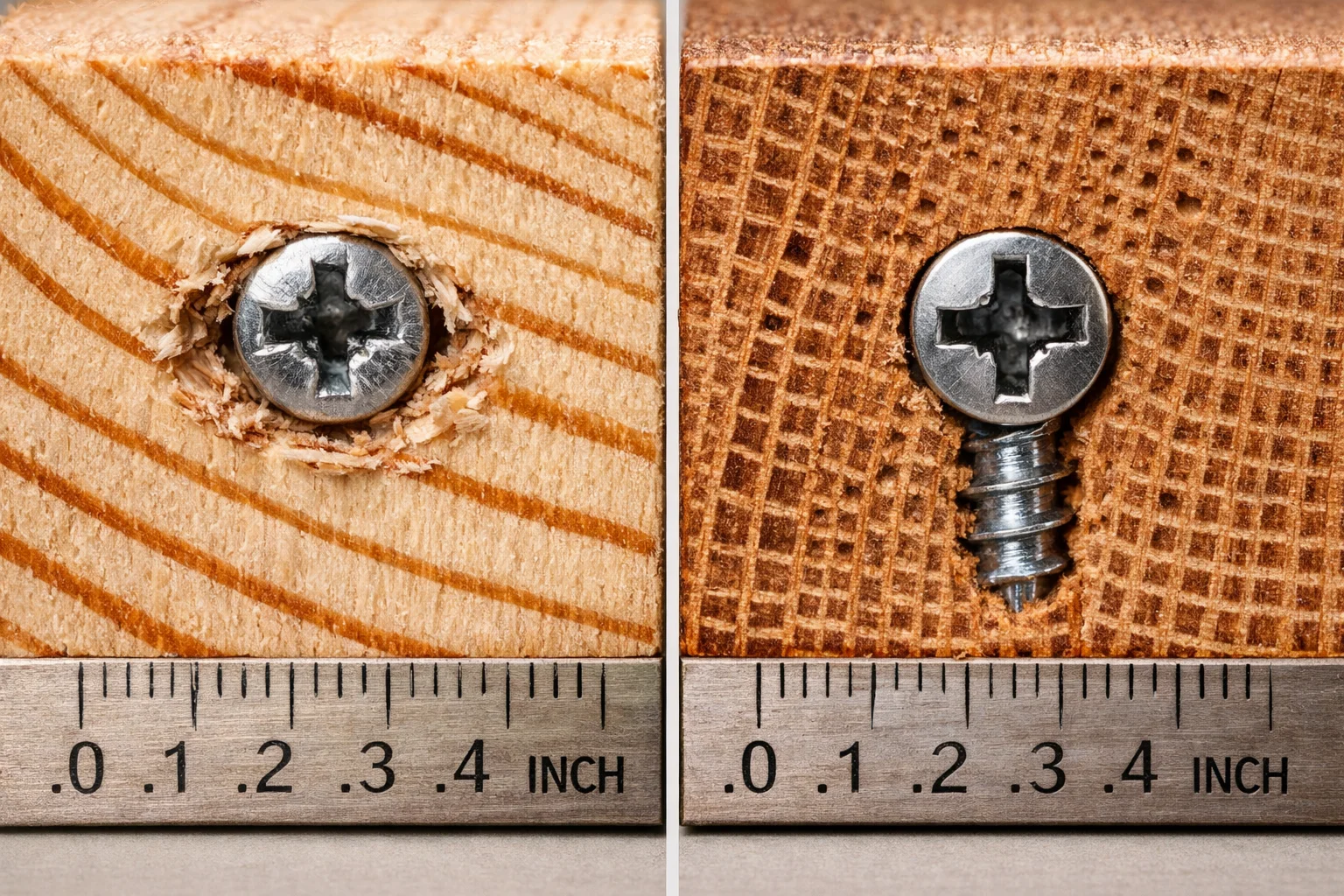
Softwood is where this tends to go wrong first, not because it cannot hold any fastener at all, but because it crushes more easily right around the fastener. In plain terms, the screw or staple compresses the wood fibers, and after enough use and seasonal humidity changes, that compressed pocket stops gripping like it did on day one.
What makes this so sneaky is that the joint can “pass” the showroom test, because a fresh staple line or a freshly driven screw feels tight. The failure shows up later when the wood around the fastener relaxes, the hole gets a tiny bit wallowed out, and the joint starts microslipping under racking loads.
When I am checking a sofa underneath, I stop staring at the rails and I start hunting for how the upholstery shop attached everything, because those fasteners tell you what the frame is relying on. If I see long staple runs into pale, soft looking wood with no real blocks behind them, I assume the holding power is mostly friction, and friction is the first thing that disappears when the wood fibers get polished and crushed.
I also pay attention to where the fasteners go, because end grain is a trap. If staples or screws are driven into the end of a rail at a corner, I treat that as a structural shortcut, because end grain is like a bundle of straws and it does not grip threads the same way side grain does, even if it feels solid today.
If you want one simple thing to look for that usually correlates with longer life, it is screws in places where you would expect real stress, especially at corner blocks and braces. I like seeing screw heads that look like they were driven intentionally into something substantial, not just a random scatter of staples that happened to catch the edge of a thin rail.
Then I look for whether the screw is doing real work or just pretending. A screw going through a corner block into a rail can be a good sign, but a screw going into a tiny softwood block can still loosen if the block itself crushes, so I try to judge the whole stack, meaning rail thickness, block size, and whether it all looks like it was designed to share load instead of concentrate it.
Staples are where my skepticism goes up fast, because staples are mostly a speed tool. When I see staples used for structural joints, not just fabric and dust covers, I assume the build is depending on compressed fibers staying compressed forever, and they do not, especially in softwoods that are more prone to that slow crushing and rebound.
This is also why I do not get hypnotized by “doweled” if the rest of the frame screams staple gun. Dowels can be great when the wood is dense and the fit is clean, but if the rails are softwood and the joint still depends on staples to locate and clamp, the dowels can end up living in a joint that slowly turns into a hinge as the surrounding wood creeps.
Threads matter here in a way you can actually use without being an engineer. If I can see a fastener and it looks like a smooth nail or a smooth shank fastener, I assume it is relying mostly on friction, and friction fades as the wood compresses and gets burnished by movement.
If I see actual screws with visible threads, I treat it as a better starting point, because threads have at least some mechanical bite. I still do not assume it is good, I just assume it is less likely to start migrating out and loosening the joint the way staples and nails tend to in softer wood.
The cascade effect is what makes this worth caring about before you buy. Once one fastener starts to move, the joint moves a hair more, that movement grinds the wood fibers into dust, and now you have permanently reduced holding power, so the load shifts to the next fastener, and the loosening spreads.
In the showroom, I try to catch early signs of that “take up slack” behavior. I do the same controlled racking twist, then I stop and repeat it with smaller motion while I keep my ear close to the arms and corners, because a good frame often stays quiet, and a frame with fasteners starting to slip often makes crisp little ticks that sound like something shifting and settling.
If the store will let you, I also like a simple push test on the arms that imitates years of getting up from the same spot. I press down hard on the front of one arm while I brace the opposite side, and I pay attention to whether the arm feels like it is anchored to a rigid box, or like it is anchored to one corner that is starting to flex on fasteners.
When you are talking to a salesperson, I find it more productive to ask fastener questions than wood questions at this stage. I ask whether the structural joints are screwed and glued, or stapled, and where exactly screws are used, because “assembled” can mean anything, and you are trying to learn whether the sofa is built to stay tight after thousands of cycles, not just survive delivery.
If you want a neutral technical source that backs up why softwoods generally hold fasteners worse over time than denser hardwoods, and why that gap matters in furniture joints, the USDA Forest Products Laboratory report on fastener behavior is a solid reference, even if you only skim it for the big idea that density drives holding power: USDA Forest Products Laboratory, Wood Handbook and fastener data.
I tie all of this back to one buying rule I use to protect myself from the slow, expensive disappointment. If the sofa relies on staples for structure in soft looking wood, and the frame is even slightly willing to creak, tick, or take up slack when you rack it, I assume fastener retention will be the thing that turns it from “nice” to “annoying” long before the fabric wears out.
Glue-Line Breakage Logic
If you have ever owned a sofa that slowly turned into a squeaky, slightly loose box even though the wood never visibly cracked, I would bet the real failure happened at the glue line. Most frames do not “die” because the lumber is too weak, they die because the bond between two pieces quietly gives up after thousands of little racking cycles.
This is why I do not let “glued” soothe me. Glue can be fantastic, but only when the joint fits tightly, the glue line is thin, and the parts were actually clamped in a way that left glue in the joint instead of squeezing it all out.
On the lower end, a lot of factories use basic water based PVA because it is fast and forgiving in production. The problem for you is that this type of glue can slowly creep under repeated stress, which means the joint can start microslipping even if it felt rock solid in the store.
I have learned to think of a sofa as a constant diagonal stress test. Every time you sit down a little off center, or you use the arm to stand up, you are not just loading the frame, you are racking it, and racking is where glue lines get fatigued.
Here is the showroom logic I use. If I rack the frame with that firm, controlled twist and I hear dry ticking or feel a tiny delayed shift, I assume I am feeling the earliest stage of glue line movement, not “normal settling.”
Then I immediately get my light underneath and look for hairline gaps where a corner block meets a rail. I am not looking for a dramatic separation, I am looking for a thin shadow line that opens and closes when I repeat that same twist.
If the corner block is there but I can see the joint line “breathe” under load, I treat that as a major warning sign. Staples and fabric can keep everything looking tidy while the actual bond line is already losing the argument.
I also watch for glue used like caulk. If I can see blobs, drips, or uneven squeeze-out around a joint, I do not read that as “extra strong,” I read it as “the fit was sloppy so they tried to make glue fill space.”
In my experience, a good glue joint usually looks boring. You might see a thin, consistent glue line, but you do not see a mess trying to compensate for gaps.
Clamping matters in a way most shoppers never hear about. Over-clamping can actually create a weak joint by squeezing too much glue out, leaving a starved joint where only a few high spots are bonded and everything else is basically air.
You cannot see clamp pressure after the fact, so I use indirect tells. If the frame is softwood and the joints look very “dry,” meaning there is barely any glue evidence and the corner blocks are relying heavily on staples, I assume the build is optimized for speed, not for keeping glue where it needs to be long term.
Softwood makes the glue problem worse because it can soak up glue unevenly. In practical terms, part of the wood can drink the glue and leave too little at the surface, so you end up with a bond that looks fine on day one but is easier to fatigue when the sofa racks.
This is also why I do not automatically trust foam-filling glues as a solution. Some glues expand as they cure, and while that can hide gaps, it can also leave a bond line that is partly foamy and weak if the builder used it as a gap filler instead of making a tight joint.
The part marketing gets backward is the idea that “solid wood” means the wood will fail before the joint. In real life, a decent piece of wood can outlast a mediocre glue line, especially when the joint fit is loose and the glue layer is thick, because thick glue lines tend to fatigue earlier.
If you want a simple way to catch this without tools, I do a two-step check. I rack the frame, then I put my fingertips right on a corner block seam and repeat a smaller version of the same twist, because your fingers can feel a tiny slip that your eyes cannot see.
If I feel any click, any take-up, or any movement that seems to come from the corner itself, I stop imagining that better cushions will save it. I assume I am feeling a bond line that is already starting to act like a hinge.
When you talk to a salesperson, I have found one question is more useful than asking “what glue do you use,” because most of them will not know. I ask whether the corners are both glued and mechanically fastened with screws through substantial blocks, and whether there is any joinery that actually locates the joint, like a real interlocking cut, rather than two pieces simply butted together and stapled.
If they can show you a cutaway, a build photo, or even just a clear description that stays consistent, I take that as a sign the brand has a process. If all you get is “it’s glued” and a return to “solid wood frame,” I assume the glue line is a cost-controlled mystery, and mysteries are how you end up paying twice.
If you want a neutral standard that at least signals glue joints can be tested rather than guessed at, you can look up ASTM D905 shear strength method. I do not expect a retailer to hand you lab data, but I use the existence of standards as leverage to keep the conversation grounded in performance instead of comfort words.
Plywood vs Particle Board in Frame Components
Plywood is one of the few engineered woods I actually like seeing in a sofa frame, because it tends to fail slowly instead of suddenly. When a frame gets racked from years of sitting, dragging, and kids flopping into one arm, plywood’s layered structure usually spreads that stress out instead of letting one crack run and take the whole corner with it.
Particle board is the opposite experience. I have seen it hold together right up until the day a joint loosens, then it crumbles around the fastener and you are done, because there is no real fiber structure left to bite into once the hole gets chewed up.
The quickest way I translate this into buying advice is that I want plywood in the parts that take racking load. If you are going to accept plywood anywhere, the “good use case” is things like seat rails, stretchers, and gusset plates, where the sofa is constantly being pushed out of square by real life.
When I see particle board anywhere near a joint, I assume I am looking at a time bomb. It is often hidden where you will not casually notice it, inside upholstered arms, behind stapled fabric, under the dust cover, or buried in an inner subframe that “looks” like wood because it is wrapped.
In the showroom I do not ask, “Is there engineered wood?” because that invites a vague answer. I ask, “Is any particle board used in the frame, and if so, where exactly?” Then I stay quiet and make them either name locations or admit they do not know.
If the salesperson says “No particle board,” I try to verify it with my eyes. I get my phone light under the sofa and look for any exposed panel edges, because plywood usually shows distinct layers, and particle board looks like a uniform, fuzzy mass of chips with a denser skin on the faces.
If I cannot see panel edges, I look for the next best clue, which is how the underside is fastened. Particle board frames often rely on staples into panel edges or screws into broad faces because edge holding is weak, so when I see lots of hardware near panel edges, especially in critical corners, I get suspicious and I start hunting harder for what that fastener is actually biting into.
Fastener holding is where this becomes real for you, because frames do not just “exist,” they are held together by screws, staples, and glue lines that get cycled thousands of times. Plywood usually gives a screw something to grab across multiple layers, so even if one layer locally splits, the screw still has material to hold onto.
Particle board behaves like it is holding, right up until it is not. The screw crushes the particles, the hole starts to loosen as the frame flexes, and then the screw starts “pumping” in the damaged hole until it spins, and once that happens you do not have a clean repair path because the material around the hole is now basically powder.
This is why I do not let a retailer sell me on particle board with a casual “It’s fine, it’s furniture grade.” My practical follow-up is, “Are the structural joints screwed into plywood or into particle board?” If they cannot answer, I assume the worst and I price the risk accordingly, which usually means I walk.
Moisture is another place where particle board turns into regret, especially if you live somewhere humid, you have a damp basement, or you are the kind of person who actually shampoos rugs and runs a wet machine near the sofa. Particle board absorbs water into its voids, swells, and loses internal strength, so a frame that was barely adequate dry can become fragile after one bad spill or one humid season.
Plywood can still swell, but in my experience it stays “structural” longer when life happens. That is not a promise of waterproof performance, it is just me saying I would rather have a frame that gets a little ugly than one that turns to mush at a joint.
If you want a simple showroom test that connects all of this back to feel, do the same controlled racking twist you have been doing, then immediately sit down hard on the front edge near one corner and listen. If you hear crisp ticks that sound like a fastener shifting, and the underside construction includes panel material, I get very wary that you are hearing a screw working loose in a material that will not recover.
If the store can tell you, clearly, that the structural rails and joint areas are solid wood and plywood, and they can point to where those materials are used without getting slippery, I treat that as a good sign. If the answers get vague, or you hear the word “composite” without specifics, I assume particle board is in there somewhere doing the worst job, which is holding your corners together.
When I am deciding whether a sofa is priced honestly, this is one of the places I look for the hidden downgrade. A sofa can have beautiful fabric and decent cushions and still be a bad buy if the frame uses particle board where the stresses live, because once that material starts failing at a joint, you do not just get a squeak, you get a structural problem that is hard to fix cleanly.
Hidden Fillers and Cost-Cutting Chemistry
There is a kind of cost cutting you will not see on a tag, because it hides inside glues, resins, and composite parts. One of the most common tricks is loading those materials with cheap mineral filler, especially calcium carbonate, basically ground limestone, because it makes parts heavier and cheaper at the same time.
If you have ever lifted a sofa in a showroom and thought, “Wow, this feels solid,” I want you to be a little suspicious of that instinct. Weight can be real structure, like thicker rails, better blocking, or steel where it actually reinforces a joint, but weight can also be dead weight that does nothing for long term durability.
The problem with heavy mineral filler is that it is not there to make the frame tougher, it is there to make it feel substantial and to bulk out adhesives and composites. In real life, the frame does not fail because it was too light, it fails because it could not flex and share load at the joints, and filler heavy materials tend to get more brittle and less forgiving under repeated racking.
Where this shows up most is at corners, rails, and any place where a glue line is supposed to transfer stress from one piece to another. If the “wood” you are looking at is actually a composite rail or a big corner block made from engineered goo and fiber, mineral filler can get in the way of the bond behaving like a tough, continuous connection, and instead you can end up with a joint area that is strong in a one time push but fragile under thousands of small cycles.
This is one of the reasons I do not use weight as my quality test anymore. A heavy sofa can still be a bad sofa if what you are feeling is dense adhesive, filler loaded composite, or even wood fiber that was not dried as well as it should have been.
In a store, I try to separate “heaviness that is structure” from “heaviness that is filler.” I put my phone light underneath and look for composite looking parts at the corners and rails, meaning anything that looks molded, perfectly uniform, or oddly smooth compared to normal wood grain, especially where the frame is supposed to be taking stress.
Then I look closely at the glue lines I can see, because filler heavy adhesive often leaves a tell. If you see dried glue that looks chalky, crumbly, or like a dusty line rather than a tough, slightly plastic looking film, I treat that as a warning sign that the maker may be bulking the chemistry instead of investing in clean joinery and good wood contact.
I also use a magnet, because steel can be a good thing when it is a real brace, and a bad sign when it is just there to add “serious” weight. If you find steel plates or straps in random places that do not clearly triangulate a corner or tie two rails together, I assume somebody is trying to buy stiffness with hardware instead of building a joint that stays tight.
If you want a quick reality check you can actually do without tools, I compare how the weight feels relative to the size. If a modest sized sofa feels strangely heavy to the point that it is the first thing you notice, I do not let that impress me, I let it trigger more inspection underneath, more racking and twist testing, and more questions about what the rails and blocks are actually made of.
If you are comfortable bringing one simple tool, a bathroom scale can be surprisingly useful at home when you are deciding between two deliveries, because you can compare the actual weight to other solid wood furniture you trust. I am not chasing a magic number, I am looking for “too heavy for what it is,” because too heavy can mean you are paying for filler and dense glue instead of paying for better joints.
When I ask questions about this in a showroom, I keep it plain and specific so I do not get a chemistry lecture or a sales dodge. I ask whether any of the frame rails, corner blocks, or braces are made from composite material or resin bonded wood fiber, and whether the structural adhesives are filled or unfilled, because I want the person selling it to tell me what is really inside the box.
If the answers get vague fast, or I hear words like “proprietary composite” without a clear description of where it is used, I assume the weight and the “solid feel” might be engineered for the showroom, not for ten years of sitting. If you want to read more about why calcium carbonate filler is used and how it changes polymer behavior, this overview is a decent starting point: Calcium carbonate filler overview.
The way I tie this back to everything you have already checked is simple. If the sofa feels heavy but the underside shows staple heavy construction, minimal blocking, and joint lines that already tick or take up slack when you rack it, I treat the weight as a red flag, not a green one, because a heavy, brittle frame still loosens at the corners, and sometimes it does it faster because it cannot absorb everyday flexing.
Failure Case Studies: How Cheap Frames Die
I like to think in failure stories, because it keeps me from getting hypnotized by fabric and seat feel. When a cheap frame dies, it usually dies slowly and predictably, and you can often spot the early version of the problem in the showroom if you know what you are trying to provoke.
Seat Rail Collapse
The front seat rail is the part that quietly takes a beating, because so many people land on the front edge, perch there to put on shoes, or slide forward to stand up. When that rail is made from soft, low-density wood, it often does not crack in one dramatic moment, it slowly compresses and takes a permanent set, which is why the seat starts to feel like it is sagging even if nothing looks broken.
In the store, I try to recreate the kind of load that causes this. I stand up, then sit down firmly on the very front edge of one seat position a few times, and I pay attention to whether the front edge rebounds cleanly or whether I feel a dull settling, like something is crushing and not coming back.
Then I get my light underneath and look at that front rail area, because the construction there tells you how the maker expects it to survive. If I see the rail relying on long staple lines, pocket screws, or tiny dowels with little blocking, I assume the rail is going to gradually deform, then the joint starts taking more of the load, and that is when the whole front corner begins loosening.
What it feels like in real life is a seat that goes from “supportive” to “hammock-ish,” then the upholstery starts feeling sloppy, and then you start hearing little clicks when you shift. That click is often the joint moving because the rail has already shortened and turned into a lever prying at its own connections.
If you want one quick confirmation test, I press up on the underside of the front rail area with one hand while pressing down on the cushion area above it with the other. I am feeling for any independent movement between the rail, the decking support, and the corner, because a good build moves as one unit and a weak build feels like stacked parts taking turns moving.
Back Frame Racking
Back frames usually fail because they are built like rectangles that were never taught how to stay square. Side loads happen constantly, you push off the arm to stand, you flop into one side, you drag the sofa a few inches on carpet, and if the back is just thin members with no real bracing, it starts turning into a parallelogram.
I check this by grabbing the top of the back near one corner and giving it a firm sideways shove while my other hand braces the opposite side. I am not trying to tip the sofa, I am trying to see if the back behaves like a rigid panel or like a hinged picture frame.
If the back shifts sideways and returns with a springy, delayed feel, I assume the joints are slipping and the staples are slowly losing their bite. If I hear ticking, popping, or a dry little creak that repeats with each shove, I treat it as the sound of a geometry problem, not “normal upholstery noise.”
This is one of those failures that gets excused as “your floor is uneven,” because the symptom is a visible lean or a back that looks slightly skewed. When I see that kind of behavior on a floor model, I walk away, because if it racks now under my hands, it will rack much faster once it is getting daily lateral loads at home.
Arm Detachment Scenarios
Arms are where people accidentally do structural testing every day. You push down on an arm to stand, kids climb on them, someone sits on the arm at a party, and the arm becomes a handle for moving the sofa, so a weak arm joint gets cycled in a really punishing way.
The most common ugly version I have seen is an arm that is basically located by dowels in soft wood, then “held” by fasteners and glue that start to loosen once the dowel holes compress and ovalize. At first it feels like a tiny squirm when you lean on the arm, then it becomes a click, and eventually it becomes a sudden crack when the remaining fibers finally give up.
In the showroom I do a very specific check that has saved me from repeat regret. I grip the end of the arm and apply alternating upward and outward pressure in small, controlled pulses, and I watch the inside corner where the arm meets the body, because that is where movement shows first.
If I can see the seam line open and close even a hair, or if I feel a tiny take-up before the arm resists, I assume the joint is already acting like a hinge. I do not argue with it, because arm joints do not get tighter with age, and once that pumping motion starts, every use removes a little more material from the holes and fastener pockets.
If the store is busy and you feel self-conscious doing this, you can make it subtler by just pressing down hard on the front of the arm while you keep your other hand on the adjacent seat rail area. I am feeling whether the arm load transfers into the whole frame box, or whether it concentrates into that one corner connection like it is trying to peel the arm away.
I know this section sounds a little doom-and-gloom, but it actually makes buying easier. When I can make a sofa do these three “real life” motions without hearing ticks, without feeling slack, and without seeing seams breathe, I relax, because most cheap-frame deaths start by failing one of these exact tests in tiny ways long before anything looks broken.
Inspection Protocol: How to Audit a “Solid Wood” Frame
When I decide whether a “solid wood” frame is actually worth paying for, I run a quick audit that does not require disassembly, and I let what I can see and feel override whatever the tag says.
I start by trying to figure out what kind of wood I am really dealing with, because “solid wood” can still mean soft, crushable rails that behave more like structural filler than a long term skeleton.
Species Identification Without Disassembly
The first thing I do is use my phone flashlight as raking light, meaning I hold it low and close to any exposed wood I can find underneath, so the grain texture throws shadows and becomes easier to read.
If I see wide growth bands with a strong light dark striping pattern, I assume I am looking at a softwood like pine or fir. That pattern is a hint that the wood’s density is uneven across each ring, which usually shows up later as denting, crushed fastener pockets, and joints that slowly start to move.
If I see a finer, more uniform texture, or obvious pores and little ray flecks that look more “busy” than striped, I relax a bit because that often correlates with denser hardwoods and better screw holding. I am not trying to play botanist in the showroom, I am just trying to avoid the really soft stuff that turns to dust around staples.
After grain, I do a simple weight and stiffness reality check, but I do it the right way. I do not just pick it up and decide heavy equals good, I lift one front corner a couple inches and pay attention to torsional feel, meaning whether the frame tries to twist like a flexible ladder or comes up like a rigid box.
A light frame can still be well-engineered, but a light frame that also feels twisty is usually telling you the joints and rails are not resisting racking. That is where loose corners begin, and once that starts, it rarely stops.
If the underside has any visible screw heads, I look at them closely and use them as a clue. In denser wood, screws usually sit firmly and cleanly, and the surrounding wood looks crisp rather than chewed up or fuzzy.
In low density wood, the area around fasteners often looks bruised, splintery, or over-stapled, like the factory needed extra bites to make the same connection hold. I treat that as the frame admitting, silently, that the wood does not hold hardware well.
Joint Exposure Points to Examine
The most honest places on a sofa are the corners, the intersections where rails meet, and anywhere a leg meets the frame, because those are the spots that get punished when the sofa racks.
I press the dust cover aside if I can do it without being obnoxious, and I look for joinery evidence rather than just “wood present.” If I see clean shoulder lines, consistent glue squeeze-out, or a joint that looks like it interlocks rather than merely meets, I treat that as a sign the joint has strength even before the screws and staples show up.
If what I see is two square cut ends butted together with a scatter of staples, I assume the joint is depending on friction in soft fibers, and that is exactly the kind of joint that feels fine in month one and starts clicking in year three.
I also look for staple density, because staples are not neutral. When I see long runs of staples doing jobs that should be done by screws, bolts, or real bracing, I assume the builder optimized for speed and accepted loosening as the long term outcome.
Then I do the lift test that exposes racking weakness fast. I lift the sofa by one top corner, hold it for a few seconds, and watch the opposite corner, because a weak frame often lags behind like it is hinged.
If I hear tiny creaks or crisp little ticks during that hold, I treat it as early joint rotation, not “normal settling.” If a frame talks in the showroom, it usually becomes a full conversation at home.
After that, I repeat the test more gently while I keep my hand on a corner seam underneath. I am feeling for any delayed take-up, the little moment where the frame moves, then the corner catches up, because that is the sensation of slack that will only grow with use.
Red Flags Salespeople Can’t Explain
If you want to cut through the script quickly, ask for specifics that a good build should be happy to state. I ask what species the main load rails are, not just “hardwood,” and I ask how the corners are joined, not just “stapled, glued, and reinforced.”
When I hear evasive phrases like “selected hardwoods,” “engineered solid wood,” or “solid wood where it counts,” I assume the brand is protecting its flexibility to substitute cheaper material. If they cannot put the species and joint method in writing, I assume it is because the answer changes too often to promise.
Staple-heavy structural construction is another red flag I have learned not to ignore. Staples belong on fabric, and when I see them doing the job of joinery, I assume the sofa will age into looseness rather than breaking cleanly.
What I Do When the Underside Is Hard to See
Some showrooms make it annoyingly difficult to inspect, with tight dust covers, fully upholstered bases, or sales staff who hover. When that happens, I switch to behavior tests that a good frame passes even when it is visually hidden.
I press down hard on one arm while bracing the opposite side, then I do the same on the other arm. I am looking for symmetry and immediate resistance, because if one arm feels like it takes a split second to “catch,” the frame is already moving at a joint.
I also sit on the very front edge near one corner, stand up, and repeat a couple times, because that is where cheap rails start to compress and corners start to pump. If I can make the sofa click with that simple motion, I do not care what the tag says about the frame.
How I Turn the Audit Into a Buying Decision
If the store can name the wood species clearly, the underside shows real corner blocking or bracing that looks intentional, and the frame stays quiet and stubborn under the corner lift and racking tests, I treat “solid wood” as a meaningful positive rather than a vague claim.
If the answers stay vague, the underside shows lots of staples doing structural jobs, and my hands can provoke even small ticks, seam breathing, or delayed corner movement, I walk away. I have never seen that kind of frame tighten up with age, and I have regretted every time I tried to talk myself into it.
Explore Technical Reference
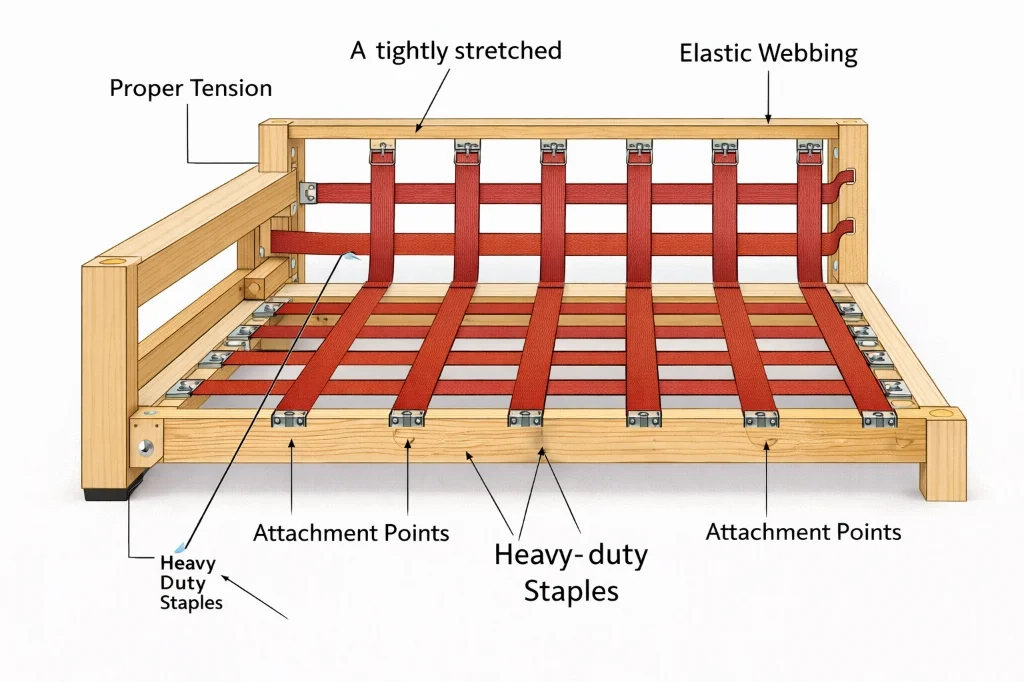
Elastic Webbing: Cheap Fix or Italian Luxury?
Dispelling the myth that webbing is always cheap. Understanding when high-quality rubber webbing like Pirelli provides superior suspension for modern design.
Analyze Details →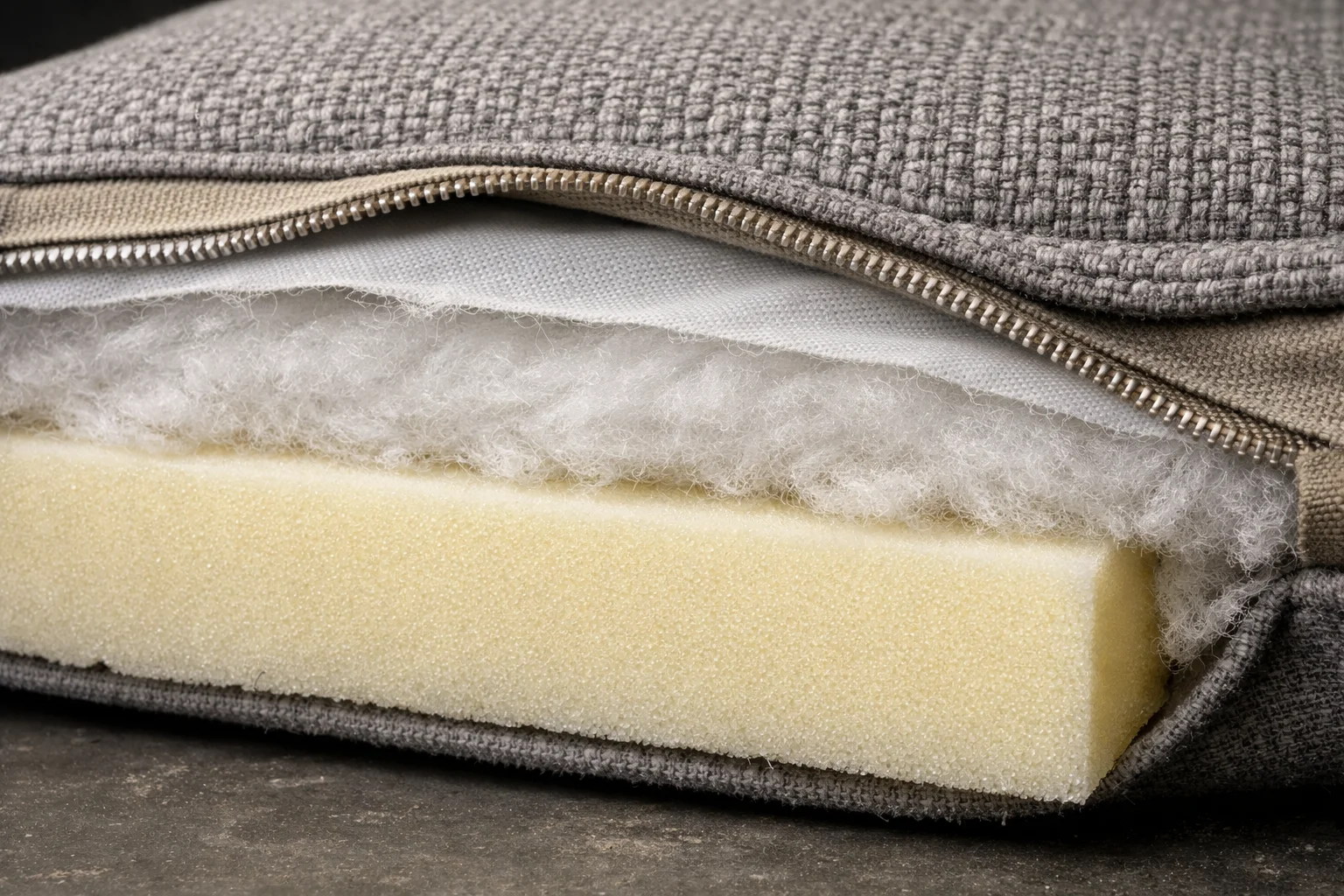
Cushion Layers: Why the Interface Materials Matter
Understanding why sitting on raw foam hurts. The critical importance of batting and ticking layers for pressure distribution and tactile comfort.
Analyze Details →