Cushion Layers: Why the Interface Materials Matter
Introduction
I once sat on an expensive 2.5lb foam sofa that felt like a school bus seat. The density was correct, but it was missing the crucial micro-layers that separate the human body from industrial plastic. Sitting directly on raw polyurethane is like sitting on a car tire, durable, but hostile to human tissue.
That experience is why I no longer let a single spec, like foam density, convince me a sofa is “good.” In a showroom, you are not buying a spreadsheet, you are buying how the layers work together after your weight and heat have had a chance to bully them for years.
When you test a sofa, I want you to focus on what you can actually feel and verify. Sit the way you sit at home, not perched politely on the front edge, and stay there long enough for the cushion to warm up and settle. If it feels initially plush but quickly turns hard or pressurey under your sit bones and thighs, you are probably bottoming into a firmer core layer with nothing friendly on top.
Ask the salesperson to describe the cushion build in plain language, and keep redirecting them if they start reciting densities and brand names. What you’re trying to confirm is whether there is a comfort layer above the main foam, something like a softer foam, fiber wrap, or other padding that creates a gentler first contact. If they cannot tell you what the top layer is, or they say it is “just the foam,” treat that as a warning sign even if the foam is technically high density.
I also press with my hand before I sit. If the surface feels slick, rubbery, and immediately springs back like an athletic mat, that is often the feel of being too close to raw polyurethane. If it feels slightly buffered, a touch less bouncy, and not plasticky to the skin through the upholstery, that usually means there is at least some kind of comfort interface doing its job.
This guide is built around that kind of reality check. I’m going to help you translate showroom feel, construction clues, and a few direct questions into a better chance of buying a sofa that stays comfortable after the honeymoon period ends.
The "Naked Foam" Mistake
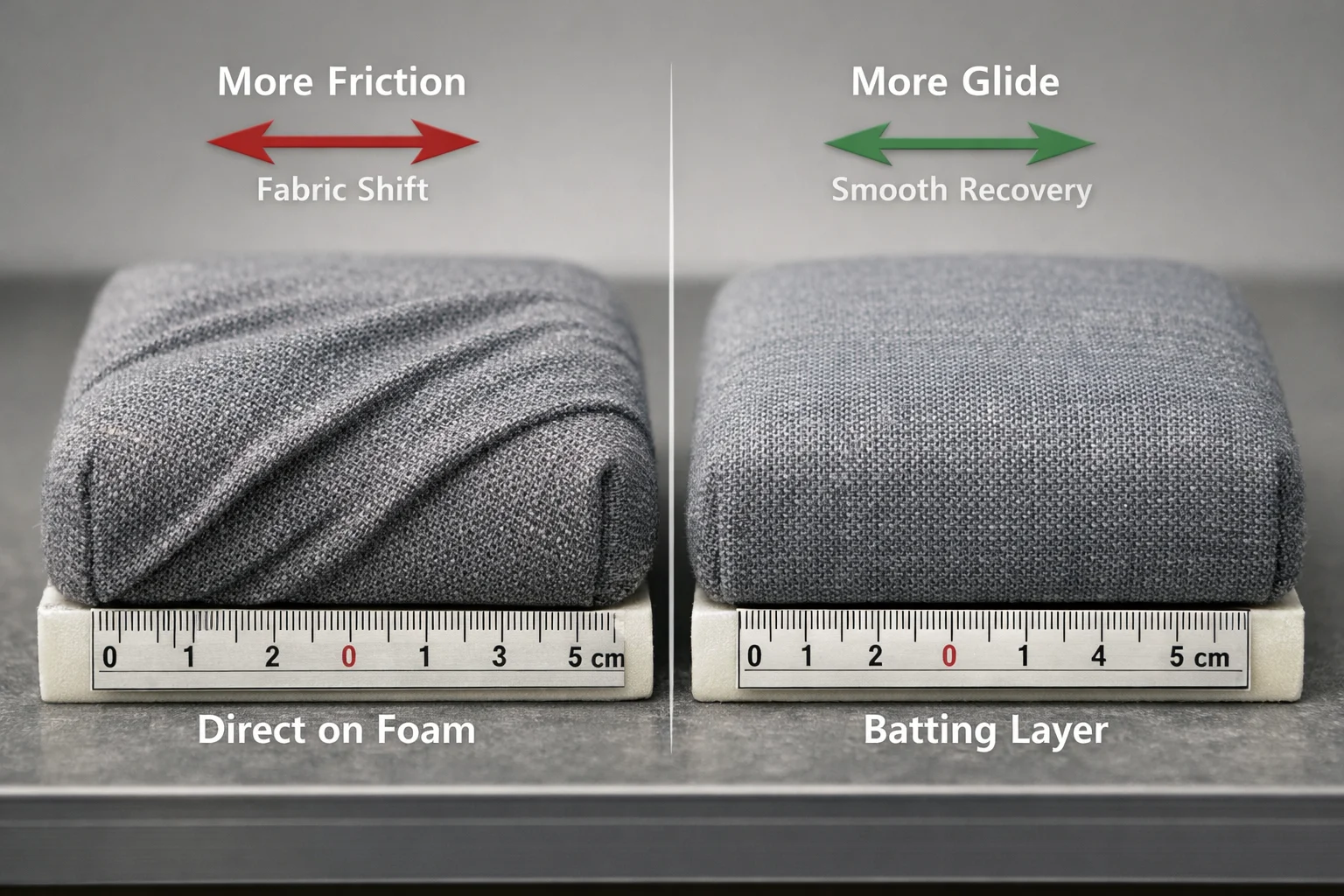
Cheap manufacturers simply stuff a block of yellow foam into a fabric cover. The high coefficient of friction causes the fabric to "grab" the foam, rippling and twisting every time you stand up. Without a slip layer (Batting), your cushions will look disheveled within a week.When I say “naked foam,” I mean a cushion core that is basically bare polyurethane shoved into the upholstery cover with little or nothing between them. It can feel fine for five minutes in a showroom, then start looking like a wrinkled pillowcase at home because the cover cannot glide as you sit, scoot, and stand.
What you are watching for is that grabby, sticky interaction between the fabric and the foam. Every time you get up, the cover wants to move back into shape, but the foam drags it, so you get diagonal ripples, twisting corners, and that permanently rumpled look that makes a new sofa feel old fast.
In a showroom, I do a simple check that tells me a lot. I sit normally, then stand up quickly, and I look at the cushion surface right away. If the fabric stays pulled, shows sharp wrinkles, or the top looks like it shifted off center and does not relax back within a few seconds, I assume the cushion is missing a proper slip layer.
I also do the “pinch and slide” test on the top panel of the cushion. I pinch a small fold of the upholstery between my fingers and try to slide it a little across the cushion surface. If it feels like the fabric is stuck to the inside, that usually means the foam is right under it with no batting or liner to help it move.
You can often feel naked foam through the cover, too. It has a slightly plasticky, grabby resistance, like your hand wants to stick instead of glide, especially on tighter, cheaper weaves. A cushion with a fiber wrap or batting tends to feel a touch more buffered and less like you are pressing directly on an exercise mat.
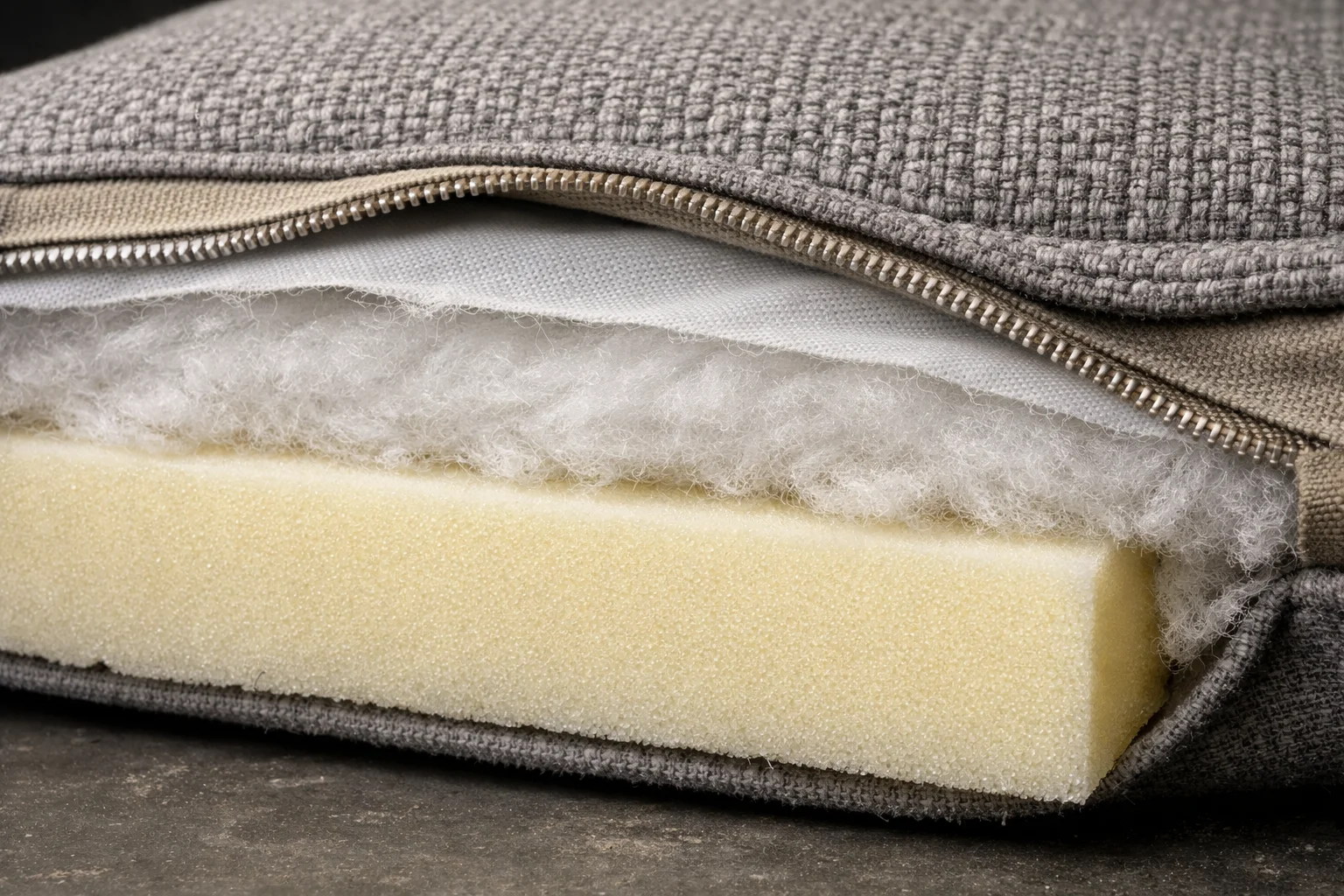
If the salesperson will let you, unzip the seat cushion cover. I do not need to see every layer, I just want one quick look at what is directly around the foam. If you see a plain yellow or white foam block with nothing wrapped around it, or maybe a thin piece of fabric that looks like a T shirt, I treat that as a durability and appearance red flag.
What I want to see is some kind of wrap that looks and feels like a thin quilt, fuzzy fiber, or a sock-like liner that is clearly meant to reduce friction and smooth the shape. Different brands call it different things, batting, fiber wrap, Dacron wrap, cushion wrap, or an encasement, but the practical point is that it lets the cover slide and it softens the edges so you do not get that sharp, blocky look.
If you cannot unzip the cushion, you can still ask a very direct question and listen for a direct answer. I ask, “Is the foam wrapped in batting or a liner, or is it just foam in the cover?” If they answer vaguely, or they keep talking about foam density without addressing the wrap, I assume it is missing or minimal.
There is one more giveaway I have learned to respect. Look at the piping and the front edge of the cushion after you stand up. If the seam line looks wavy, the corners look slightly torqued, or the cushion face looks like it is trying to rotate inside the cover, that is often the fabric grabbing the foam and dragging it out of alignment.
I am not saying a cushion needs to be overstuffed with loose fiber that will pack down and turn lumpy. I am saying you want a deliberate slip layer between foam and cover, because it protects the look of the sofa and it helps the cushion recover neatly after normal use.
If you love everything else about a sofa but you suspect naked foam, I would treat it like a negotiation point or a reason to keep shopping. In my experience, once you are living with wrinkly, constantly messy cushions, you stop blaming the cushion and start resenting the sofa.
Layer 1: The Batting (Dacron)
The first “micro layer” I look for is the batting, often called Dacron. It is usually a white, fluffy sheet wrapped around the foam core, and it is one of those unglamorous details that quietly determines whether a sofa feels civilized or industrial.
The most practical job it does is friction management. When the foam is wrapped properly, the upholstery cover can slide and settle without grabbing, so the cushion face stays smoother and the corners do not twist as easily when you stand up and the cushion rebounds.
It also helps with that annoying pressurey feeling you can get across the backs of your thighs. If you have ever felt a “burning thigh” sensation on a sofa that otherwise seemed fine, that can be your body telling you it is too close to something hard and unyielding under the cushion surface, and the top layers are not doing enough buffering.
The third thing I watch for is the shape, because batting is what rounds the foam block into a softer crown instead of that squared off, packaged look. In a showroom, I step back and look at the seat cushions from the side, because a good wrap tends to make the top surface look slightly domed and forgiving, not like a perfectly flat slab with sharp edges telegraphing through the fabric.
The Pinch Test
Pinch the cushion wrap fabric between your thumb and forefinger. If you instantly feel the hard foam block with basically no pillowy separation, I treat that as a fail because the batting is either missing or so thin it is doing almost nothing. If you feel a distinct soft buffer before you hit the foam core, where your fingers compress something airy first and only then reach firmer foam, that is what I consider a pass and it usually means there is a real bonded fiber wrap doing its job.When I do the pinch test, I like to try it on the top panel near the front edge and again near a corner. Corners are where cheap builds give themselves away, because without enough wrap, you can feel the foam edge like a book cover, and that is the same edge you will see printing through the upholstery as the cushion ages.
If the salesperson is willing to unzip the cover, I am looking for a wrap that is clearly separate from the foam, like a fuzzy quilted layer or a sock-like encasement that goes all the way around. If I just see bare foam, or a whisper thin lining that looks like it exists only to help the foam slide into the cover at the factory, I assume it will not do much for comfort or appearance once you start living on it.
If you cannot unzip anything, you can still ask in a way that forces a useful answer. I ask, “Is the foam fully wrapped in bonded Dacron or fiber, or is it basically foam straight under the upholstery?” If they respond with “it’s all high density” but do not address the wrap, I take that as a sign they either do not know or they do not want to say it is minimal.
One caution from my own trial and error is that more is not always better if the wrap is loose and migrates. I am not looking for a cushion stuffed with fluffy fiber that will shift and bunch, I am looking for a thin, consistent layer that stays put and keeps the cover moving smoothly over the foam.
If you like a sofa but the surface feel is immediately “hard through the fabric,” the corners look sharp, or the cover seems to cling and wrinkle after you stand up, I treat inadequate batting as a real buying decision point. In day to day use, that missing slip and buffer layer tends to show up fast, and it is one of those problems that never gets better with time.
Layer 2: The Ticking (The Enclosure)
Once I know there is some kind of batting or wrap, the next thing I care about is whether that soft layer is actually contained in its own inner bag, usually called ticking. In better cushions, the wrap is not just floating under the upholstery or tacked on with glue, it is enclosed like a pillow inside a pillow.
The simplest way I explain this to you is that ticking is there to keep the cushion from slowly turning into a lumpy corner problem. If the batting can migrate, it will, and it tends to walk away from the high pressure zones and bunch up where you do not want it, which is how you get those sad, underfilled corners and that uneven top surface that never looks quite right again.
Ticking also matters for cleanliness in a very practical sense. Foam is a sponge for oils and dust, and once that stuff works into the pores it is hard to undo, so a real enclosure layer acts like a filter between your life and the foam. In a showroom, I am not thinking about germs in an abstract way, I am thinking about whether the cushion will stay springy and neutral smelling longer because the foam is not being fed skin oils and grit every day.
There is also a feel component that surprises people. A tighter weave ticking changes how air moves in and out of the cushion, so instead of a fast collapse when you sit, you get a slower, controlled release of air that feels more like a soft sigh than a drop. If you sit and the cushion instantly whooshes flat under you, then springs back like a trampoline when you stand, that is often a sign you are dealing with a simpler build with less control over airflow.
In a showroom, I try to confirm ticking in the least awkward way possible. If the seat cushion unzips, I look for an inner liner around the fill that looks like a separate, purpose-made bag, not just the upholstery cover itself doing all the work. If I see a distinct inner casing, especially one with a tighter, smoother fabric, I take that as a good sign that the wrap and any soft fill are going to stay where they belong.
If you cannot unzip anything, you can still learn a lot by feel. I press the cushion top and then do a slow sit down, paying attention to whether the cushion settles gradually or drops quickly. I also squeeze near a corner and see if the surface fill seems evenly present all the way to the edges, because cushions without good containment often feel hollow in the corners even when the center feels fine.
When you talk to a salesperson, the question I ask is plain: “Is there an inner ticking bag around the wrap or fill, or is everything loose right under the upholstery cover?” If they say it is “down-proof ticking,” I ask them to show me on a floor model or in a swatch book, because those words are easy to say and hard to verify unless you can actually see an inner casing.
One warning from my own experience is to be cautious when the story is “it’s glued on.” Glue can hold a wrap in place at first, but it can also create hard spots and weird ridges over time, and once it starts to let go you get unevenness that you cannot unsee. I would rather have a properly fitted inner enclosure doing the holding than a spray of adhesive doing it.
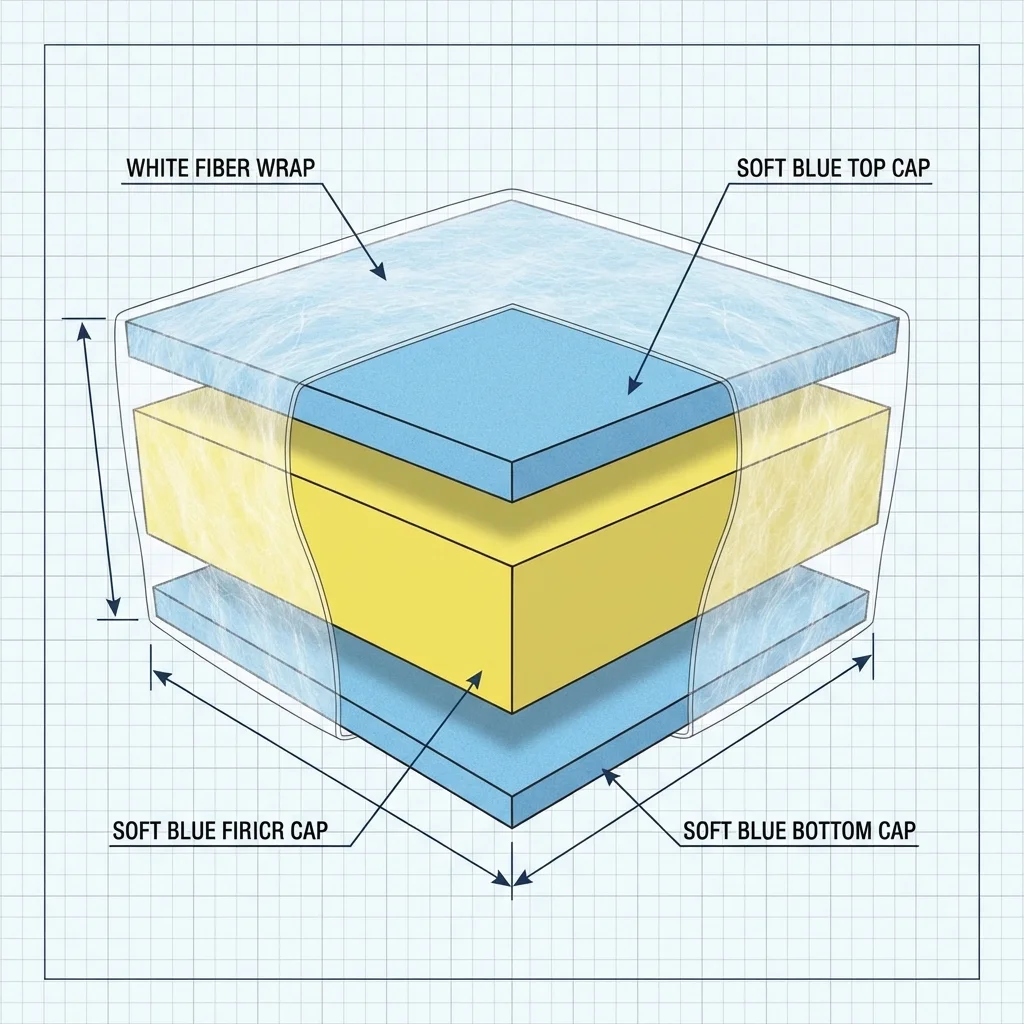
If you remember nothing else from this layer, remember that ticking is what keeps the nice, soft stuff behaving like a designed system instead of a sweater stuffed in a cover. When a cushion has real containment, it tends to stay even, feel more controlled when you sit, and age without those familiar dead corners and lumpy edges that make you feel like you bought a sofa that gave up early.
The Three-Stage Comfort Rocket
When a sofa feels “right,” it is usually because the cushion is doing three different jobs in a specific order as you sit. I think of it like a little comfort rocket, with a gentle launch, then a controlled glide, then a firm braking system so you do not crash into the frame.
Stage 1 is the interface layer, which is your batting and ticking doing the first tiny bit of compression. This is the part that removes that initial boardy harshness and keeps you from feeling like your skin is sitting directly on a rubber block through fabric.
In a showroom, I can usually identify a missing Stage 1 fast. If you sit down and your first thought is “this is firm” but not in a supportive way, more like a flat, stubborn resistance, that is often the interface layer not doing its job.
Stage 2 is the comfort layer, usually a softer foam cap above the main core. This is what lets the cushion deform around your sit bones and thighs so you do not get those hot spots that make you constantly shift.
When Stage 2 is missing, I get that “perched” feeling, like I am balancing on top of the cushion instead of settling into it. In the showroom, you can catch this by sitting still for a minute and noticing whether the pressure concentrates into two obvious points under your pelvis even though the cushion still looks thick.
Stage 3 is the support layer, which is the higher density core that handles the deeper compression. This is what brakes your descent, stops you from bottoming out, and keeps your spine from folding into a slouch because the seat keeps sinking after you think you have landed.
If Stage 3 is weak or too thin, it can fool you at first because the top can feel soft and welcoming. Then you realize your hips are lower than your knees, you can feel something hard underneath, or you feel a vague ache in your low back because the cushion is not holding you up in a stable way.
Here is how I test all three stages without cutting a sofa open. I do a normal sit, then I do a slow controlled “half stand” where I lift myself an inch and sit back down a few times, paying attention to whether the cushion gives me a gentle first contact, then a deeper contour, then a firm stop. If it feels like one single slab that just pushes back the whole time, it is usually missing Stage 1 or Stage 2, and if it feels like it just keeps sinking with no clear stopping point, Stage 3 is not doing enough.
I also do a practical bottom out check by sliding my hand, palm down, next to my thigh between my body and the cushion and pressing. If I can easily feel the platform or a hard transition underneath with only moderate pressure, I assume the support layer is too thin, too soft, or both.
If you are talking to a salesperson, the phrasing that gets me real information is, “What is the soft top layer above the main foam core, and how thick is it in plain terms?” If they cannot describe a cap layer at all, or they keep repeating that it is “all high density,” I assume Stage 2 is minimal and you are relying on the cover alone to create comfort.
If you skip Stage 1: the sofa tends to feel boardy, and it often looks messy faster because the fabric grabs the foam.
If you skip Stage 2: you tend to feel perched, with pressure points that show up quickly under your sit bones.
If you skip Stage 3: you bottom out, and the sofa can feel tiring because your body is constantly stabilizing itself instead of being supported.
The $30 Upgrade Hack
If your current sofa feels hard but the foam is not sagging, I start suspecting it is missing that Stage 1 interface, especially batting. The cheapest experiment I have found is to buy about three yards of bonded Dacron in a light weight and use it to add a real buffer layer. I unzip the cushion, lightly spray adhesive on the foam, then wrap the top, bottom, and front faces so the fabric gets a smoother, softer first contact. I avoid wrapping the sides because the cushion still needs to breathe and vent air when you sit. The result is usually immediate, the surface feel becomes less harsh, and the cover tends to look more tailored because the wrap rounds the edges and reduces wrinkling.I like this “hack” because it teaches you what you are shopping for. Once you feel how much a simple interface layer changes a cushion, it becomes easier to spot in a showroom when a sofa is trying to sell you durability specs while skipping the parts that actually make it pleasant to live on.
The Durability of Adhesives
Once cushions become a layered sandwich, the glue line becomes a real “will this age well” question. I have sat on seats where everything seemed fine until a year or two in, then the cushion started feeling oddly ridged or lumpy, and it turned out the layers were either separating or the adhesive had hardened into a detectable edge.
In a showroom, I do not try to identify the exact glue chemistry, because you will not reliably get that information. What I do instead is look for the symptoms of a bad glue choice, and I push for one simple confirmation: the bond should stay flexible so the cushion can bend and recover with your body, not fight it.
When cheap solvent based glues dry hard, they can create a stiff ridge right at the seam where two foams meet, and you can sometimes feel it through the upholstery as a faint line or “speed bump” when you slide your hand across the seat. I do a slow palm sweep across the cushion top, especially across the front third where most people sit, and I pay attention to any straight, unnatural boundary that does not feel like normal tufting or a seam in the cover.
I also do a twist test with my hands. I press down with one hand and gently shift the surface sideways with the other, not aggressively, just enough to see if the top layer seems to move with the cushion as one unit. If it feels like the surface skin wants to shear, or like there is a thin layer sliding over a firmer block underneath, I start suspecting either poor bonding or a comfort layer that is not properly contained.
The better outcome, and what I associate with higher quality builds, is an adhesive bond that rubberizes and stays a little stretchy, like a water based latex style bond. Practically, that means when you press and release, the cushion feels like one coherent piece that deforms smoothly, with no crisp hinge points and no boardy strip where the layers meet.
If the salesperson can describe the cushion as having a comfort cap laminated to a support core, I ask one follow up question in plain language: “Is that bond meant to stay flexible, or does it dry hard?” If they cannot answer, I pivot to what they can show you, which is the feel. I ask to sit on the exact floor model for a full minute, then I shift my weight side to side and see if any ridge announces itself once the foam is warmed up and under load.
If you are allowed to unzip the cushion and you can actually see the layer stack, I look closely at the glue line. A good bond usually looks even and boring, with no thick crusty overspray and no crunchy patches that look like dried shellac. If I see heavy glue buildup along an edge, I assume I am going to feel that edge later, even if I cannot feel it today.
What I do not let myself be talked into is “glue is normal” as a blanket reassurance. Glue is normal, but the way it is used changes everything. A thin, flexible bond that keeps layers behaving as a system is very different from a hard dried band that turns a comfort layer into a detectable plate on top of the core.
If you feel a ridge now in the showroom, I would walk away unless you love the sofa enough to gamble. In my experience, ridges do not soften into invisibility with time, they become the thing your body keeps finding, especially when you sit in the same spot every evening.
Technical Summary: Layer Specification
When I am ordering custom cushions, or when I am trying to decide if a showroom sofa is built like it will still look good in two years, I ask for a simple layer summary in writing. I want to confirm the batting, the ticking, the adhesive type, and how much of the foam block is actually wrapped, because those are the interface specs that decide whether the cushion behaves like a designed system or like a bare block in a pretty cover.For batting, what I look for is bonded polyester at a meaningful weight, at least 1.0 oz. I avoid unbonded polyester, even if the salesperson calls it “soft,” because it is the stuff that tends to migrate, clump, and leave you with weird hollow corners and lumpy high spots. If you cannot unzip the cushion to check, I ask directly, “Is the wrap bonded so it stays as a sheet, or is it loose fiber that can shift,” and I treat any vague answer as a sign it is the cheaper option.
For ticking, I ask for a real cotton ticking that is tight enough to do its job, around 230 thread count or higher, and I especially care about this when there is any down or feather involved. Practically, “down proof” is the phrase you want to hear, because if the ticking is too open, feathers start poking, dust works its way in, and the cushion starts feeling messy even if the core foam is fine. In a showroom, if they claim down or a down blend, I ask to see the inner casing fabric or a cutaway, because if they cannot show you ticking at all, the claim is not worth much.
For adhesive, I push for a water based latex style bond, or anything they can clearly describe as staying flexible after it cures. What I am trying to avoid is a hard, crunchy glue line that turns into a ridge you can feel through the upholstery, so I connect this to a simple comfort check you can do right there. I press and do a slow palm sweep across the top, then I shift my weight side to side after sitting for a minute, and if I can detect a straight “plate edge” under me, I assume the lamination and glue choice are not on my side.
For coverage, I ask how the wrap is applied, because the words matter and people use them loosely. “Book wrap” usually means the batting covers the top, bottom, and front face, and that is the baseline I want for most fixed orientation seat cushions because it protects the sitting surface and the front edge where wear shows first. If the cushions are truly reversible and the salesperson expects you to flip them, I want “full wrap,” meaning all faces are wrapped, because otherwise the cushion will age like it has a favorite side no matter how often you try to rotate it.
If you want to keep this simple in the store, here is how I phrase it so I get something useful without sounding technical. I ask, “Is the foam wrapped in at least 1 oz bonded Dacron, is there a cotton ticking bag around the fill, is the comfort layer glued with a flexible water based adhesive, and is the wrap a full wrap or just top, bottom, and front.” If they cannot answer those four parts plainly, I assume the cushion is built to a price, not to long term comfort and appearance.
Explore Technical Reference
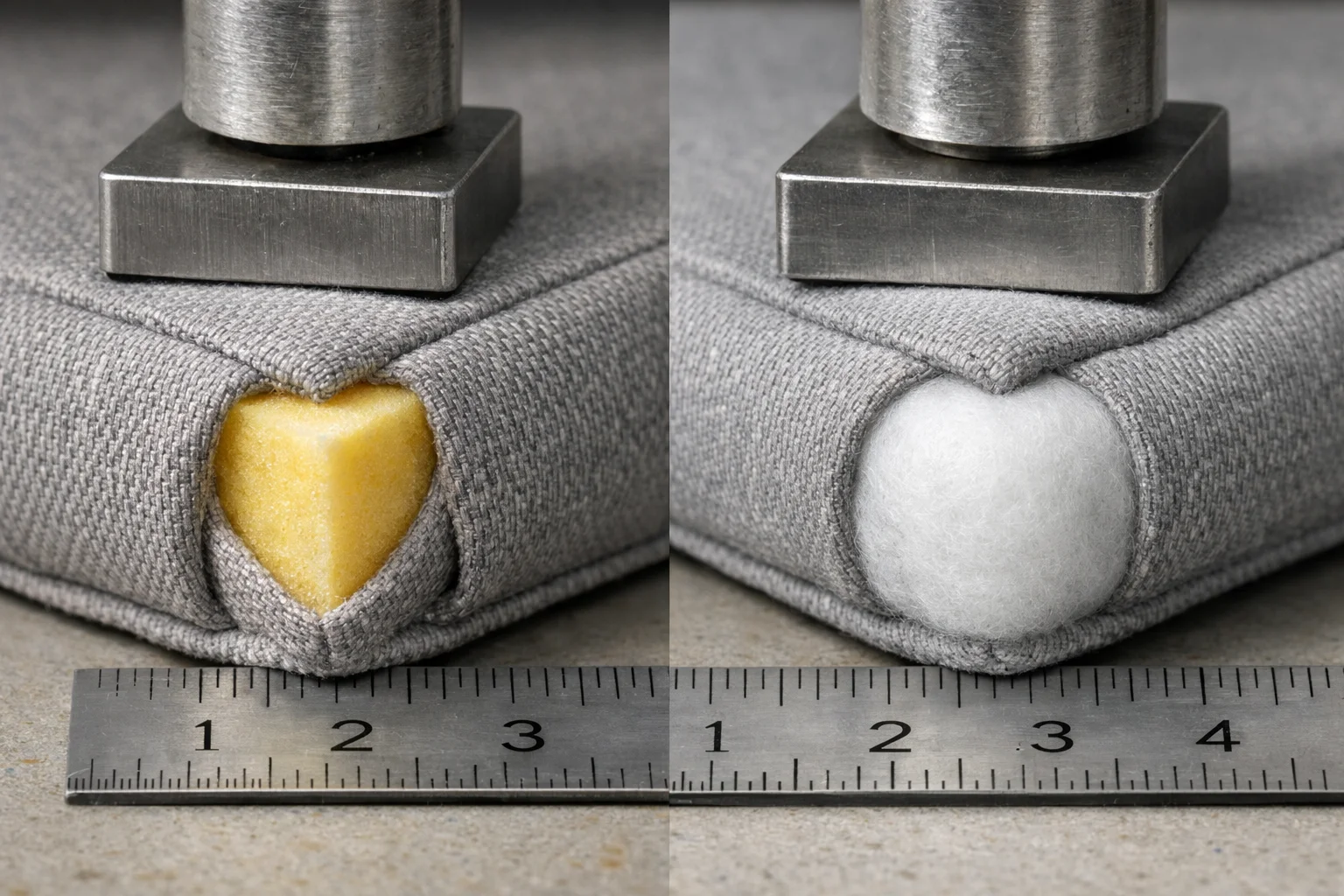
Wrapped Foam: The "Secret Sauce" of Cushions
Understanding the batting layer that creates smooth cushion appearance and protects both foam and fabric. The difference between Dacron, down, and wool wrapping materials.
Analyze Details →
Removable vs. Fixed Covers: The "Washable" Myth
Understanding the trade-offs between slipcover flexibility and fixed cover structure. Why removable covers often cannot be washed despite the expectation they create.
Analyze Details →