Elastic Webbing: Cheap Fix or Italian Luxury?
Introduction
I own a vintage Italian lounge chair that is 40 years old. It has no springs, yet it is the most comfortable seat in the house, and it does it with rubber webbing.
That one chair is why I do not buy the idea that “no springs” automatically means “cheap” or “disposable.” I have sat on plenty of spring sofas that felt great for five minutes and then started to sag, squeak, or develop that annoying tilted, hammock feeling within a couple of years.
What I have learned the hard way is that comfort and longevity are mostly about the whole support system working together, not one buzzword. Springs can be excellent, and they can also be used as a fig leaf to distract you from weak framing, flimsy decking, or cushions that collapse early.
Rubber webbing is a good example of how furniture marketing messes with your instincts. In a lot of higher end seating, elastic or rubber webbing is used intentionally because it can spread your weight smoothly, stay quiet, and avoid the “hard bar” feeling you sometimes get when spring units are under-padded.
When you are in a showroom, I want you to stop using “springs versus no springs” as your first filter. Instead, get curious about what is under you and how it is attached, because that is where the rip offs hide.
If a salesperson says “it has springs” and leaves it there, I treat that as a red flag, not a reassurance. Ask what kind of support it uses under the seat, whether it is sinuous springs, eight way hand tied springs, webbing, or a hybrid, and then ask how it is fastened to the frame.
Then do a quick reality check with your body. Sit in the same spot for a full minute, shift your weight side to side, and pay attention to whether you feel a sharp dip, a hard ridge, or a slow sinking that keeps going. A good support system, spring or webbing, should feel even and predictable, and it should bounce back quickly when you stand up.
This guide is here to help you spot the difference between honest construction and clever shortcuts. I am going to show you what I look for, what I press on, what questions I ask, and which answers usually mean “walk away,” even when the sofa feels nice today.
The "Underwear" Analogy
Not all elastic is equal.When I hear “webbing” described as if it is one thing, I think about the elastic waistband in a cheap pair of underwear. It feels fine at first, then it stretches out, stays stretched, and you are stuck with that loose, saggy feeling that never really resets. Cheap seat webbing behaves the same way, it gives you that soft initial sit, then a few months later you are chasing comfort with pillows because the support never fully comes back.
The version that changed my mind is the good stuff, especially the heavy rubber webbing people often call Pirelli style webbing. It is solid rubber reinforced with fabric, and the practical difference you will feel is “memory.” You sit, it flexes, then it snaps back instead of slowly staying deformed, and that snap back is what keeps the seat from turning into a hammock over time.
In a showroom, I do not try to diagnose chemistry or brand names, I try to catch the consequences. I press down hard with my palm near the front edge of the seat, then I let go and watch and feel how quickly it rebounds. If it comes back promptly and evenly, that is a good sign, and if it hesitates, stays slightly dished, or feels like it is stretching more the longer I hold pressure, I assume it will age badly.
I also pay attention to the kind of bounce. Cheap elastic often feels “floaty” and vague, like you can keep sinking with no clear stopping point, while better rubber webbing tends to feel controlled, like it gives and then supports you in a consistent range.
If you can get the salesperson to show you the underside, I ask for two things in plain language: what material the webbing is made of, and how it is attached. I am listening for real answers like rubber webbing with reinforcement, or high quality elastic webbing used in multiple runs, and I get cautious when the answer is just “Italian webbing” or “premium elastic” with no details.
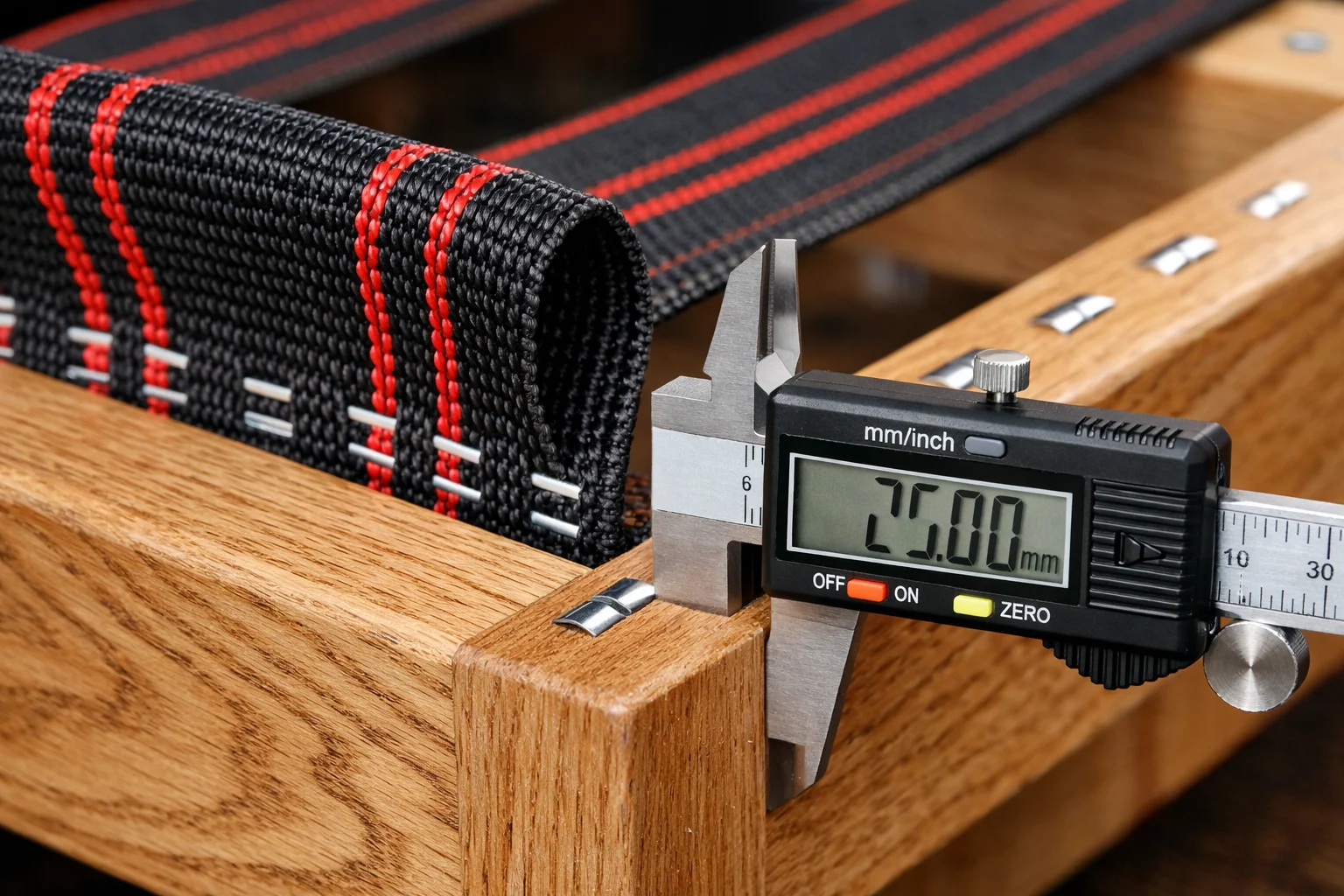
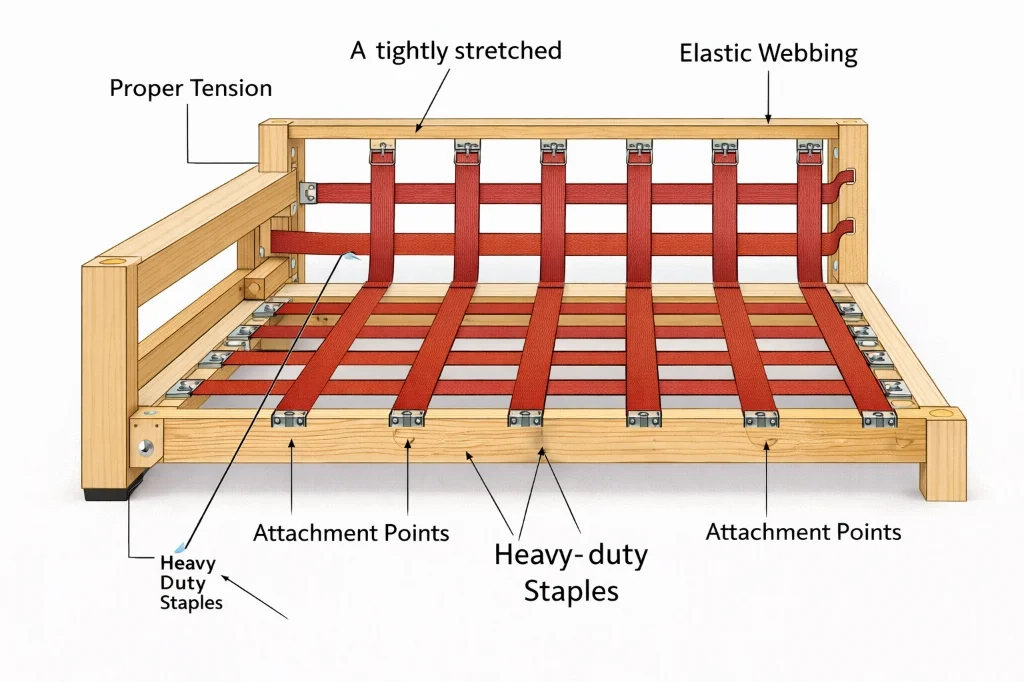
Then I look at the attachment points, because that is where shortcuts hide. Webbing that is stapled neatly, evenly tensioned, and anchored with more than a couple of random staples usually lasts longer than webbing that looks wrinkled, unevenly stretched, or barely caught at the ends, even if it feels okay today.
The other tell you can use without seeing anything is edge support. When you sit near the front edge like you are about to stand up, a good support system will keep you from feeling like you are sliding off a cliff. If the edge collapses dramatically or you feel your thighs dropping while your hips slide forward, that is often webbing that is too stretchy, too sparse, or already under tension in a way that will only get worse.
I am not telling you to avoid webbing, I am telling you to treat it like elastic in clothing. The word itself is meaningless without quality, and the quality shows up as recovery, control, and even support, not just softness on day one.
The 3 Types of Straps
When a salesperson says “webbing,” I immediately ask what kind, because three very different materials get lumped under that one word. If you can see the underside, you can often tell which one it is just by look and feel, and if you cannot, you can still use the sit test to catch the personality of each type.
Jute (The “Potato Sack”)
Jute is basically plant fiber strapping, and it behaves like a stiff belt. It does not really stretch in a useful way, so the comfort has to come from whatever padding is above it, and once it loses tension it tends to stay lost.
In a showroom, jute usually shows up as a dull, rough, tan strap that looks and feels like old packaging material. If you press down and it feels hard and board like, then later in the same sit you feel a sudden sagging pocket that does not rebound cleanly, I assume the seat is going to develop a permanent hammock.
I personally treat jute as a “why are they doing this” moment unless you are buying an antique style piece where the whole point is historical accuracy. For modern everyday seating, I would rather see almost anything else.
Polypropylene (The “Seatbelt”)
Polypropylene webbing is the tough, slick, plastic feeling stuff that reminds me of a car seatbelt. It is strong, and it does not stretch much, which sounds good until you realize that low stretch can feel dead and unforgiving.
If you sit on a sofa and your first thought is “this is oddly firm under the cushion, like a park bench,” this is often the reason. You can sometimes feel the individual runs of webbing as broad, flat bands that do not really yield, especially near the front edge where your thighs load the seat.
My showroom test for this is to shift your weight side to side and see if the seat ever “settles in” around you. With polypropylene, it often does not, it just holds you up in a flat, rigid way, and the cushion ends up doing all the comfort work, which is risky if the cushion foam is not excellent.
Elastane or Rubber (The Gold Standard)
This is the stuff that changed my mind about no springs. The good versions are a rubber core with a fabric wrap, sometimes sold under names like Pirelli style webbing, and when it is done right it gives without feeling floaty.
What I feel for is “calm” support. You sit, it yields, then it stops yielding, and when you stand up it recovers quickly instead of staying stretched, which is the whole game for long term comfort.
If you can see the underside, rubber webbing often looks denser and more substantial than generic elastic, and it usually has a more matte, grippy look. If you cannot see it, you can still catch it by doing a slow sit down and noticing whether the seat catches you in a controlled way instead of continuing to sink as you breathe and shift.
One more practical tip I use is the two stage test. I sit down, stand up, then immediately sit in the exact same spot again. With better rubber webbing, the second sit feels basically the same as the first, and with cheaper elastic systems the second sit often feels a little looser, like it is already giving up.
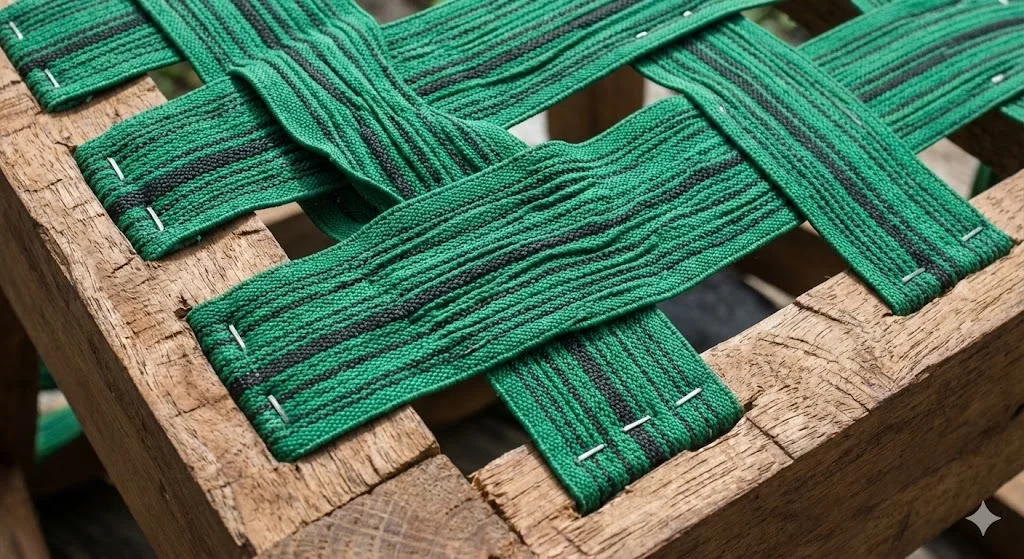
When I do get a look underneath the sofa, this is the kind of webbing I hope to see. I am not trying to be a brand detective, I am trying to see whether the straps look like serious rubber parts or like flimsy elastic you would find on a cheap office chair.
The first thing I check is strap width and “body.” If the bands are wide, usually around two inches or more, and they look matte and substantial instead of thin and shiny, I relax a bit because that visual usually matches the controlled, springy feel you want over time.
Color is not a guarantee, but it is a useful clue when you are comparing pieces side by side. A lot of the better rubber webbing I have seen is green or grey, while the stuff that worries me tends to look black, glossy, and ribbon like, and it often reads more like a plastic strap than a rubber support.
Then I look at how it is laid out across the frame. Good installations tend to look like a tidy grid with consistent spacing and consistent tension, and the straps sit flat without twisting. If I see straps that look wavy, uneven, or randomly spaced, I assume the seat will feel uneven later, even if it feels fine in the showroom.
I also focus on the ends, because that is where the whole system either holds up or slowly unravels. I want to see the straps pulled tight and secured cleanly, and I do not like seeing a couple of lonely staples, torn edges, or straps that are already curling up at the anchor point.
If you cannot see underneath, you can still use the picture as a mental reference and shop by feel. When rubber webbing is the good kind, the seat usually feels supportive near the front edge without that sharp drop, and when you stand up it rebounds quickly enough that the next person does not inherit your body imprint.
If you do see thin, shiny straps, especially narrow ones that look like slick tape, I treat that as a “proceed with caution” moment and I lean hard on the repeat sit test you already did. I will sit, stand, and sit again, and if the second sit feels looser or deeper in the same spot, I assume the webbing is stretching out in real time and it is not going to get better at home.
Why Use Webbing? (The Design Factor)
If you want that sleek, low profile sofa that looks like it is floating, webbing is often the only way to make the proportions work. Springs are not “bad,” but they are physically tall, and that height has to go somewhere.
In real terms, a spring setup needs several inches of vertical space just to exist, and it also needs room for padding above it so you do not feel the metal. Webbing can do its job in about an inch, which frees up a lot of design space for thinner arms, a thinner deck, and that crisp mid century silhouette people chase.
This is why you will keep seeing webbing under beautiful, thin framed sofas, especially anything that looks like it sits low to the ground and does not have a bulky base. The support system is chosen to fit the look, not because the maker is automatically cutting corners.
What I want you to do in the showroom is connect the design to the risk. The thinner the whole seat profile is, the less “forgiveness” there is for cheap materials or sloppy installation, because there is not much depth for extra foam, extra padding, or a second support layer to hide problems.
So when you fall in love with a slim sofa, I stop thinking “springs versus webbing” and start thinking “does this thin seat feel controlled or does it feel like a trampoline.” Sit down slowly, then shift forward like you are getting up, because that moment loads the front edge hard and it will tell you whether the webbing is doing real support work or just stretching.
I also do a quick hand check along the top of the seat, right behind the front edge. If you can feel a hard ridge or distinct bands under light pressure, that often means the seat is thin enough that the webbing pattern is telegraphing through, and that usually gets more noticeable over time as the cushion softens.
If the salesperson tries to sell you on the sleek look as proof of quality, I push back gently and ask what the payoff is supposed to be. A slim sofa can be fantastic, but it only stays fantastic if the webbing is the good kind, tensioned correctly, and paired with cushions that are not going to collapse and leave you sitting “on” the webbing instead of “above” it.
The DIY Check
The DIY Check
If the store will let you, I flip the sofa and look at the strap “grid” underneath, because it tells you in ten seconds whether the support was built like a platform or like a hammock waiting to happen.What I want to see is a woven pattern where the straps go over and under each other, not just a bunch of parallel bands. I also want the spacing to be tight and consistent, because close spacing spreads your weight and keeps the cushion from bulging down between straps as it softens with use.
In plain terms, I get comfortable when the gaps are small, around a finger width. When I see big, lazy gaps, especially anything that looks closer to a few fingers wide, I assume you will eventually feel the holes as the cushion ages, even if the sit feels fine on day one.
The failure mode I watch for is what I call the waffle iron effect. The cushion starts to sink into the empty spaces between straps, and you end up feeling like you are sitting on a grid instead of a smooth base, with soft valleys and firmer ridges that you cannot fix with fluffing.
If you cannot flip it yourself, I ask the salesperson to show me the underside or a cutaway, and I say exactly why. I tell them I am checking whether the straps are woven and closely spaced, because a supportive grid is the difference between a seat that stays even and one that slowly turns into a hammock.
Technical Summary: The Lifespan Trade-Off
When I zoom out and try to be brutally honest about what you are trading, springs usually win on raw lifespan. A well built spring seat can easily stay serviceable for twenty years or more, and I have sat on older spring sofas where the support was still there long after the fabric looked tired.
The catch is that springs tend to push the design in a bulkier direction, because they need vertical room and they need padding above them so you do not feel the hardware. So if you are shopping for a slim, low profile sofa, a “springs last longer” rule can accidentally steer you away from the very designs you like, even when those designs are being executed well.
Webbing is typically more of a ten to fifteen year play, especially with rubber based systems, simply because rubber can dry out and lose some of its snap over time. That does not automatically make it a bad buy, it just means you should treat it like a wearable component, not a forever component, and you should price your expectations accordingly.
Here is the part I actually care about as an owner, not a theorist. When webbing finally loses the plot, it is often a relatively straightforward repair because the straps are usually stapled to the frame, and a competent upholsterer can strip the bottom, pull the old straps, and install new ones without dismantling the entire seat build.
When a spring system goes, the support may still be fixable, but the path to get there is usually much more invasive. Springs are tied into the rest of the seat in a way that often means peeling back a lot more upholstery and padding to reach the failure, so the repair bill and the hassle can jump fast.
So in a showroom, I use this as a decision lens. If you are buying a sofa you want to keep for decades with minimal intervention, a genuinely well made spring seat is a comforting answer. If you are buying a very slim, webbed design because you love the look and it passes the sit tests, I just want you to go in with eyes open that you might be re-webbing it one day, and that is not the end of the world if the frame and cushions are worth keeping.
Explore Technical Reference

Dacron Wrapped Cushions: The Illusion of Softness
Why plush-looking cushions often go flat quickly. The difference between visual loft from fiber wrapping and actual structural density from foam cores.
Analyze Details →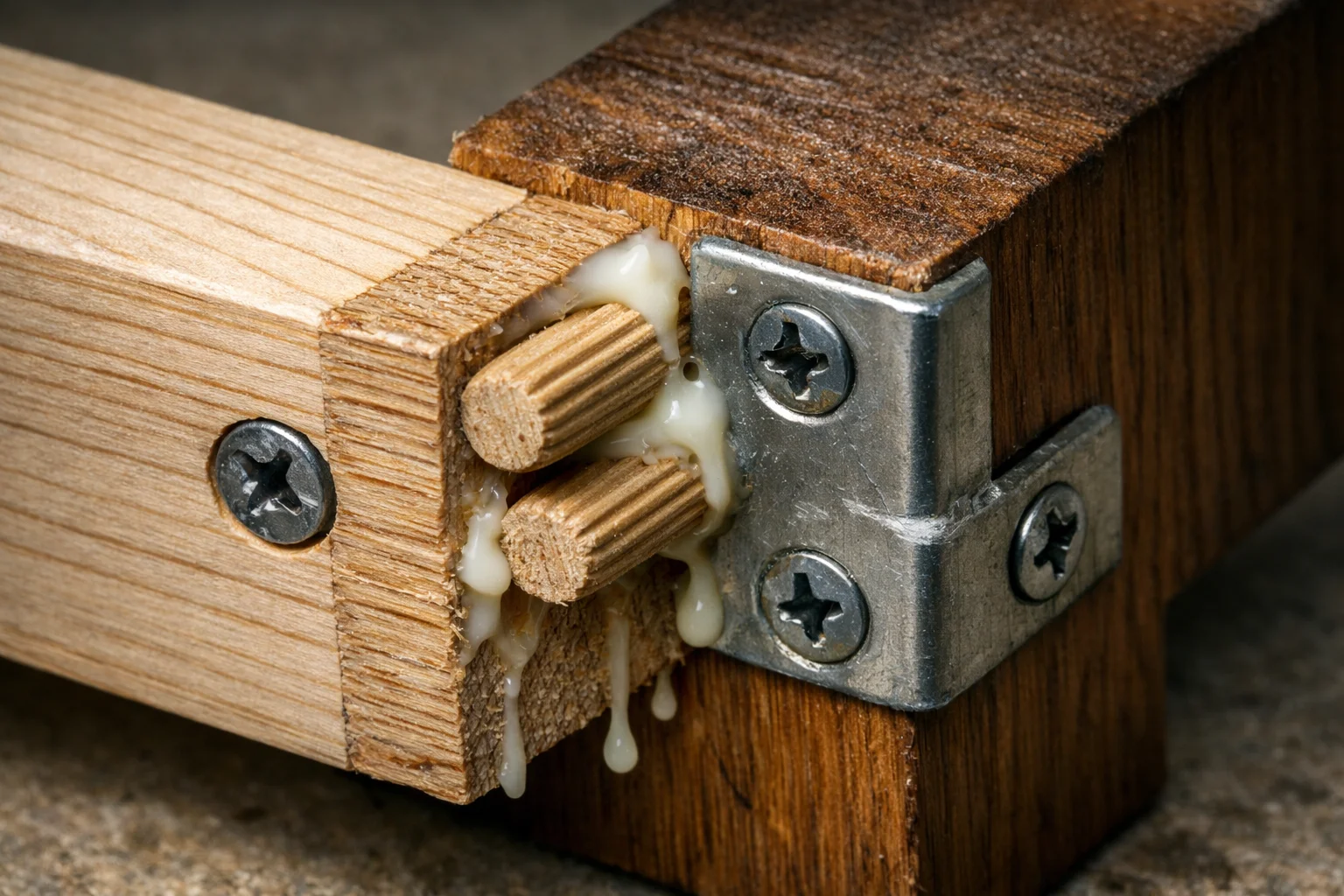
Frame Quality: The Showroom Audit Checklist
How to judge a frame you cannot see. The lift test, the squeak test, and the warranty warning signs.
Analyze Details →