Dacron Wrapped Cushions: The Illusion of Softness

Introduction
I learned the hard way that a sofa can look plush and luxurious without actually being built to stay that way. Those domed, puffy cushions that seduce you in the showroom are often being “propped up” by a layer of polyester batting, usually called Dacron, wrapped around the foam or the inner insert. It is not automatically evil, but when it is doing most of the visual work, it is basically makeup.
When I say “Dacron Trap,” I mean this specific experience: the sofa looks rounded, full, and tailored at first, then normal sitting quickly crushes that outer loft and the cushion starts looking tired. You end up feeling like you did something wrong, but the truth is you were sold the early version of the cushion, not the version you will live with.
When you are shopping, I want you to treat puffiness as a question, not a feature. The question is whether the cushion has real structure inside, or whether you are seeing a thick cosmetic wrap that will compress long before the core loses much height. If the seat looks like a cloud, I now assume there is a reason, and I try to figure out what that reason is before I get attached.
In the showroom, I press down with an open palm and hold it for a few seconds, then let go and watch what returns and what does not. If the cushion pops back but the surface looks instantly wrinkled or hollowed at the top, that is a sign the outer batting is collapsing even if the foam underneath is still springy. I also pinch the fabric at the edge of the cushion and feel for a thick, fluffy layer that seems separate from the core, because that is often the part that gives you the “new sofa glow” and then disappears.
I also pay attention to what the cushion looks like after I stand up. If the sofa is brand new on the floor and it already shows handprints, shallow dents, or a kind of permanently “petted” look, I take that as a warning about how quickly it will look lived in. Some people are totally fine with that, but I am not, and most stores do not describe it that plainly.
The goal of this guide is to help you separate the parts of a sofa that are there to impress you on day one from the parts that keep it comfortable and presentable on day one thousand. I am going to focus on checks you can do in a store, questions you can ask without sounding like an engineer, and the handful of construction choices that tend to decide whether a sofa ages gracefully or turns into a saggy project.
The "Push-Up Bra" Effect
Standard Dacron is not padding, it is a volume increaser. It is the upholstery equivalent of a push-up bra. It creates shape where there is none. Do not confuse the visual "puff" of fiber with the actual mechanical support of the foam core.When I see a seat cushion that looks extra rounded and “overfilled,” I assume I am mostly looking at fiber doing styling work. That does not mean the sofa is junk, it means you need to figure out what is providing the real support, because fiber is not the thing holding you up after a long movie night.
Here is the simple mental model I use in a store. Foam is the structure, fiber is the photo filter. Fiber can smooth the surface, hide a blocky foam shape, and make the cushion look tailored, but it cannot stop the foam underneath from feeling too soft, too thin, or cheaply spec’d.
If you want to catch the push-up-bra effect, I think you need to test the cushion in a way that forces the core to reveal itself. I sit down normally, then I shift my weight forward like I am about to stand up and pay attention to whether I suddenly “bottom out” and feel the base under me. If it feels plush at first contact but quickly turns into a hard stop, you are feeling through the fiber and finding the limits of the foam.
I also do a two-part press with my hand. First I press lightly and feel that fluffy resistance, then I press deeper until I feel the firmer, more elastic pushback of foam. If there is a big difference between those layers, and especially if the top layer feels thick and airy, I assume the pretty dome you are seeing is going to relax fast.
The edges tell on this trick, too. I squeeze the front rail area of the seat cushion and the top corners where the piping is, because fiber likes to migrate and mash down there. If the edge feels like a bag of cottony fluff around a smaller, harder block, that is a cushion that is being “presented” to you, not necessarily built to stay crisp.
When a salesperson tells you the cushions are “wrapped in Dacron for softness,” I do not argue, I just translate it. I ask what inside component is doing the support work, and I listen for a clear answer like “a higher density foam core” or “a spring and foam insert.” If the answer stays vague and keeps circling back to “fiber fill,” I take that as confirmation that the showroom look is the main selling point.
You can also learn a lot by looking for zipper access. If the cushion cover has a zipper, I ask if I can feel the insert through the opening, or at least confirm what is inside. If there is no zipper and the cushion is sealed shut, I assume I will have fewer options later if the outer loft collapses and the cushion starts looking sloppy.
What you do with this information depends on your taste. If you genuinely like a relaxed, rumpled sofa and you do not mind fluffing and rotating cushions, then a fiber-heavy look can be fine. If you want the sofa to keep its shape with normal use and minimal fuss, I would treat extreme puffiness as a yellow flag and push yourself to find a seat where the foam core itself looks well-shaped and supportive, even before the fiber does its cosmetic work.
The last thing I do is step back and look at the cushion silhouette from the side. If the cushion looks tall and domed but the seat feels low and sinky, that mismatch often means you are seeing loft that will not last. I would rather buy a cushion that looks slightly flatter on day one but feels consistent and supportive through the whole press, because that is the one that usually still looks respectable after the honeymoon period ends.
What is Dacron?
Dacron is basically polyester batting, a brand name that got popular enough that people use it like a generic term. In plain English, it is a sheet of synthetic fiber that feels a bit like fluffy wool, except it is plastic fibers formed into a soft blanket.
In upholstery, I treat it as a cosmetic wrap that sits between the fabric and the foam. It smooths the outline so you do not see sharp foam corners through the fabric, it adds that “new sofa loft,” and it can make an average cushion look more tailored than it really is.
What matters for you in a store is that Dacron comes in different thicknesses, and thickness is usually code for how much of the sofa’s first impression is coming from fiber instead of the core. A very thin wrap is often just there to keep the fabric from looking bony and to reduce friction between fabric and foam. A standard wrap gives the cushion a noticeably rounder top, and a plush, thick wrap can make the cushion look dramatically fuller even if the foam underneath is pretty ordinary.
When you are sitting on a sofa with a lot of Dacron, the first contact often feels welcoming and pillowy, then the sensation changes as you compress through the fiber and hit the foam. That shift is not automatically bad, but I want you to notice it, because the part that compresses fastest over weeks and months is usually that outer loft.
If you can get access to a zipper, I like to pinch the wrap itself. Dacron feels like a uniform, springy blanket around the insert, not loose clumps like a stuffed animal. If what you feel is extremely thick and airy, and the foam underneath feels smaller than the cushion looks from the outside, I assume some of that showroom “height” is borrowed.
Salespeople sometimes describe these wraps in ounces, and you do not need to memorize the specs, you just need the translation. The thinnest wraps tend to show up on cheaper arms and backs where the maker is trying to hide hard edges without spending more on better padding. A more typical wrap adds a modest, visible loft and is common on lots of decent sofas. The really plush wraps add a lot of puff, and that is where I get extra cautious about how the sofa will look after the fiber relaxes.
If you want a simple way to use this, ask one direct question while you are standing there: is the cushion wrapped in a thin smoothing layer, or is it wrapped in a thicker loft layer meant to make it look fuller. If you hear that it is “extra plush” or “double wrapped,” I take that as my cue to focus even harder on whether the foam core feels supportive and consistent when I press deep, because I know the wrap is doing a lot of styling work up front.
The Flattening Physics (Why It Fails)
What makes Dacron tricky is that it does not really have “memory” in the way foam does. Foam is like a springy field of tiny cells that wants to rebound after you get up, while batting is more like a mass of slick plastic fibers that can rearrange and stay rearranged.
When you sit, your weight does not just press down, it crushes the loft. Those fibers bend, buckle, and pack closer together, and the cushion loses that rounded, freshly upholstered look faster than most people expect.
Heat makes it worse, and I think this is the part shoppers never get warned about. Your body warmth softens polyester a little, not enough to feel hot or melty, but enough that the fibers deform more easily while they are under pressure, so the same “sit” does more long term damage than you would guess from a quick showroom test.
After enough cycles of weight plus warmth, the fibers start grabbing and locking together. Upholstery people sometimes call this felting, and you can think of it as the wrap turning from a fluffy blanket into a thinner, tougher pad that does not want to loft back up.
In real life, that is why a cushion can go from looking two inches puffy and crowned to looking flatter and a bit harsh in the same spots you sit, even if the foam core underneath still feels basically fine. The wrap is the part that takes the early beating, and once it compresses into a denser layer, it also tends to telegraph wrinkles and a “lived in” sheen through the fabric.
In a showroom, I try to simulate this failure mode instead of just doing one polite sit. I sit in the exact same spot and do a few slow, deep compressions, leaning back and then forward as if I am watching TV and then reaching for a coffee table, because that is the kind of movement that repeatedly loads the same front edge and the same sit bones.
Then I stand up and look for the specific tell, which is a cushion that regains height in the middle but keeps a shallow dish or a faint ridge where my legs were. If the shape comes back unevenly, that is usually the fiber wrap staying mashed while the foam rebounds underneath.
I also like to do a “heat and pressure” proxy with my hand. I press my palm down firmly and keep it there longer than feels natural in a store, then I release and watch whether the fabric surface looks slightly puckered or newly rumpled even though the cushion height looks similar. When the surface texture changes faster than the height, I assume the wrap is the weak link.
If you want one practical question to ask that cuts through the marketing, I ask whether the cushion is designed to be “self dressing” or whether it is meant to be fluffed and rotated to look right. If the salesperson casually says you will want to pat the cushions back into shape, that is not automatically a dealbreaker, but it is a pretty honest hint that the loft layer is expected to compress and migrate.
What I do with that answer depends on what you want from the sofa. If you do not want maintenance, I would rather see a cushion that looks a touch flatter and more tailored on day one, because that usually means the core is doing more of the shaping work and the wrap is just there to smooth, not to perform. If you love that cloud look, I would at least go in with eyes open and choose a sofa where you can access the insert later, because replacing a wrap is a lot easier than replacing a whole cushion you cannot open.
Bonded vs. Unbonded (The Quality Check)
When I’m trying to figure out whether a sofa will stay looking crisp, this is one of the few Dacron details that actually matters in real life. Some cushions use unbonded fiber, which is basically loose, dry fluff, and it behaves like the stuffing in a cheap throw pillow. It shreds, it bunches up, and it slowly walks away from the high pressure zones where you actually sit, so you end up with corners that feel overstuffed and a seat top that looks hollowed out and messy.Bonded fiber is the version I look for because it is the same idea, but stabilized. The fibers are lightly glued together so they act more like a coherent sleeve around the foam instead of a cloud of lint, which means they resist clumping and they are less likely to migrate into the front edge and corners. In plain shopping terms, bonded fiber tends to keep the cushion looking more even, and it keeps that “one spot is flat, one spot is lumpy” look from showing up as quickly.
In a showroom, I do not assume the salesperson knows what kind it is, so I ask it in a very specific way: you can say, “Is the Dacron wrap bonded, sometimes called bonded Dacron, or is it loose fiber batting?” If you get a vague answer like “it’s polyester” or “it’s Dacron,” I treat that as a non answer and ask if they can check the spec sheet or the manufacturer description.
If the sofa has a zipper and they will let you open it, I use my fingers instead of my imagination. Bonded wrap tends to feel like a slightly springy, uniform layer that wants to stay in one piece when you pinch it, while unbonded wrap is more like grabbing hair or dryer lint, it feels wispy, it pulls apart, and it does not have much integrity. If all you can do is feel through the fabric, I squeeze the top corner of the cushion and the front edge, because those are the places unbonded fiber loves to abandon or overstuff, and unevenness shows up there first.
I also watch what happens when I do a couple deep sits in the exact same spot and then stand up. With unbonded fiber, I often see a slightly ropier, rumpled surface texture and a kind of dragged looking fabric at the front edge, because the fiber is shifting inside the cover instead of staying evenly wrapped around the foam. With bonded fiber, the cushion might still relax a bit, but it usually relaxes more evenly, which is what you want if you are trying to avoid that “why does it already look worn” feeling.
If you like a relaxed look and you do not mind occasionally rotating and patting things into place, unbonded fiber might not ruin your life, but I personally avoid it on seats because the failure mode is so annoying. If you want the sofa to keep its shape without babysitting it, I would push for bonded Dacron on the seat cushions, and I would consider it a small red flag if nobody can tell you what they used.

When you see a cushion with that smooth, rounded “waterfall” front edge, what you are often looking at is the wrap doing styling work, not just the fabric and foam. The “book wrap” idea is basically that the batting is folded around the foam like you would fold a cover around a book, which is a neat way to hide a squarer foam core and still present a soft, curved edge.
In a store, I use this shape as a cue to check whether the cushion will keep a clean front edge, because that edge gets punished every time you perch, slide off, or sit forward. I press right on the front lip with my fingertips and then with my whole palm, and I pay attention to whether it feels like a substantial, supportive front edge or like a fluffy roll sitting in front of a smaller, harder block.
If you can unzip the cover, this is one of the easiest places to confirm what you are dealing with. I look at whether the wrap stays like a single sleeve around the foam, which suggests a bonded wrap, or whether it looks like separate sheets or tufts that can shift, which is where I start expecting the waterfall edge to turn into a wrinkly, collapsed edge with use.
Even if you cannot open anything, you can still test the “book wrap” failure mode by doing one very specific sit. I sit a little forward so my thighs load the front edge, then I stand up and look at the front band of fabric. If the front edge immediately shows a dragged, slightly loosened look while the rest of the cushion still looks tall, I assume the wrap is already compressing and creeping right where I will notice it every day.
What I personally want to see is boring consistency. If the cushion looks less dramatic from the side but the front edge feels firm and springs back evenly, I trust it more than a super rounded waterfall that only exists as long as the batting stays lofty.
Application Methods
How the fiber is applied matters as much as what it is. In a showroom, I am trying to figure out whether the wrap is secured to the foam in a way that keeps it evenly distributed, or whether it is basically a loose hat that will slide, bunch, and betray you.
The Direct Lay (Cheap)
This is the one I avoid on seat cushions whenever I can, because it is exactly what it sounds like. The maker just lays a loose square of batting on top of the foam and then pulls the cover over it.
In a store, I look for the telltale “shifty” surface. When you run your hand across the top, it can feel like there is a separate fuzzy layer skating around instead of one unified cushion, and after you stand up you can sometimes see a slightly uneven puff on one side where the batting has crept.
If you can unzip the cover, this method is obvious because the batting is not attached. If you cannot unzip it, I do a firm press near the front edge and then a second press near the back, because a direct lay often turns into a cushion that looks lumpy on top even though the foam underneath is fine.
If you love the sofa otherwise, I would at least treat it like a maintenance sofa. You are probably going to be smoothing and redistributing that top layer by hand, and it is the kind of cushion that can start looking messy long before it feels uncomfortable.
The Book Wrap (Standard)
This is the minimum version I consider acceptable for a normal foam seat. The wrap is attached to the foam and folded over the top, front, and bottom like a jacket, and the sides are often left open so the cushion can “breathe” and the cover can slide on without fighting you.
In the showroom, what I like about this method is that the fiber tends to stay where it was put. When I press and release, the cushion surface usually settles more evenly instead of developing one flat spot next to one puffy spot.
You can also use the seams to your advantage here. I pinch near the side seam and compare it to the top center. With a decent book wrap, those areas feel like the same cushion in different spots, not like the center is hollow and the edges are stuffed.
If a salesperson is being vague, this is a good time for a simple question that does not sound technical. I ask whether the wrap is glued or otherwise attached to the foam core, or if it is just laid in loose inside the cover.
The Envelope (Premium)
This is the method that tries to mimic a down feel without actually being down. Instead of a sheet of batting, there is usually a ticking bag that holds loose blown fiber, sometimes treated to be slicker so it shifts and refluffs more easily, and that bag “envelopes” the foam.
When I sit on this kind of cushion, I expect it to feel more luxurious at first contact, but I also expect more upkeep. The fiber can move, and that means you will often need to fluff and pat the cushion back into shape to keep it looking even.
In a store, I test this by doing a couple of sits and then looking for a subtle moat effect around where I sat, especially near the front edge. If the cushion looks great while you are on it but looks slightly dish shaped after you get up, that is not necessarily poor quality, it is a clue that you are buying a cushion that wants occasional dressing.
If you want this feel, I would not buy it unless you have zipper access and you are comfortable with the idea of maintaining it. I also ask directly whether the fiber is in a baffled inner bag, because baffling is what helps keep the fill from all rushing to one end and turning into that annoying “one corner is fat, one corner is empty” problem.
Repairing the “Puddle”
If your sofa looks sad and wrinkly, what people often call puddling, I do not automatically assume the whole cushion is shot. I have seen plenty of seats where the foam core still had decent spring, but the outer Dacron wrap had basically given up and turned into a thin, stubborn pad that will not loft again.
The first thing I try to figure out is whether you are dealing with a looks problem, a comfort problem, or both. If you sit and the cushion still feels supportive and you do not feel yourself sinking down to the deck, but the top looks baggy and creased, that is the classic “wrap died first” situation.
You can do a quick home check without tools. I smooth the fabric tight with my hands from the back toward the front, then I stand back and see if the wrinkles come right back in the same places. When the same shallow dish and the same diagonal wrinkles reappear quickly, that is often the cover no longer being “held up” evenly by loft underneath.
If your cushion cover has a zipper, this is where you get real leverage. I unzip just enough to feel the layers and I try to separate what is foam from what is wrap, because it tells you what is worth fixing.
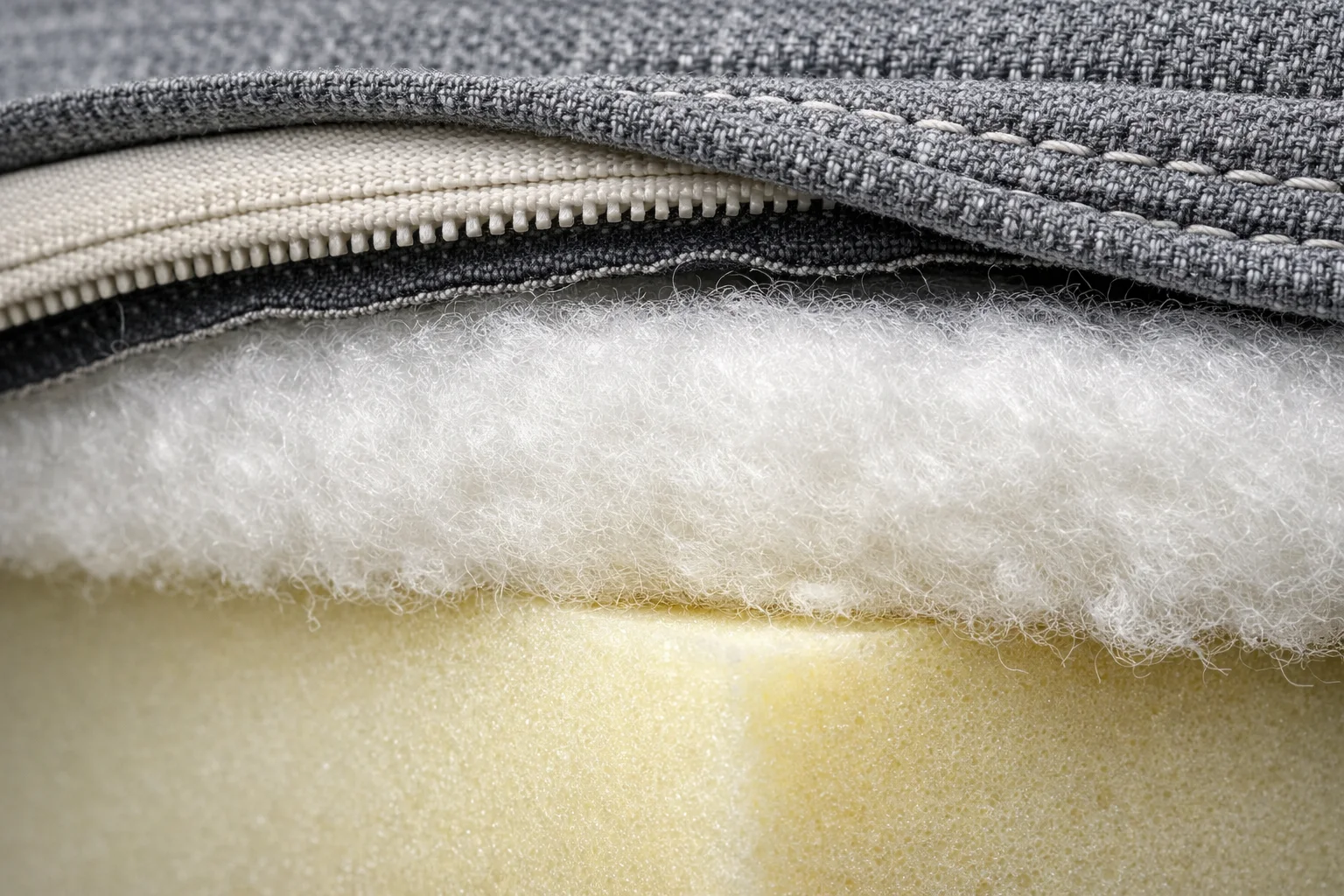
If you pinch what should be the Dacron and it feels thin, crunchy, or matted, like a dense felted sheet, I treat that as good news in a weird way. It often means the foam is not the main culprit, and replacing that wrap can bring back a lot of the tailored look for less money than replacing the whole insert.
If you pinch and you feel loose, lumpy clumps instead, I assume the fiber has migrated and shredded. That can still be fixable, but the “repair” is usually less about refluffing and more about opening it up, redistributing or removing the messy stuff, and replacing it with a fresh, more stable wrap.
If there is no zipper, I get more cautious, because your options narrow fast. I have learned that a sealed cushion is basically the manufacturer telling you they do not expect you to service it, so any fix becomes either a professional upholstery job or a compromise like living with the wrinkles, using a throw, or swapping the whole cushion if the brand will sell you one.
In a showroom, this is exactly why I care about zipper access even when the sofa looks perfect. I ask, “If the cushion starts to puddle, can I open it and rewrap it, or is it sealed?” If they cannot answer, I assume the worst and I price that into my decision, because the prettiest cushions are often the ones that look the saddest when the loft collapses.
If you do have zipper access and the cushion insert is removable, the practical repair is usually rewrapping, not doing anything heroic to the foam. The foam tends to fail by losing height and resilience, which feels like bottoming out, while the wrap fails by losing loft and evenness, which looks like wrinkles and a collapsed crown.
I also pay attention to whether the cushion looks puddly because it is underfilled in general, or because it has one dead zone where you sit. When it is localized to your favorite spot, that points to crushed wrap plus a cover that has relaxed a bit, and a fresh wrap can often tighten the appearance enough that you stop noticing it every time you walk into the room.
One thing I would not let a salesperson do is talk you into thinking puddling is always “normal.” Some relaxed styles are meant to look rumpled, but if you bought a sofa for a clean, tailored look and it turned into a wrinkly dish quickly, that is not a personality trait, it is a cushion system aging early.
If you are shopping and you want to avoid needing this section at all, I would ask one simple question that forces clarity: “If the cushion starts wrinkling, is the insert designed to be rewrapped, or do I have to replace the whole thing?” The tone of the answer tells you a lot about whether the brand expects the sofa to be maintained or discarded.
If you are already living with puddling and you are trying to decide whether it is worth fixing, I use this rule of thumb on my own furniture. If the seat still feels good and the frame is solid, I am willing to spend money on refreshing the cushion wrap because it is one of the rare repairs that can improve how the sofa looks without turning into a full rebuild. If the seat feels like it is collapsing and the support is gone, new Dacron will not save it, it will just put makeup on a worn out core.
The Steam Rescue Hack
The Steam Rescue Hack
Before you replace anything, I would try steam, because it can make a crushed fiber wrap look dramatically better for a little while, and it costs almost nothing if you already own a garment steamer. The basic idea is to get the cover out of the way if the fabric and construction allow it, or steam right through the upholstery if it is a robust, tightly woven fabric that can take a little moisture without spotting.When I do it, I am trying to reintroduce a bit of loft into that matted polyester layer. The moist heat can relax the fibers enough that they spring apart again, and you will often see the cushion visibly puff as you work, especially around the dead, shiny zones where people always sit.
I treat the result as a temporary rescue, not a real fix. It can buy you time, it can make a sofa presentable for guests, and it can help you confirm that the ugliness is mostly the wrap and not a totally failed foam core.
I want you to be careful about when to bother with this. If the cushion feels supportive but looks flat and wrinkly, steam is worth trying because you are chasing a looks problem caused by crushed wrap.
If you sit down and you are bottoming out, steam will not change the underlying support. In that case, any “puff back up” you see is mostly cosmetic, and it can trick you into putting off the real solution.
If you are doing this at home, I do a quick fabric sanity check first. If water leaves marks on the fabric when you blot a hidden area, or if the fabric is a delicate velvet, rayon blend, silk, or anything that looks like it would spot easily, I skip steaming through the cover and I only consider it if I can safely remove the cover and steam the insert wrap itself.
If the cover does come off, I keep the steam moving and I do not soak anything. I hold the steamer a little off the surface and work in slow passes, then I stop and use my hands to gently “tease” the loft back up, because the steam helps but the physical fluffing is what redistributes the wrap.
If the cover does not come off and I am steaming through the fabric, I pay attention to the seams and piping. Those areas like to hold moisture, so I give them extra time to dry before I sit on the cushion again, because sitting on a damp cushion is a great way to mash everything right back down.
After steaming, I let the cushion fully dry and cool before I judge it. Warm fiber can look puffier than it will look once it settles, so I check it again later the same day or the next morning to see what actually held.
Here is the part I wish someone had told me earlier. If steaming makes a cushion look much better, it is strong evidence that the foam core is not your main enemy, and you might get real mileage out of a proper rewrap later instead of buying all new inserts.
If steaming barely changes anything, or the cushion puffs for an hour and then collapses back into the same dish, I take that as a sign the wrap is too far gone, or the foam underneath is also tired. That is when I stop trying clever tricks and start thinking about whether the cushion is serviceable, meaning zippered and rebuildable, or disposable, meaning sealed and replacement only.
Technical Summary: The Dacron Specification
I try not to get hypnotized by the “cloud” look, because that is exactly where the trap lives. A super rounded cushion can be hiding a soft, low density foam core that will feel okay in a quick test and then start to feel unsupportive once the fiber calms down.When I want a cushion that stays presentable, I push the conversation back to the core. I ask what the foam density is in the seat cushions, and I specifically listen for a real number at or above 2.5 lb density. If nobody can tell you, or they dodge the question and keep selling the wrap, I treat that as a warning that the cushion is being styled more than it is being built.
Then I ask for the wrap spec in plain terms. What I personally look for is 1.5 oz bonded Dacron applied as a book wrap, because that combination is usually enough to give you the nice crown and the smooth “waterfall” edge without relying on loose, lofty fluff that collapses fast. If the salesperson does not know what that means, I ask them to check the written spec sheet or the manufacturer description, because this is one of those details that often exists on paper even when it is not on the hang tag.
For Dacron Repairs and Replacements
- Dacron polyester batting — the standard wrap used to restore loft and shape to sagging cushion covers.
- Handheld garment steamer — used for the steam hack to temporarily revive compressed fiber wrap.
Explore Technical Reference
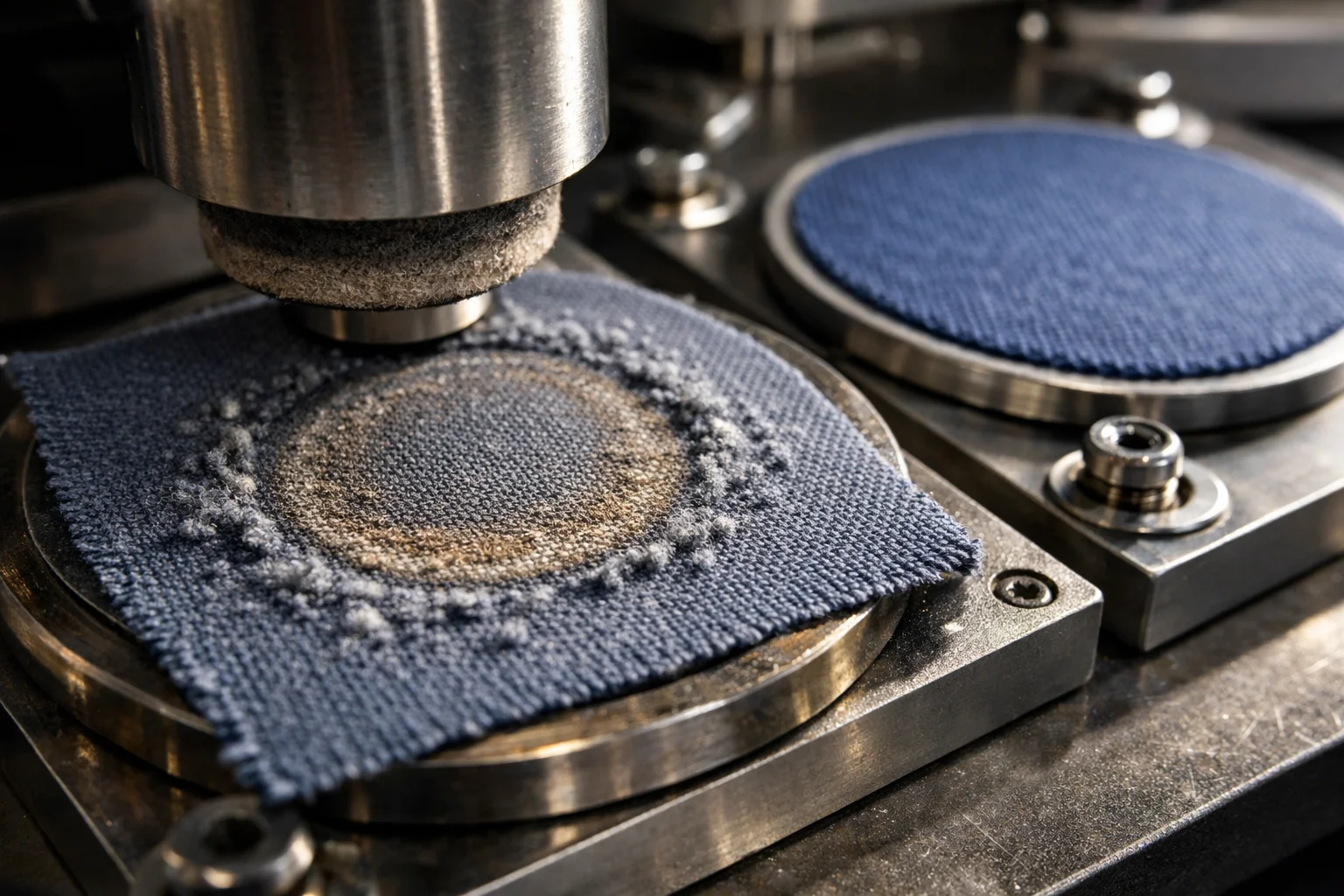
Fabric Types: The Durability Hierarchy (Pet & Kid Proofing)
Understanding the durability hierarchy from microfiber to silk. Why velvet is tough and cotton is fragile despite common assumptions.
Analyze Details →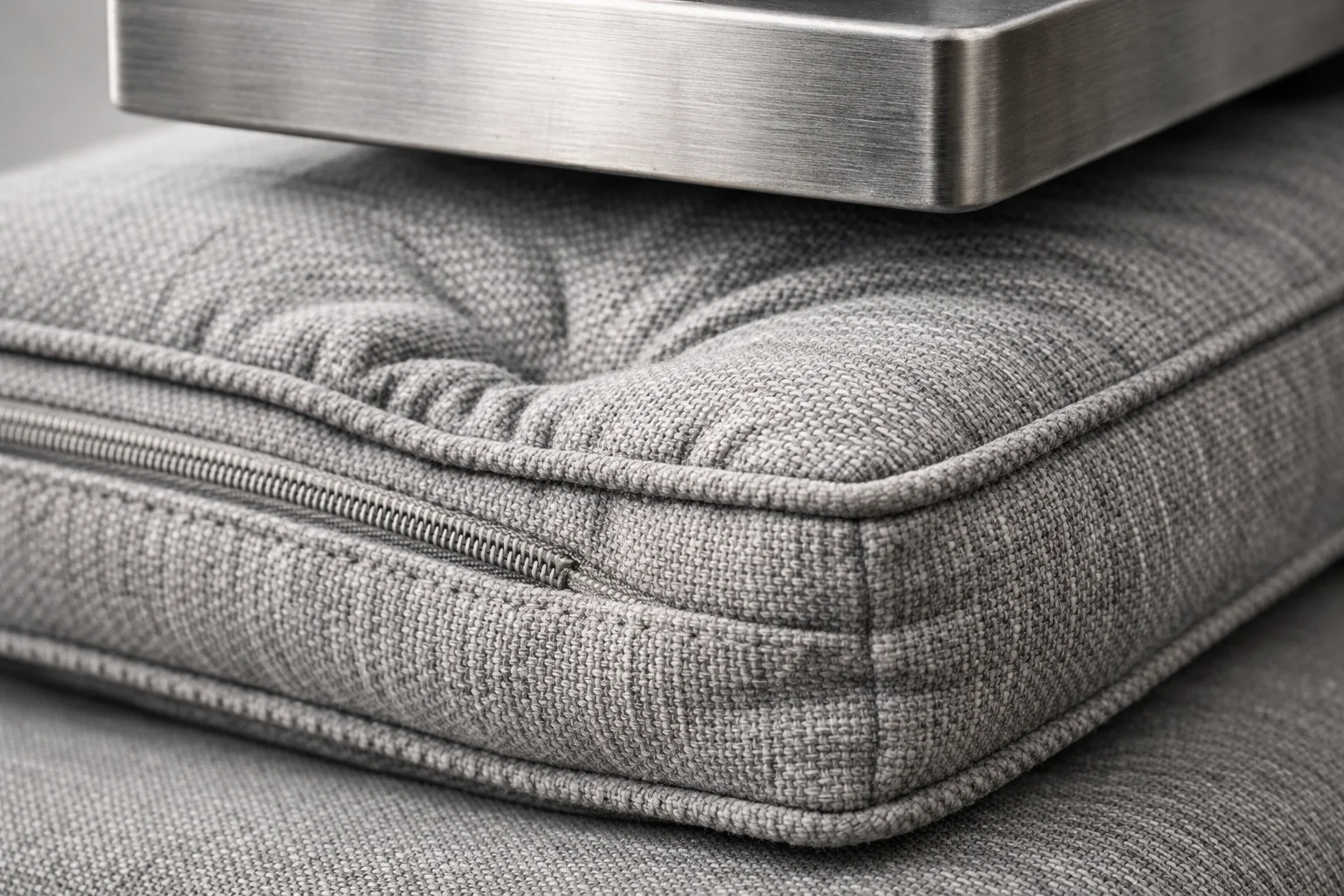
Spring Down Cushions: The "High Maintenance" Luxury
Understanding why premium spring-down cushion construction requires ongoing maintenance. The trade-off between exceptional comfort and required effort.
Analyze Details →