Spring Down Cushions: The "High Maintenance" Luxury
Introduction
That moment taught me something important. Comfort in a showroom is not the same thing as comfort six months later in your living room. The way a sofa feels for five minutes under bright lights tells you almost nothing about how it will behave when you stop babying it.
I started paying attention to what actually goes wrong with sofas people own, including mine. Cushions that look great at first but collapse. Seats that slope forward after a year. Frames that creak once the return window is long gone. None of this is obvious when you first sit down.
I am not here to tell you what brand to buy or what style is in. I am here to help you avoid the mistakes I made by showing you what to physically check and ask about while you are standing in the store. You do not need technical specs or fancy terminology. You need to know how the sofa will react to your habits, your body, and the people and pets who will actually use it.
As you read, imagine your worst sofa behavior, like flopping down, napping, letting a dog claim one cushion forever, or never rotating anything. If a sofa only works when you treat it carefully, it is not built for real life. This guide is about spotting that before you swipe your card.
The "Lazy" Test
Spring Down is often described as the Ferrari of sofa cushions, and I get why the first time you sit on it. The surface feels soft and welcoming, and there is a buoyant push underneath that makes the sofa feel alive instead of dead.
What nobody emphasizes in the showroom is that this comfort comes with homework. These cushions are designed to be fluffed and rotated constantly, sometimes daily, to keep their shape. If you skip that step, the feathers migrate, the springs stop helping, and the cushion starts to look tired fast.
I learned this the hard way. I am lazy, and I assume you might be too, or at least busy. Within six months my once perfect seat looked like a deflated pancake, even though it still felt soft when I sat down.
Here is how I use the lazy test when you are in the store. Ask what is inside the seat cushion and listen for the words spring down. Then ask if the cushion needs regular fluffing to keep its shape. If the salesperson hesitates or says yes but downplays it, assume daily maintenance is expected.
Next, physically grab the cushion and give it a lazy person test. Sit down hard, stand up, and see if the cushion rebounds on its own. If it stays compressed or wrinkled until you punch it back into shape, that is your future if you do not plan to baby it.
I am not saying spring down is bad. I am saying it is only right for you if you enjoy maintaining your sofa the way some people enjoy caring for plants. If you want a sofa that forgives neglect, this is the moment to be honest with yourself and walk away.
Anatomy of the "Perfect" Cushion
When salespeople talk about the perfect cushion, they usually mean spring down. I used to nod along without really understanding what that meant, until I lived with it and watched how it aged.
Spring down is not one material. It is a layered system that only works as well as its weakest part, and you can feel each layer if you know what to check while you are sitting there.
At the center are pocket springs, sometimes called Marshall coils. These are small springs wrapped in fabric, and their job is to give the seat lift and bounce instead of that dead, sinking feeling. When they are doing their job, you feel gently pushed back up when you stand.
Around those springs is a box of high density foam. This foam is not there for comfort, it is there to hold everything in place and keep the cushion square. If this foam is cheap or thin, the cushion will start to bulge or slump even if the springs are fine.
On the outside is a thick wrap of down and feathers. This is the part you feel first, and it is why spring down feels luxurious in the showroom. It is also the part that moves, clumps, and escapes if you do not manage it.
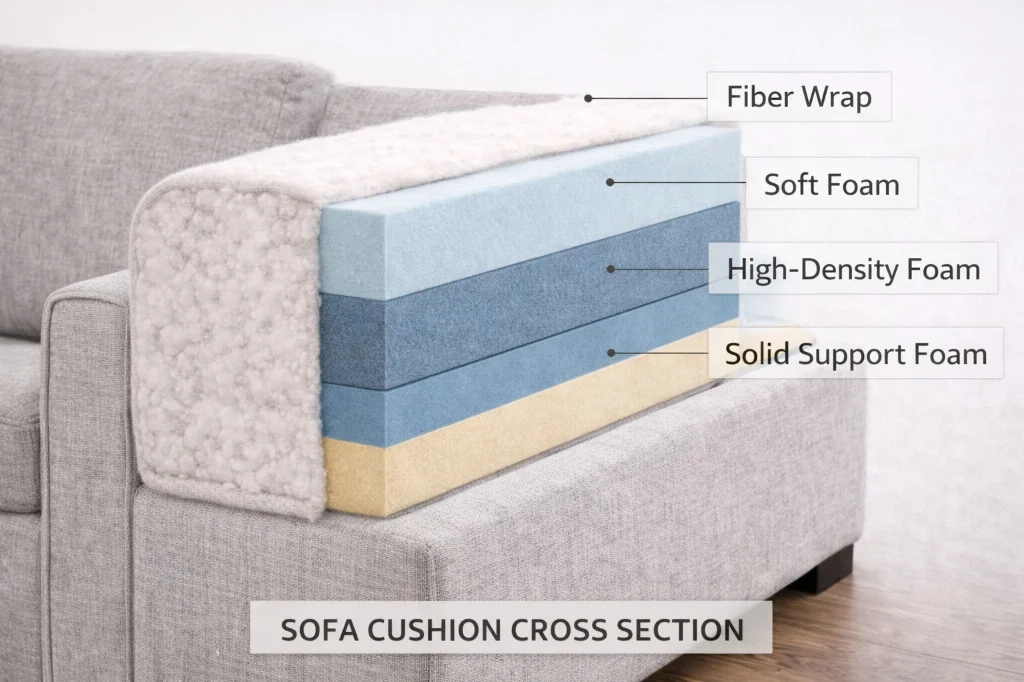
Here is what I actually do in the store to judge this sandwich. I unzip the cushion if they allow it, or I squeeze the sides hard. You are feeling for resistance at the edges. If the sides collapse easily, the foam box is weak, and the cushion will lose its shape no matter how good the springs are.
Then I sit in the same spot for a full minute and stand up. I watch the cushion, not how it feels under me. If the center pops back up but the surface looks rumpled and uneven, that is the down telling you it needs daily attention.
I also press down with my hand until I feel the springs engage. If I have to push very far before anything pushes back, the down and foam are doing all the work, and the springs are more of a marketing feature than a support system.
The important thing to understand is that spring down is expensive because it tries to do everything at once. It wants to be soft, supportive, and structured. That balance is fragile. When one layer gives up, the whole cushion looks tired even if parts of it are still fine.
If you love that hotel sofa feel and you are willing to fluff, rotate, and babysit your seats, this construction can be wonderful. If you want to sit down and forget about it for a week, the same design will quietly punish you over time.
I learned to stop asking if a cushion is high end and start asking how each layer behaves when I ignore it. That mindset has saved me more money than any warranty ever did.
The Failure of Neglect
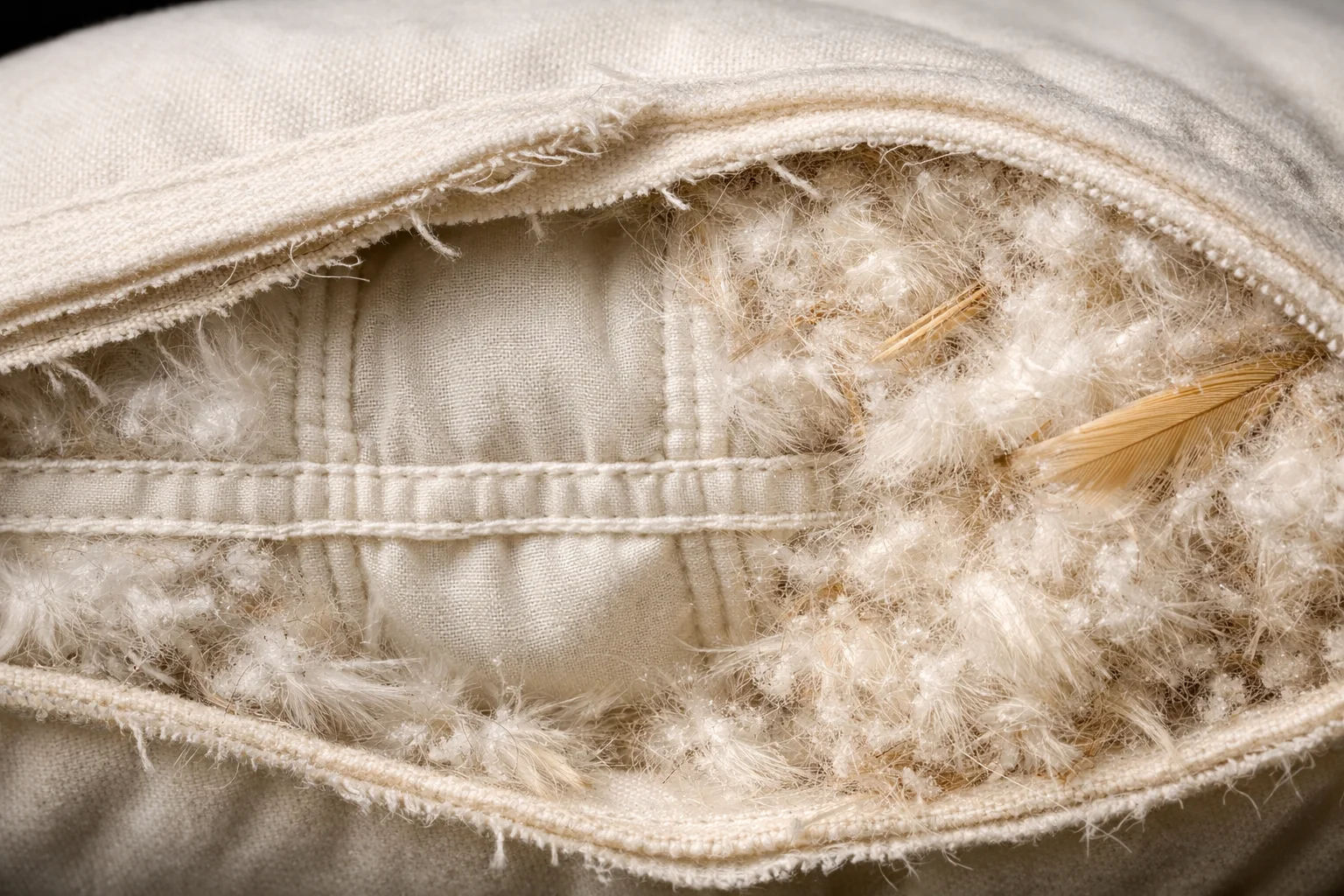
Down and feathers behave like a fluid, and once I understood that, a lot of ruined cushions suddenly made sense. When you sit, the feathers slide away from the pressure and drift toward the corners and edges. When you stand up, they do not magically return to the center.
What brings them back is you. The design assumes you will punch, knead, and redistribute the filling by hand, over and over again. If you do not, the center of the cushion slowly empties while the edges get heavy and overstuffed.
This is not just a cosmetic problem. Inside that cushion, the springs are meant to stand straight and share the load. When the feathers stop supporting them evenly, the springs start to lean, and once they tilt, they rarely recover.
I have felt this happen in my own sofa. One day the seat looked a little uneven, and a few months later it felt lumpy no matter how much I fluffed it. At that point the damage was already done, because the internal structure had adapted to neglect.
Here is what I want you to do in the showroom. Sit on a cushion, then stand up and walk away for a minute. Come back and look at it from the side and from the front. If the center looks hollowed out or the corners look puffed up, that cushion is already telling you how it reacts when ignored.
Then push down near the front edge and release. If the surface skin slides or wrinkles instead of lifting evenly, the feathers are free to migrate. That means maintenance is not optional, it is structural.
I also pay attention to how the salesperson talks about care. If they casually mention fluffing as if it were wiping crumbs off the fabric, I slow the conversation down. I ask how often a real owner needs to do it to keep the cushion looking level, not luxurious, just level.
This is where you need to be brutally honest about your habits. If you know you will always sit in the same spot and never rotate cushions, a down heavy seat is working against you. The sofa is not forgiving, it is silently keeping score.
Neglect does not show up in the first year photos. It shows up when one seat dips, another feels higher, and everyone fights over the least ruined spot. When you see that in someone’s house, it is not because they bought cheap furniture, it is because the design demanded attention they never planned to give.
I no longer judge a cushion by how good it feels when I sit down. I judge it by how badly it will punish me when I forget about it, because that is the version of me that will actually live with it.
The "Spring Poly" Alternative
If you like the idea of spring support but do not want a relationship with your cushions, this is where I tell people to look first.In the store, I ask for something called spring poly or pocket coil with a foam wrap. What that usually means is the same small springs in the center, but instead of down and feathers on the outside, they use fiber or batting that is stitched and anchored in place.
The practical difference shows up after you stand up. These cushions are built to rebound on their own. You sit, you get the lift from the springs, and when you walk away the surface smooths itself without needing to be punched back into shape.
Maintenance is almost nonexistent compared to spring down. You are not expected to fluff or rotate constantly, and the filling does not migrate away from the center when you use the same spot every day.
Here is how I check this in the showroom. I sit down firmly and then stand up and watch the cushion for a few seconds. If the surface rises evenly and looks basically the same as before I sat, that is a good sign.
Then I press along the front edge with my hand and release. I am looking for the cushion to lift as one piece instead of wrinkling or sliding under the fabric. If it behaves like a single unit, the wrap is doing its job.
I also ask a very plain question and listen closely to the answer. I ask how often an owner needs to fluff the seat to keep it looking level. If they say you do not really need to, or maybe just occasionally, that is what you want to hear if you know you will forget.
Spring poly is not as pillowy as spring down, and it will never have that hotel lobby softness. What it gives you instead is consistency. The seat you love in month one will feel much closer to the seat you have in year three.
I ended up preferring this construction because it matches how I actually live. I sit in the same spot, I get distracted, and I do not want my sofa to punish me for that. If that sounds like you, this is the option that quietly saves you from yourself.
Technical Summary: The Buyer Profile
When I step back and look at all of this honestly, the right cushion comes down to who you are on your worst, busiest day, not who you are when you are trying to impress a salesperson. I have learned to sort buyers into a few real life profiles, because the cushion that makes one person happy will quietly drive another person crazy.
If you are a nester, spring down can make sense. By that I mean you like adjusting pillows, you enjoy making the sofa look inviting, and you do not mind touching the cushions every day or two. You probably like a relaxed, lived in look and you do not panic when things look a little rumpled. For you, the softness and sink of spring down feels worth the effort, because the maintenance does not feel like a chore, it feels like part of using the sofa.
If you want your sofa to look clean and crisp without thinking about it, high resilience foam or a spring poly style cushion is the safer choice. I am talking about the kind of person who wants to stand up and walk away and have the sofa look basically the same as it did before. If you hate fluffing, forget to rotate cushions, or always sit in the same spot, you want a seat that rebounds on its own and does not rely on you to keep it honest.
I also want to be very clear about where spring down does not belong. I would never put it in a playroom or a family room where kids climb, jump, and claim one cushion as their throne. That environment destroys down filled seats through pure repetition and uneven use. It is not a quality issue, it is a mismatch between design and reality.
When you are in the showroom, I want you to picture your actual living room three years from now. Picture who uses the sofa most, where they sit, and how little attention the cushions will realistically get. Then choose the construction that survives that picture, not the one that feels nicest for five minutes.
I stopped asking what felt luxurious and started asking what would still look acceptable if I ignored it for a week. That one question changed how I buy seating furniture, and it is the simplest protection I know against an expensive regret.
Explore Technical Reference
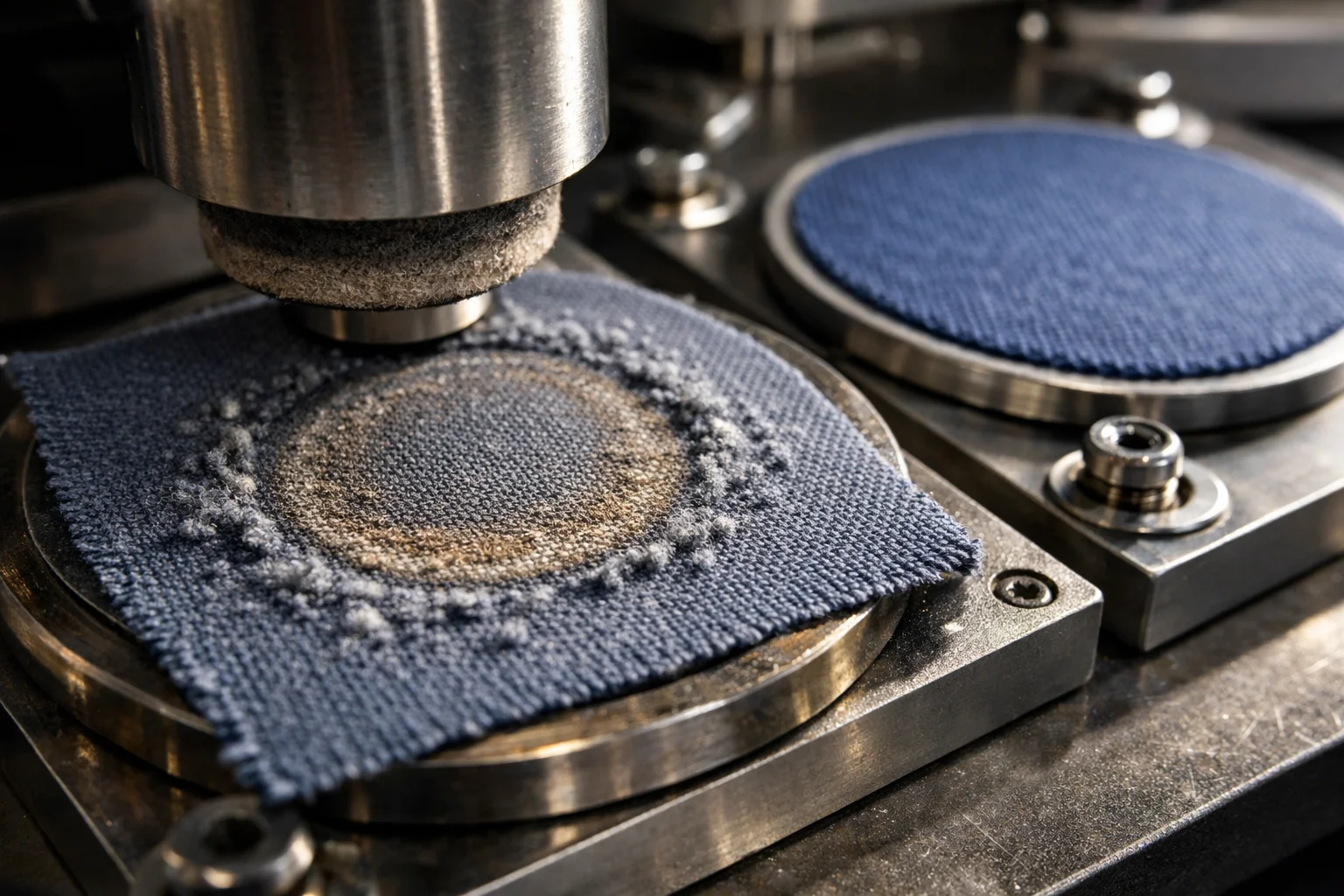
Fabric Types: The Durability Hierarchy (Pet & Kid Proofing)
Understanding the durability hierarchy from microfiber to silk. Why velvet is tough and cotton is fragile despite common assumptions.
Analyze Details →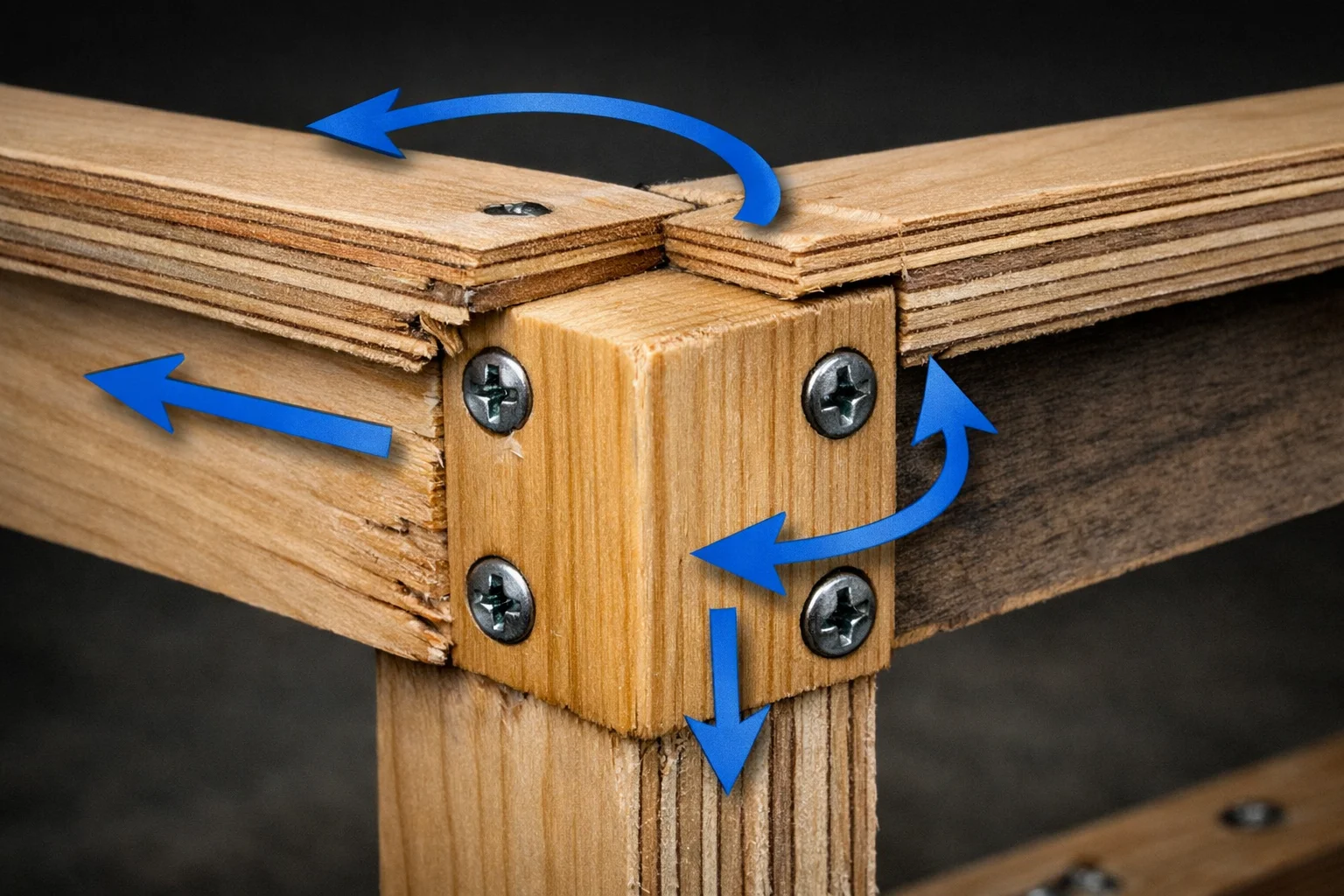
Engineered Wood Frames: Why Plywood Beats Solid Wood
Understanding why high-quality plywood can outlast solid pine. The critical difference between multi-ply laminates and particle board in furniture construction.
Analyze Details →