Layered Foam: Why "Sandwiches" Beat "Slabs"
Introduction
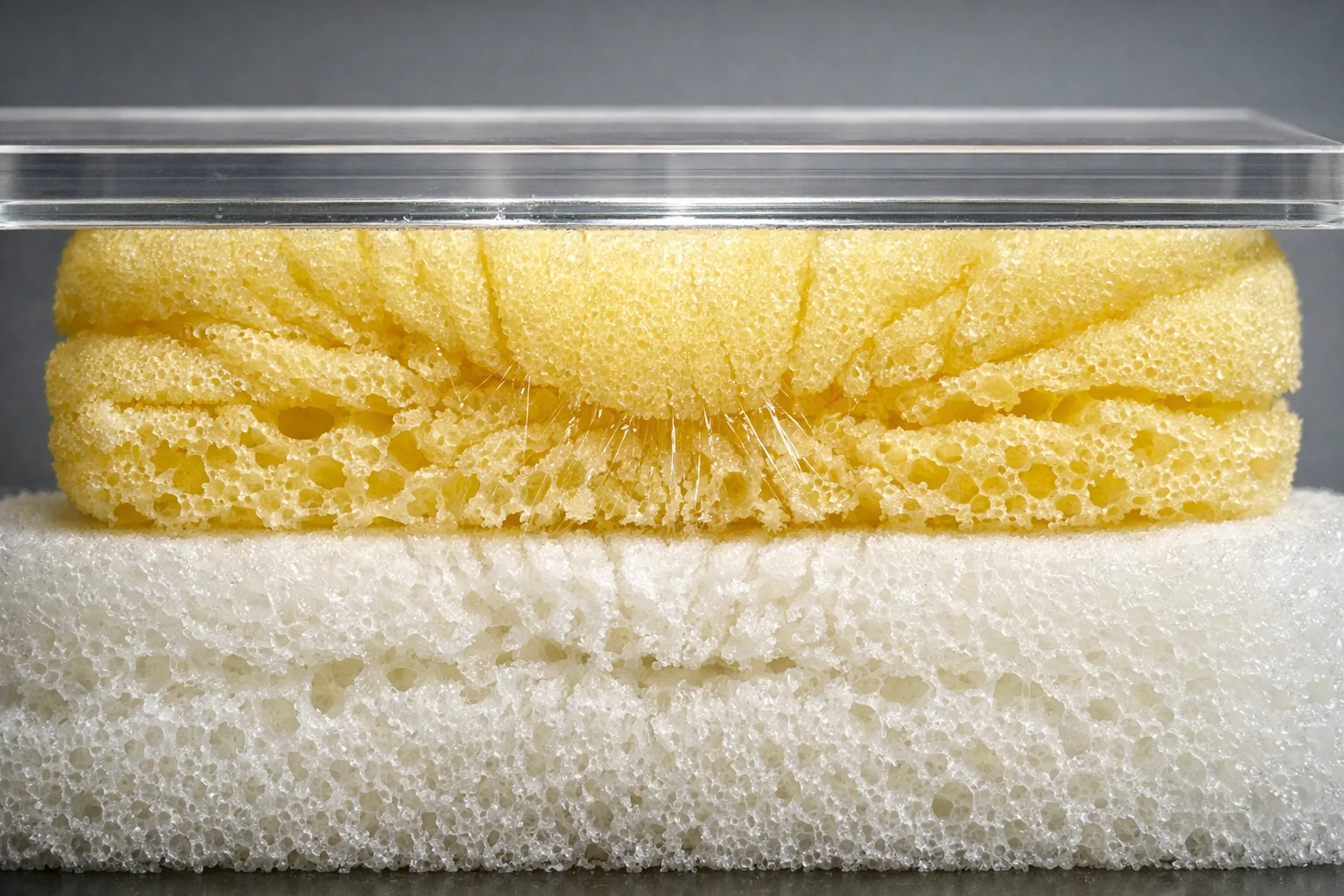
I learned this the hard way when my old sofa cushions turned into one sad, yellow slab. It felt fine in the store, then a few months later it started doing that “sit, sink, and stay sunk” thing that makes you feel like you are sliding into a hole.
A cushion has two jobs that fight each other. It has to feel soft enough to mold around your hips and shoulders, and it has to be firm enough underneath to stop you from bottoming out on the frame. When a manufacturer tries to make one piece of foam do both, you usually get one of two outcomes: either it starts out comfy but collapses and stays flat, or it starts out stiff and never really breaks in, so you perch on it instead of settling into it.
When I shop now, I assume a good cushion is built like a sandwich, not a single loaf. In a showroom, you can check this without tools by unzipping the seat cushion and looking at the cross section, or at least feeling for layers by squeezing from the top and the sides. If the store will not let you open a zipper, you can still do a “pinch test” by pressing down slowly with your palm and paying attention to whether you feel a soft top give way to a firmer core before you hit the hard stop of the base.
If you do get a look inside, what I want to see is a comfort layer on top and a more supportive layer below it. That might be a softer foam over a firmer foam, or a fiber wrap around foam, or foam over springs, but the idea is the same. Your body should meet something forgiving first, then something that holds you up.
If the salesperson tells you “it is all one high quality foam,” I do not automatically walk away, but I get skeptical and I make them prove it with how it feels under real pressure. I sit all the way back, plant my feet, and shift my weight like I would at home, because quick polite sitting does not reveal much. If I can feel the seat deck through the cushion, or if it rebounds slowly and stays dented, I treat that as an early warning that the physics problem is coming for me later.
This guide is basically me trying to save you from repeating my mistake. I am going to focus on what you can actually check in a store, what questions are worth asking, and what vague marketing phrases I have learned to distrust.
The "Bottoming Out" Effect
The fastest way I know to spot a bad seat cushion is to check whether it has a “hard stop.” A lot of sofas use what I think of as the single slab approach, meaning one uniform piece of foam is trying to be both plush and supportive. If it is soft enough to feel great in the first ten seconds, you can sink right through it, and your sit bones end up meeting the wood frame or the seat deck. That is the “ouch” moment you might not notice in a quick showroom sit, but you will notice at home after an episode or two.What I actually want is the sandwich effect, where you sink through the top layer and then get held up by something firmer underneath. In a good cushion, the first bit of travel feels welcoming, then the rate of resistance increases and you feel like you are floating rather than falling. The comfort layer might be soft foam, a fiber wrap, or even a bit of down alternative, but there should be a clear transition to a support layer that stops you before you reach anything hard.
Here is how I test this in the store without overthinking it. I sit where people actually sit, usually the middle front edge of a seat cushion, then I scoot back and do it again. I plant my feet and deliberately load one hip at a time, because bottoming out often shows up on one side first. If I feel the cushion go from soft to suddenly hard with no “catch” in between, I assume it is a single slab or a too thin build, even if it is thick on paper.
If the cushion is reversible or has a zipper, I ask to see it open, because that is the only moment in the buying process where you can verify what is inside instead of trusting a label. When it is a true sandwich, you can usually see or feel distinct layers, and the bottom layer feels noticeably firmer when you pinch it between your fingers. If everything looks and feels the same from top to bottom, I take that as a sign I will be relying on one material to do everything, and that is where sagging and bottoming out tend to show up sooner.
The Architecture of a Sandwich
When I say “sandwich,” I mean a cushion that is intentionally built in layers, usually two, sometimes three, and those layers are glued together so they behave like one piece instead of sliding around inside the cover.
The glue part matters more than most people realize. I have owned cushions where the top felt nice at first, but the layers shifted over time and I ended up with a lumpy seat that never looked centered again, even though the foam itself was not totally dead.
In a showroom, you are trying to figure out two things, whether there are distinct layers at all, and whether those layers feel bonded into a single unit. If you can unzip the cover, you should see a clear change in material or color, and you should not be able to peel layers apart with light finger pressure at an edge.
If you cannot unzip it, you can still get a decent read by squeezing the cushion from the side like you are pinching a thick book. I am looking for a softer outer feel that gives quickly, then a firmer core that pushes back, and I want that transition to feel consistent across the whole front edge, not mushy in one spot and firm in another.
A simple way I test for a real top layer is to press with my fingertips first, then repeat with my whole palm. Fingertips “read” the surface and palm pressure “reads” the support, and a good sandwich will feel welcoming at the surface but noticeably more resistant once you load it like a body actually does.
If the cushion has three layers, the third is usually there to solve a specific problem, either to make the top feel less “foamy,” to slow down wear, or to smooth out the transition into the support layer. In plain terms, I want the top to feel kind to bony parts, the middle to keep you from sinking too deep, and the bottom to act like the chassis that spreads your weight instead of letting it concentrate in one dent.
You do not need to memorize materials to use this, you just need to notice whether the cushion has a staged response. When you sit, you should feel an easy first inch or so, then a gradual increase in resistance, and you should not feel a sudden drop followed by wood or webbing.
If a salesperson tells you it is “multi density foam,” I ask them to show me where the density changes. If they cannot show it and you cannot feel it, I treat that phrase like decoration and I go back to what my body is telling me in the sit test.
One more thing I watch for is whether the cushion looks like a neat rectangle when you pick up a front corner and let go. A properly bonded layered cushion tends to spring back as a unit, while a loose build tends to ripple, fold, or take a second to catch up, like the inside is doing something different than the cover.
None of this guarantees a cushion will last forever, but it dramatically improves your odds. When the comfort and support jobs are assigned to different layers and those layers are actually bonded together, the cushion has a plan, and I have learned the hard way that cushions without a plan are the ones that turn into that sad slab.
Layer 1: The Comfort Cap (Top 2 Inches)
This top layer is the part that decides whether you feel cradled or perched. I think of it as the “hello” layer, the first contact your hips and thighs make before the real support kicks in underneath.
In most sofas that get this right, the comfort cap is a softer foam, sometimes a slow moving memory foam, sitting over a firmer core. In plain store terms, it should feel plush in the first moment, then stop you from continuing to sink once your weight is fully on it.
When I unzip a cushion and see a clearly softer top section that is roughly the thickness of two fingers stacked twice, I relax a little because the cushion is at least trying to separate comfort from support. If the top looks like the same foam as the rest of the block, just cut and re glued, I do not count that as a real comfort cap.
If I cannot open the cover, I try to “read” that top layer with my hand. I press straight down with two or three fingertips first, then I repeat with my whole palm in the same spot, and I pay attention to whether the surface gives easily before I hit a firmer, springier resistance. If it is firm immediately, I assume the cushion is going to feel boardy for bony hips. If it is soft and stays soft with no increase in resistance, I assume I will be flirting with bottoming out.
Memory foam on top can be great for pressure relief, but I only like it when it is used as a thin comfort cap, not the entire cushion. In the showroom, memory foam usually gives itself away because it feels a little “sticky” and slow, and when you stand up you can sometimes see your handprint or a shallow dip that takes a moment to recover. I am not scared of that in the top layer, but if the whole seat has that slow, sleepy rebound, I take it as a hint that the sofa may feel cozy for five minutes and swampy after an hour, especially in warmer rooms.
I also watch for a comfort cap that is too thick. A super plush top can feel amazing in a quick sit, but if you can sway side to side and feel your pelvis drifting like it is on a pillow, that softness is probably not just pressure relief, it is becoming the main structure of the seat. For me, the right feeling is that the top takes the edge off, then the cushion gently says “that is far enough.”
There is one more practical check I use, and it is simple. I sit down normally, then I slide my hand next to my thigh and try to press straight down near my sit bone area without standing up. If I can easily compress what feels like the entire cushion thickness with my hand, the comfort layer is either too soft, too thick, or the support layer underneath is not doing its job.
If you are sensitive to pressure points, the comfort cap matters a lot, but it is still only the top of the sandwich. I have made peace with the idea that I should judge it on two things you can feel immediately in the store, whether it removes that perched feeling, and whether it hands you off to firmer support before you get anywhere near a hard stop.
Layer 2: The Support Core (Bottom 4 Inches)
This bottom layer is where the seat earns its keep. When I think about long term comfort, I stop obsessing over the plush top and start caring about what is doing the unglamorous work of holding you up day after day.
In a typical foam sandwich, the support core is a firm high resiliency foam. You will sometimes see this described with an ILD range in the mid 30s up into the 50 range, but I do not try to shop by that number because stores rarely prove it. What I actually shop for is the feel it creates when you load the cushion like a real person, which is active resistance that increases as you sink.
This layer’s job is basically suspension. It is what stops gravity from slowly turning your favorite seat into a permanent crater, and it is what keeps your hips from finding the deck, the webbing, or the frame.
In the showroom, I try to “find” this core on purpose. I sit down normally, then I do a slow controlled bounce with my weight, not a dramatic jump, just enough to feel whether the cushion pushes back progressively or whether it collapses quickly and then hits a hard stop.
When the support core is doing its job, the first part of the sit feels easy because of the comfort cap, then you feel a firmer, springier pushback that ramps up. The sensation I want is that the cushion is meeting me and holding me, not just letting me drop until something underneath says no.
I also pay attention to how the cushion behaves when I shift forward to the front third of the seat. A weak support core often feels fine when you sit all the way back, but near the edge you suddenly feel like you are sliding downhill or you can feel the seat platform through the foam.
If I can unzip the cover, this is where I get nosy. I press the bottom layer between my fingers and I compare it to the top layer, and I want the bottom to feel noticeably harder to pinch and quicker to rebound. If the bottom feels spongy or easy to squeeze, I assume it is going to fatigue faster, especially in the “favorite spot” where someone sits every night.
One small trick that has helped me is to grab the cushion at a front corner with one hand underneath and one hand on top, then compress it like I am trying to fold a thick phone book. A real support core feels like it does not want to fold, it fights you. A cushion that folds easily often ends up feeling hammocky on the sofa, even if it felt plush for a moment.
I also ask a very specific question that is hard for a salesperson to dodge: “Is the bottom layer high resiliency foam, and is it the thickest part of the cushion?” If they pivot to vague words like “premium” or “high density” without answering, I treat that as a sign I need to trust my sit test more than the pitch.
What I do not want is for the support core to be replaced by extra softness. Some sofas try to win you over with immediate plushness, but if the bottom four inches are not truly firm and resilient, the cushion tends to develop that stuck, tired feeling where it compresses and does not fully recover, and that is when the sofa starts to feel older than it is.
If you are choosing between two sofas that both feel good in the first minute, I would rather you pick the one where the deeper pushback is more obvious. That deeper resistance is the part you will still appreciate after months of use, when the novelty of the soft top is gone and you just want the seat to hold you at the same height every time you sit down.
Diagram of a 3-layer foam sandwich cushion
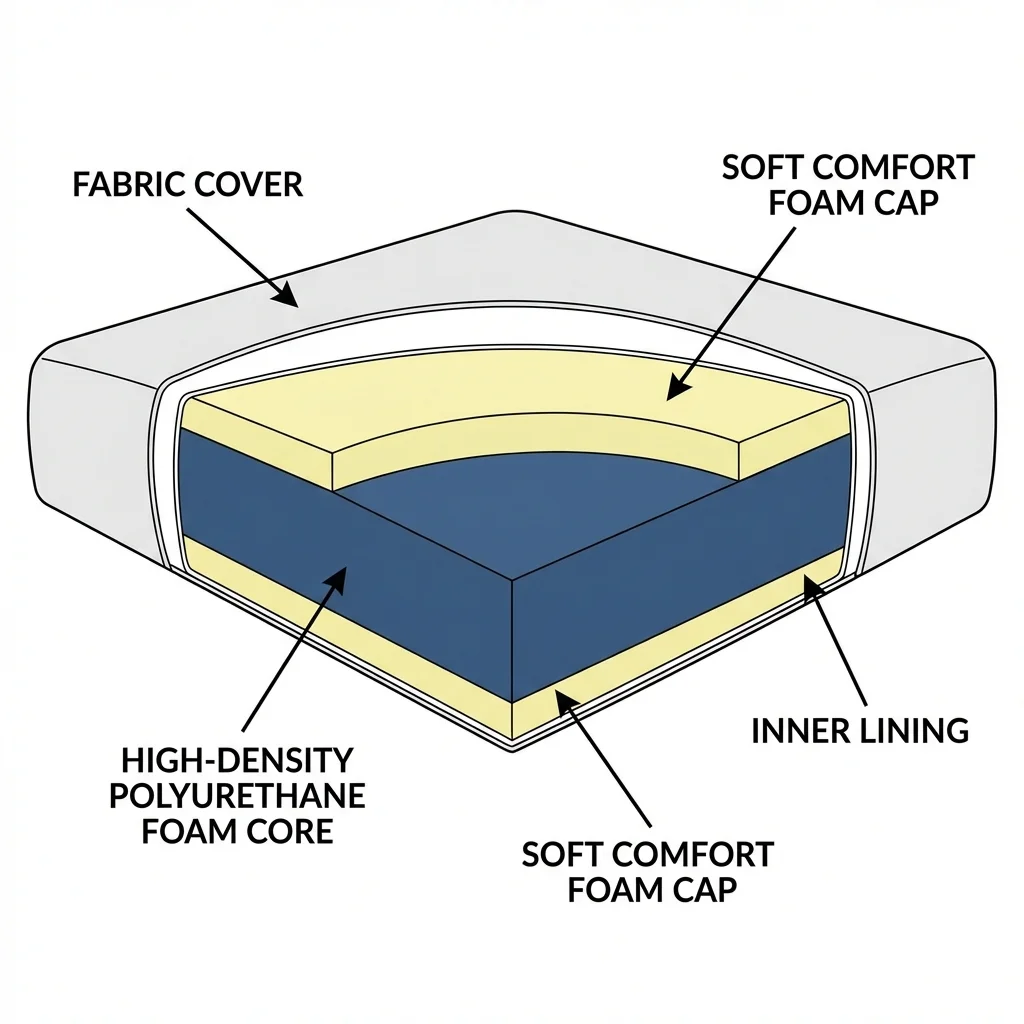
When I am in a showroom, this is the mental picture I carry around. I want my body to meet a softer top first, then I want a firmer middle to slow the sink, and finally I want a bottom layer that acts like a chassis and keeps the cushion from deforming into a permanent bowl.
If you can unzip the cushion, I look for obvious layer boundaries. The easiest tell is color, because a lot of manufacturers literally use different colored foams for different jobs, and that is why I get suspicious when the entire block is one uniform color with no change from top to bottom.
I do not treat “one color” as a scientific proof of anything, because foam can be dyed and some brands use the same color across multiple grades. I treat it as a reason to press harder and be pickier about feel, because the cheap shortcut I keep seeing in the wild is a single slab that is asked to be soft and supportive at the same time.
When the cushion really is a three layer sandwich, I can usually confirm it with my hands even if I cannot fully pull the foam out. I pinch the front edge and slowly compress it, and I should feel a quick, easy squish at the surface, then a firmer zone that pushes back, then a final layer that feels harder to compress and wants to spring back fast.
The part that matters most to you is not the label, it is the transition. If you press down and it feels soft, soft, soft, then suddenly hard, that is the pattern that tends to lead to bottoming out or that “stuck in a dent” feeling later, because there is no supportive ramp up before you hit the limit.
If you are stuck with a non removable cushion and no zipper, I still try to read the layers by using my knuckles near the front edge. I press in about halfway down the cushion height from the side, because if there is a firmer base layer, you can often feel it as a resistant band that does not want to compress the way the upper part does.
If the salesperson says it is a “multi layer” cushion, I ask them to point to what each layer is doing in plain language. I want to hear something like “soft top for pressure relief, firmer middle for support, firm base to keep shape,” and if they cannot describe the jobs, I assume the layers are marketing, or worse, the layers are there but too thin to matter.
I also pay attention to whether the cushion behaves like one bonded unit. When I squeeze the cushion at a corner, it should compress and rebound together, not feel like the top is sliding over the bottom inside the cover, because that sliding is how you end up with a seat that looks crooked even when you fluff it.
If you remember nothing else from this diagram, I would remember this. A good cushion feels staged when you load it, it welcomes you, then it supports you, then it protects you from the hard stuff underneath, and you can usually verify that in a store with nothing more than a zipper check or a slow, deliberate press.
Memory Foam Hybrids
The dangerous trend I keep running into is the all memory foam seat cushion, where the entire block is slow, soft, and heat sensitive. It can feel luxurious for the first minute because it molds so easily, but then you realize it is not really holding you up, it is just letting you sink until something else stops you.
The core issue is that memory foam does not have much push back. In a sofa cushion, that lack of push back often turns into the “quicksand” feeling, where you keep descending, your hips drop lower than your knees, and the front edge starts to feel like it is tipping you backward into the seat.
In the showroom, I test for this by sitting longer than feels polite and by changing positions. If you sit still for a full minute and you feel yourself continuing to settle downward instead of leveling off, I treat that as a red flag that memory foam is doing the support job, not just the comfort job.
I also do a simple exit test. If you have to rock forward or push off the arms to stand because the cushion is gripping you and not giving anything back, that is usually an all memory foam build, or at least too much memory foam too high up in the stack.
What has worked best for me is what I think of as a hybrid sandwich, where memory foam is used as a thin comfort cap and the real support comes from a firmer foam underneath. In practical terms, I like the feel of around a couple inches of memory foam on top for pressure relief, sitting over a thicker block of firm high density poly foam that does the job of holding you up.
When this is done right, you get the molding sensation on the surface without the trap. You settle in, you feel the top layer conform a bit around your hips and thighs, and then you hit a supportive layer that stops the descent and keeps you at a consistent sitting height.
You can often confirm this without trusting the brochure. If the cushion has a zipper, I look for a clear memory foam layer on top and a different, firmer foam below it, and I want that bottom layer to feel harder to pinch and quicker to rebound when I squeeze it.
If you cannot open it, you can still read it with your hands. Press slowly with your palm and pay attention to whether the cushion “catches” and firms up partway through the travel, because that catch is the support layer showing up before you hit the hard stop of the deck.
If the whole seat feels uniformly slow and sleepy from the first touch to the deepest push, I assume it is either all memory foam or memory foam doing too much of the structure. I have learned to walk away from that even when it feels amazing in a 30 second sit, because at home it tends to turn into that stuck, low, hard to get out of feeling that makes a sofa age fast.
Determining Quality (The Glue Line)
Once I know a cushion is actually built in layers, I start caring about how those layers are bonded. This is one of those quiet details that never makes it onto a tag, but you can often feel it in a showroom if you know what to look for.
In a better cushion, the layers are usually joined with a flexible, water based adhesive. In practical terms, that glue line stays a little rubbery instead of turning into a brittle strip, so the cushion compresses like one smooth piece and you cannot “read” the seam through the foam.
In a cheaper cushion, the layers can be joined with a harder solvent type glue that cures stiff. Over time, that stiff line can become a hinge point, it can contribute to a ridge you feel through the seat, and it can even make a faint crackly sound when you press in the right spot.
If you can unzip the cover and expose the foam edge, I like to press right across the layer boundary with my thumb, then with the flat of my fingers. With good bonding, it just feels like the foam changes firmness, not like there is a distinct strip of something hard in between.
If you cannot unzip it, you can still do a useful version of this test from the outside. I press down slowly with my palm in the center of the seat, then I repeat closer to the front edge, and I pay attention to whether there is a crunchy, papery “crinkle” sensation partway through the compression.
That crinkle feeling is what I associate with a hardened glue line. It is not always loud, sometimes it is just tactile, like pressing on a thin sheet inside the cushion, and once you notice it, it is hard to unfeel.
I also do a twist test with my hands. I put one hand on top of the cushion and one on the side and gently try to rotate the foam inside the cover a tiny amount, like I am wringing out a towel but barely. A well bonded cushion resists and moves as one, while a poorly bonded build can feel like the top layer wants to shear over the bottom, which is the kind of thing that later turns into a lumpy seat that never looks quite centered.
If the glue line feels hard, crunchy, or obvious, I treat it like a durability warning even if the sofa feels great at first sit. If the seam is basically invisible to your hand and the cushion compresses smoothly through the transition, I take that as a sign the layers are going to behave like a single unit instead of aging into a ridge and a dip.
Technical Summary: Inspection Guide
If there is one slightly awkward thing I will do in a showroom, it is unzipping the seat cushion and looking at the foam edge. I am not trying to be difficult, I am trying to confirm whether the cushion is a planned stack of materials or just one block that is being asked to do everything.When you get the zipper open, look at the side of the foam like you are looking at a layer cake from the cut face. I am watching for obvious lamination, which often shows up as two different foam colors bonded together, something like a pink or white top section over a yellow or blue bottom section. That visual split is not magic, but it is a fast, honest clue that there is at least a comfort layer and a support layer.
If what you see is one single, uniform color slab from top to bottom with no clear change in material, I treat it as a basic budget build until it proves otherwise with feel. That does not automatically mean it is junk, but it does mean you should push harder with your sit test and be extra alert for that soft then hard bottoming out pattern.
If what you see is a multi color sandwich, where the layers are clearly distinct and look bonded together, I put it in the advanced premium category for cushion architecture. It is a sign the maker is at least trying to separate pressure relief from support, which is the exact problem that tends to ruin cushions over time.
Before you zip it back up, I also like to press each layer at the exposed edge with my fingers and compare them. I want the top to pinch easier and the bottom to feel harder to deform and quicker to rebound, because that is the simplest in store confirmation that the layers have different jobs instead of just different marketing names.
Explore Technical Reference

Dacron Wrapped Cushions: The Illusion of Softness
Why plush-looking cushions often go flat quickly. The difference between visual loft from fiber wrapping and actual structural density from foam cores.
Analyze Details →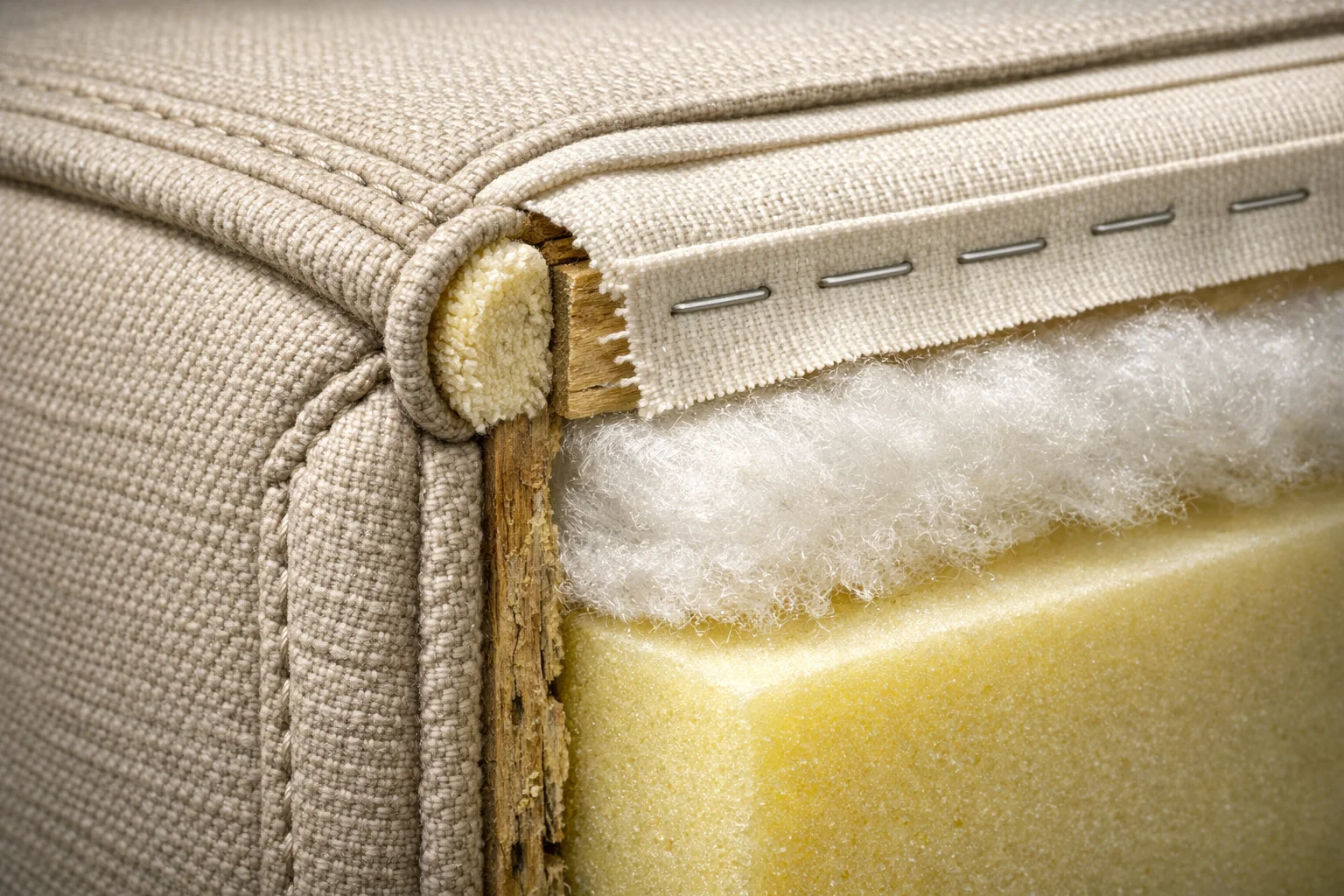
Upholstery Quality: How to Spot "Cheap" Sewing
Understanding why upholstery labor constitutes sixty percent of furniture cost. The differences between quality work and cost-cutting visible in every seam.
Analyze Details →