Frame Anatomy 101: The Skeleton of Comfort
Introduction
That beautiful vintage Chesterfield looked perfect, but when I sat down, it felt liquid. The ground shifted. I realized a sofa is not a solid object, it is a tension structure made of sticks, fighting a war against gravity. If the skeleton is rotten, the expensive leather is just a shroud.
Once you see sofas this way, shopping changes. I stop asking, “Do I like this fabric?” and I start asking, “What is this thing doing under me right now, and what will it do after two years of real life?”
In a showroom, I give myself permission to be a little awkward. I sit in the exact spot I know I will claim at home, then I shift my weight side to side and pay attention to whether the seat feels like it is tipping into a shallow bowl. If it feels supportive at first but then slowly sinks and spreads, that is a warning that the structure or support system is already losing the fight.
I also listen and feel for movement that is not supposed to be there. A healthy sofa feels boring when you scoot, it does not rack, twist, or creak as the frame takes up slack. If I can feel the back moving independently from the seat when I lean, I assume it will get worse, not better.
The other trap is judging comfort too quickly. Plenty of sofas are built to feel plush for the first thirty seconds, then they bottom out in a way you only notice once your body relaxes. I stay seated for a full minute, plant my feet, and stand up without using my hands, because that shows me whether the seat height and firmness are actually working together or just faking it with soft foam.
This guide is about the checks you can do right there on the sales floor, without tools and without taking anyone’s word for it. My goal is simple, I want you to go home with a sofa that still feels like a sofa after the honeymoon period is over.
The "Seasick" Symptom
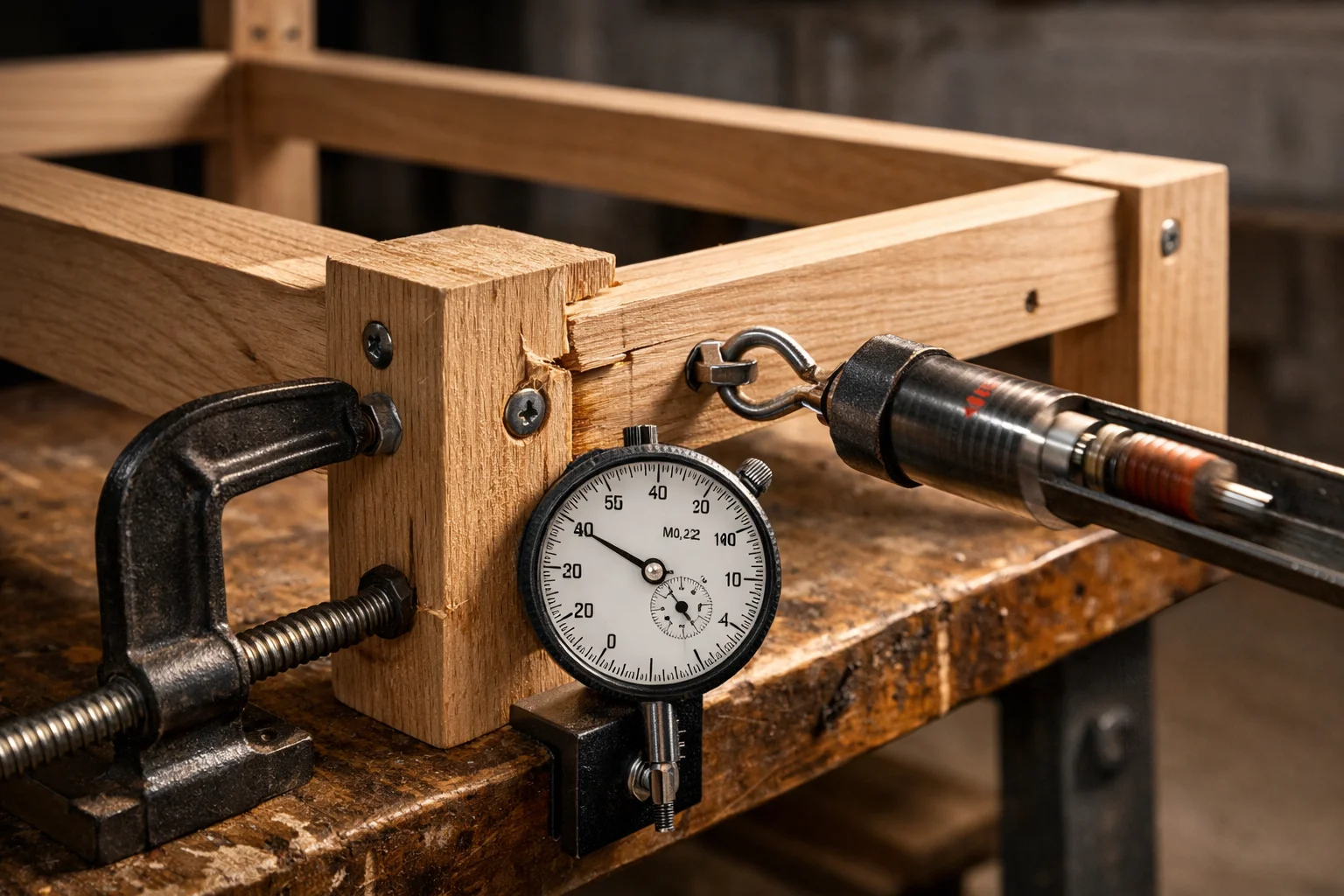
If a sofa "racks" (wobbles side-to-side) or feels unstable when you shift your weight, the joints have failed. This isn't a quirk; it's a structural emergency.When I say a sofa feels “seasick,” I mean I can make the whole thing sway just by shifting my hips an inch or two. It is that uneasy, rolling sensation where the seat and back do not feel like one unit.
In a showroom, I test this on purpose. I sit in one corner seat, plant one foot, then gently push sideways with my knee while keeping my butt planted, because that sideways load is what frames hate, and it is what real life gives them when you flop down, scoot over, or perch on an arm.
If the sofa rocks, twists, or makes a delayed clunk like something is catching up, I treat it as already broken even if it looks perfect. A sturdy frame feels boring under that test, the motion should come from the cushions compressing, not from the box underneath changing shape.
I also check whether the back and arms move independently. I brace my hand on the arm, lean my shoulder into the back, and see if I can feel the back “walk” or flex away from the seat, because that often means the back rail joints are loosening and the whole thing is starting to rack.
The key detail is that racking often shows up diagonally. If you sit in the front left and the back right feels like it lifts or shifts, that is the frame parallelogramming, and it usually gets dramatically worse once the upholstery fabric stretches and the fasteners loosen with use.
When I feel this symptom, I do not negotiate with myself about it. No amount of better cushions later will fix a frame that is already moving, and I have learned the hard way that tightening a few screws, if there even are screws, is not a real cure when the underlying joints are failing.
If you want one quick reality check before you fall in love with the fabric, ask the salesperson to step away for a second and do the same side load test yourself on both ends of the sofa. If one side feels tighter than the other, that inconsistency is a bad sign, because well built frames behave the same everywhere.
If a sofa passes every comfort test but gives you that seasick wobble, I would walk away. I have never seen a wobbly new sofa turn into a stable old sofa, it only goes the other direction.
The Core Components
When I evaluate a sofa’s frame, I zoom in on a couple of parts that do a disproportionate amount of work. If these are weak, the rest of the sofa can be great on paper and still fail in the way you actually feel, which is sagging, wobble, and that slow slide into a hammock.
1. The Front Rail (The Bridge)
The front rail is the long beam that runs under your knees, right at the front edge of the seat. In real life it is taking constant tension from the seat support system and then sudden, repeated hits from your legs and from people dropping into the seat.
In the showroom, I do a simple check by sitting close to the front edge, then bouncing my weight lightly once or twice and paying attention to what I feel through my thighs. If the front edge gives in a sharp way, or you feel a little dip that is more “frame moving” than “cushion compressing,” I assume that rail is either underbuilt or already starting to bow.
I also kneel down and look under the front lip if the upholstery allows it. I am not trying to become a technician, I just want to see if there is a real beam there and whether there is any center support on longer sofas. Once a sofa gets wide, the front rail is basically a span, and spans like to sag.
If the sofa is over about seventy inches wide, I specifically look for a center support leg, sometimes called a fifth leg. If there is no center support, I assume gravity will slowly win and that rail will eventually bow, which is when you start feeling the seat slope toward the middle even if the cushions are fine.
If you cannot see underneath because of a tight panel, I ask the salesperson directly whether there is a center support under the front rail and under the seat frame, not just a decorative leg in the middle of the front apron. If they cannot answer clearly, I treat that uncertainty as a no, because the consequences show up later and they are expensive.
2. The Corner Blocks (The Lock)
The corners of a sofa frame are where racking starts. Two boards simply butted together and fastened is the cheapest way to make a rectangle, and it is also the easiest way for that rectangle to turn into a parallelogram once people start living on it.
What I want to hear in the specs is “corner blocked,” because corner blocks are triangular pieces of wood that reinforce the inside corners and help lock the geometry in place. In practice, that means when you do that awkward side load test in the showroom, the frame is much more likely to stay boring and square.
If the tag, the spec sheet, or the product page does not explicitly say corner blocked joinery, I do not assume it is there. I have learned to treat missing information as missing structure, because brands love to brag about it when they have it.
If you can peek underneath, sometimes you can actually spot the corner blocks inside the frame at the junction where the side meets the front. If you cannot see them, I still push for the wording in writing, because “reinforced frame” and “quality construction” do not mean anything concrete to me.
This is one of my simplest walk away rules. If a salesperson steers you toward vibes and away from construction details at the corners, that is usually because the corners are exactly where the cost cutting happened.
Diagram of Corner Blocks
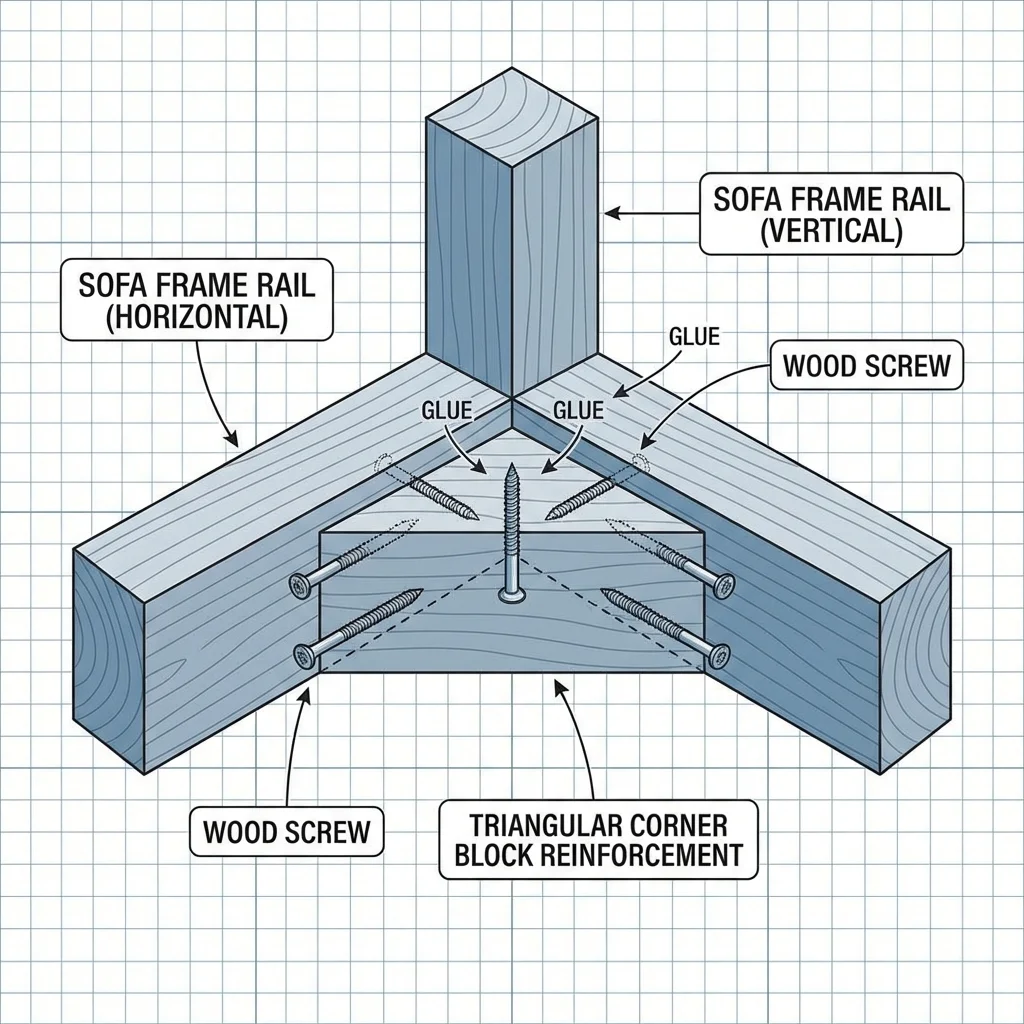
When you look at that diagram, what I want you to notice is how a cheap little triangle changes the whole story of the joint. Without the block, the corner is basically asking a few fasteners and maybe some glue to resist a twisting force, and that is exactly the kind of force your body creates when you scoot, flop, or perch on an arm.
With a corner block, the stress spreads into more wood, in more directions. The frame is no longer relying on one skinny line where two boards meet, it is bracing itself like a doorframe with a diagonal support, which is why a good sofa stays square instead of slowly turning into that parallelogram shape you can feel as wobble.
In a showroom, I use the diagram as a mental checklist while I look underneath. I am not trying to admire woodworking, I am checking whether there is a solid triangular block at the inside corner, and whether it looks like it is actually attached like it means it, not just tacked in as a token.
If you can see a corner block, I pay attention to its size and how it meets the rails. A tiny sliver of wood stapled to fabric does not calm me down, I want to see a real chunk that sits flat against both pieces of the frame so it can do the job the diagram shows.
If you cannot see the inside corners because everything is covered, I switch to language. I ask for “corner blocks at all load bearing corners” and I ask them to show me where that is stated, because “corner blocked” can be used loosely, and I want it tied to the actual frame and not just a marketing sentence.
If the salesperson says it is corner blocked but cannot produce a spec sheet, a hang tag, or a manufacturer description that uses that exact term, I treat it as uncertain. This is one of those details that is either there or it is not, and uncertainty usually means you are paying for confidence instead of wood.
My final reality check is still the feel test you already did for racking, because that is the whole point of the triangle. When I do that sideways knee push, a properly corner blocked frame tends to respond immediately and quietly, while a weak corner responds with a tiny delay, a faint creak, or a sense that the box is taking shape under me instead of holding shape.
The Wood Hierarchy
After I have a sofa that passes the wobble test, I start caring what the frame is actually made of, because the wood choice is often the quiet reason one sofa stays tight for ten years and another one turns spongy and noisy.
When you read a spec sheet, “hardwood” sounds like a guarantee, but it is not. I have learned to treat wood claims like ingredients, you want the specific type and you want to know whether it was dried properly before it got wrapped in fabric.
At the top of the pile is kiln dried hardwood, usually things like maple or oak. Kiln dried simply means the moisture was baked out in a controlled way before the frame was built, and that matters because wet wood keeps shrinking and twisting after you bring it home.
In a showroom, I cannot measure moisture content, so I look for indirect tells. If the brand is willing to say “kiln dried hardwood frame” in writing, and the sofa also feels dead stable under that sideways knee push, I take that combination seriously.
I also listen for the early warning sounds. A new sofa that already creaks when you shift can be a joinery problem, but it can also be wood that is moving as it flexes, which is exactly what you are trying to avoid.
The sleeper material, and the one I ask about even when it is not advertised, is furniture grade plywood. Good plywood is not the cheap stuff that flakes, it is multiple layers of real wood veneer glued with the grain alternating, which makes it resist warping and splitting in the directions a sofa frame gets stressed.
This is where my shopping mindset had to change, because “solid wood only” sounds premium, but a well made plywood rail or panel can actually behave better over time than a random piece of solid lumber that wants to twist. If a salesperson says plywood is automatically inferior, I ask what kind, because furniture grade plywood and construction sheathing are not the same thing.
The practical question I ask is where the plywood is used. Plywood used for big structural panels, seat decks, or long rails can be a good sign, as long as the overall frame still feels rigid and the joints are properly reinforced, since plywood does not magically fix sloppy assembly.
At the bottom is particle board and MDF, which I treat as a red flag in anything structural. It is basically compressed wood dust and glue, and the problem is not that it cannot hold still on day one, the problem is that fasteners do not stay tight once it has been stressed a thousand times.
In the showroom, I cannot see particle board easily, so I go by disclosure and by the “feel” clues. If the specs say “engineered wood” without stating plywood or hardwood, I assume it could be MDF or particle board and I start getting skeptical.
If you can lift a corner of the sofa slightly, even just enough to shift it an inch to look underneath, sometimes you will see the raw edge of a panel. Plywood usually shows a layered edge, while MDF and particle board look like a uniform crumbly brown core, and that is the moment I stop rationalizing and move on.
I also pay attention to screw locations like legs and center supports, because that is where particle board fails first. If a leg mounting plate looks like it is biting into a soft, fuzzy substrate instead of real wood, I assume the leg will loosen, then the sofa will start rocking, then you will be chasing it forever.
The simplest way I keep this actionable is by pushing for specific words, not vibes. I ask, “Is the frame kiln dried hardwood, furniture grade plywood, or does it include MDF or particle board,” and I ask them to show me where that is stated, because the answer that matters is the one you can point to later.
The “Squeak” Test
Silence is the sound of quality, and I mean that literally. A sofa can look flawless and still be quietly failing where you cannot see it, so I treat sound like a free X-ray.
When I hear a creak, I assume wood is rubbing on wood because something that used to be glued tight is now moving. That can be a glue joint that never bonded well, a joint that was stressed during shipping, or wood that is already flexing and shifting as the frame takes load.
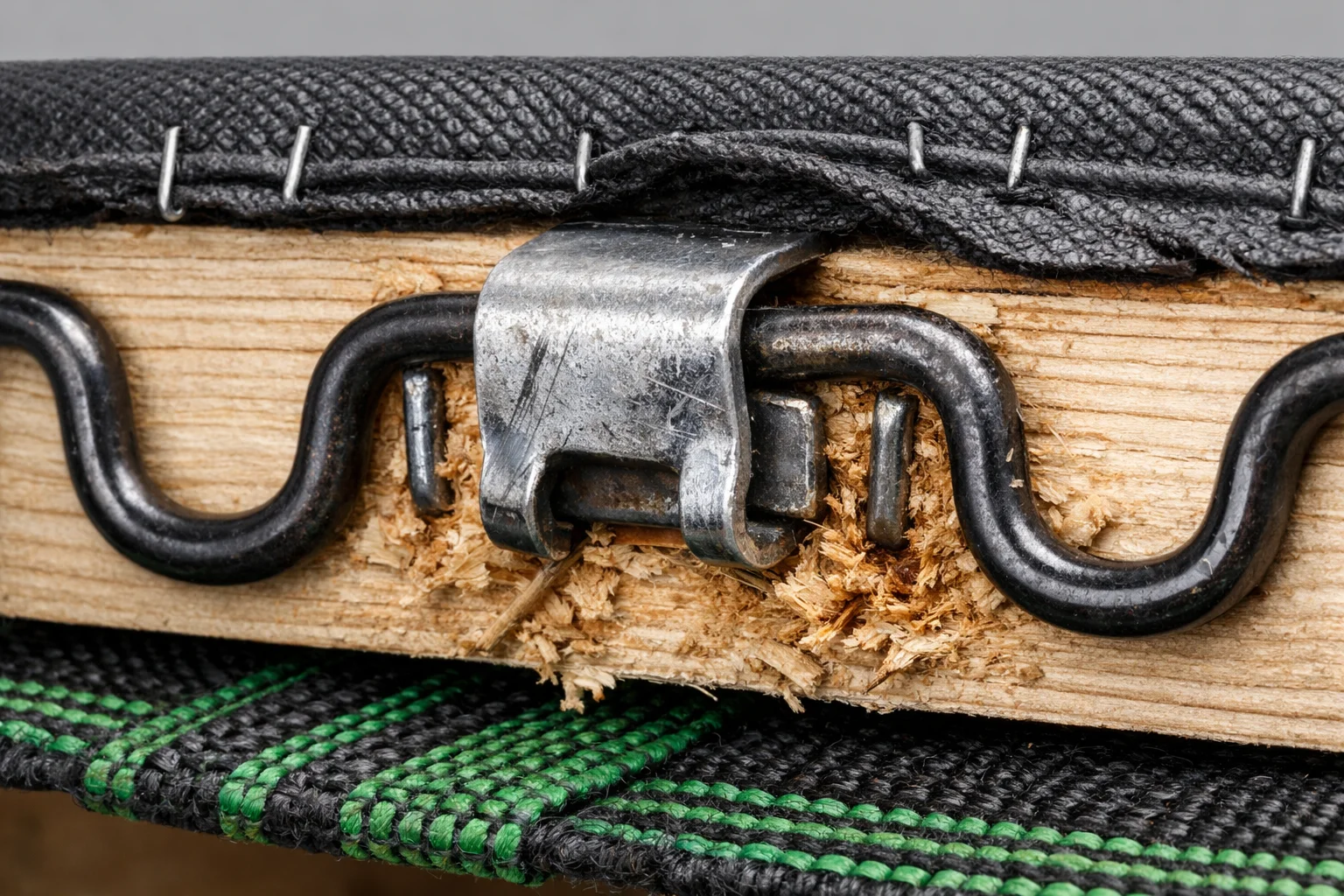
When I hear a squeak, I assume metal is rubbing on metal, usually from the spring system. That often means a clip, a wire, or a fastener is loose, and once a spring assembly starts moving against itself it tends to get louder over time, not quieter.
In the showroom, I do a test that feels a little aggressive, on purpose. I sit down hard in the seat I would actually use at home, not delicately, and I let the frame take a real hit the way it will when someone drops in after a long day.
Then I immediately wiggle, not the cushions, but the structure. I shift my hips side to side, I scoot an inch, and I press down on the front edge under my thighs, because that is where the support system talks back if anything is loose.
After that, I grab each arm and give it a firm shake, like I am checking whether it is part of the same box as the seat. I am not trying to break it, I am trying to see if it complains, because a good frame usually stays quiet even when you are being slightly rude to it.
If the sofa groans, chirps, or makes a little complaint sound that repeats every time you move the same way, I treat that as a serious warning. My rule is simple: if it is already noisy on a flat showroom floor, it will be worse on your imperfect floor at home, after a year of humidity changes, kids, guests, and everyday dropping and scooting.
I also pay attention to whether the sound is immediate or delayed. A delayed creak, where you shift and then a half second later you hear the joint catch up, is the sound that makes me walk away, because it suggests the frame is taking slack before it settles, which is another way of saying it is moving in places it should not.
If you want to be fair to the sofa, try to separate upholstery noise from structural noise. Leather can squeak just from rubbing, and some fabrics rustle, so I put my hand on the arm or the seat deck while I move and I try to feel vibration through the frame, not just hear noise from the surface.
If a salesperson tells you it will go away, I do not argue, I just repeat the test and see if the sound is consistent. In my experience, a brand new sofa that makes the same noise on demand is not “breaking in,” it is showing you exactly where the movement is starting.
The best outcome is boring. When you sit down hard, shift, and shake the arms, you want a dead, quiet response where all you feel is cushion compression, not the skeleton flexing, and all you hear is basically nothing.
Technical Summary: The Forever Frame
The frame is the one part you cannot easily replace, so I treat it as the real product and I treat the fabric as decoration. If you are forced to choose where the money went, I would rather you sit on an ugly sofa with a great frame than a gorgeous sofa that starts to wobble and sag once the joints loosen.When I see “kiln dried hardwood” in writing, I relax a little, because it usually means the maker cared enough to start with wood that is less likely to twist and shrink after it is built. If the specs mention a good multi layer plywood, sometimes phrased as a seven ply laminate, I also take that seriously, because stable plywood can outperform random solid wood in the long spans that want to warp.
Joinery is where I stop accepting vague phrases. What I want is language that says the frame is double doweled, glued, screwed, and corner blocked, because that combination tells me the joints are mechanically locked, bonded, and braced against racking. If they can only say “stapled” or “reinforced,” I assume it is the cheap method dressed up with confidence.
Support is the quiet deal breaker on longer sofas. If the sofa is over about seventy two inches wide, I look for a real center support leg that reaches the floor and actually carries weight, because long spans sag over time even when the wood is decent. I also look underneath to see whether the center support seems properly anchored into solid wood, not just a small plate biting into something soft.
On warranty, I do not get hypnotized by the word “lifetime,” but I still want to see a lifetime frame warranty in writing because it tells me what the company thinks is safe to promise. I read the exclusions enough to see whether it is basically meaningless, and I treat a seller who will not show you the warranty terms as a seller who does not want you to notice what is not covered.
Explore Technical Reference
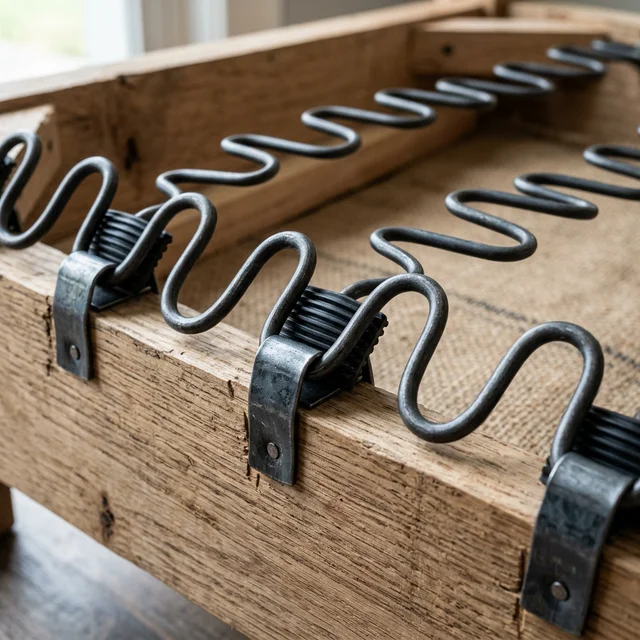
Sinuous Springs: The "No-Sag" Myth
Why No-Sag springs sometimes sag. Understanding wire gauge, clip quality, and tie wire construction that determine whether sinuous springs provide lasting support.
Analyze Details →
Foam Lifespan: Predicting When Your Sofa Will Die
How long should a cushion last? Understanding the density-to-duration ratio and the phases of foam death.
Analyze Details →