Cushion Construction: Why Multi-Layer Design Matters
Introduction
That moment taught me something important. Most sofas fail quietly, long before the fabric looks worn. The cushions lose shape, the seat feels dead, and you start avoiding your own couch without knowing why.
I am not writing this as a designer or an expert with credentials. I am writing as someone who has sat on too many sofas that looked fine in the showroom and felt terrible two years later.
What I learned is that comfort is not about brand names or price tags. It comes from a few construction choices that are easy to hide and easy for sellers to gloss over.
The good news is that you can check most of these things yourself, right there in the store, without tools and without special knowledge. You just need to know where to look and what questions actually matter.
This guide is about those checks. I will show you how to tell if a sofa is built to feel good for years, or just long enough to get it out the door.
If you remember nothing else, remember this. The outside sells the sofa, but the inside decides whether you regret it.
The Physics Contradiction
A seat cushion has to pull off two opposite jobs at the same time. It needs to welcome your body so you feel relaxed when you sit down. It also needs to push back enough to hold you up hour after hour.One single material cannot do both jobs well for very long. If it is soft enough to feel cozy in the store, it usually compresses until you feel the frame underneath. If it is firm enough to truly support you, it often feels stiff and uninviting, like a park bench.
This contradiction explains why so many sofas feel great for five minutes and disappointing after a year. I learned to stop asking whether a cushion feels comfortable, because almost all of them do at first. I started asking how that comfort is being created.
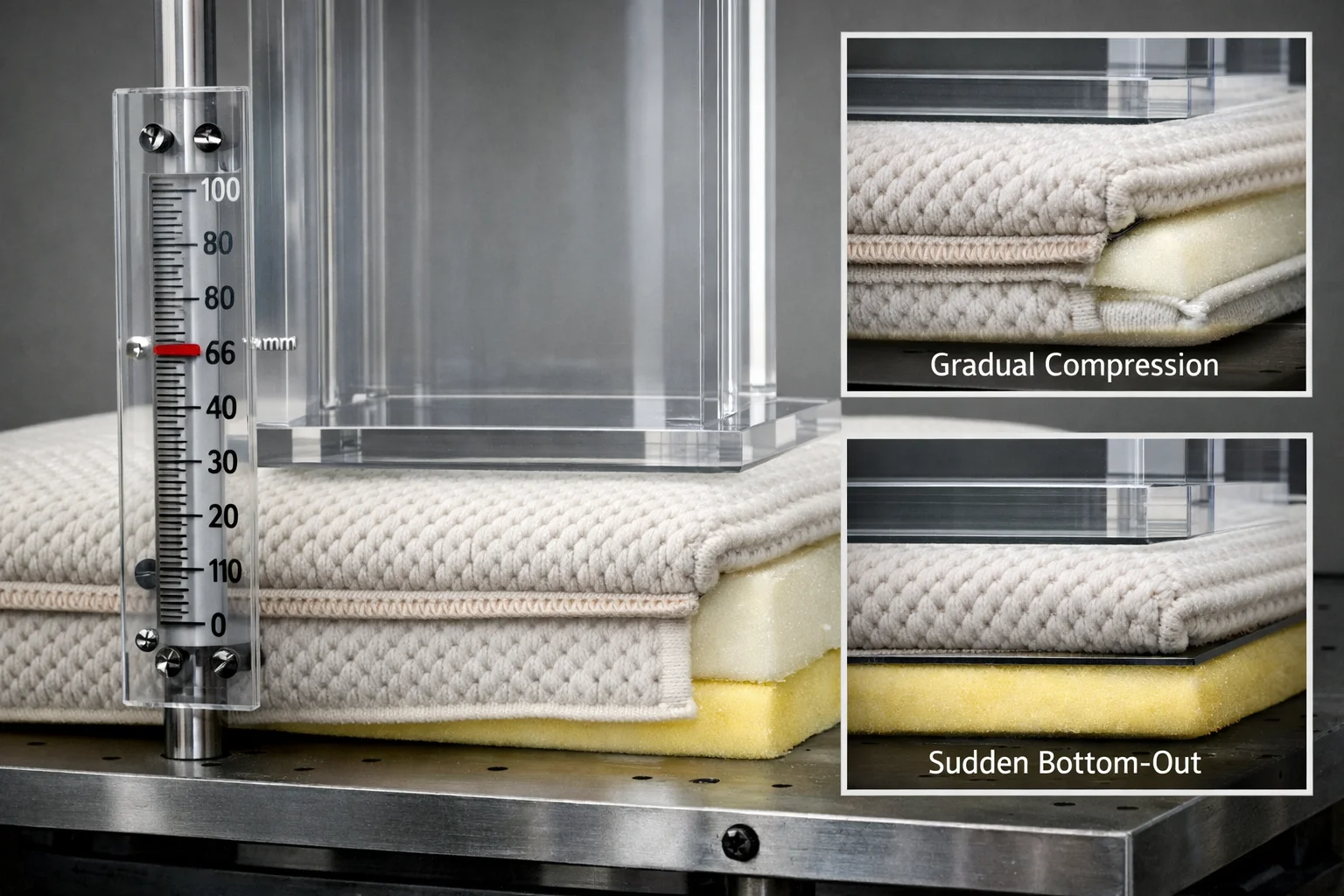
When you are in a showroom, sit down normally and then stay there. Do not bounce and do not test it like a mattress. Pay attention to whether you slowly sink until you feel resistance, or whether you drop quickly and stop hard. That sudden stop is a warning sign that softness and support are coming from the same layer.
I also press straight down with my hand near where I am sitting. If my hand easily finds something hard underneath with very little cushion in between, that tells me the cushion is relying on thin softness over a firm base. That usually feels good on day one and tired on day three hundred.
What you actually want is a feeling of stages. First the cushion should give and feel welcoming. Then, before you reach the bottom, something should catch you and hold you there. When I find that gradual handoff from soft to supportive, I know the sofa has a chance of aging well.
If a salesperson says the cushion is both soft and firm, I treat that as a sales phrase, not an explanation. I ask what creates the softness and what creates the support. If they cannot explain that in plain language, I assume both jobs are being forced onto one material, and physics usually wins in the end.
The Solution: “The Sandwich” Strategy
Once I understood that one material cannot do everything, the solution started to make sense. The sofas that age well usually cheat the problem by stacking different materials together, each doing one job instead of all of them.
This is what I call the sandwich. The top layer is there to feel friendly when you sit down. The middle layer slows you down and spreads your weight. The bottom layer is there to stop you from ever feeling the frame.
Manufacturers describe this as laminating different densities together, but you do not need to remember that phrase. What matters to you is whether the cushion is built in layers instead of being one uniform block.
When you sit on a good sandwich cushion, your body does not crash into support. It eases into it. You feel a soft welcome, then a gentle increase in resistance, and then a stable hold that does not disappear after a few minutes.
I test this by sitting still for at least a full minute. If the cushion keeps sinking the whole time, the bottom layer is too weak or missing. If it stops me abruptly, the top layer is doing all the work and will wear out fast.
I also unzip the cushion if I am allowed to. You would be surprised how often stores say yes. I am not looking for brand names or technical specs, I am looking for visible layers that are clearly different in feel when I press them with my fingers.
If I cannot unzip it, I squeeze the cushion from the side and feel for changes in resistance. A sandwich cushion usually feels slightly softer near the surface and noticeably firmer deeper in. A single material cushion feels the same all the way through.
When a salesperson says the cushion is high quality foam, I ask a simple follow up. I ask whether it is one piece or multiple layers. If the answer is vague or defensive, I take that as information.
This strategy matters because each layer protects the others. The soft top is not crushed as quickly because it is backed up. The firm base does not feel harsh because it is buffered. Over time, that balance is what keeps the seat feeling alive instead of flat.
I have learned that you do not need luxury pricing to get this right. You just need a cushion that admits it cannot do everything at once, and is built accordingly.
Layer 1: The Core (The Engine)
This is the layer that decides whether you will still like the sofa after the novelty wears off. I think of it as the engine because everything else depends on it doing its job quietly and consistently.
The core is usually a thick slab of firm foam, often four to five inches deep, and its only responsibility is to stop you. Not gently, not cozily, just reliably. When this layer is right, you never think about it because you never feel the frame.
In the store, I am not trying to judge whether this layer feels comfortable. It should not. If the core feels plush on its own, it is probably too soft to survive years of daily sitting.
What I look for is resistance that does not give up. When I sit and stay still, I want to feel that at some point the sinking slows down and then stops. If I keep sinking little by little for a full minute, the core is too weak or too thin.
I also test this by pressing straight down with my palm near my hip and holding it there. If my hand quickly bottoms out and touches something hard, the core is either missing or doing too much work with too little material.
A good core feels unyielding once you reach it. It does not push you back up, but it does not let you go any further either. That steady stop is what keeps your posture from collapsing over time.
When I can unzip the cushion, I look for a clearly defined bottom layer that feels much firmer than what sits above it. It is usually darker in color and harder to squeeze. If everything inside feels the same from top to bottom, that tells me the core is not really a core at all.
If I cannot unzip it, I pinch the cushion from the side and slowly compress it between my fingers. I am feeling for a point where the foam suddenly resists more strongly. That change usually marks the core.
Salespeople sometimes describe this layer using terms like high density or high firmness foam. I do not ask for numbers because they rarely help me in the moment. Instead, I ask how thick the firm base is and whether it runs the full width of the seat.
Thickness matters here more than almost anything else. A thin firm layer can feel fine at first and then give up once the softer layers above it wear down. A thick firm layer keeps doing its job even as the top ages.
If a sofa feels great but light, I am cautious. A real core has weight to it, and you can often feel that when you lift the cushion. If it feels suspiciously airy for its size, the engine may be undersized.
This layer is not about luxury or indulgence. It is about restraint. When manufacturers skimp here, they can still sell comfort, but they are borrowing it from the future.
I have learned that if the core is right, small flaws in the softer layers bother me less. If the core is wrong, no amount of plushness on top ever saves the seat.
Layer 2: The Caps (The Cloud)
Once the core is doing its job, the next thing I care about is the thin soft foam on the top and bottom of the cushion. I call these the caps because they are not structural, they are there purely for feel.
This layer is what your body meets first. When it is right, your hips sink in just a little and the pressure spreads out across your thighs before the firmer layers step in.
In the store, this is the part that tricks most people. A thick, very soft cap can feel amazing for a few minutes, especially if you are just dropping down and popping back up. That same softness is usually the first thing to die.
I have learned to be suspicious of cushions that feel marshmallow soft right away. If I sit down and immediately feel like I am melting, that top layer is probably doing too much work.
What I want instead is a gentle welcome, not a hug. When I sit, the cushion should give slightly, then slow me down, then hand me off to the support underneath. If the first inch feels great but the second inch disappears instantly, the cap is too thick or too weak.
I test this by pressing down slowly with my hand and paying attention to the first moment of resistance. A good cap feels easy at first, then noticeably firms up before my hand travels very far. A bad one feels easy until it suddenly hits a wall.
I also rub my fingers across the surface while pressing down. If the foam feels spongy and slow to rebound right at the surface, I know that softness will be the first thing to break down with daily use.
Another thing I watch for is symmetry. Better cushions usually have a soft cap on both the top and the bottom of the core. This helps the cushion wear more evenly, especially if you rotate it.
If the salesperson mentions that the cushion is double sided, I listen. If they say it cannot be flipped, I ask why. Sometimes it is just design, but sometimes it means all the softness is stacked on one side and will compress faster.
I also pay attention to how the cap behaves when I shift my weight. If I lean slightly to one side and feel the cushion bunch or wrinkle under me, that top layer is probably too loose or too soft to hold its shape.
Thin caps tend to age better than thick ones. I know that sounds backwards, but the cap is supposed to cushion, not carry me. When it is asked to do more than that, it usually gives up early.
If you can unzip the cushion, this layer is easy to spot. It is usually a lighter color and much easier to squeeze than the core. I press it between my fingers and see how fast it springs back. Faster rebound usually means it will stay useful longer.
If you cannot unzip it, trust your sit. Stay seated for a minute and notice whether the comfort fades quickly. If the seat feels flatter after just a short time, the cap is already collapsing under your weight.
This layer is where comfort lives, but it is also where shortcuts hide. I have learned to enjoy a cushion that feels slightly less impressive in the first ten seconds if it still feels the same after ten minutes.
When the caps are modest and backed up by a real core, the sofa tends to feel good year after year. When they are overstuffed and asked to impress, they usually steal comfort from the future.
Layer 3: The Wrap (The Polish)
This last layer is the one that makes a cushion look good before it does anything else. I think of it as the polish because it hides the hard geometry underneath and gives the cushion that rounded, inviting crown.
The wrap is usually polyester fiber batting, sometimes called Dacron, or down feathers in more expensive pieces. Its job is not support and not real cushioning. Its job is to smooth edges and make the cushion look full instead of boxy.
In the showroom, this layer is easy to mistake for comfort. When you first touch a cushion, what you are often feeling is the wrap, not the foam doing the real work underneath.
I pay close attention to how thick and loose this outer layer feels. If a cushion looks very puffy but feels oddly insubstantial when I sit, that puffiness is probably coming from a heavy wrap instead of good internal structure.
One simple test I use is to pat the top of the cushion with a flat hand. A modest wrap springs back quickly and keeps its shape. An overstuffed wrap feels fluffy but slow, and it often leaves a temporary dent where my hand was.
I also look at the corners of the cushion. The wrap is what rounds them off. If the corners look extremely bulbous and soft compared to the rest of the seat, that can be a sign that the manufacturer is using extra wrap to create showroom appeal.
When I sit down, I notice whether the cushion loses its crown almost immediately. If the nice rounded top collapses into a flat pancake as soon as I put weight on it, the wrap is doing more visual work than it should.
Down wraps deserve special attention. They can feel wonderful at first, but they require maintenance. If you do not want to fluff and reshape your cushions regularly, down may slowly migrate and leave the seat looking tired even if the foam underneath is still fine.
I always ask whether the cushions need regular fluffing to keep their shape. If the answer is yes, I ask myself honestly whether I will do that. If the answer is no, I treat that as a real cost, not a small detail.
With polyester fiber wraps, I press along the edges of the cushion and see if the fiber feels evenly distributed. Lumpy or uneven areas tell me the wrap may shift over time and create permanent-looking dents.
Another thing I check is whether the wrap completely encases the foam or is only on the top surface. A full wrap tends to wear more evenly and helps the cushion keep its shape as the foam ages.
If I am allowed to unzip the cushion, this layer is obvious. It looks like a quilted blanket wrapped around the foam. I gently pull it back and see how easily it separates from the foam. Very loose wraps tend to bunch and slide with use.
If I cannot unzip it, I squeeze the cushion from the side near the seam. I can usually feel where the soft outer layer ends and the foam begins. If that soft zone feels very thick, I know most of the visual fullness is coming from the wrap.
This layer should be subtle. When it is doing its job well, you barely notice it because the cushion looks good and feels consistent. When it is overdone, it creates a great first impression and a disappointing long term relationship.
I have learned to value cushions that look a little less dramatic on day one but keep their shape month after month. A modest wrap over honest foam almost always beats a glamorous puff hiding shortcuts underneath.
The wrap is not where comfort lives, but it is where expectations are set. When the polish is restrained and supported by the layers below, the sofa tends to age with dignity instead of deflating its promise.
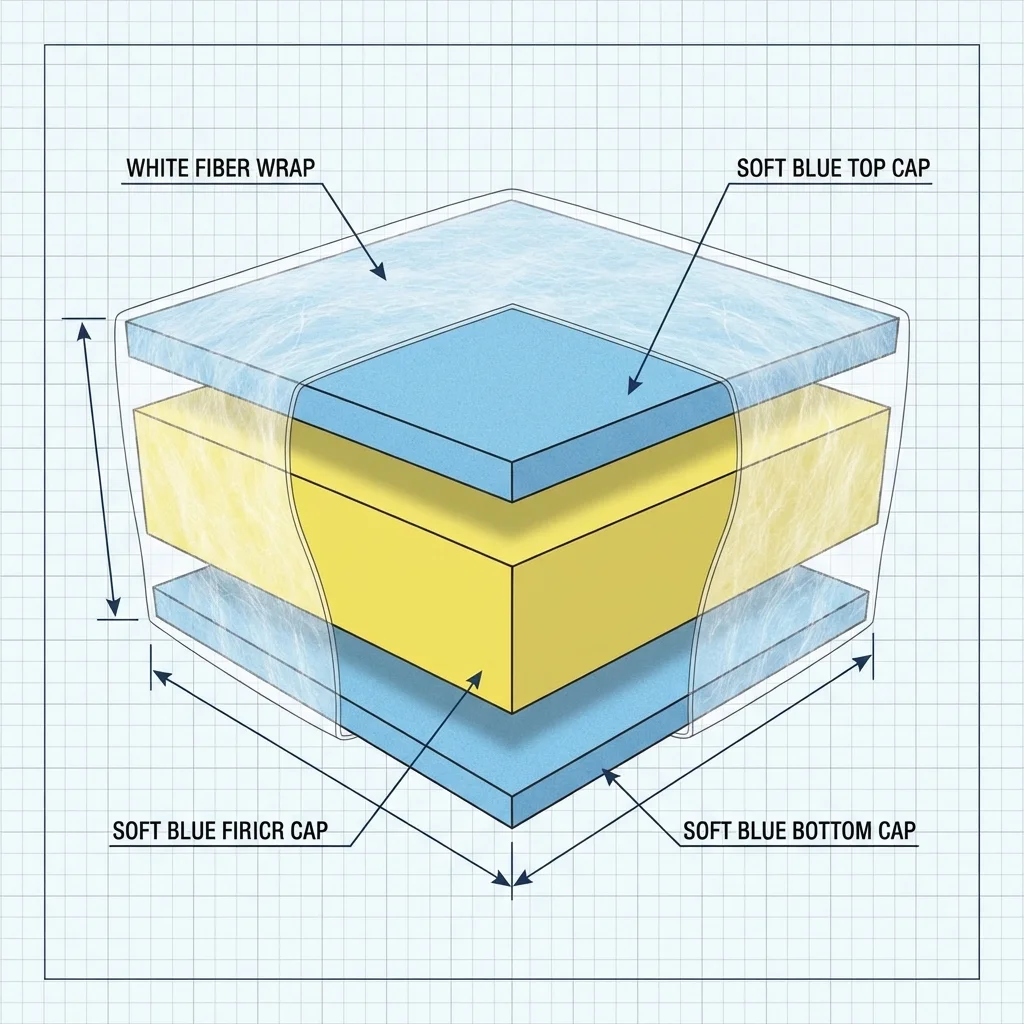
When I look at this kind of diagram, I am not thinking about engineering. I am translating it into what my body should feel when I sit down in a store.
The top layer in the image is the cap, and this is what greets you. In real life, that means the cushion should not feel hard or defensive when you first sit, but it also should not collapse like a pillow.
The middle transition and the firm core underneath are what save you later. When you are sitting still for a few minutes, this is the part that should quietly take over and hold you in place without you having to shift or brace.
I use this mental picture while I am testing a sofa. As I sit, I ask myself where I am in the stack. First I notice the initial softness, then I wait to see if I feel a second phase where the cushion slows me down, and finally I pay attention to whether there is a stable end point.
If all I feel is one sensation from top to bottom, the cushion probably is not built like this diagram. It is likely a single block dressed up with wrap, even if the salesperson uses layered language.
This image also explains why unzipping the cushion is so powerful. When I see distinct layers that match what I am feeling with my body, it builds trust. When I see one uniform slab, I know the comfort I feel is doing all the work on day one.
If you are not allowed to unzip, keep the image in your head and use your hands. Squeeze from the side and imagine compressing through these layers one by one. You should feel a clear change in resistance as you go deeper.
I also think about longevity when I look at this construction. The top layer is expected to age and soften a bit. The core is not. If the core is thick and serious, the sofa can survive a tired cap. If the core is thin or weak, no wrap or softness will save it.
This diagram helps me ignore marketing names. I do not care what they call the cushion. I care whether the support and the comfort are clearly coming from different places.
When a sofa matches this structure in both feel and reality, it usually behaves predictably over time. When it does not, the disappointment is also predictable.
I keep this image in mind because it turns a vague idea of comfort into something I can actually test. Once you start thinking this way, you stop being impressed by softness alone and start noticing whether the sofa is built to last past the honeymoon.
Alternative Constructions
Not every sofa uses the foam sandwich I just described. Some use older ideas or shortcuts dressed up as features, and I have learned to recognize how they usually behave over time.
One common alternative is the all foam block, where the entire cushion is one uniform piece wrapped in fiber. In the store this can feel consistent and simple, but it also means one material is doing every job. When that foam softens, there is nothing underneath to take over, and the seat often goes flat all at once.
If you sit on one of these, stay still for a full minute. If the feel does not change at all from top to bottom, and there is no moment where support clearly takes over, you are probably sitting on a single block.
Another variation replaces the firm foam core with springs or coils inside the cushion. These are sometimes described as luxury or hotel style, and they can feel lively at first. What I watch for is control.
When I sit on a spring based cushion, I pay attention to whether my body settles or keeps subtly moving. If I feel small rebounds when I shift my weight, that tells me the springs are doing support work without enough foam to calm them down.
I also press down with my hand and listen. If I hear or feel spring movement right under the surface, I know there is not much buffer between me and the mechanics. That can feel fun at first and tiring later.
Some cushions combine down feathers with a foam center. These can be wonderful if you like a relaxed seat, but they are honest about their demands. They need regular fluffing, and they will look lived in quickly even if the structure is fine.
I ask myself a simple question here. Do I want to maintain this sofa like a pillow, or do I want it to quietly hold its shape on its own. There is no wrong answer, but there is a wrong match.
Another construction I see a lot uses very thin foam over a springy seat deck, relying on the frame suspension to do most of the work. In the showroom this can feel firm and supportive, especially when new.
I test this by sitting and then lifting my feet slightly off the floor. If the seat suddenly feels much harsher, that tells me the cushion itself is doing very little. Over time, when the suspension loosens, there is nothing left to save the comfort.
There are also cushions that feel thick and heavy but still fail early. These often stack several soft foams together without a true firm base. They feel indulgent, but they never reach a stable stopping point.
When I sit on these, I notice that I keep adjusting. My body is looking for support that never quite arrives. That constant micro shifting is a clue that the cushion has depth but no backbone.
I am not against alternatives in principle. I am against confusion. Whatever the construction, I want to be able to feel distinct jobs being done as I sit.
If the cushion welcomes me, then slows me, then holds me, I do not care whether that comes from layered foam, springs with foam, or another honest solution. If all I feel is one vague sensation, I know the sofa is asking one system to do everything.
When a salesperson uses a new term I have not heard before, I bring it back to my body. I ask them to explain where the softness comes from and where the long term support comes from. If those answers blur together, the construction usually does too.
I have learned that good sofas are not mysterious. You can feel what they are doing if you slow down and stay seated. Alternative does not mean better or worse, it just means you need to listen more carefully to what the seat is actually telling you.
By the time I stand up, I want to understand the bargain I am being offered. Am I trading early wow for faster wear, or am I buying something that feels a little restrained now and stays steady later.
Once you start framing it that way, alternative constructions stop being intimidating. They become another version of the same question, which is whether the sofa is built to impress you today or support you quietly for years.
The Spring-Down (Envelope) Method
This construction is often held up as the gold standard by luxury brands, and after sitting on enough of them, I understand why people fall for it. When it is done right, it feels alive in a way foam rarely does.
Inside the cushion is a grid of small pocketed steel coils, very similar to what you would find in a mattress. Those coils are boxed in with foam to control their edges, and the whole thing is slipped into a fabric envelope filled with down feathers.
When you sit, you feel stages very clearly. First the down gives and feels indulgent. Then the coils engage and gently push back, creating a buoyant, almost floating sensation.
In a showroom, this can feel incredible. I always notice a light bounce when I shift my weight, and the seat seems to meet me instead of just absorbing me.
The first thing I do with this type of cushion is stay seated longer than usual. If the bounce feels controlled and then settles into stillness, that is a good sign. If I keep feeling little movements every time I breathe or adjust, the coils may not be well dampened.
I also press down firmly with my hand and release. A good spring down cushion rebounds smoothly and quietly. If I hear noise, feel uneven pushback, or sense coils right under the surface, there is not enough foam buffering the springs.
This method has a real strength, which is durability of support. Steel coils do not permanently compress the way soft foam does, so the core support often lasts a very long time.
The tradeoff is maintenance. That outer down envelope is not structural, it migrates. If you do not fluff it, gravity will rearrange it for you.
I always ask a blunt question here. How often do these cushions need fluffing to look right. If the answer is weekly, I imagine my actual life, not my best intentions.
I have owned down filled cushions before, and I know myself. If I skip fluffing for a month, the seat still feels fine, but it starts to look tired and uneven. Corners go flat, the center domes, and the sofa begins to look older than it is.
In the store, I test this by standing up and looking at the cushion I just sat on. If it looks rumpled or sunken and needs obvious reshaping, that is exactly what I will be doing at home.
I also squeeze the edges of the cushion and feel for where the down ends and the foam box begins. A well made envelope feels evenly padded all the way around. A cheaper one feels thin on the sides and bulky on top.
Another thing I pay attention to is weight. Spring down cushions are heavy. If I lift one and it feels surprisingly light, something inside is smaller or thinner than it should be.
This construction is not forgiving. When it is good, it is wonderful. When it is cheapened, it still feels good for a while, which makes it dangerous.
I treat spring down as a lifestyle choice, not just a comfort choice. If you love a lively, buoyant seat and do not mind regular hands on maintenance, it can age beautifully.
If you want a sofa you never have to think about, this method may quietly annoy you over time, even though the support itself holds up.
I do not see this as better or worse than foam sandwiches. It is simply honest about what it asks from you. It gives you long lasting support and a luxurious feel, and in return it asks for attention.
When I evaluate one, I decide based on behavior, not reputation. Does the bounce calm down when I stop moving. Does the cushion look presentable when I stand up. Do I actually want to fluff this every week.
If the answers line up with how you live, spring down can be a joy. If they do not, it is better to know that in the store than after the honeymoon fades.
The Memory Foam Cap
Sometimes the soft cap layer is not regular foam at all but memory foam. I have seen this show up more and more, often described as an upgrade or a premium comfort feature.
I understand the appeal because memory foam feels instantly accommodating. When you first sit, it molds to you and spreads pressure in a way that can feel luxurious and calm.
If you like to nap on your sofa, this kind of cap can feel wonderful at first. Your body settles in and stays put, which can feel relaxing if you are lying still.
Where I have been disappointed is how this plays out over time and over longer sitting sessions. Memory foam responds slowly, and that changes how the cushion behaves once you are actually living on it.
In a showroom, I test this by sitting down and then staying completely still for at least a minute. With a memory foam cap, I usually notice that the seat keeps adjusting under me instead of finding a stable point quickly.
I also pay attention to temperature. Memory foam absorbs body heat, and after a while I can feel the seat getting warmer than the rest of the room. That might not bother you in winter, but in summer it can quietly become irritating.
Another thing I check is how easy it is to stand up. I lean forward and try to get up without using my hands. If the cushion feels like it is holding onto me, that is the sandbag effect people talk about.
That slow recovery can be comfortable when you are staying put, but it can feel awkward if you shift positions often or get up and down a lot. I have owned sofas like this, and over time that resistance started to annoy me more than I expected.
I also press down with my hand and release it, then watch how fast the surface comes back. Memory foam is slow by design, so if it takes several seconds to rebound, that tells me this softness will always be passive rather than supportive.
What matters most is where the memory foam sits in the sandwich. As a very thin top layer over a real, responsive support system, it can work fine for some people. As a thick cap doing most of the comfort work, it often creates a seat that feels dead instead of lively.
I ask the salesperson directly whether the cushion has a memory foam layer and how thick it is. If they hesitate or describe it vaguely, I assume it is doing more work than they want to admit.
I also try shifting my weight side to side. With memory foam, the cushion can lag behind my movement. If I feel like the seat is always catching up to me instead of moving with me, that is a red flag.
This is very personal, so I am not saying memory foam is always bad. I am saying it has a specific personality. It rewards stillness and punishes movement.
If you know you like a sofa mainly for lounging, watching movies, or napping, you might enjoy this feel. If you sit upright, change positions, or use the sofa as an everyday seat, the same qualities can become frustrating.
I have learned not to be impressed by how memory foam feels in the first thirty seconds. I care about how it behaves after forty five minutes and how it treats me when I try to get up.
In the store, I ask myself a simple question. Does this seat feel helpful or does it feel passive. Supportive cushions work with you. Memory foam often just receives you and stays there.
If you love that sensation and understand the tradeoffs, that is a valid choice. If you are being sold on it as universally superior, I slow down and test longer.
Comfort that traps heat and resists movement is not wrong, but it is very specific. Knowing whether that matches your real daily use is the difference between a sofa you enjoy and one you quietly avoid.
I have passed on several beautiful sofas because of this layer alone. They felt amazing at first touch and subtly wrong once I stayed put and paid attention.
If you are unsure, trust the longer test. Sit, wait, warm the cushion up, then stand up. Your body will tell you more than any brochure ever will.
The "Fiber-Fill" Trap
Avoid cushions that are 100% blown fiber with no foam core. They cost pennies to make and look huge and puffy in the showroom. However, fiber has zero memory. It will lose a large portion of its volume within months, turning from a cloud into a bag of lumpy laundry.This is one of the easiest traps to fall into because it looks so good at first. I have sat on many sofas where the cushions looked enormous and inviting, and I assumed that meant generous comfort.
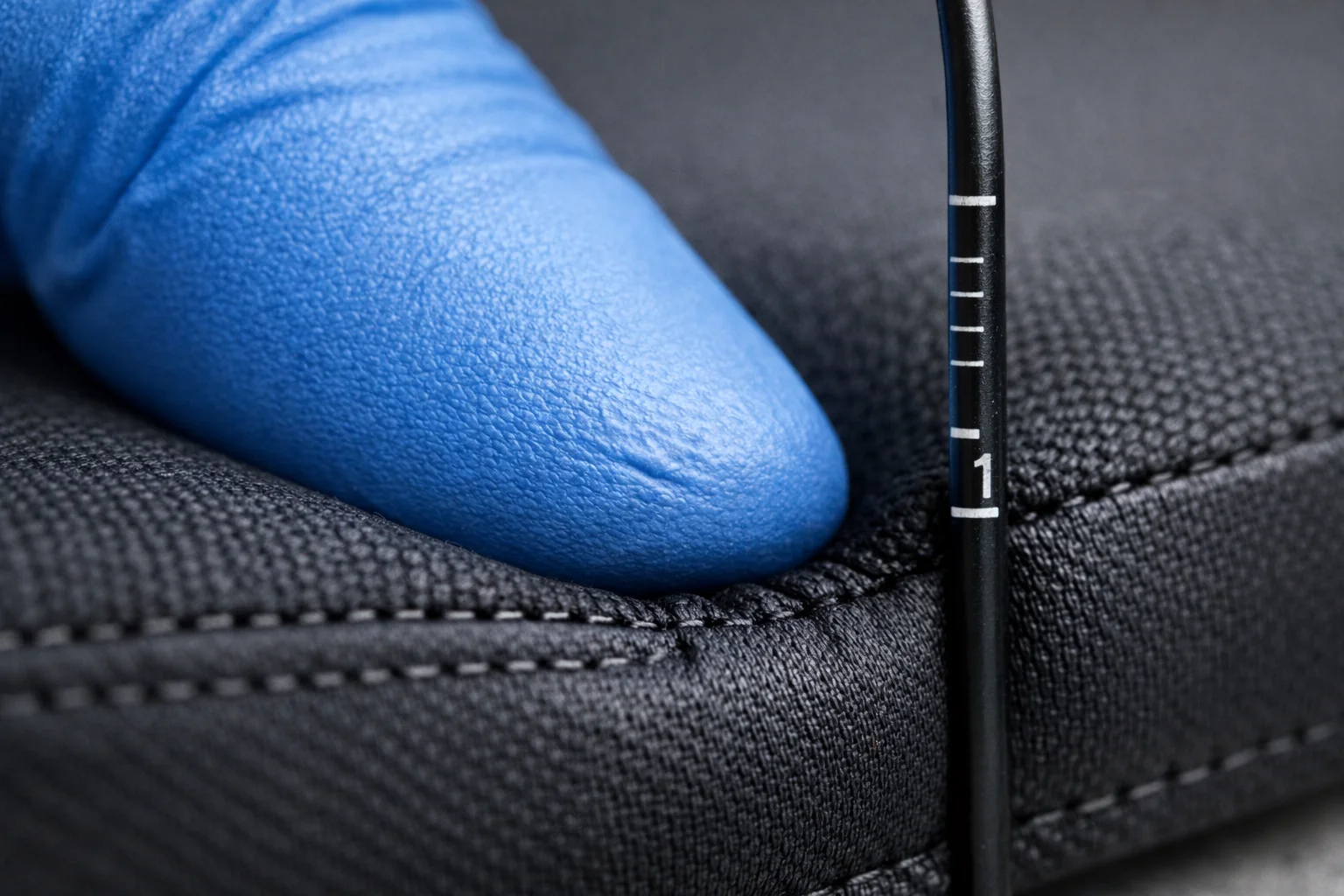
What I eventually learned is that blown fiber is almost all air. It feels soft because it collapses instantly, not because it is supporting you in any meaningful way.
In the store, these cushions often feel like sitting on a pile of pillows. You sink quickly, feel cozy for a moment, and then your body keeps sinking until there is nothing left to give.
The problem is not that fiber is used at all. The problem is when it is asked to do everything by itself.
Fiber has no internal structure. Once your weight compresses it, it does not push back. It just moves out of the way and stays there.
I have owned sofas like this, and the timeline is painfully predictable. In the first few months the cushions start to look a little flatter. Then they develop dents where you sit most often. After that, no amount of fluffing ever really brings them back.
In the showroom, I can usually spot these by how light they feel. I pick up a seat cushion, and if it feels suspiciously airy for its size, I assume there is no real core inside.
I also press straight down with my hand and hold it there. With fiber only cushions, my hand sinks easily and never finds a firm stopping point. It just keeps going until it hits the base.
Another giveaway is how fast the cushion rebounds. Fiber pops back quickly when you remove pressure, but that bounce is misleading. It is not resilience, it is just air moving back into place.
I also sit still for a full minute. On fiber only seats, the comfort fades quickly because my body is no longer being held up, it is just resting on whatever is underneath.
Salespeople sometimes describe these as ultra plush or cloud fill. I listen carefully to whether they mention any foam core at all. If they do not, I assume there is none.
If I ask what is inside and the answer is just fiber or polyester fill, I treat that as a hard stop. No amount of fabric quality or frame strength will fix a seat that cannot support itself.
There is a very specific reason these cushions are common. They are cheap to make, easy to ship, and dramatic in appearance. They sell comfort instantly without having to invest in real materials.
That does not make them evil, but it does make them disposable. You are buying something that is designed to impress for a short time, not endure daily use.
If you love the look of a puffy seat, there is a safer version. I look for cushions where the fiber is only the wrap, and I can clearly feel a firm foam core underneath doing the real work.
In that case, the fiber is just polish. It smooths the shape and softens the surface, but it is not responsible for holding me up.
The key question I ask myself is simple. If all the air disappeared from this cushion, would there still be something solid left to sit on.
If the honest answer is no, I move on, no matter how inviting it looks. I have learned the hard way that air filled comfort is borrowed comfort.
This is one of those places where restraint pays off. A cushion that looks slightly less dramatic but has a real core almost always feels better a year later than the one that looked like a marshmallow on day one.
When you are standing in the store, do not let size and puffiness convince you. Lift the cushion, press it deeply, and wait while sitting.
Fiber alone can sell a sofa. It cannot keep it comfortable.
The “Knee Drop” Test
Sometimes you are not allowed to unzip anything, and sometimes the cushion is sewn shut on purpose. This is when I use the Knee Drop test, which sounds a little silly but tells me more in five seconds than most sales pitches.
I always ask permission first, then I take one seat cushion and place it flat on the showroom floor. I make sure it is right side up, the same way it would be used on the sofa.
I stand over it and drop one knee straight down into the center with my full body weight. I am not slamming it aggressively, just letting gravity do the work the way my body would every day.
What I am listening and feeling for is how the cushion stops me. If my knee hits the floor almost instantly with a hard thud, that cushion is basically one uniform slab of foam with a wrap. All the softness I felt on the sofa is coming from the same material that is supposed to support me.
When that happens, I know exactly how it will age. The foam will soften, the thud will arrive sooner and sooner, and eventually I will feel the frame every time I sit.
If instead my knee sinks in, slows down, and feels briefly suspended before I reach the floor, that tells me there are layers inside doing different jobs. I can feel the soft top give, then a firmer layer catching me before everything bottoms out.
That moment of floating is what I am looking for. It means the cushion is not asking one material to do everything at once.
I also pay attention to sound. A good layered cushion makes a dull, controlled impact. A cheap single block often makes a sharper noise when my knee hits, which usually means there is nothing inside to absorb energy gradually.
After the drop, I press my knee down and hold it there for a second. I want to feel steady resistance, not a slow collapse. If the cushion keeps compressing under constant pressure, the core is either missing or too soft.
Then I lift my knee and watch how the cushion recovers. I am not looking for instant bounce like a trampoline, but I do want to see it regain most of its shape within a few seconds. A cushion that stays crushed is already tired.
This test is especially useful because it bypasses surface tricks. Thick wraps, down fills, and showroom fluff do not fool gravity. Your knee goes straight to the truth.
I do not need this test to tell me everything. It will not tell me whether I like the feel or whether the fabric will wear well. What it tells me is whether there is a real sandwich inside or just one layer dressed up to look impressive.
If a salesperson looks nervous about this test, that also tells me something. A cushion with honest construction can take a knee without drama.
I have walked away from sofas that felt wonderful to sit on because they failed this test completely. I have also found modest looking sofas that passed easily and ended up being some of the best seats I have owned.
Think of the Knee Drop test as a shortcut. When you cannot see inside, you let your body ask the cushion a direct question. Does this stop me in stages, or does it give up all at once.
If it gives up all at once on the floor, it will do the same thing under you every single day.
Technical Summary: Cushion Specification Request
This is the part where I stop testing with my body and start testing with my questions. I do not ask this to sound smart, I ask it to see whether the sofa has anything real behind the feel.I ask the manufacturer or the salesperson for a simple layer breakdown of the seat cushion. I want to hear that there is a firm core made from high resiliency foam, ideally around four inches thick or more, because that tells me there is a real engine doing the support work. If they cannot describe a distinct core, I assume there is none.
I then ask what sits on top of that core. What I am listening for is a softer foam cap that is thinner, usually about an inch, whose job is comfort and pressure relief, not structure. If they describe the entire cushion as one foam with varying feel, I treat that as a warning sign.
Next I ask about the wrap. I want to hear that the foam is wrapped in bonded polyester fiber, often called Dacron, and that it is there to smooth the shape, not create the comfort. If they talk about a very heavy or ultra plush wrap, I assume the visual appeal is doing more work than the internal structure.
I also ask how the layers are held together. This sounds technical, but it matters. If the foam layers are glued together with a proper adhesive, they tend to act like one unit over time. If they are just stacked or loosely encased, they can drift, bunch, or separate as you sit and stand day after day.
I do not need exact lab numbers to make this useful. I am listening for confidence and clarity. When a manufacturer can calmly explain what each layer does, it usually means those layers exist for a reason.
If the salesperson says they do not have that information, I take that seriously. Cushion construction is not a secret. If they cannot tell you what is inside the seat, you are being asked to buy comfort on faith.
I sometimes frame it this way. I say I am less concerned about how it feels today and more concerned about how it will feel in three years. That often changes the conversation.
This request is not about being picky. It is about confirming that the cushion follows the same logic your body is already testing in the store. Separate softness from support, give each job its own material, and hold it all together so it acts as one.
When a sofa can answer these questions without hesitation, I relax. When it cannot, I slow down. Comfort that cannot be explained usually cannot be maintained.
I have learned that this short conversation tells me more than another ten minutes of bouncing on the seat. It turns a vague promise of quality into something concrete I can decide on.
You do not need to memorize these terms. You just need to listen for the story they tell together. A real core, a modest cap, a simple wrap, and a method that keeps them from drifting apart.
If that story makes sense, the sofa usually does too. If it does not, I move on before I have to learn the lesson at home.
Explore Technical Reference
Frame Anatomy 101: The Skeleton of Comfort
The foundation of all furniture. Understanding the terminology of rails, stiles, stretchers, and localized reinforcement.
Analyze Details →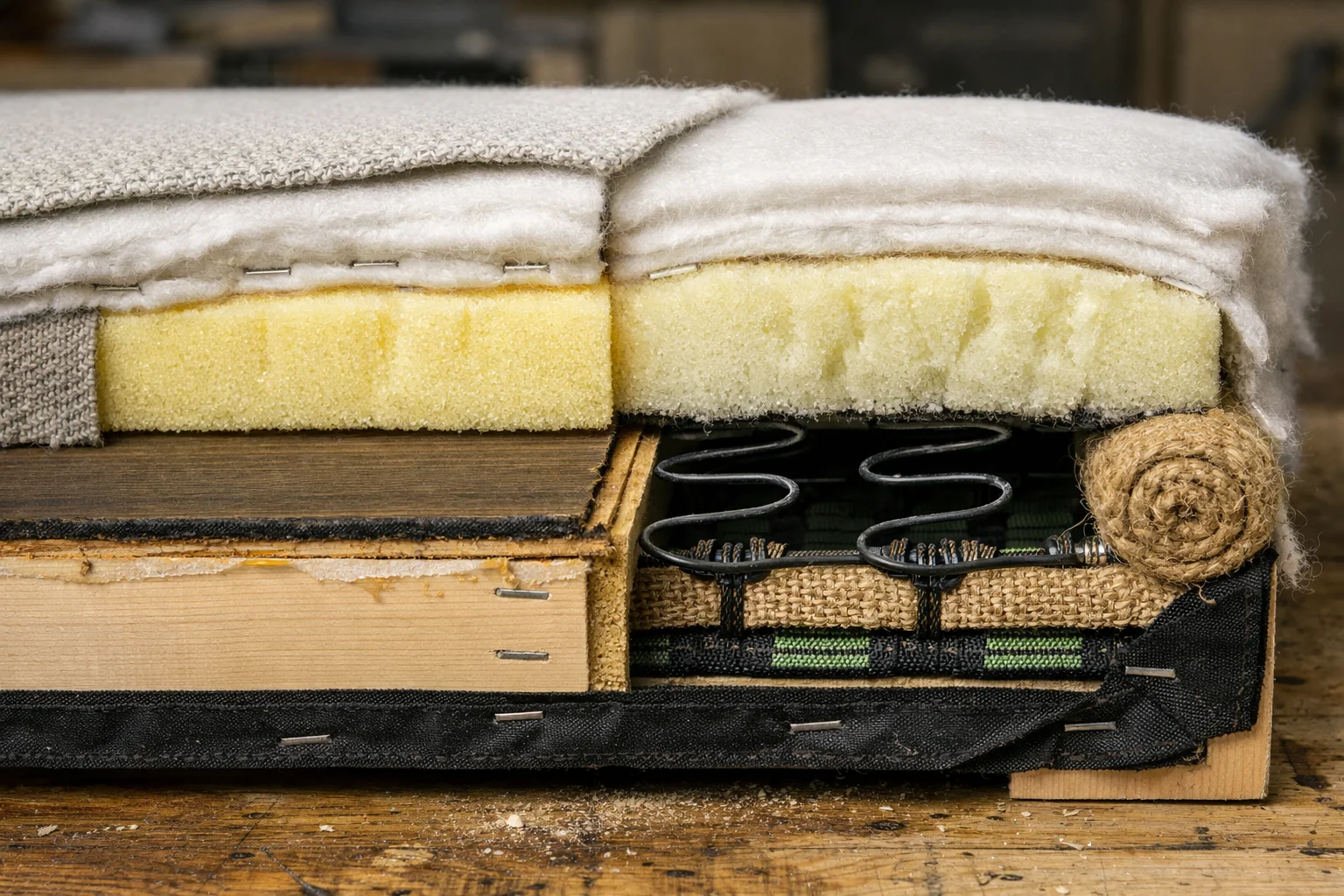
Sofa Support Systems: Making the Right Choice
The three tiers of suspension explained. Understanding webbing, sinuous springs, and hand-tied coils, and why heavier users need specific support types.
Analyze Details →