Construction Red Flags: Identifying Structural Shortcuts
Introduction
That experience changed how I shop for seating. I no longer assume a nice outline means a durable sofa. I assume the opposite until the piece proves itself under my hands.
This guide is about learning what to touch, press, and listen for while you are standing in a showroom. You do not need tools, measurements, or a sales pitch to do this. You need a few quiet moments and the willingness to feel awkward poking at furniture that costs more than your car payment.
I am not trying to turn you into an expert. I am trying to help you avoid that sinking feeling two years from now when the shape gives up before the fabric does. Everything I share comes from mistakes I paid for and from habits I use every time I sit down on a floor model.
If there is one idea to hold onto, it is this. A sofa tells the truth the moment you touch it, even when it looks perfect from across the room.
The Tactile Investigation Rule
The Tactile Investigation Rule
The showroom is designed to seduce eyes. You must shut off the visual attraction and become a tactile auditor. Pinch, poke, lift, and shake every component you can access. If something feels flimsy in the store, it will be unserviceable within a year of daily use.When I walk into a show room now, I remind myself that my eyes are the least reliable sense I have. Good lighting and tidy staging hide weaknesses that only show up under your hands. I slow down and treat the sofa like it already belongs to me and already has problems.
I start with the arms because they fail early and get abused daily. I grip the end of the arm and try to twist it slightly. I am not trying to break it, just to feel if the structure underneath resists me or gives way. If the arm flexes or creaks, that movement will grow with time and use.
Then I press down hard on the arm pad with my thumb. I am looking for immediate bottoming out. If my thumb hits something hard right away, there is not much material there to wear evenly. That usually turns into a dented arm where everyone rests their weight.
Next I grab the front rail under the seat cushions and pull it toward me. I want to feel solid resistance and no rattling. If the front edge feels light or hollow, that is often where frames loosen and fabrics start to sag.
I lift one corner of the sofa just an inch off the floor. I am not checking my strength, I am checking the balance. A well built piece feels like a single object. A weak one twists slightly or feels like parts are lagging behind each other.
After that I sit down hard, then shift my weight side to side. I listen as much as I feel. Small noises now become constant noises later. If the sofa talks back in the store, it will complain loudly in your living room.
Finally I run my hand along the underside edges where fabric is stapled. I am checking if it feels neat and tight or loose and careless. Sloppy work you cannot see usually matches sloppy work you cannot fix.
I know this all feels awkward. I still catch myself glancing around to see if a salesperson is watching. I do it anyway because every sofa that disappointed me would have failed one of these touch tests if I had trusted my hands instead of my eyes.
The Hollow Arm
The arm of a sofa is not decoration. I lean on it every day, I use it to push myself up, and someone always ends up sitting on it when the room fills up.
On a good sofa, the arm is a solid box. It is built from plywood or hardwood panels that resist sideways pressure and keep their shape when weight shifts onto them.
On the sofa that failed me, the arm was an empty cavity wrapped in cardboard and foam. It looked fine until the day it did not.
You can test this in a showroom without tools. Stand beside the sofa and grip the armrest from the outside, with your fingers pressing in from opposite sides.
Squeeze firmly and pay attention to how the side wall responds. I am not trying to crush it, I am trying to see if it holds its ground or caves inward.
Red Flag: The "Oil Can" Bow
If the side panel bows inward when you squeeze it, like pressing on a cheap oil can, walk away. That feeling is cardboard. It has no lateral strength and it will not survive a single hard kick or a heavy guest leaning their full weight on it.A real arm feels dense and stubborn. When I knock on it with my knuckles, it sounds like a door or a cabinet, not like packaging material.
I also press my thumb straight into the side of the arm, not the top cushion but the vertical face. If it compresses easily or feels spongy under light pressure, there is nothing substantial underneath to spread the load over time.
This matters more than people realize. Hollow arms deform slowly, then suddenly. One day the fabric wrinkles, then a corner collapses, and after that every touch makes it worse.
Salespeople sometimes tell me that hollow arms are fine because nobody sits there. I ignore that completely. If an arm cannot handle pressure, it will fail even if it is only leaned on.
When I find an arm that feels solid, I relax a little. It tells me someone cared about the frame, not just the silhouette. That single test has saved me from more bad purchases than almost anything else I do in a showroom.
The Dry Squeak
You cannot usually see how a sofa is joined together in a showroom, but sometimes you can hear it if you give it the chance.
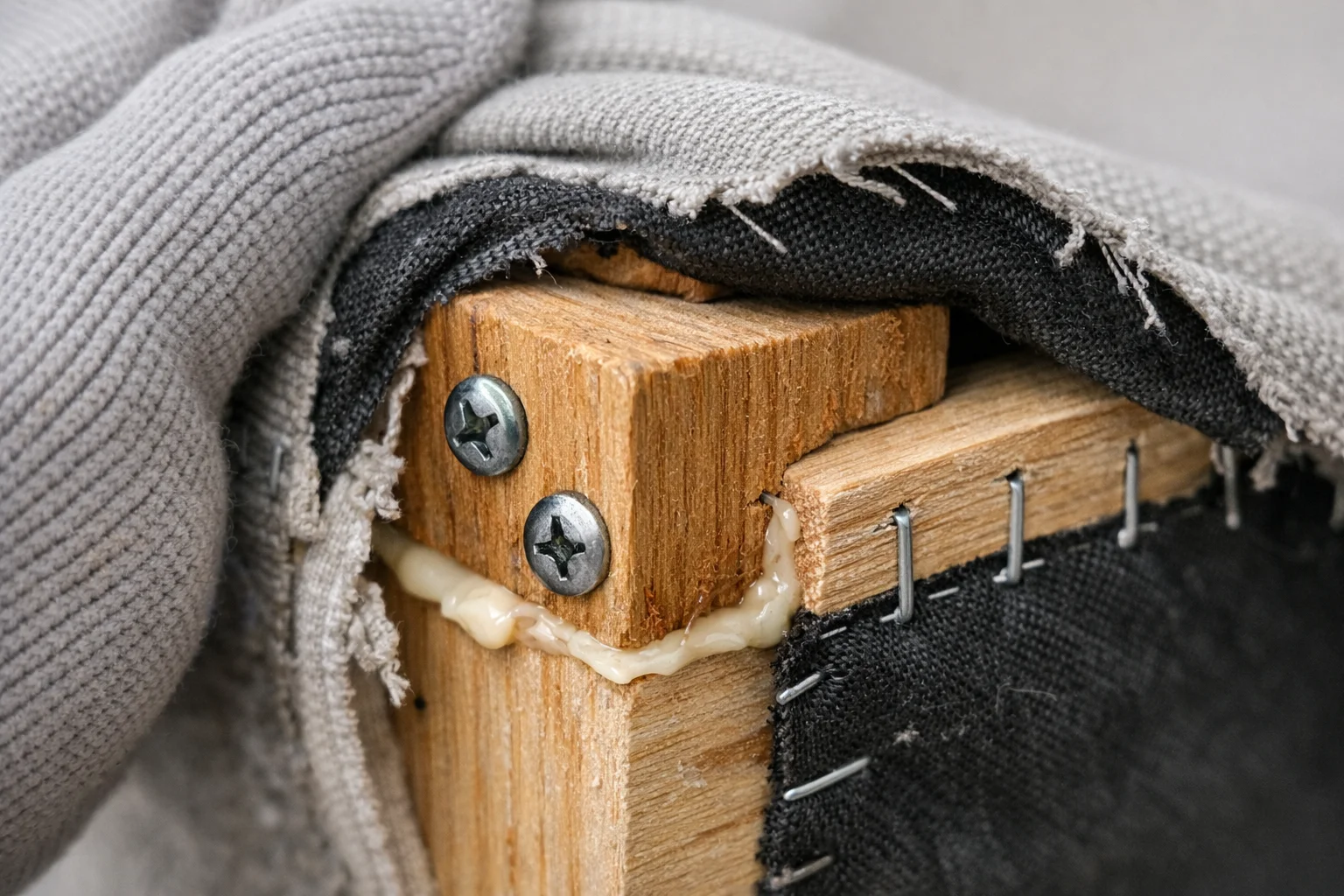
Wood moves over the year. It swells when the air is damp and shrinks when the air dries out. Good joinery expects that movement and holds on anyway, which is why proper glued joints are still the quietest and strongest option when wood shifts seasonally.
Bad joinery cheats. It relies on metal staples shot into raw wood with little or no glue doing the real work. At first the friction feels tight enough, but once the wood dries and shrinks, the staple hole gets bigger and the grip disappears.
The first warning sign is sound. I sit down on one corner of the sofa, not gently, and I pause. I listen before I shift or bounce or do anything else.
What I am listening for is a dry squeak. It sounds like two sticks rubbing together, not a soft cushion noise and not a springy bounce. It is a sharp, dusty sound that seems to come from inside the frame.
That sound means parts are already moving against each other. It usually means the glue failed early or was never applied, and the staples are sliding back and forth in their holes.
I always test both front corners because that is where frames are stressed the most. I lower my weight, lift myself back up, then do it again. I do not rush because a weak joint sometimes only speaks after the second or third load.
A brand new sofa should be completely silent. No creaks, no chirps, no rubbing noises of any kind. If it talks to you on day one, it will complain constantly once it has lived through a winter heating season.
Salespeople sometimes tell me that a little noise is normal and will settle down. That has never been true in my living room. Noise almost always gets worse as the joints loosen further.
If you hear a dry squeak and you are tempted to ignore it because everything else feels good, I suggest you trust your ears instead. Sound is one of the few honest signals a hidden frame gives you in a showroom.
When I find a sofa that stays silent no matter how I sit or shift, I take that seriously. Silence tells me the joints are locked together as a single structure, not held in place by hope and friction.
This is one of those tests that feels almost too simple, but it has saved me from long term regret more than once. A quiet sofa at the store is far more likely to stay quiet when it becomes part of your daily life.
The webbing Trap
This is the point where I stop sitting and start lifting. I flip the seat cushion up and look at the fabric deck underneath, then I press straight down with my hand.
In a well built sofa, my hand meets firm resistance almost immediately. I can feel something solid pushing back, either a grid of steel wires or the deep springy push of coils under the fabric. There is a sense that the support has a backbone.
The warning sign is what I call the hammock feel. If I press down and my hand sinks smoothly with no hard stop, like pushing on a trampoline, I know I am touching webbing and nothing else.
Webbing is basically wide rubber bands stretched across the frame. It is cheap, fast to install, and very forgiving on day one. In a showroom it often feels plush and comfortable, which is exactly why it fools people.
Rubber does not age gracefully. It dries out, oxidizes, and loses tension. When webbing stretches, it does not bounce back, and there is no practical repair that restores it to new.
Once that sag forms, you are sitting in a permanent dip. Cushions get blamed, but the real failure is underneath you where you cannot see or fix it.
When I test for this, I do not just press lightly. I put my palm down and lean some weight into it. I am asking a simple question. Is there anything rigid under this fabric, or is it all elasticity.
If all I feel is stretch, I move on. I do not care how good the cushions feel or how nice the fabric looks. I have lived with webbing long enough to know how this ends.
Some very expensive modern sofas use high quality elastic systems, including premium Italian webbing that is engineered to last. Those systems are usually advertised clearly and come with detailed specifications from suppliers like Intes. If the salesperson cannot name the system confidently and show it in writing, I assume it is not that.
In the mid range price bracket, webbing is almost always the cheapest version available. It is chosen to hit a price point, not a lifespan. I treat it as a trap unless proven otherwise.
There is also a mixed construction that catches people. Some sofas use a few steel springs near the front edge and webbing everywhere else. When you sit down, the front feels supportive, but your weight eventually settles into the softer middle and stays there.
That is why I always press in more than one spot. I test the center of the seat, then closer to the front rail, then near the back. Support should feel consistent, not like a strong edge and a weak belly.
If you are not allowed to lift the cushions or touch the deck, that alone tells me something. A manufacturer confident in their support system does not need to hide it.
Salespeople sometimes say that webbing is more comfortable or more modern. I ignore that framing. Comfort on day one means nothing if the support gives up before the fabric wears out.
When I feel steel pushing back under my hand, I relax. It tells me the sofa is designed to carry weight for years, not just long enough to leave the store.
This single test has saved me from buying sofas that felt great for six months and awful for the next six years. If you remember nothing else from this section, remember this. Softness without resistance is not luxury, it is a countdown.
The Floating Leg
This is a detail I missed for years because I assumed a leg was just a leg. It is not, especially at the back of the sofa where most of the stress ends up.
When you are in the showroom, crouch down and look at the back legs. I want you to figure out whether they are part of the frame itself or screwed on as separate pieces.
Back legs take enormous abuse. Every time you drop your weight backward into the cushions, you are levering those legs forward and twisting them at the same time.
If the leg is a separate block of wood screwed into the bottom of the frame, that screw is doing all the work. Usually it is a single metal hanger bolt buried into soft wood, and that bolt is the weak link.
At first it feels fine. Then one day the sofa starts to wobble just a little. After that, it never really stops.
I learned this the hard way on a sofa that looked solid and weighed a ton. The fabric held up, the cushions were fine, and yet the back end slowly turned into a loose shopping cart.
The gold standard is what I now look for immediately. The back vertical post of the frame runs all the way down to the floor as one continuous piece of wood.
There is no joint to loosen because nothing is attached there. The leg is the frame.
You can usually tell without tools. If you see a visible seam, a metal plate, or a circular mounting point where the leg meets the frame, that leg is probably separate.
If the leg flows straight into the body of the sofa with no hardware in sight, that is what you want. It looks boring, but boring is durable.
Red Flag: The Screw In Back Leg
If a heavy or expensive sofa uses screw in back legs, I take that as a serious warning. Those legs are under constant torque, and when they fail, the repair is never clean. Wobble is not a matter of if, it is a matter of when.I also put my hand on the top of the back rail and gently rock the sofa forward and back. I am not shaking it, just feeling for any delay or movement at the legs.
A solid frame with integral legs moves as one object. A sofa with floating legs often feels like the body shifts first and the legs catch up a split second later.
Salespeople sometimes tell me that removable legs are convenient for delivery. I understand the appeal, but I am not buying a sofa for the hallway, I am buying it for ten years of sitting.
If the front legs are removable, I am less strict. They take mostly vertical load and are easier to replace. The back legs are non negotiable for me.
When I find a sofa with back legs that are clearly part of the frame, I mark that as a quiet win. It tells me the builder expected the structure to survive real use, not just look good on a platform.
This is one of those checks that takes ten seconds and saves years of annoyance. Once you know to look for it, you will start noticing how many sofas fail this test without ever advertising it.
The Zipper Quality
I always check the zippers on the seat cushions, even when the salesperson looks confused. It feels like a small detail, but it tells me exactly how seriously the manufacturer took the parts you cannot see.
I unzip the cushion slowly and look at what is there, not just whether a zipper exists. What I am hoping to see is a metal zipper with a locking pull that stays put when I let go.
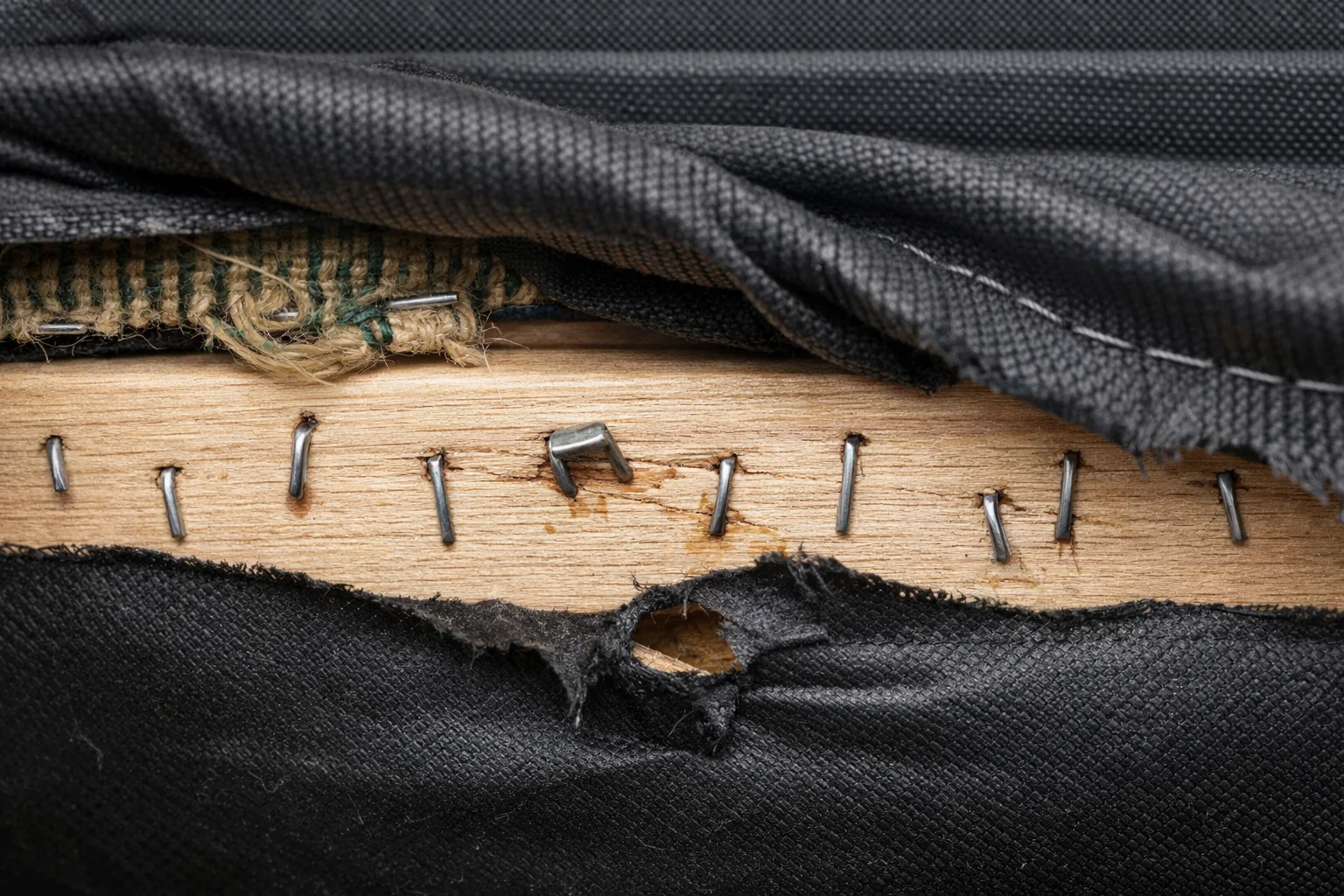
The warning sign is a plastic coil zipper with a loose, flimsy pull and no locking action. These are the cheapest zippers available, and they are chosen to save pennies, not to survive daily pressure.
I have owned cushions with those zippers, and they always fail the same way. One day you sit down and the zipper teeth separate under load, even though the pull did not move.
When that happens, the foam starts creeping out of the opening. The cushion loses its crisp edge, the fabric relaxes, and the whole seat starts looking tired long before its time.
Once a zipper splits like that, there is no simple home fix. Replacing a cushion zipper usually means paying for professional upholstery repair, which often costs more than people expect for something that feels so trivial.
A good zipper feels different immediately. Metal teeth have weight, the pull locks in place, and when you tug gently on the closed zipper, it does not spread apart.
When I see a metal zipper from a known supplier like YKK, I take that as a good sign. These zippers are designed to lock under tension, not slide open when the cushion is compressed.
I also run my fingers along the zipper tape where it is sewn into the fabric. If the stitching looks tight and straight, it tells me the cushion was assembled with care, not rushed through a line.
Sometimes the zipper is hidden under a fabric flap. I still open it. A manufacturer who believes in their construction does not need to hide the hardware.
If a salesperson tells me the zipper does not matter because you never see it, I ignore that logic. The zipper is under constant stress, and it is one of the first things to fail if corners were cut.
Here is the simple rule I follow. If a company skimps on a fifty cent zipper, they are almost certainly skimping on the much more expensive foam inside the cushion.
Foam quality is invisible in a showroom and expensive to get right. Zipper quality is visible and cheap to upgrade. Manufacturers who care usually upgrade both.
When I find solid, locking metal zippers on every seat cushion, I relax a little. It tells me the builder expected the cushion to stay under pressure for years, not just long enough to look neat on a sales floor.
This check takes less than a minute, and it has saved me from buying sofas that looked fine but slowly unraveled from the inside out.
The Non-Reversible Bottom
This is a check most people never think to do, and it quietly cuts years off a sofa’s life.
If the seat cushions are loose, I flip one over in the showroom. I am not being nosy, I am trying to see whether the bottom is upholstered in the same fabric as the top.
What I often find is cheap black felt on the underside. It is usually called cambric or lining cloth, and it exists for one reason, to save money.
When a cushion is built this way, it is non reversible. You are only meant to sit on one side for the rest of its life.
That matters because cushions do not wear evenly. Your body compresses foam where you sit most, and over time those spots become permanent.
If you can flip a cushion regularly, you spread that wear across both surfaces. The foam relaxes more evenly and holds its shape much longer.
If you cannot flip it, all the compression piles up in the same places until the cushion warps. At that point, no amount of fluffing fixes it.
I have owned sofas like this, and they all aged the same way. One seat became the favorite, then the favorite became a crater, and after that the whole sofa looked tired even though the fabric was fine.
This is why I say non reversible cushions cut the usable life in half. You are using only one side of something that needs two sides to age gracefully.
Salespeople sometimes tell me the felt bottom helps the cushion breathe or keeps it from sliding. I ignore that explanation. Both of those things can be solved without sacrificing reversibility.
What I want to see is full upholstery fabric on both sides, or at least a fabric of similar weight and durability. It does not have to be decorative, it just has to be real.
If the cushion has a zipper, this check takes seconds. I flip it, look at the bottom, and flip it back. No tools, no confrontation.
If the cushions are attached and cannot be removed, I slow down and ask why. Fixed cushions often hide the same cost cutting, and you lose the ability to rotate or flip anything as it ages.
There are designs where non reversible cushions make sense, like very tailored modern sofas with complex shapes. In those cases, I accept that I am trading lifespan for looks and I price it accordingly in my head.
What I do not accept is a basic sofa pretending to be durable while quietly removing the one habit that keeps cushions alive.
Here is the simple rule I follow. If I cannot flip the seat cushions, I assume I am buying a disposable sofa, no matter what the warranty brochure says.
When I find a sofa with fully upholstered, reversible cushions, I feel a real sense of relief. It tells me the builder expected the piece to live in a real home with real habits, not just look good until the return window closes.
This single check has saved me from more long term disappointment than almost any fabric upgrade ever could.
The Cushion Crunch
After I check structure and support, I move to the back cushions. These are the parts people rarely think about, but they age faster than you expect because they get leaned on constantly.
I do something very simple. I punch the back cushion with a closed fist and then I pause.
I am not judging softness here. I am listening.
If I hear a crinkling sound, especially something that reminds me of a plastic bag or snack wrapper, I stop taking the sofa seriously. That noise is the warning.
Cheap polyester fiber is slick. It slides around instead of staying where it is supposed to, so manufacturers trap it inside stiff, low grade polypropylene ticking. That ticking makes noise every time the fill shifts.
The sound tells you two things at once. The fill is low quality, and the casing exists to control it instead of support it.
High quality cushion fill behaves differently. Whether it is down, a down blend, or a better grade of synthetic fiber, it is quiet. When I punch it, the cushion absorbs the impact silently and rebounds without commentary.
It feels organic under my hand. There is resistance, then give, then a calm return to shape.
When a cushion crunches, it never gets better. The fiber clumps over time, the casing gets louder, and every lean back turns into a reminder that the inside was built to a price, not a standard.
I have owned sofas like this, and the sound becomes part of daily life. You hear it when you sit, when you shift, when someone rests their head. It is a small irritation that slowly erodes your enjoyment.
Salespeople sometimes tell me the noise is normal and will soften with use. That has not been my experience. It usually gets worse as the fill breaks down and moves more freely inside the casing.
I also squeeze the cushion from the sides and then from the top and bottom. I am feeling for even resistance. If it feels hollow in spots or like the fill is migrating away from my hand, that cushion is already losing the fight.
This matters even if the seat cushions are great. A sofa you hate leaning back on becomes a chair, not a place to relax.
Here is how I simplify it for myself. If a back cushion makes noise in the showroom, I assume it will drive me crazy in a quiet living room.
If the cushion is silent and calm under pressure, I give it credit. Silence here usually means better fill, better casing, and a longer stretch before everything collapses into a lumpy mess.
This test takes five seconds and no explanation. I punch, I listen, and I trust what I hear.
If your sofa sounds like a bag of chips when you lean back, it is built with the same mindset as a bag of chips. Fine for a moment, disposable by design.
When I find back cushions that respond quietly and hold their shape without fuss, I feel like I have cleared another invisible hurdle. It tells me the comfort was engineered, not faked.
That is the difference between a sofa that still feels good years later and one that only ever looked good on the sales floor.
The Seam Pull
The last thing I do before I step away is test the seams, because seams fail quietly and then all at once.
I pinch the fabric on either side of a seam and pull gently in opposite directions. I am not yanking, just applying the kind of tension the fabric will see every time someone sits down and shifts.
What I want to see is the fabric tightening evenly while the seam stays flat. The stitches should disappear into the tension, not announce themselves.
The warning sign is when the seam opens into little gaps and I can see the thread laddering between the panels. That tells me the stitch length is too long or the thread is too weak, and both are cost cutting choices.
I also look closely at the corners where seams meet. Corners carry stress, especially on seat cushions and arm fronts. If the corner looks puckered or sloppy now, it will look torn later.
Then I run my fingers along the seam itself. A good seam feels smooth and firm, almost like a cord under the fabric. A bad one feels flat and fragile, like it could split if I catch it with a fingernail.
Salespeople sometimes say seam issues are rare or covered by warranty. I have learned that warranties do not put fabric back together cleanly once it starts to pull apart.
This test matters even more on textured fabrics. Loose weaves and chunky materials hide weak seams well until the first season of use tightens everything up.
If the seams hold their shape under light tension, I trust them more. If they gape or look stressed in the store, I move on without debate.
I have ignored this before because the sofa felt solid otherwise. Every time, the seams were the first thing to fail and the hardest thing to live with.
When the seams pass this test, it feels like the sofa can handle being used, not just sat on politely. That is the standard I hold everything to now.
At this point, I step back and take a breath. If a sofa has survived my hands, my weight, my ears, and my skepticism, it has earned my attention.
I still care how it looks in my room, but only after it proves it can survive being lived with. Touch first, trust later.
Technical Summary: Structural Red Flag Checklist
When I am standing in a showroom and everything is starting to blur together, I fall back on a simple mental checklist. I run it quickly, with my hands, before I let myself care about fabric, color, or style.
The first thing I check is the arm squeeze. I grip the arm from the side and apply pressure, looking for a solid panel that resists me instead of a hollow cavity that caves in. If the arm behaves like cardboard under my hands, I stop there because nothing else will compensate for that weakness.
Next I pay attention to sound. I sit, shift, and load the corners while listening closely. A good frame stays completely silent, while a bad one announces itself with a dry squeak that tells me staples are moving where glue should be holding.
Then I look at the back legs. I crouch down and check whether the rear legs are part of the frame itself or screwed on as separate pieces. If I see hardware or a clear joint, I assume wobble is in the sofa’s future and I move on.
After that I lift the seat cushion and press on the deck underneath. I am feeling for steel pushing back instead of elastic stretching away. Springs tell me the support has a lifespan, while webbing tells me I am sitting on something that will slowly turn into a hammock.
Finally I look at maintenance, specifically whether the seat cushions are reversible. If the bottom is cheap felt instead of real fabric, I know I am only allowed to use half the cushion for its entire life. That is not a small compromise, it is a countdown.
I do not treat this checklist as theory. Every sofa that disappointed me failed at least one of these checks, usually more than one. Every sofa that has held up in my home passed them quietly and without drama.
If you remember nothing else from this guide, remember this. Structure matters more than appearance, and the structure always reveals itself if you are willing to touch, listen, and look underneath.
I use this checklist to cut through the noise of a showroom. It keeps me focused on what cannot be fixed later and helps me walk away from sofas that are designed to age badly.
Once a sofa clears these red flags, I finally let myself think about whether I actually want to live with how it looks. Until then, I treat good design as irrelevant if the bones are wrong.
Explore Technical Reference
Custom vs Stock Sofas: Understanding the Patience Tax
Why estimated lead times rarely prove accurate. Understanding the risks of non-returnable custom orders versus the flexibility of stock items.
Analyze Details →
Price vs Quality: Understanding the Law of Diminishing Returns
Why doubling your furniture budget does not double durability. Mapping the value curve and understanding where extra spending stops adding longevity.
Analyze Details →