Sofa Bed Problems: Diagnosis and Repair

Introduction
I learned the hard way that a sofa bed is not just a sofa that happens to fold out. It is a compact machine crammed into a piece of furniture that you sit on every day, and machines wear out in predictable ways.
When something goes wrong, it is rarely dramatic. Most failures I have seen came from parts rubbing where they should not, bolts loosening over time, or thin metal bending just enough to throw the whole thing out of alignment. That matters to you because these problems usually start long before the bed completely stops working.
The mistake I made early on was judging sofa beds the same way I judged normal sofas. I pushed on the arms, bounced on the cushions, and checked the fabric, then assumed the rest would take care of itself. With sofa beds, the hidden mechanism is the real product, and the upholstery is almost secondary.
What I want to help you do is slow down in the showroom and interact with the sofa bed like the mechanical object it is. You do not need tools, technical knowledge, or a salesperson’s permission to do this. You just need to know what to touch, what to listen for, and what kinds of resistance or noise should make you uneasy.
If you take a few extra minutes to open and close the bed properly, pay attention to how the frame moves, and notice how the weight is supported, you can avoid most of the long term disappointments I have lived through. The rest of this guide is about showing you exactly how I now evaluate a sofa bed before I even think about fabric or price.
The “Bedding Jam” Interference
The "Bedding Jam" Interference
The most common failure I see is not a snapped part or a torn strap. It is a linkage jam that starts with something as innocent as extra bedding left inside the folded bed.The usual scenario is a guest who leaves a thick comforter or a couple of pillows on the mattress and then tries to close the bed anyway. I have watched people do this without realizing anything is wrong.
Inside the sofa, the mechanism is designed to fold tightly around a mattress that is about five inches thick, with almost no extra space. When you add even a little more bulk from bedding, the metal parts are forced to close under pressure they were never meant to handle.
If you keep pulling the handle when it resists, the steel arms that guide the fold start to bend outward just a little. Once that happens, the rivets no longer line up cleanly and the bed will never close flush again, often leaving a visible gap of an inch or two.
The only real fix is prevention. Any time you feel resistance while closing a sleeper, stop immediately and clear everything off the mattress before trying again.
When I am in a showroom, I always close the bed myself and I do it slowly. I pay close attention to whether it folds smoothly all the way down or if there is a point where I feel the urge to muscle it shut.
If you feel any sudden stiffness near the end of the closing motion, that is a warning sign. Even on a brand new floor model, that resistance tells you the mechanism is intolerant of extra bulk, and real life use will only make that worse.
I also look at the closed sofa from the side once the bed is folded in. If the front rail does not sit flat or there is already a small gap, I assume the mechanism has been stressed before, and I move on.
This one habit alone has saved me from several purchases that looked fine at first glance but would have turned into permanent annoyances within a year.
Common Mechanical Failures
After the bedding jam issue, the next failures I watch for all come from repeated motion under load. These are problems that develop quietly, and by the time most owners notice them, the sofa bed already feels unpleasant to use.
One of the most common is arm sag and twist. I see this when the main frame relies on thin stamped steel arms that carry both your weight and the folding action. In the showroom, I sit near the front edge of the sofa and then near the back, and I pay attention to whether the seat feels level in both spots. If the front dips more than it should or the sofa feels like it wants to tip you forward, that tells me the arms are already flexing.
When you open the bed, that same weakness shows up as a slight skew. The mattress might not land square on the floor, or one side reaches the end of its travel before the other. Even a small mismatch like that means the mechanism is fighting itself every time it opens, and that wear adds up fast.
Another failure I look for is loose pivot noise. This is the clicking, clacking, or dull popping sound you hear when the bed moves through its arc. I do not mean the general sound of metal moving, which is normal. I mean a sharp, repeated noise that comes from the same spot every time.
In the showroom, I open and close the bed twice in a row and listen closely. If the sound gets louder on the second cycle, I assume the pivots are already loosening under use. Once those rivets or bolts wear their holes slightly oval, there is no simple adjustment that makes the bed feel tight again.
Support bars are another weak point that people rarely check. These are the cross pieces that hold the mattress off the floor. I reach under the open bed and gently push up on them with my hand. They should feel firm and spring back cleanly.
If a bar flexes easily or feels like it is bowing, that means it is relying on tension instead of structure. Over time, those bars take a permanent bend, and the mattress develops a low spot that no topper will fix.
I also pay attention to how the mechanism returns to sofa mode. When you fold the bed in, it should settle into place without you having to jiggle it or push down on the seat cushions afterward. If you need to adjust it by hand to make the sofa look normal, that tells me the geometry is already off.
All of these issues share one thing in common. They show up when you move the bed slowly and deliberately, not when you yank it open for a quick demo. If you take control of the motion in the showroom and notice where it resists, tilts, or makes unhappy sounds, you are seeing the future of that sofa bed in your own home.
1. Rivet Shear (The “Limp” Frame)
This is the failure that taught me to stop trusting a sofa bed just because it feels solid on day one. Rivet shear is what turns a bed that technically still opens into one that feels loose, uneven, and vaguely unsafe every time you use it.
Inside almost every sleeper mechanism, the moving joints are held together with steel rivets. They look sturdy, but they are really just metal pins that get rubbed thousands of times as the bed opens, closes, and supports weight. When the bed is used by two adults whose combined weight pushes the limit of the mechanism, those rivets slowly grind themselves thinner.
You never see this happen directly, but there is a very specific early warning sign. In real homes, it shows up as fine grey metal dust on the floor under the sofa, usually near one side. In a showroom, you obviously will not see dust, so you have to rely on feel instead.
When I open the bed, I stand at the foot and gently lift one corner of the mattress frame with my hand, then the other. I am not trying to strain it, just to see if both sides feel equally stiff. If one side lifts easily and the other feels tight, that imbalance tells me the pivots are already wearing unevenly.
I also watch how the bed settles when it is fully open. A healthy frame lands flat and feels planted. A frame with rivet wear has a soft, sagging moment at the end of its travel, like it is hesitating before it commits to the floor.
The biggest giveaway comes when you sit or lie down. If the bed feels fine at first but then slowly dips on one side as your weight settles, that is classic rivet fatigue. The joint is no longer holding a fixed position and is instead shifting under load.
In the showroom, I test this by sitting near the edge of the open bed on one side, then switching to the other. I pay attention to whether the height and firmness feel the same. If one side makes me feel closer to the floor, I assume the frame will only get worse once it is used regularly.
Repairing this later is rarely satisfying. Rivets are pressed in at the factory, and once they wear the holes around them, the damage is done. People sometimes replace a failed rivet with a bolt and nut, but that creates a new rubbing point that was never designed into the mechanism.
As a buyer, the only real protection you have is to reject any sleeper that already feels even slightly limp or asymmetrical. A frame that depends on rivets staying perfectly tight has no margin for error. If it does not feel square, stiff, and balanced in the showroom, it will not magically improve in your living room.
I now assume that a sleeper will eventually be used by two adults, even if I plan to host only occasionally. If the frame does not inspire confidence under that assumption, I move on without second guessing myself.
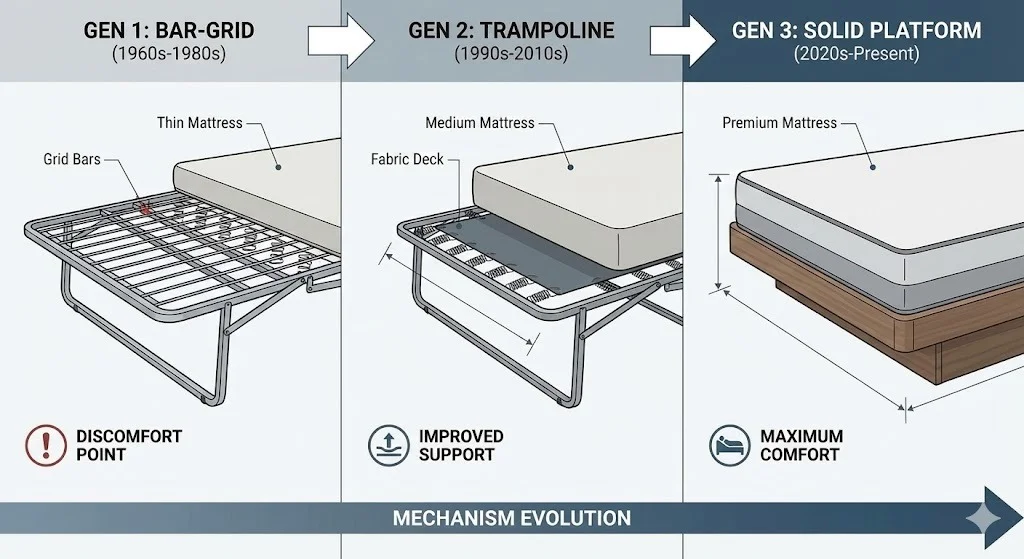
2. Trampoline “Grommet Tear”
This failure shows up in sleeper sofas that use a trampoline style fabric deck under the mattress instead of solid support bars. The deck is stretched tight and clipped to the metal frame with springs that hook through metal grommets in the fabric.
On paper this looks durable, but real life use is rougher than the design assumes. When kids jump on the bed or even when an adult drops their weight suddenly, the load spikes far beyond normal sitting pressure, and those metal spring hooks start acting like little knives.
What fails is not the spring or the frame. The hook slowly chews into the fabric around the grommet until one day it rips straight through. When that happens, the mattress sags in a very specific spot and the bed immediately feels broken.
The reason this matters to you is that there is no simple fix. You cannot sew or patch this fabric in any meaningful way because the tension is too high. Once a grommet tears out, the only real repair is replacing the entire fabric deck, which means ordering a full replacement kit and using a spring pulling tool that most owners do not have.
In a showroom, I always lift the mattress corner and look underneath. I am not inspecting craftsmanship, I am looking for how the load is carried. If I see a stretched fabric sheet with lots of small springs around the edge, I know exactly what kind of failure I am signing up for.
I then press down firmly with my hand near the edge of the open bed, right where a person would sit before lying down. I pay attention to whether the surface feels evenly supported or if there is a soft dip near the perimeter. A soft edge tells me the fabric is already taking more stress than it should.
I also look closely at the grommets themselves if I can see them. If they look thin, loosely set, or already slightly oval instead of round, I assume they will not survive repeated heavy use. Floor models often reveal this early because they get abused in ways homes rarely do.
If you have kids, or if you know guests are likely to sit hard or flop down, this support style is a gamble. I am not saying it will fail immediately, but when it does fail, it fails completely and expensively.
Because replacement is such a hassle, my rule is simple. If I see a trampoline deck and I do not absolutely love everything else about the sofa, I walk away. There are other mechanisms that age more gracefully and give you warning before they collapse.
This is one of those cases where knowing how something breaks is more important than how it feels on day one. A sleeper bed that relies on fabric and grommets to hold real weight has very little forgiveness once real life gets involved.
3. The “Head-Dip” (Leg Lock Failure)
This is a failure you feel immediately, even if you cannot see it. The bed opens fully, but when you lie down, the end near the sofa back sinks lower than the rest, usually by a few inches.
What causes this is not the mattress or the frame bending. It comes from the small spring that is supposed to pull the support legs into a straight, locked position. When that spring weakens, snaps, or slips off, the legs never quite stand upright.
Instead of carrying weight vertically, they stay slightly angled. That angle steals height and stability, and all of it shows up as a dip right where your head and shoulders should be supported.
In a real home, this often starts quietly. Guests complain that the bed feels off, or people stack extra pillows without knowing why. By the time the owner notices the tilt, the spring is already gone and the legs will never self correct.
In the showroom, I test for this very deliberately. I fully open the bed and then stand at the side, near the sofa back. I press down firmly with both hands right where the head of the mattress would be.
I am not looking for softness from the mattress. I am looking for movement in the frame itself. If that end drops more than the foot of the bed when I apply the same pressure, I take that as a warning.
I also crouch and look at the support legs from the side. They should be close to vertical when the bed is open. If they lean noticeably toward the center of the bed, even on a new floor model, that means the leg lock system is marginal.
Another thing I do is lift the head end of the frame just slightly off the floor and then set it back down. A healthy leg lock snaps back into place with a confident, planted feel. A weak one lands softly, like it is unsure where it belongs.
If you are allowed to sit or lie on the bed, pay attention to how your body settles. A leg lock problem feels like a slow nod downward, not a bounce. Once it dips, it stays there.
This matters because fixing it later is harder than it sounds. The spring itself is cheap, but accessing it means partially disassembling the mechanism. Many owners never bother, and they live with a permanently tilted bed.
As a buyer, you have one big advantage. You can reject the problem before it ever enters your home. If the head of the bed does not feel just as tall and confident as the foot in the showroom, I assume it will only get worse with use.
I have learned to trust this instinct. A sleeper that cannot hold itself level on day one is telling you exactly how it will age.
This image shows a failure that looks dramatic on an X ray, but feels subtle when it starts. Mechanical interference is what happens when one bent or shifted part blocks the normal path of another, and the whole bed loses its ability to finish a motion.
I have owned a sleeper that worked perfectly for years, then suddenly refused to close all the way. Nothing was broken in an obvious way. One side rail had bent just enough that a folding arm hit it instead of passing cleanly by.
What matters to you is that this kind of damage almost never comes from one big mistake. It comes from repeated small stresses like forcing the bed closed, sitting hard on the edge, or dragging the frame slightly sideways as it opens.
In a showroom, I look for early signs of this by watching the path of the mechanism, not just the end result. As I open the bed, I stop halfway and look down both sides to see if the arms mirror each other.
If one side seems to travel closer to the frame or looks like it is brushing past something, I get suspicious. A healthy mechanism has clear visual space around moving parts, even when folded tightly.
I also listen for rubbing sounds. Not a clunk or a click, but a dry scraping noise that happens at the same point every time. That sound means two pieces are already touching when they should not be.
When I close the bed, I do not push it straight down from the middle. I guide it evenly from both sides and see if it wants to twist. A mechanism that fights you diagonally is already telling you that something is not lining up.
Once the sofa is closed, I crouch and look underneath from the front. I am not hunting for perfection, I am checking whether anything looks freshly shiny where paint has rubbed off. Bare metal on a floor model is evidence of repeated contact.
The reason I take this seriously is that interference failures tend to cascade. One bent rail causes a linkage to jam, which puts more force on the next pivot, which then loosens, and soon the bed feels stiff and uncooperative every time.
There is almost never a clean repair. Straightening a bent rail weakens it, and replacing it usually means replacing the entire mechanism. Most owners just live with a bed that never quite closes right.
As a buyer, your leverage is simple. If the motion does not feel generous and forgiving, I walk away. A sleeper should tolerate slightly uneven handling without punishing you for it.
When I find one that opens and closes with space to spare, no scraping, no diagonal fighting, and no shiny rub marks, I relax. That extra clearance is what allows the mechanism to age without turning into a jammed machine.
This is one of those cases where smoothness is not a luxury. It is the difference between a sleeper that quietly works for years and one that traps you in a wrestling match every time guests leave.
The “WD-40” Error
The "WD-40" Error
Never use standard WD-40 on a sofa bed mechanism.I learned this one after trying to quiet a squeaky sleeper and accidentally making it worse within a month. Standard WD-40 is not a lubricant in the way most people think of it. It is a solvent that flashes off and leaves behind a tacky film.
That sticky residue acts like a magnet for dust, grit, and pet hair. Inside a sofa bed, that debris gets pulled straight into the scissor links and pivot points. Over time, it turns into a grinding paste that wears the joints faster than if you had done nothing at all.
The fix is simple, but specific. What actually works are dry style lubricants like clear silicone spray or white lithium grease. These coat the metal without staying wet, so they do not attract hair and they do not drip onto your carpet.
I am including this in a buying guide because it tells you something important about how the mechanism will be treated in the real world. Most owners reach for WD-40 instinctively. If a sleeper design is so sensitive that one bad lubrication choice accelerates failure, that mechanism has very little forgiveness built into it.
In a showroom, I ask myself a quiet question. Does this bed already sound dry, scratchy, or fussy when it moves. If it does, I assume someone will eventually spray the wrong thing on it at home, even if that someone is not me.
When I open and close a bed, I listen for smooth, dull movement rather than sharp squeaks. A mechanism that is quiet without being oily is usually one with better tolerances and less metal on metal scraping.
If you already own a sleeper, this advice can save it. If you are shopping, it helps you judge how robust the design really is. A sofa bed that works only when perfectly clean and perfectly maintained is not built for real living.
I now see WD-40 as a kind of stress test that happens eventually in most homes. If a mechanism cannot survive that common mistake without eating itself, I would rather know before I buy it.
Sofa Bed Troubleshooting Guide
Sofa Bed Troubleshooting Guide
When a sofa bed refuses to close all the way, I assume something is physically blocking it before I assume anything is broken. The first thing I check is whether the side rails look straight when the bed is halfway folded, because even a slight bow will stop the mechanism from finishing its path. I also remove absolutely everything from the mattress, including thin sheets, because bedding is the most common and least obvious cause of a closing jam.If a sleeper makes a loud squeak when you toss or shift your weight, I do not treat it as a harmless annoyance. That sound usually means dry pivots that are rubbing instead of rotating cleanly. A healthy mechanism has a lot of moving joints, and when they are dry, the noise is sharp and repetitive rather than dull. In real life, the fix is lubricating all the pivot points with a silicone based spray, not flooding them, just enough to coat the metal without leaving it wet.
When the middle of the bed sags but the ends feel fine, I stop blaming the mattress. What usually fails first is the fabric deck or support surface underneath, which stretches and loses tension over time. In homes, people often add a thin bunkie board between the mattress and the frame to spread the load and buy time. As a buyer, I look underneath in the showroom and ask myself whether that center support looks like something that will still be firm in five years, not just today.
If a bed will not stay fully open and feels like it wants to fold back up, I immediately suspect the return or tension springs that control the opening angle. These are small parts, but they do critical work. When they weaken or snap, the bed never quite commits to the open position. In the showroom, this shows up as a bed that feels nervous, like it wants to move when you sit down. I avoid anything that does not feel calmly locked in place.
Gaps between the steel mechanism and the wooden sofa frame are another quiet warning sign. Over time, vibration and use loosen the bolts that tie metal to wood. When that happens, the whole bed starts shifting slightly inside the sofa, and that movement multiplies wear everywhere else. In a showroom, I crouch and look underneath to see if the steel looks snug against the wood or if there are visible gaps that suggest things are already working loose.
I include this troubleshooting section in a buying guide for a reason. Every one of these problems starts small and feels fixable at first. By the time most owners realize what is happening, the sleeper has already trained them to live around its quirks.
When I am shopping, I flip this around in my head. If I can already imagine myself diagnosing, lubricating, tightening, or compensating for something, I assume the design is asking too much. A good sofa bed should not require you to become its caretaker just to keep it usable.
The goal is not perfection. It is forgiveness. I want a sleeper that can tolerate a missed sheet, a hard sit, or a little neglect without immediately drifting into one of these failure patterns.
When I find one that closes without protest, opens without noise, stays level under weight, and sits tight inside its frame, I know I am looking at a mechanism that will age slowly instead of dramatically. That, more than any brand name or fabric choice, is what keeps me from feeling ripped off years later.
Useful Products for Sofa Bed Owners
- Dry silicone spray lubricant — the correct lubricant for sofa bed pivots and hinges. Do not use WD-40.
- Sofa bed mattress topper — adds comfort to an existing sleeper mattress without a full replacement.
Explore Technical Reference

Futon Durability: Hardwood vs. Hollow Tubes
Why futon frames fail and what construction features predict long-term durability. Understanding the weak points that determine whether a futon lasts years or months.
Analyze Details →
Daybed vs. Sofa Bed: Choose Your Sacrifice
A daybed is a bed pretending to be a couch. A sofa bed is a couch pretending to be a bed. Understanding when each approach produces better results.
Analyze Details →