Sofa Bed Mattresses: Foam vs. Innerspring
Introduction
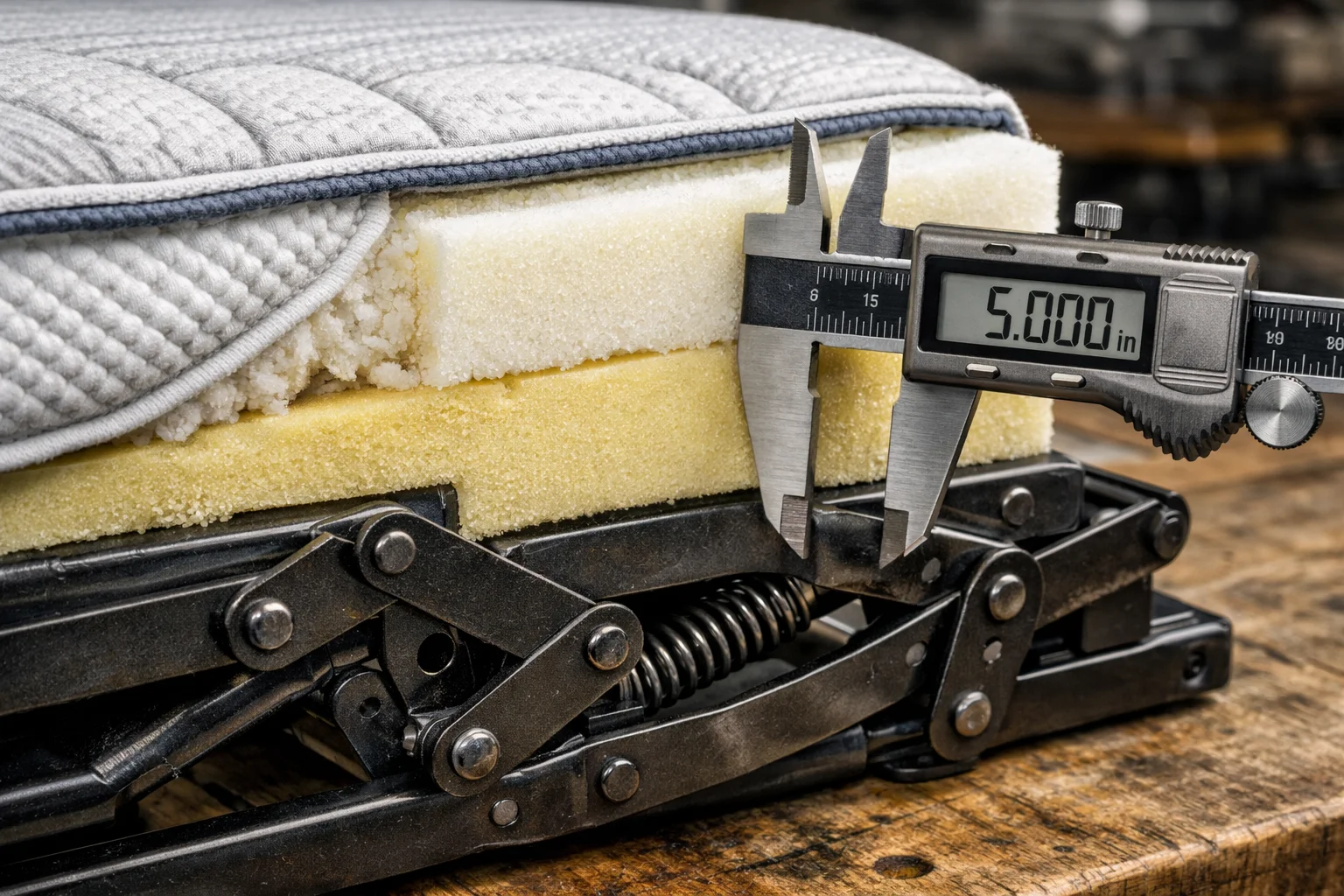
A normal bed mattress gets to be thick enough to hide a lot of sins, because depth gives you room for comfort layers on top and support layers underneath. A sofa bed does not get that luxury, because it has to fold up inside the couch, and that folding geometry caps the mattress at around five inches.
That five inch limit changes how you should shop. On a regular bed, extra thickness can make up for mediocre materials for a while. On a sofa bed, thickness is not available, so the material quality has to carry the whole experience.
When the materials are too soft, too thin, or just cheap, you feel it fast. The mattress compresses until you are basically lying on the steel bars and the folding mechanism, and that is the “bottoming out” sensation people describe as a torture device.
If you remember nothing else going into a showroom, remember this: you are not really shopping for plushness, you are shopping for resistance to bottoming out. I treat every sofa bed mattress as guilty until proven supportive, because the design is working against it from day one.
So when you test one in person, do not just sit on the edge and call it good. I get it opened up, I lie down on my back and then on my side, and I pay attention to whether my hips drop sharply, because that is usually the first place a thin mattress gives up.
If you can feel the frame through the mattress with your hand by pressing down near the middle, or you can feel distinct bar lines when you lie still, that is your warning sign. It might feel “fine” for five minutes, but it is telling you exactly what it will feel like at 2 a.m. when your shoulder finds the metal.
This is also why marketing terms on sofa bed mattresses can be misleading. A label can say gel memory foam or cooling comfort, but what matters to you is whether the mattress can keep your heavier points, usually hips and shoulders, from collapsing straight into the mechanism.
The "Travel Distance" Deficit
A lot of the misery of a sofa bed mattress comes from a simple physical limit, the mattress is so thin that the innerspring coil does not have enough room to work. A steel coil needs travel distance to compress gradually, because that gradual compression is what gives you support without feeling like you hit a hard stop.In a roughly five inch sofa bed mattress, those coils are short, and they run out of compression fast. When you lie down, the coil might feel springy for the first inch or two, then it reaches its solid height and it basically turns into a rigid piece of wire. That is when the mattress stops acting like a mattress and starts acting like a metal grid with fabric on top.
This is why people describe innerspring sofa mattresses as “sleeping on a cage.” It is not just that they are firm, it is that they do not have enough room to create pressure relief at the hips and shoulders before the springs effectively lock up. If you sleep on your side, you usually feel it first in the shoulder, because your shoulder needs to sink in without the rest of you dropping into the frame.
When I am testing one in a showroom, I do a very specific check for this. I lie on my side and slowly roll my hip forward and back a little, like I am trying to settle in, and I pay attention to whether there is a point where the mattress suddenly feels like it stops moving. That “it stops moving” moment is the travel distance deficit, and it is a dealbreaker for me unless you are only using the bed for very occasional, very short stays.
If you are choosing between spring and foam in a thin sleeper mattress, I lean foam for a reason. Foam does not need a tall profile to work, because it resists you through the compression of the foam structure itself, so it can still give you a more gradual, forgiving response even when it is thin. In plain English, a decent foam mattress can feel supportive without having that sharp transition from soft to metal.
You can use this to ask better questions on the sales floor. Instead of asking if it is comfortable, I ask what the core is made of and how thick the foam layer is above it, because that top layer is the only thing standing between your shoulder and the mechanism. If they cannot tell you what is inside, or they only describe it with marketing words, I assume it is built to a price, not to survive real sleep.
If the store will let you, try this quick reality check: kneel gently on the mattress with one knee, then shift your weight a bit and notice whether you can feel the spring grid or bars as distinct lines. If you can map the metal with your knee in a few seconds, your hips will find it overnight.
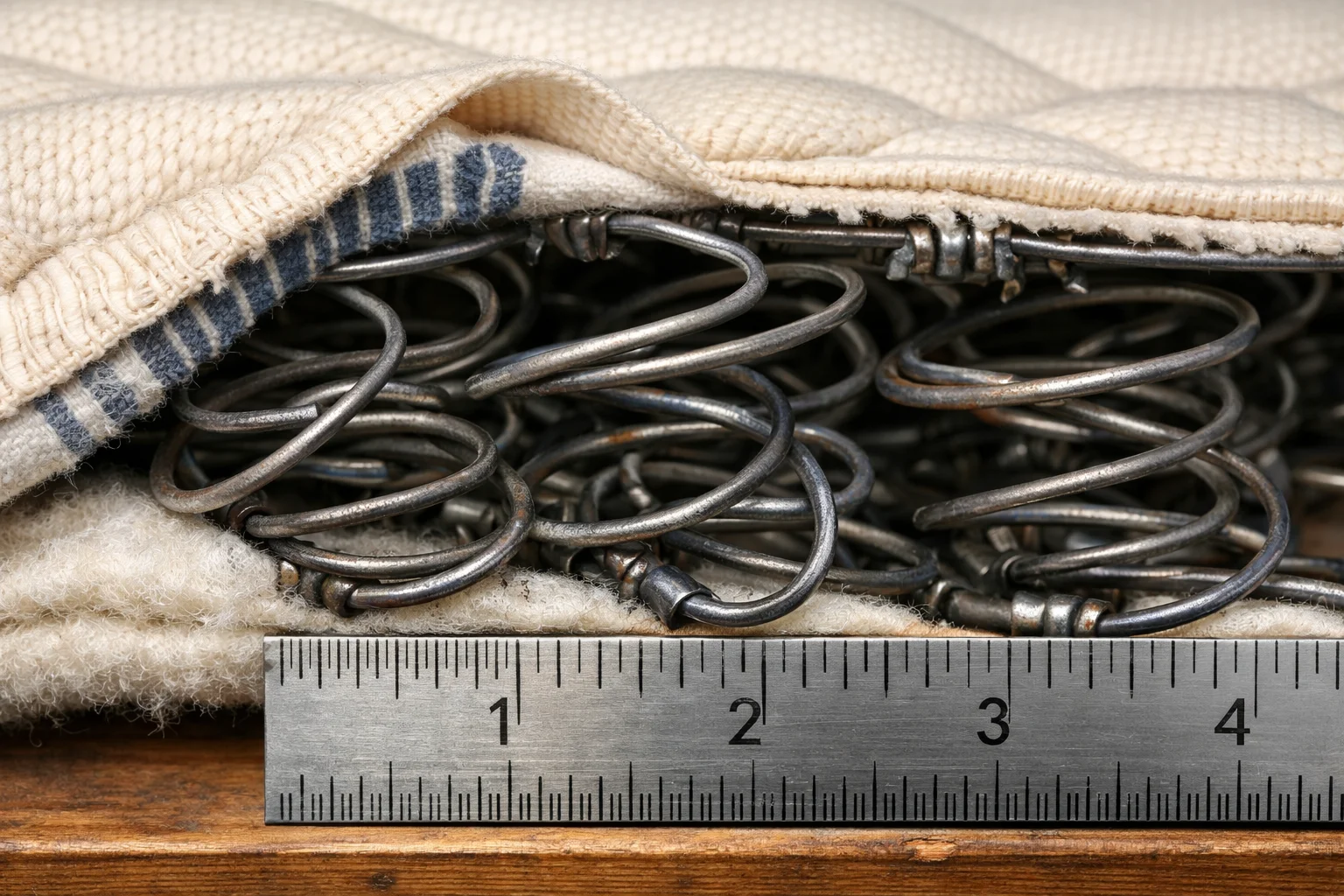
When you are standing in a showroom, this is the kind of close up detail I try to notice, because edge failure is one of the fastest ways a sofa bed starts feeling awful even if the middle seems “okay” at first.
What I am looking for is whether the spring unit has a real, stiff perimeter, often called a border wire, that keeps the coils at the edge from buckling outward. If it is missing, the edge can do that roll off thing where your weight pushes the coil pack sideways instead of compressing it, and you feel like you are sliding off the bed or like the mattress is peeling away from the frame.
You can test this without tools. With the bed opened, I sit near the edge like I am putting on shoes, then I shift a little side to side and pay attention to whether the edge holds me up or whether it tilts and squishes outward. If the edge collapses easily when you are just perched there, it is going to feel much worse when a real sleeper ends up near the side overnight.
Then I do the hand check. I press down with an open palm about two inches in from the edge and compare it to the middle, because a healthy mattress should feel a little firmer at the edge, not dramatically weaker. If the edge feels like it has no backbone and you can see the quilting stretch and the coils angle outward, I treat it as a red flag.
This matters more than people think because sofa bed mattresses are narrow, and sleepers end up using the edge a lot, especially two adults or one adult with a kid. A weak edge also makes the whole setup feel smaller, because you subconsciously avoid the sides, and you end up sleeping on a strip down the center.
If you are looking at a foam sofa bed mattress instead of springs, you still want to do the same edge test, because cheap foam will “crumble” at the side over time and it can develop that same roll off feeling. I press down at the edge and see if it slowly returns to shape and feels consistent, or if it stays crushed and feels dead compared to the center.
If the salesperson cannot tell you whether there is any edge reinforcement, I take that as a signal to stop guessing and start relying on what your body tells you. If you feel unstable on the edge in the showroom, you will not magically feel stable after a few months of use.
Comparing the Material Specs
When I compare sleeper mattresses, I try to ignore the adjectives and hunt for the few specs that actually predict whether you will bottom out. The frustrating part is that many showrooms do not post those specs, so your job is half detective work and half physical testing.
The first thing I want to know is what the support core is, because that is what you are really sleeping on once the comfort layer compresses. If the core is an innerspring unit, I assume it will feel firmer and more “cage-like” unless there is enough foam above it to buffer the pressure points. If the core is all foam, I assume it can be more forgiving in a thin profile, but only if it is not the squishy, low quality kind that collapses and stays collapsed.
In a showroom, I ask a very plain question and then I wait through the sales talk: what is the mattress made of, layer by layer, and how thick is each layer. If they cannot answer without grabbing a brochure, I ask them to unzip the cover if it is designed to do that, because some sleeper mattresses have a zipper specifically so you can see the build. If there is no zipper and no cutaway sample, I treat the mattress like an unknown, and I lean harder on my own testing.
What you are trying to find out is how much real material sits between you and the mechanism. When a tag says “memory foam,” that can mean a thin sheet of foam quilted into the cover that feels nice for thirty seconds, then you sink right through it. I press down slowly with my palm in the middle of the mattress and pay attention to whether it ramps up in resistance, or whether it goes from soft to hard with almost no transition, because that sudden hard stop is what shows up later as hip pain and shoulder pain.
If the mattress is marketed as gel foam or cooling foam, I treat that as a comfort garnish, not a support guarantee. Cooling features do not prevent bottoming out, and on a sleeper mattress that is only a few inches thick, support is the whole game. I would rather have boring foam that holds me up than fancy foam that feels nice in the first minute and then collapses into the bars.
The next spec I care about is foam quality, and I do not mean whether it is “high density” on a hang tag. If they can tell you the foam density, that is helpful, but most retail staff will not have it, and I do not expect you to memorize numbers anyway. Instead, I do a simple fatigue test with my body: I kneel in one spot for ten seconds, then I move my knee and immediately press that spot with my hand to see if it rebounds promptly or if it stays cratered and feels dead.
That rebound check is my shortcut for how the foam will age. Cheap foam tends to take a set, especially in the middle where hips land, and once it takes a set in a thin sleeper mattress, you are basically done because there is no extra thickness to compensate. If you see a visible depression that hangs around after a short test, I take it as an honest preview of what a year of guests will do to it.
If you are comparing memory foam to latex foam, I treat latex as the more resilient material in general, and it tends to push back in a way that keeps you off the frame. The catch is that not many sleeper sofas include true latex, and plenty of products use the word loosely, so I ask directly whether it is actual latex foam or just a “latex-like” polyfoam. If it is real latex, you will usually feel it in the response, it springs back quickly and feels supportive without that slow, stuck-in-the-mud sink.
I also look at the cover and quilting, not because a cover makes a bad core good, but because a thin mattress needs every bit of stable padding it can get. A very fluffy, lofty quilt can feel great in the showroom, then pack down fast and leave you with the hard truth underneath. I pinch the top panel between my fingers and see whether it feels like there is real padding or just air and fiberfill, because fiberfill compresses and migrates.
If you are stuck choosing between two unknown builds, I use a tie breaker that has saved me from a couple of bad purchases. I lie on my side in my usual sleep position, then I slide my hand palm-up under my waist, because that is where thin mattresses usually fail in a sneaky way. If there is a big hollow under your waist while your shoulder and hip feel jammed, the mattress is not distributing pressure well, and you will wake up feeling twisted.
Then I roll onto my back and do the “hip check,” where I place a hand under my lower back and see if my hips are dropping lower than my ribcage. On a good sleeper mattress, you can feel that the mattress is meeting you and holding you level. On a bad one, your hips sink until you are in a shallow V shape, and that is when people say they slept “hammocked.”
If the store offers an upgraded mattress option, I do not automatically assume the upgrade is worth it. I ask what changes besides the name, meaning did they add actual thickness to the comfort layer, change the core type, or improve edge support, or did they just add a different cover and some cooling buzzwords. If the only difference is a softer top feel, I assume it will still bottom out, just more comfortably for the first few minutes.
Finally, I match the material choice to how you will really use it. If this is for frequent sleeping, I would rather you buy the more supportive, higher quality mattress now than try to fix it later with a topper, because toppers can help with pressure relief but they cannot erase the feeling of the frame underneath. If it is truly for occasional, short stays, you can tolerate a little less, but I still would not accept a mattress that you can “map” with your knee in the showroom, because that is the fast track to guest complaints.
1. Innerspring (The Legacy Choice)
When you see an innerspring sofa bed mattress, I assume you are looking at the default, legacy setup that has been shipped for decades because it is cheap, familiar, and easy to describe. You will often hear gauge numbers like 13 or 14 for the steel coils, and while that sounds reassuring, the real question is whether the design makes sense in a folding mattress that is only a few inches thick.
The biggest practical problem I see with innerspring in a sofa bed is the edge. On a normal mattress, a border wire or some kind of perimeter structure helps the whole coil unit behave like a single, stable box. On many sleeper mattresses, that perimeter piece is missing because the mattress has to fold, and that usually means the edge has almost no structural integrity.
You can catch this in the showroom in a way that is hard to unsee once you know it. With the bed open, I sit right on the edge the way a guest would when they are getting dressed, and I watch what the mattress does relative to the metal deck. If the mattress shifts sideways, creeps, or feels like it is trying to slide off the frame instead of compressing under you, that is the no border wire problem showing itself.
If you want an even clearer check, I put one hand on the mattress edge and one hand on the frame, then I gently push down and a little outward with my palm. A decent edge will mostly push back in place, but a weak edge will buckle, roll, and walk away from the frame like it is not attached to anything.
This is not just a comfort issue, it is a usability issue. A guest who sits down on that edge to tie their shoes can literally shift the mattress off center, and then the whole bed feels crooked for the rest of the night.
The other thing I am wary of with innerspring sofa bed mattresses is how fast they age in the real world. Even with occasional use, I have seen a lot of these start squeaking and taking a set within a couple of years, and once the springs take a set in a thin mattress, you do not have any extra thickness left to hide it.
In the showroom, I listen for early warning signs instead of assuming squeaks are just a store floor issue. I lie on my back and do a slow bridge, meaning I lift my hips an inch and settle back down a few times, then I roll side to side like I am changing positions at night. If I hear creaks or pingy spring noises from the mattress itself, not the folding frame, I treat that as a preview of what your guests will hear at 2 a.m.
I also do a s
2. High-Density Polyurethane Foam
When a sleeper sofa offers an “upgraded” mattress, this is the upgrade I most often see, a polyurethane foam core that is simply denser than the basic stuff. I do not get excited by the word upgrade on its own, because it can still be the same thin profile with a slightly nicer cover, but a genuinely higher density polyfoam core is one of the few changes that can actually reduce bottoming out.
If the staff can give you a real spec, I want to hear foam density, not just “firm” or “supportive.” The number I look for is 1.8 lb per cubic foot or higher, because below that I have repeatedly felt foam that seems fine at first, then collapses fast once your hips settle in. If they cannot tell you density, I do not argue, I just switch to physical tests that expose the same weakness.
Here is what low density foam feels like in the showroom once you know the pattern. You lie down, it compresses easily under your hips, and then it hits a hard stop that is not the foam pushing back, it is the deck or bars underneath. A 180 pound adult can trigger this instantly, but even lighter sleepers will notice it on their side when their shoulder tries to sink and the mattress runs out of “give.”
When I am testing a polyfoam sleeper mattress, I do a slow sink test with my hips instead of bouncing. I lie on my back, take a breath, and wait ten seconds, because cheap foam often keeps collapsing for those first moments, and that is exactly what it does at night. If I feel my hips continuing to drop after the first contact, and the support never ramps up smoothly, I assume it will bottom out once the foam fatigues.
I also do a fold line check because sleeper mattresses live a hard life. They spend months folded, sometimes strapped, sometimes stored in a warm room, and some foams permanently lose their resilience along those bend points. With the bed open, I run my hand across the mattress at the hinge areas and press firmly with my palm, because if the foam is already softer or more crushed there, you will feel those zones as ridges and valleys when you lie across them.
This is one place where better density tends to show up in a practical way. Higher density polyfoam is more likely to keep its feel after being folded and unfolded repeatedly, so you do not end up with a mattress that feels supportive in one panel and dead in the next. I am not looking for perfection, I just want the resistance to feel consistent as I move from head to foot.
If you are trying to decide quickly in a showroom, I use a simple comparison move that tells me more than the label. I press down with a flat palm in the center until I feel real resistance, then I release and watch the rebound. Better foam comes back cleanly and fairly promptly, and it does not leave a hand shaped depression that lingers like memory foam, or worse, like exhausted foam that cannot recover.
Do not let “ILD” talk throw you off if it comes up, because it is not a number you can easily verify in a store. What matters to you is whether the mattress holds its firmness after pressure and time, not just whether it feels firm for the first five seconds. If a salesperson is leaning on technical terms, I bring them back to a question they can answer plainly, which is whether the core foam is at least 1.8 density, and whether the build changes from the standard mattress besides the cover.
There is also a small, real comfort win with a solid polyfoam core that people do not mention. Foam tends to damp sound and vibration, so if the sleeper mechanism is a bit rattly or the metal deck has minor squeaks, a denser foam can mask some of that just by absorbing movement. It will not fix a truly noisy frame, but I have noticed that an all foam mattress is less likely to amplify every shift and roll the way a spring unit can.
One caution I learned the annoying way is that polyfoam can be made dense and still feel wrong if the top is too soft or too thin. You can end up with a mattress that has a decent core, but a plush top that lets your hip sink quickly before the core catches you, and on a thin sleeper mattress that quick drop can still slam you into the mechanism. When you test it, pay attention to the transition, because a good foam build feels like it is catching you progressively, not letting you free fall for an inch and then stopping you abruptly.
If you are shopping for a sleeper that will see real use, I treat high density polyfoam as the minimum “serious” foam option. It is not fancy, but it is one of the few constructions where I have seen the feel stay reasonably stable over time, especially compared to the airy, cheap foam that looks fine in a tag photo and then turns into a hammock with edges.
3. Memory Foam (Visco-Elastic)
Memory foam is the slow responding, heat and pressure sensitive stuff, the kind that lets you sink in and then sort of “holds” your shape for a moment. In a thin sleeper mattress, that can be a real advantage because it can spread pressure across your shoulder and hip instead of letting those spots punch straight down to the bars.
The best use case I see for memory foam in a sofa bed is what I think of as the bar zone, basically the middle third where your hips live. If you are a back sleeper, or you have guests who complain that their hips feel bruised on sleeper sofas, a decent memory foam comfort layer can be the difference between tolerable and miserable because it rounds off that harsh, thin mattress feel.
The trade off is heat, and I do not mean “a little warm,” I mean wake up sweaty warm. Memory foam is an insulator, and on a sofa bed you usually have lousy airflow underneath because the folding deck and frame block it, so the mattress can turn into a heat trap faster than a normal bed.
In a showroom, I do not try to guess from labels like gel, copper, cooling cover, or ventilated foam. I do a simple body test, I lie still on my back for a full minute, then I pay attention to whether my lower back and hips start feeling clammy or overly warm compared to how I feel on a basic polyfoam mattress nearby.
You can also learn a lot by how the foam lets you move. I roll from back to side and back again a few times, slowly, like you would at night, and I notice whether I feel stuck in a crater. If you have to do a little push up to change positions, that is a warning sign for two reasons, it tends to sleep warmer because you are more enveloped, and it can make the thin mattress feel like it is swallowing you right toward the frame.
I also watch for the “nice for thirty seconds” memory foam build, which is common in sleeper sofas. This is where the top feels plush and slow, but once you sink through it you hit something much firmer immediately, either a hard foam core or the deck, and that transition can feel like pressure relief on top of a board. When you do the hip check, give it ten to fifteen seconds, because memory foam often keeps relaxing under you, and that extra sink is exactly what can turn into bottoming out later in the night.
If you want a quick way to separate supportive memory foam from pure showroom softness, press your palm down in the middle and hold it there for a few seconds, then release and immediately press again. If the second press dives much faster and deeper because the foam “warmed up” and softened, I assume the mattress will feel less supportive the longer someone sleeps on it.
The fold line issue matters with memory foam too. Because it is temperature sensitive and it spends a lot of time bent, I run my hand across the hinge areas and look for zones that feel extra soft, lumpy, or delayed in rebound compared to the rest. If the mattress already feels uneven panel to panel on day one, it usually gets more noticeable once guests sleep across those bends.
If you know you or your guests sleep hot, I personally treat memory foam as a risk unless the overall feel is more on top of the mattress than in it. In plain terms, I want enough contour to take the edge off the bar zone, but not so much sink that you are wrapped up with no airflow, because the sleeper frame underneath is not helping you cool off at all.
When memory foam works in a sofa bed, it feels like gentle pressure relief without that trapped, swampy warmth, and it still ramps up in resistance before you meet the mechanism. When it does not work, it feels great in the first minute, then you get warmer, you sink more, and the frame starts making itself known right when you are trying to fall asleep.
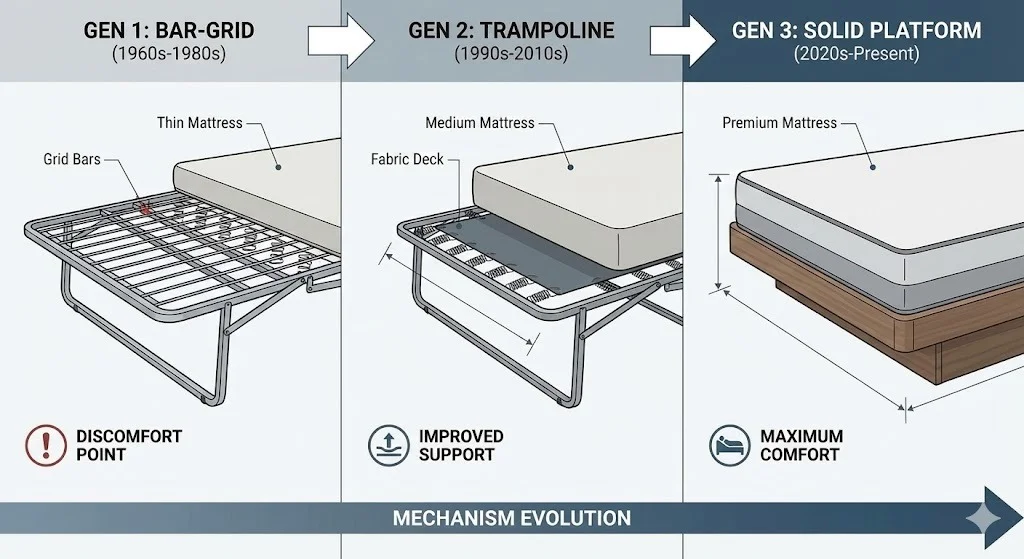
This picture is the mental model I keep in my head when I test a sleeper in person. The spring side is not just “firmer,” it is uneven in a way your body can feel because the support is concentrated where the wire is, and the gaps between wires do not help you.
Those pressure spikes are why people wake up with one shoulder or one hip feeling bruised, even when the mattress seemed acceptable at first touch. In a thin sleeper mattress, you do not have enough padding to blur those high spots into something smooth.
In the showroom, I try to prove to myself whether I am dealing with spikes or a more uniform deck. I press down with my palm and I slide it slowly across the surface while keeping steady pressure, and if I feel a repeating pattern of ridges and troughs, I assume a sleeper will feel that pattern too once the comfort layer packs down.
Then I do the same test with an elbow, gently, because elbows behave more like a shoulder than a flat hand does. If my elbow immediately finds a hard line, that is my sign that the comfort layer is too thin to protect a side sleeper.
Foam has its own risks, but what I like about it in a thin mattress is that it can act like a single, continuous platform instead of a grid. When foam is decent quality, the resistance builds more smoothly, so your shoulder and hip do not get that sharp, pointy feedback that a short spring unit can create.
You can check for that smooth build up in a way that does not require any jargon. I lie on my side and I pay attention to whether my shoulder can sink in a little without my ribcage feeling like it is perched on something hard, and I also pay attention to whether my hip settles gradually or drops and hits a stop.
If you are stuck choosing quickly between a spring mattress that feels lively and a foam mattress that feels plain, I would rather you choose the one that feels boring but even. A sofa bed is one of those purchases where “even support” usually beats “fun showroom bounce,” because at 2 a.m. you feel spikes, not adjectives.
If you want to be extra sure, ask the staff to let you lift a corner of the mattress slightly and look underneath. I am not trying to see brand names, I am trying to see whether there is a smooth deck under you or a bar and wire layout that is going to telegraph through as the mattress ages.
The “Latex” Holy Grail
The "Latex" Holy Grail
If your budget can handle it, I would actively look for a sleeper mattress that is described as natural latex, not just foam with a latex-sounding name. In a thin sofa bed mattress, latex is one of the rare materials that can feel both cushioned and genuinely supportive, instead of feeling soft for a minute and then dumping you onto the mechanism.The main reason I like latex here is that it breathes and it pushes back in a lively, springy way without needing a lot of thickness. In plain terms, it tends to keep you floating higher, so your hips and shoulders are less likely to punch through to the bars, and it also tends to sleep less swampy than memory foam because air can move through it more easily.
There is a technical reason for this that actually shows up in the showroom. Latex usually firms up as you compress it more, so the first bit of sink feels comfortable, then it starts resisting harder before you hit the frame. When it is good, you feel a smooth ramp up instead of that scary moment where you drop and suddenly meet something hard.
Here is how I try to confirm you are feeling that ramp up. With the bed open, I lie on my back and do the ten second hip wait like I do with memory foam, and I pay attention to whether I keep sinking. With latex, I expect a little settling, then I want to feel it catch me and hold me level, not slowly keep giving up under my hips.
Then I go to my side and focus on my shoulder. Latex should let your shoulder sink just enough that you are not jammed, but it should still feel like it is holding you up in a buoyant way, not trapping you in a crater. If you feel like you have to fight the mattress to roll over, that is usually not latex, or it is latex buried under too much slow, sticky foam.
The other thing I watch for is the way latex bounces back. I press down firmly with my palm near the middle, release, and I expect an immediate, eager rebound. If it returns slowly, stays dented, or feels mushy and dead, I assume you are dealing with polyurethane foam being marketed with a latex word somewhere in the description.
I also get very literal with my questions because “latex” gets used loosely. I ask whether the mattress core is latex foam, or whether it is a polyfoam core with a thin latex layer, and I ask if it is natural latex or a latex blend. If they cannot answer, I do not argue about chemistry, I just fall back on what my body is telling me, which is whether it ramps up in support before the hard stop.
One caution I have learned is that latex can still be ruined by a bad overall build. If the mattress is still too thin above the deck, or the cover quilting is puffy fiber that will pack down fast, you can end up feeling the hinge bars anyway. So even if the tag says latex, I still do my knee mapping test near the center and across the fold lines, because the mechanism does not care what the foam is called.
When you find a true latex sleeper mattress that is built decently, it is the closest thing I have felt to a normal bed experience inside the five inch limit. It is not magic, but it is one of the few times I lie down on a showroom sleeper and do not immediately start planning how I would apologize to a guest.
Mattress Specification Comparison
When you see a chart like this, I want you to treat it as a quick way to ask better questions, not as a promise that one material will automatically feel good in your living room. In sofa bed mattresses, the harsh truth is that almost everything is stuck in the same thickness range, so the real difference is how each material behaves when it is forced to work inside that thin profile.
Thickness is listed as roughly four to five inches across the board, and that is exactly the problem you are shopping around. Since you cannot buy your way out with extra depth, you have to buy your way out with a support core that does not hit a hard stop too fast, plus a comfort layer that does not pack down and vanish.
When the “primary support” is steel wire, you are gambling on short coils that can feel springy at first and then suddenly turn into a rigid grid when they run out of travel. In the showroom, I take an extra minute on these and do the slow side lying shoulder test, because the coil pattern loves to announce itself right there.
When the “primary support” is foam cells, meaning polyfoam, you are betting on the foam’s ability to resist compression smoothly instead of spiking. The practical move I use is time under load, because weak foam lies in the first five seconds. I lie there, let my hips settle, then I decide whether the support ramps up or whether I keep sinking until the frame becomes the support.
When the “primary support” is heat reactive cells, meaning memory foam, you usually get better pressure relief at first touch, but you have to check whether it turns into a warm, slow sink that lets you drift closer to the deck over time. In a store, I always do at least one position change test on memory foam, because if you already feel stuck just trying to roll, it is going to feel worse at 2 a.m. when it is warmer and softer.
When the “primary support” is vulcanized rubber, meaning latex, that is where I personally start paying attention, because latex can stay supportive without needing a thick build. What I look for is buoyancy plus a firming up feeling as I sink, and I still check the fold lines because even great foam cannot erase a bad hinge zone.
Foldability is not just a convenience feature, it is durability. Wire kinks, foam generally tolerates folding better, and latex often folds fine but can be heavy, which matters because heavy mattresses tend to drag and rub during folding, and that can chew up the cover and seams. When I watch a salesperson close the bed, I watch whether the mattress fights the fold, bunches, or looks like it is being forced, because those are the ones I see looking lumpy later.
Repulsion is basically the “push back” feel you notice immediately. Springs and latex tend to feel lively, polyfoam sits in the middle, and memory foam feels like it is absorbing you. In a sleeper sofa, I prefer push back that keeps your hips from sinking into the mechanism, but I do not want that push back to come from wire lines, so I try to separate “buoyant” from “spiky” by doing that elbow press and slide test across the surface.
Cooling looks straightforward on paper, springs and latex breathe better, and memory foam tends to trap heat, but the sleeper sofa frame underneath changes the game because it blocks airflow. This is why I do not let “cooling” labels decide it for you. I lie still for a minute, then I pay attention to whether my lower back starts feeling warm and damp, because that is where people usually complain first.
Lifespan numbers are always a little optimistic, but the ranking matches what I have personally watched happen in actual homes. If you are buying for frequent use, I treat springs as the shortest lived option in this thin format, polyfoam as acceptable only if it is genuinely higher quality, memory foam as potentially decent but very dependent on the build, and latex as the one I expect to still feel like itself years later.
If you want to use this comparison in a showroom without turning it into an argument, here is how I do it. I point to the material type, then I ask what that means in this specific mattress, meaning what the core is and how much foam sits above it, and whether anything is reinforced at the edges. Then I lie down long enough for my hips to settle, I test the edge like I am putting on shoes, and I run my hand across the fold lines to see if the hinge zones already feel softer or crushed.
Explore Technical Reference

Futon Durability: Hardwood vs. Hollow Tubes
Why futon frames fail and what construction features predict long-term durability. Understanding the weak points that determine whether a futon lasts years or months.
Analyze Details →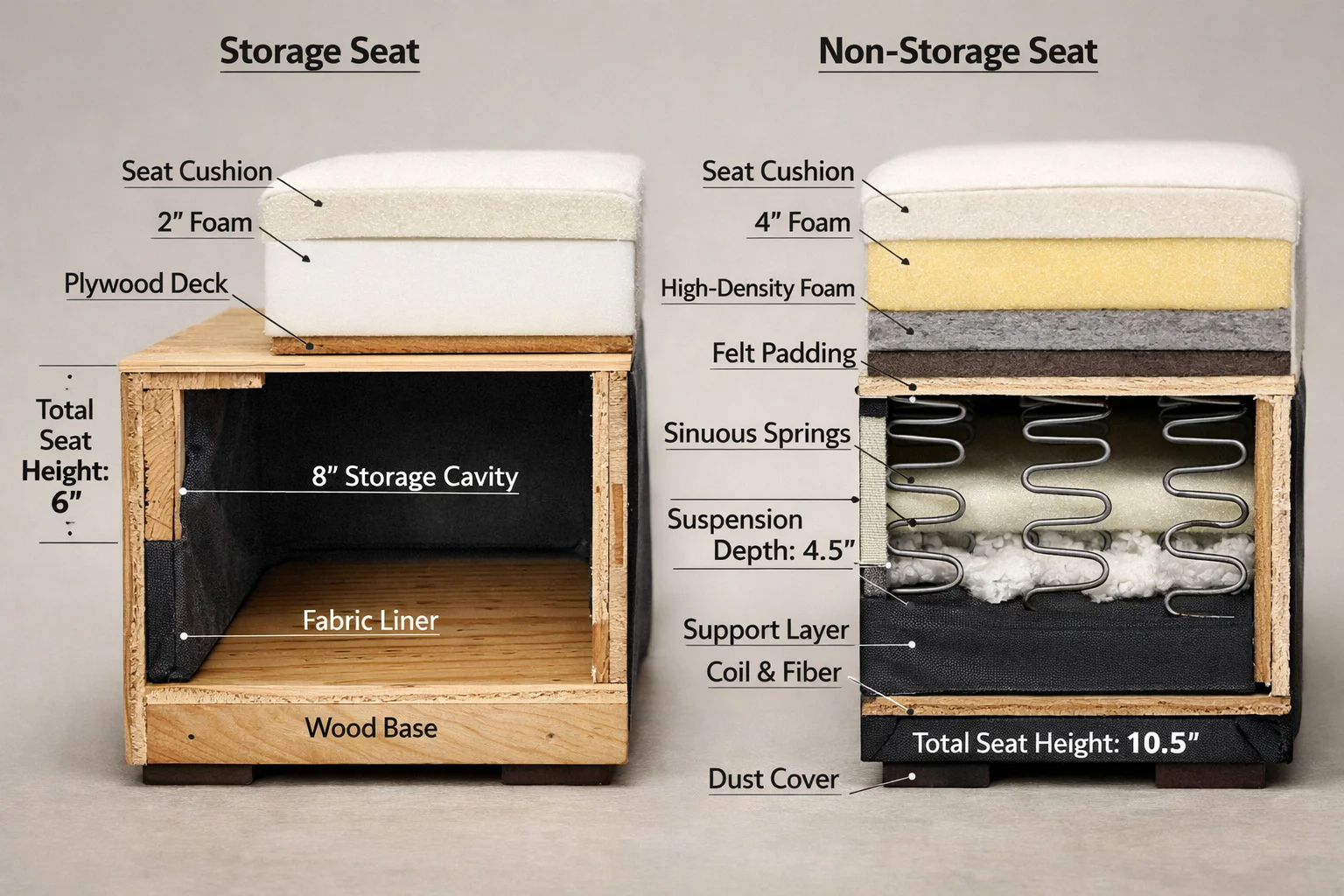
Storage Sofas: The Capacity vs. Comfort Trade-off
How built-in storage affects sofa construction and comfort. Analyzing lift mechanisms, internal capacity, and why storage seats feel different from standard seats.
Analyze Details →