Sofa Beds: The Dual-Function Compromise
Introduction
A sofa bed is an engineering paradox. To be a good sofa, it needs a deep, soft seat. To be a good bed, it needs a flat, firm, and thin support structure. These goals are physically contradictory, leading to the “Sofa Bed Compromise”, a piece of furniture that is often mediocre at both functions unless specific technical standards are met.
I learned the hard way that most sofa beds are sold on the idea, not the experience. In the showroom they feel fine for two minutes, then you get them home and you notice the seat is oddly high, the cushions slide, the frame creaks, and the mattress feels like it has a ridge right where you do not want one.
What I want you to take from this guide is simple: you are not shopping for a clever mechanism, you are shopping for two separate pieces of furniture sharing the same box. If you do not check both jobs in the store, you end up paying for a compromise you never agreed to.
When you are standing in front of one, I suggest you decide your priority before you fall in love with the fabric. If this will be a real bed for real people, you need to treat the bed function like you are buying a mattress and a frame, and the sofa function like you are buying a couch, then only keep the models that pass both tests.
I also want you to be realistic about frequency. If it is for occasional guests a couple of times a year, you can tolerate a little compromise, but you should still demand that it opens smoothly, lies flat, and does not punish someone’s hips and shoulders. If it is going to be used weekly or as a primary bed, the “good enough” sofa bed tends to become a very expensive regret.
In the next sections I am going to walk you through what I physically do in a showroom to expose the usual weak points. You will be able to check the mechanism, the frame, the mattress support, and the comfort in a way that sales talk cannot gloss over.
The "Lumber Bar" Physics
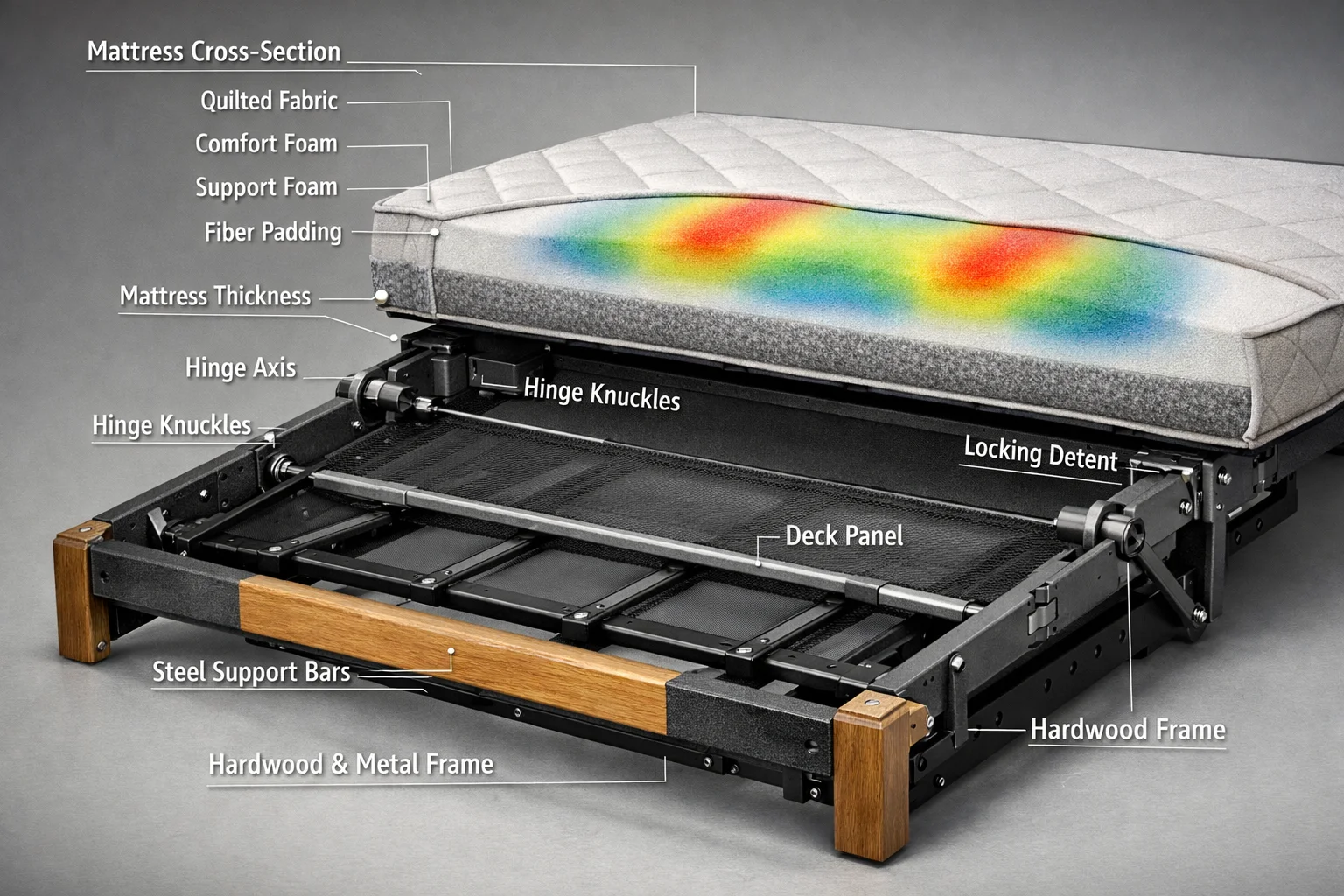
When people complain about a sofa bed having a “metal bar in the back,” I take that literally, because in a lot of designs there really is a rigid cross piece sitting right under where your lower back wants to sink. The reason it shows up so often is simple geometry: the bed has to fold into a sofa that is not very deep, so the frame needs a hinge around the middle to make that fold.Historically, manufacturers made that hinge area strong by tying it together with a structural cross bar so the frame would not flex or collapse. The problem is that the mattress on most sofa beds is thin, so your weight does not get spread out much, and your hips and lower back are exactly where you press hardest. In real use, that means you can end up bottoming out onto that steel bar, even if the mattress feels acceptable when you first sit on it.
In a showroom, I do not try to “judge it with my hand” because almost any padding feels fine to a palm. I open the bed and actually lie down on my back and then on my side, and I pay attention to whether I feel a ridge or a hard line across my midsection. If I feel anything like a firm bar under my lower back, I assume a real guest will feel it more after an hour, not less.
I also look underneath with the bed opened and I follow the support structure with my eyes. If I can clearly see a prominent metal cross member running across the middle area under the mattress, I treat that as a warning sign unless there is a thick, real mattress and some kind of suspension layer above it that keeps my body from ever contacting that point.
If you want a design that avoids the classic “bar” feeling, I ask specifically about a trampoline deck style support. The idea is that instead of relying on a central cross bar under the mattress, the system uses a taut sheet of webbing that is held under tension and supported at the perimeter, so your weight gets distributed across a broader area rather than punching down to a single hard line.
The way I translate that into something you can do in the store is to ask the salesperson to show you the support surface with the mattress lifted slightly, then you look for a continuous, tensioned deck under the sleeping area rather than a few hard members that you can mentally map right to your spine. Then I lie back down and do a slow “hip drop,” where I relax my hips and lower back on purpose, because that is the moment a bar reveals itself.
If the salesperson tries to steer you away from opening it or lying on it, I take that as information. A sofa bed that is genuinely comfortable as a bed is usually something the store is happy to demonstrate, because the difference is obvious when you actually use it the way a sleeper will.
The Three Primary Mechanisms
When you hear a salesperson talk about a sofa bed “mechanism,” what they usually mean is the way it turns from couch into bed. I have learned to treat that choice like choosing a transmission in a car, because it changes how it feels every time you use it, how much you can reasonably expect it to last, and what kinds of comfort problems you are most likely to inherit.
The three you will run into over and over are the traditional pull out tri fold, the click clack hinge fold, and the front opening trundle style. None of them is automatically “good” or “bad,” but each one has predictable tradeoffs that you can test in a showroom in a few minutes if you know what you are looking for.

The Traditional Pull-Out (Tri-Fold)
This is the classic hotel style sleeper where the mattress is folded into thirds inside the sofa. To use it, you usually have to remove the seat cushions, then grab a handle and pull, and the steel frame unfolds in sections.
In the store, the first thing I do is insist on doing the whole routine myself, including taking off the cushions and putting them back. If you feel like you are wrestling it, your guests will too, and you will start avoiding using the bed even when you bought it specifically for that.
Pay close attention to how the frame “scissor lifts” out and whether it tries to rack sideways as it opens. If one side comes out ahead of the other, or if you have to yank it to get it to square up, that is a hint that the mechanism is already finicky, and finicky mechanisms get worse after months of use and minor floor unevenness.
I also ask, right there in front of the model, how thick the included mattress is and whether a thicker replacement is even possible later. With this tri fold style, you are usually limited to a fairly thin mattress, because the folded stack has to fit back into the chassis and still latch. If the salesperson starts pitching an “upgrade mattress,” I make them explain how it still closes without forcing it, because forcing it is how latches bend and frames start to squeak.
Another thing I do is lift one end of the opened bed slightly, just enough to feel how heavy and rigid the frame is. These units can be very heavy because there is a lot of steel involved, and heavy is not automatically bad, but it does tell you something: you are buying a big metal machine living inside a sofa. That means you should take opening smoothness and latch feel seriously, because if it is clunky new, it will be more annoying in your home when you are doing it at night in a tight room.
Comfort wise, I treat the midsection as the danger zone. I lie down and slowly shift my hips and ribs across the center fold areas, because thin mattresses and folding frames are where you get that familiar ridge or bar feeling. If I can feel the structure through the mattress in the showroom, I assume it will feel worse after the foam breaks in and softens.
The Click-Clack (Hinge-Fold)
This is the type where the back folds down, usually with a couple of distinct “click” positions, and the sofa surface itself becomes the sleeping surface. There is no separate mattress, you are sleeping on the same foam you sit on.
The biggest advantage is simplicity. In a showroom I can usually convert it in seconds, and there are fewer moving parts to fight you, which I appreciate if you will open it often.
The comfort risk is also very consistent. There is almost always a physical gap or valley where the seat meets the back, and over a full night people tend to drift into that low spot. In the store I do not just lie down in the middle and declare it fine, I lie where a real person ends up, which is slightly off center, then I roll from my back to my side a few times and notice if my hip wants to settle into that hinge gutter.
I also look for how the hinge behaves under load. I sit near the hinge line, then shift my weight and listen for any clicking, popping, or a feeling that the two halves are not staying locked. A click clack that feels solid should feel like one stable platform in the bed position, not like two pieces negotiating with each other.
If this style is going into your home, I would think hard about who will actually sleep on it. For a kid or an occasional overnight, it can be perfectly fine. For an adult side sleeper, that hinge valley can turn into a real complaint, and no cute throw blanket fixes a geometry problem.
The Front-Opening “Trundle”
This style pulls out from the front like a big drawer, often with a platform that rises or levels out to make a bed. The motion is usually guided by telescoping rails, and the platform is often supported by small wheels or casters.
In a showroom I get down low and look at what is actually touching the floor when it is extended. If I see small casters carrying most of the load, I immediately think about your floor, not just the sofa. On hard floors, those wheels can leave marks or dents over time, and on rugs they can bind and pull the rug forward, which turns “easy pull out” into a two person job.
I also test how sensitive it is to a slightly imperfect floor by extending it slowly and watching whether it tracks straight. If it drifts to one side, chatters, or feels like one rail is doing more work than the other, that is where I expect tracking errors later, especially after the sofa has been moved during cleaning or after a few seasons of the house settling.
The comfort upside is that you can sometimes get a flatter sleeping surface than a tri fold, because you are not folding a frame into thirds under you. Still, I do the same real life test: I lie down and deliberately scoot toward the edge and toward the center, because some trundle designs are well supported in the middle and less supported where the platform transitions or where the casters carry the weight.
If you like this style, I would also measure your space mentally while it is fully extended. It is easy to fall in love with the idea and forget that a front opening bed steals the walking path right where you need it, and you do not want to learn that lesson the first time someone is trying to get to the bathroom at night.
The main thing I want you to remember is that each mechanism has a signature failure mode. With the tri fold, I worry about thin mattress comfort and cranky latches. With the click clack, I worry about the hinge gutter and whether the platform really locks flat. With the trundle, I worry about wheels, floors, and rails that go out of alignment.
In the next section I am going to get more specific about what I check in the frame and the support under the sleeper, because even a mechanism that opens smoothly can still be built around weak wood, noisy joints, or a support surface that guarantees sagging.
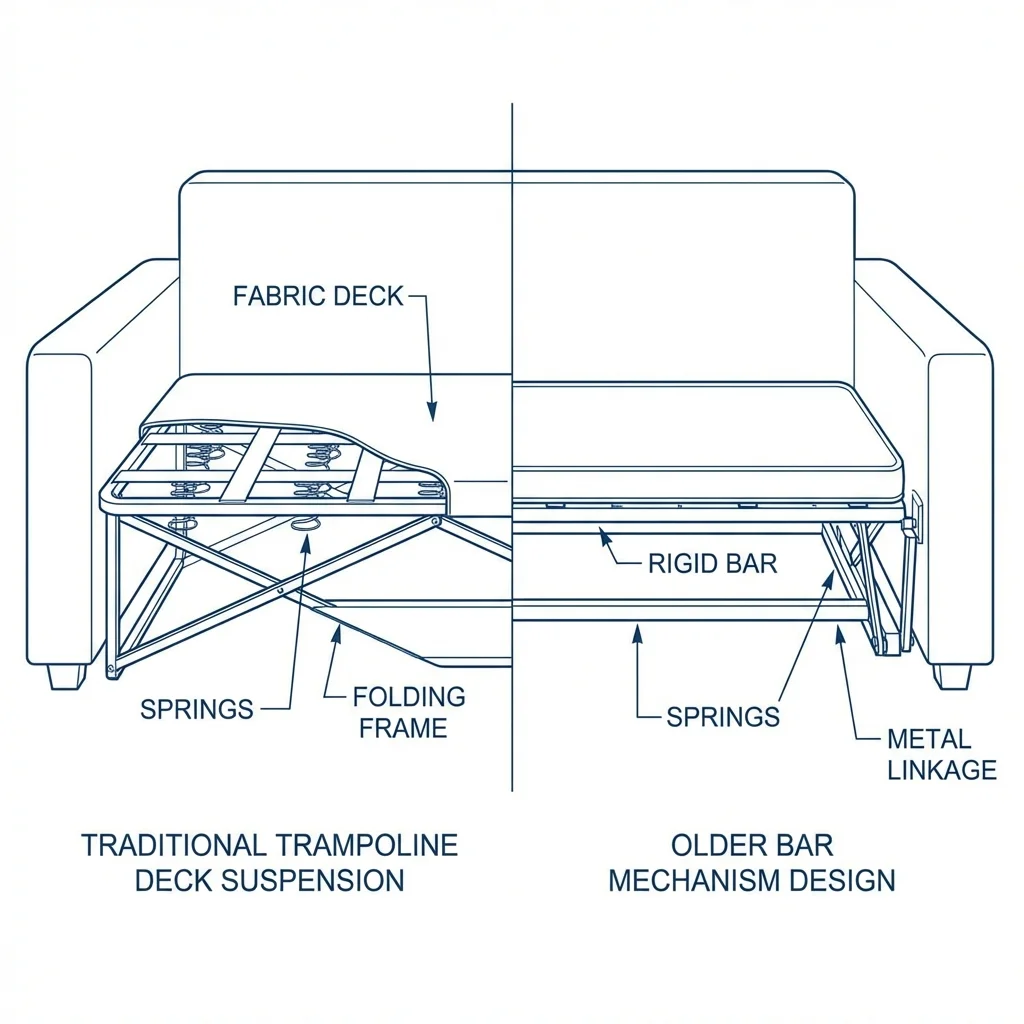
When I say “trampoline deck,” I am not looking for a gimmick, I am looking for a very specific feel under my body. The goal is to replace that classic hard mid bar sensation with a continuous, tensioned surface that spreads your weight out, so your hips do not punch through a thin mattress onto a rigid frame member.
In the showroom, I ask them to open the bed fully, then I lift the mattress corner just enough to see what is directly under it. What I want to see is a broad, continuous deck, usually webbing or a fabric like surface, held tight across the sleeping area, not a handful of metal tubes I can trace across the middle like a roadmap to discomfort.
Then I do a simple test that has saved me a lot of regret. I put a hand on the support surface and press down in the center area where your hips go, and I pay attention to whether it gives evenly or whether it hits a hard stop quickly. Even support feels springy and progressive, while a bad design feels like you are immediately contacting something solid.
After that I actually lie on it and force the issue. I lie on my back and deliberately relax my lower back and hips, then I roll to my side and let my hip sink in, because side sleeping is where weak support shows up fast. If I feel a narrow ridge or a line under me, I assume it will be worse at 2 a.m. than it is under bright showroom lights.
The other thing I watch for is edge behavior. A trampoline deck can be comfortable in the middle but feel unstable near the perimeter if the tension is not well controlled, so I scoot close to the side and see if it tilts or dumps me toward the edge. If you have ever slept on something that feels like it is trying to roll you off, you know why I take this seriously.
I also listen for noise while I shift my weight. A good deck support tends to sound quieter because it is not a bunch of metal parts rubbing under load, but if I hear squeaks when I simply breathe and roll, I treat that as a warning that something is already moving against something else.
If you are comparing two sofa beds and one has this kind of tensioned deck support and the other is a more traditional bar and tube layout, I generally trust the deck style more for comfort with a thinner mattress. I still will not buy it without lying on it, because a trampoline deck can be done well or done cheaply, but it at least aims at the right problem instead of pretending a thin mattress can magically hide a steel structure.
The "Mattress Choke" Warning
I want to flag one mistake I see all the time, because it sounds like a smart “comfort upgrade” and it can quietly destroy the sleeper mechanism. If you buy a sofa bed that comes with a thin mattress, do not assume you can fix it later by stuffing in a thicker third party mattress.What matters is mechanism clearance, which is just the honest amount of space that mechanism was designed to close around. If the frame was built to fold up around a four inch mattress and you force in a six inch one, the bed might still close once or twice, but you are turning the closing action into a clamp.
The reason I take this so seriously is leverage. When you close the bed, the mechanism pivots and pulls the folded mattress stack through tight arcs, and that extra thickness multiplies the stress right where the frame is pinned together. In plain terms, you are asking the pivot rivets and side rails to do a job they were not designed for, and they will eventually lose that argument.
The failure is not subtle when it happens. The main pivot rivets can shear, the side rails can bend, and then the whole unit starts twisting, binding, or refusing to latch, which usually turns into “the bed is stuck open” or “the sofa will not close,” not a gentle inconvenience.
In a showroom, I protect myself by having the salesperson tell me the included mattress thickness and then I ask one direct question: if I ever replace the mattress, what is the maximum thickness this specific mechanism is rated to close around without forcing it. If they cannot answer, or they say “people do it all the time,” I assume the safe answer is “only the original thickness,” and I judge the comfort on that reality.
I also watch how the display model closes, because you can sometimes catch the warning signs even before any upgrade. If it takes a hard shove to get the frame to tuck in, if the last few inches feel like you are compressing something unwilling, or if the upholstery bulges strangely when latched, I assume the internal stack is already tight and there is no headroom for a thicker mattress later.
If you truly need a thicker, more normal mattress feel, I treat that as a reason to change the sofa bed type, not a reason to gamble on an after purchase swap. I would rather you buy a design that is meant to sleep on a thicker surface from day one than end up with a “comfort upgrade” that turns into a broken mechanism and an awkward warranty conversation.
Sofa Bed Selection Matrix
If you are stuck comparing styles and everything is starting to blur together, this is the mental filter I use. I stop thinking about “sofa bed” as one product and I ask you to pick which kind of disappointment you can live with, because each mechanism fails in its own predictable way.
For guest comfort, the traditional pull out tri fold is the one I trust most when it is built with a trampoline deck, because it gives you a real mattress feel and real separation between the sofa cushions and the sleeping surface. When I am expecting multi day guests, this is the category I keep on my short list, but only after I have actually lain on it and confirmed I cannot feel a bar or a ridge through the mattress.
For guest comfort, the click clack is the one I treat as a one night emergency solution, not a hospitality plan. The problem is not that the foam is automatically terrible, it is that the hinge line creates that gutter effect that pulls a sleeper into the valley, and I have never found a throw blanket that changes the geometry.
For guest comfort, the pull out trundle usually lands in the middle. I have slept on trundles that felt surprisingly flat, but I have also felt the transition points where segments meet or where the platform changes support, so I always do the side sleep test and I scoot around to find any soft spots before I assume it is “good enough.”
For sitting comfort, the tri fold usually does well because you are sitting on real seat cushions and the bed hardware is mostly below and behind you. I still pay attention to seat height and whether I can feel the front rail through the cushion, but as a pure sofa it often feels the most normal to me.
For sitting comfort, click clack can feel very good in the store because it is one continuous foam surface and it often has a firm, tidy look. What I watch for is whether the seat feels like it is encouraging you to perch instead of relax, because many of them sit shallow and upright to make the bed geometry work.
For sitting comfort, the trundle is often just okay. The reason is packaging, because the sofa has to hide a big drawer like structure, which can limit cushion depth and change how the front edge feels under your thighs, so I always sit back like I am watching a whole movie, not like I am waiting for a salesperson to return.
Weight is the practical reality nobody tells you about until delivery day. The tri fold can be extremely heavy, sometimes well over 250 pounds once you add the steel frame and mattress, so I want you to think about stairs, tight turns, and whether you will ever need to move it to clean or rearrange, because a heavy sleeper that you dread moving becomes a sleeper you keep forever in the wrong spot.
The click clack is usually the lightest, often closer to a simple sofa weight, and that makes it appealing in walk up apartments or places where you might move again. Light weight is not the same thing as durable, so I treat it as a convenience factor, not a quality signal.
The trundle tends to land in between, and the weight is distributed in a way that can be awkward because you are pulling a big section out on rails. In the showroom I always pull it out and push it back in myself, because if it feels draggy on a polished retail floor it will feel worse on your rug at home.
Mattress type matters most when you are choosing between tri fold and everything else. With a tri fold, you are usually getting either memory foam or innerspring in a thin profile, and that can be genuinely sleepable if the support deck is good and the mattress is not so thin that you bottom out. What I focus on is not the marketing name, it is whether my hips can sink without hitting structure and whether my shoulders can sink without forcing my neck up.
With a click clack, the “mattress” is really integrated poly foam, meaning you are sleeping on the same foam you sit on, seams and all. In the store I press along the hinge line with my hand, then I lie down and roll slowly over it, because if I can find the valley easily, a tired guest will find it at 2 a.m. even faster.
With a trundle, you often get multi segment foam, which is a polite way of saying it is a platform made of pieces that have to fold or stack. I look for how those segments meet, and I try lying with my hips and ribs directly on a seam, because that is where you learn whether it is a smart design or a band aid.
If you tell me you expect multi day guests and you care about them waking up without a sore back, I would have you start with a tri fold that has trampoline deck support and a mattress you can tolerate at full pressure, meaning you have done the hip drop test and a side sleep test. If you tell me this is for an occasional one night situation and you need speed and simplicity, I would have you consider a click clack but only after you accept that the hinge gutter is real and you test whether your body personally hates it.
If you tell me you are in a small apartment and you need something that converts without removing cushions and without a big metal frame unfolding into the room, I see why a trundle is attractive. I just want you to treat the floor contact points and rail feel as part of the purchase, because those are the parts that will annoy you every week, even if the bed is only used once a month.
Explore Technical Reference

Foldable Floor Sofas: The Physics of Frameless Seating
How floor sofas, foam blocks, and origami-style seating work. Understanding the trade-offs of purely foam-based seating without traditional frame construction.
Analyze Details →
Futon or Sofa Bed: The Conversion Conflict
Comparing the two main approaches to dual-purpose seating and sleeping furniture. Why the choice depends on priorities rather than either being universally better.
Analyze Details →