Sectionals: The Architecture of the Corner

Introduction
A sectional is not really one sofa, it is a little system of separate boxes that you’re trusting to behave like one solid piece. I’ve learned the hard way that the weak spots usually show up where those boxes meet, not in the middle of a seat where you expect wear.
When a store says a sectional “maximizes space,” I now translate that into a question for you: maximizes space for who, and at what cost. The cost is often mechanical, because every connection point is a place that can loosen, rack, creak, or shift over time, especially if the floor is even slightly uneven or you move the sectional to vacuum.
The other cost is ergonomic, especially in the corner. Most corners force at least one person into a weird posture where your hips slide forward, your shoulder leans into the back at an angle, or your legs have nowhere to go, and you do not notice it in a five minute sit. You notice it after a movie night, or after owning it for a year and realizing the “favorite” seat is the only one that feels normal.
In a showroom, I want you to treat the sectional like a handshake test between modules. Ask the salesperson to let you separate and reconnect the pieces, and pay attention to how much slop you feel when the units are latched. If you can push one section and see the neighboring section lag behind, or you hear clicking as it settles, that is the exact motion you will feel every day when someone plops down or shifts their weight.
I also want you to watch the seams and gaps where modules meet. If the cushions don’t line up cleanly, or the backs meet with a visible step, that is usually a hint that the frames are not perfectly square or the connector hardware is forgiving in the wrong way. In real life, those little misalignments tend to grow, not shrink.
Corners deserve their own skepticism. If the corner seat is a wedge, sit in it the way you actually lounge, then try to get up without using your hands. If standing up feels awkward or you feel like you are climbing out of a pit, you are not “being picky,” you are catching a daily annoyance before it moves into your living room.
Throughout this guide, I’m going to help you focus on the few checks that actually predict long term satisfaction. My goal is simple, I want you to leave the showroom knowing whether a sectional is a solid set of modules that will stay tight and comfortable, or a loose compromise that looks good in a staged photo and slowly disappoints you.
The RAF/LAF Ordering Trap
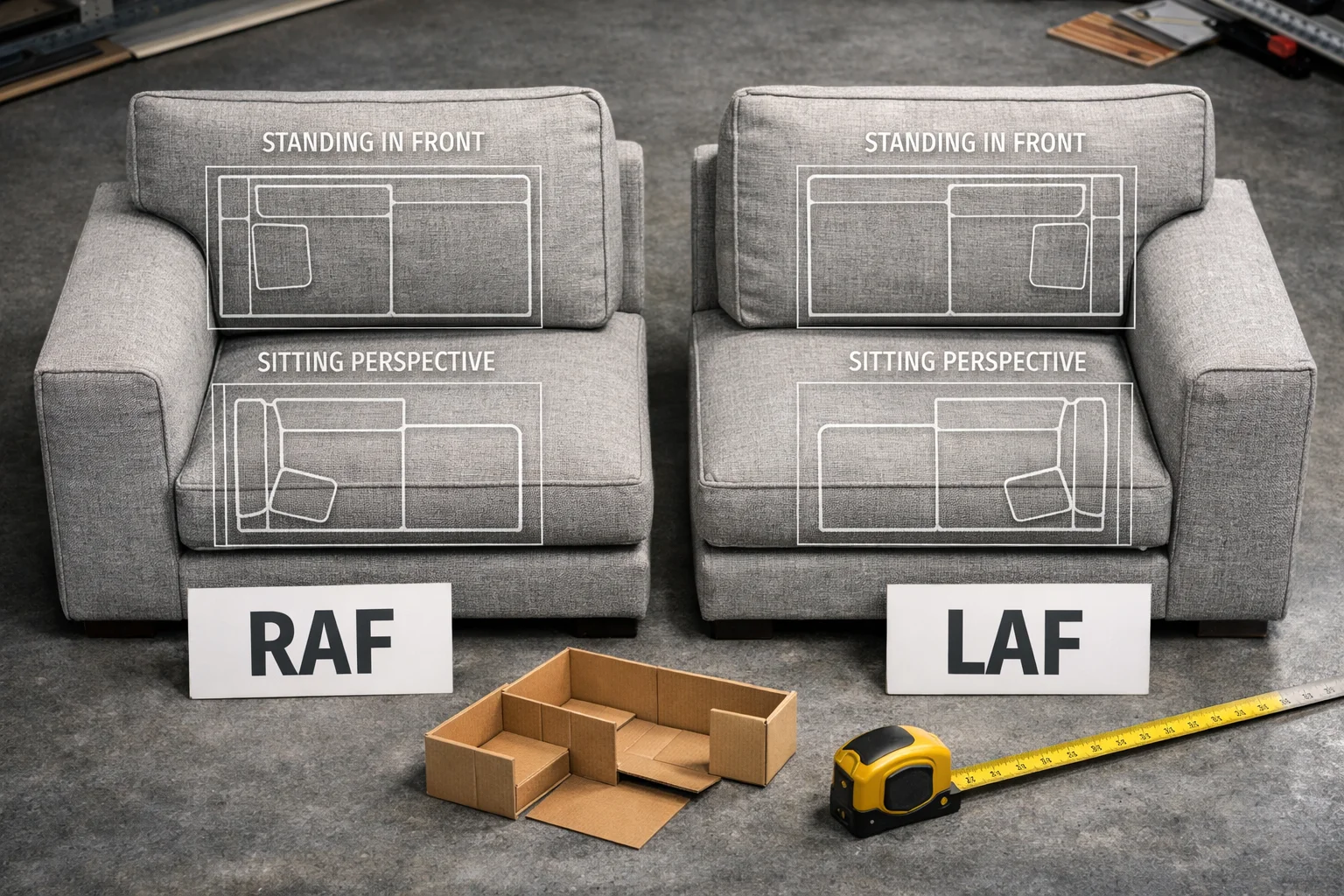
RAF and LAF sound like harmless jargon, but I’ve seen more returns and “this doesn’t fit” panic from these two letters than from almost anything else. The trap is that the labels are not based on how it feels when you are sitting on the sofa, they are based on how it looks to someone standing in front of it and looking at it.Here is the mental flip that gets people. If you sit on a chaise and the arm is on your right side, your brain wants to call that “right arm.” In store language, that is usually the opposite, because the salesperson is naming the piece from the viewpoint of someone facing the sofa, not using it.
When you are ordering, I want you to physically stand where your coffee table would be, or where your TV wall is, then face the sofa like you are about to sit down. From that spot, if the arm you are talking about is on your right, that piece is Right Arm Facing. If the arm is on your left from that same spot, it is Left Arm Facing.
I also recommend you do a quick “doorway test” before you pay. Point at the exact arm and say out loud, “Standing here, this arm is on my right, so we are ordering RAF,” or the opposite, and make the salesperson repeat it back while you both look at the same display. I do this because mistakes happen when you and the salesperson are using different viewpoints without realizing it.
If you are ordering a sectional made of multiple parts, do not rely on a tiny thumbnail picture on an order sheet. Ask to see the full layout diagram in the orientation you will see when you walk into your room, and confirm the arm facing for every end piece, not just the chaise. One wrong facing can turn a perfect plan into a sectional that blocks a walkway or puts the long side on the wrong wall, and it is the kind of error you only notice once it is in your house.
The Failure of the Corner Seat
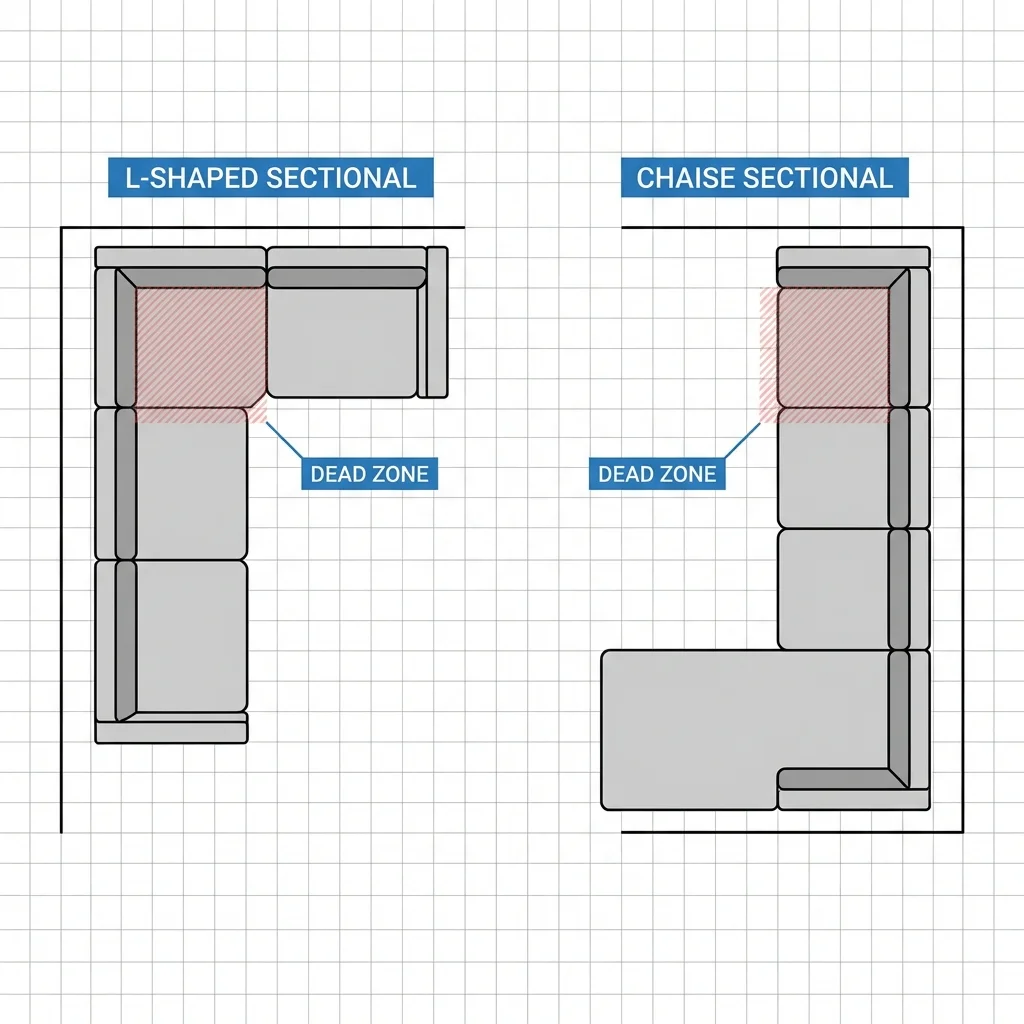
In furniture sales, the corner of an L shaped sectional is often counted as a functional seat. After living with a couple, I now treat that corner as dead volume, meaning it looks like a seat on paper but it rarely behaves like one in real life.
The first failure is legroom, and you can test it in a showroom in about ten seconds. Sit two people in the two seats that meet at the corner, then both of you try to sit normally with your feet on the floor, knees forward, and backs against the cushions. What usually happens is that one of you has to splay your legs, tuck your feet under, angle your knees into the other person’s space, or perch forward, because both of your leg paths are trying to occupy the same patch of floor.
If you shop alone, you can still catch this by sitting in one of the two seats next to the corner and then swinging your feet side to side like you are trying to get comfortable. If your shoes keep bumping the base, the adjacent cushion front, or the corner wedge, that is the future, because the geometry does not change when you get it home.
The second failure is back support, and this is the one that tricks you because it can feel fine for a minute. Most corner units either give you a sharp L in the back or they aim you into a 45 degree wedge, and neither matches how your spine wants to rest when you are upright. I want you to sit in the actual corner position, not the seat next to it, and then try to sit like you would for a full episode, shoulders relaxed, hips back, head neutral.
Pay attention to what your lower back does after a few breaths. If you feel your hips sliding forward, or you notice yourself hunting for a throw pillow to fill a gap behind your lumbar area, you are already compensating for a shape that is not supporting you.
A quick test I use is to put both feet flat, sit back, and then take your hands off your thighs and off the cushions. If your torso immediately wants to twist, or you feel like you are balancing rather than resting, that corner is not a real seat, it is a transitional space.
The third issue is what I call the pivot point, and it shows up in how people actually use the sectional. In a typical five seat layout, the corner gets claimed by pillows, a blanket pile, or a person who is half lying down, which means you effectively bought fewer usable seats than the salesperson counted. If you regularly host, this matters a lot, because the corner becomes the spot nobody chooses until every normal seat is taken.
When you are shopping, I want you to mentally price the sectional as if the corner does not count as a seat. If the value only makes sense when the corner is counted, you are probably paying for square footage, not comfort.
If you still want the L shape, I would treat the corner as a feature for lounging, not seating. In the showroom, try using the corner the way it will actually be used, with one person reclining across it, and then check what happens to the adjacent seats. If the person lounging forces the neighbor’s legs into a cramped angle, or steals an armrest, you are looking at an L that photographs better than it lives.
The simplest way to avoid disappointment is to decide before you buy whether you need true seats or you need a big soft landing zone. A sectional can do either one well, but the corner rarely does both, and once you see that in the store, it gets much easier to judge the layout honestly.
Sectional Connection Systems
If you take nothing else from this section, take this: a sectional that does not actively lock together will slowly turn into two or three separate chairs that just happen to be near each other. When the sections drift, you get that annoying gap that eats remotes, crumbs, and phone chargers, and you also lose the clean visual line that made you want a sectional in the first place.
In the showroom, I want you to physically try to make the pieces misbehave. With the sectional connected, plant one hand on one module and shove it sideways, then do the same from the other side. If you can create a visible gap with a casual push, or if the pieces slide apart when you sit down hard and then stand back up, that is not a small quirk, it is the daily reality on smooth floors.
The best connector I have personally seen for stopping the sideways drift is the alligator clip style ratchet hardware. It is basically metal teeth that click into a receiver, and when it is done well you feel a very definite engagement, then it stays put when you try to wiggle the seam. When you reconnect it, listen for a solid click and then try lifting slightly at the seam, because a good horizontal lock should not feel like it is skating around loosely once it is latched.
The other common style is a gravity bracket, sometimes called a drop in connection, where you lift one section and drop it onto a pin or hook. These can be great at keeping the tops aligned so one seat does not sit higher than the next, and in a showroom they often feel satisfyingly precise. Where I have seen them disappoint is in real rooms with slightly uneven floors, because a tiny wobble can slowly work the joint loose, so I want you to do a quick uneven floor simulation by pressing down on one corner of a module, then watching whether the connection starts to clack or separate at the seam.
What I avoid is the “no hardware” approach where the salesperson talks about non slip feet or grippy pads, because friction is not a connector. On hardwood or tile, those sections will separate every time someone sits, especially if the floor is even a little dusty, and you will find yourself kicking the pieces back together like you are straightening rugs. If you do not see or feel a real connector when you look underneath near the meeting edge, I treat that as a budget shortcut that you will pay for in annoyance.
There is a simple question I ask that cuts through vague answers: “How do these modules lock together, and can you show me the connector under the seam.” If they cannot show you hardware and demonstrate it engaging, I assume it will drift, even if it feels okay for the first five minutes on carpet.
I also want you to think about how you will actually live with the connectors, because some systems are secure but annoying. If you are the kind of person who reconfigures for company or moves pieces to vacuum, try disconnecting and reconnecting it yourself in the showroom, because a connector that requires a perfect lift and drop can become a two person job at home.
Before you leave the store, do one last reality check by sitting right on the seam between modules, then shifting your weight side to side. If you feel the sections scissor against each other, or you hear a repeated tick as the connector takes up slack, that is the sound of drift starting. I would rather buy a sectional with a slightly less perfect fabric than one that makes me police the gaps for the next five years.
The "Cost-Per-Seat" Metric
When I’m torn between a pricey sectional and a mix of a sofa plus chairs, I stop arguing about the sticker price and I start asking one boring question, what am I actually paying per usable seat. This is where a sectional can look like a deal until you count seats the way people really sit, not the way a brochure counts cushions.Here is how I run the math in my head in a showroom. If a sectional is $3,000 and the salesperson calls it “five seats,” I immediately assume it is four functional seats unless that corner is genuinely comfortable and does not steal legroom from the two seats beside it. At that point you are often paying about $750 per real seat, and that is before you factor in the frustration cost of the corner seat nobody wants.
Now compare that to something like a $1,200 sofa plus two $800 chairs. In real use, that is five functional seats because nobody is forced into a corner wedge, and each seat has its own boundaries. You are often closer to $560 per seat, and more importantly you can move the chairs when you have company, or rotate them so the most worn spot is not always the same cushion.
The “engineering win” of separate chairs sounds abstract until you sit in both layouts back to back. A chair gives the person 360 degree legroom and their own armrests, and that is a physical advantage a sectional cannot really match because the seats share edges and fight over the same floor space near corners and chaises. In the showroom, I want you to actually sit five adults the way you would host, then watch who loses an armrest, who has to angle their knees, and who looks for a different place to perch, because that is your real seat count.
If you like the sectional look but you also like the flexibility, I treat the cost per seat check as permission to negotiate with yourself. If the sectional only makes sense when you count the corner as a seat, I walk away or I reframe it as a lounging purchase, not a seating purchase. If the sofa plus chairs setup feels “less dramatic” on the floor, I remind myself that comfort and usable seats are the whole point, and the math usually keeps me from paying extra for a layout that performs worse over time.
Sectional Configuration Specification
A sectional layout only works as well as its worst module, so when you are choosing a configuration I want you to stop thinking in terms of “left side and right side” and start thinking in roles. Some pieces are for lounging, some are for turning a corner, and some have to do the unglamorous job of keeping the whole thing from drifting, tipping, or feeling loose.The bumper or chaise is a lounging piece, not a social seating piece, and I shop for it accordingly. In the showroom, I want you to sit on the chaise and then watch what happens to the main run when someone walks past, sits down on the adjacent seat, or tries to perch on the chaise edge. If the chaise is going to be in a high traffic path, you will live with people sliding past feet, stepping around legs, and treating that lounging zone like a hallway, which is how chaises get scuffed, how cushions get sat on wrong, and how the “nice seat” becomes the daily mess seat. I place the chaise on the low traffic end of the room whenever I can, meaning the end where nobody needs to squeeze by to reach a doorway, a kitchen, or the most used chair.
The corner wedge is the 90 degree turn, and it is where the geometry either saves you or punishes you. If you have the option of a curved wedge, I take it seriously because the curve usually buys you real knee clearance and makes the corner feel less like two people are trying to occupy the same patch of floor. In a showroom you can test this immediately by sitting in the two seats that feed into the corner and then standing up at the same time, because that is when you notice whose knees collide and whose feet have nowhere to go.
An armless chair is basically an extension module, and it is one of the few pieces that can make a sectional feel flexible instead of locked in. I like armless units when they can be moved without creating an ugly gap or a weird unfinished side, so I want you to ask the salesperson to show you what that piece looks like if it is used as an end temporarily. If the fabric wraps cleanly, the back looks finished, and the connectors are not permanently married to one layout, you gain the ability to expand for company or shrink the run when you want space, which is a practical advantage you will actually use.
The LAF or RAF end is the anchor, and I pay extra attention here because an end piece is where people lean, flop, and use the arm like a lever to stand up. In the showroom, I want you to do a mild tip test, which is just you sitting on the very front edge near the arm and then shifting your weight outward as if you are reaching to pick something up. A good anchor feels planted and boring, and a bad one feels like it wants to lighten or lift at the opposite feet. If you feel any tendency to tip, that usually means the base is too light for the leverage that end piece sees, and I would not assume a rug or grippy pads will fix a balance problem.
Connectors are where the layout either behaves like one sofa or slowly turns into separate islands, and for a high traffic home I only trust the styles that actively bite and hold. If the sectional you are looking at uses an alligator clip style connector, I want you to reconnect it yourself and then try to pull the modules apart with a firm tug. You are looking for that definite engagement where it resists sideways shear, because the daily abuse is not a gentle vertical lift, it is kids launching into seats, adults plopping down on the seam, and people pushing off an arm to stand. If the connector relies on gravity alone, I treat it as more sensitive to uneven floors and repeated micro movement, and I become stricter about the shove test and the sit on the seam test you already did earlier.
If you take one practical thing from all this, I want it to be this. When you choose a configuration, you are choosing where the stress will concentrate, so put lounging pieces where traffic is low, choose a corner that does not steal legroom, make sure any “extra” armless module can stand on its own without looking unfinished, and demand connectors that lock like they mean it. That is how you get a sectional that stays tight and usable instead of one that looks right on delivery day and then slowly turns into a shifting puzzle.