Click-Clack Mechanisms: The Gutter Effect

Introduction
I used to think a click clack sofa bed was a clever solution. You push the back down, it lies flat, and suddenly your living room is a bedroom. After owning a few and sleeping on more at friends’ places, I started noticing the same problem every time, a hard line right where your body wants support.
That problem comes from the hinge itself. In a click clack, the back and seat meet at a metal joint, and that joint has to live somewhere. When the sofa is flattened, the hinge creates a shallow valley across the middle of the bed. I call this the Axis of Discomfort, and once you feel it, you cannot unfeel it.
What matters for you as a buyer is that this is not a rare defect or a bad batch issue. It is built into the geometry of the design. In a showroom, you can spot it by fully opening the sofa and running your hand slowly across the center where the seat meets the back. If your palm drops into a dip or hits something firmer than the surrounding surface, your spine will find it at three in the morning.
The “Hinge Void” Physics
The "Hinge Void" Physics
A click clack sofa bed is essentially two cushions joined by a ratcheting hinge. When the back folds flat, that hinge needs clearance to move, and it creates a two to three inch empty zone between the seat foam and the back foam.That empty zone has no real support under it. When you lie down, gravity pulls your hips into that gap, and your lower back twists slightly to follow. By morning, that twist shows up as stiffness or pain right around the hips and lower spine.
This is the part salespeople rarely explain. Adding more foam does not fix it, because the foam still has to bend ninety degrees when you convert the sofa. If it were solid enough to fill the gap, the mechanism would bind and the sofa would not fold.
I learned this the hard way because I kept believing thicker cushions meant better sleep. What actually matters is whether the sleeping surface stays continuous when the sofa is flat, and a click clack hinge breaks that continuity by design.
When you are in a showroom, do not just sit. Ask to fully flatten the sofa and lie on it on your side, because that is when the hinge void shows itself. Pay attention to where your hips land and whether you feel yourself sag into a line across the middle.
If you want a quick test without lying down, kneel beside the open sofa and press your forearm across the center seam. If your arm sinks noticeably or you feel a hard edge beneath the padding, that is the hinge void you will sleep on later.
I am not saying every click clack is unusable. I am saying you should assume this problem exists until the sofa proves otherwise under your own body weight. If the salesperson avoids opening it fully or rushes you through the test, that alone tells you what you need to know.
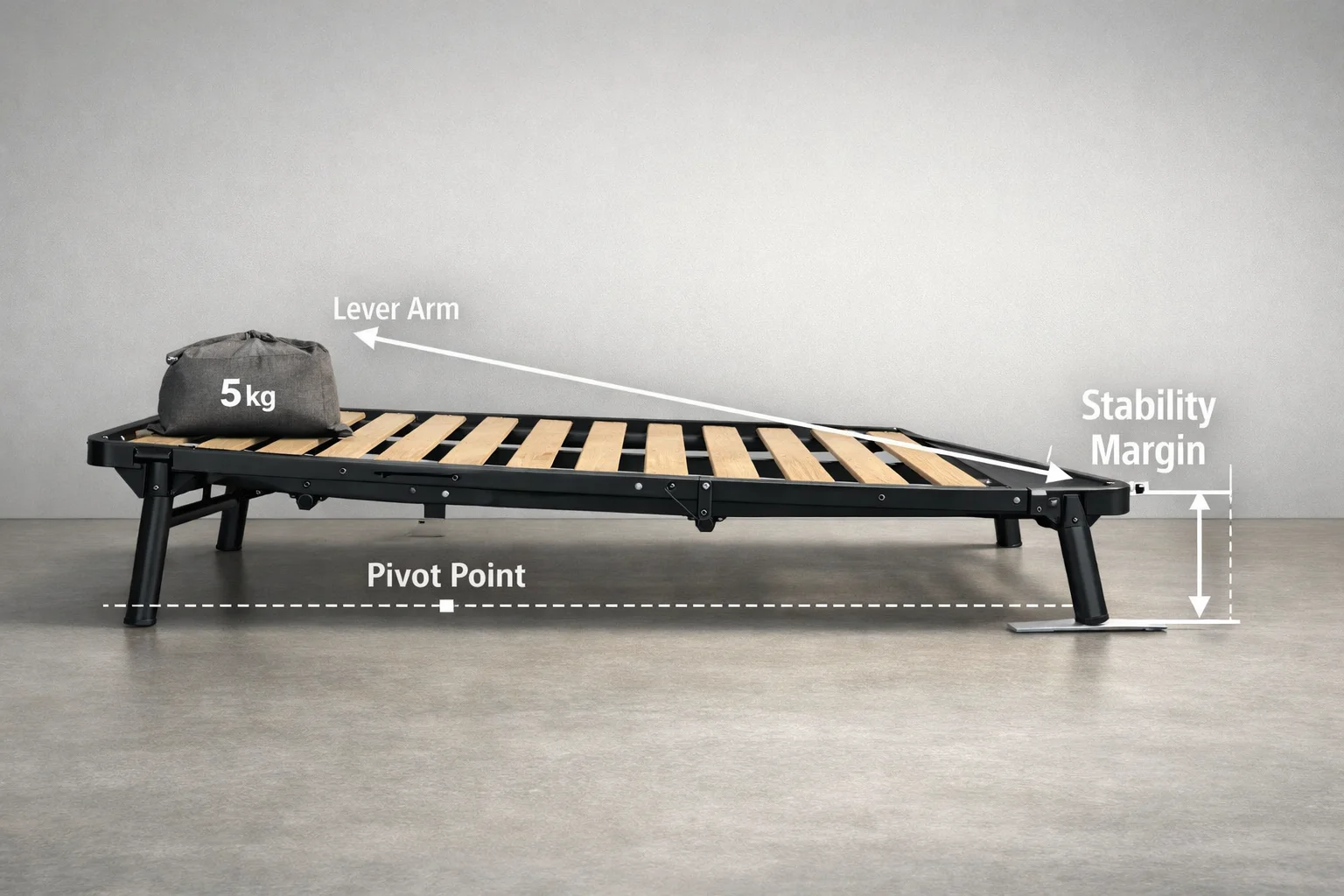
This image shows another problem I learned to watch for, and it has nothing to do with comfort at first. It is about balance and leverage, and it can turn a sofa bed into something that feels oddly unstable when you sit or lie near the edge.
In many click clacks, the back section sticks out past the rear legs when the sofa is flat. That overhang becomes a lever. When you put weight near the headrest edge, part of that force tries to lift the front of the frame instead of pushing straight down.
You may never notice this in a quick sit test. I usually feel it when I sit down on the open bed to put on shoes, or when someone sits at the very end while another person is already lying on it.
In a showroom, you can check this without tools. Open the sofa fully, then sit right on the edge where the back cushion used to be upright. Do it slowly and pay attention to the front legs. If they feel light, shift, or even momentarily lift, that frame is relying on your weight to stay planted.
I also look underneath and eyeball where the legs actually land compared to the ends of the bed. If the mattress surface extends far beyond the leg footprint, that extra length is not free. It changes how the forces travel through the frame.
Salespeople sometimes call this flexibility or a floating feel. I call it poor stability margin. Over time, that rocking motion works screws loose and twists joints, especially if the sofa gets used as a bed often.
If you live in a small space and plan to sit on the open sofa daily, this matters more than you might expect. A sofa bed should feel boringly solid in every position. If it feels clever or delicate when you test it, it will feel worse after a year of real use.
When I walk away from a click clack now, it is usually because of this combined issue. The hinge creates a sleep problem, and the overhang creates a stability problem. Either one alone is annoying. Together, they tell me the design is fighting basic physics, and physics always wins.
The Three Mechanical Failures of the Click-Clack
The first failure is the hinge void, and you have already seen how that shows up in your body. The second is the leverage problem from rear overhang and leg placement, which turns normal sitting and sleeping into a slow stress test for the frame. The third failure is quieter at first, but it is the one that usually finishes the sofa off.
That third problem is the ratcheting hinge itself wearing out under mixed loads. A click clack hinge is asked to do two conflicting jobs at the same time. It has to lock rigidly enough to act like a solid bed, and it also has to move freely enough to fold back and forth without binding.
In real use, people do not load it gently or evenly. You sit on the back while it is half reclined. You flop down on one side. You lean against it while it is in a click position that is not fully locked. All of that force goes straight into the teeth of the ratchet and the thin steel plates holding it together.
In a showroom, this problem is easy to miss because it develops gradually. What I listen for is sound and feel. When you raise and lower the back, it should move smoothly and land firmly in each position. If you hear a faint crunching sound, feel a gritty hesitation, or notice that one side clicks before the other, that hinge is already telling you its future.
I also pay attention to whether the back ever feels like it wants to keep moving after it clicks. A healthy mechanism stops decisively. A worn or underbuilt one settles slowly, like it is chewing into itself. That settling is metal deforming, and once that starts, it does not reverse.
This matters because hinge wear makes the first two problems worse. As the ratchet loosens, the hinge void grows deeper under load. As the back gains play, the overhang lever becomes more active. What started as a mild discomfort turns into a nightly sag, and what started as a slight rock turns into a visible wobble.
If you want to protect yourself as a buyer, you need to test all three failures together, not in isolation. Open the sofa fully, sit near the edge, then raise the back through every click and lower it again. Do it slowly and without help. If anything feels uneven, vague, or noisy, assume that feeling will double after a year in your home.
I learned to stop believing claims about reinforced hinges or upgraded mechanisms unless I can feel the difference myself. Thicker steel does not help if the geometry is still wrong. More clicks do not help if the load is still concentrated in the same small teeth.
When a click clack works, it works by staying within very tight mechanical limits. Most of them do not, because they are asked to be a sofa, a lounger, and a bed using the same stressed joint. Once you understand that, the warning signs in a showroom become obvious.
If you still want one, your job is not to find the most comfortable seat. Your job is to find the one that feels the least clever when you move it. The boring ones, the ones that feel almost overbuilt and uninteresting, are the only ones that have a chance of staying tolerable over time.
1. The “Topographical Cliff” (Uneven Wear)
There is another problem that sneaks up on you after you think you have learned the hinge lesson. Even if the surface feels acceptably flat when new, a click clack wears unevenly because you use different parts of it in completely different ways.
I sit on the seat every day. You do too. That compresses the foam again and again in the same zone, usually right where your thighs land. The back, by contrast, mostly gets leaned on, which barely compresses it at all.
After about a year of normal use, those two sections no longer behave like one surface. The seat becomes a soft, tired valley, and the back stays a higher, firmer plateau. When you flatten the sofa to sleep, those two worlds meet abruptly.
The first time you notice it will not be visual. You will feel it when your body slowly migrates downhill during the night. Your hips drift toward the softer seat section, and your torso keeps bumping into the firmer back section, like rolling against a low curb.
I call this the topographical cliff because it feels like sleeping across a small but persistent slope change. It is not dramatic enough to show up in a quick test, but it is strong enough to wake you up when you turn over.
In a showroom, you can check for this problem even on a brand new sofa. Fully open it, then sit near the middle seam and bounce lightly a few times. Then slide your hand from the seat area toward the back area and pay attention to resistance. If the seat compresses easily and the back pushes back firmly, that difference will only grow with time.
I also press down with both hands, one on the seat foam and one on the back foam, using the same force. If one hand sinks deeper than the other, I already know how this bed will feel after months of daily sitting.
Salespeople sometimes say the foam will break in evenly. That has never been my experience. Foam breaks in exactly where you use it most, and on a click clack, that is the seat and almost never the back.
This matters because unlike a real mattress, you cannot rotate or flip the surface to even things out. The wear pattern is locked in by the design. Once the cliff forms, it stays there.
If you are light and only sleep on it occasionally, you might tolerate this longer. If you plan to sit on it daily and sleep on it even once a week, this uneven wear becomes part of your nightly routine.
What I look for now is not initial comfort but similarity of feel between seat and back. If they feel different on day one, they will feel dramatically different later. I would rather lie on something that feels uniformly mediocre than something that feels great in one half and stiff in the other.
When you are testing, take your time and ignore the upholstery. Close your eyes and focus on pressure. Your body is very good at detecting slopes and transitions, even subtle ones. If you sense a line where your weight wants to roll, that line will deepen with every month you own it.
This is one of those problems no warranty really covers because nothing is technically broken. The sofa still opens, still closes, and still looks fine. It just stops feeling flat, and once that happens, no topper or cushion really fixes the underlying mismatch.
If you remember only one thing from this section, let it be this. A click clack does not wear as one surface. It wears as two separate cushions that are forced to pretend they are one bed, and your sleep pays the price for that pretense.
2. The Ratchet Friction Jam
There is a sound most click clacks make right before they start failing, and it is not the loud bang people worry about. It is a dull clicking that turns scratchy, like something is dragging where it should be dropping cleanly into place.
That sound comes from the pawl and ratchet inside the hinge. It is a small metal tooth that falls into notches to hold the back at different angles. On most click clacks I have owned or examined, that mechanism sits just behind the fabric with no real protection.
What happens over time is boring but destructive. Dust, lint, and pet hair work their way inside and mix with the grease that is supposed to keep the hinge smooth. The grease turns into a gritty paste, and the pawl starts skating over the teeth instead of dropping decisively into them.
At first, you barely notice. The back still clicks, but it takes a little more effort, or it sounds rough on one side. Then one day it will not lock at a certain angle, or it will refuse to click flat unless you slam it harder than feels reasonable.
As a buyer, you cannot see inside the hinge, but you can listen to it. In a showroom, I slowly lift and lower the back several times and do it unevenly, first from one side and then the other. A healthy ratchet sounds crisp and metallic, not sandy or muffled.
I also pay attention to whether the back ever hesitates before clicking. If it floats for a second and then drops in, that tells me the pawl is already struggling to find its slot. That struggle will get worse once the sofa lives in a real home with dust and daily use.
Salespeople sometimes say this is normal break in noise. I do not buy that anymore. Metal mechanisms either engage cleanly or they do not. Noise that sounds like friction is friction, and friction means wear.
There is a practical reason this matters beyond annoyance. When the pawl does not seat fully, the back can slip under load. That slip adds sudden force to the hinge teeth and accelerates the wear you are already hearing.
If you already own one and it stops clicking reliably, there is a short term fix that has helped me buy some time. You can flip the sofa over, find the ratchet, and flush it with a dry silicone spray. I emphasize dry because anything oily will just attract more debris.
This is not a real repair. It is more like rinsing sand out of a zipper. It can restore the click for a while, but it does not undo the wear that has already happened to the metal.
As a buyer, the takeaway is simple. Do not accept gritty sounds, uneven clicks, or a back that needs persuasion. Those are not cosmetic quirks. They are early warnings that the hinge is already losing the fight against contamination and wear.
When I test a click clack now, I imagine that hinge a year from today, full of household dust and used by tired people who do not baby it. If it already sounds compromised in a clean showroom, it will not improve once it is yours.
This is why I care so much about how boring the mechanism feels. A dull, firm, predictable click is what you want. Anything clever, soft, or gritty is a problem waiting to mature.
3. The Center-of-Gravity (CoG) Tip
This is the failure that makes a click clack feel almost embarrassing when it happens, because it is not subtle. It is the moment the sofa reminds you that it is very light and not very well anchored.
What I am talking about is the center of gravity shifting outside the footprint of the legs. In plain terms, the bed becomes a lever instead of a platform.
When you flatten a click clack, the back section usually hangs past the rear legs. That overhang is not just extra length, it is weight that is no longer supported directly underneath. The whole frame is now balanced between the front and rear legs with very little margin.
If you sit near the headrest edge while it is flat, your body weight is no longer pushing straight down. It is pushing down and back at the same time. That turns the back section into a lever arm.
I have felt this most clearly when sitting down slowly. The front legs do not slam up dramatically. They just get light, then they scrape, then you feel a tiny lift. Your body reacts before your brain does, and you tense up.
In a showroom, I always test this deliberately. I open the sofa fully and sit right at the far edge where the back cushion ends. I keep my feet off the floor so they cannot stabilize me. If the frame even hints at rocking, I am done.
You should also watch the legs themselves. If you see the front legs tilt inward, slide, or momentarily lose contact, that means the center of gravity is already too close to the edge. It will be worse at home on a rug or uneven floor.
Salespeople sometimes say this only happens if you sit incorrectly. I ignore that. People sit incorrectly all the time, especially when tired. Furniture should tolerate normal human behavior, not require training.
The real issue is that many click clacks have no meaningful counterweight in the base. There is very little mass below the seat to resist that lever action. Everything is thin, hollow, and optimized to ship cheaply.
You can see this if you crouch down and look under the open bed. If the frame rails are light and the legs are placed far inboard from the ends, the stability margin is narrow. The sofa is relying on friction with the floor instead of geometry to stay put.
This matters even if it never fully tips you over. That repeated near tipping loads the joints in a way they were not designed for. Screws loosen, holes oval out, and the hinge takes side loads it should never see.
Over time, the sofa starts to feel nervous. You sit down and it responds before you finish moving. That constant micro motion is what turns a tolerable sofa into one you stop trusting.
If you plan to use the open bed as a place to sit during the day, this is critical. Putting on shoes, folding laundry, or perching while talking all put weight right where the lever effect is strongest.
The simple rule I follow is boring but reliable. When the sofa is flat, it should feel as stable at the edge as it does in the middle. If it does not, the center of gravity is wrong.
You cannot fix this later with felt pads, heavier legs, or clever placement. The balance is baked into the frame. If it feels marginal in a controlled showroom, it will feel worse in a real room with real movement.
This is why I treat lightness as a warning sign, not a benefit. A sofa bed does not need to be heavy, but it needs enough mass in the right places to resist becoming a lever.
When you test this, take your time and do it without embarrassment. Sit at the edge, shift your weight, and listen to the frame. If it feels planted and indifferent to you, that is good design. If it feels alert, responsive, or eager to move, that is physics telling you to walk away.
Once you notice this center of gravity problem, you will start seeing it everywhere. It explains why some click clacks age quietly and others start feeling sketchy long before the fabric wears out.
I stopped forgiving this flaw because it never improves with time. Stability only goes in one direction, and it is not the direction you want.
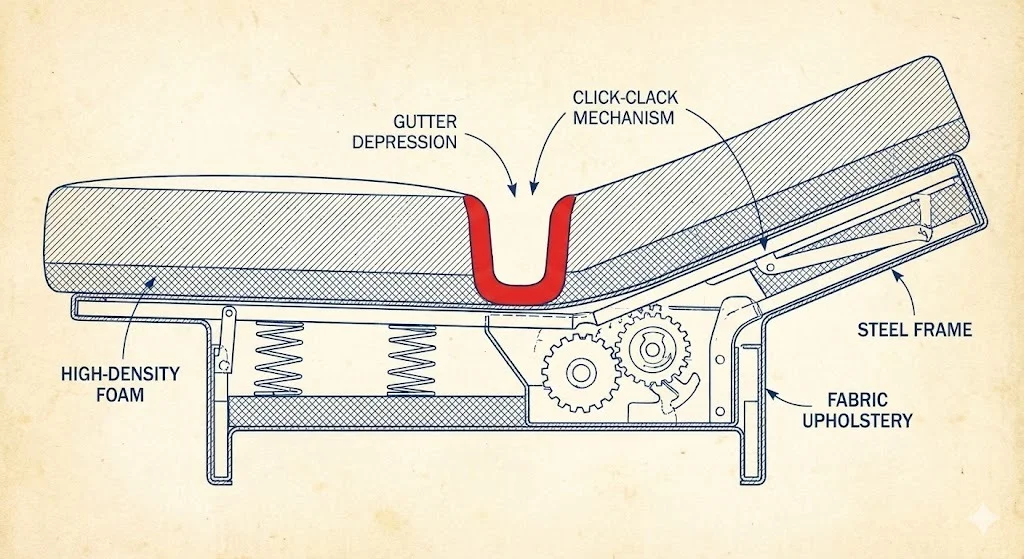
When I first saw a cutaway like this, it explained years of bad nights in about five seconds. That red gutter is not a manufacturing shortcut or a cheap brand problem. It is empty space that has to exist for the hinge to move.
What matters for you is not the hinge itself but what is missing around it. Foam has been carved away to make room for rotation, and nothing meaningful replaces it when the sofa is flat. Fabric stretches over air, and your body becomes the filler.
In a showroom, I want you to picture this image while you test the bed. When you press down at the center seam, you are not compressing foam evenly. You are pushing into a cavity that collapses more than the surrounding areas.
I test this very deliberately now. I place one hand flat on the seat side and one hand flat on the back side, then I slide both toward the middle at the same pressure. When my hands suddenly drop or meet resistance at different depths, I know exactly where this gutter lives.
Salespeople sometimes say a topper fixes this. I have tried. A topper can soften the feel, but it cannot remove a void underneath. Your weight still finds the lowest point, and the topper just follows it.
This image also explains why thicker foam often makes things worse. The thicker the foam, the more has to be removed to clear the hinge. You end up with a deeper cavity and a sharper transition at the edges of the gutter.
If you want to protect yourself, ignore claims about memory foam or layered comfort. Focus on whether the sleeping surface stays supported across the hinge line. Ask the salesperson to show you the bed fully open and then kneel beside it so you can press straight down at the center.
I also look from the side at mattress height. If I can see the fabric dip slightly at the hinge line even before anyone lies down, that is the gutter showing itself visually. Under a real body, it will be worse.
This is one of those moments where understanding the picture saves you money. Once you know the foam has been removed on purpose, you stop expecting comfort upgrades to fix it. The only real fix would be a different mechanism, and a click clack does not have one.
When I walk away after seeing this clearly, I do it without regret. I am not rejecting a brand or a price point. I am rejecting an empty space that my spine will eventually fall into.
If you take nothing else from this image, take this. Wherever foam has been cut out to make a mechanism work, your body will be asked to finish the job. I no longer volunteer my sleep for that role.
The “Topper” Workaround
The "Topper" Workaround
If you must use a click clack for more than one night, the only way I have ever made it tolerable is by neutralizing the gutter rather than pretending it is not there.The solution that has actually worked for me is a three inch memory foam topper. Thinner toppers just follow the shape of the void underneath and do nothing meaningful once your weight settles in.
The logic is simple and physical. A thick enough topper can create what I think of as bridge support. It is stiff enough to span the two to three inch gutter created by the hinge without collapsing fully into it. Instead of your body sinking into the lowest point, the topper distributes your weight across the higher foam on either side and turns the surface into something closer to a uniform supportive deck.
I want to be very clear about what this does and does not fix. A topper does not repair the hinge, improve the frame, or stop uneven wear. It is a workaround, not a cure, and it only helps while the topper itself stays resilient.
When I say three inches, I mean it literally. I have tried two inch toppers because they are cheaper and easier to store, and they always bottom out right at the hinge line. You feel fine for about twenty minutes, then the foam warms up, softens, and you are back in the gutter.
Firmness matters more than branding here. I look for memory foam that resists my hand when I press down quickly, not something that feels marshmallow soft in the package. If it feels luxurious in the store, it will likely feel useless by morning.
There is also a practical showroom takeaway hidden in this. If you are testing a click clack and thinking about using a topper at home, press down hard at the hinge line with your palm and imagine that force spread across three inches of foam. If the void feels very deep or sharply edged, even a topper will struggle to bridge it.
Storage is the other cost people forget. A three inch topper is bulky, heavy, and awkward in a small space. You need somewhere to put it every morning, and folding it repeatedly shortens its life. In my experience, this daily hassle becomes part of the decision whether the sofa was really a good idea.
I also learned that toppers mask warning signs. With a topper in place, you stop feeling how much the hinge is wearing or how uneven the surface has become. By the time the topper no longer helps, the sofa underneath is usually far past its prime.
If you already own a click clack and cannot replace it, this workaround can buy you better sleep. I have used it successfully for guests and short stretches. I just do not fool myself into thinking it has turned the sofa into a real bed.
As a buyer, my advice is to reverse the logic. If you are standing in a showroom and already planning to spend extra money and space on a thick topper just to make the bed usable, that sofa has already failed the test. The topper should be a last resort, not part of the original plan.
I now use this workaround as a decision filter. If a click clack needs a three inch bridge to hide its geometry, I would rather put that money toward a design that does not create the gutter in the first place. My sleep has taught me that workarounds are always more expensive than they look at first.
Click-Clack Performance Specs
When I see performance specs listed for a click clack, I no longer read them as maintenance advice. I read them as a quiet description of where the sofa is most likely to fail and how soon I will notice.
Take the ratchet hinge first. If a spec sheet suggests annual vacuuming, what that really tells me is that the hinge is exposed and sensitive to debris. In a showroom, you cannot vacuum it, but you can listen to it. Raise and lower the back slowly and then a bit off center. If it already sounds muted, scratchy, or inconsistent, imagine that sound after a year of dust and daily use. A hinge that is truly robust does not rely on careful cleaning to stay functional.
The foam deck spec often mentions rotating your sleep position. That sounds reasonable until you remember that a click clack is not a mattress you can rotate. What this line is really admitting is that uneven wear is expected. In the showroom, I test this by pressing down where I would normally sit and then where my shoulders would land when sleeping. If one area collapses faster or deeper than the other, I already know a cliff is forming. No amount of rotating your body at night will stop that foam from aging differently.
Hinge mounting specs that talk about tightening bolts are another tell. If the sofa uses visible bolts, often 13mm in size, it means the hinge is carrying enough stress that loosening is expected. I always look closely at the fabric around the hinge area. If I see puckering, pulling, or a faint gap even on a new floor model, that is movement already happening. Once fabric shifts, it never really goes back, and it usually means the hardware underneath is working loose.
Leg levelers are often framed as a simple setup detail, but I read them as a stability warning. If all legs must be perfectly adjusted to maintain contact with the floor, the design has very little tolerance for real rooms. In the showroom, I gently rock the open sofa at the corners. If it wobbles or feels like it is balancing on points instead of standing flat, those levelers will become a constant annoyance at home, especially on rugs or uneven flooring.
The last spec I pay attention to is the stop pins that hold the back upright. When a spec sheet tells you to check for bends, it means those pins are lightly built and take real load. In practice, this shows up when the back no longer locks confidently. In a showroom, I lean back firmly while seated and see if the back feels absolutely solid or if it gives even a little. Any hint of movement there means the pins are already flexing, and once they bend, the sofa stops feeling trustworthy very quickly.
What I want you to understand is that these specs are not features to admire. They are a map of weak points. Each line tells you where attention, adjustment, or eventual failure is expected.
When I am standing in front of a click clack, I use this information to guide my hands and ears. I listen to the hinge because I know contamination is an issue. I press into the foam because uneven wear is assumed. I watch the legs because stability is fragile. I lean back because locking hardware is under strain.
If a salesperson presents these specs as reassurance, I mentally flip them around. A sofa that needs reminders to be tightened, rotated, leveled, and cleaned just to behave normally is already telling you how hard it plans to be to live with.
The best click clacks I have tested are the ones where these specs feel almost irrelevant because nothing moves, shifts, grinds, or flexes noticeably. Unfortunately, those are rare.
Use this section as a translation guide. Whenever you see a performance or maintenance note, do not ask yourself whether you are willing to do the upkeep. Ask yourself why the sofa needs it in the first place. That question has saved me more money and discomfort than any warranty ever has.
Explore Technical Reference
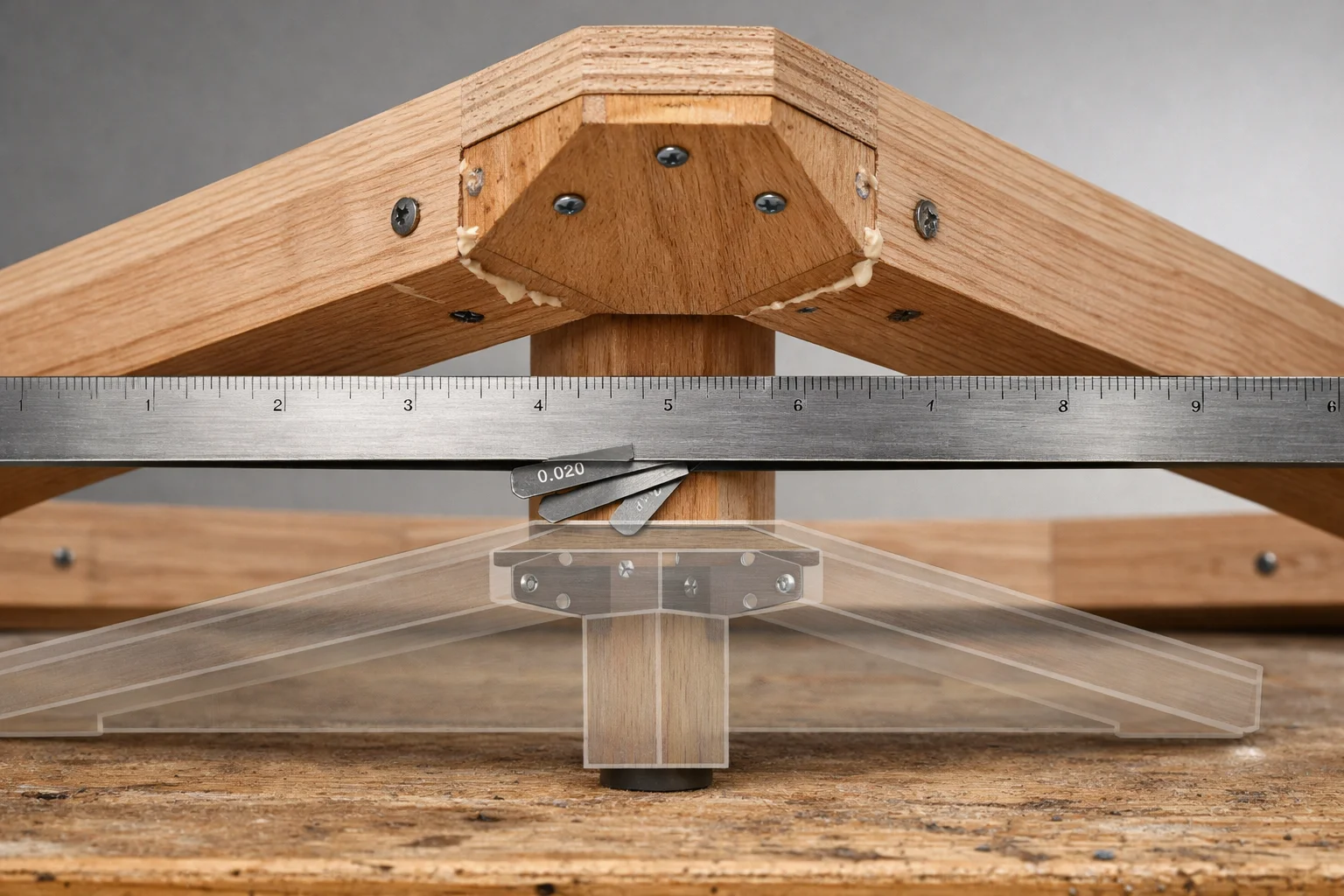
Sectional Stress Points: The Geometry of Collapse
Where sectional sofas experience the greatest structural stress and what
Analyze Details →
Futon Durability: Hardwood vs. Hollow Tubes
Why futon frames fail and what construction features predict long-term durability. Understanding the weak points that determine whether a futon lasts years or months.
Analyze Details →