Modular Support: The Elastic Webbing Standard
Introduction
If you flip over a truly good modular sofa, the thing that surprises most people is what you do not see. You do not see a row of metal springs like your parents’ old couch, you see a neat grid of fabric straps stretched across the frame.
A lot of showrooms still lean on the idea that metal springs automatically mean quality, because springs feel “serious” and familiar. I used to believe that too, until I watched how modular sofas actually fail over time, and it is usually not because the seat lacked metal, it is because the support system did not match the shape and the way the sections get used.
Most modular sofas are basically square boxes that have to play nicely with other square boxes. That “square box” geometry is the whole point of modular, you want pieces you can rearrange, push together, pull apart, and still have everything sit level and feel consistent.
In that kind of design, elastic webbing is not a cheap shortcut, it is often the smarter engineering. Webbing spreads your weight across a wider area, and it can keep the seat feel more even from the middle to the edges, which matters a lot when you are sitting right near a seam between modules.
Springs can be great in a traditional one piece sofa built around them, but I have found they can be a mixed bag in modular. When modules get moved, when connectors loosen a little, or when one seat gets used harder than the others, spring systems can create more “hot spots,” where one area starts to feel higher, lower, or noisier than the one next to it.
What I want you to take from this section is simple. When you are shopping modular, do not use “it has springs” as your shortcut for quality. Use your hands, your ears, and a couple of quick tests in the showroom to figure out whether the support under you is evenly built and likely to stay that way.
If the salesperson can unzip the underside dust cover or show you an exposed base, look for wide, dense straps arranged in a tight, consistent grid. I also press down hard near the front edge, then near the back, then right along where two modules meet, because good webbing support should not suddenly change character when you move your weight a foot to the left.
If you hear creaks, feel a sharp dip, or notice the edge collapsing faster than the center, I treat that as a red flag regardless of whether it is webbing or springs. The goal is not a specific material, it is stable, even support that makes a modular sofa feel like one coherent seat instead of a bunch of separate boxes pushed together.
The Geometry Constraint
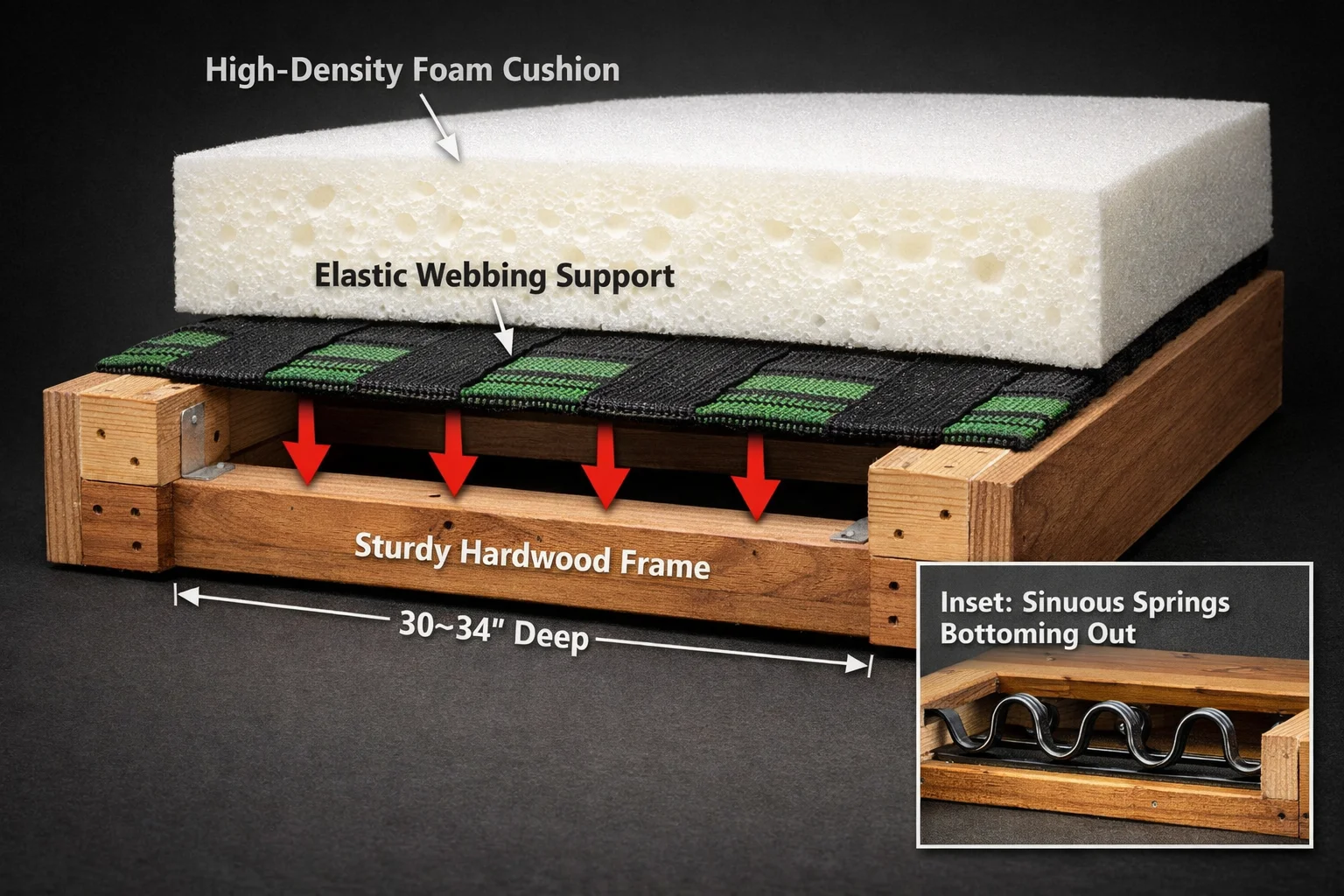
Here is the part that finally made spring versus webbing make sense to me. A metal spring needs room to do its job, because it has to arc and flex through a range before it firms up in a pleasant, supportive way.
In the real world, that means a spring wants a longer run of frame, roughly the kind of front to back span you see in a traditional sofa seat. A lot of modular units are simply too short and boxy for that, because many of them land in that 30 to 34 inch depth range once you account for the back and the way the cushions sit.
When you squeeze a spring into a short module, you can get a seat that feels okay for ten seconds, then suddenly hits a hard stop. That is what people mean when they say a seat “bottoms out,” and in a modular it can show up quickly because there is just not enough travel for the spring to ramp up gradually.
Elastic webbing is less picky about geometry. In a short, cube shaped frame, a tight webbing grid can still create a flat, consistent support plane, so the seat does not depend on having a long spring arc to feel stable.
In a showroom, I try to catch this by doing a slow, deliberate sit instead of a plop. I lower myself down, pay attention to whether support builds smoothly, and then I do the same thing again on the same seat but closer to the front edge, because that is where short spring setups often give up first.
I also do a “two stage” test with my hand. I press down firmly and see if the resistance feels steady, or if it suddenly collapses, hits something, and stops. If I feel that abrupt cliff, I assume the sofa will feel harsher and less forgiving once the cushions soften, because the cushion will stop doing the work and the base will reveal itself.
If you are looking at a modular that advertises springs, I do not automatically walk away. I just get more demanding about how it behaves near the front edge and near the seams between modules, since those are the spots where short geometry and uneven support usually show up first.
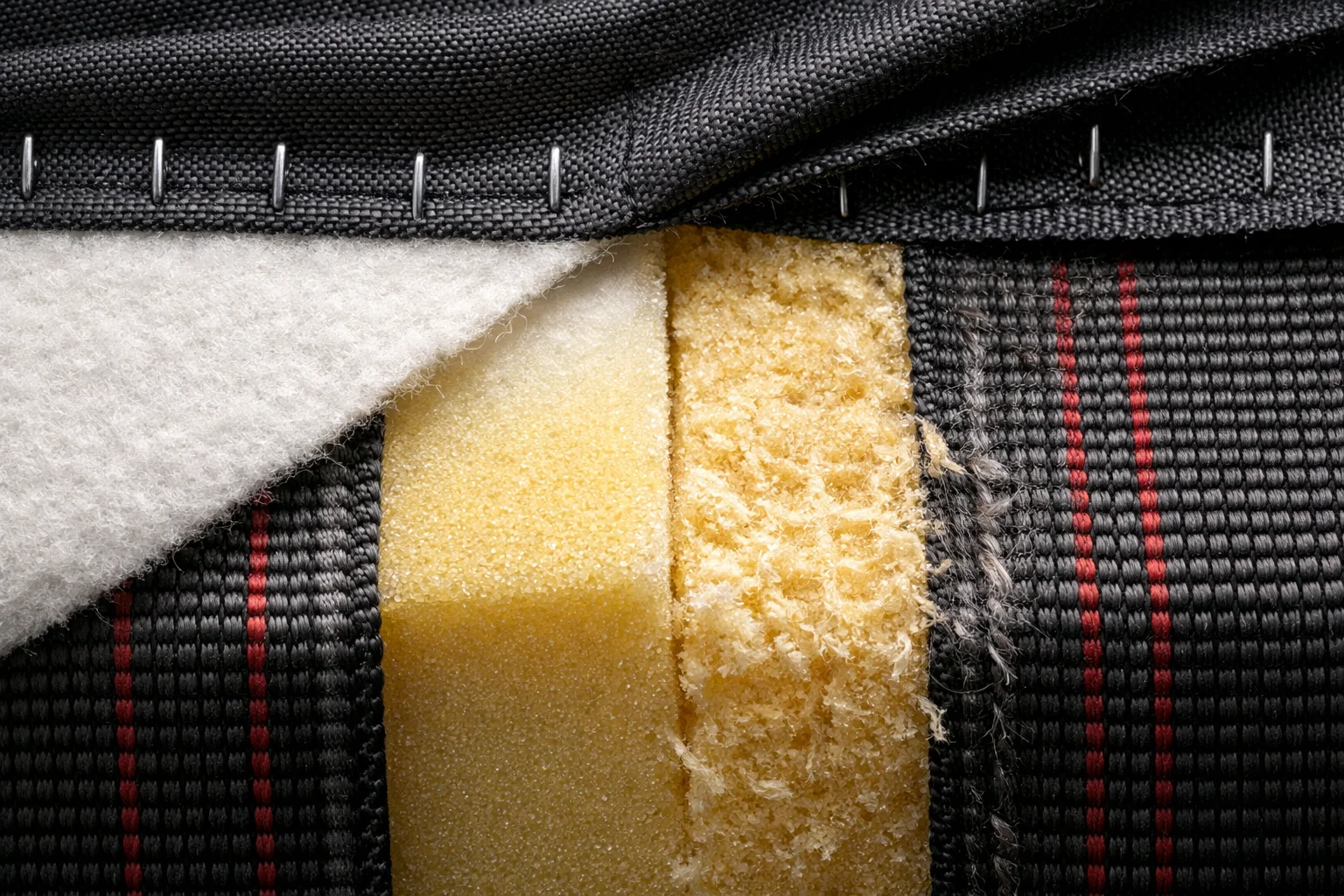
When I started paying attention to why webbed seats fail, it was rarely the webbing snapping first. What I kept seeing was the webbing slowly sawing into whatever sits above it, especially when there is nothing substantial between the straps and the bottom of the cushion.
In a showroom, I try to confirm there is a real barrier layer between the support system and the cushion. If you can see the underside, you want to see a tough decking fabric and, ideally, a thicker insulator pad on top of the webbing, not just bare straps sitting right under foam.
You can sometimes feel this even if you cannot see it. I press down with my fingertips and slide my hand slightly across the seat base from underneath, or along the bottom edge where the dust cover is stapled, and I pay attention to whether it feels like webbing directly under cushion material, or whether there is a smoother, more continuous layer in between.
If the salesperson lets you lift the seat cushion, I look at the bottom of the cushion and ask myself a blunt question, does it look protected, or does it look like it is already getting polished and scuffed. A cushion bottom that is just foam or thin lining is more vulnerable to abrasion, and once it starts to wear through, you get that annoying hammock feeling and uneven soft spots that no amount of fluffing fixes.
This is one of those details that is easy to ignore because it does not change the first sit. I have learned to treat it like tire tread on a used car, it tells you whether the sofa is designed for years of friction and flexing, or just the first few months of feeling good under showroom lights.
The “Pirelli” Standard (Interwoven Webbing)
Not all webbing is equal, and I have learned the hard way that “elastic webbing” on a spec sheet can mean anything from excellent to flimsy. When you hear people praise “Pirelli” webbing, what they are really pointing at is a high tension elastic system that holds its shape, stays quiet, and does not develop those weird low channels that make a modular feel like separate seats.
The first thing I try to figure out in a showroom is whether the straps only run in one direction, or whether they form a true grid. When a cheaper base runs straps only front to back, your weight can settle between them over time, and that is when you get the guttering effect where you subtly slide into a groove. You might not notice it on day one, but you will notice it when one favorite spot becomes the default sag spot and the cushion starts “learning” that shape.
What I want to see instead is interwoven webbing that goes front to back and side to side, with the straps laced over and under each other so they behave like one tensioned deck. The practical difference is that when you sit down, the load is shared across the whole rectangle of the frame instead of asking a few straps to do all the work. In a modular setup, that matters even more near seams and edges, because those are the areas that get perched on, slid across, and used as leverage when people stand up.
If the underside is visible, I look for a consistent weave pattern and consistent strap spacing. If I see wide gaps, straps that look twisted, or a grid that turns into simple parallel runs in certain areas, I assume the support will feel uneven once the cushions relax. If I cannot see anything, I still try to read it through the sit by moving my weight in small increments, because a true grid tends to feel uniform when you shift left, right, forward, and back.
I also do what I call the drum test, and I do it before the salesperson starts talking. I ask if I can lift the seat cushion, then I tap the seat deck with my knuckles and listen. A good, tight webbing deck gives a higher, tighter drumlike sound and a springy rebound under the tap, while a low tension setup tends to give a dull thud and a sluggish bounce that feels like it is already tired.
You can combine that with a hand check that tells you a lot fast. I press down hard near the front rail, then I press down in the center, then I press down close to where two modules would meet, and I pay attention to whether the resistance feels like the same “surface” everywhere. When the base is a properly tensioned interwoven grid, those three spots usually feel like variations of the same support, not three different sofas.
If you are stuck with a sofa you cannot inspect underneath, I get more picky about how it behaves when you stand up from it. I sit, then I stand, and I watch whether the seat snaps back to level quickly or whether it lingers in a depression for a second. Webbing will always move, but the better systems recover cleanly and consistently, and the worse ones start teaching you where the low spots are going to be.
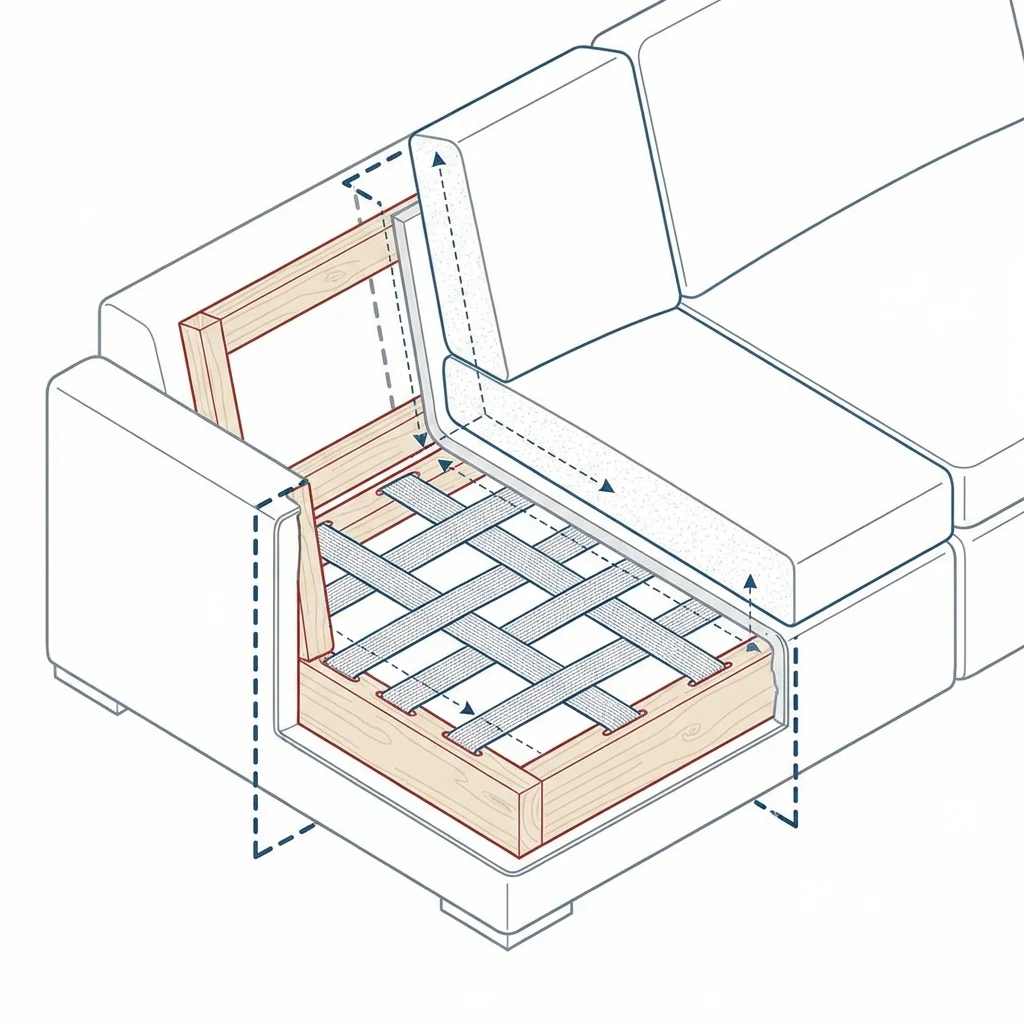
This diagram is the mental model I keep in my head when I am testing a modular in a showroom, because it explains why some seats age gracefully and others suddenly feel “off” in one spot.
When straps run as a true weave, your weight is not asking one staple, one clip, or one strap end to be the hero. It is spread out, so if one attachment point starts loosening or one strap relaxes a little, you are less likely to feel an immediate crater in the exact place you sit every night.
The showroom move I use to check this is deliberately unfair. I perch on one front corner of a seat, the way people actually do when they are putting on shoes, and I hold it for ten seconds, then I shift to the opposite front corner and do the same thing.
On a properly interwoven deck, both corners feel like they are connected to the same underlying “platform,” just with a little extra give at the edge. On a cheaper or sloppier setup, one corner will feel like it is hanging off the frame, and you will notice a more sudden drop as you load it.
I also pay attention to whether the seat wants to twist when I sit off center. If I sit slightly left and the cushion tips or the module feels like it is torquing, that is often a sign the support underneath is not distributing load evenly, which is exactly how seams between modules start feeling mismatched over time.
If the underside is visible, I look at how the straps terminate at the frame. I want to see strap ends that look clean, flat, and consistently fastened, because uneven attachment is where “single point failure” shows up in real life, even when the webbing itself looks decent.
If you cannot see the underside, you can still detect load sharing by doing a slow side to side shift while seated, almost like you are sliding a few inches at a time. A woven deck tends to feel smoothly continuous, while a one direction layout tends to reveal subtle lanes where the resistance changes as you cross from one strap bay to the next.
When you are buying modular, this is one of the rare cases where I think a quick, slightly awkward test is worth it. If a seat already has a favorite corner, a favorite lane, or a spot that drops faster than the rest, I assume it is going to amplify that difference once the cushions break in and the connectors get a little real world wear.
The “Decking” Fabric
The "Decking" Fabric
The fabric covering the webbing, the thing many people call the black bottom, is not just there to make the underside look finished. Its real job is to keep your cushion from grinding directly against the support system every time you sit, shift, and stand up.When that layer is too thin, too slick, or missing an actual insulator pad, the webbing underneath can act like a slow saw. The straps flex, the cushion flexes, and over months that repeated rubbing can chew up the bottom of the foam until you get a soft crater that never really comes back.
In a showroom, I treat the decking fabric like a “hidden wear surface,” because it is one of those parts that does almost nothing for the first sit and everything for the fifth year.
If you can lift the seat cushion, look at the very bottom panel of the cushion and the surface it sits on. I am looking for a tough, slightly textured deck fabric and, ideally, a separate felt like insulator pad between the webbing and the cushion, because that is what stops the strap edges and weave ridges from printing into the foam.
If you cannot see anything underneath, you can still feel for warning signs. I press down on the bare deck with the cushion removed and drag my palm lightly across it, because thin decking will often feel like you can “read” the straps beneath it. When I can clearly feel distinct ridges, gaps, or strap edges through the fabric, I assume the foam cushion will feel them too over time.
I also do a simple friction check that has saved me from bad builds. With the cushion back in place, I push it forward an inch and pull it back, then I pay attention to whether it slides too easily and whether I hear a gritty rubbing sound. A good non slip deck fabric tends to keep the cushion from skating around, and it tends to move quietly, while a cheap slick layer can let the cushion travel more, which increases rubbing and accelerates wear.
If the salesperson tells you the black fabric is “just a dust cover,” I do not argue, I just get more cautious. What I want to hear instead is that there is a real deck fabric meant for abrasion, or an insulator layer, or both, because those words usually mean the manufacturer expected movement and built for it.
The quickest red flag I know is seeing bare foam sitting directly on webbing, or a paper thin lining that looks like the inside of a cheap pillowcase. That is the scenario where webbing can do its job structurally and still destroy the cushion underneath, and you end up blaming the cushion quality when the real issue was the interface between the cushion and the support.
If you are choosing between two sofas that feel similar, this is where I would break the tie. I would rather buy the one with a boring, heavy duty deck and a real insulator pad than the one with flashier fabric and a prettier showroom sit, because once the cushion bottom starts getting chewed up, you cannot unwear it.
Technical Comparison: Webbing vs. Springs
If you are trying to decide between webbing and sinuous springs, I think the most useful way to look at it is not “which is higher end,” it is “which one matches the shape of this sofa and how I will use it.”
In shorter, boxier modular frames, the support system has less room to flex, so I usually see interwoven webbing behave more predictably. Springs tend to shine when the seat is a longer, more traditional run, because there is enough front to back depth for them to arc and recover smoothly instead of feeling like they hit a limit.
When I sit on webbing that is done right, the force feels spread out, like I am being held up by a whole platform. When I sit on sinuous springs, the force can feel more like rails under me, and if the build is not dialed in, I can sometimes find the lines where the wire is doing the work and the gaps where it is not.
That “platform versus rails” feeling is something you can check fast in a showroom. I plant my feet and slowly scoot my hips a few inches left and right, then I do the same move closer to the front edge, and I pay attention to whether support stays consistent or whether it rises and falls in lanes.
Noise is another place where the showroom tells the truth if you give it a chance. Webbing is usually silent, so when I hear squeaks, it is often a spring system, a loose clip, or metal rubbing where it should not, and I assume it will get louder once the sofa lives in a dry house and gets bounced on for a year.
I always do an “ear test” on anything with springs. I sit down, twist my torso like I am reaching for a remote, then I stand up, and if I hear even a small chirp, I do it again on a different seat and right near the seams between sections, because that is where movement and hardware stack up.
How these systems fail matters as much as how they feel on day one. Webbing usually fails gradually by stretching, so you feel the seat getting a little lazier over time, and you can often spot it early because the seat stops snapping back as cleanly. Springs more often fail at the attachments, so one clip pops or one run starts sagging, and you get a sudden low spot that feels localized, like one part of the seat fell out of sync with the rest.
That difference changes how I shop. If the sofa is webbed, I get picky about even tension, the quality of the deck and insulator layer, and whether the edges feel supported, because those are the things that decide whether the webbing stays flat or slowly turns into a hammock. If the sofa has springs, I get picky about consistency across seats and modules, and I look for any hint of a single seat developing its own personality, because that is how you end up with one saggy bay you cannot stop noticing.
Repair is the unsexy part that I wish I had thought about earlier in my life. Webbing is not “easy,” but it is usually a staple and tension problem, which a competent upholsterer can address without hunting for brand specific hardware. Spring systems can be a pain when a clip or fastener fails, because you may need a particular clip style and the labor can get fussy fast, especially inside a tight modular box.
If you want one simple rule that helps in a showroom, here is mine. If the seat depth is short and the sofa is clearly modular, I give webbing the benefit of the doubt and I demand it be tight, woven, and well protected by decking and an insulator layer. If the seat depth is long and the sofa is clearly built like a traditional couch, I am open to sinuous springs, but only if it stays quiet, feels even at the front edge, and does not have that lane like bounce when I slide side to side.