Modular Problems: The 3 Hidden Failures

Introduction
When I first bought a modular sofa, I believed the promise that flexibility meant longevity. What I learned the hard way is that flexibility in seating often means more moving parts, and more moving parts mean more ways for things to fail once real bodies start using it every day.
A modular sofa is not one solid object. It is a set of smaller seats that are asked to behave like a single piece of furniture, and that difference matters more than most showrooms admit. When people sit, shift, flop down, or lean on one section more than another, each module ages at its own pace. That uneven aging is what I now recognize as differential wear, and you can feel it long before you see it.
In practical terms, this means one seat goes soft while the next stays firm. One section starts to sag while the corner still looks fine. In a showroom everything feels uniform because nothing has been used yet, but at home your body will always favor certain spots, and the sofa cannot redistribute that stress the way a one piece frame can.
The second problem is hardware fatigue, which sounds abstract until you hear it. Every connector, latch, or bracket that holds modules together is taking repeated sideways and twisting forces. Over time those forces loosen fasteners, deform metal, and create tiny gaps that turn into squeaks, shifting, and visible separation.
When you are standing in a store, I want you to stop thinking about how easily the sofa rearranges and start thinking about how often it will not be rearranged. Most people find a layout they like and leave it there for years. At that point, a modular sofa is being used like a fixed sofa, just without the structural advantages of being built as one.
As you keep reading, I am going to show you how I now test modular sofas in person, what I press on, what I listen for, and which design choices tell me a sofa will still feel solid after the novelty wears off. My goal is not to scare you away from modular furniture, but to help you avoid paying premium prices for problems you can predict if you know where to look.
1. Hardware “Wallowing”
1. Hardware "Wallowing"
When two modular units are joined, the entire connection depends on a small metal bracket screwed into wood. On a traditional sofa, your weight spreads along long wooden rails, but on a modular piece that same weight is focused again and again on a few small screws.Each time someone sits, shifts, or drops into the seat, those screws are asked to resist sideways force. Over hundreds of sits, the wood around the screws slowly widens. The screws are still there, but the holes they sit in are no longer tight.
What you feel first is not a dramatic failure. It is a faint click, a tiny wobble, or a sense that the sections hesitate before settling when you sit down. That movement is the hardware no longer holding the modules firmly together.
When I am in a showroom, this is the first thing I test, even though the sofa is brand new. I grab one section and push it sideways toward the next one, then pull it back. If the modules shift independently instead of moving as one solid block, I know the connection is already relying on friction instead of structure.
I also sit right on the seam where two modules meet. I do not ease down carefully. I sit the way people actually sit at home. If I hear a click or feel a tiny drop before the cushion takes my weight, I assume that sensation will get worse, not better.
You should also get down low and look at how the pieces connect. If you see thin metal tabs with short screws going straight into soft wood, I treat that as a warning sign. Thicker brackets, longer screws, or connectors that pull the frames together instead of just pinning them tend to stay tight longer in real use.
Salespeople often tell you that hardware can be tightened later. That is technically true, but it misses the point. Once the wood fibers are crushed and widened, tightening the screw only masks the problem for a short time. I now assume that any looseness I can feel in a store will turn into daily annoyance after a year of normal living.
If you love the look of a modular sofa, this is where you slow down and get skeptical. A sofa that feels absolutely rigid when brand new is not being picky. It is giving you the only real clue you have about how it will feel after thousands of sits.
2. The “Cliff” Effect (Differential Sag)
This is the problem that finally made me give up on my first modular sofa, because it sneaks up on you. In most modular systems, each seat has its own block of foam instead of one continuous cushion, and those blocks do not age evenly once real people start using them.
At home, everyone gravitates to the same spot. I always sit in the middle, and guests spread out around me. Over time, the foam in that favorite seat compresses faster, while the neighboring seat stays closer to its original height and firmness.
At first, you barely notice it. Then one day you lie down across the sofa and your body tells you something is wrong. Your hip or lower back drops suddenly at the seam between two modules, like stepping off a curb you did not see. That drop is what I mean by the cliff.
What makes this worse in modular sofas is that the seam is fixed. On a traditional sofa with a single cushion or a unified cushion core, the foam can share the load across a wider area. In a modular piece, the foam blocks cannot help each other, so the difference becomes more pronounced every year.
When I am in a showroom, I try to predict this problem instead of assuming it will not happen. I press down hard on the center of one seat cushion, then I move my hand to the cushion right next to it and do the same. If the foam response already feels noticeably different from one module to the next, I assume that gap will widen with use.
I also sit sideways across the seam between two seats, letting my weight bridge both cushions. I pay attention to whether my body feels evenly supported or if one side sinks faster than the other. Even on a brand new sofa, that uneven give is a warning sign.
You should ask how the cushions are constructed, but not in technical terms. What you want to know is whether each module has its own separate foam core and whether those cores are identical and replaceable. If the salesperson cannot clearly explain how one sagging seat would be fixed without replacing the entire module, that cliff is likely permanent once it forms.
I now avoid modular sofas where the seat cushions are thin, very soft, or permanently attached to each unit. Softer foam feels great for ten minutes in a store, but it loses height faster, and when it does, the seam becomes a fault line you feel every time you stretch out.
If you plan to nap, lounge, or lie flat on your sofa, this issue matters more than almost anything else. The cliff effect is not about looks, it is about your body being forced into awkward positions because the sofa can no longer support you as one continuous surface. Once you feel it at home, there is no rearranging the modules that makes it go away.
3. Connector Contamination (Velcro Sandpaper)
This is a quieter failure, and it took me longer to understand because it does not show up as wobble or sag at first. Many modular sofas rely on heavy duty hook and loop strips under the cushions or between modules to keep everything from sliding apart.
What most people do not realize is that these connectors live right near the floor. Dust, hair, crumbs, and grit get pulled into those seams by static and normal air movement, especially in homes with pets or hard floors.
Once that debris gets embedded in the hook side, it turns the connector into sandpaper. Every time you sit down and the modules shift even a little, the grit chews away at the soft loop fabric on the other side. The grip weakens slowly, then suddenly the sections start drifting no matter how carefully you align them.
In a showroom, I always lift the cushions and look for these connectors. If the salesperson hesitates or tells me not to worry about what is underneath, I worry more. I run my fingers lightly across the hook surface and check whether it feels clean and flexible or already stiff and scratchy.
You should also ask where exactly the hook and loop is doing the work. If the sofa depends heavily on wide Velcro strips instead of solid mechanical connectors, I assume maintenance will be part of ownership whether they mention it or not. That maintenance usually means vacuuming inside the seams, not just the visible floor around the sofa.
I also think about my own habits. If you are not the kind of person who moves cushions, flips things over, and cleans underneath furniture, this system is working against you. The connectors do not fail because they are cheap, they fail because they are asked to live in a dirty environment without regular attention.
When you test the sofa, try pushing one module sideways with a slow, steady force instead of a quick shove. If it slides easily and then creeps back into place, that resistance is often just the hook and loop gripping, not the frames locking together. Once those loops are worn smooth, that resistance disappears.
Salespeople rarely mention that these connectors need periodic cleaning to keep their grip. I now assume that if a modular sofa uses hook and loop as a primary stabilizer, I will be vacuuming inside the seams at least twice a year. If that sounds annoying now, it will feel worse after the sofa starts drifting during normal use.
For me, this comes down to honesty about how you live. A connector system that only works if it stays perfectly clean is not forgiving furniture. If you want something you can forget about for years at a time, you should be wary of any sofa where fabric strips are doing the job that wood and metal used to do.
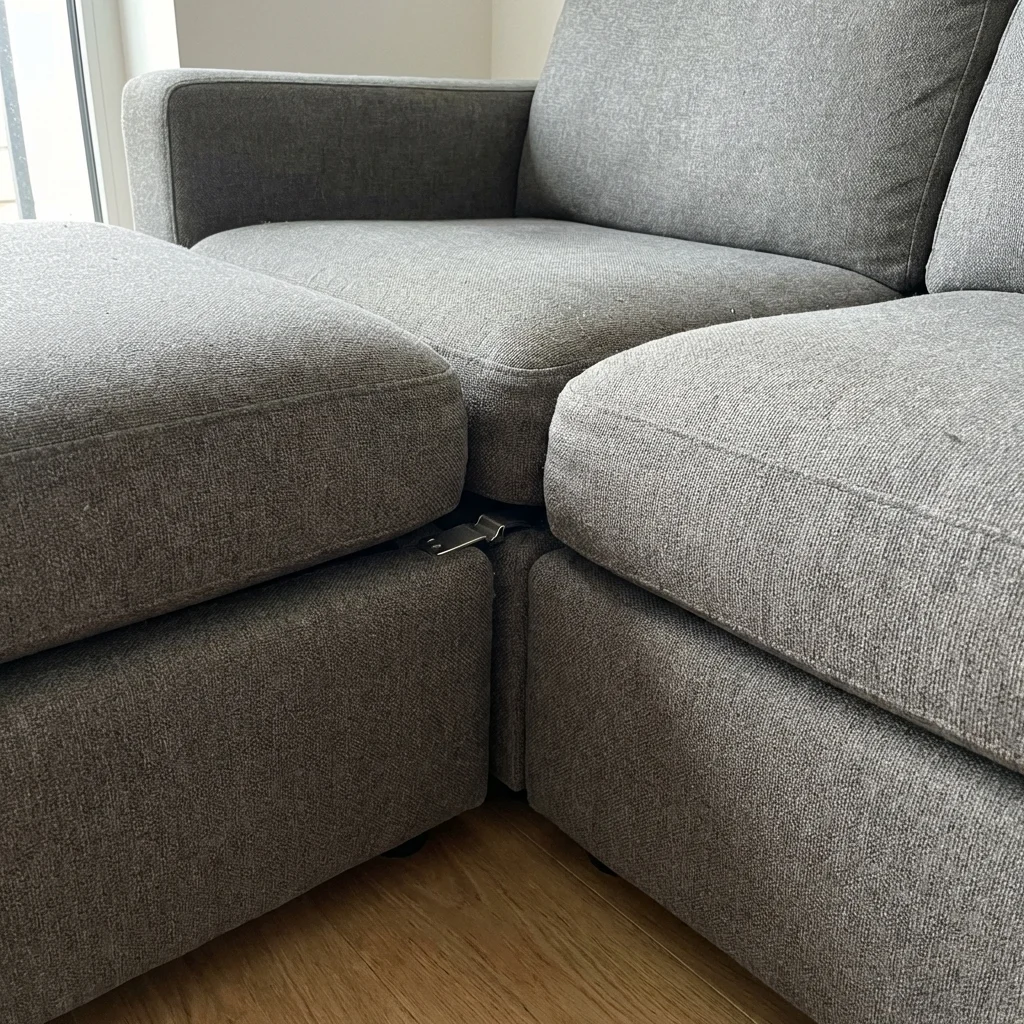
When I look at this photo, I do not see a cosmetic issue. I see a mechanical failure that has already passed the point where tightening anything will help.
That quarter inch gap did not appear overnight. It formed because the screws that once pulled the frames together slowly ground out the wood around them, and now the hardware is floating instead of clamping.
In a showroom, you will never see a gap this obvious, but you can feel the beginning of it if you know what to check. I place my eye level with the seam and look for light coming through or a shadow that widens toward the floor. Perfect alignment should look boring and uniform all the way down.
I also run my hand across the seam with light pressure. If my fingers dip into a soft valley or catch on one module sitting slightly proud of the other, I assume that difference will magnify with use.
What matters most here is how the sofa reacts when weight comes off it. I sit, stand up, then immediately look back at the seam. If the modules do not settle back into the same position, that tells me the connectors are no longer pulling the frames into a fixed relationship.
Salespeople sometimes describe this kind of gap as normal tolerance. I have learned that real tolerance works both ways. If the sofa can drift apart, it should also snap back together, and most modular systems do not.
You should imagine this photo taken two years from now, not on delivery day. Ask yourself whether you would still accept the sofa if the seam looked like this, because once the wood is wallowed out, the only real fix involves opening the frame, filling or replacing material, and reinstalling hardware. That is not a simple warranty visit.
I now treat visible alignment drift as a one way door. A modular sofa either stays flush under real use, or it slowly teaches you where not to sit, lean, or lie down. The moment you start adjusting your body to accommodate the furniture, the furniture has already lost.
Equalization: Move the “Favorite” Unit
Equalization: Move the "Favorite" Unit
One advantage modular sofas do have is that the pieces are interchangeable, and I have learned you need to actually use that feature if you want the sofa to age evenly.At home, there is always one seat that gets used more than the others. I can usually identify it by feel, because it is the one that compresses faster and feels a little lower or softer when I sit down.
When that happens, I swap that squishier unit with the firmest one, which is usually a corner or an end piece that no one sits in for long. This spreads the wear instead of letting one module take all the punishment.
I do this about every six months. That timing matters, because once the height difference becomes obvious, the damage is already harder to hide. Regular swapping helps keep the whole sofa line feeling level for much longer.
I want to be honest with you about what this means in practice. Equalization is not a fix for a poorly built sofa, it is damage control for a decent one. If the modules are already sagging unevenly after a short time, moving them around will not save you.
When I am shopping, I ask myself a simple question. Can I realistically lift, slide, and re lock these units twice a year without it becoming a chore. If the modules are extremely heavy, awkward to disconnect, or rely on fussy alignment tricks, I know I will never keep up with this habit.
In the showroom, you can test this without feeling awkward. Ask the salesperson to help you separate one unit and move it to another position. Pay attention to whether it goes back together cleanly or if it takes repeated shoving and readjustment to line things up.
I also check whether the seat height stays consistent after the move. If one unit suddenly sits higher or lower in a new position, that tells me the frames are already tolerating uneven loads, and equalization will only mask the problem for so long.
If you are the kind of person who never rotates a mattress or flips a cushion, be realistic with yourself. A modular sofa that requires periodic rearranging to stay comfortable is asking you to be part of its maintenance plan.
For me, this section is less about technique and more about mindset. A modular sofa will not automatically age well just because it is modular. If you are willing to actively manage wear by moving pieces around, you can stretch its comfort life. If not, you should favor designs that feel solid and uniform enough that they do not depend on your intervention to stay comfortable.
Maintenance Schedule for Modular Systems
If you own a modular sofa, I have learned that ignoring it between purchases is what shortens its life the fastest. These systems do not fail all at once, they drift out of alignment slowly, and small checks catch problems while they are still reversible.
About once a month, I take a moment to look closely at the seams where the modules meet. I am not measuring with tools, I am using my eyes and fingertips. If I can see daylight, feel a ridge, or notice a gap that looks wider than a couple of stacked credit cards, I assume the connectors underneath are starting to loosen and need attention before the movement gets worse.
Twice a year, I pull the cushions off and vacuum deep into the seam valleys where the modules touch. This is not about surface dust, it is about grit that works its way into connectors and slowly grinds them down. I focus on the areas you never see when the sofa is dressed, because that is where most connection failures quietly start.
Once a year, I flip the units and actually interchange them, not just rotate cushions. I move the most used seat into a less favored position and bring a firmer module into the main sitting spot. This simple swap evens out foam fatigue and keeps one section from becoming the permanent low point that your body learns to avoid.
Every couple of years, I check the connector hardware and snug the screws by hand. I use a manual screwdriver and stop the moment I feel resistance, because forcing it only chews up the wood and makes the problem worse later. If a screw spins without tightening, I take that as a sign the frame material is already compromised, not something that more torque will fix.
I do not treat this schedule as optional care. I treat it as part of the real cost of owning a modular system. If that level of attention sounds unreasonable to you now, it will feel even more annoying once the sofa starts shifting or sagging, and at that point maintenance turns into damage control.
What I want you to take from this is not that modular sofas are fragile, but that they are honest. They reward owners who notice small changes early and punish those who expect them to behave like a single solid frame. Knowing that before you buy lets you decide whether the flexibility is worth the ongoing responsibility.
Keep Your Modular Sofa Tight
- Sectional connector hardware — replacement brackets and screws when the original connectors have wallowed out.
- Heavy duty hook-and-loop tape — refresh worn Velcro strips that no longer hold modules in position.
Explore Technical Reference
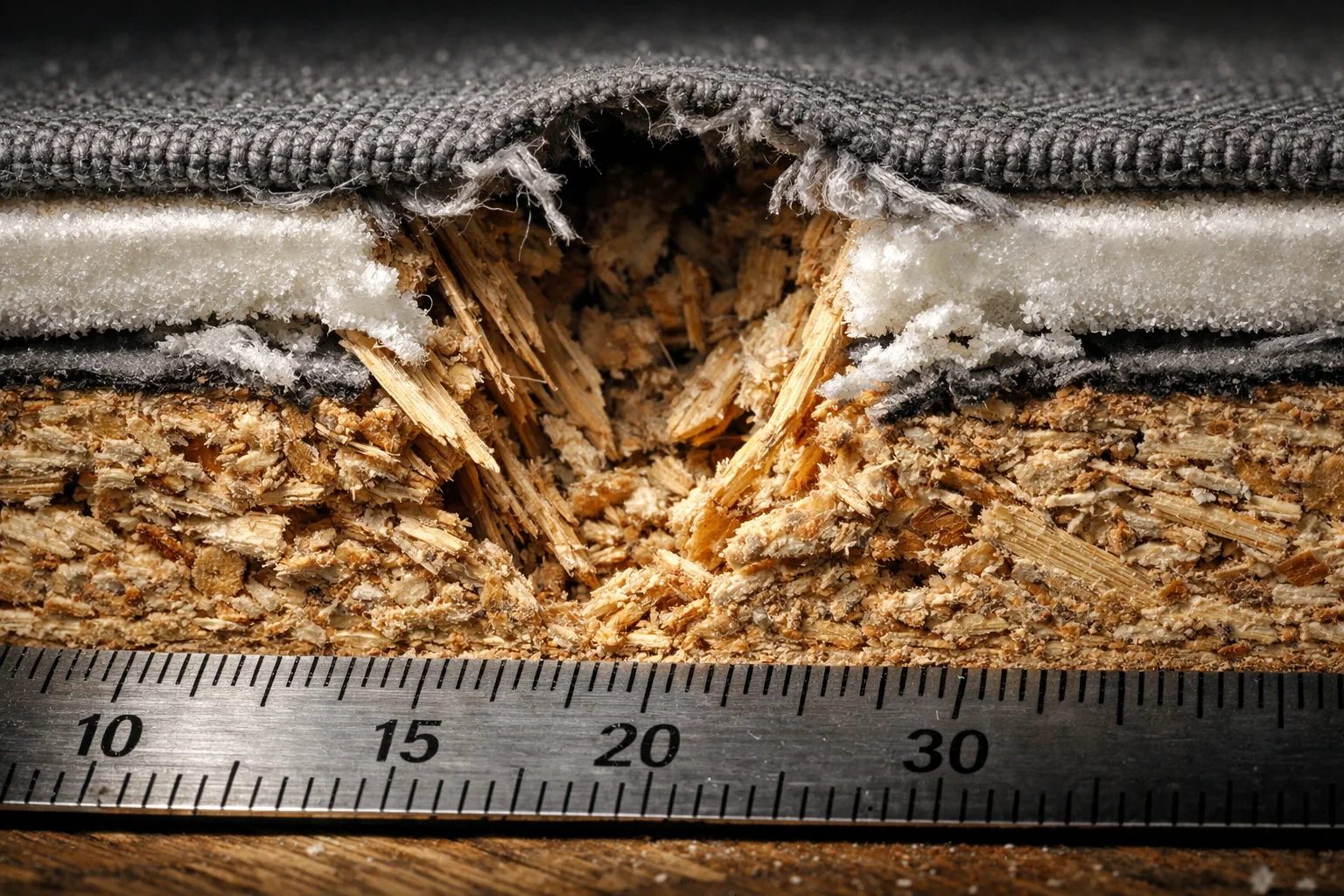
Storage Capacity: The Point-Load Limit
Why storage sofa lids can fail under concentrated loads. Understanding
Analyze Details →
Foldable Floor Sofas: The Physics of Frameless Seating
How floor sofas, foam blocks, and origami-style seating work. Understanding the trade-offs of purely foam-based seating without traditional frame construction.
Analyze Details →