Modular Sofas: The Interchangeability Equation
Introduction
I see “modular” slapped on a lot of sofas that are really just sectionals, and that label can cost you money if you assume you are buying flexibility that is not actually built in. When a set is sectional, the pieces are meant to lock together in one main layout, and any “options” are usually limited to choosing left facing versus right facing when you order.
When it is a true modular system, the units are standardized so you can swap positions later without the whole sofa looking mismatched or leaving weird gaps. In real life, that means you can move the chaise to the other side, split the sofa into two smaller loveseats, or add a seat in the middle down the road without replacing everything.
If you are standing in a showroom and you want to sort this out fast, I would start by asking the salesperson to show you at least two different complete layouts using the exact same pieces. If they cannot do it without adding a special corner piece that only works one way, or if they start talking about “this piece only goes here,” you are probably looking at a sectional being marketed as modular.
Then I would look at how the pieces connect, because that tells you whether the brand expects you to reconfigure it often. A true modular usually has consistent connectors on every mating side, and the upholstery and arm shapes are designed so the sofa still looks intentional when you change the arrangement. If the connectors are only in one direction, or the arms and backs only make sense in a single layout, treat it like a sectional and decide if that one layout works for your life long term.
The reason I care about this distinction is simple. If you pay a premium for “modular” but the parts are not genuinely interchangeable, you are paying for a promise you cannot use, and you will feel it the first time you move, rearrange the room, or try to add onto it later.
True vs. Fake Modularity
When I hear “sectional,” I assume the pieces are purpose built for one orientation, like a left arm chaise that only works on the left and a right arm loveseat that only works on the right. In that setup the frame and upholstery are usually asymmetrical, so swapping sides is not a real option even if the salesperson says it is “configurable.”When I hear “true modular,” I expect the sofa to be made from repeatable seat blocks, with arms and backs that can bolt onto any side of any block. In plain terms, you should be able to turn a left arm sofa into a right arm sofa fairly quickly using the same parts, not by buying a different “mirror image” piece.
In a showroom, I ask for a literal demonstration, not a brochure explanation. I want them to detach an arm or back and move it to the other side of the same seat, because that tells me whether the hardware and the upholstery were designed for real reconfiguration.
If they tell you the arms are “fixed,” or they say you have to order a different left version and right version, that is not true modularity, it is a sectional with options at purchase time only. You can still buy it if you love the one layout, but I would not pay extra for future flexibility you will not actually have.
I also look for symmetry cues you can spot with your eyes. If one end has a thicker arm profile, a different seam layout, or a different base detail, that usually means the pieces were never meant to swap sides without looking odd.
The last check I do is to ask what happens if you add a seat later. With true modular, adding one more seat block should be straightforward and it should not require a unique corner unit that locks you into a single shape, because that corner is where “modular” marketing often hides a sectional reality.
The Component Premium
The price jump on a real modular sofa often feels rude until you look at what you are actually buying. The brand is not just selling you “a sofa,” they are building the same structural work over and over again in smaller chunks, and each chunk has to stand on its own.
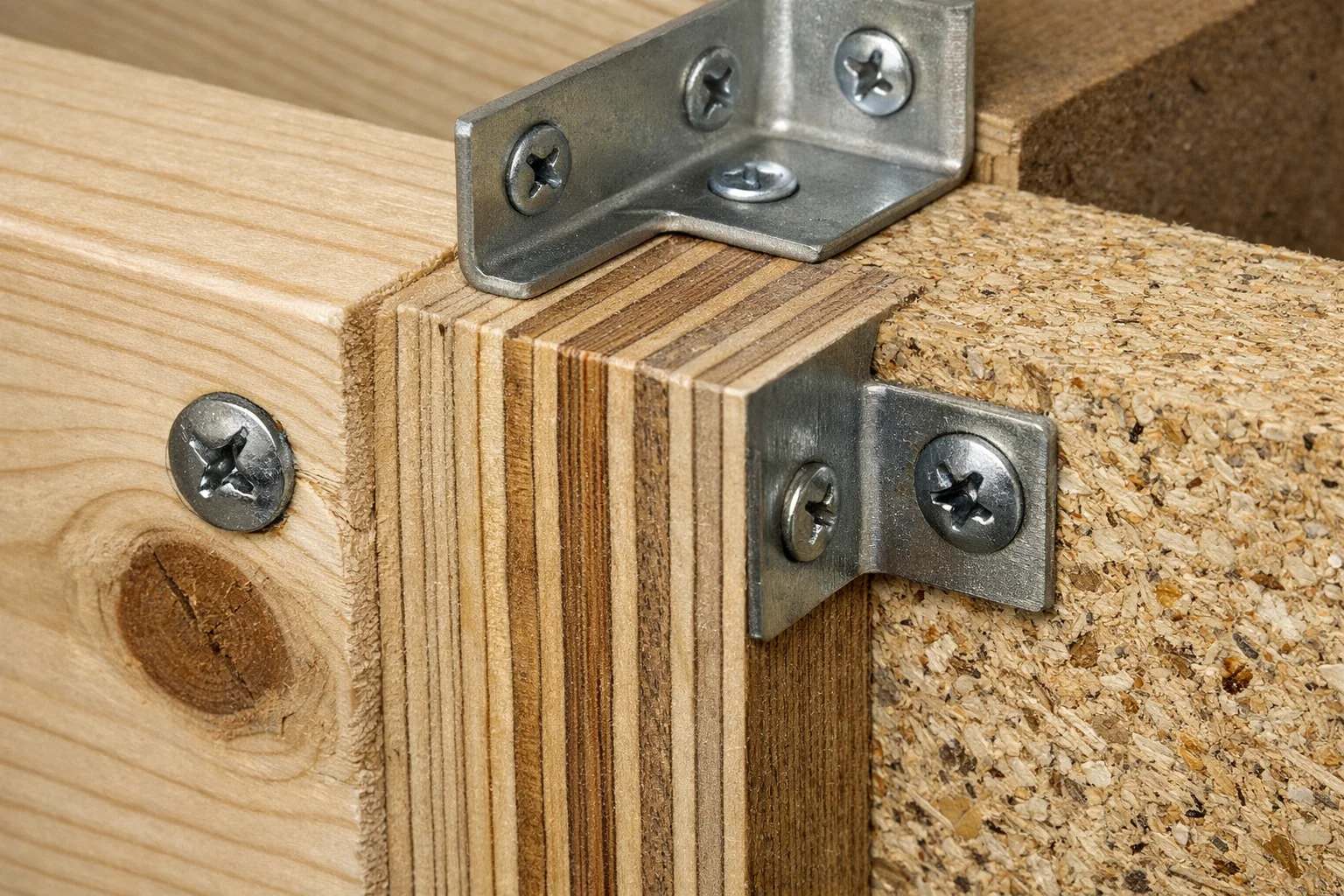
On a normal three seat sofa, there is one long frame doing the heavy lifting. On a three seat modular, you are basically buying three separate structural boxes, and each one needs its own perimeter frame, its own corners tied together, and its own surfaces stiff enough to not rack when you sit on the edge.
In a showroom, I try to confirm this by lifting one module slightly at a front corner, just an inch or two. If the box twists easily or the seat deck ripples, that is where the modular premium becomes a trap, because you are paying extra for multiple frames but not getting multiple strong frames.
The legs are another quiet cost multiplier. A standard sofa might stand on four legs, but modular pieces typically need legs at every corner of every box so each unit can support itself when it is used alone or when someone sits right on the seam between pieces.
What I do is crouch and count, then I check how those legs attach. If I can see a leg that screws into a flimsy plate or particleboard edge, I assume it will loosen and wobble over time, especially if you ever slide the modules to vacuum or rearrange. If the salesperson will let you, I like to gently rock a module by pushing at the arm or back, because a bad leg mount shows up as a tiny click or shift that you will absolutely notice on carpet at home.
The upholstery work is the third reason modular costs more, and it is the one that affects your eyes and your resale value. Each module has to be finished on all sides because any side could become an exposed end after you reconfigure, whereas a standard sofa can hide cheaper fabric or rougher work on the “inside” faces that always sit against another piece.
You can use that to your advantage when you inspect the floor model. I walk around the back and the sides and look for consistency in fabric, seams, and pattern matching, including on the faces that currently butt up against another module. If you cannot see those faces, I ask them to separate two pieces so I can look, because if the hidden sides are sloppy or use a cheaper fabric panel, that tells me the system is not truly intended to be rearranged often, even if the marketing says it is.
Where this becomes actionable for you is deciding when the premium is worth it. If you know you will keep it in one layout for years, a well built sectional can be the better value because you are not paying for duplicate structures you will never use.
If you genuinely plan to move, reconfigure, or add pieces later, I think the right way to shop is to demand proof that the extra components are not cheapened to hit a price point. I want to feel that each module is solid on its own, I want the legs to feel confidently anchored, and I want the upholstery to look like it was meant to be seen on every side, because that is what you are paying for when you pay the modular premium.
Connector Engineering
Once you accept that a modular sofa is a bunch of separate boxes, the next problem becomes obvious in daily life, those boxes want to drift apart. The whole “does this feel solid” question often comes down to the connector system more than the fabric, the cushions, or even the frame.
In a showroom, I always ask them to unlock two pieces and reconnect them while I watch. I am not looking for a polished sales demo, I am looking for whether the connection is positive and repeatable, meaning it lines up the same way every time without a lot of wiggling, lifting, or swearing.
After they connect it, I do a simple reality check. I sit right on the seam between two modules and shift my weight side to side, then I stand up and look straight down the joint to see if a gap opened up or if one module is now slightly forward of the other.
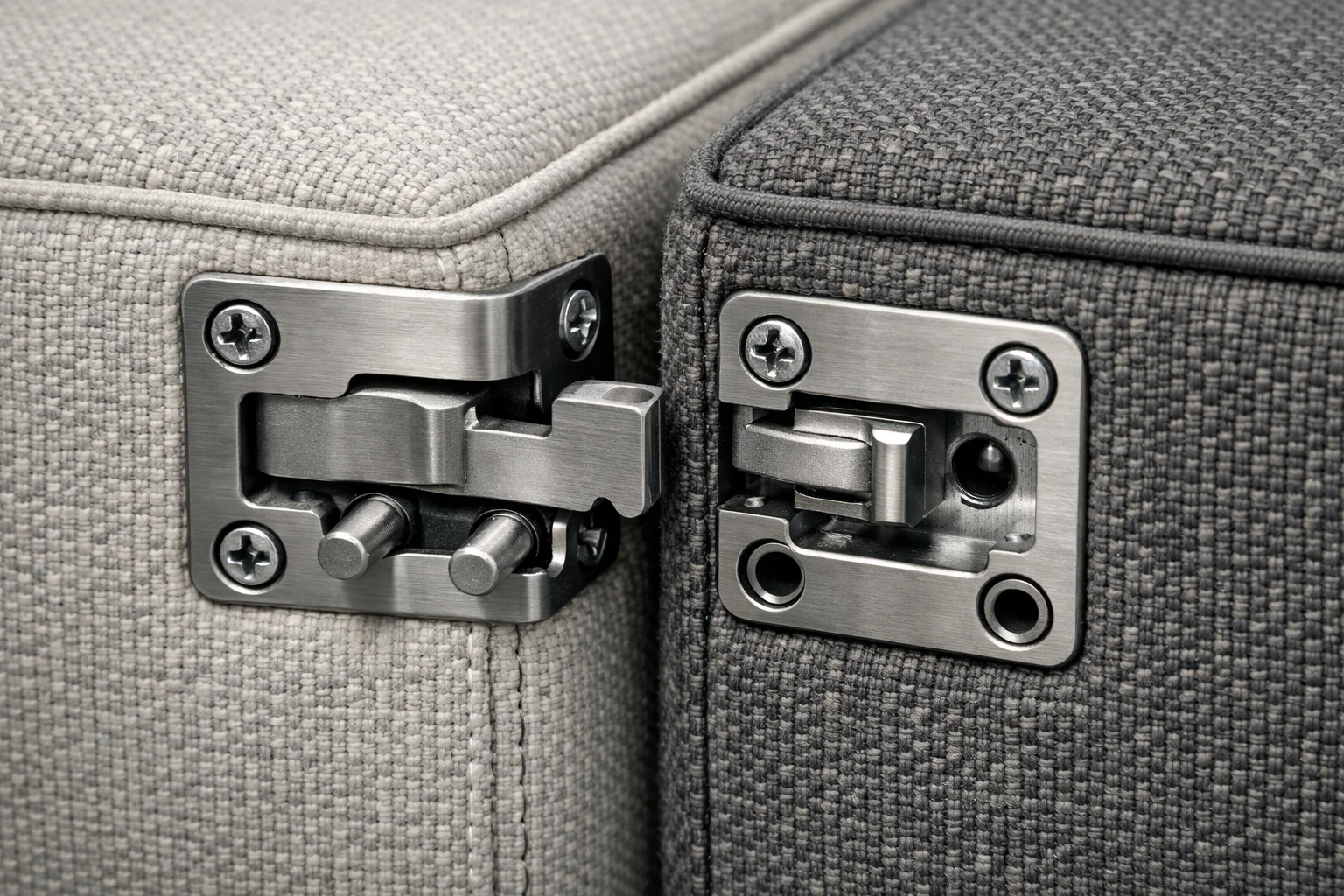
The easiest connector to spot is the basic gravity hook style, usually a pair of metal brackets that drop into each other. These are convenient because you can separate the pieces quickly to vacuum or move, but in my experience they are also the most likely to allow tiny “micro gaps” that grow into an annoying crack that eats phones, remotes, and crumbs.
If you are considering that style, I would do two checks in the store. I would push one module sideways with my knee while the other stays put and see how easily the seam walks open, and I would run my fingers along the joint to feel whether the faces are truly pulled tight or if they are just parked next to each other.
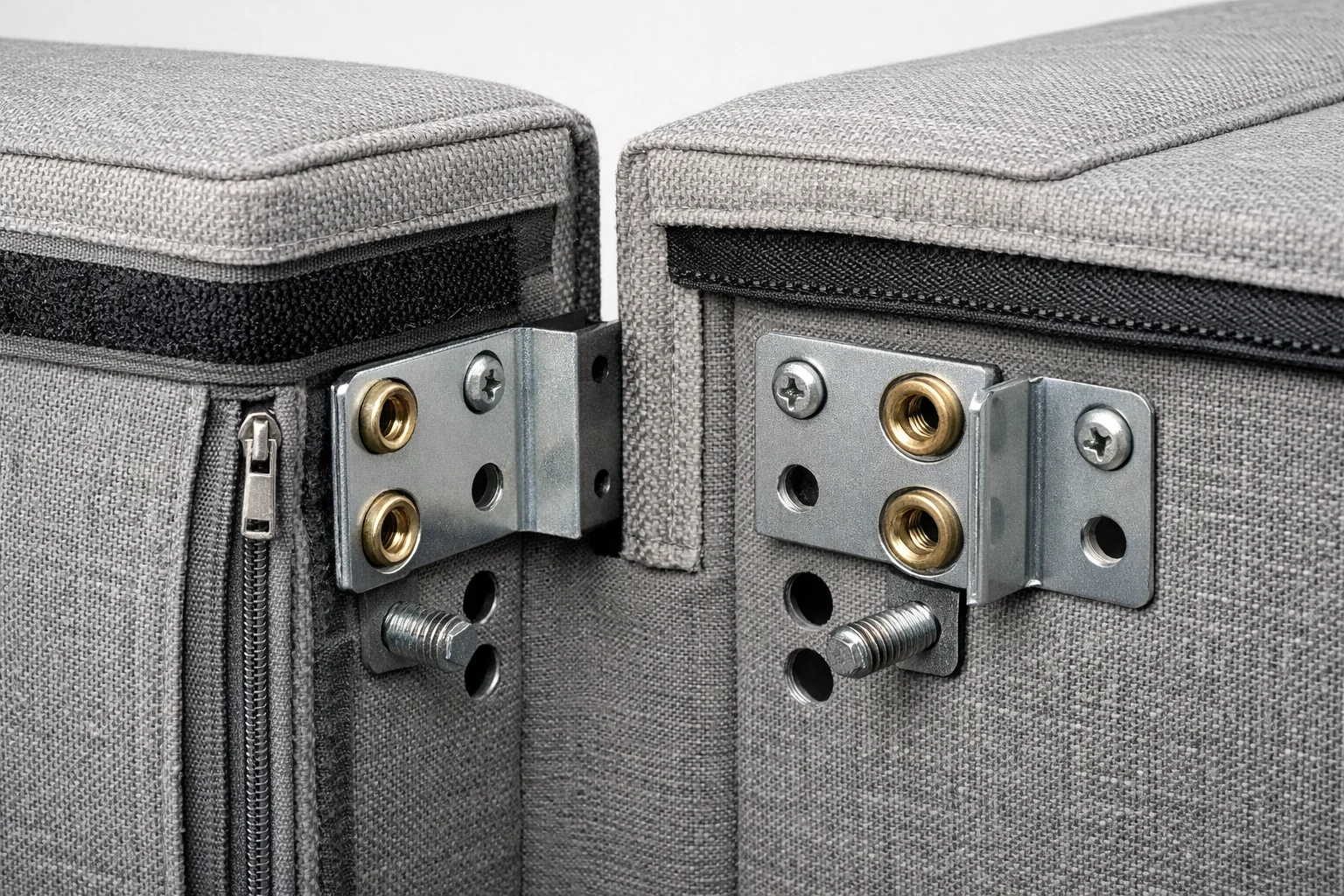
The more serious, “make it feel like one sofa” approach is when adjacent frames are actually clamped together with heavy steel plates and bolts, what many people call a U clamp setup. When this is done well, three separate boxes stop feeling like three separate boxes, and the seam becomes more like a line you can see than a motion you can feel.
The downside is that you will not casually reconfigure it on a whim, because it takes tools and a little patience. If you think you will rearrange often, that might be a deal breaker, but if your main fear is the sofa slowly turning into a row of drifting islands, this is the connector style that usually calms me down.
In the showroom, I ask where the clamp lives and whether it is metal bolting into real wood or into something that can strip. Then I ask them to show me the actual hardware, not just describe it, because I have seen “bolted together” mean a tiny screw going into a thin corner block, and that is not the same thing once you have kids flopping into the corner day after day.
Ratchet clip systems are the ones that feel like teeth clicking together, and they make sense if you are the type of person who genuinely reconfigures. They are usually faster than clamps and more positive than loose hooks, but I pay attention to noise because a clicky system that develops a squeak will drive you nuts if you sit and shift a lot during a movie.
To test for that, I plant one hand on each side of the seam and rock my upper body gently, like I am getting comfortable, and I listen. If I hear plastic on plastic chatter or a little chirp already on the floor model, I assume it will not get quieter at home.
No matter what connector style it uses, I want you to check one more thing that salespeople rarely bring up. I look underneath and confirm that every side that could connect has matching hardware, because some sofas have “real” connectors only in the one factory intended layout, and the other sides have token brackets that do not align cleanly.
If you want a quick, low awkwardness question to ask, I would say, “If I move this armless seat to the other end, will it lock in just as tightly, using the same hardware?” If the answer turns into a long explanation about specific sides, specific order, or “it can, but,” I treat that as a warning that the connector engineering is not truly designed for flexible living.
At the end of the demo, I like to do one last visual check, because the gap problem is not only structural. I stand back and look at the seam alignment from the front, and I check whether the seat heights and cushions line up cleanly across modules, because even a strong connector cannot hide sloppy tolerances that make the sofa look crooked over time.
Exploded view of a modular seat unit
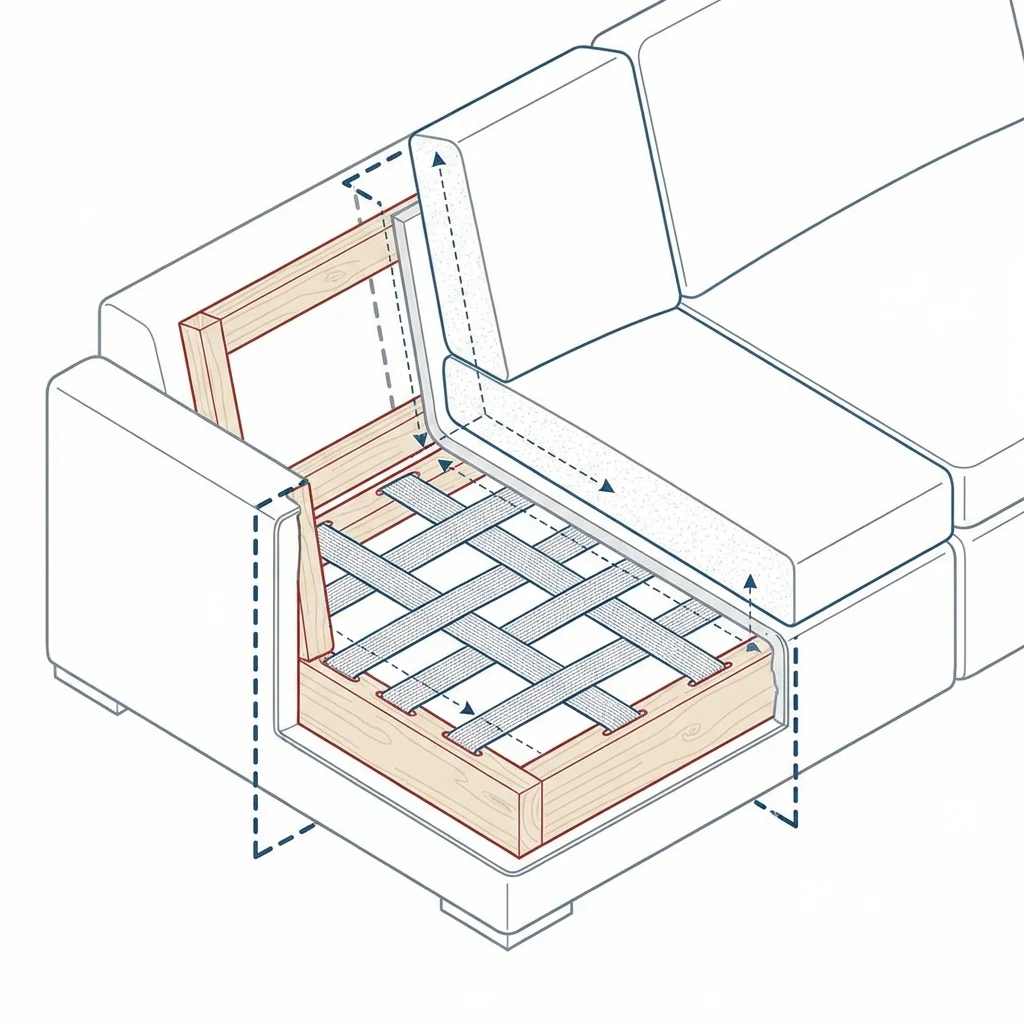
When I look at a modular seat “exploded,” I am basically asking one question, is each unit built like a complete little sofa, or is it a dressed up shell that depends on its neighbors to feel solid.
In a showroom, you cannot actually see a cutaway like the picture, so I fake it by treating one armless seat like it is going to live alone in a studio apartment. I sit on the very front edge, then I sit on the outer back corner, then I sit right on the side edge where it would normally touch another module, and I pay attention to whether the box feels equally supported in all those spots.
If the seat feels firm in the middle but “gives” near the edges, that usually means the internal structure is not perimeter strong. That is when modular can age badly, because people naturally perch on edges and seams, and those repeated edge loads are what loosen joints, flatten padding at the border, and turn seams into visible valleys.
I also put my hand on the side panel while I sit down, because a good self contained cell will not flex its side wall much. If I can feel the side panel bow outward or hear the upholstery creak as the unit takes weight, I assume the module is relying on the connector to fight twisting, and connectors are not meant to be the primary structure.
The legs are part of the “cell” too, and this is where modular systems quietly fail after a couple of years. I crouch and look for a leg near every corner of each seat box, then I look for a center support if the module is wide, because a long span without support is where you get a subtle sag that you only notice once the sofa is home and the cushions break in.
If the salesperson tells you the modules “float” on a shared base, I would stop and decide what you actually want. That can look clean, but it often means the seat box is not truly self supporting, which can limit the whole infinite expansion promise if future pieces need a specific base or specific layout to stay level.
Next I look for how the seat surface is supported, because that is what you feel every single day. You do not need a lecture on springs versus webbing versus panels, you just need to notice whether the support feels consistent across the whole seat and across multiple modules.
I do this by using the same sit test on two different modules in the display, ideally one that is in the middle and one that is at an end. If one feels bouncier, louder, or softer at the same body position, it tells me the “repeatable block” idea is more marketing than manufacturing consistency, and those inconsistencies tend to show up later as one seat becoming the “bad seat.”
The seams between modules are where bad architecture becomes visible, so I watch how the cushions meet. I press down with my palm on both sides of the seam at the same time, and I see whether both sides compress the same amount and rebound the same way, because mismatched cushion support makes the seam feel like a ridge or a dip even if the frames are locked together.
If the system uses loose seat cushions, I also check whether each cushion is clearly assigned to a module, or whether they are meant to float across. When cushions can migrate, the sofa slowly stops looking lined up, and you end up constantly tugging cushions back into place to hide unevenness at the seams.
Finally, I ask a question that sounds simple but reveals a lot about the internal “cell” idea. I ask, “If I buy one more seat later, will it sit perfectly level with what I am buying today, or does the layout require a specific base or special support pieces?” If they can answer confidently and show you where the leveling happens, like adjustable feet or a standardized leg pattern, I feel better about the infinite expansion pitch.
If they get vague, or they say the added piece “usually works” but depends on carpet, floor flatness, or a certain arrangement, I assume the modular cells are not truly independent. That does not mean you should not buy it, but it does mean you should buy it for how it feels right now in the layout you will actually live with, not for the dream of endless add ons later.
The "Seam Sink" Problem
Even when a modular system is genuinely well made, I have learned you cannot fully escape the gap, because you are always spanning the meeting point between two separate boxes.In a traditional sofa, you are sitting on one continuous deck, or on several cushions that still sit on one continuous frame. In a modular, there are two separate frame rails meeting under you, and that double structure creates a different feel right where the modules touch.
The sensation part matters more than people admit. If you sit upright in your own spot, most modulars feel great and that is what they are optimized for. If you nap across the seam, you are far more likely to feel a ridge, a dip, or a hard line underneath, even when the upholstery looks perfectly aligned.
What I do in a showroom is deliberately test the sofa the way your body will betray you later. I lie down across the joint with my hips on one module and my shoulders on the next, because that is the position that tells the truth fast.
If you feel a hard bar or a sharp change in support, do not talk yourself out of it by thinking a throw blanket will fix it. It might hide a little, but the structure underneath does not change, and seam discomfort is the kind of annoyance that gets worse as cushions soften over time.
Then I do a second check that sounds silly but catches a lot. I kneel with one knee on each side of the seam and shift my weight slowly, because that reveals whether the seam is just a visual line or whether it is a functional hinge where the modules give differently.
If the seam “sinks” when your weight crosses it, that is usually not the connector alone. It is often a combination of two frame edges that are slightly lower than the centers, plus cushions that are not supported evenly at their borders, plus a little real world floor unevenness that the showroom’s flat surface was hiding.
You can also learn a lot with your hands. I press down firmly with one palm on each side of the seam at the same time and pay attention to whether one side bottoms out sooner or rebounds slower, because mismatch is what turns a seam into a valley.
If you like to lounge, I would ask one direct question while you are still in front of the floor model: “Where is the softest place to lie down on this layout?” If the honest answer is “not across the joints,” that is not necessarily a deal breaker, but it tells you to stop imagining it as a single big bed.
If seam comfort really matters to you, I would rather you buy for your real lounging habits than for the modular dream. Sometimes the smartest move is choosing a layout where your usual nap line lands on a continuous chaise or a single extra deep unit, instead of across two standard seats that are forced to meet in the middle.
I also want you to notice how the brand tries to hide the problem, because those choices affect maintenance. Some systems use very tight, tailored cushions that make the seam look clean, but you still feel the structure underneath. Other systems use thicker, softer top cushions that mask the seam better at first, but those are also the ones that can compress into a permanent trench if the edge support is weak.
If you are on the fence, I would treat this as a compatibility issue, not a quality issue. A modular can be high quality and still be a bad “nap sofa,” and it is better to learn that in the store than after you have arranged delivery and realized your favorite position lands exactly on the double rail.
Technical Summary: Modular Complexity Matrix
When you are trying to decide whether “modular” is worth paying for, I find it helps to think in terms of complexity. A traditional sofa is basically one rigid body, and a true modular is a set of repeatable structural cells that have to behave like one sofa when you connect them, and like stand alone furniture when you separate them.The first practical difference is the frame. On a traditional sofa the frame is a single unit, so the strength comes from long rails and corners that never have to come apart. On a true modular, each seat is its own structural cell, so I want you to treat every single unit like it should pass a mini quality test on its own, because it will eventually be sat on, dragged, or leaned on as if it were a complete chair.
The next difference is legs, and this is where I see people get surprised later. A normal sofa may have four to six legs total, but modular systems often have four legs per unit, because each unit has to support itself even when someone sits right at the seam. In the showroom I literally count legs per module and then look at the mounting, because more legs only helps if they are anchored into something solid and they sit flat without rocking.
Moving logistics is where modular can genuinely pay you back, but only if it is truly built as smaller boxes. A traditional sofa often requires a truck, movers, and door measuring stress, while a real modular can usually move in smaller pieces that fit in a hatchback or come in manageable boxes. If moving is part of your plan, I would ask them to show you the largest single piece by itself and have them tell you its packed size, because “ships in boxes” can still mean “one box that does not fit up your stairs.”
Repairability is the quiet advantage that makes me willing to consider modular in the first place. With many traditional sofas, a broken frame corner, collapsed support, or destroyed arm can turn into a full rebuild or a full replacement. With true modular, the promise is that you can replace a damaged unit, a cover, or a single component without scrapping the whole sofa, so I always ask what parts are actually orderable later, and whether the brand considers covers and modules to be long term items or short run seasonal products.
Aesthetics is not a small thing, it is just not advertised honestly. Traditional sofas tend to look unified and formal because they are one continuous silhouette, while modulars often read blockier and more modern because they are repeating boxes. In the store I step back and look for whether the seams and breaks look intentional from across the room, because if the sofa only looks good from close up, you will eventually start seeing it as furniture that never quite “settles.”
Upholstery construction is another tell you can use immediately. Many traditional sofas have fixed upholstery that is stapled and built to stay put, while modular systems often use removable upholstery with zips or Velcro so you can service, wash, or replace what gets worn first. I would not just accept “removable covers” as a win, I would unzip one cushion cover and look at the stitching and zipper path, because a cover that is hard to remove or reinstall becomes the kind you never actually maintain.
If you want to use this matrix as a buying filter, the simplest way I can put it is this. If the system is truly structural cells, four legs per unit, easy to move in smaller pieces, and parts are meaningfully replaceable, then you are paying for real modular benefits. If you are mainly getting a blocky look and some extra seams, but the covers are still effectively fixed and the units do not feel self supporting, I would shop it like a sectional and only buy it if you love the one layout you are standing in front of right now.
Explore Technical Reference
Sleeper Frames: The Torque Conflict
Understanding why sleeper sofa frames require heavy-duty construction
Analyze Details →
Sofa Beds: The Dual-Function Compromise
How sofa bed mechanisms balance sitting and sleeping functions. Understanding pull-out systems, click-clacks, and why engineering has improved but compromise remains inevitable.
Analyze Details →