Futon or Sofa Bed: The Conversion Conflict
Introduction
I have owned both futons and sofa beds, and the reason I care about the difference now is simple. One of them aged in a predictable, annoying way. The other failed faster than I expected, even though it looked more expensive on the showroom floor.
When you stand in a store and sit on these pieces for thirty seconds, they can feel similar enough. The problem is that short test does not show you what daily folding, gravity, and body weight do over years. The way the mattress is stored when you are not using it is the real story, not the upholstery or the sales pitch.
A futon mattress lives out in the open and folds once, usually in the middle. That means it bends the same way every time, and it is always supporting its own weight evenly. When you sit or sleep on it, there are no hidden hinges or tight creases fighting against your body.
A sofa bed mattress is hidden inside the frame and folded into thirds. That means it is sharply creased in two places for most of its life, even when no one is using it. Over time, those folds become weak spots that you feel as bars, dips, or sagging, no matter how thick the mattress looked at first.
I want you to keep this mental image while you shop. Imagine how the mattress spends its time when no one is sitting on it. If it is constantly bent and compressed, it is aging even while you are not using it. If it lies mostly flat, it has a much better chance of staying comfortable.
This guide is not about which one looks nicer in your living room. It is about helping you spot the designs that quietly fail and the ones that hold up, using things you can check right there in the showroom without special tools or technical knowledge.
The "Mattress Stress" Comparison
When I compare these two designs, I think about how much punishment the mattress takes before you ever lie down. A futon mattress folds once, usually at a right angle, and that bend is wide and gentle. Because of that, it can be made fairly thick, often around eight or nine inches, without destroying itself over time.
A sofa bed mattress lives a much harder life. It has to fold all the way back on itself twice so it can disappear into the frame. To make that possible, it has to be thin, usually closer to four or five inches, and that thinness is not a design choice for comfort. It is a survival requirement so the mattress can squeeze into the metal cage.
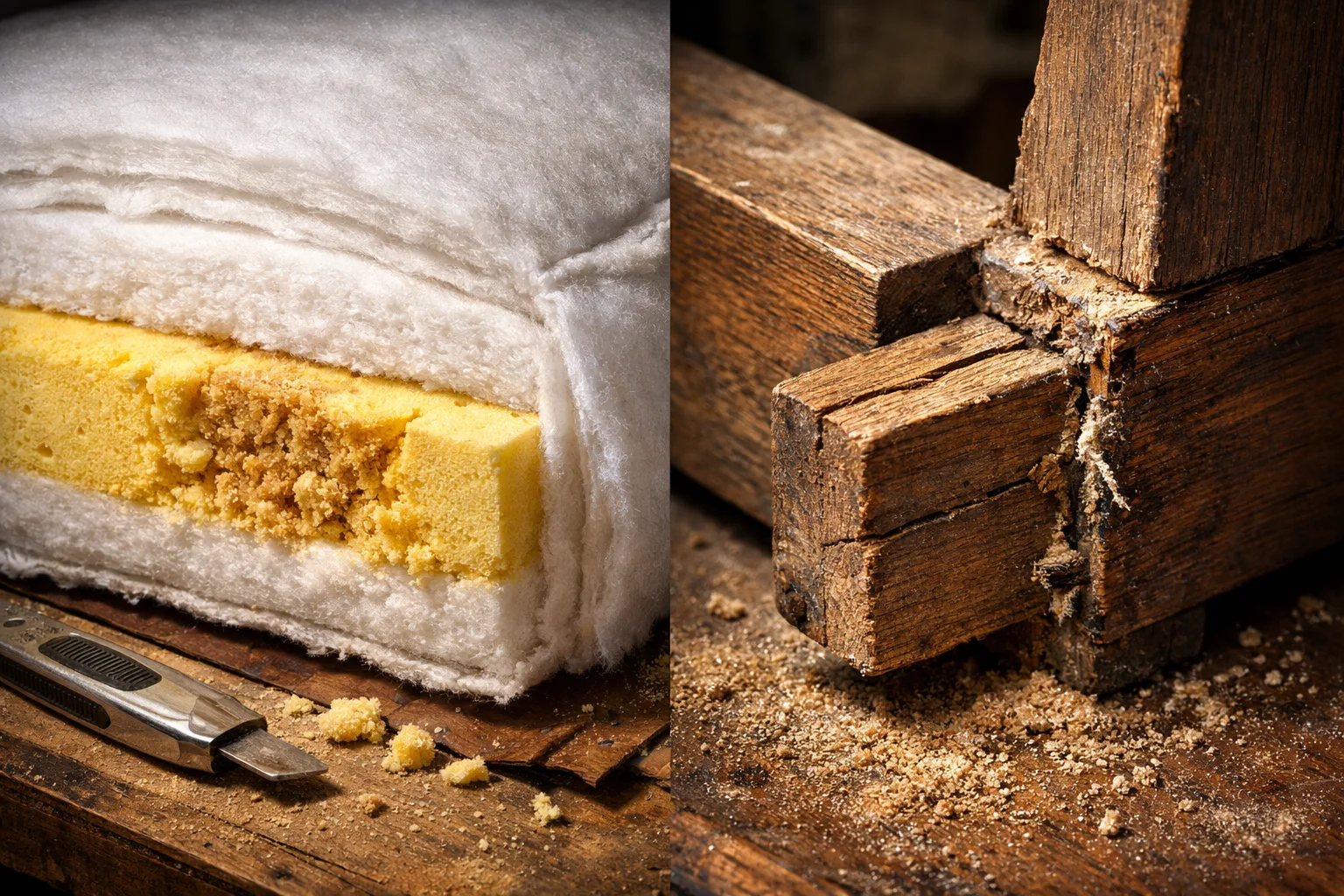
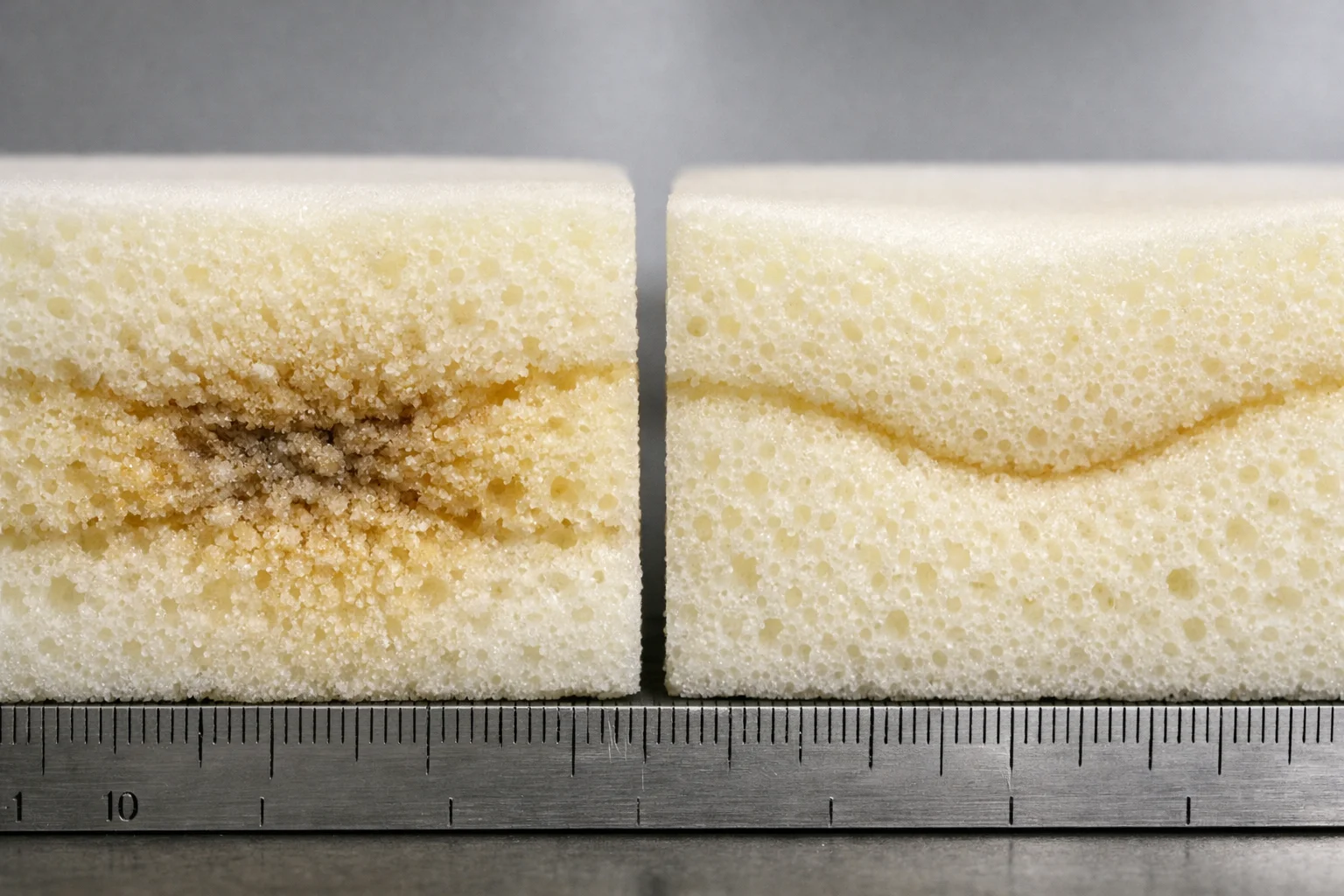
Here is the part I wish someone had explained to me earlier. Foam and springs do not like being sharply bent and held that way for months or years. When a mattress is folded tightly in multiple places, those fold lines slowly turn into permanent weak spots.
This is why futons usually feel better to sleep on for longer, even when they cost less. The mattress is allowed to be thicker, and more importantly, it is allowed to rest without being crushed into itself every day. Nothing inside it is being asked to survive extreme folding.
When you are in a showroom, you can actually use this comparison to your advantage. Ask the salesperson to pull the sofa bed all the way out and look closely at the mattress. If you can clearly see or feel the two main fold lines before anyone has slept on it, imagine how obvious those spots will feel after a few years.
With a futon, lift one side of the mattress and let it fold naturally. Notice how wide the curve is and how evenly it bends. That gentle motion is the whole reason these mattresses age more gracefully, and it is something you can see and feel in seconds if you know to look for it.
The “Stealth” vs. “Honest” Design
This is where I stopped being impressed by looks and started paying attention to behavior. A sofa bed is trying very hard to hide what it is, and a futon is not hiding anything at all. That difference shows up every time you convert it, not just on the first night.
A stealth design wants to pass as a normal sofa first and a bed second. To make that illusion work, everything has to be tucked away and compressed. When you pull it out, you usually have to strip the sofa down, lift heavy cushions, and stack them somewhere else in the room.
I want you to actually imagine doing that when you are tired or when you have guests standing around waiting. Ask yourself where those cushions are supposed to go in your space. If the salesperson cannot give you a clear, realistic answer, that inconvenience will become your problem later.
An honest design does not pretend. A futon looks like a mattress on a frame because that is exactly what it is. When you convert it, nothing gets removed and nothing gets stored elsewhere.
In a showroom, ask to convert it yourself instead of watching a demonstration. If it clicks flat in a few seconds without lifting anything heavy, that simplicity is not just convenience. It means fewer parts being stressed and fewer habits that lead to shortcuts or misuse over time.
I learned the hard way that complicated conversions change how often you actually use the bed. When it is annoying, you leave it half folded, or you sit on it in ways it was not designed for. Those small compromises add up and accelerate wear.
Here is what I want you to do while shopping. Stand in front of the piece and trace the steps in your head from sofa to bed and back again. If there are many steps, loose parts, or awkward lifting angles, that design is quietly asking more from you than it should.
Honest designs age more predictably because they assume you are human and sometimes lazy. Stealth designs assume perfect behavior every time. Based on my experience, that assumption is where the trouble starts.
Weight and Logistics
This part sounds boring until you are the one trying to get the piece into your home. I started paying attention to weight only after a sofa bed gouged a doorway and nearly took out my back.
A futon is usually light enough that two average adults can tilt it, rotate it, and walk it through a hallway without drama. In many cases it arrives in separate pieces, which means you can carry the frame and mattress independently instead of wrestling one huge object.
A sofa bed is a different animal. Once the metal mechanism and hidden mattress are inside, the weight jumps dramatically, and most of it is dead weight you cannot remove. Even before you think about stairs, ask yourself if you could lift one end off the floor without straining.
Here is what I do in a showroom. I grab the arm or front rail and gently try to lift it an inch. If it barely moves, that weight is coming home with you, and it will matter every time you move, rearrange, or repair.
You should also think about how it gets delivered. Many sofa beds ship mostly assembled, which sounds nice until you realize the delivery crew now has to maneuver a bulky, rigid shape through your doorways. Measure your narrowest doorway at home and compare it to the depth of the sofa, not just the width.
With futons, the logistics are more forgiving. Frames often come apart, and mattresses bend easily without damage. That flexibility is not just about moving in. It matters later when you move apartments or want to put the piece in a different room.
Another thing I learned to check is where the weight sits. On a sofa bed, much of the mass is concentrated in the center because of the folded mechanism. When you drag or pivot it, that center weight twists the frame and stresses the joints.
On a futon, the weight is simpler and more evenly distributed. The mattress is the weight, and it stays roughly where you expect it to be. That predictability is why futon frames tend to survive moves better, even cheaper ones.
I also want you to think about who will be using it. If you live alone or with someone who is not strong, a heavy sofa bed quietly limits your options. You end up avoiding moving it, cleaning under it, or converting it because it feels like a chore.
In the store, ask yourself a blunt question. If this showed up at my door right now and the delivery people left, could I deal with it on my own if I had to. If the honest answer is no, that is not a minor detail.
Weight is not just a number on a spec sheet. It affects delivery costs, moving stress, long term flexibility, and even how often you use the bed function. From where I stand, lighter and simpler almost always leads to fewer regrets later.
Diagram of bi-fold vs tri-fold mattress mechanics
When I first saw a diagram like this, it finally explained what my back had been trying to tell me for years. The issue is not style or price, it is how much the mattress is forced to change shape just to exist inside the furniture.
Look at the futon side of the diagram and focus on the bend. The mattress folds once, and the curve is wide. That means the foam or batting is bending, not being crushed, and it springs back close to its original shape when you flatten it again.
Now look at the sofa bed side and trace the folds with your eyes. The mattress is folded into thirds and pressed tightly into the frame. To make that fit, the material has to compress deeply, not just bend, and it stays that way most of the time.
Here is how I use this in a showroom. I ask to see the sofa bed half folded, not fully closed and not fully open. I run my hand across the fold areas and press gently. If those sections already feel thinner or stiffer than the rest, that is the compression shown in the diagram making itself known.
You can also lift the mattress slightly at a fold and see how it behaves. If it snaps into a sharp crease instead of forming a smooth arc, that crease is being trained into the mattress every day it is stored. Over time, your body will find that exact spot when you sleep.
With a futon, I do the opposite. I fold it slowly and watch the curve form. If the bend stays broad and even, that matches the low stress side of the diagram. If it kinks sharply in one place, even a futon can be poorly designed or paired with the wrong mattress.
The percentage numbers in the caption matter only in a practical sense. More compression means faster fatigue. Less compression means the materials get to rest. You do not need to measure anything, you just need to see whether the mattress is being folded gently or stuffed aggressively.
I want you to remember this image when a salesperson talks about upgraded foam or a thicker quilted top. No material performs well when it is crushed into itself day after day. The mechanics come first, and the diagram shows you where the long term stress really lives.
If you take nothing else from this section, take this. When you are standing in the store, picture the mattress spending most of its life exactly as shown here. If that picture makes you wince a little, listen to that reaction. It is usually more honest than the brochure.
The “Gutter” vs. The “Bar”
The "Gutter" vs. The "Bar"
When people complain about futons over time, they are usually describing what I call the gutter. That is the soft channel that develops right where the mattress folds in the middle. It happens because the foam bends in the same place every day, and eventually that spot gives a little more than the rest.With budget sofa beds, the complaint is different. Instead of a soft dip, people feel a hard bar across their lower back. That is often a literal metal support bar sitting exactly under the mattress, right where your weight presses when you lie down.
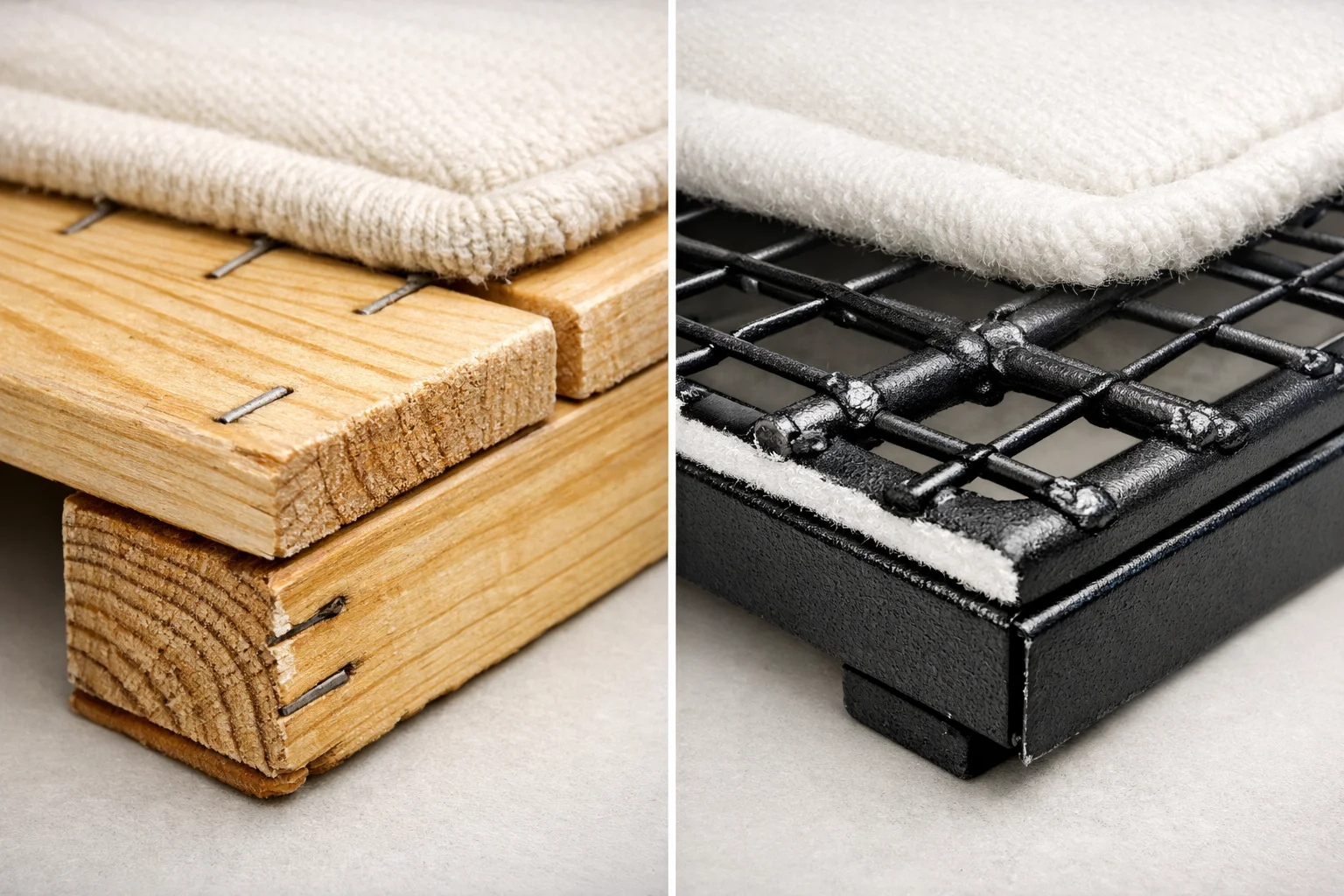
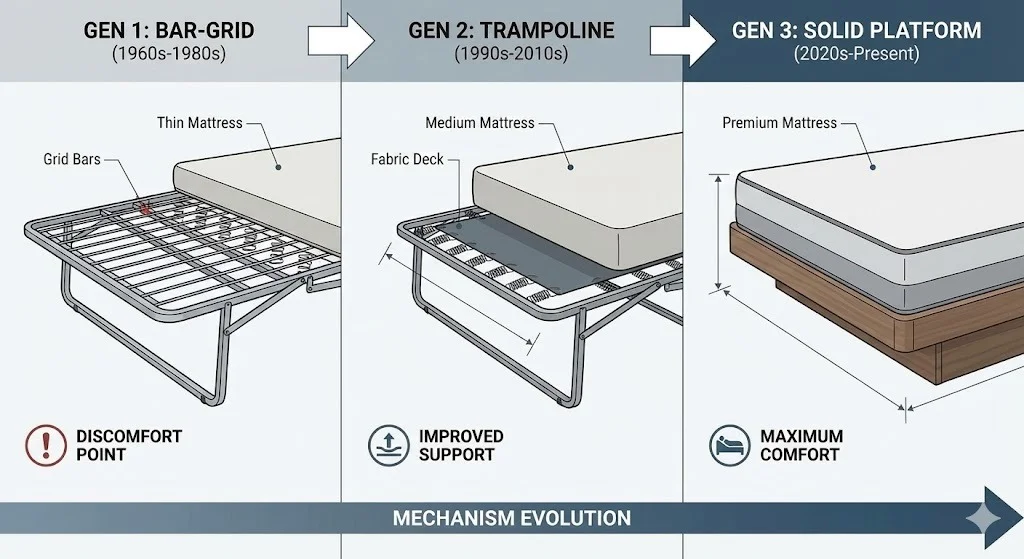
There is one technical detail that actually helps you shop smarter. Some sofa beds use a trampoline style deck made from stretched fabric mesh instead of rigid metal bars. That fabric acts like a shallow hammock and removes the worst pressure point.
I want to be very clear about why this matters in real life. A gutter is annoying, but a bar is painful. I can sleep through a slight dip with an extra blanket or by rotating the mattress. I cannot sleep through a strip of metal pressing into my back.
When you are in a showroom, sit and then lie down right in the middle of the bed, not diagonally and not near the edge. Shift your weight slowly and pay attention to what you feel under your lower back. If there is a sudden firm line instead of a gradual support, that is the bar announcing itself.
Salespeople will often encourage you to focus on the mattress thickness. I learned to ignore that at first and focus on what is underneath. A thin mattress over a flexible deck can feel better than a thicker mattress stretched over a hard bar.
Here is a simple thing I do that anyone can copy. I press down with my fist through the mattress in the center area. If I can feel something solid pushing back immediately, I know there is a rigid structure too close to the surface.
With futons, I check for the gutter in a different way. I sit directly on the fold line and then slide a few inches to either side. If the center collapses noticeably compared to the rest, that mattress is already training a dip that will only get deeper.
The key difference is predictability. The futon gutter develops slowly and evenly, and you can often flip or rotate the mattress to manage it. The sofa bed bar never goes away, because it is part of the frame, not the mattress.
If you are set on a sofa bed, this is where I slow down and ask specific questions. I ask what supports the mattress when it is open, and I ask to see it without the mattress if possible. If the answer is a grid of metal bars, I know exactly how that will feel in a year.
If the answer is a stretched fabric deck, I lie down again and notice how the support feels more uniform. It should feel springy, not bouncy and not hard. That difference is subtle in the store, but dramatic at two in the morning.
I also think about who will be sleeping on it. Lighter guests might never complain, while heavier bodies will find the bar immediately. I learned not to shop for the imaginary average person, but for the heaviest and most sensitive sleeper who might actually use it.
Between a gutter and a bar, I know which problem I would rather manage. A soft spot can be worked around. A hard edge cannot. When you are testing these pieces, trust your back more than the label, and do not let anyone rush you past this check.
Decision Logic: Which fits your life?
This is the point where I stop arguing theory and start matching the furniture to how you actually live. I have learned that the wrong choice is not the cheaper one or the uglier one. It is the one that quietly fights your habits.
If this piece is going to be used as a real bed, not an emergency option, I lean toward a futon. A thicker futon mattress handles nightly sleeping with less drama because it is not being crushed into folds every morning. In a showroom, lie on it for a full minute and notice whether your hips sink evenly instead of bottoming out. If it already feels supportive without tricks or toppers, it has a better chance of holding up when it becomes part of a daily routine.
If this is going into a formal living room where appearances matter most of the time, I understand the pull of a sofa bed. It does a better job of hiding the fact that someone might sleep there later. When you are shopping with this goal, I focus less on the fabric and more on how invisible the bed function actually is. Sit on it as a sofa and see if you can feel the mechanism through the cushions. If the seat already feels uneven or firm in strange spots, that hidden complexity is already leaking into everyday comfort.
If you move often, or even just rearrange your space every year or two, I strongly consider a futon. I have timed myself breaking one down with a single hex key, and it took less time than it takes to remove cushions from a sofa bed. In the store, ask how the frame comes apart and whether you can see the fasteners. If the salesperson hesitates or says it is not meant to be disassembled, imagine dealing with that during a rushed move.
I also think about how honest I am willing to be with myself. If I know I will avoid complicated setups when I am tired, I choose the option that asks the least from me. If converting it feels like a small chore now, it will feel like a big one later, and that affects how the furniture gets used and abused.
Here is the question I ask myself at the end. Which compromise will annoy me less six months from now. A futon asks you to accept the look of a bed in your room. A sofa bed asks you to accept mechanical stress, extra weight, and hidden wear. Once you name which tradeoff fits your life better, the choice usually becomes obvious.
I wish someone had framed it this way for me earlier. There is no universally better option, only the one that aligns with your space, your guests, and your tolerance for hassle. When you decide based on that instead of the showroom fantasy, you are much less likely to feel ripped off later.