Futons: The Engineering of Simplicity

Introduction
When I say a futon is honest, I mean you can see the whole deal at a glance. It is hinges, slats, and a mattress doing double duty, so there is less mystery and fewer hidden parts waiting to fail.
That simplicity is exactly why I treat futon shopping like buying a basic tool. If the frame feels flimsy in the showroom, it will feel worse at home, and if the mattress already seems fussy to fold or uncomfortable to sit on, you will not magically start loving it later.
You should walk up to a futon and do the things you will do every week at home. Sit down hard in the middle and then on the edges, shift your weight, and notice whether the frame twists or creaks. Then convert it back and forth yourself, slowly, because a good futon should move predictably without you having to yank, slam, or fight it.
The exposed engineering is also the weak point because there is nowhere for bad design to hide. If the hinge binds, the slats bow, or the frame racks when you lift one side, that is telling you how it will age, especially if it is your main sofa and not just an occasional guest bed.
I also want you to be honest about what you are buying it for. A futon can be a great everyday bed or a decent occasional sofa, but it rarely excels at both unless you are willing to accept a firmer, flatter seat feel than a typical upholstered couch.
In the rest of this guide, I am going to focus on what you can physically check in a showroom, what materials tend to hold up, and what red flags I personally walk away from even when the price looks tempting.
Bi-Fold vs. Tri-Fold Physics
When you are looking at futons, the fold style quietly decides how the whole thing will feel day to day. I pay attention to this early because it affects the seat depth, how fussy the conversion feels, and how much comfort you can realistically expect from the mattress.
A bi fold futon mattress folds once, the classic taco shape, and that is why most futons you see are built this way. In the showroom, you will usually feel a deeper seat, closer to a lounge chair, which can be great if you like to slouch and put your feet up. The downside is that if you are shorter, or if you like sitting more upright at a table height coffee table, that depth can turn into a constant little annoyance, so I make a point of sitting all the way back and checking whether my feet still land comfortably on the floor.
A tri fold mattress folds twice, which makes the sofa position more compact and can fit better in a tight room. The physics cost is that the mattress has to bend more sharply in two places, so it is typically thinner to cooperate with the frame. In practice, that thinness tends to show up when you sleep on it, because you are closer to feeling the frame and the hinge zones, even if it seems fine for a quick sit in a showroom.
If you are deciding between them, I would treat bi fold as the safer bet if you care about sleeping comfort, especially for adults or frequent overnights. I treat tri fold as something I only consider when the compact sofa footprint is the priority, and then I test it like a bed in the store, not like a chair, by pressing my hand, then my knee, into the fold lines to see how obvious those transition spots feel before I ever believe the mattress will be kind to my back.

The Support Deck (Slats vs. Tubes)
The part under the mattress matters more than most people think, because it is basically the futon’s box spring. I always look at the deck before I judge the mattress, since a decent mattress can feel lousy on a bad deck, and a cheap mattress can feel surprisingly okay on a supportive one.
If you see a wood slat deck, that is usually a good sign, because wood has a little natural flex. In a showroom, I press down with my palm between slats and then sit on the futon and bounce lightly, not to be goofy, but to feel whether the support has any springiness or if it feels like sitting on a hard platform.
What I want from slats is boring consistency. I look for slats that are straight, thick enough not to look like paint stirrers, and supported well so they are not spanning huge gaps with nothing under them, because that is when they start to bow or crack later.
The single easiest thing you can do is check the spacing. I physically look for how wide the gaps are, because if the slats are far apart, the mattress will sag into those gaps over time, and you will feel it as ridges and valleys when you sleep. If you can easily fit a couple of fingers into the gap and wiggle them around, I treat that as a warning and I either move on or I plan on adding a bunkie board or a firm deck panel at home, which is an extra cost you should mentally add to the price tag.
If the sales person mentions kiln dried hardwood, I take that as a plus, but I still verify with my eyes and hands. I run my fingers along the slat edges and I look for splits, knots that look like they could pop, or rough staples, because those are the little details that turn into squeaks and broken slats once the futon has been folded and unfolded a few hundred times.
Metal tube decks are the other common option, especially on cheaper frames. They can look sturdy and they usually do not break easily, but they have no give, so the mattress ends up doing all the work of cushioning you from a rigid surface.
Here is how I test tube decks in the store. I kneel gently on the mattress with one knee and then shift a few inches at a time, because tubes tend to create pressure lines, and you can sometimes feel those lines even through a decent mattress. If I can feel distinct hard zones, I assume that mattress is going to wear faster, especially if it is foam, because constant pressure points are how foam starts to get those dead spots and dips.
If you are stuck choosing between a tube deck futon and a slat deck futon at the same price, I personally lean slats for comfort and for how the mattress ages. If you really like everything else about a tube deck model, I would only feel good about it if the mattress is thick and resilient enough that you cannot detect the tube pattern at all when you do that knee test, and if you are realistic that you might be replacing the mattress sooner than you want.
The Mattress: Beyond Cotton Batting
Traditional futon mattresses were basically layers of cotton batting, and if you have ever owned one, you know the story. It starts out pleasantly firm, then your body heat and weight pack it down, and it never really fluffs back up on its own.
The core problem with cheap cotton batting is that it does not rebound. In the showroom it can feel substantial because it is thick and heavy, but after a few months of sleeping or even just sitting in the same spot, it compresses into a dense pad and the futon starts to feel like you are perched on hard lumber.
When I am in a store, I stop thinking about how a futon mattress feels in the first five minutes and start thinking about how it recovers. I press down hard with my palm for a full few seconds, then let go and watch what happens. If it stays dimpled, or if it slowly creeps back but never looks the same, I assume it is going to develop a permanent butt groove and a permanent sleep channel.
I also do what I call the fold memory check. I ask the salesperson to let me fold it into the sofa position and unfold it again, then I run my hand across the fold zone. If I can feel a ridge, a hard line, or a hinge like flat spot that does not relax after a minute, that is the mattress telling you it will get uglier every time you convert it.
What has changed in better futons is that the mattress is not just cotton anymore, it is cotton plus a springy core that can take a set and then bounce back. If you see language like “hybrid core,” I treat that as a promising direction, as long as they can tell you what the core actually is.
One common upgrade is micro pocketed coils inside the futon mattress. In plain terms, that means a lot of small springs that can compress and then rebound, which helps the mattress survive being folded and helps it feel less like a flat pad when you sleep. In a showroom, I can often spot this because the mattress has a slightly livelier push back when I sit and shift, and it tends to feel more even when I kneel and move around.
The other upgrade I look for is a real high resilience foam core inside the cotton wrap. If the spec mentions HR foam around the two pound range, that is usually the point where the foam is meant to act like structure, not just squish. The practical test is simple, when you stand up after sitting, the surface should rise back quickly instead of staying mashed.
If the store cannot tell you what is inside, I assume it is mostly batting with maybe a token foam sheet, and I price it mentally as a short term mattress. A good question that does not require you to know jargon is, “Is there a coil unit or a solid foam core in this, or is it mainly cotton?” If they dodge it or answer with vague comfort words, I treat that as a red flag.
Thickness is tricky because it sells, but it is not a guarantee. A thick cotton mattress can still pack down into a brick, while a slightly thinner hybrid can keep its shape longer and feel better through the fold zones. I would rather have a mattress that springs back and stays even than one that just looks impressively tall on day one.
If you are buying the futon to sleep on regularly, I would put most of your budget into the mattress and treat the frame as the second priority, as long as the frame is not junk. If you are mainly using it as a sofa and only occasionally as a bed, you can accept a firmer feel, but I would still avoid the all cotton type because the seat “set” is what makes futons feel permanently tired fast.
Before you commit, I want you to do one last real world check. Sit in the exact spot you will default to at home, usually the middle, for a couple minutes, then get up and look at the surface. If it already shows a lasting depression in the showroom, it is not going to get better in your living room.
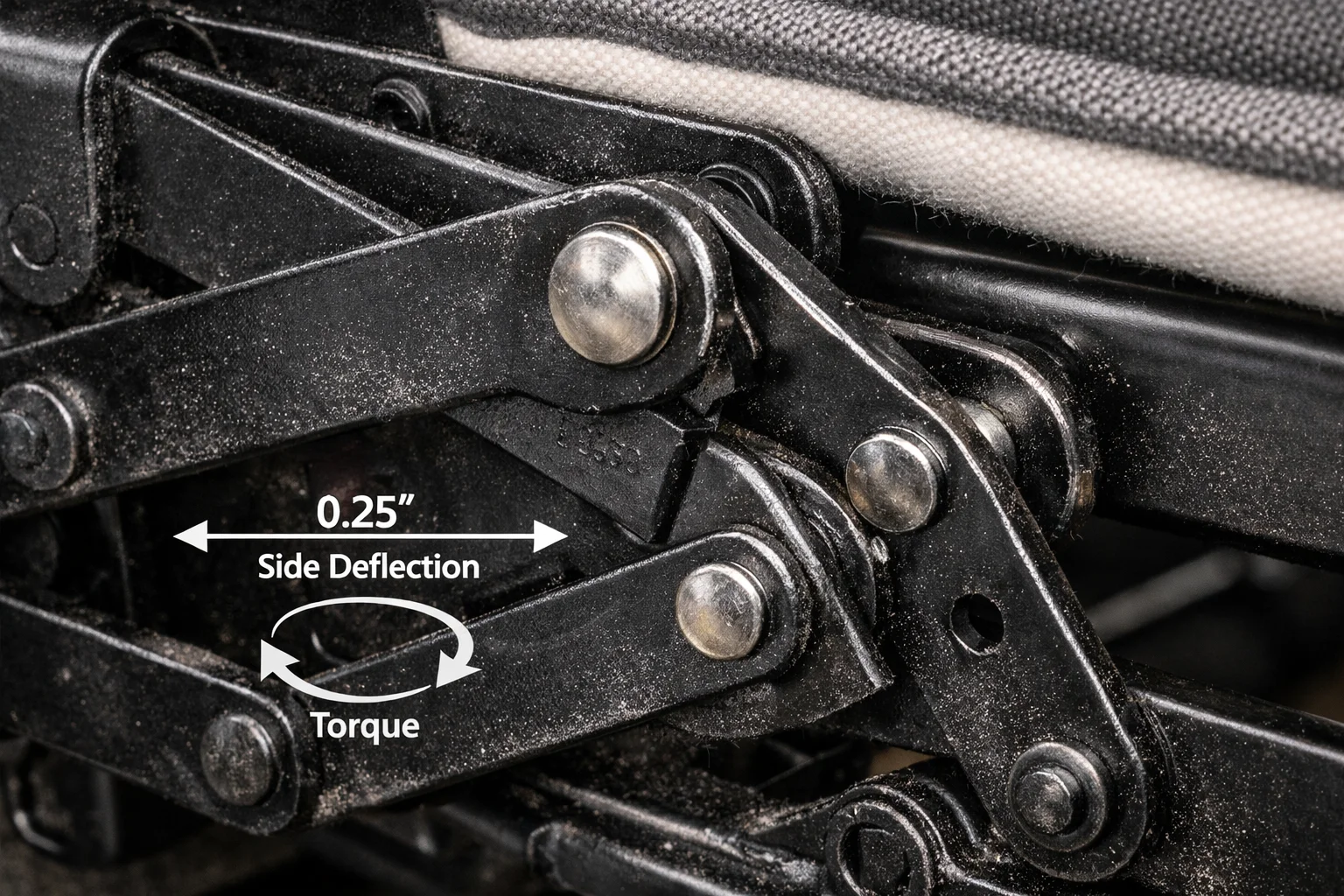
Diagram of a bi-fold futon frame in motion
When you watch a bi fold futon convert, what you are really watching is leverage. The mattress is not just along for the ride, its weight is part of what makes the motion feel controlled instead of jerky.
In the store, I want you to convert it slowly and pay attention to whether the frame seems to fall into position on its own or whether it wants to slam. A good frame feels like it has a predictable arc, you lift, it rolls through the hinge, and it settles without needing a big final shove.
If the futon feels easy to convert only because it is flying and banging into place, I treat that as a warning. That kind of impact is what loosens hardware, enlarges screw holes in wood, and turns a quiet frame into a squeaky one.
I also watch what happens when the mattress is on the frame, because the mattress is the real test load. If the salesperson demonstrates with the mattress shifted halfway off, or with no mattress at all, I ask them to set it up properly and let me do it myself, since the counterbalance effect changes everything.
Here is a simple showroom check that has saved me from annoying frames. I stand at one end and lift that side only a few inches, then I pause and see if the other side twists or lags behind. If it racks diagonally instead of moving as a square, that tells me the frame is going to feel worse once it is in a real room with uneven floors and daily use.
I also put my hand near, not on, the hinge area while I convert it, because you can feel binding through the frame. If the motion feels gritty, catches in one spot, or requires a sudden extra yank to get past a point, I assume that hinge is either poorly aligned or cheaply made, and it will not get smoother with age.
Listen for sound, but interpret it the right way. One soft thump as it settles can be normal, but repeated clicking, pinging, or a little metal snap noise as it crosses the midpoint is the kind of thing that turns into loosening and play later.
I pay attention to where the futon wants to be when it is halfway between sofa and bed. If it will not hold a controlled halfway position and it either tries to spring back or drop forward, that means you will always be fighting it during conversion, especially if you are doing it alone.
If you are buying for a small space, this is the moment to think about your walls and your fingers, not the sales tag. I make sure there is clearance behind the backrest as it swings, and I check that there are no obvious pinch points where the frame scissor action comes together, because those are the spots that bite you when you are tired and doing it in the dark.
The most practical takeaway is this. The best bi fold conversion feels boring, steady, and repeatable, and it feels that way when you do it, not when someone strong and practiced does it for you. If you have to use momentum, or you find yourself bracing the frame with your knee to keep it from twisting, I would walk away, because that annoyance is what you will live with every single week.
The "Mattress Slide"
This is one of those problems that sounds small until you live with it. Because the frame deck is usually smooth wood or metal and the mattress cover is fabric, the mattress slowly creeps forward every time you sit down, shift, and stand up, until one day you realize it is hanging off the front edge and bunching at the fold.In a showroom, I check for this by sitting down normally, then doing a few exaggerated scoots like I am getting comfortable for a movie. When I stand up, I look at the front edge and see if the mattress has walked forward relative to the frame, especially at the corners, because that is usually where it starts.
If you can already see it shifting in the store, I assume it will be worse at home on smoother floors and with repeat use. You can sometimes reduce it by tucking the mattress hard into the back corner in sofa mode, but if you have to constantly reset it, that is a daily annoyance, not a one time setup.
The simplest technical fix is adding friction. I use a rubberized grip pad, basically the same kind of non slip rug pad you would put under a runner, placed on the seat deck under the mattress. In plain terms, it gives the mattress something to grab so it stays in that L shape while you sit instead of slowly sliding forward.
If you are considering doing this, I would ask the salesperson if you are allowed to place a non slip pad under the mattress without affecting the warranty or the way the frame locks. Some futons rely on the mattress sliding a little during conversion, so I want to know I can remove the pad or trim it to just the seat section if the folding action feels weird.
Technical Summary: Futon Buying Specs
When I look at a futon frame as a long term purchase, I start with the wood because the hinge hardware is only as trustworthy as what it is bolted into. I look for solid oak or rubberwood because they tend to hold fasteners better over years of folding and sitting. If the tag says pine, or the wood feels very light and dents easily when I press a fingernail into an inconspicuous spot, I back away, because soft wood is how hinge bolts slowly loosen and start wallowing out their holes.
Then I focus on the hinge itself, because that is where most futons either stay civilized or turn into a squeaky wrestling match. I specifically want nylon bushings in the hinge, since that little layer is what prevents metal from grinding directly on metal. In the showroom, I ask the salesperson to point out the bushing or show me a diagram of the hinge assembly, and if they cannot explain what separates the moving parts, I assume it is metal on metal and I listen extra carefully during conversion for chirps, scraping, or that dry squeal that tends to get worse over time.
I also treat the weight rating as a real spec, not marketing filler. For a full size futon frame, I want to see a stated rating around 500 pounds of static load, and I want it in writing on a spec sheet, a hang tag, or the manufacturer card, not just a verbal promise. If they cannot produce a number, or they only talk about it being “sturdy,” I assume the frame is built to a price and I adjust my expectations, especially if you will have two adults sitting on it regularly or if you expect it to function as a real bed.
The way I tie these specs together in the store is simple. If the frame is hardwood, the hinge has a quieter, smoother feel because it is not fighting itself, and the rating is clearly stated, that usually lines up with a futon that stays square and behaves after the honeymoon period. If one of those three is missing, I slow down, I test harder, and I only proceed if the comfort, motion, and build details are good enough that I would still be happy after the first year.