The Exit Strategy: 3 Signs Your Sofa is Dead
Introduction
I kept a broken loveseat in my spare room for 3 years because I couldn’t fit it in my car to take it to the dump. I told myself I would “fix it someday.” I didn’t. It was just a large, upholstered trash can occupying $5,000 worth of square footage in my home.
That is the part people do not tell you when you are shopping. A bad sofa does not just wear out, it becomes a disposal problem that is awkward, heavy, and weirdly hard to get rid of.
I am not writing this because I think everyone needs heirloom furniture. I am writing it because I have learned the expensive way that a sofa can look perfect in a showroom and still be built in a way that gives up fast once it is in your living room.
If you only take one mindset into a store, make it this. You are not buying a shape and a fabric, you are buying a structure that has to survive years of sitting, flopping, napping, and guests perching on the edge.
In this guide I am going to focus on things you can actually check while you are standing in front of a sofa, without special tools and without trusting a sales pitch. I will keep pulling you back to simple tests, plain language, and the specific questions that force clear answers.
I also want you to treat delivery and returns as part of the product, not an afterthought. If a sofa starts failing early, your best outcome is usually a clean return or a straightforward warranty claim, not a heroic DIY repair you will never get around to.
The "Sunk Cost" Trap
You spent $2,000 on it 10 years ago. The fallacy is telling yourself you cannot throw away $2,000, so you have to keep the sofa no matter how bad it has gotten. The reality is that money is already gone, and what you actually bought was 10 years of sitting, which you already used up. Keeping a broken object does not get your money back, it just keeps charging you in space, comfort, and constant low grade annoyance.I have watched people, including me, make worse and worse decisions because the original price still feels “active” in our heads. That is how you end up spending another few hundred on a cushion refill, a slipcover, or a handyman visit, just to keep living with a frame that is still loose and noisy underneath.
When you are shopping, I want you to flip that mindset around and make it work for you. If a sofa feels wrong in the showroom, the fact that it is expensive is not reassurance, it is a warning, because it means the future regret will be expensive too.
The practical move is to decide in advance what “done” feels like, so you do not negotiate with yourself later. If you sit down and you can already feel the front edge digging into your thighs, or you can feel the support under you in a lumpy way, or you hear a creak when you shift your weight, I treat that as a preview of the argument I will have with myself two years from now. I do not buy the argument.
You can also use the sunk cost idea to protect yourself after purchase. The minute you notice a real problem in the first weeks or months, like a cushion that is collapsing much faster than the others, a seat that suddenly tilts, or a frame noise that was not there at delivery, I would rather you push for a return, an exchange, or a warranty fix right then than try to “be reasonable” and live with it. The easiest time to fix a bad sofa decision is when the store still considers it their problem.
If you are already living with a worn out sofa, the same logic applies. If you are avoiding sitting on it, stacking extra pillows to tolerate it, or apologizing to guests about it, you are paying for it every day. At that point, the most cost effective thing is often to stop spending energy and money trying to rescue a structure that has already given up, and put that effort into choosing the next one with clearer tests and firmer boundaries.
The 3 Terminal Symptoms
When I say a sofa is “terminal,” I mean it has crossed the line where small fixes stop making it meaningfully better. You can still sit on it, but you will start adapting your life around it, and that is how a sofa quietly turns into that big upholstered problem you cannot easily move, sell, or donate.
These symptoms are also buying tools. If you can spot even the early version of them in a showroom, you can walk away before you spend years telling yourself it is “fine.”
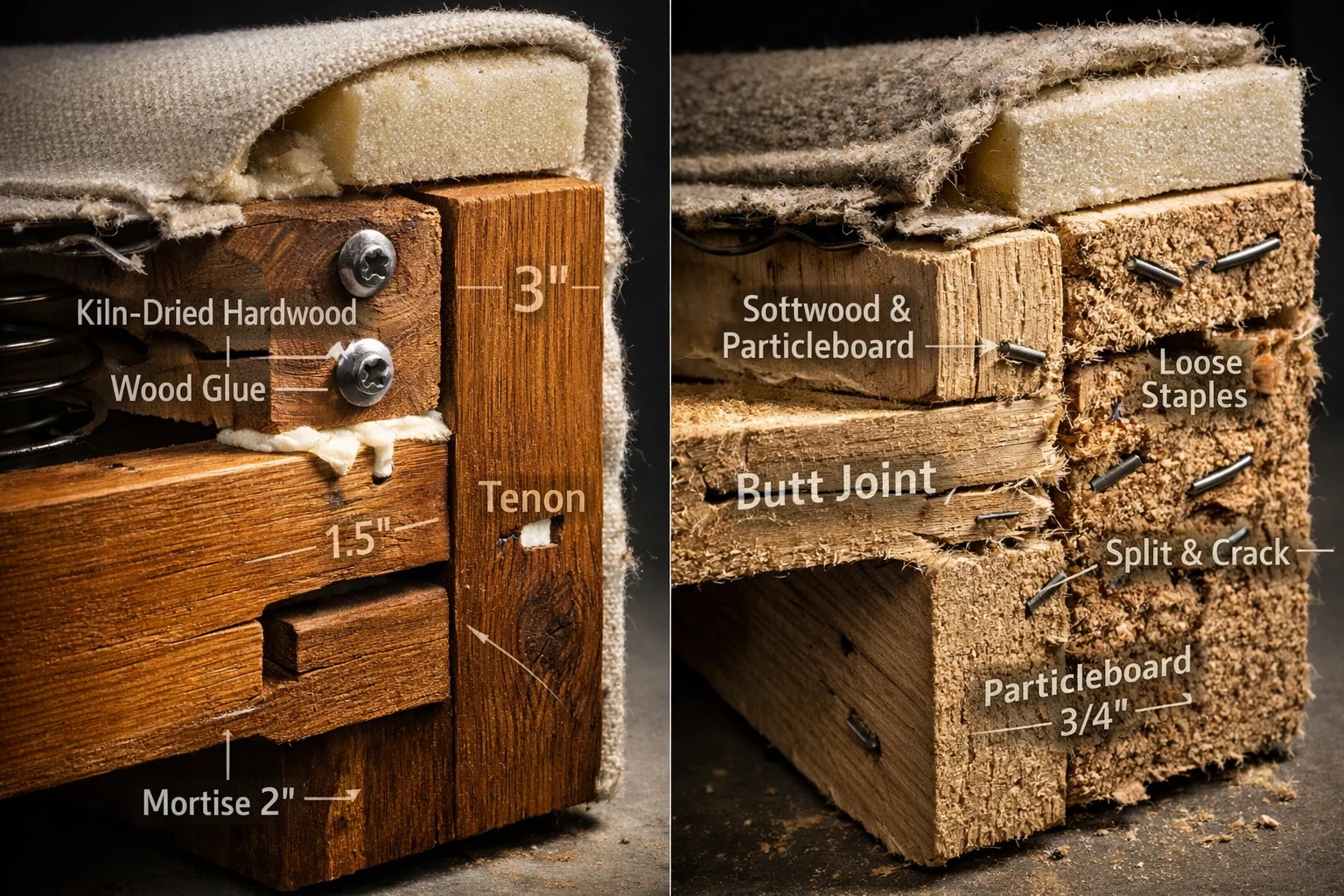
The first terminal symptom is a frame or foundation that is already moving, talking, or twisting. In a store I do not baby the sofa, I sit down firmly, I shift my hips side to side, and I press down hard on one arm and then the other. If I hear creaks, clicks, or any crunchy wood sound, or if I can feel the seat angle change when I move my weight, I treat that as the sofa telling me it is not one solid unit.
You can also do a simple corner test without tools. I put one hand on the top of the back near a corner and the other hand on the arm near that same corner, then I gently try to rack it, like I am trying to twist the corner out of square. A good frame feels boring, it resists and springs back as one piece. A weak one feels like parts are negotiating with each other, and that is the feeling that turns into wobble later.
If a salesperson tells you, “It just needs to break in,” I get very literal. I ask whether the sound is expected and whether it is covered if it worsens, and I want that answer tied to the written warranty. Break in should mean the cushions relax a bit, not that the skeleton starts finding its voice.
The second terminal symptom is seat support that collapses unevenly or lets you “find the bottom.” In the showroom, I sit in every seat the way people actually sit at home, centered, near the front edge, and slightly off center because that is where you end up when you perch to talk. What I am feeling for is whether the support stays consistent, or whether one spot suddenly drops lower, tilts, or feels like a hard bar is pushing back up at me.
Then I stand up and look at what the cushions did. If one cushion already looks more wrinkled, more sloped, or more compressed than the others after only a minute, that is not a cute quirk, it is an early warning that the fill and the support underneath are not going to age evenly. At home that becomes the “good seat” and the “bad seat,” and once that dynamic starts, it rarely reverses.
If the seat cushions are loose, I pick one up and I look for two things you can see. I want a substantial insert with some structure, not a limp bag of fluff, and I want a cover that looks like it is built to keep the insert from migrating and bunching. You do not need to know foam jargon to do this, you just need to notice whether the cushion holds its shape when you hold it by the sides, or whether it folds and collapses like a sleeping bag.
If the cushions are attached and you cannot inspect them, I lean harder on the sit test. I sit, I shift, I perch, and I pay attention to whether I feel supported in the same way across the full depth of the seat. If the front edge digs into my thighs or the middle hammocks while the edges stay high, I assume it will get worse, not better.
The third terminal symptom is a sofa that forces you into workarounds. This is the one people ignore because it sounds subjective, but it is the most predictive in real life. If you immediately want to add a pillow behind your back, avoid the corner because it feels strange, or sit only in one spot because the rest feels off, your body is telling you it is already compromising.
I use a simple rule when I am in a store. If I have to explain away discomfort with a story, like “Once we add throw pillows,” or “It will soften up,” or “We will not sit there much anyway,” I stop and treat that as the product failing the test in front of me. The best sofas I have owned did not require imagination, they were comfortable in the exact configuration I was buying.
There is also a visual version of this symptom. I stand back and check whether the seat deck looks level, whether the cushions align cleanly, and whether the arms match each other. If anything looks slightly crooked on a brand new floor model, I assume the internal stresses are already winning, because showroom use is not gentler than home use, it is usually harsher.
None of these tests guarantee perfection, but they do one important thing. They keep you from buying a sofa that is already showing you the three ways it will fail, the frame loosening, the seat collapsing, and you adapting around it until you resent it.
If you notice even one of these symptoms early after delivery, I want you to treat it like a ticking clock. Take photos, take a short video of any noise or tilt, and start the return or warranty conversation while the purchase is still fresh and the store is still motivated to make it right.
1. The “Crunch” (Structural Death)
This is the one I take the least politely, because it is the hardest one to “fix later.” I sit down firmly, not in a reckless way, but the way a real person sits when they are tired and not thinking about preserving a showroom display.
What I am listening for is any cracking, popping, or crunchy wood sound, especially from the front rail under your thighs, the corners where the arms meet the seat, or the area right under the middle seats. A little fabric rustle is normal, a little spring ping can happen, but wood sounds are the red flag because wood does not crunch unless something is moving that should not be moving.
If you hear it, do not let anyone reframe it as character or break in. In my experience, that sound is usually glue joints and fasteners starting to give up, and once a frame begins to loosen at multiple joints, it tends to keep loosening as the sofa racks back and forth with daily use.
Here is the practical buying advice I wish I had followed sooner. If a new sofa crunches on the floor, I walk away, even if it is the perfect size, even if I love the fabric, even if the sales pitch is confident. A frame that is already complaining is not a candidate for a “small repair,” it is a candidate for a future disposal plan.
If you want to double check without tools, I do the sit again but I change where the force goes. I sit hard near the front edge of one seat, then I stand and do the same near the front edge of the next seat, because weak front rails and loose corners often reveal themselves when the load shifts. Then I sit in the corner seat, close to the arm, because that is where twisting forces show up first.
If the salesperson offers to “tighten it up” or says it is just a staple, I get very specific. I ask where the sound is coming from, what exactly they would do to fix it, and whether the fix is written into the warranty process if it comes back. If the answer is vague, or if they want to move you along to another talking point, I treat that as my answer.
I also want you to be realistic about glue as a rescue plan, because I have talked myself into that fantasy before. Wood glue can help a clean, accessible break where you can clamp it properly, but a sofa frame that is crunching is rarely one clean break. It is a bunch of joints gradually loosening under upholstery, and you cannot re glue what you cannot expose, align, clamp, and hold under pressure.
So my verdict is simple. If you hear crunchy wood on a sit test, I treat the sofa as structurally dying, and I do not buy it. If it is already in your house and it starts doing this, I would focus your energy on a return or a warranty claim while you still can, because the longer you wait, the more it turns into “normal wear” in someone else’s eyes and a bigger hassle in your living room.
2. The “Yellow Dust” (Chemical Death)
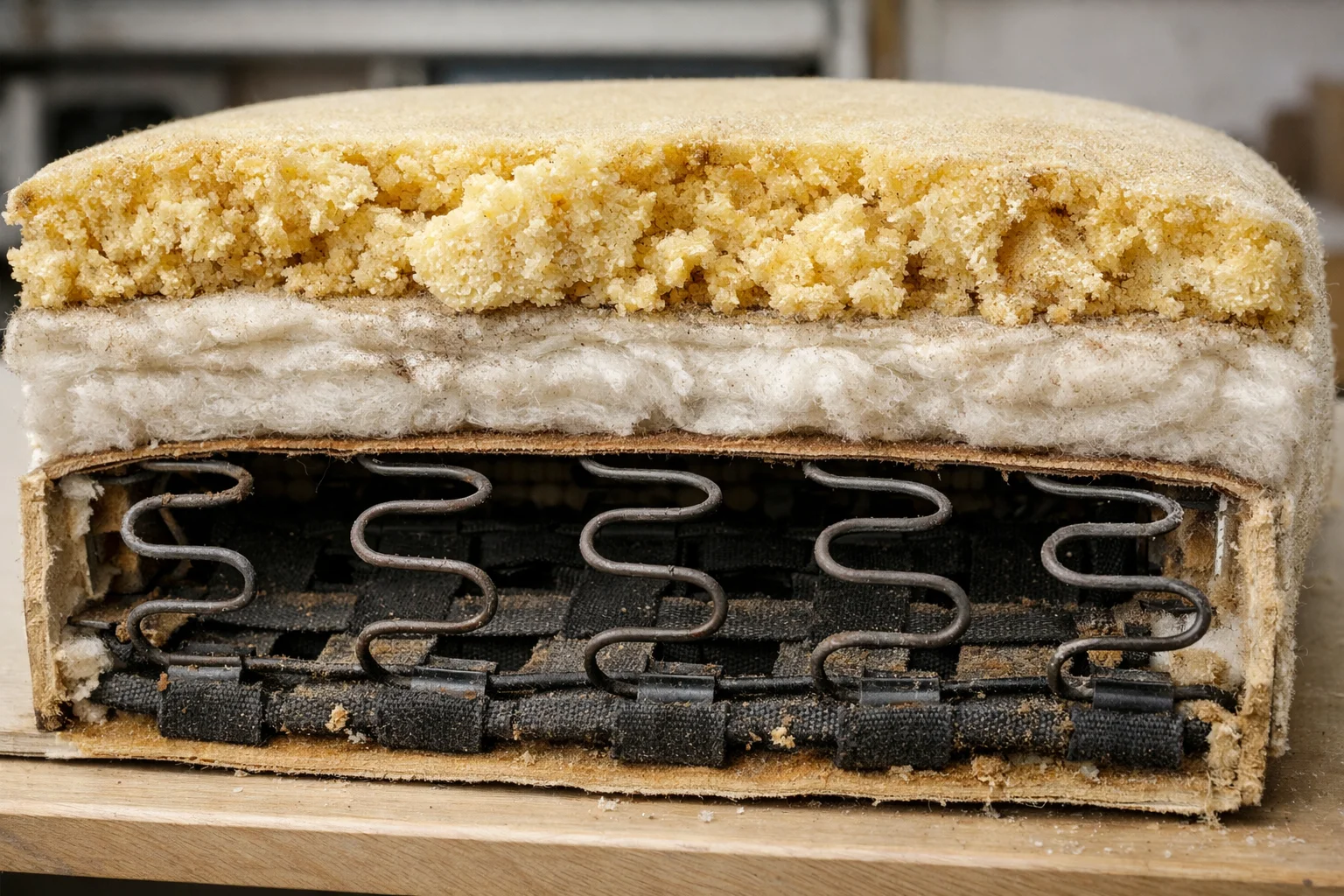
This one is easy to miss because it is not a noise and it is not a wobble, it is a quiet material failure. I call it chemical death because once it starts, you are not dealing with a cushion that is “a little soft,” you are dealing with foam that is breaking down into powder.
The test is simple. While you are in the showroom, ask if you can lift the front skirt a little or look underneath with your phone camera, and at home you can just get down and look under the sofa with a flashlight. I am looking for little piles of fine yellow grit that looks like sand, or a dusty yellow film stuck to the black fabric under the seats.
If you see it, the symptom is oxidizing foam. That yellow dust is essentially the cushion material crumbling, and it tends to show up under the seat area first because gravity and vibration shake the particles down through the upholstery layers.
Practically, here is what it means for you. The sofa may still look okay on top, but the foam has already lost the springy part you were paying for, so it keeps getting flatter and harsher no matter how many times you “fluff” it. It also means you are living with a steady supply of pulverized plastic dust in the exact place where you sit and breathe, which is not a trade I am willing to make.
If you are shopping and you notice any version of this on a floor model, I walk away. If the floor model is already shedding, the one in the box is not going to magically be a different design, it is just going to be earlier in the same timeline.
If it is already in your house, my verdict is replace, not refurbish. Replacing just the seat foam rarely fixes the whole experience because the back cushions and arms are usually the same failing material, and once you price out re foaming multiple pieces plus labor, you often end up spending real money to keep a frame you do not even trust.
There is also a decision trap here that got me once. You tell yourself you will “just do the cushions,” then you live with it long enough that the dust becomes normal, the seat gets worse, and you are stuck again with a big disposal problem and a half measure repair you already paid for.
So I use a blunt rule. If I see yellow foam dust under a sofa, I treat it as a terminal symptom and I stop negotiating with it.
When you are in a store and you cannot inspect underneath, I shift to indirect clues and direct questions. I ask what the seat and back cushions are made of, whether the foam is wrapped, and whether the cushions are replaceable modules or glued in place, because glued in foam is a future headache when it fails. If the answer is vague, or if the salesperson pivots to fabric care, I take that as a sign they do not want you thinking about what is inside.
If you see this problem early after delivery, do not wait and hope it stops. Take a clear photo of the dust under the sofa and a close up of any crumbling foam you can access, then start the warranty conversation immediately while you can still frame it as premature failure, not “normal aging.”
3. The “Dry Rot” (Skin Death)
This one is fabric failure, not frame failure, but I still treat it as terminal because it turns a perfectly usable sofa into something you cannot live with. I learned this the annoying way when an old sofa looked fine in normal light, then I grabbed the top of the arm one day and it tore like tissue.
The showroom test is simple and a little uncomfortable, which is why it works. I go to a spot that gets the most light and the most hand contact, usually the top of the arm closest to a window, the top edge of the back, or the front corner where people hook a leg when they perch. I pinch a small fold of fabric between my fingers and give it a sharp, confident tug, not a gentle stretch.
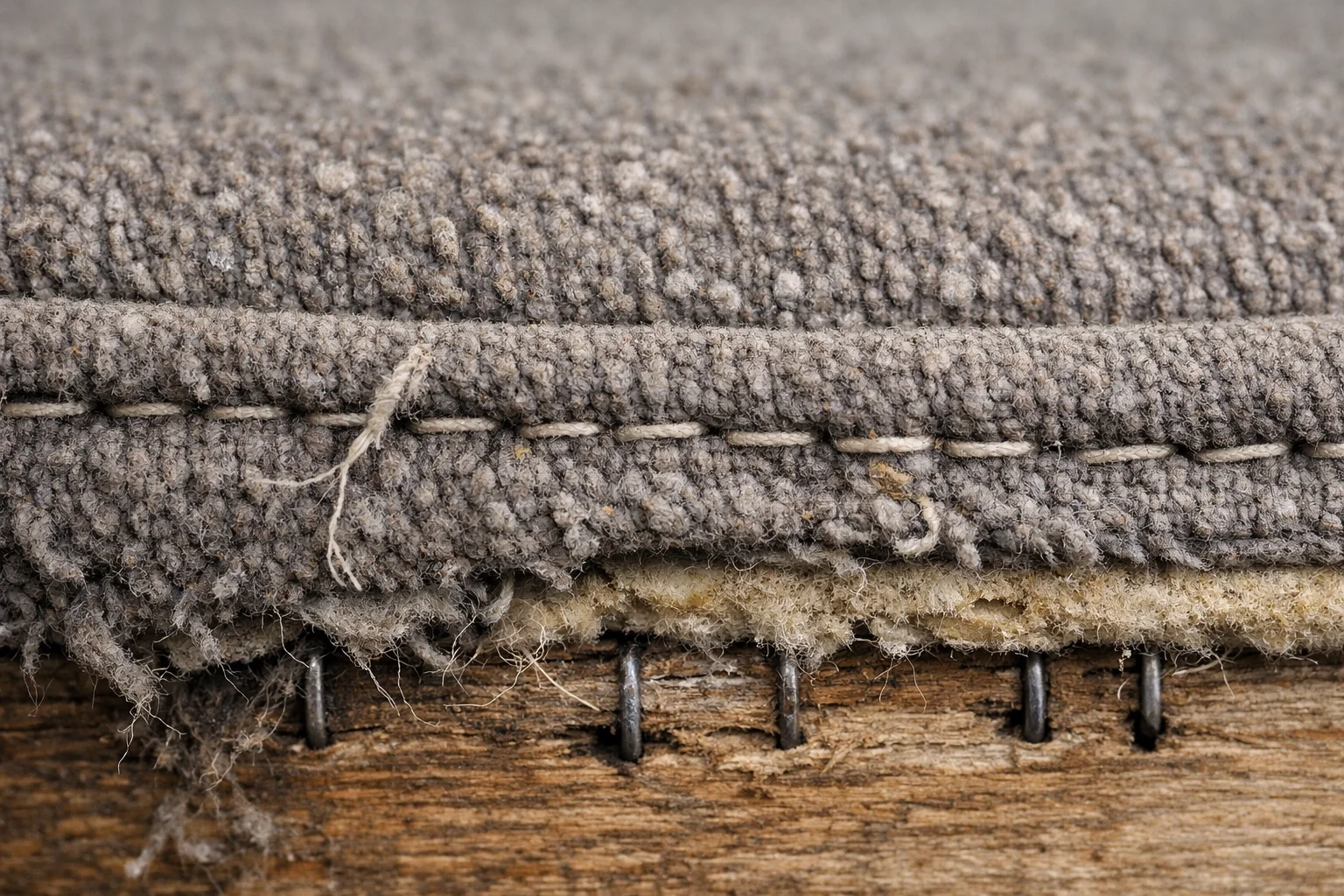
What I am feeling and listening for is that dry, papery sensation that says the fibers have been cooked by UV and time. If it makes a crackly sound like old paper, or if it starts to split with surprisingly little force, the fabric is already dying, even if the color still looks decent.
If this happens on a floor model, I walk away. People will tell you the floor gets more sun than your home, but what it is really telling you is how that exact fabric behaves when it is stressed and aged, and the top of the arms in your house will still see sun, skin oils, cleaning sprays, and abrasion.
I also do a quick seam reality check right after the tug. I look closely at the stitching holes and the seam line in that same sunny area, because UV damage often shows up as tiny gaps, fraying, or a seam that looks slightly “laddered,” like the thread is still there but the fabric around it is giving up.
If a salesperson tells you it can be stitched, this is where I get blunt. Stitching only works when the fabric around the new stitches is strong enough to hold tension, and with dry rotted upholstery it is not. The thread just pulls through the weakened cloth, and you end up with a longer tear and a repair that looks like it is losing a tug of war.
At home, if you suspect this is starting, do not test it on a hidden panel first and then convince yourself it is fine. Sun damage is usually worst exactly where you touch and sit, so the first real tear tends to happen on the arm tops and back top rail, which are the places you cannot hide with a throw pillow without turning your sofa into a draped object.
My verdict is replace, not patch, if the fabric fails this tug test. You can sometimes buy time with a slipcover if the frame and cushions are genuinely good, but I would treat that as a temporary cover over a material that is going to keep tearing the moment it gets pulled, caught by a belt loop, or scratched by a pet.
When you are shopping and you want to prevent this problem, I stop guessing and ask one direct question while I am still standing there. I ask whether the fabric is rated for high light exposure or labeled as UV resistant, and I ask them to show me where that is written for that exact fabric, not just the brand in general. If you have a sunny room and they cannot produce a straight answer, I assume you are taking on the risk.
If you see early tearing or you hear that paper crackle on a nearly new sofa after delivery, I would not “be careful and see what happens.” I would photograph the area in good light, take a short video of the tug test if it is already failing without you forcing it, and start the warranty conversation immediately, because fabric that is already rotting is not going to stabilize later.
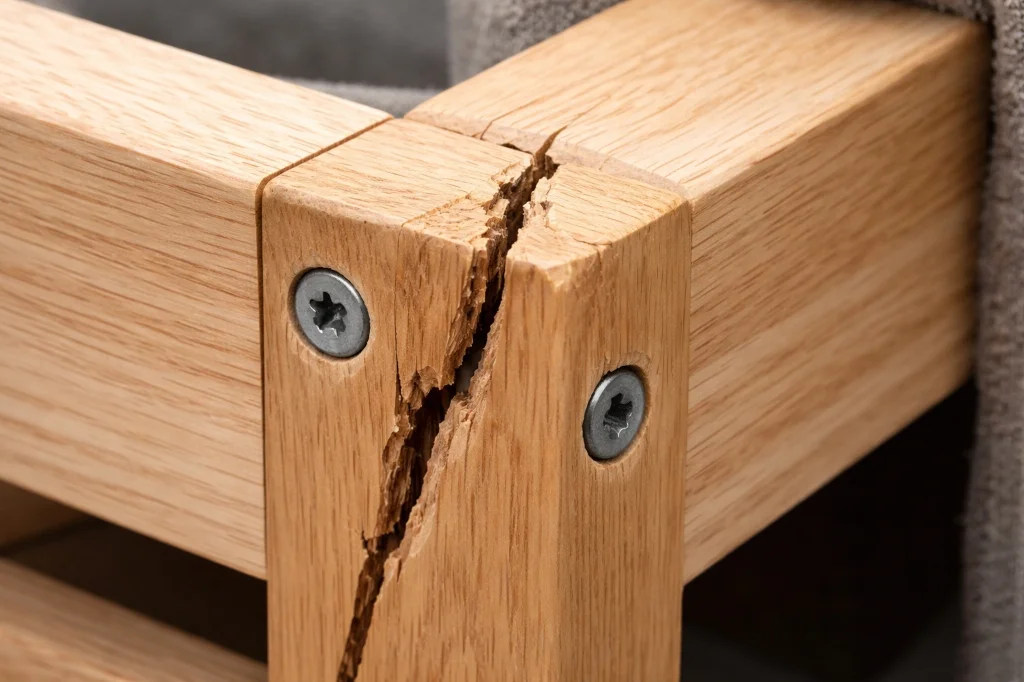
When you see a photo like that, it is tempting to think, “Okay, but that is an extreme case.” I used to think that too, until I learned that a lot of “small” sofa problems are just the early chapter of that exact crack.
The front rail, the long piece of frame under the front edge of the seats, is where your weight keeps landing day after day. Once that rail splits, the sofa stops being a rigid rectangle and starts being a loose shape that can never hold alignment again, even if someone screws metal plates all over it.
In a showroom, I am trying to figure out whether a sofa is the kind that fails like this. You cannot see the rail, so you have to provoke it a little and then listen and feel like a skeptic.
I sit down hard near the very front edge, right where your thighs would be if you perch to put on shoes. Then I stand up and repeat that same sit in the neighboring seat, because a weak rail often reveals itself when the load moves across it instead of staying centered.
After that, I do one test that feels almost rude but has saved me from buying mistakes. I kneel or crouch and put my hands on the front edge of the seat, then I press down firmly with straight arms, like I am trying to compress the front rail directly. If I feel a little give that is not cushion give, or I hear a tick, pop, or creak that seems to come from the wooden structure and not the springs, I assume the frame is already flexing in the exact way that leads to that crack.
I also pay attention to the “two halves” feeling. If you sit near the middle and it feels supported, but when you sit near an arm the seat suddenly feels different, like the whole corner is dipping or twisting, that mismatch is a clue that the frame is not distributing load as one piece.
When a salesperson tells me they can reinforce it later, I do not argue, I just get specific. I ask whether the manufacturer will replace a cracked main rail under warranty, and whether they will cover the labor and pickup, not just the part, because a rail crack is not a cute tighten and go situation.
If you are already at home and you suspect the early version of this, treat it like evidence gathering, not like a weekend project. I would flip the sofa enough to look underneath, take clear photos of the corner blocks and rails, and record a short video of the noise while you press on the front edge, because once a rail is truly cracking, it can go from annoying to unusable faster than you expect.
The main buying takeaway I want you to keep is simple. A sofa can survive soft cushions and mediocre fabric for a while, but it cannot survive a frame that is flexing where it should be rigid, and the front rail is the place I most want to be boring, silent, and solid while you test it in the store.
How to Dispose (The Hard Part)
Getting rid of a sofa is physically difficult, and it is the part of the lifecycle I wish I had planned for sooner. When a sofa fails, it does not fail into a neat box you can carry out, it fails into a big, floppy object that fights you through doorways and down stairs.
If your sofa is still structurally sound and genuinely clean, donation can be the simplest exit, but I am strict about this because I have seen people treat charities like a free dump. If the frame is loose, if the cushions smell, if there are stains you would be embarrassed to point out to a friend, it is not a donation item, it is disposal wearing a halo.
Before you try to donate, I would do a quick honesty check that takes two minutes. I press down hard on the arms and front edge and listen for the crunch or creak we talked about earlier, and I look for any sagging that would make someone sink crooked. Then I look at it in bright light for stains, pet damage, or that general grayness that means it has absorbed years of life, even if you vacuum it.
If it passes that test, measure your doorways and the sofa at its widest point before you schedule anything. The humiliating version of this is having a charity truck show up, watching them realize it will not fit through your hallway, and then you are back to square one with a too big object and a new time window to solve.
If you cannot donate it, junk removal is the path I reach for when I want my room back without turning the weekend into a wrestling match. Services like 1-800-GOT-JUNK can be a few hundred dollars depending on where you live and how much they are taking, and I have still found it worth it when the alternative is me dragging a dead sofa around my house for another month.
When you call a junk hauler, I would describe the access honestly, especially stairs, tight turns, and whether you are in an apartment with rules about elevator padding. I also ask, right then, whether the quote includes carrying it out from the room, because “curbside” pricing is a different deal and it matters if you are not physically able to move it.
If you want the lowest stress version, clear a path before they arrive, remove anything that can snag like wall art near the hallway, and take the door off its hinges if you know the clearance is tight. I have dinged more trim and drywall moving a sofa out than moving one in, because at that point you are frustrated and trying to force an awkward shape through a space it barely fits.
If you are handy and you have more time than money, the method that actually works is cutting the sofa into manageable pieces. A reciprocating saw, often called a Sawzall, can take a sofa down into chunks you can carry, and once it is in pieces it stops being a puzzle and starts being normal trash logistics.
This is where I want you to be realistic about what you are cutting and what you are breathing. Upholstery is full of staples, hidden nails, fabric dust, and sometimes fiberglass in the lining, so I treat basic protection as part of the plan, and I keep pets and kids away from the mess. I also check local rules before I start, because some places will not take bulky upholstered waste in a standard bin, even if you cut it up, and you do not want to create eight pieces of trash that still cannot leave your property.
The practical reason I am putting disposal in a buying guide is that it should change how you shop. If two sofas feel similar in the showroom, I lean toward the one that is easier to disassemble and easier to move, because someday you might have to get it out fast, after a move, a breakup, a leak, a bedbug scare, or just a failure you cannot unsee anymore.
So when you are standing in a store, I want you to think one uncomfortable thought on purpose. I want you to imagine getting that exact sofa back out of your home, and I want you to notice whether the design is setting Future You up to lose a whole Saturday to a disposal problem. That little moment of realism has saved me from buying “pretty” furniture that becomes a long term, heavy regret.
Technical Summary: The "Back Pain" Indicator
The ultimate test is not visual, it is biological.When I am trying to decide if a sofa is still doing its job, I ask myself one slightly embarrassing question. Do I groan when I stand up from it, not because I sat too long, but because my lower back feels like it has been holding me together?
If the answer is yes, I stop treating it as “getting older” and I start treating it as a failed suspension system. The whole point of the seat support is to carry your weight in a way that keeps your spine neutral, and once the support hammocks or tilts, your muscles start working overtime to keep you upright.
You can use this as a showroom test too, even on a brand new sofa. Sit the way you actually sit at home, let your body relax for a full minute, then stand up normally. If you feel that little wince or stiffness in your lower back right away, or if you find yourself bracing with your hands on your thighs to get up, I take that as your body telling you the support geometry is wrong for you, even if the sofa looks “supportive.”
At home, if a sofa has reached the point where you reliably make a noise getting up, I think you should take that seriously instead of toughing it out. For me, that is the point where I stop buying cushion inserts and stop stacking extra pillows to compensate, because it means the furniture stopped being support and started being a low grade injury.
My blunt conclusion is that if a sofa is making you hurt, the suspension has failed in the only way that really matters. Stop hurting yourself, buy a new sofa.