The Repair Formula: When to Fix vs. When to Fold
Introduction
I received a quote for $1,400 to reupholster my wingback chair. I laughed. I could buy a new chair for $400. But I was comparing apples to sawdust. My chair was handmade in 1990. The $400 chair was made by a robot yesterday.
That moment is what pushed me to stop judging sofas by the price tag alone. If you only look at the sticker price, cheap furniture looks like a deal and decent furniture looks like a scam. The truth is you are often paying for what you cannot see, and what you cannot see is exactly what determines whether a sofa still feels good after a couple of years.
When I walk into a showroom now, I assume the outside is trying to distract me. Cute fabric, trendy legs, big cushions, and a “lifetime warranty” sign are all easy. What matters is the boring stuff under the cushions, inside the frame, and in the seat support, because that is where sagging, squeaking, and lumpy seats come from.
You can absolutely shop smart without being a furniture expert. My goal in this guide is to help you do quick checks in a store, ask the right questions without feeling awkward, and spot the common shortcuts that make a sofa feel great for five minutes and awful for five years.
I am not trying to talk you into the most expensive thing on the floor. I am trying to keep you from paying twice, once for the “deal” sofa and again when you replace it early, or when you realize reupholstery costs more because the bones were worth saving in the first place.
As you read, keep one simple idea in your head: you are not buying a shape. You are buying a structure, a support system, and a cushion recipe. If those three are solid, you can live with almost any style, and if they are weak, no fabric or brand name will rescue it.
The "Tuxedo on a Corpse" Rule
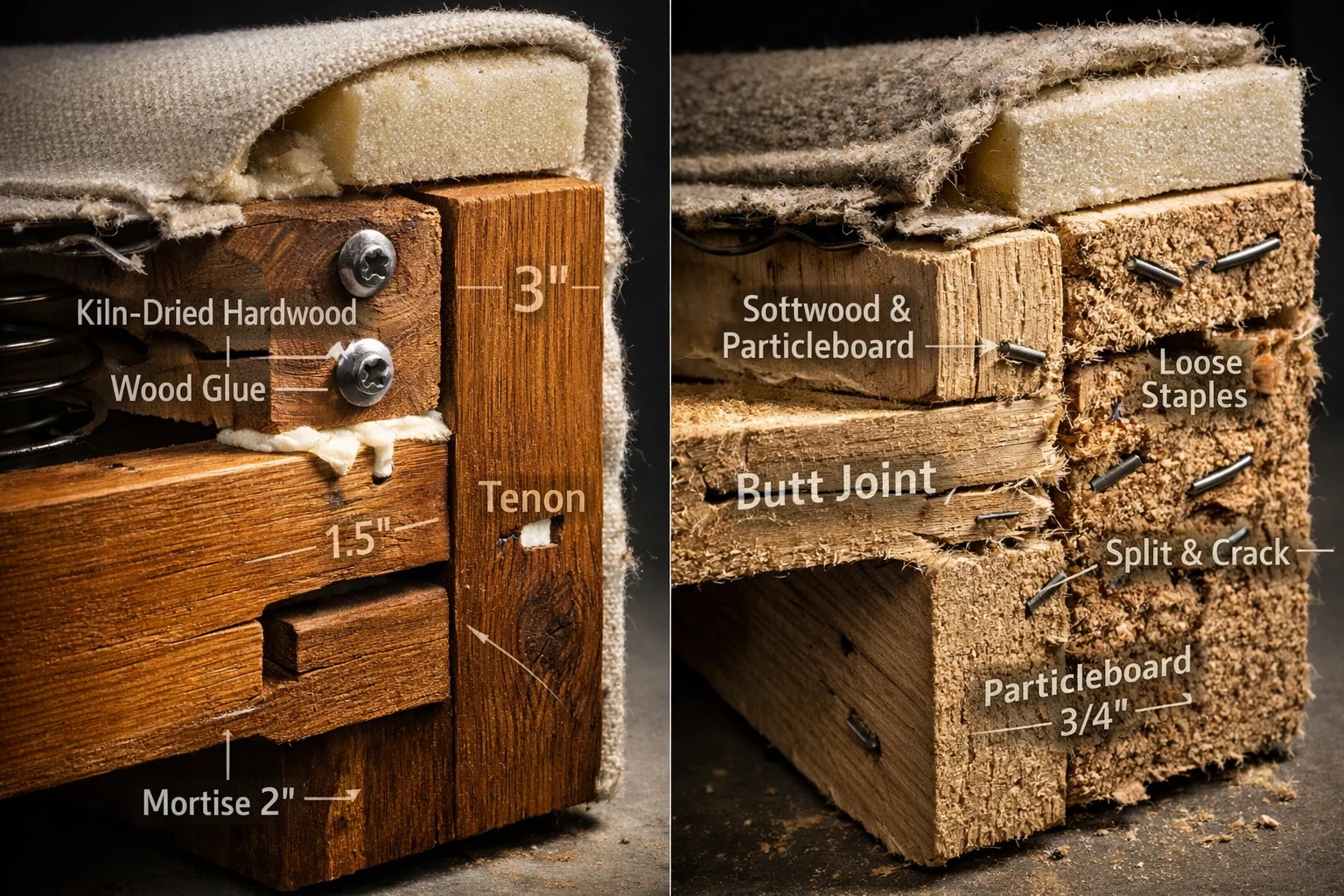
I learned this the expensive way, and I repeat it to myself anytime a salesperson starts talking about “just reupholstering it” or “upgrading the fabric.” Do not spend $1,000 putting new fabric on a $300 frame. Fancy cloth on a weak structure still gives you a weak sofa, just dressed up.When you are deciding whether something is worth repairing, reupholstering, or buying used, you are really judging the bones. The fastest showroom check I use is a simple weight test. I grab one front corner of the sofa, usually under the arm where I can get leverage, and I lift just enough to feel whether the piece has some real mass to it. If it feels heavy and solid, that usually means there is real wood and real joinery doing the work, and I start thinking “this might be worth saving” if the price is right and the style is something you actually want to live with.
Then I do the wobble test, because weight alone can fool you. I put one hand on the arm and give it a firm shake like I am trying to slide the sofa across the floor. If the arm moves independently, if the whole frame flexes, or if I hear creaks and little crackly noises, I treat that as bad bones and I stop fantasizing about new fabric fixing it. A frame that twists now will twist more later, and that is how you end up with cushions that never sit right, seams that get stressed, and a sofa that starts squeaking when you shift your weight.
If you feel awkward doing these checks in a store, I get it. I keep it casual and I do it like I am just getting a feel for sturdiness, because that is exactly what I am doing. If a salesperson looks concerned, I simply say I have had sofas loosen up on me before and I am checking for frame flex, and I want to know how it is built under the upholstery.
What I am trying to protect you from is paying for cosmetics when you needed structure. If the bones are good, you can justify spending money on better fabric, new foam, or repairs because you are improving something that can actually last. If the bones are bad, the smartest move is usually to replace it, even if the fabric is gorgeous and even if it feels fine for five minutes on the showroom floor.
The “Apples to Apples” Fallacy
Most people, including me at first, compare a repair quote to the cheapest thing they can replace it with. That math will almost always make the repair look stupid, because you are comparing a durable, fixable object to a disposable one.
Here is what that wrong comparison looks like in real life. You get a $1,400 repair quote and you think, I can buy a $400 chair at IKEA, so repairing is a ripoff. What you are actually doing is swapping categories without noticing, because that $400 chair is not a replacement for the chair you are holding onto, it is a different product with a different life expectancy.
The comparison that matters is repair cost versus the cost of a new piece with the same kind of bones. If your old chair or sofa has a real hardwood frame, decent joinery, and a support system that can be rebuilt, then the honest comparison is what it would cost to buy a new hardwood framed sofa that is built the same way. When you run that math, a $1,400 repair can start to look like a bargain compared to replacing it with a $3,000 plus piece that is truly comparable.
This is the mindset shift I want you to practice in a showroom, because it also protects you when you are buying new. If you are shopping two sofas and one is $1,200 and one is $2,800, your brain will want to treat them as interchangeable shapes. I force myself to slow down and ask, are these even the same category of object, or is the cheaper one only winning because it is built to be replaced?
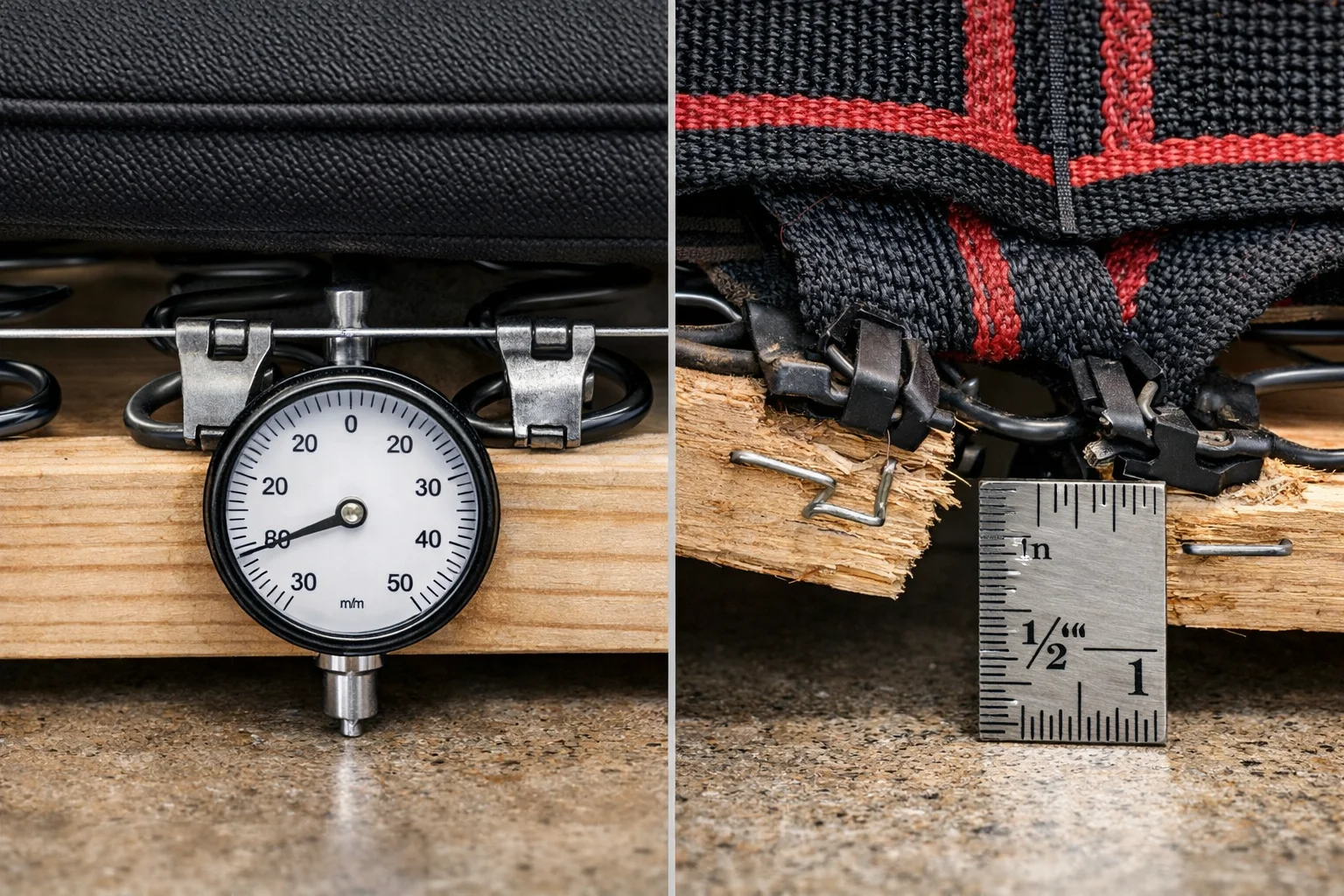
If you want an actionable way to do this without becoming a furniture nerd, I use a simple question when I am looking at a sofa I might keep long term. I ask the salesperson what the frame is made of and how the seat is supported, and then I ask myself whether I would pay to repair those bones later. If the answer is no, because it is a softwood or composite frame with a flimsy support system, then I treat the whole sofa like a short term purchase and I stop pretending it belongs in the same mental bucket as a rebuildable piece.

I like the basic idea in that decision tree, but I translate it into something I can actually use while I am standing on a sales floor. If a piece has good bones and the repair is clearly less than half of what a truly comparable new piece would cost, I lean toward repairing. If the repair is creeping up toward the cost of buying a genuinely equivalent new sofa, I pause and look harder at whether I are throwing good money after bad, or whether the frame is special enough to justify it.
The trap is that “equivalent” is not the cheapest sofa that fits the space, it is the cheapest sofa that is built the same way. If you walk out with a low priced replacement that has weaker bones, you did not solve the problem, you just reset the countdown to the next sag and squeak.
So when you are deciding whether to repair, buy used, or buy new, I want you to keep one blunt sentence in your head. You are repairing a luxury asset, not buying a disposable commodity, and you should only do it when the bones are truly worth investing in.
The “50% Rule”
When I am stuck deciding whether to repair or replace, I fall back on a simple standard that the industry uses because it keeps you from making emotional, expensive decisions. I ask one question: is the repair cost less than half of what it would cost to buy a new, truly equivalent piece.
The word “equivalent” is where people get burned, so I slow down here. I do not compare a repair quote to the cheapest sofa that fits the wall. I compare it to the cheapest new sofa I can find that matches the bones, meaning a real hardwood frame, a seat support system that is meant to last, and cushions that are not built to pancake in a year.
Here is how the math plays out in real life. If you get a $1,200 repair quote, and a new equivalent sofa would run about $2,500, then the repair is under half, around 48 percent, and I treat that as a clear “fix it” situation. In that scenario, you are basically buying yourself more years out of a frame you already know fits your space, without paying full price for a new build.
What I like about the 50% rule is that it forces you to price the right replacement before you decide. If you cannot find the new equivalent price because the salesperson is slippery or the construction details are vague, that is information too. I take that as a sign that I should either keep shopping until I can confidently identify a comparable build, or I should stop treating the repair quote like it is competing with bargain furniture.
I also use the 50% rule as a gut check against “death by upgrades.” If your quote keeps growing because you are adding premium fabric, new foam, new webbing, and little fixes that pile up, you can cross that halfway mark without noticing. When the repair starts to approach the cost of a genuinely comparable new piece, I pause and ask what I am really buying, which is time, convenience, and keeping a known good frame, or just avoiding the hassle of shopping.
If you want to use this while buying new, flip the logic around. When a sofa is priced suspiciously low, I ask myself what the equivalent would cost if it were built like a repairable asset. If that answer is “at least double,” I stop expecting the cheap one to be a long term sofa, and I negotiate with myself honestly about whether I am okay treating it as temporary.
The DIY Loophole
If you have more time than money, there is a loophole that changes the math completely. Most upholstery quotes feel insane because you are not just paying for fabric and foam, you are paying for skilled, slow, physical labor.
Once I understood that, a lot of pricing started to make sense. A big chunk of what you are quoted is the hours it takes to strip the piece, rebuild the soft parts, cut and sew, stretch and staple, and make it look clean again. The actual materials, even decent ones, are often a smaller slice than you would assume when you are staring at a four figure number.
That is the hack, and it is real. If you do the labor yourself, you can sometimes turn a quote that felt like “never in my life” into a materials run that is merely annoying. The difference can be the gap between a sofa you would otherwise dump and a sofa you can keep, especially if the bones are truly worth saving.
I want to be very honest though, DIY upholstery is not a cute weekend craft. It is heavy, it is awkward, it eats your hands, and it asks you to be patient when things look worse before they look better.
If you are even considering this route, I would not start on a sofa. I would start on a dining chair seat or a simple ottoman, because you get to practice pulling staples, cutting clean lines, and getting fabric taut without wrestling a giant frame with arms, corners, and long seams that have to look intentional.
There is also a buying angle here that can save you from getting ripped off. When you are in a showroom looking at a “great deal” sofa, I sometimes ask myself a blunt question: if I owned this for five years and it got ugly or saggy, would I ever bother rebuilding it, even as a DIY project. If the answer is no because the frame feels flimsy, the seat support looks like it would be a nightmare to redo, or the whole piece seems built to be stapled together once and discarded, then the low price stops looking like a bargain and starts looking like a short lease.
On the other hand, if you find a solid frame, whether it is an older piece or a well built new one, DIY can be a way to buy quality bones and then “pay” with your effort instead of your wallet. You can also use that thought process to negotiate, because you can calmly point out wear that is purely upholstery related and not structural, and you can decide what you can live with now versus what you could realistically tackle later.
My personal line is simple. I only consider the DIY loophole when I am confident the structure is worth the pain, and when the project is small enough that I will actually finish it instead of living with a half stripped sofa for a year. If you use it that way, DIY is not just a way to save money, it is a way to avoid paying premium prices for labor when all you really needed was a decent foundation and a fresh skin.
Technical Summary: The Upholsterer Interview
If you are thinking about paying a professional, I have learned to treat the first phone call like a filter, not a vibe check. I am listening for whether they rebuild the structure properly or whether they are the kind of shop that makes something look refreshed while leaving the original problems underneath.The first question I ask is whether they strip it all the way to the frame. I want a clear yes, because stapling new fabric over old fabric is how you pay real money and still keep the same lumps, looseness, and hidden wear, just with a prettier cover.
Then I ask what density foam they use, and I specifically want them to answer with an actual number and type, not “high quality” or “standard.” When someone can tell you something like 2.5 lb high resilience foam without hesitating, it usually means they buy materials intentionally, and it gives you something concrete to compare between quotes.
Finally, I ask if I can see it stripped before the new fabric goes on. A good upholsterer will not act offended by this, because you are not trying to micromanage their craft, you are trying to confirm that any frame repairs, spring work, webbing, and padding builds were actually done before the cosmetic part hides it again.
Explore Technical Reference
Can Cushions Be Replaced? (The 20% Rule)
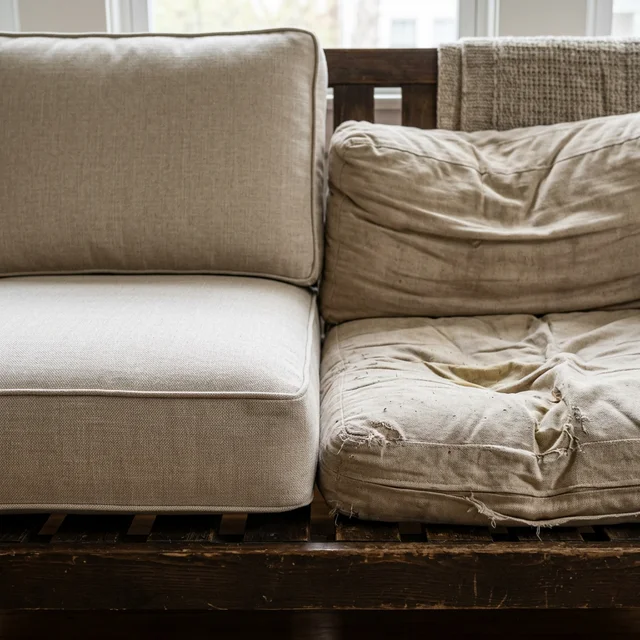
Why foam fails before other components and how cushion replacement restores furniture at a fraction of replacement cost. Understanding component lifespan and restuffing economics.
Analyze Details →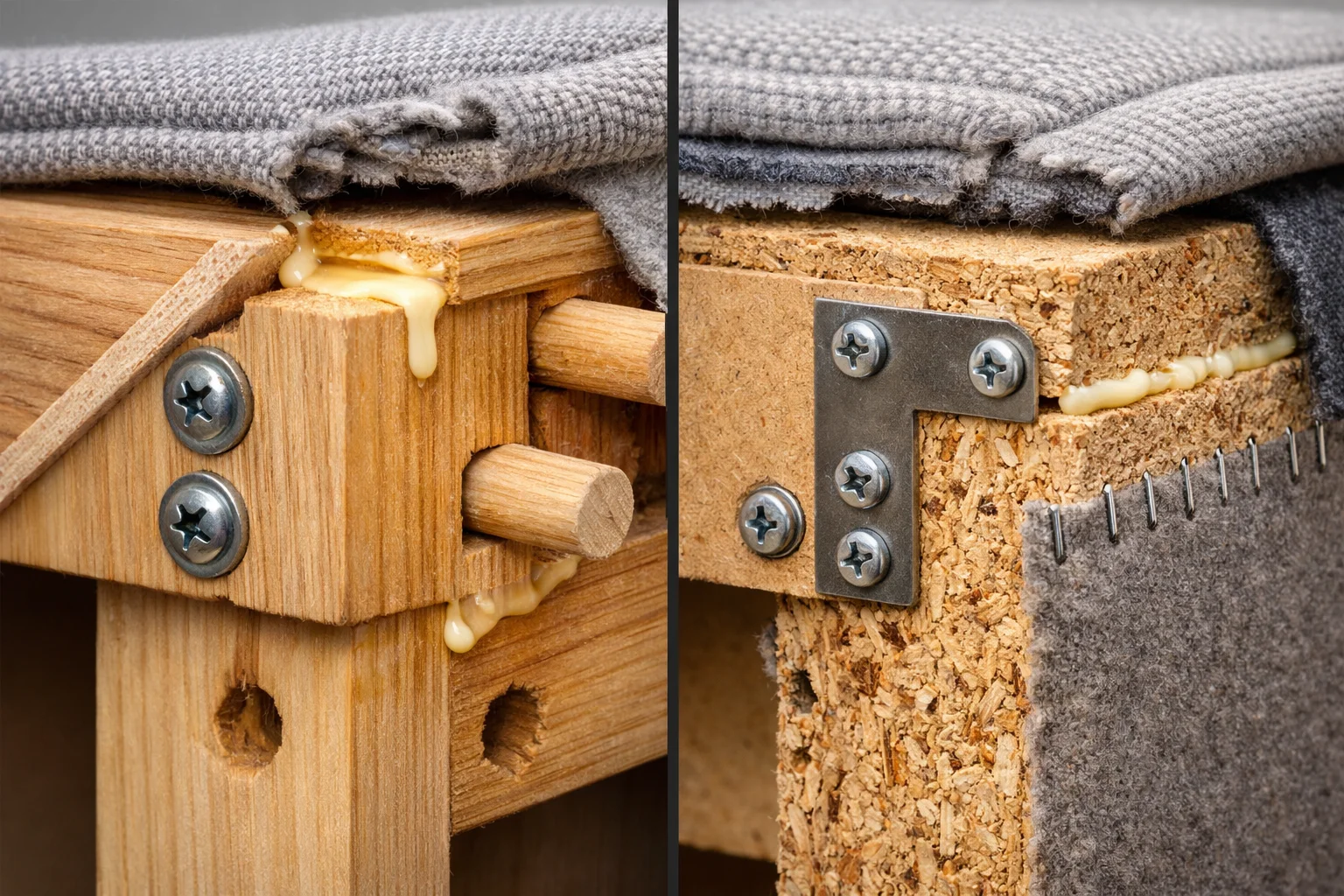
The Math: Is a $400 Repair Worth It?
Understanding when foam replacement costs justify the investment over purchasing new furniture. The math of repair versus replacement quality comparisons.
Analyze Details →