The Architecture of Failure: Why Sofas Die
Introduction
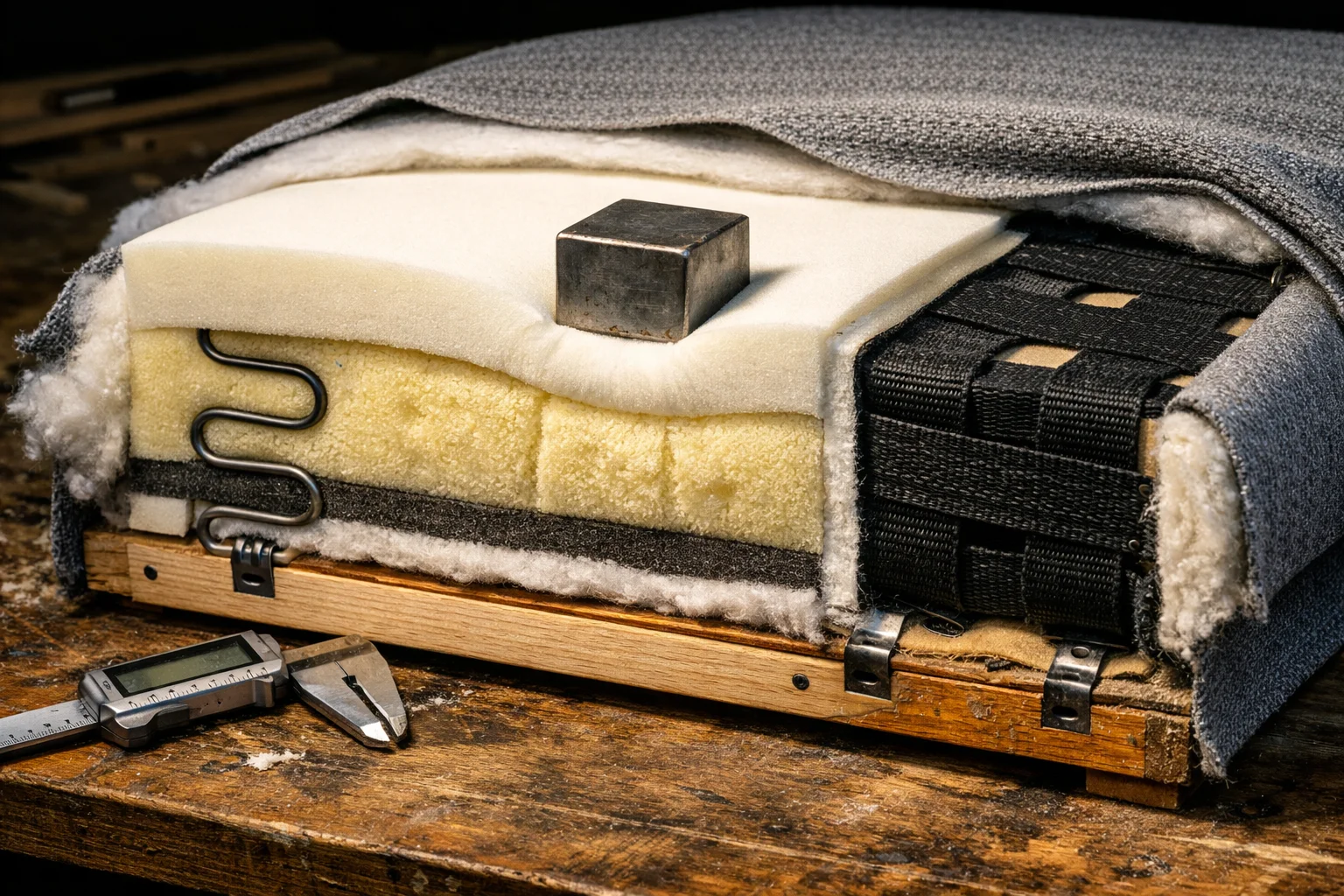
I have learned the hard way that “it looked great in the showroom” is not the same thing as “it will still feel good in year five.” The ugly part is that a lot of sofas are built to feel plush for the first few months, then quietly fall apart in the exact ways you cannot easily fix, like sagging support, flattened cushions, and arms that wobble.
When I say “engineered to expire,” I do not mean there is a timer inside your couch. I mean the parts that do the real work, like the frame joints, the seat support, and the cushion cores, are often chosen because they are cheap and fast to assemble, not because they will hold their shape under real human weight.
If you want to avoid getting ripped off, you have to shop like you are buying the inside of the sofa, not the silhouette. Most of the time, the outside is where they spend the money you can see, like trendy fabric, big pillows, and deep seats that feel like a lounge bed for five minutes, then turn into a slump.
This guide is me walking you through what I now check every single time, in the showroom and in the product details, before I let myself care about color or style. You do not need to become an expert, you just need a few simple tests and a short list of dealbreakers, so you can spot the common failure points before they become your living room problem.
I am also going to be honest about tradeoffs, because every sofa is a compromise. You can buy soft, you can buy supportive, you can buy cheap, and you can buy long lasting, but you rarely get all four at once, and the showroom experience is designed to distract you from that reality.
By the end, you should be able to sit on a sofa for two minutes and come away knowing whether it is likely to crater, squeak, and bag out, or whether it is built in a way that usually survives normal life.
The "Break-In" vs. "Break-Down" Rule
A little change after you bring a sofa home is normal, and I actually expect it. In the first couple of months, most foam softens a bit and the fabric or leather relaxes, which can make the seat feel less stiff and more comfortable.What I do not accept is change that looks like failure. If the cushion collapses and never really springs back, if you start hearing creaks when you shift your weight, or if the upholstery starts pooling and wrinkling like a loose bag, that is not “breaking in,” it is breaking down.
In the showroom, I try to predict which one I am seeing by testing for rebound and support, not just softness. I sit down normally, then I stand up and look at the seat surface right away. If it stays dented or looks rumpled immediately, I assume it will look worse fast at home.
I also do a simple edge test because breakdown often starts there. I sit on the very front edge of the seat like I am tying my shoes, and I pay attention to whether I feel a hard bar, a dead drop, or a springy platform that pushes back. A good seat support feels resilient, a bad one feels like it gives up and does not want to return.
Then I listen. I do not care about tiny upholstery noise, but I do care about frame or spring noise, especially a repeating creak when I rock my shoulders or shift side to side. In my experience, if it creaks new on a quiet showroom floor, it rarely gets quieter in a real house.
With leather and faux leather, I look for how it behaves across the seat and inside corners. A little looseness can be normal, but if it already looks puddly on the seat deck or has big waves where your thighs would go, I treat that as a warning sign that it is going to bag out and stay that way.
When a salesperson tells you, “It just needs to break in,” I ask a more precise question: what part is expected to change, and how much. If they cannot describe it beyond “it will soften,” I assume they are trying to reframe early breakdown as normal wear.
The way I protect myself is by choosing a sofa that feels supportive on day one, even if it is not my dream level of plush. You can always add softness with a throw, a pillow, or even a topper later, but you cannot add back structure once the seat has started to crater.
The Four Horsemen of Furniture Apocalypse
When a sofa disappoints you over time, it usually does it in a few very specific ways. I think of them as the four failure modes that turn “new couch day” into “why do I hate sitting here” later, and the key is that only some of them are realistically fixable.
Foam Fatigue (The Pancake)
If you sit down and you can feel something hard under your thigh, like a ridge or a board, that is the classic pancake. What is happening is the foam is losing its ability to hold you up, and once it compresses it does not fully recover, so you start bottoming out into whatever is underneath.
In the showroom, I try to separate “soft foam” from “tired foam.” I sit normally for a full minute, then I stand up and press the cushion with my palm where I was sitting. If it feels thin and dead in the center, or the cushion shows a deep dent that lingers, I assume it will get worse quickly at home.
If the tag or spec sheet mentions foam density and it is under about 1.8 pounds, I treat that as a risk sign for a seat cushion in a daily use sofa. A lot of sales floors will not volunteer density, so I simply ask, “What is the seat foam density in pounds per cubic foot?” and I pay attention to whether they can answer cleanly or start hand waving.
The reason I do not panic if I love everything else is that this one is often fixable. If the seat cushions are removable and zipped, you can replace the foam cores later and essentially reset the feel, as long as the rest of the sofa is still sound.
Before you buy, I would unzip a seat cushion if the store allows it, or at least confirm in writing that the seat cushions are removable and have a zipper. If they are sewn shut or fully attached, you are much more trapped when the foam goes.
Spring Hysteresis (The Hammock)
The hammock is when the middle of the sofa becomes the low spot and you subtly roll into it, even if you start out sitting upright. It is a different feeling than foam fatigue because the whole seat platform feels like it is drooping, not just the cushion giving up.
My showroom test for this is simple. I sit in the middle, then I shift my weight side to side and forward to the edge, and I notice whether the seat feels like a resilient trampoline or like a stretched-out sling. If I feel myself drifting into a trough, or I have to brace with my core to keep from slumping, I assume the support system is already on the weak side.
This is the one I treat as a near dealbreaker because it is usually not economically fixable. When the underlying spring system stretches and does not bounce back, the repair is basically rebuilding the suspension, and in my experience that often costs enough time and money that people give up and replace the sofa instead.
If you cannot see the support system, you can still learn a lot by doing the edge sit. I sit on the very front edge like I am putting on shoes, and if the edge collapses or feels like it is dragging me downward, I take that as a warning that the whole suspension is likely soft or overstressed.
Frame Racking (The Wobble)
Frame racking is when the sofa loses its squareness, and you start getting wobble, twisting, or a feeling that the piece is no longer sitting as one solid unit. The clearest sign is when you lift one front corner and the opposite leg does not lift with it, like the rectangle is turning into a parallelogram.
I check for this even in a showroom by grabbing the arm and giving a gentle, controlled shake, not a dramatic one. If the arm moves independently, if I hear a clack, or if the whole sofa feels like it is flexing at the joints instead of moving as a solid block, I walk away.
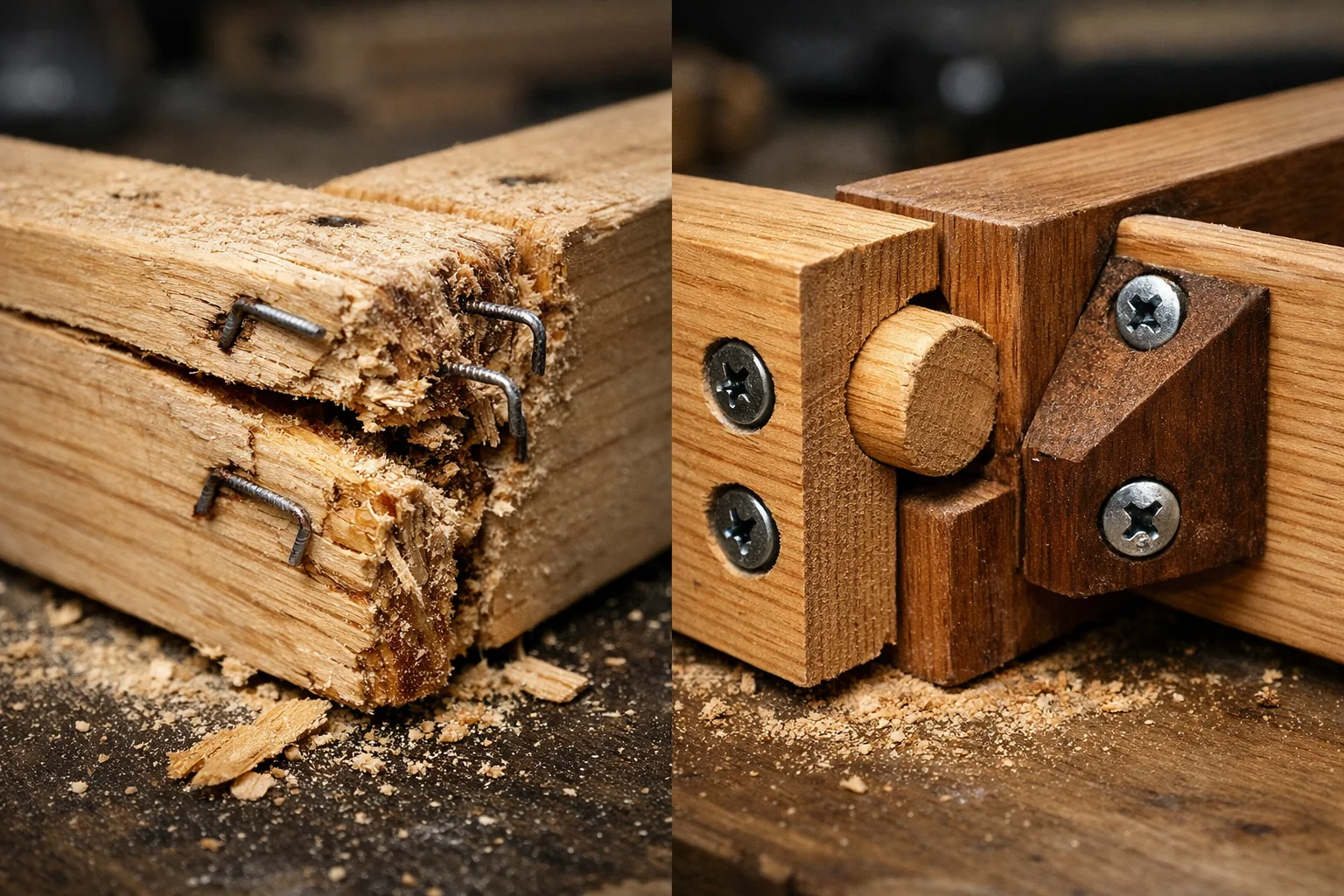
This tends to come from cheap joinery choices that rely on fast assembly, like staples and glue doing most of the work instead of more mechanically secure joints. Once a frame racks, you are fighting loosened joints inside a fully upholstered box, and it is usually terminal from a practical consumer standpoint.
If you want a quick sanity check without tools, I press down hard on one arm, then the other, then I sit down and push my shoulders into the backrest. A good frame feels boring, it just resists you. A bad frame feels talkative, it flexes, complains, and makes itself known.
Diagram showing the “Smile Test” on a sofa frame
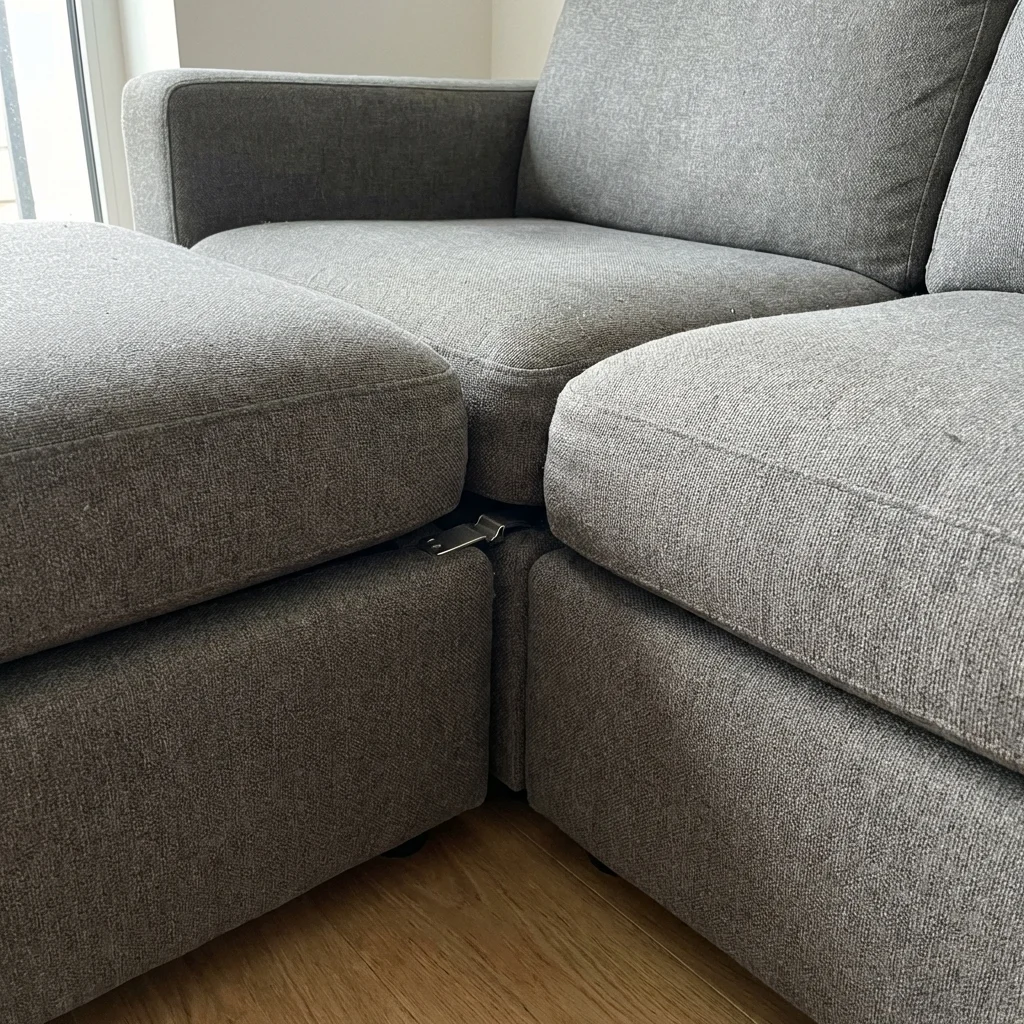
This is one of the fastest frame checks I know, and I do it even when a salesperson is standing right there. I get down to about knee height, or fully crouch if the sofa sits low, and I look straight across the very bottom front edge of the sofa, the part just under your knees when you sit.
What I want to see is a front rail that reads as straight and level. If the middle of that front edge is sagging lower than the corners, like a subtle smile shape, I treat it as a sign that the structure is already losing the fight.
I am not talking about the cushion line here, because cushions can be overstuffed, underfilled, or just arranged weirdly in the showroom. I am looking at the hard geometry of the sofa itself, the frame line that should not be changing shape under normal use.
If you see that smile, I assume one of two things is happening, and both are bad for you. Either the seat support has stretched and is pulling the front rail down over time, or the rail and joints are flexing because they were underbuilt to begin with, and now they are permanently taking a set.
I also look for the opposite problem, a front rail that bows up in the middle like a frown. That can mean someone already tried to “fix” a sag with a crude support, or the sofa is sitting twisted on uneven feet, and neither makes me feel confident about how it will behave in a real room.
When I do the Smile Test, I pair it with a quick sit in the center seat, because that is where weak frames and weak suspension reveal themselves first. I sit down normally, then I stand up and immediately crouch again to see if the line changed even a little, or if the sofa made a new noise when it loaded and unloaded.
If the store has the sofa on a thick rug or squishy pad, I try to slide it a few inches so one front foot is on a firmer spot, then I repeat the look. I have seen floors and display pads fake a “smile” that is really just a wobble, but I have also seen the opposite, where the floor props up a sofa that would sag at home.
If you are choosing between two similar looking sofas and one has a dead straight front rail while the other has even a mild smile, I would treat that as an easy decision. Fabric, color, and pillows are the fun part, but a frame that is already bending is the kind of problem you cannot shop your way out of later.
Diagnosing by Sound
Your ears are your best diagnostic tool, because sound is the sofa telling you where it is rubbing, slipping, or crushing. In a showroom I do not just sit once and call it good, I shift my weight slowly, I lean back, I rock side to side, and I do a careful little bounce, because repeatable noises under gentle movement are the ones that get louder at home.
A high pitched squeak usually means metal on metal somewhere in the seat support, often at a clip, a spring end, or a connector that is rubbing as the sofa flexes. I do not automatically panic about this one, because it can be fixable with felt, a tighter clip, or a bit of lubrication, but I still treat it as a negotiation point, not a cute quirk.
What I do in the store is try to locate it. I shift my weight toward the left front, then the right front, then the middle, and I listen for whether the squeak follows my weight or stays in one spot, because a consistent location suggests a single contact point that could realistically be addressed.
If the salesperson says, “That will go away,” I ask them to show me the same model on the floor that has “gone away,” because squeaks that vanish tend to be fabric or cushion noise, not hardware noise. If they cannot demonstrate it, I assume it is a design or assembly issue, and I decide whether I can live with the risk, especially if you are sensitive to repetitive sounds.
A low pitched creak is the one I take personally, because in my experience it is often wood on wood at a joint that is moving when it should be locked. When a new sofa creaks like an old staircase just from you leaning back or shifting your hips, I treat that as a serious warning that the frame is flexing, the joint is already loose, or the fasteners are not holding the way you need them to.
The reason I call this “terminal” as a buyer is not that wood cannot be repaired in theory, it is that the problem is usually buried inside upholstery where you cannot tighten it properly without opening the sofa up. If it creaks now, it usually creaks more later, and the “fix” you actually get is living with it until you replace the sofa.
When I hear a creak, I do one quick cross check for false alarms. I put one hand on the arm and one on the back, I apply pressure separately, and I listen for whether the sound comes from the structure or just a loose leg on an uneven display floor, because floors can fake you out.
If it turns out to be a leg issue, I want the store to level it on the spot and let me re test. If it is still creaking after that, I move on, because you are about to pay for a sofa that is already telling you the frame is working too hard.
A dry crunching sound is different, and it often shows up when you press down on the arms or lean your weight hard into the corner. That noise can be thin plywood, fiberboard, or cardboard like paneling under the upholstery flexing and getting crushed, and while it might not immediately change how the seat feels, it is a big tell about cost cutting in the parts you cannot see.
When I hear that crunch, I do not just think about the sound, I think about how you actually use a sofa. People perch on the arms, kids climb, guests push off the arm to stand up, and if the arm is built like a hollow shell, it can start feeling wobbly or dented even if the seat cushions are fine.
My personal rule is that any repeating structural noise is a reason to slow down, and any low pitched creak is a reason to walk away unless there is a very clear explanation and a clear fix happening before delivery. A sofa can be soft or firm, deep or upright, modern or traditional, but it should be quiet and boring when you move on it, because quiet usually means the structure is not sliding around trying to find a new position.
Technical Summary: The Triage
Before you throw it out, I run a quick triage so you do not waste money fixing the wrong thing.First, I ask myself if it is really just the cushions. If the sofa still feels structurally boring in the good way, meaning no creaks when I shift and no wobble when I press on the arms or back, and the seat platform still has a dependable springy push back, then I stop blaming the whole sofa. In that situation, I would rather spend real money on new foam than replace the entire piece, because dead foam can make a healthy sofa feel ruined.
The practical check is simple: I take the cushions off and sit on the deck for a moment, with a folded blanket if I need to make it tolerable. If the deck feels level and resilient and I am not sinking into a trough, then the main structure is probably fine and the cushions are the weak link. If your cushions unzip and come out, I would price out replacing the foam cores, and I would only do it if the rest of the sofa passes the noise and wobble tests you already did in the showroom.
Next, I ask if the deck is sagging, because this is where I draw a hard line. If the suspension feels dead, meaning you get a hammock dip in the middle, the edge collapses when you sit to tie your shoes, or the seat just does not rebound when you stand up, then the sofa is functionally dead even if it looks okay. You can throw thicker cushions at a sagging deck, but you are usually just masking the problem, and you will feel it again as soon as the new foam breaks in.
Finally, I listen for frame creaks and I take them seriously. If the frame is creaking under normal movement, not a one time noise but a repeatable groan when you lean back or shift side to side, I do not put repair money into it and I do not buy that model in the first place. In my experience, a creaking frame is the sofa telling you the joints are moving, and once that starts, you are paying to chase a problem that is buried where you cannot properly tighten it.
Explore Technical Reference
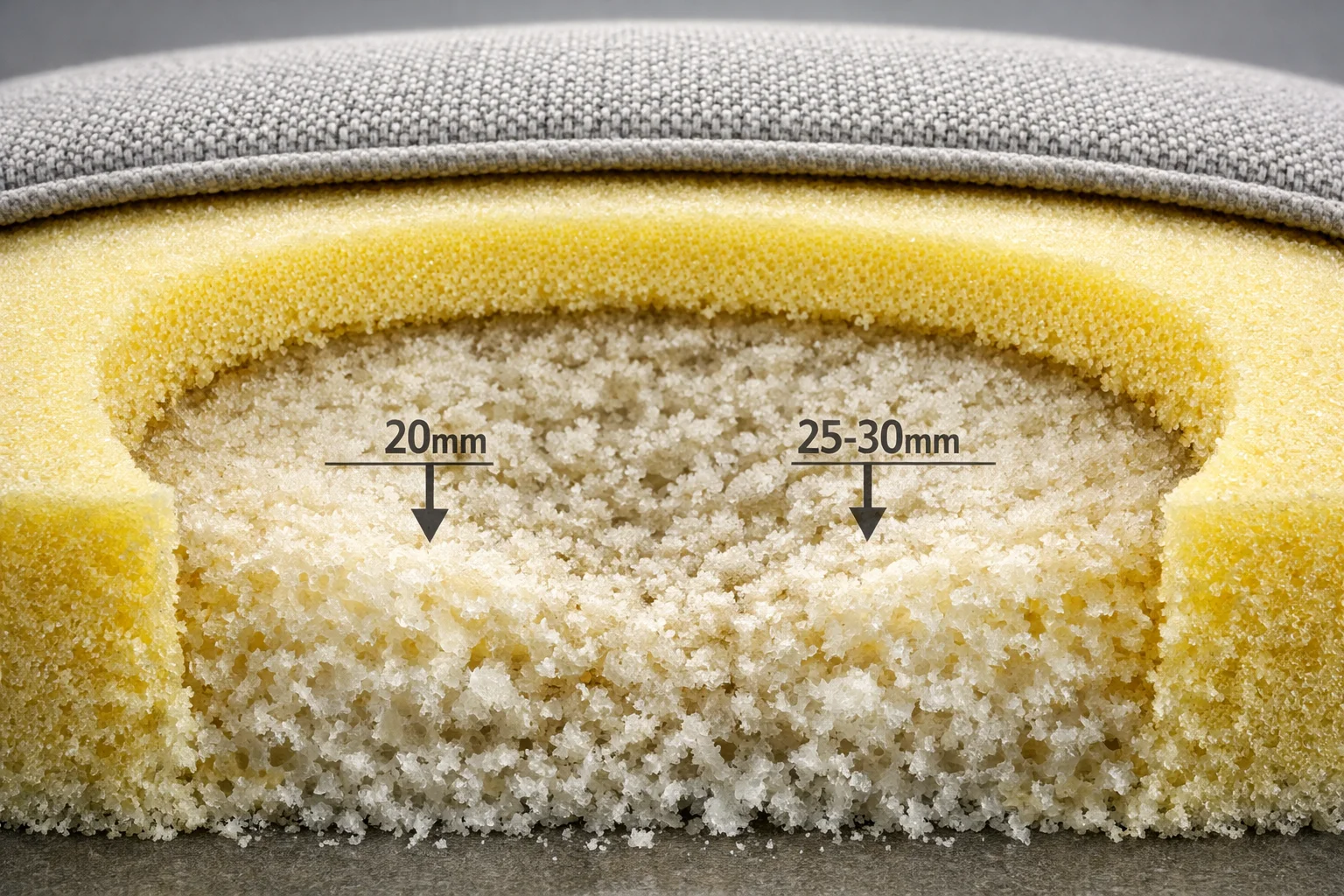
Cushion Collapse: Why the Center Fails First
Why the front of your cushion looks fine but the center is a crater. The mechanics of point-load failure.
Analyze Details →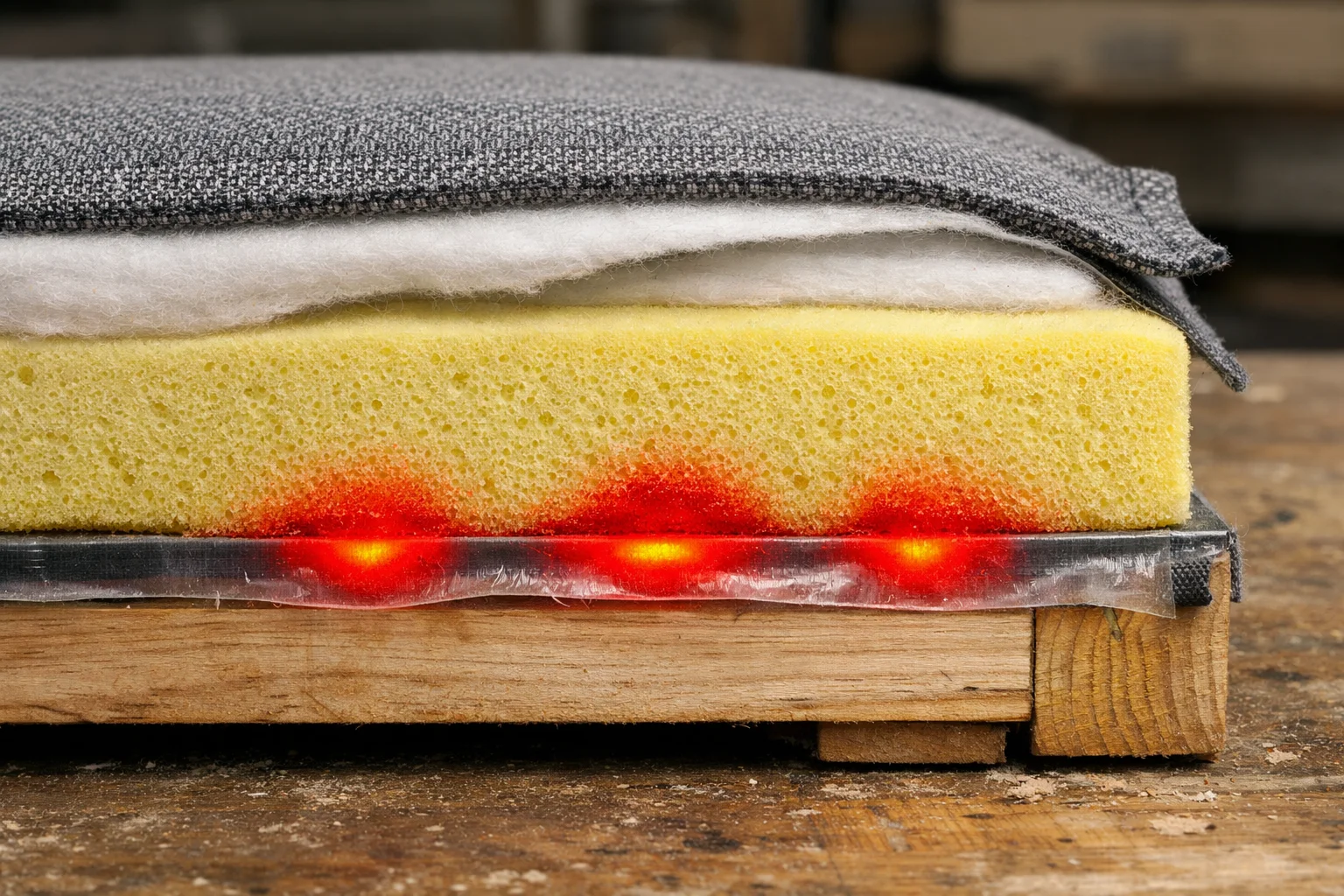
Bottoming Out: Why You Feel the Frame
The physics of 'hollow' sitting. Why deep cushions fail faster and why 'softness' is often the enemy.
Analyze Details →