Sofa Support Systems: Making the Right Choice
Introduction
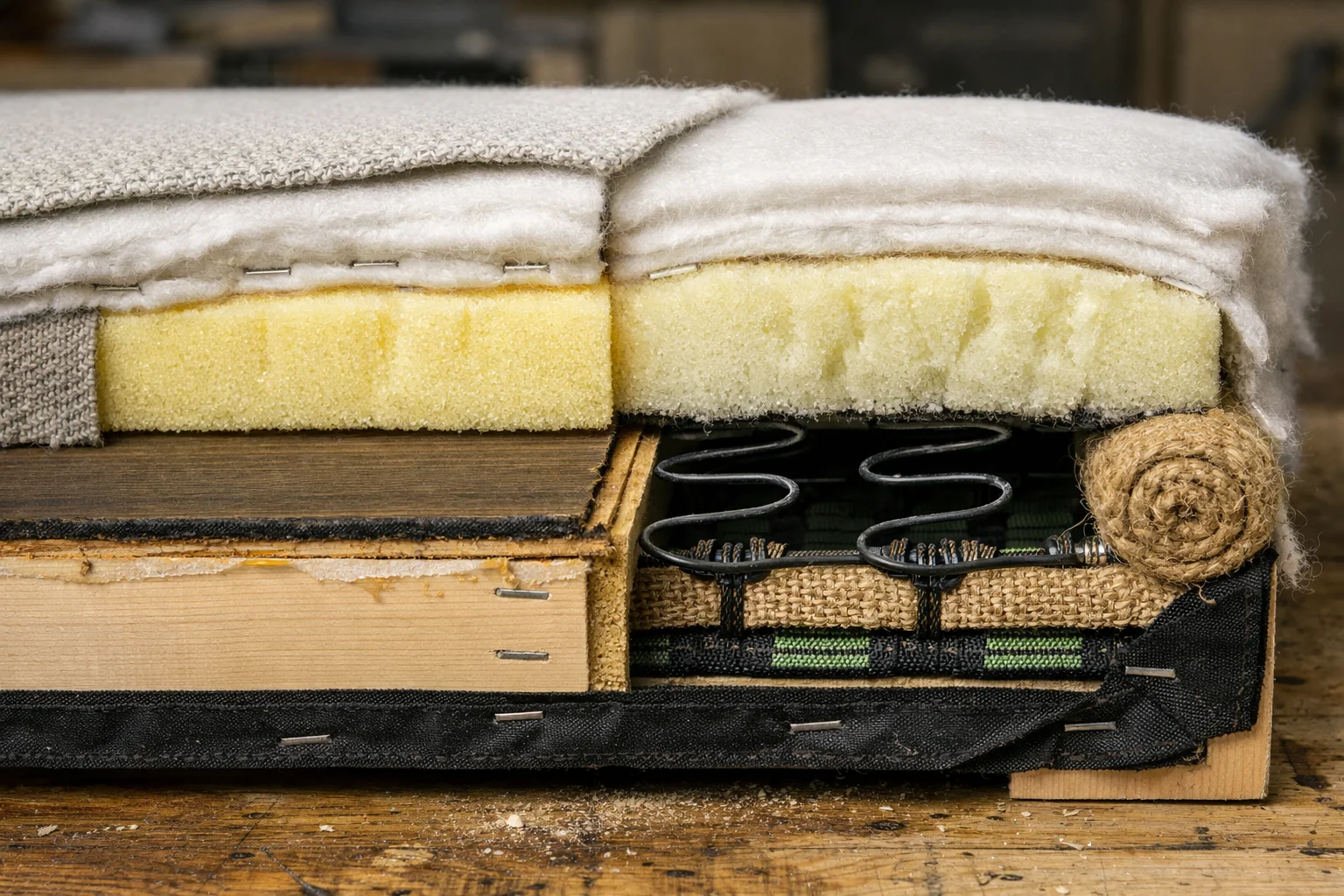
After that “platform foundation” mistake, I started treating suspension like the first thing I check, not a footnote. Cushioning is what you feel in the first thirty seconds. Suspension is what you live with after thirty minutes, and it is what decides whether the sofa stays supportive a year from now or turns into a saggy hammock.
When you are shopping, don’t let thick cushions or fancy fabric distract you. A sofa can look plush and still be basically a board with foam on top, which is exactly what cooked my hips. What you want is a seat that pushes back evenly, not one that feels firm only because it is hard underneath.
In a showroom, I do one simple test before I fall in love with anything. I sit where I would actually sit at home, not perched on the edge, and I stay there long enough to notice pressure points. If you feel a hot spot under your sit bones, or you can tell where the front rail is, or it feels like you are sinking into a low spot right away, that is your warning that the support system underneath is weak or overly simplified.
Then I use my hands because they tell me more than the marketing tag. I press down firmly near the front edge, then in the middle, then near the back, and I pay attention to whether the resistance feels consistent. If one area collapses more than the rest, or rebounds slowly like a tired mattress, you are likely looking at suspension that will wear into a permanent dip.
If the salesperson will let you, I also lift the front of the seat cushion and look into the gap. I am not trying to identify every component like a technician. I just want to confirm there is a real suspension system under there, not a flat deck doing all the work. If you see a taut grid of webbing, distinct springs, or something that clearly flexes and supports, that is a better sign than a hard, unyielding platform.
This matters even if you think you like a firmer sofa. Firm is fine when it comes from support plus cushioning working together. Hard is what you get when the “support” is basically a sheet of wood and the cushion is forced to act like a shock absorber all by itself.
In the rest of this guide, I am going to help you separate showroom comfort from long term comfort. I will walk you through what to look for and what to ask, so you can spot the sofas that keep their shape and feel good after the return window is long gone.
The "Platform" Trap
When I see the words “platform foundation” or “flexolator grid,” I slow down, because those labels can hide a lot of cost cutting. The name sounds engineered and supportive, but in practice it is often a rigid board under the cushions, or a thin wire grid that barely flexes.
You can usually feel it within a minute. The seat comes across “firm,” but it is the dead, park bench kind of firm where your sit bones start complaining and the pressure feels concentrated instead of spread out.
Here is what I do in the showroom to catch it fast. I sit back like I would at home, then I subtly shift my hips an inch or two in different directions. If the comfort does not change much and everything feels uniformly hard, that is a clue the cushion is just sitting on a flat deck instead of being supported by something that moves with you.
Then I do my hand test again, but I pay special attention to what happens after the initial push. If I press down and it feels like I am hitting a “stop” almost immediately, or the resistance feels like a countertop, that is platform behavior. With active suspension, even a firm sofa usually has a little give, then it pushes back progressively.
If you can lift the front edge of the seat cushion, take a quick look into the gap and trust your eyes. A platform is usually obvious because you will see a broad, flat surface spanning the seat. A cheap wire grid can look like a metal lattice, and it often sits very close to the cushion, with not much depth to it.
When a salesperson says, “People like platform because it lasts,” I translate that as, “It stays hard.” What actually lasts in a good way is support that flexes and returns, like real springs or taut webbing that shares the load with the cushion instead of forcing the foam to do all the work.
My verdict for most people is simple. If the seat feels like a board during your first real sit, walk away, because it rarely gets better at home. You want active suspension underneath you, whether that is springs or webbing, so the sofa can be supportive without punishing you.
Matching Suspension to Body Weight
Gravity is the enemy here, and it plays favorites. The heavier you are, or the more often the same seat gets used, the more you need a suspension system that can take repeated loading without stretching into a dip.
I learned to stop thinking in terms of “soft versus firm” and start thinking in terms of “how hard is this sofa being asked to work.” If you are light and you sit politely, a lot of suspensions can feel fine in a showroom. If you are heavier, tall, broad, or you like to lounge in one spot for hours, weak suspension does not just feel a little worse, it fails faster.
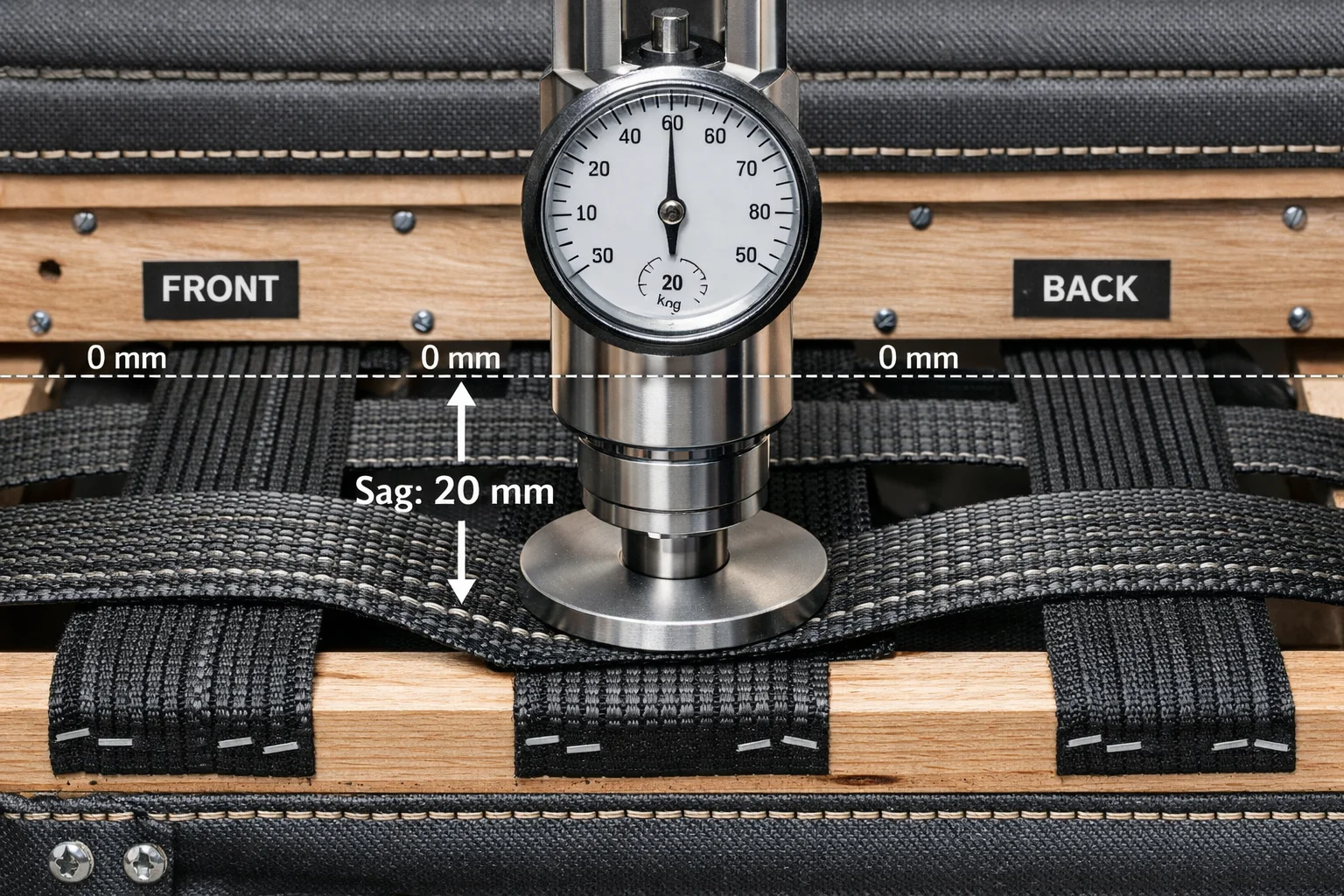
When you test a sofa, try to simulate real life weight, not showroom posture. I sit all the way back, feet on the floor, then I lean back and relax my core like I would during a long movie, because that is when a marginal seat suddenly reveals itself.
Pay attention to whether you bottom out gradually or abruptly. On a well matched suspension, you feel controlled give and then a steady pushback, like the sofa is holding you up. On an underbuilt suspension, you feel a quick drop and then a hard stop, and your body starts recruiting your thighs or lower back to compensate.
If you share the sofa with someone significantly heavier than you, do not only test “your” side. I press and sit in the most used spot and I look for early signs of mismatch, like one seat feeling looser than the others even on a brand new floor model, or the front edge collapsing more than the center.
The front edge is where weight concentrates when you stand up, perch, or slide in and out, and it is a common failure point for heavier users. I do my hand press right on that front band, then I sit with my thighs supported, and I notice whether the edge holds me level or tips me into a subtle forward slump.
You can also learn a lot by standing up and immediately sitting back down a few times in the same spot. A good suspension rebounds quickly and predictably. A weak one starts to feel like it is getting “tired” even during your short test, and the seat may come back slowly or unevenly.
If you can lift the cushion and see what is actually supporting you, match what you see to your reality. Springs or taut webbing that clearly has tension and depth under it usually handles heavier loads better than a thin, shallow system that barely moves. I am not chasing a specific brand name here, I am watching for a support layer that looks like it is meant to flex repeatedly, not just exist.
When a salesperson says, “This is a firm seat, it’s great for support,” I ask one follow up question: what is providing the support under the cushion. If the answer stays vague, or they pivot back to foam density and fabric, I assume the suspension is nothing special and I test more skeptically.
If you know you are harder on seating, the safest buying move is to be picky about evenness. I want the resistance to feel consistent across the whole sitting area, because uneven support is what turns into a permanent crater when the same seat takes the majority of the load.
The practical takeaway is simple. The more weight the sofa will regularly carry, the more you should demand active, progressive pushback during your sit test, and the less you should tolerate any quick drop, hard stop, or obvious soft zone, even if the cushions feel plush on top.
1. Light Use / Lightweight (<180 lbs)
If you are under about 180 pounds and the sofa is not going to be treated like a daily crash pad, you can usually get long term comfort out of simpler suspension without it wearing into a dip quickly. In this range, I am generally comfortable with a seat built on elastic webbing or on 11 gauge sinuous springs, assuming the rest of the build is not cutting corners.
With elastic webbing, what I want you to look for is a seat that feels evenly supported across the whole cushion, not just “soft.” When I press down with my hands, good webbing feels taut and springy, and it pushes back right away instead of letting me sink and then stopping hard.
If the salesperson will let you lift the cushion, I look for webbing that forms a real grid and sits flat without obvious slack. If you can see straps that look droopy, twisted, or widely spaced, or you can press with one hand and feel the webbing give way too easily, I treat that as a sign it will stretch out and start feeling hammock like.
With 11 gauge sinuous springs, I am mainly judging the feel because you often cannot see the spring runs clearly. When I sit, I want a controlled, even give, and when I stand up, I want the seat to rebound quickly and return to the same height without a delayed “rise.”
There is one common trap for lightweight buyers, and it is buying a hard, board like seat because it feels “supportive” for a minute. If you are light, a platform style base can trick you because you are not heavy enough to immediately expose how dead the support is, and you end up relying on the foam to do all the work over time.
My practical advice is to do your normal sit, then do a lazy lounge sit, then do a quick edge perch like you would when tying your shoes. If webbing or 11 gauge sinuous springs are done well, those three positions still feel consistent and you do not suddenly find a hard ridge at the front or a low spot in the middle.
If you are choosing between the two and everything else about the sofa is equal, I personally lean toward whichever one feels more even side to side and front to back during your hand press test. For lighter use, the “best” suspension is usually the one that stays predictable across the whole seat, because you are not stressing it enough to need an overbuilt system, you just need it to avoid developing an uneven sag.
2. Standard Use / Average Weight (180 - 230 lbs)
If you are in the 180 to 230 pound range and this is going to be a normal, everyday sofa, I stop treating elastic webbing as the default “good enough” option. In my experience this is the range where webbing is most likely to feel fine in the showroom, then slowly relax until you get that hammock effect where you are subtly sliding toward the middle and the cushion starts doing all the heavy lifting.
What I look for here is steel support under the cushions, and the simplest shorthand is sinuous springs. If you can confirm the spec, I want 8 gauge sinuous springs for this range, because they resist taking a permanent set better than lighter spring wire when the same seat gets used day after day.
In the showroom, you usually will not be able to measure gauge with your eyes, so I focus on two things you can actually do. I sit down normally, then I shift my weight side to side and see whether the seat “follows” me with even pushback, or whether it rolls me toward a low spot like a shallow bowl.
Then I do my front edge check more aggressively than I would for a lighter buyer. I plant my feet and perch like I am about to stand up, and I pay attention to whether the front edge keeps my thighs supported or dumps me forward. A too flexible webbing base often gives you that forward slump feeling first, even before the middle of the seat starts to sag.
If the salesperson tells you it has webbing, I would not automatically walk away, but I would get very specific and ask what kind of webbing it is and whether it is rubber based. Rubber webbing is the one I am most suspicious of in this weight range because once it stretches, it rarely feels truly supportive again, it just feels looser and looser until the cushion starts bottoming out sooner.
If you can lift the cushion and peek inside, I am looking for a clear run of zig zag steel springs across the seat with enough depth that it looks like a suspension system, not just a token layer. If all you see is a flat deck, or a few straps that already look relaxed on the floor model, I treat that as a forecast of where your body will end up a year from now.
When a sofa in this range is built right, you should feel a little give when you sit, then a steady pushback that holds you at a consistent height. If instead you feel an easy drop and then you hit a firm stop, it is often because the suspension is underbuilt and the cushion is masking it, and that is exactly the situation that turns into “it was comfy at first” regret.
If you are choosing between two sofas and one has confirmed 8 gauge sinuous springs while the other is vague about “supportive webbing,” I personally put my money on the springs. It is not because springs are magic, it is because steel is much less likely to slowly stretch into a permanent dip under everyday adult weight.
3. Heavy Use / Heavyweight (>230 lbs)
If you are over about 230 pounds, or one seat is going to take a lot of daily lounging, I would stop treating sinuous springs and webbing as “good enough” by default. They can be fine when executed well, but this is the range where I most often feel that uneven, twisting sag develop, where the middle gets low and the front edge goes soft first.
What I personally trust most in this category is 8-way hand-tied suspension, because it is built around vertical springs that compress straight down under you. In real sitting, that “straight down” behavior matters, since your weight is not politely centered, it shifts, leans, and loads the front edge when you get up.
If you are trying to confirm 8-way hand-tied in a showroom, I do not rely on the tag alone. I ask the salesperson to point out where it is documented in their spec sheet for that exact frame, and if they cannot, I assume it is not there and I test accordingly.
Then I use my hands and my ears. When I press down firmly in the middle and then near the front edge, a good coil based seat tends to feel more like a mattress, progressive resistance, even pushback, less of that sideways roll. If I feel the seat pull or torque as I shift my weight side to side, that is the sensation I associate with horizontal wire systems that are being asked to carry more load than they really want to.
If 8-way hand-tied is out of budget, the compromise I look for is a drop-in coil unit. This is basically a prebuilt spring module that sits inside the seat frame, and it is still vertical coils doing the work, which is what you want for heavier, repeated loading.
With drop-in units, I get picky about edge support because that is where shortcuts show up. I perch on the very front edge like I am tying my shoes, then I stand up and sit back down in the same spot a few times, and I pay attention to whether that front band stays level and rebounds immediately, or whether it starts feeling mushy and lower than the rest of the seat.
If you can lift the seat cushion, I want you to look for depth and structure, not just “some metal.” A coil system usually looks like a real spring field or a contained unit with noticeable height, while an underbuilt system often looks shallow, flat, or overly simple, like it is trying to do the minimum while the foam pretends everything is fine.
One thing I would push back on in this weight range is the idea that a very hard seat equals durability. If it feels like you are sitting on a board and the cushion is acting like the only shock absorber, that often means the sofa is not truly supporting you, it is just refusing to move. Over time, that tends to punish the foam and your body at the same time.
My bottom line for you is that you should demand a seat that gives a little, then pushes back evenly without rolling you into a dip. If you are heavier and you already notice a quick drop, a hard stop, or a weak front edge on a brand new floor model, I would treat that as a forecast, not a fluke, and keep shopping.
Diagram showing the three main support systems
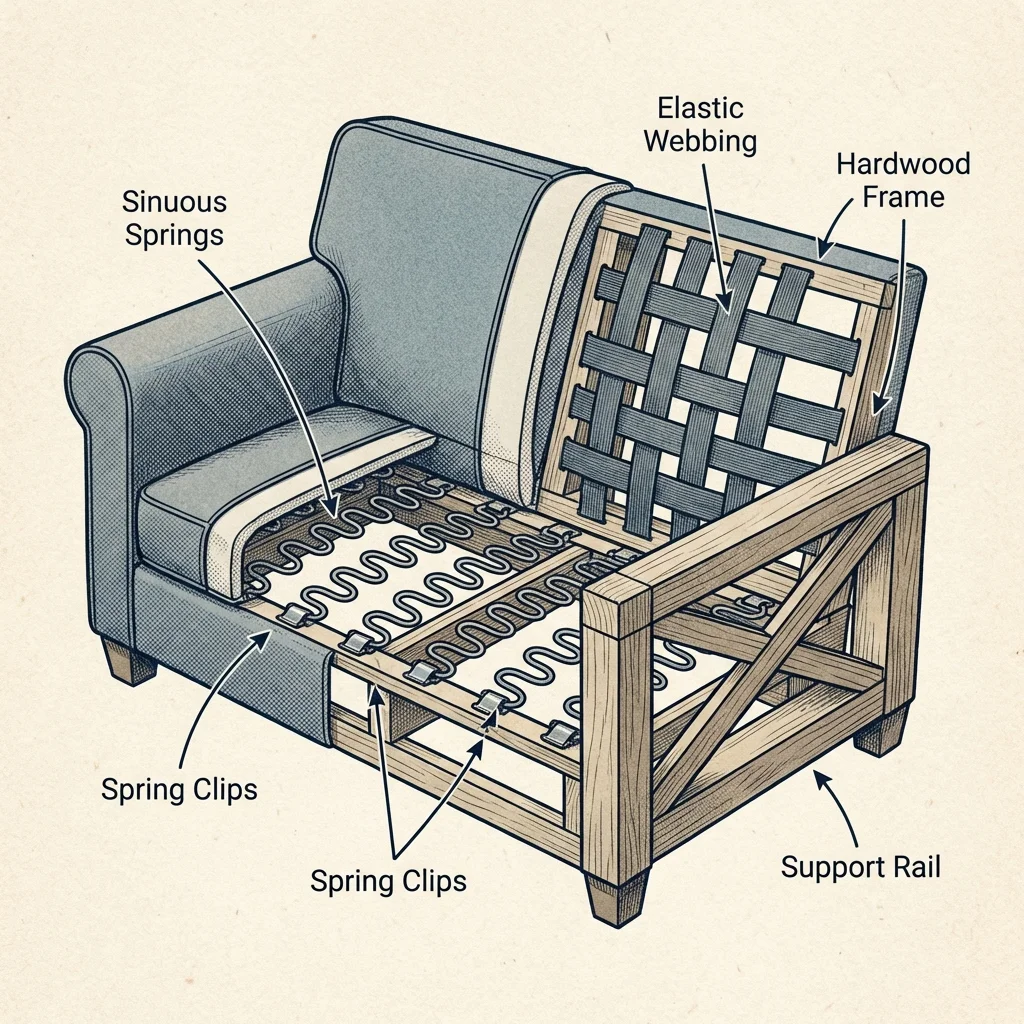
When I look at a sofa, I mentally sort the seat support into three buckets, webbing, sinuous springs, and coils. That little categorization keeps me from getting hypnotized by cushions and upholstery, because those are easy to make feel good for five minutes.
Webbing is the simplest system, and it can be perfectly fine if you are lighter, the sofa is for occasional use, or you rotate where you sit. In the showroom, I treat webbing like it has to earn my trust with consistency, because the failure mode is usually gradual stretch that turns the seat into a shallow sling.
Sinuous springs are the middle ground, and this is where I land most often for everyday adult use when the build is honest. The feel I want is steady, even resistance that does not change dramatically when you shift side to side, because the annoying long term problem with underbuilt spring layouts is that they develop a favorite low spot.
Coils are what I look for when the sofa is going to work hard, whether that is higher body weight, lots of hours per day, or a household where the same seat gets hammered. The reason is simple from a buyer’s perspective, a coil system tends to compress more straight down and less sideways, so you are less likely to get that rolling, funneling sensation that turns into a permanent dip.
If you only remember one practical move from this diagram, make it this. Match the support system to how the sofa will actually be used, then test for even pushback and edge strength, because that is where the honest sofas separate from the ones that are just dressed up to feel good under showroom lighting.
When you are unsure what you are sitting on, I ask you to do one small reality check. Sit in the exact spot you would claim at home, then slide your hips a few inches left and right and see if the sofa stays consistent or if it tries to guide you into a low zone, since that low zone is usually the future crater.
I also like to do a quick front edge perch right after a normal sit. If the edge suddenly collapses compared to the middle, I stop caring what the fabric is and start assuming the support system is either too light for the job or not anchored well enough to hold up over time.
The Failure Timeline
One of the most useful ways I have found to protect myself from a bad sofa is to stop thinking about “will it sag” and start thinking about “when will it sag.” Suspension failures are often boring at first, then suddenly obvious, and by the time they are obvious you are usually outside any meaningful return window.
The classic example is a heavy body on elastic webbing, or any situation where the sofa is being asked to do a job it was not built for. In the first month it can feel completely fine, even impressively comfortable, because nothing has had time to take a permanent set yet and the cushions are still masking what is happening underneath.
Around the six month mark, the problem often stops being comfort and starts being geometry. Webbing can stretch and stay stretched, which means the “neutral” position of the seat is now lower than it was when you bought it, even when nobody is sitting on it.
Around the one year mark, you feel it as a drop in seat height, and two inches is not an exaggeration in a mismatched setup. That is the moment when you realize you are not really sitting on “support” anymore, you are sitting on cushion that is now much closer to the hard frame rails, so the comfort turns into that bottoming out, pressure point feeling that makes you shift around all night.
When I am in a showroom, I try to predict this timeline by looking for early signals of slack. If a brand new floor model already has a seat that feels a little lower in one favorite spot, or the front edge already feels easier to collapse than the rest, I assume normal living will only exaggerate it, not magically stabilize it.
You can do a simple test that mimics the way a suspension starts to lose its fight. I sit in the same spot, stand up, and immediately feel the cushion and the seat deck with my hand, then I sit again and notice whether the second sit feels a tiny bit looser or lower. A good system feels boringly consistent, a marginal one starts to feel like it is getting tired right in front of you.
The other check I rely on is the frame rail hunt, because that is what you end up feeling once a seat drops. I press down with my palm and slowly sweep from the front edge toward the middle, and I pay attention to any sudden hard line or “ridge” sensation that suggests the cushion is already close to something unyielding underneath.
If you take one practical lesson from this, let it be this. A sofa that feels fine today can still be a bad match for your body and your habits, so you want to buy the one that stays the same under repeated loading, not the one that merely feels plush in the first sit.
Technical Summary: The Golden Rule
When I am trying not to get talked into the wrong sofa, I keep one rule in my head and I make myself say it out loud: “What is the suspension?” If you ask that early, you force the conversation onto the hidden part that decides whether the seat stays supportive or slowly turns into a dip.
If the answer is “webbing,” I treat that as a clue that the sofa is meant for lighter duty. I will still sit test it, but in my own buying decisions I only choose webbing when the sofa is for a formal room, occasional seating, or a spot where nobody is going to claim the same seat every night.
If the answer is “no sag springs” or “sinuous springs,” I immediately ask one follow up: “Do you know the gauge?” I am listening for 8 gauge because it is one of the few concrete specs that tends to correlate with a sturdier, longer lasting feel in everyday use. If they cannot tell you, I would not assume it is 8 gauge, I would assume it is whatever was cheapest for that model and then rely heavily on your edge perch test and your repeated sit test to see if it already feels too easy to compress.
If the answer is “platform,” I do not argue, I just move on. I have sat on too many “platform” seats that feel fine for five minutes and then punish you later, and I have never found a way to make a dead, board like foundation turn into the kind of even, forgiving support I actually want at home.
The point of this rule is not to win a technical debate with a salesperson. It is to keep you from buying a pretty sofa that is asking the cushion foam to do a suspension job, because that is the kind of sofa that feels like a regret right around the time you can no longer return it.
Explore Technical Reference
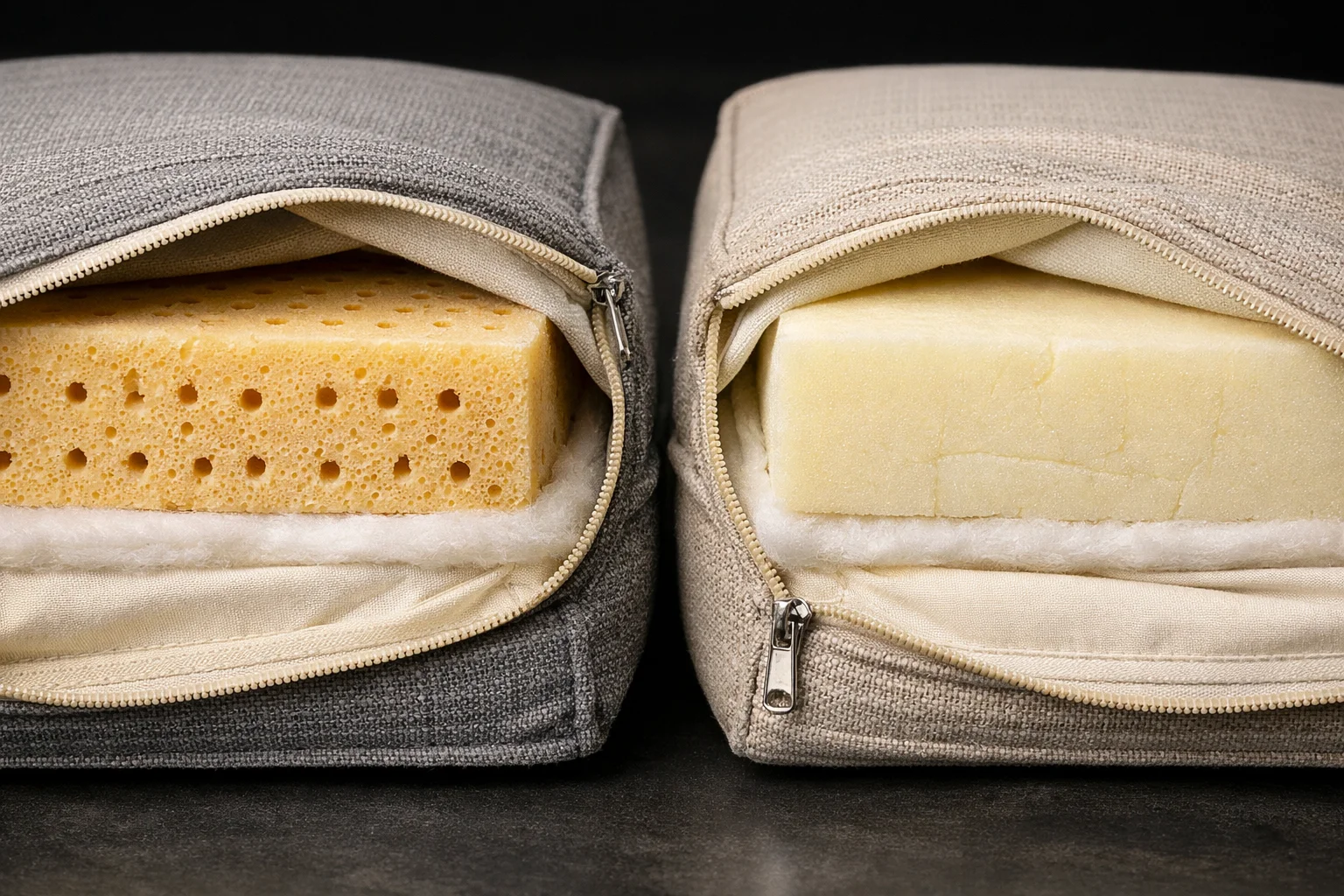
Latex vs. Polyurethane: Rubber Trees vs. Oil Wells
Understanding the fundamental differences between natural rubber foam and petroleum-based foam. Why latex outlasts polyurethane by decades and when the premium price is justified.
Analyze Details →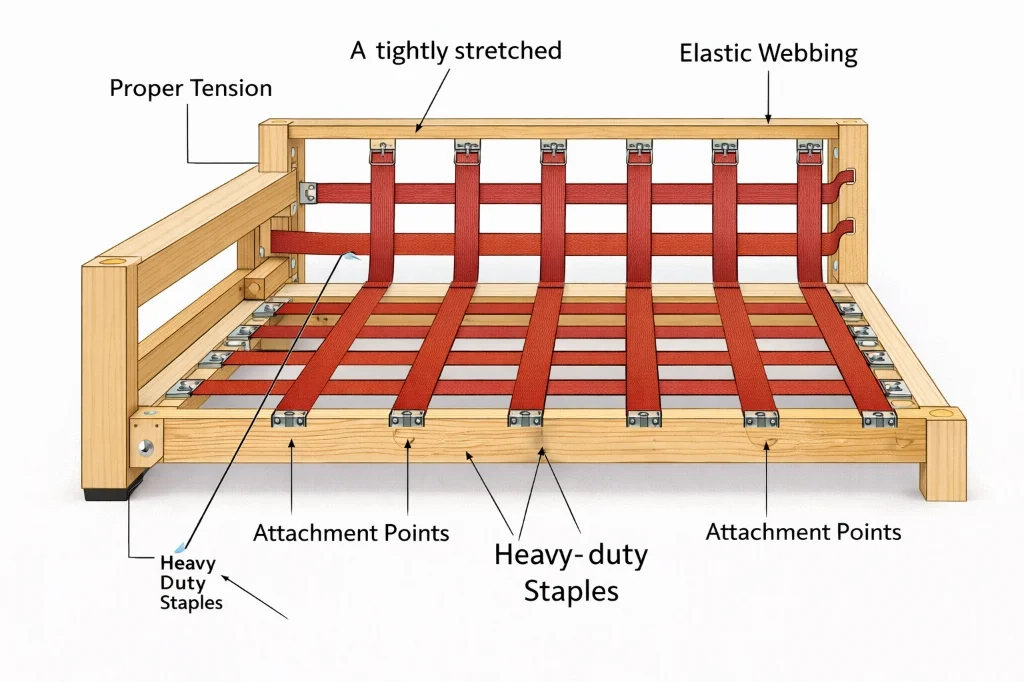
Elastic Webbing: Cheap Fix or Italian Luxury?
Dispelling the myth that webbing is always cheap. Understanding when high-quality rubber webbing like Pirelli provides superior suspension for modern design.
Analyze Details →