Plywood Frames: The "Engineered" Advantage
Introduction
I stared at the spec sheet: “Engineered Hardwood Laminate.” Was this a fancy word for particle board, or was it something better? I learned that “plywood” is a spectrum. At the bottom, it is construction junk. At the top, it is stronger than steel by weight.
What I wish someone had told me early is that furniture marketing loves vague wood terms, because most people do not push back on them. If you let the tag do the talking, you end up buying the cheapest version of whatever that label could possibly mean.
When you are standing in a showroom, your job is not to become a materials engineer. Your job is to force the salesperson and the product to be specific. When I see a phrase like “engineered wood,” “hardwood laminate,” or “composite,” I treat it like an unanswered question, not an answer.
If you only do one thing, ask what the actual core material is where the sofa is stressed. I mean the arm posts, the front rail under your knees, the long side rails, and the joints around the seat. If the answer stays fuzzy, or you only hear “it’s all engineered,” I assume it includes a lot of low density board somewhere important.
Then I look for proof that the frame is built like it expects years of twisting. I get my hands under the front edge and gently rack the sofa by lifting one front corner a bit. A good frame feels like one piece and it settles back quietly. A weak one will creak, shift, or feel like the seat box is flexing independent of the arms.
I also ask one very plain question that has saved me time: “Is there particleboard anywhere in the structural frame, yes or no?” Some people will try to redirect with “it’s furniture grade,” but I bring them back to the yes or no. If they cannot answer, I treat that as the answer.
This guide is basically the checklist I built for myself after being disappointed by sofas that looked fine for a year, then started to loosen up, sag, and squeak. I am going to show you how I evaluate what you cannot see easily, using simple showroom tests and a few specific phrases that get you real information instead of brochure language.
The Vocabulary Trap
When I see “engineered wood” on a tag, I treat it as a dodge, not a material. It can mean decent plywood, or it can mean the cheapest pressed fiber they could get away with, and the whole point of the phrase is that you cannot tell which one you are paying for.
Particle board and MDF are the ones I avoid in anything structural. In real life they behave like sawdust held together with glue, which is fine for a cheap drawer bottom, but a problem when a sofa frame is being twisted every time you sit, flop, or drag it a few inches to vacuum.
Hardwood plywood is what I want to hear, because it usually means layers of real wood veneer glued in alternating directions. In a showroom, that translates into rails and panels that resist flexing and that hold fasteners better over time, which is exactly what you need where the seat box is under constant stress.
Here is the rule I use when the conversation starts to feel slippery. If they cannot comfortably say the word “plywood” for the structural parts, I assume it is particle board somewhere that matters, and I keep shopping.
When you are talking to a salesperson, listen for the moment they switch from a noun to an adjective. “Plywood” is a noun. “Engineered,” “composite,” “furniture grade,” and “hardwood materials” are adjectives that often exist to keep you from pinning down what the thing actually is.
I ask in a way that makes it hard to hide. “When I remove the dust cover and look up into the frame, what am I going to see for the long side rails and the front rail, plywood or particle board?” If they say “engineered wood,” I calmly repeat the question and wait.
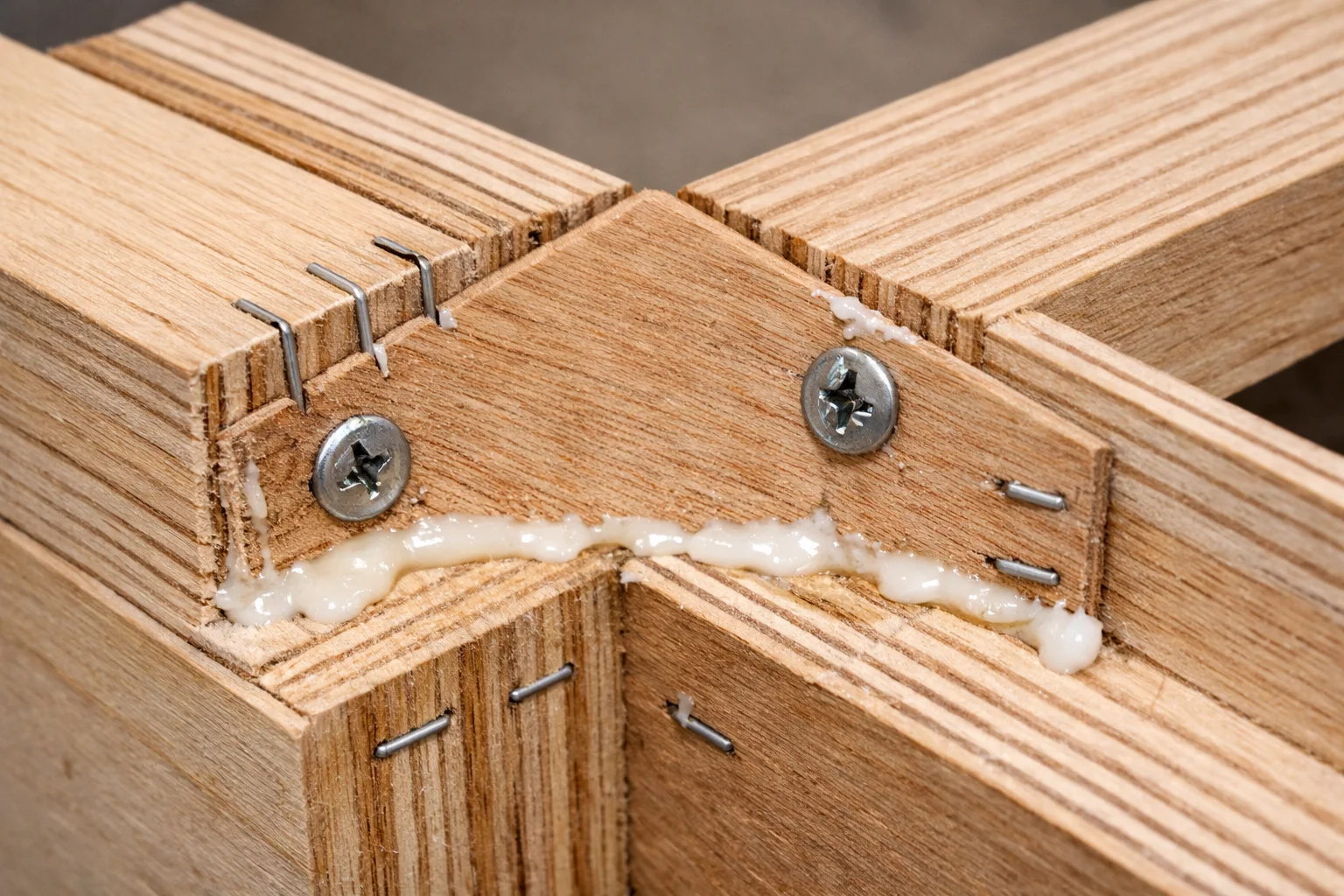
If you are allowed to, I also look under the sofa with my phone flashlight. You are not trying to do surgery, you are just trying to spot the telltales, like crumbly edges, swollen corners, or stapled joints that look like they are relying on thin board to hold everything together.
If there is a zipper on the seat deck or the platform is accessible, I look for exposed edges. Plywood usually shows clear layered plies along the edge, while MDF looks uniform and powdery, and particle board looks like visible chips and flakes. Even a quick glance can turn marketing language into a real answer.
If the model on the floor is fully upholstered underneath and you cannot see anything, that is when I lean harder on documentation. I ask to see the written frame material in a spec sheet, not just the hang tag, and I ask them to point to the line that says plywood if that is what they are claiming.
If you get pushback like “it’s all standard” or “all our frames are engineered,” I take that as a sign they are not confident you would like the truth. I would rather buy the sofa that is proud to say “hardwood plywood frame” than the one that asks me to trust a foggy phrase.
Good Plywood vs. Bad Plywood
When a salesperson finally says “plywood,” I do not relax yet, because plywood can be excellent or basically job site sheathing with a nicer story. What I am trying to avoid is paying a furniture price for construction grade panels that were never meant to hold screws and staples through years of sitting and twisting.
The good stuff, what I think of as furniture grade plywood, is usually maple or birch based, and it has lots of thin layers you can see if you find an exposed edge. In practice, that means the edge looks like a tight stack of many stripes, not three or four chunky slabs.
What matters most to me is whether it is “void free,” which is just a plain way of saying there are no hidden air pockets inside the panel. In a sofa, that translates into fasteners that keep biting wood instead of occasionally landing in a hollow spot, which is how joints start to loosen and squeaks show up later.
Here is how I try to verify it in a showroom without tools. I look for any place I can see the raw edge of a panel, sometimes inside the storage cavity of a sleeper, under a removable deck panel, behind a zipper, or at the underside edges near the legs if the fabric is cut cleanly.
If I can see the edge, I am looking for two things at once. I want many thin, even layers, and I want them to look consistent, without dark gaps, craters, or spots where the glue line suddenly bridges a missing chunk.
If I cannot see an edge, I switch to questions that force a specific answer. I ask, “Is the plywood birch or maple, and is it void free?” If they cannot answer either part, I assume they do not know what is in it, and that usually means it is not the premium kind.
Construction grade plywood is often pine or fir, and it is built with fewer, thicker layers. It can be perfectly fine for a wall, but inside a sofa it is risky because it tends to have knots and voids, and those are exactly where a staple or screw can end up when the factory is assembling frames fast.
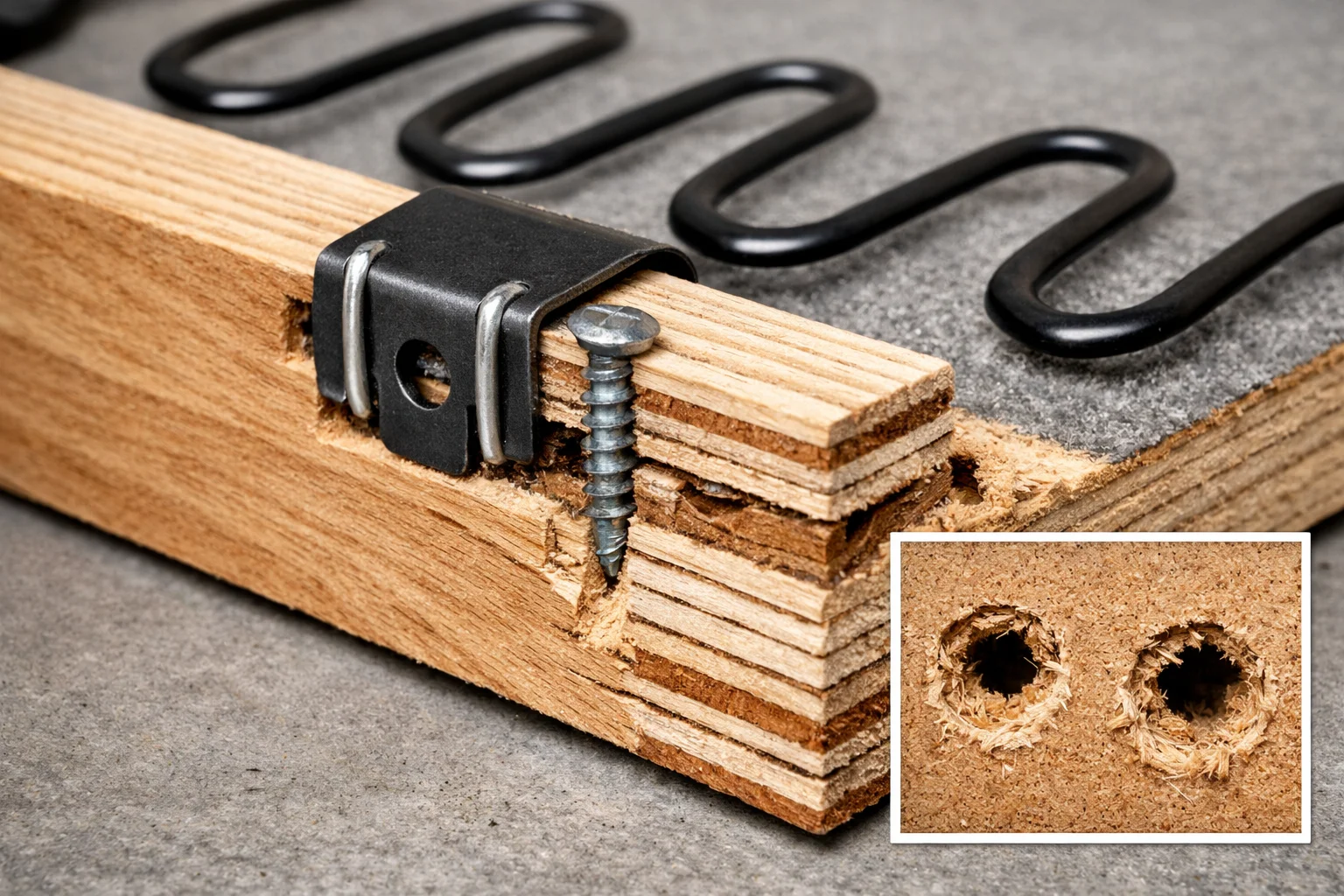
The failure mode is annoyingly simple. If a screw goes into a void, it is not really holding anything, so the joint can feel tight at first and then suddenly loosen, or it can creak right away if the parts are shifting against each other under load.
When I am standing there testing a sofa, that is why I do that gentle corner lift and twist. If I feel the seat box flexing and then settling back with noise, I start wondering if the frame is relying on thin, lower grade panels and staples where I would rather see dense material and solid attachment.
I also pay attention to where plywood is being used. I am happiest when the long side rails and the front rail under your knees are hardwood plywood, because those are the parts that get stressed every single time you sit down. If a salesperson tells you “some plywood is used,” ask where, because plywood in a non structural panel is not the same as plywood in the rails and corners that actually hold the shape.
If you want one phrase that tends to separate real information from sales talk, this is the one I use. “Is it hardwood plywood that is void free, or is it sheathing grade plywood?” If they answer with another adjective like “premium” or “engineered,” I bring it back to those two options and wait quietly.
None of this guarantees a perfect sofa, but it stops you from accidentally buying the kind of frame that is most likely to loosen up early. I have learned to treat plywood like a category, not a promise, and I only feel good when the sofa can prove it is using the good kind in the places that take the beating.
Why Plywood Beats Solid Wood
This is the part that surprised me when I first started digging into frames, a high quality plywood frame can actually be the safer bet than a “solid wood” frame. “Solid wood” sounds premium, and sometimes it is, but it also gives manufacturers a lot of room to pick a cheaper species and then lean on the romance of the phrase.
The big practical issue with solid wood in a sofa is that it has a grain direction, and grain is a built in weak line. When a sofa gets racked, which is what happens every time someone drops into the corner seat, leans hard on an arm, or the piece gets dragged an inch across carpet, solid wood parts can start to split along the grain, especially around staples, screws, and tight corners.
Plywood fights that in a way you can feel over time, because its layers alternate direction. In plain English, it is harder for a crack to take off and run, because it keeps running into a layer that is going the “wrong” way. That is why I worry less about a plywood rail slowly turning into a loud, loosening joint, and I worry more about whether the plywood itself is the good void free kind we just talked about.
The second reason I end up favoring good plywood is boring but real, humidity. Solid wood moves as the seasons change, and in a sofa that movement shows up as joints that slowly get less square. If you have ever had a sofa that started life silent, then gradually developed a chorus of little ticks and squeaks, that is often parts moving and rubbing where they did not used to.
Plywood is much more dimensionally stable, so the frame is less likely to twist out of square just from normal living. What that means for you is that the sofa is more likely to keep sitting like one unit, instead of turning into a slightly wracked box where the upholstery is hiding a frame that is no longer perfectly aligned.
In a showroom, I do not let “solid hardwood frame” end the conversation. I ask what wood it is, and where it is used, because “hardwood” can include softer, cheaper hardwoods, and it can also mean small solid wood blocks stapled to a lot of panel material.
If they are pitching solid wood as the upgrade, I ask a question that forces the real tradeoff into daylight. “Are the long side rails and the front rail solid wood, and if they are, how are you preventing splitting at the joints, is it glued and screwed, or mostly stapled?” If the answer is vague, I stop treating “solid” as a win.
When I am trying to decide between two sofas, I would rather have a frame that is clearly hardwood plywood in the long rails and corners, with tight joinery and clean, confident assembly, than a frame that brags about “solid wood” but cannot explain how it handles twisting and seasonal movement. I have learned the hard way that the frame does not need to sound fancy, it needs to stay quiet and square after years of being torqued by real people.
Comparison of particle board strength vs plywood strength
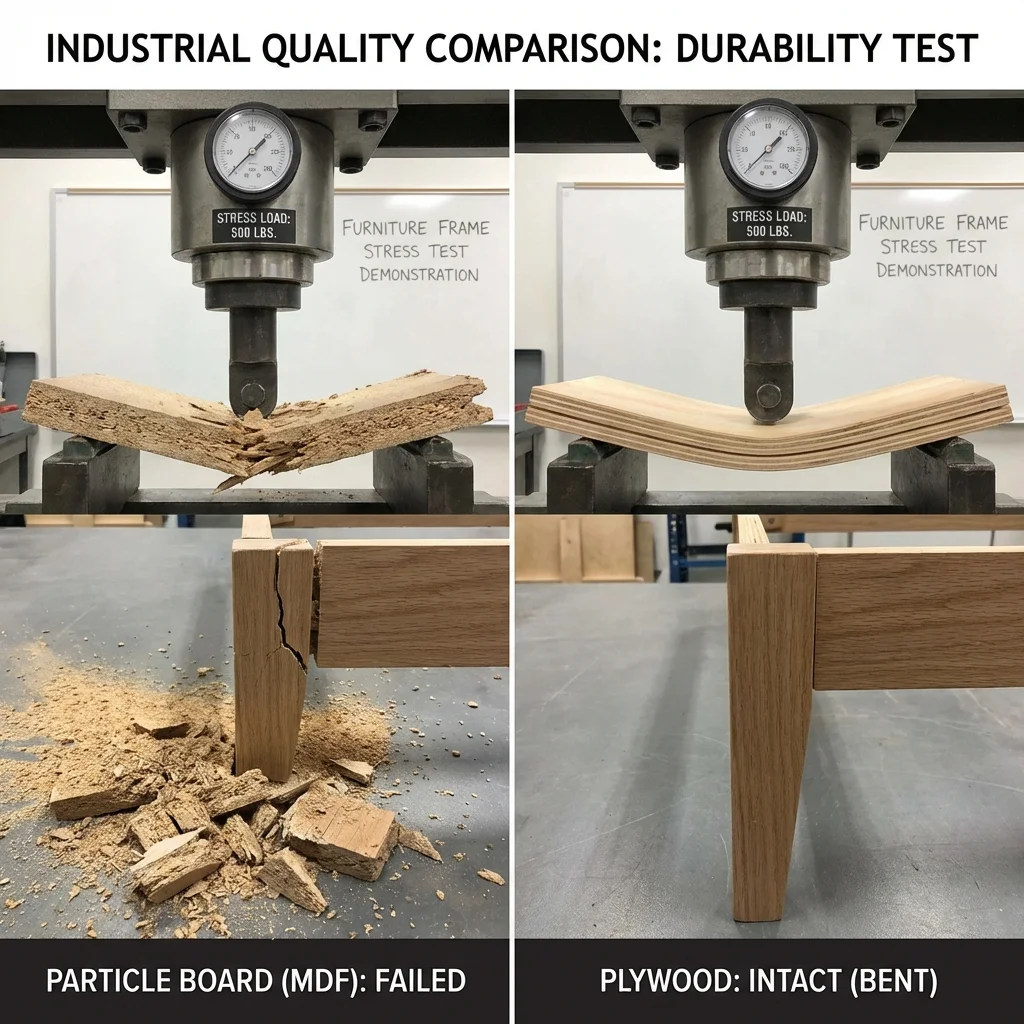
When I say I avoid particle board in a sofa frame, I am not being precious about materials. I am thinking about what happens after a couple of years of sitting, twisting, and moving the piece around, because that is when weak panel products start to show their personality.
Particle board usually fails in a way that is hard to fix. It does not “crack” like wood, it tends to crush and crumble around fasteners, which means screws and staples slowly lose their grip and a joint that used to feel tight starts to shift, then squeak, then wobble.
Plywood usually fails in a more forgiving way. Because it is real wood veneers stacked in alternating grain directions, the panel tends to resist splitting and it holds fasteners more consistently, so the frame is less likely to start loosening just from normal use.
What this means for you in a showroom is that you should stop thinking of particle board versus plywood as a lab chart and start thinking about the exact spots where the sofa is being yanked on. The front rail under your knees, the long side rails, the arm posts, and the corner blocks are where you want plywood, because those are the parts that get torqued every time someone sits off center or leans on an arm.
If you can get your hand under the front edge, I like to do a simple stress check that tends to expose particle board frames. I press up firmly on the front rail near one corner and then near the center, not trying to break anything, just trying to feel whether the rail feels solid and continuous or whether it flexes like a thin shelf.
If the sofa makes a dry crunching sound, or you feel a little give that does not feel like cushion give, I get suspicious. Particle board often telegraphs itself with that slightly gritty, collapsing feel when the structure is loaded, while plywood usually feels springy or stiff but not crumbly.
The other quick reality check is to look for fastener evidence. If you can see into the frame at all, I look for screws biting into something substantial, not just a row of staples shot into the edge of a panel, because particle board edges are exactly where staples loosen first.
When a salesperson says “it’s furniture grade particle board,” I treat that like a smoke screen and I steer the conversation back to outcomes. I ask, “If I remove and reinstall a screw in that joint five years from now, will it still bite, or will it strip out?” If they hesitate, that tells you what you need to know.
Moisture is the silent killer for particle board, and sofas see more moisture than people admit. Wet vacuuming, a spilled drink that runs down an arm, mopping near the legs, even humid basements, all of that can make particle board swell at edges and corners, and once it swells it rarely goes back to normal.
If you want a showroom clue for this, look closely at any exposed underside edges near the legs. If you see a slightly puffy edge, a rippled veneer, or a corner that looks like it has grown, I assume the core is a swelling prone board and I walk away, because that is usually an early warning of what your home will eventually do to it.
Plywood is not magic, and cheap plywood exists, but it usually gives you a better margin of safety in the exact ways sofas fail. When the frame gets racked, plywood tends to distribute the stress across layers, while particle board tends to concentrate stress right around the staple line or screw hole until it starts to crumble.
So when you are choosing between two sofas that feel similar on the floor, I would rather you pick the one that can prove plywood in the structural rails, even if the fabric is less flashy. I have learned that the pretty parts are easy to re love, but a frame that has started to loosen is the kind of problem you end up living with.
The “Count the Stripes” Test
When I can find an exposed plywood edge on a floor model, this is the quickest reality check I know. I call it the “count the stripes” test, because those stripes are just the layers of veneer, and the layer count tells you a lot about what kind of panel you are actually paying for.
I flip my phone flashlight on and look for a raw edge anywhere I can see it, usually underneath near the legs, inside a storage cavity, along the edge of a removable deck panel, or behind a zipper if the upholstery lets you peek in. I am not trying to dismantle anything, I just want one honest edge that the marketing cannot hide.
If what I see looks like three thick bands, maybe with a fuzzy soft core look in the middle, I treat that as construction grade behavior even if they call it “furniture plywood.” In a sofa frame, that usually means fewer, thicker plies, more chances of voids and weak spots, and edges that do not hold staples and screws as confidently over the years, which is exactly how you end up with looseness and noise later.
If what I see looks like a stack of many thin, crisp stripes, something closer to a tight sandwich of layers, that is when I start to relax. When people say “Baltic birch,” this is the look I associate with it, lots of thin plies that tend to be more consistent, and that consistency is what makes joints stay tight longer.
I do not actually stand there counting every layer like a lab tech, but I do use the extremes as a gut check. A chunky looking edge that reads like three obvious slabs is a warning sign for me, and a fine, even, many ply edge is a green flag, especially if I am looking at a long rail or a structural panel near a corner.
The other thing I watch for while I am staring at that edge is whether the stripes are even and continuous. If I see gaps, dark cavities, or spots where it looks like the glue line bridges over nothing, I assume voids, and I stop believing claims about “strong joinery” because the fastener has to bite into real wood to matter.
If a salesperson is hovering, I use the edge I found to force a specific statement. I will point and ask, “Is this the same plywood used in the long side rails and the front rail, or is this just a non structural panel?” If they cannot answer, I assume the good material, if it exists, is being saved for the least important parts.
Sometimes you will not find an exposed edge at all because the sofa is fully wrapped and dust covered. In that case I treat the absence of evidence as a reason to lean harder on written specs and direct questions, not as a reason to trust the brand vibe.
When I cannot verify it visually, I ask for one plain commitment: “Is the structural frame multi ply hardwood plywood throughout the seat box rails, or are there any three ply panels or particle board components in those rails?” If they will not say it clearly, I move on, because the whole point of this test is that good materials are usually something they are proud to describe precisely.
Technical Summary: The Spec Sheet Demand
When I am close to buying, this is where I stop doing vibe checks and start demanding a spec sheet answer. I am not afraid of the word “plywood” at all, because it is at least a real, checkable material, and it usually means the maker expects the frame to take twisting without turning into a noise machine.What I am afraid of is “composite,” because in furniture that word often means a blend of whatever is cheapest that week. In a showroom, “composite” is the label I hear right before someone asks you to trust them instead of showing you what the rails and joints are actually made from.
The exact phrasing I push for is “7 ply or higher kiln dried hardwood plywood” for the structural frame, especially the long side rails and the front rail under your knees. I am not clinging to the number like it is magic, I just want a clear, written commitment that it is multi ply hardwood plywood and not a thin panel product hiding behind a friendly term.
If the salesperson claims that level of plywood, I ask them to show me where it is written, on a cut sheet, a manufacturer spec, or a warranty document that lists frame materials. If they can only say it out loud but cannot point to it, I treat it like marketing, because the truth is usually easy to print when it is good.
When I can get a species name, Baltic birch is the one that makes me relax the most. The reason is practical, not romantic, it tends to be consistent and void free, which is exactly what keeps fasteners from landing in hollow spots and joints from loosening later.
Even if the frame really is good plywood, I still do not let them skip joinery. I want to hear that the corners are corner blocked, meaning there is an actual block reinforcing the inside corner where stress concentrates, and I want to hear double doweled at key joints, meaning the parts are mechanically aligned and locked together instead of just being stapled and prayed over.
Here is how I translate that into showroom action. I ask, “Are the seat box corners corner blocked, and are the main rail to post joints double doweled, or is it mostly staples and glue?” If they cannot answer that clearly, or they start talking about the fabric or the brand history instead, I assume the frame is not something they want examined closely.
Explore Technical Reference
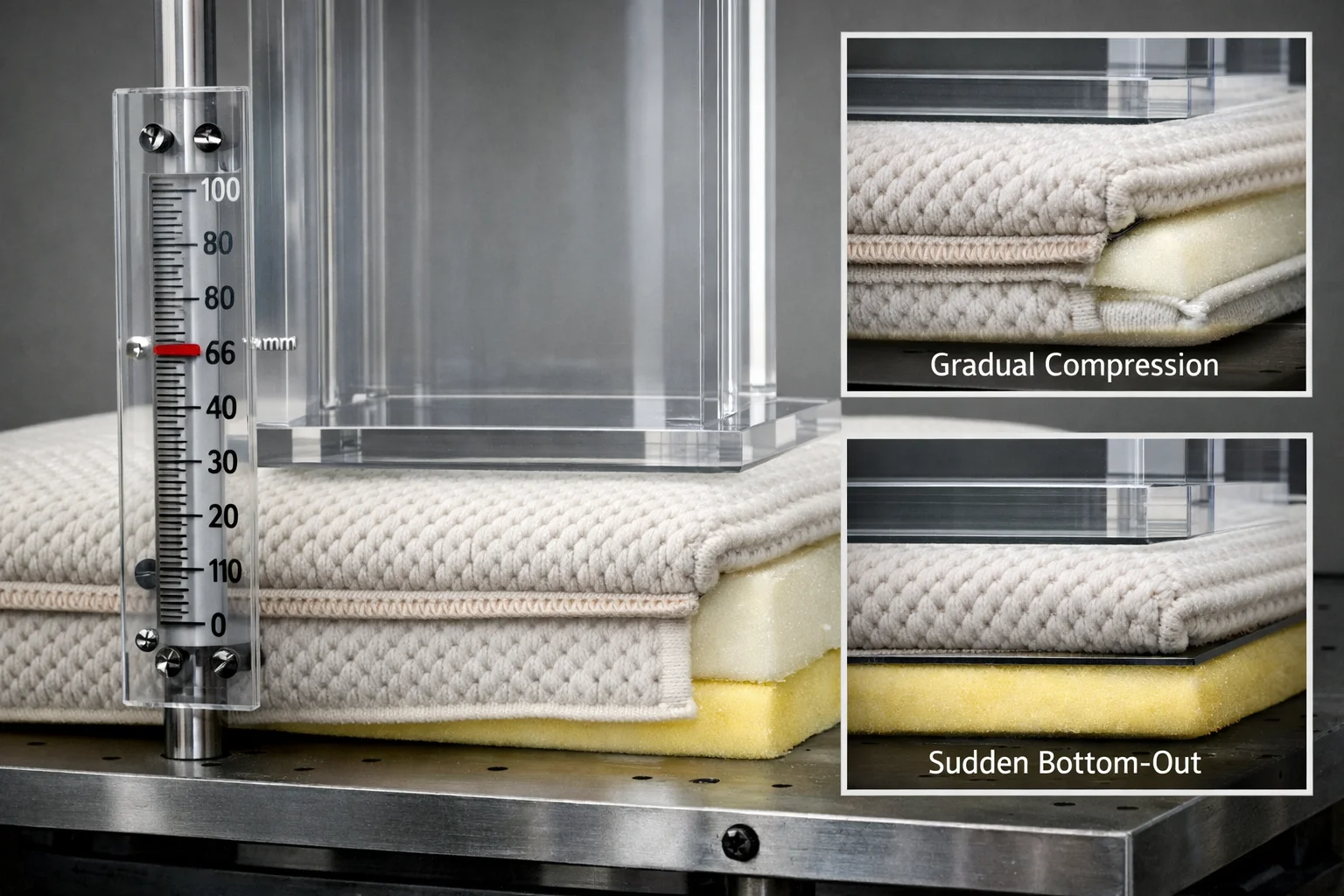
Cushion Construction: Why Multi-Layer Design Matters
Understanding the sandwich approach to cushion engineering. Why single-layer foam fails and how manufacturers stack layers for both comfort and support.
Analyze Details →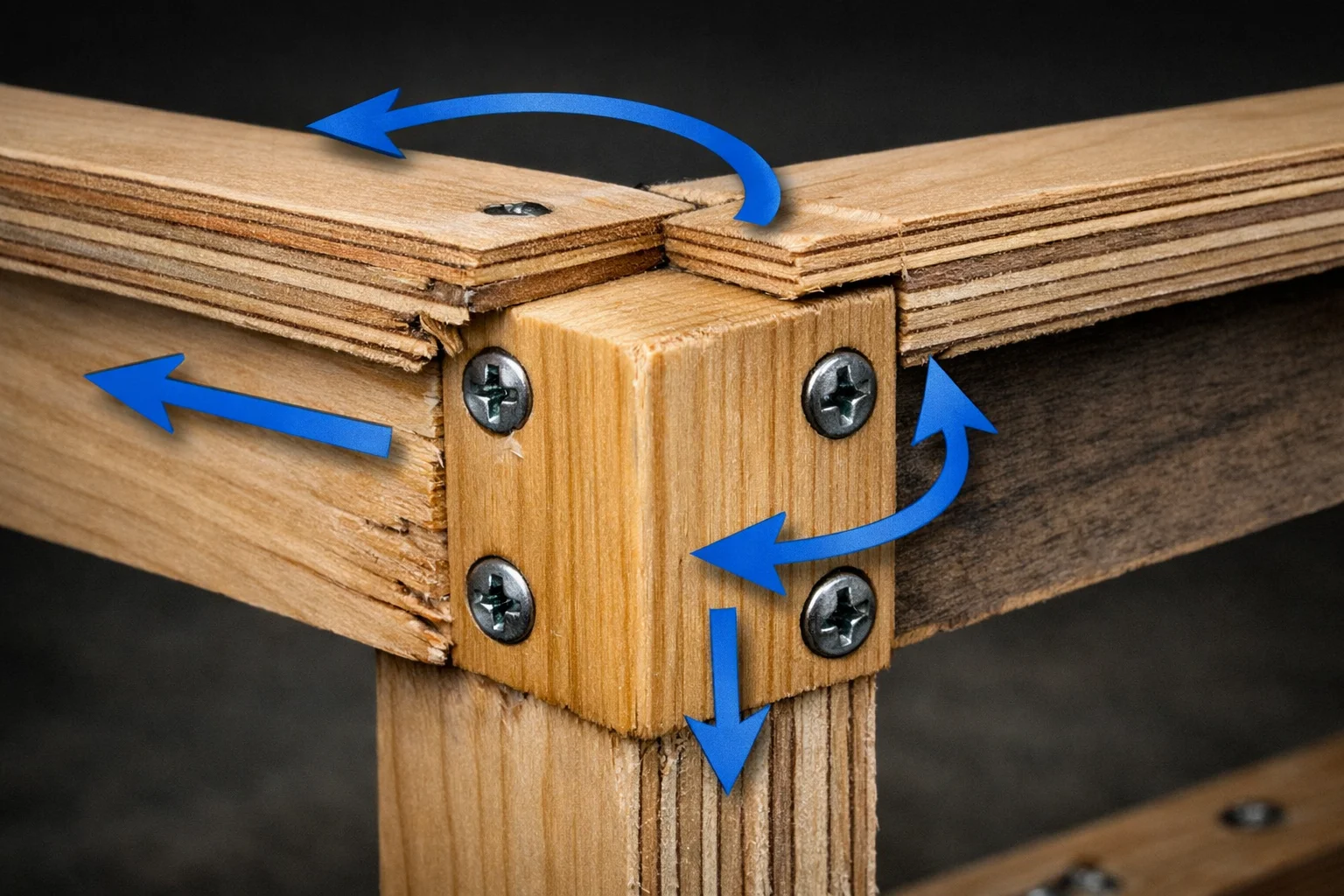
Engineered Wood Frames: Why Plywood Beats Solid Wood
Understanding why high-quality plywood can outlast solid pine. The critical difference between multi-ply laminates and particle board in furniture construction.
Analyze Details →