Foam Density vs. Firmness: Decoding the "4-Digit" Specs
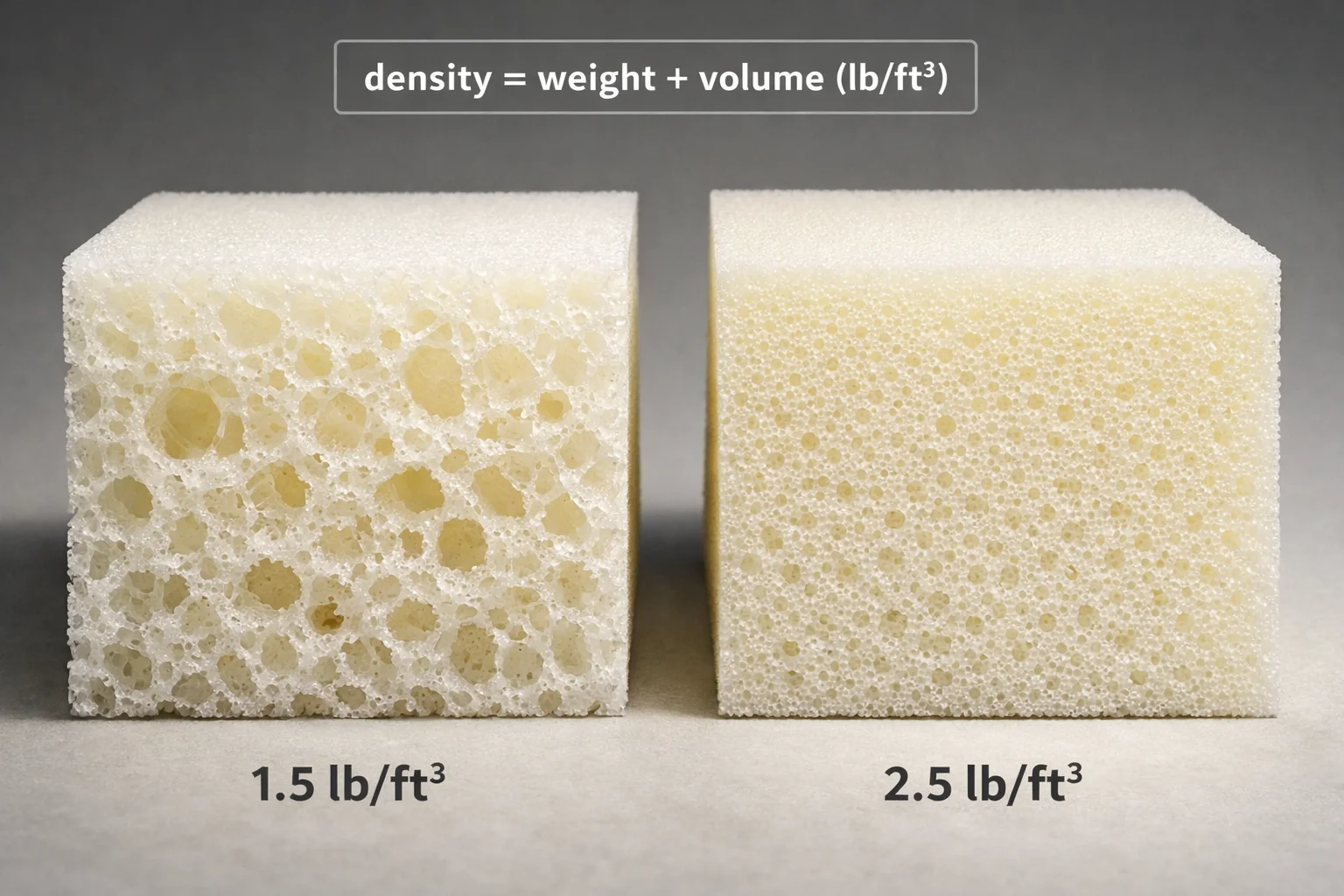
Foam Density Is Not Firmness: The Foundational Lie
I have learned the hard way that “firm in the showroom” is not the same thing as “still supportive in two years.” The industry benefits when you assume those two are connected, because firmness is easy to sell in a ten second sit, and durability is what costs money.
Density is simply how much foam material exists in a given volume, and it is usually described as pounds per cubic foot. More material generally means thicker internal walls and more structure to share the load, which is why density is the durability clue, not how firm it feels today.
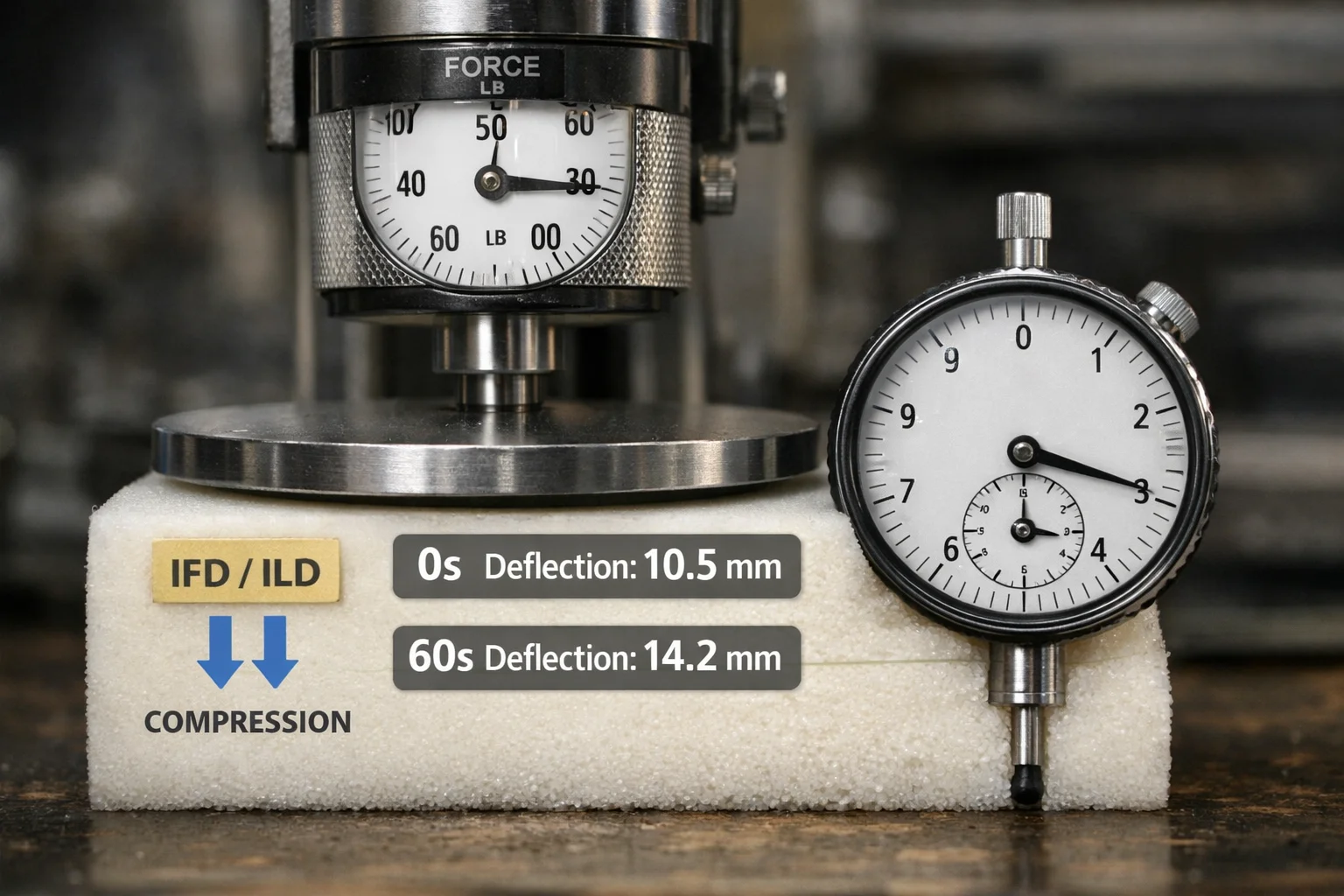
Firmness is a separate spec, often described as IFD or ILD, and it is basically how much force it takes to compress the foam a set amount. A manufacturer can make a low density foam feel surprisingly firm at first by tweaking how the foam is made, so you can get that “supportive” first impression without getting the long term resilience that comes from having more actual material.
Here is what I want you to do in a showroom, because it cuts through the sales talk quickly. When you sit, do not just drop down and pop back up, stay put. Give it a full minute, then shift your weight side to side and notice whether you start finding the hard layer underneath or whether the cushion still feels like it is holding you up evenly.
Then press with your hand, but do it slowly and hold the pressure for a few seconds. Cheap foam often fights you at first, then keeps sinking, and it is that slow creep that tends to show up later as the “why is my favorite spot sagging” problem.
You should also ask a direct question that forces a real specification instead of a vibe. I ask, “What is the seat foam density in pounds per cubic foot, and is that for the core or just the topper layer?” If they cannot or will not answer, I treat it as a warning sign, because reputable brands have this in a spec sheet even if the salesperson does not love talking about it.
If they tell you it is “high density” but refuse the number, assume it is not high. If they give you a number that sounds like it belongs in mattress marketing instead of upholstery, ask them to show you where it is written, because density is a weight per volume measurement, not a trademarked comfort story.
I also watch for constructions that make a cushion feel firm on the floor but do not reflect normal use. A cushion sitting on a rigid platform, a very taut cover, or a thin firm layer on top of softer stuff can all create that crisp first sit, while the lower quality foam underneath is what actually carries you every day.
If you already own the sofa, or you are buying used and you can unzip a cushion, you can do a basic reality check at home. You can weigh the insert and measure it, then calculate density as weight divided by volume, and if it lands under about 1.8 pounds per cubic foot for a daily use seat, I would not expect it to hold up no matter how firm it started out.
I am not telling you to chase a single magic number, because other factors matter, but I am telling you not to let firmness substitute for specs. The moment you separate “how it feels right now” from “how it will handle years of compressions,” you start shopping like someone who will not be surprised later.
Decoding the 4-Digit Foam ID Code (Example: 1835)
When I see a code like 1835, I treat it like the closest thing to an honest label in a sofa store. The trick is that it is not one number, it is two different ideas shoved together, and salespeople often talk about it like it is all “firmness” because that keeps you focused on how it feels today.
The first two digits tell you density, not firmness. In 1835, the 18 means 1.8 pounds per cubic foot, which is basically how much actual foam material is in that cushion, not how stiff it feels when you first sit down.
If you take only one practical thing from this section, let it be this. Density is my durability shortcut, because more material usually means more internal structure to resist tearing and permanent flattening after thousands of sit downs. That is why a sofa can feel great in the showroom and still turn into a saggy “favorite spot” later if the density was low.
So when you spot 18, 20, 22, 25, or 28 as the first two digits, you can compare those across brands in a way that “premium comfort” never lets you. If the store will not tell you the density, I assume it is because you would not like the answer, and I push for a spec sheet or I move on.
The last two digits are ILD, which is a firmness measurement taken under a specific test, typically at 25 percent compression. In 1835, the 35 means it takes a certain amount of force to compress the foam sample down to that test point, and it is commonly referenced under standards like ASTM D3574.
What I want you to remember is that ILD is a snapshot, not the whole movie. Two cushions can both be “35” and still behave very differently when you sit for an hour, when you slouch into a corner, or when you bottom out into the support layer, because the foam can stiffen up differently as it compresses deeper.
This is where people get fooled, and I have been one of them. A low density foam can be made to hit a showroom-friendly ILD and feel impressively firm at first, but it can also lose that feel faster because there is less real structure inside to survive daily flexing and heat.
So if you are comparing two sofas and you manage to get the codes, I read them like this. I look at the first two digits as the “how long will it stay itself” clue, then I look at the last two digits as the “how firm will it feel at first” clue, and I refuse to let the second part distract me from the first.
If a salesperson tells you the sofa has “1835 foam” and tries to close the sale on that alone, I ask a follow up that changes the conversation. I ask whether that code describes the main seat core, or only a thin top layer, because a decent topper over a cheap core can still be a cheap core, and that is the part that collapses into a hammock.
If they cannot produce the code, I ask them to check the cushion label, the factory order sheet, or the spec page. The reason I push is simple: once you can see 1835 versus something like 2835, you can make a real cross-brand comparison without trusting anyone’s adjectives, and that is exactly why these codes are so often kept out of sight.
1.8 lb Foam: The Industry’s Disposable Standard
When you hear “1.8 lb foam,” that is not firmness, it is density, meaning how much actual foam material is packed into a cubic foot. I treat 1.8 as the industry’s default “good enough to sell” level for a daily use seat, not a level chosen because it will still feel good after years of sit downs.
What I have noticed is that 1.8 often feels great at first, sometimes even better than denser foams, because it can be made to feel plush and welcoming in a quick showroom test. The catch is that this comfort can come from a structure that has less material doing the work, so the cushion has less reserve when the daily abuse starts adding up.
If you want the practical translation, 1.8 is where I start assuming the chemistry and build choices are being optimized for cost and shipping efficiency more than long term resilience. Density is not the only thing that matters, but when I see 1.8 as the core in a sofa meant for everyday use, I stop giving the brand the benefit of the doubt.
This is also why 1.8 became so common, it tends to clear the showroom test. It keeps the sofa from feeling like a rock, it hits a nice first impression, and it helps the manufacturer control materials and weight.
If you want a buying move that actually works in a store, you have to force the conversation away from “it feels supportive” and toward “what is the seat made of.” I ask, “Is the main seat core 1.8 lb density, or is that just the top layer,” because a thin nicer layer over a cheaper core is one of the easiest ways to make a sofa feel impressive for a minute and disappointing a year later.
Then I sit in the exact same spot longer than feels socially normal. After a minute or two, I pay attention to whether I am sinking closer to the deck, springs, or platform, and whether I start feeling a harder, flatter layer underneath that was not obvious at first.
If you can do a hand test, do it at the front edge of the seat where people slide in and out, because that area usually fails first. I press down slowly with the heel of my hand and hold it, and I am looking for that delayed sinking feeling, where the foam keeps giving after the initial resistance.
The failure timeline on 1.8 lb foam is not usually dramatic, it is slow and annoying. In real life, I expect many 1.8 lb seat cores to feel meaningfully less supportive somewhere around the three to five year mark, even if the cushion still looks “fine,” because the problem you feel is loss of support, not the foam turning to dust.
This is the part that makes people think they are imagining it. The cushion “breaks in” quickly, and that early softening can feel like normal settling, but it can keep creeping until your hips start bottoming out, and then the whole sofa suddenly feels cheap even though nothing looks torn.
I also want you to be cynical about warranties here, because the paperwork is often designed around visible defects, not the comfort failure you actually care about. A brand can deny you while you are clearly uncomfortable by calling it “normal softening,” because proving comfort loss is messy, and warranty language is usually written to avoid that fight.
So when a salesperson points to a long cushion warranty as proof of durability, I ask one more question that changes the meaning of the promise. I ask, “What counts as a defect for the seat foam, and how much softening or height loss is considered normal,” because the gap between “feels bad” and “qualifies for coverage” is where a lot of buyers get trapped.
If you are comparing two sofas and one is 1.8 lb in the seat core while the other is clearly higher, I treat that as a real durability difference, even if the 1.8 feels nicer today. I am not telling you that 1.8 automatically means the sofa is trash, but I am telling you that if you buy it for daily lounging, you should do it with your eyes open and your expectations set accordingly.
When I am stuck with a 1.8 option because of budget or a specific style, I at least try to reduce the risk by checking whether the cushions are loose and replaceable, and whether the covers unzip so I can swap inserts later. If the cushions are attached, sealed, or oddly shaped so replacements are a hassle, then 1.8 stops being “maybe acceptable” and starts looking like a planned future headache.
If you want deeper background on how flexible polyurethane foams age, the American Chemistry Council’s polyurethane resources can give you the official, chemistry focused view. For shopping, I keep it simple: 1.8 is where I assume the sofa will ask you to pay for it twice, once at the register and again when your body starts avoiding that “favorite spot.”
2.5 lb Foam: The Real Gold Standard
When I say 2.5 lb foam is the gold standard, I am not talking about some luxury “feel.” I mean it is a durability threshold where the foam has enough actual material inside it to behave like a structure, not just a soft filler that is waiting to pack down.
In plain shopping terms, 2.5 lb seat foam is the point where I stop expecting the cushion to suddenly lose its personality after a few years. It still breaks in, but it tends to do it slowly and evenly, instead of developing that one dead “favorite spot” that makes you start perching on the edges.
What changes at 2.5 is how the load gets handled. When you sit, your weight gets spread across more of the foam’s internal structure, so you are less likely to crush one small zone into a permanent dip.
This matters most if you actually live on your sofa, if you sit in the same place every night, if you nap, if you curl up in a corner, or if more than one person uses it hard every day. Those are the situations where lower density foams start showing their weak spots, because the foam takes the hit in the same areas over and over.
I also care about how it fails. A better foam usually gives you warning, it gradually feels less supportive, and you can tell it is changing, while cheaper foam often seems fine until it crosses a line and then the cushion feels “done” in a way you cannot ignore.
In a showroom, the annoying part is you cannot see density by touching the fabric. So I treat 2.5 lb like a paperwork hunt, and I make the salesperson either produce a spec or admit they do not have one.
When I am shopping, I ask it in a way that boxes them in politely. I say, “Is the seat core foam 2.5 pounds per cubic foot or higher, and can you show me that in the spec sheet or on the cushion tag.” If they answer with “high density,” “HR,” “premium,” or “luxury,” I repeat the question and wait for a number.
I also make sure we are talking about the seat core, not a thin comfort wrap. You can put a nice layer on top of a cheaper core and it will still feel good for a while, but the core is what carries you day after day, and that is what decides whether the sofa turns into a hammock.
If the brand uses foam ID codes, I look for something that starts with 25, like 2535, because those first two digits are the density clue. If they only have a generic description and no code, I ask them to look up the build sheet for that exact configuration, because “this model usually has” is how you end up buying the cheaper version by accident.
Then I do a sit test that is designed to catch the stuff that collapses under time, not just the stuff that feels firm at first. I sit all the way back, stay there for at least a full minute, and pay attention to whether my hips keep sinking slowly after the first contact, because that slow creep is what becomes long term sag.
I also press down hard with my hand and hold it, then I watch how the foam comes back. With better foam, I usually see the surface return more evenly, without a lingering dent or a delayed “memory” spot where it stays low.
If you want a really useful place to test, do not only test the middle. I press and sit near the front edge where you slide in and out, because that edge takes concentrated stress and it is often where cheaper foam gives itself away first.
You should expect 2.5 lb foam to cost more, and I have stopped treating that as a ripoff when it is real. If a sofa is priced like it is using better materials but the store cannot tell you the seat foam density, I assume the price is going into the look, not the parts that keep your back and hips supported.
One more thing I do, because I have been burned by “contract grade” language. If someone claims it is contract seating foam, I ask which part is contract grade, the seat core, the back, or just the fabric, because I have seen sofas where only the marketing is heavy duty.
If you already own the sofa and you are trying to figure out whether it is holding up, I keep it simple. I measure seat height from the floor to the top of the cushion in the same spot every month or two, and I write it down, because visible height loss is one of the clearest signs the foam is taking a permanent set.
I also compare the main sitting spot to a spot nobody uses, like the far corner, because the difference tells you more than your memory does. If your usual spot is noticeably lower or feels flatter even after you rotate cushions, that is your foam telling you it has started to give up its structure.
If you can only afford one upgrade in a sofa, I would rather you pay for a real 2.5 lb seat core than pay for a nicer fabric over a disposable cushion. Fabric wears out slowly and you can live with it, but when the seat stops supporting you, the whole sofa becomes a daily irritation no matter how good it looks.
The Durability Threshold
If there is only one number you remember from this guide, make it 1.8 lbs. For a daily-use sofa, anything under 1.8 lbs per cubic foot is essentially disposable. If you can move the budget up to 2.5 lbs, you are moving from a 3-year product to a 10-year product. The initial price might be 20% higher, but the cost-per-year of use drops significantly.Molecular Architecture of Polyurethane Foam
When you hear “polyurethane foam,” it is tempting to think it is all the same stuff with different firmness. I have stopped thinking of it that way, because the long term outcome is heavily driven by how much actual polymer network is inside the cushion and how that network is stitched together.
At the most basic level, cushion foam is plastic chains linked into a springy 3D net, with a lot of trapped gas creating the bubbles you compress. The foam that lasts is usually the foam with more real material forming more connections, so the load is shared instead of concentrated in a few stressed strands.
Polymer Chains and Cross-Link Density
Marketing loves to say “high resilience,” but what I care about is whether the foam has enough internal junction points to keep its shape after thousands of sit downs. When density goes up, you generally get more polymer per cubic foot, and in plain English that usually means more places where the structure can act like a net instead of a few thin ropes.
In the store, you cannot see “cross links,” but you can test for the behavior they create. I sit for a full minute and pay attention to whether the cushion stabilizes and holds me, or whether it keeps slowly letting me sink as the chains slip and the structure creeps.
Lower density foams often have more air and less load bearing polymer, and the ugly part is what happens over time. Those thinner load paths take more stress in the same few spots, and they start breaking down from repeated flexing and everyday oxygen exposure, which is why the cushion can go from “fine” to “why does this feel dead” without anything looking obviously ripped.
If you want a buying move that matches this reality, I ask one question that forces the store to admit what kind of network you are paying for. I ask, “Is the seat core foam a higher density formulation, or is the density only in a thin topper layer,” because a pretty top layer does not stop the deeper core from getting chewed up.
Cell Wall Thickness and Elastic Recovery
Foam durability is not just chemistry, it is also geometry. Foam is a lattice of tiny walls and struts, and when those struts are too thin, they fatigue, crack, and stop springing back, which is when you get that permanently tired spot that never quite rebounds.
This is why I do a slow press and release test with my hand in a few different areas, especially the front edge where people slide in and out. I press down gradually, hold for a few seconds, then let go and watch whether it returns cleanly and evenly, or whether it leaves a delayed dent that lingers like it is struggling to re inflate.
I also pay attention to heat and “deadness” during a longer sit. When foam starts losing elastic recovery, more of your movement turns into heat and less turns into bounce back, and you feel it as a cushion that absorbs you instead of supporting you.
Why Density Slows Degradation
I treat density as a durability shortcut because it usually means more polymer mass, more load paths, and thicker internal struts sharing the work. That does not make the foam immortal, it just delays the point where wear accelerates and the cushion starts degrading faster because it is already softened.
You can see the start of that runaway effect in the showroom if you know what you are looking for. If a seat feels supportive on first contact but then keeps settling and warming under you, I assume it is using its structure up quickly, and I stop letting the fabric, styling, or initial plushness talk me into it.
If you want to connect this section back to shopping decisions, here is the mindset that has saved me money. I treat higher density as buying more internal scaffolding, not buying a specific feel, and I make the salesperson prove the seat core density on paper, because the foam that holds up is the foam that has enough structure to keep acting like a springy net after years of being crushed.
Open-Cell Foam and the ‘Lung Effect’
Open cell seat foam does something most people never think about. Every time you sit down, shift, or bounce a little, the cushion is basically breathing, pushing air out when you compress it and sucking air back in when it rebounds.
That matters because the inside of foam is not a smooth block, it is a huge maze of tiny internal surfaces. When air is being pumped through that maze all day, the foam is constantly getting fresh oxygen and whatever humidity is in your home, and those are two things that help aging along.
In a showroom, I use this as a reality check on “breathable” sales talk. If someone praises breathability like it is automatically a premium feature, I mentally translate it to “this cushion is going to inhale and exhale thousands of times,” and then I get very serious about density and construction, because low density open cell foam tends to move air more easily.
You cannot measure airflow in a store, but you can feel the kind of foam that tends to have that fast bellows behavior. When you sit down and the cushion compresses very easily at first, then you feel a quick whoosh of give before it stabilizes, that often lines up with foam that has a lot of open passageways and not a lot of material doing the work.
If you want a simple test, I sit, hold still for a few seconds, then stand up and immediately press the same spot with my hand. If it feels like it rebounds fast but also feels a little hollow or “spongey” rather than supportive, I treat it as a sign I should not accept vague answers about what the core foam actually is.
This is one of those moments where density stops being a nerd detail and becomes your protection. If the salesperson cannot tell you the seat core density and only talks about comfort, cooling, or breathability, I assume I am being sold a sensation, not a durable build.
Breathability also has a less obvious downside: it carries moisture into the cushion. If you live somewhere humid, if you have kids and spills happen, if you sit on the couch after workouts, or if you run a blanket on the sofa most nights, you are giving that foam more water to pull in and hold.
I have learned to pay attention to the cover and the cushion design because they decide whether that moisture can leave. If the seat cushion is wrapped in a waterproof liner, or the cover fabric feels like a tight synthetic that does not vent much, the foam can still pump air, but moisture can get trapped longer, and odors tend to show up sooner.
If you are shopping, I would rather you choose removable seat cushions with zippers you can actually access than a sealed, upholstered seat deck, especially if the sofa is pitched as plush or very sink in. The ability to unzip and air out a cushion, or replace an insert later, is not a luxury, it is a way out if the foam starts smelling musty or starts feeling tired.
Heat makes all of this worse, and this is where placement becomes part of durability. A sofa that sits in direct sun, near a radiator, or right over a floor vent is getting warmed up and cooled down over and over, and that cycling pushes more air exchange and speeds up the kind of slow breakdown that shows up as crumbling, dusting, or sudden loss of support.
When I am in a showroom, I do not just ask about the foam, I ask how the sofa is likely to live in my room. If your sofa is going to sit in a sunny spot, you should treat higher density in the seat core as even more important than you otherwise would, because heat plus daily compression is a brutal combination for cheaper foam.
If you already own the sofa and you are trying to slow aging, I have had the best luck with boring habits. I keep the sofa out of direct sun when I can, I rotate reversible cushions, I occasionally unzip and let inserts breathe if the design allows it, and I clean spills in a way that dries the cushion fully instead of just making the surface look fine.
The buying takeaway I want you to keep is simple. Open cell foam is supposed to be open, that is how most cushion foam works, but once you understand the “lung effect,” you stop falling for breathability as a pure upgrade and you start treating it as a reason to demand real specs, especially the seat core density and whether the cushions are replaceable.
Oxidation and the Dusting Death
Foam failure rarely announces itself honestly. When you finally see yellow dust, it is not the start of the problem, it is the end of a long collapse that has been happening inside the cushion for years.
What is actually happening is boring chemistry with a very real shopping consequence. Oxygen slowly attacks the foam’s internal structure, and it starts by stealing rebound, meaning the cushion stops springing back crisply after you get up.
If you do one thing differently in a showroom, make it this. Do not only judge how a cushion feels when you sit down, judge how it behaves when you stand up. If the cushion stays squished for a few seconds, or you can still see your “butt print” as a slow fading dent, I treat that as foam that has already started losing integrity, even if it still looks smooth under the fabric.
I also pay attention to a weird little tell, sound. When I press down slowly and I hear faint crackling, like cellophane or dry leaves deep under the upholstery, I assume internal cell walls are breaking and rubbing, and I stop letting anyone tell me it is “just break in.”
The dusting phase is what people notice because it is visible, but by then the cushion is already failing at its job. The foam is no longer spreading your weight across the whole seat, it is forcing your body weight into a few stressed paths, which is why you start feeling the deck, the springs, or the hard frame edge in the same spot.
This is also why I do not accept the argument that “you can always replace the foam later” unless the sofa is clearly built for it. If the seat is attached, the cover does not unzip, or the cushion shape is custom and hard to match, the moment dusting shows up you are not looking at a simple refresh, you are looking at either an upholstery job or living with a dead seat.
Sunlight and heat speed this up, and I have watched it happen. If your sofa is going to live in a bright window, a sunroom, near a radiator, or over a floor vent, you should treat foam durability as a bigger deal than you would in a shaded room, because warmth and UV exposure push the same chemical aging that eventually turns into that yellow powder.
In a store, this is where I connect materials to your actual room instead of just your taste. If you know the sofa will get sun, I would rather you choose a model with removable seat cushions you can unzip and swap later than a sleek fixed seat that looks clean but gives you no exit when the foam cooks itself over time.
Density still matters here, and this is one of the reasons I keep pushing you to get the number. Higher density foam generally means there is more actual material forming the internal walls, so there is more structure to lose before it turns fragile, and the cushion tends to resist that slow oxygen driven thinning longer.
Marketing will keep trying to steer you toward firmness because firmness is immediate. Oxidation is invisible during most warranty periods, and that is why I treat a spec sheet like protection, not trivia.
If you already own a sofa and you are trying to diagnose what is happening before it gets messy, I do a simple “thumb audit” in the spot you sit the most. I press my thumb into the cushion with the seat unweighted, I hold it for a moment, then I let go and watch how quickly and fully the surface returns. If it is slow, if it leaves a lingering low spot, or if it feels oddly dead compared to a rarely used cushion, I assume the foam has already started its slide.
If you want the hard truth I wish someone had told me earlier, once foam starts doing the slow rebound thing, there is no cleaner that fixes it and no fluffing that restores it. At that point, the honest fix is replacement foam, and the buying lesson is to choose a sofa that either uses a seat core you trust on paper, or at least gives you access, zippers, and standard shapes so you are not trapped when the chemistry catches up.
Hydrolysis: Humidity Rot From the Inside Out
Hydrolysis is the failure mode I wish more shoppers knew about, because it can ruin a cushion that still looks totally fine. I am talking about humidity damage that happens inside flexible polyurethane foam, where the structure quietly gets weaker long before you see dusting or tearing.
What makes this sneaky is that a lot of “premium” seat cushions use polyester based polyurethane because it is cheaper to make and it can feel softer and more inviting right away. That initial softness gets marketed as luxury, but in a humid home it can also be the start of the early “broken in” feeling that turns into collapse.
Water Molecules vs Ester Bonds
Here is the practical translation: some foams are simply more sensitive to humidity than others, and you cannot reliably feel the difference in a five second sit. In polyester polyurethane, moisture in the air can slowly break the internal links that give the foam its strength, so the cushion loses rebound and tear resistance from the inside out.
What this looks like in real life is a cushion that seems to soften “for no reason.” It can keep its shape under the cover, it can still look full from across the room, but when you sit you notice your hips sinking deeper than they used to and you start finding the harder layer underneath more often.
In a showroom, I handle this by forcing a materials conversation that most sales scripts try to avoid. I ask, “Is the seat core foam polyester based polyurethane or polyether based, and do you have that written in the spec sheet,” because if they cannot tell you the foam type, they also cannot tell you how it tends to age in humidity.
If the salesperson looks confused, I simplify without backing off. I say, “I am trying to avoid seat foam that breaks down faster in humid homes, can you check the build sheet for the foam type,” and then I wait through the awkwardness.
If you want the chemistry reference for why polyester type foams tend to be less hydrolysis resistant, this overview from a major raw materials company explains the concept without being too hand wavy: What is polyurethane. I do not use that link to win an argument in the store, I use it so I do not get talked out of asking the right question.
Climate Zones and Failure Rates
I have noticed this problem tracks humidity more than temperature. If you live where the air stays damp for long stretches, the cushion spends more time “wet enough” internally for the slow breakdown to keep moving, even if your room feels comfortable.
If you live in a dry climate, you still want good foam, but you can often get away with a little more because the cushion has more chances to dry out between uses. If you live in a hot humid climate, I treat the seat foam spec as a bigger deal than fabric, legs, or almost any styling detail, because a pretty sofa with humidity sensitive foam is just a slow disappointment.
This is also why I care about density even more in humid areas. Denser foam usually slows how fast moisture works its way into the deepest part of the cushion, so it can buy you time before the “soft from the inside” phase becomes obvious, even if it does not magically stop the chemistry.
In a store, my best humidity reality check is to do the long sit you have already been doing, then add a second step. I stand up, immediately sit back down in the same spot, and pay attention to whether the cushion feels like it is getting easier to compress with each cycle, because moisture weakened foam tends to feel more “gel like” and less springy under repeated compressions.
Why Coastal Homes Eat Foam
If you live near the coast, I would be extra cautious about anything described as plush, cloud, sink in, or ultra soft, unless the seat core is clearly specified and the cushions are clearly replaceable. Coastal air stays humid, mild temperatures keep the foam in a comfortable range for that slow internal breakdown, and the covers and seams can stay just damp enough for long enough that the foam never really gets a deep dry out.
In a showroom, this is where I stop treating zippers as a nice feature and start treating them as a risk control. I unzip the seat cushion if they will let me, I look for a real inner liner and a normal insert shape, and I make sure it is not some sealed, glued, odd shaped insert that will be a nightmare to replace later.
If you cannot access the insert, I compensate by getting stricter about documentation. I ask for the written foam density and the foam type for the seat core, and if they cannot provide it, I assume I am being sold a pleasant first impression that will not survive my climate.
If you are trying to protect a sofa you already own in a humid home, I have had the best results from drying habits rather than products. I make sure spills get dried all the way through instead of just blotted on the surface, I avoid leaving thick throws on the seat all the time if the room runs damp, and when I can unzip cushions I occasionally let the inserts breathe in a dry room so the moisture does not live inside the foam.
The buying takeaway I want you to hold onto is that hydrolysis is comfort loss without visible warning. If you are in a humid or coastal area, you should treat “soft and luxurious” as a reason to ask harder questions, not a reason to relax, because the cushion can be failing chemically while it still looks showroom perfect.
Compression Set Explained (ASTM D3574)
When you see a sofa seat “go flat,” what you are usually feeling is not just softening, it is thickness that never came back. Compression set is the lab way of describing that, it measures how much foam fails to rebound after it has been compressed for a set time and then allowed to recover.
I care about this spec because it matches the real world failure I actually hate, the cushion that looks mostly fine but sits lower, bottoms out sooner, and keeps getting worse in the same spot. In plain language, compression set is the difference between foam acting like a spring that returns, and foam acting like a ratchet that collapses and stays collapsed.
In the store, nobody wants to talk about it because it ruins the “plush equals premium” pitch. A cushion can be made to feel amazing on day one by using foam that is easier to compress, and the easiest way to do that is often less durable structure inside the foam.
If you do get a spec sheet, compression set is one of the rare numbers that is actually about tomorrow, not today. It is reported as a percentage, and lower is better because it means less permanent height loss after compression and recovery.
Here is how I translate the numbers into shopping decisions. If the seat foam is showing compression set under about 5 percent in relevant conditions, I treat that as a good sign that the cushion is built to rebound instead of pack down. If it is drifting up into the 8 to 10 percent range, I assume you are buying a slow motion comfort loss that will show up as a dead favorite spot even if the upholstery still looks clean.
I also watch for a common trick, quoting a reassuring foam density or a nice ILD, while skipping the part that tells you whether it holds its thickness. A cushion can be firm and still take a set over time, and once thickness is gone, you cannot “fluff” support back into existence.
You will probably not get compression set data from a typical retail salesperson, so I handle it like this. I ask, “Do you have the foam spec sheet with the compression set result for the seat core,” and I make sure I say seat core, not topper, not wrap, not “comfort layer.” If they cannot provide it, I do not argue, I just treat that as permission to be stricter about density, replaceability, and how the cushion behaves in a longer sit.
When I am trying to catch high compression set behavior with my own hands, I do a test that mimics what that ASTM number is warning you about. I sit in one spot for a full couple of minutes, then I stand up and immediately look at the cushion surface and feel it with my palm.
If I can still feel a low spot that lingers, or if the cushion seems slower and less “willing” to rise back up, I assume I am seeing the early version of permanent set. If the cover is tight and hides the shape, I press the spot I sat on and then press an unused spot, and I pay attention to whether the used spot already feels a little less tall and a little less buoyant.
I also do this near the front edge, because edge loading is where permanent set shows up early in real life. I press down slowly with the heel of my hand right where your thighs would sit, hold it there for a few seconds, then release and watch whether the foam springs back quickly and evenly or whether it hesitates like it is remembering the compression.
If you want a simple reality check you can do at home after purchase, I have used a ruler and a hardback book to catch trouble early. I measure the cushion thickness at rest in my usual sitting zone, I use the sofa normally for a couple of weeks, then I remeasure after the cushion has had an overnight recovery with nobody sitting on it.
If the thickness is measurably and persistently lower in the favorite spot, that is compression set showing up in your living room. At that point, rotating cushions can slow the unevenness, but it will not reverse what the foam has already lost.
What makes compression set so important is the feedback loop it creates. Once a cushion loses a bit of thickness, you start hitting the firmer layers underneath more often, your pressure concentrates in smaller zones, and the foam gets crushed harder in the same areas, which speeds up the next round of permanent set.
This is also where I connect it back to the buying decisions you can control. If you are choosing between a fixed upholstered seat and loose cushions, I lean loose cushions when I am worried about compression set, because you can rotate them, flip them if they are reversible, and replace inserts later without reupholstering the whole sofa.
If you are choosing between a mystery foam build and one with a clearly stated higher density seat core, I take the higher density almost every time, because it is one of the few clues you can reliably get at retail that tends to correlate with lower permanent set. I still want you to sit long enough to see whether it creeps downward under you, because that slow sinking is often the first hint that the foam is going to “ratchet” over time.
When a salesperson tells you “it will soften like all sofas do,” I agree with the first half and challenge the second half in a specific way. I ask, “Will it soften and rebound, or will it lose seat height,” because softening you can live with, but lost thickness is how a sofa starts forcing you into a slump and makes your hips search for the hard stuff underneath.
If you want the official standard that defines this test method, it lives under ASTM D3574, and you can read the public overview at ASTM D3574. I do not need you to memorize the lab procedure, I need you to use the idea behind it to shop like someone who cares about what the cushion looks and feels like after thousands of compressions, not after one impressive showroom sit.
HR Foam: High Resilience or High Marketing?
When a salesperson says “HR foam,” I do not hear “better.” I hear “maybe,” because HR is one of those labels that gets used like a compliment even when it is not backed by the numbers that make it real.
In actual testing language, HR has a meaning that is not about “plush” or “premium.” The common reference point is ASTM D3574, which is the same family of foam tests you have already seen me bring up for compression set, and the shorthand for true HR usually starts around 2.5 pounds per cubic foot density paired with a higher support factor, meaning the foam firms up more as you compress it deeper.
Here is why I care about that support factor in real life. A cushion that just collapses evenly can feel friendly at first, but it is the type that turns into a hammock, because it never transitions into real “holding you up” behavior when your hips sink in.
This is also where marketing plays games with your senses. “Resilience” gets sold as bounce, and bounce is easy to demonstrate in a store, but bounce on day one is not the same as staying supportive after a few thousand sit downs.
If you want a quick way to not get hypnotized by bounce, I want you to do a slow sit and a slow stand. If it pops back like a trampoline but you still notice that your hips keep finding the bottom layer during a longer sit, that is not the kind of HR performance you are paying for, it is just lively foam that may not have the structure to keep its shape.
When HR is real, I treat it as a structural layer, not the whole comfort story. The best use I have felt is HR as a seat core under a softer comfort layer, because it spreads the load and reduces that one crushed “favorite spot” problem.
When HR is used as basically the entire cushion stack, I get cautious. High rebound foam can shove energy back into the cover and seams every time you shift, and I have seen that show up as covers that look tired early, zippers that start creeping, and fabrics that get stressed in the same spots even when the foam itself still has some fight left.
Cost pressure is where “HR” turns into a word instead of a material. The move I watch for is a sofa described as HR, but the brand will not state the seat core density, or they only mention HR in the top layer and get vague about what is underneath.
If they claim HR, I ask a question that forces the claim to become specific. I ask, “Is the seat core actually 2.5 pounds per cubic foot or higher, and is it HR all the way through the core or just a thin layer,” and I ask them to show me the spec sheet, not a brochure sentence.
If they cannot show you anything in writing, I treat the HR label as decoration. I have learned that the foam that truly costs more is the foam they can name precisely, and the foam they avoid naming is usually the foam they saved money on.
You can also catch a lot with a simple “deep compression” hand test. I press slowly with the heel of my hand until I am well past the initial surface feel, and I am paying attention to whether the resistance builds as I go, or whether it just keeps sinking at the same rate like wet bread.
If you are allowed to unzip the cushion, I also pay attention to whether the insert looks like a deliberate stack, with a clear core and a separate comfort wrap, or whether it looks like one undifferentiated block. A real build usually looks intentional when you can see it, while a marketing build often looks like “one foam to rule them all.”
If you are the type who wants to do an at home reality check after you buy, you can do a rough density audit with a scale and a tape measure if the insert comes out. I do not treat this as lab grade accuracy, I treat it as a lie detector, because a seat insert that claims “HR” but works out closer to the 1.8 to 2.0 range is telling you what it really is.
What I want you to take away is that HR is not a luxury upgrade by default. It is a role specific material, and I only treat it as a positive when the brand can prove the seat core density on paper and the cushion build uses HR to carry load, not to create a bouncy first impression.
The Calcium Carbonate Filler Scam
Calcium carbonate sounds harmless, and it gets sold as “reinforcement,” but when I see it show up in cheap seat foam I assume I am looking at a cost trick. In practice it acts like ballast, it makes the foam weigh more without giving you more of the springy polymer structure that actually does the work when you sit down.
This is how you end up holding a cushion in the showroom that feels substantial, even a little “premium,” while the sofa still develops that dead favorite spot way too fast. The weight is real, but a chunk of that weight is basically rock dust, and rock dust does not flex and rebound like foam.
The specific way it messes with you is through density. Foam density is measured as weight per volume, so if a manufacturer loads the foam with mineral filler, the density number can look better on paper even though you are not getting more usable cushion material.
I want you to slow down and really let that sink in, because it changes how you interpret every density claim. A heavier cushion is not always a better cushion, it can be a cheaper cushion with extra weight added so the specs and the first impression look stronger than the long term performance.
How Weight Is Artificially Inflated
What makes polyurethane foam last is the elastic network inside it, the part that bends millions of times and comes back. Calcium carbonate is rigid particles mixed into the foam recipe before it cures, and once it is in there it stays rigid forever.
When you sit, the polymer network has to flex around those hard particles. Instead of acting like one continuous springy structure, the foam becomes a stressed matrix full of little hard interruptions, and that is the kind of structure that tends to fatigue early.
This is also why I do not let a salesperson win me over with a single density number if they cannot tell me what is in that foam. There is a test standard for measuring foam density by weight and volume, but that measurement does not tell you how much of the weight is actual foam structure versus inorganic filler, and that gap is where the trick lives.
If you want the official reference for what retailers mean when they quote foam “density,” it is commonly measured under ASTM D3574. I am not sending you there to read it for fun, I am telling you that the test reports weight per volume, and it does not automatically protect you from filler-loaded foam that behaves worse over time.
Short-Term Feel vs Long-Term Collapse
The filler scam works because it can feel good at first. Heavily filled foam can feel firmer on day one because the hard particles resist initial squish, and that firmness gets mistaken for “support.”
I have learned to treat that kind of firmness as suspicious until it proves itself in a longer sit. When I sit for a couple minutes and the cushion starts as firm but then turns into a slow settling, slightly dead feeling, I assume the foam is resisting in a brittle way instead of supporting in an elastic way.
You can also catch this with your hand if you stop doing quick presses and start doing holds. I press hard with my thumb or the heel of my hand into the seat for about ten seconds, then I let go and watch the recovery, because the foam that is more about filler than structure tends to recover in a sluggish, uneven way.
If the cover is tight and hides the surface, I do the same press in two spots, one spot in the main sit zone and one spot off to the side, and I compare how lively the rebound feels. I am looking for that subtle “tired” return, where it comes back but it does not feel eager about it.
Fillers and Early Fatigue, What You Can Actually Check
The ugly part of filler-loaded foam is not that it fails instantly. It is that the cushion can look fine, even feel okay for a while, then it crosses a line and starts taking a permanent set faster because the stressed polymer network has been losing integrity the whole time.
In the store, I try to catch this with a very low-tech comparison. If you are shopping multiple sofas, pay attention to how heavy the loose seat cushions are relative to their size, then connect that to how they behave when you do a long sit and a slow press. If a cushion feels oddly heavy for its thickness but still shows that slow sinking and slow recovery behavior, I treat it as a strong “do not trust the density claim” signal.
If you are allowed to unzip a cushion, I also pay attention to what the foam looks and feels like in the hand. I am not looking for color or a magic texture, I am looking for whether it feels springy and elastic as a whole, or whether it feels like a dense, slightly chalky block that resists and then sort of gives up.
When I want to force an honest conversation, I ask for more than just “density.” I ask, “Is there calcium carbonate or other mineral filler in the seat core foam, and can you show me the foam spec or formulation statement,” because that question makes it much harder for someone to hide behind a single number.
Most retail staff will not know, and that is fine, I am not testing their character. I am testing whether the brand is transparent enough to provide real material information when you ask, because the brands that are proud of their foam usually have a cleaner answer than “it is high density, trust me.”
If the salesperson cannot get any documentation and tries to steer you back to how the sofa feels, I take that as my cue to double down on what you can control. I choose removable cushions over fixed seats, I choose standard shapes over weird sealed inserts, and I assume I may need to replace foam later because I have no way to verify what I am buying today.
If you want one last reality check that costs you nothing, do the “hold and watch” test, then do it again at the front edge where people slide in and out. If the edge area already shows delayed recovery, or it feels firm but not springy, I walk away faster than I used to, because edge failure is where cheap foam shows up early, and filler-loaded foam is a common reason it happens.
Hetlon Sheets and the Layering Illusion
I have learned to be wary of a seat that feels crisp and “engineered” for the first half second, because one of the most common tricks is a thin, very firm foam sheet laminated over a softer, cheaper core. That top sheet can be genuinely firm, but it can also be doing most of the work only in the shallow part of the compression, which is exactly the part you test when you do a quick sit or a quick hand press.
What happens in the store is predictable. Your hand and your body usually compress only the first little bit at first contact, so the thin firm layer takes the load and gives you that clean, supportive first impression, even if the deeper core is low quality and close to bottoming out.
When I want to catch this, I stop doing “first impression” tests and I start doing “depth” tests. I sit down slowly instead of dropping, then I stay still long enough for the cushion to finish settling, and I pay attention to whether the support I felt in the first few seconds turns into a slow slide downward.
You can also find it with your hand if you press like you mean it. I press with the heel of my hand and I keep going until I feel a clear change in resistance, and if it goes from firm skin to suddenly easy sinking, that is often the thin sheet giving way to a weaker core.
If the sofa has loose seat cushions and the store will let you, I try to unzip and look for a “layer cake.” A thin top layer by itself is not evil, but when the whole comfort story depends on a thin firm sheet, I treat it like makeup, not structure, and I get strict about what the core density actually is.
I also do not let “engineered support” end the conversation. I ask, “What is the foam density of the seat core itself, not the top layer,” because the core is what gets strained every day, and the thin sheet is mostly there to create that crisp showroom moment.
There is a second problem with these stacks that shows up later, and it is not obvious when everything is new. Whenever you glue different foams together, you create an interface, and over time that interface can become the failure line, because sitting loads create shear right where the layers meet.
In a showroom, I cannot see glue lines, but I can sometimes feel the early hint of it. I press a knee in slowly, hold it there for about ten seconds, then I release and watch what happens, and I am looking for the situation where the surface pops back fast but a deeper hollow seems to linger.
If you feel that, the sofa can fool you twice. It can feel firm when you tap it, but it can still be losing the deeper resilience that keeps you from developing a hammock spot, and that is the exact pattern that makes people say, “It feels both harder and less supportive than when it was new.”
I also pay attention to wrinkles and ridges that appear while I am sitting, not after years of use. If the cover starts to look like it is shifting or walking a little while you move around, I take it as a clue that the layers underneath may also be moving against each other, which is a long-term annoyance even when the foam itself is not fully dead yet.
If you want a simple rule that has saved me time, it is this. If a seat is trying really hard to impress you in the first second with a firm surface, you should make it prove itself at the two minute mark, because that is when the thin-sheet illusion starts to run out of runway.
Density vs Thickness: The Misused Trade-Off
I have noticed the industry loves selling cushion thickness because it photographs well and it is easy to feel in a ten second sit. A thick, tall cushion looks luxurious, and it can also hide a weak build underneath in a way you cannot see through fabric.
What I want you to keep straight is that thickness is just more volume. Density is what tells you how much actual foam material exists in that volume, and that is the part that tends to govern how well the cushion survives years of being crushed.
If the foam is low density, making it thicker usually just delays the disappointment. The top part of the cushion is still the first thing to collapse under your hips, then the stress transfers deeper until the whole stack starts behaving like one tired mass, and that is when you start feeling the deck or the support system through a seat that still looks “plush.”
This is where the load distribution sales pitch annoys me, because foam does not spread your weight evenly like water. Your weight concentrates under your main pressure points, and if the foam is not structurally strong enough, it collapses mostly straight down instead of sharing the load sideways across the seat.
In a showroom, you can test this without any tools by doing what almost nobody does. You sit in your normal posture for long enough that the cushion stops “introducing itself,” and I mean closer to several minutes than several seconds, then you shift your hips a little and see if the seat keeps supporting you evenly or if you are sinking into a smaller and smaller pocket.
When a thick cushion is built from weak foam, the failure pattern is usually a slow drop followed by a dead, flat feeling. You will notice that the cushion stops pushing back, and instead it starts absorbing you, and the seat suddenly feels weirdly hard and weirdly unsupportive at the same time.
If you are allowed to touch the cushions freely, I also do a deep hand press that is designed to get past the surface layer. I use the heel of my hand, press slowly until I am well into the cushion, and I pay attention to whether resistance builds progressively as I go, or whether it gives me a little initial firmness and then the support just disappears.
That abrupt “now there is nothing” feeling is the thickness trap. The cushion can be six inches tall and still be weak where it counts, because thickness does not change the foam’s internal structure, it just adds more of the same weak structure.
The flip side is what surprises people. A thinner cushion can absolutely outperform a thicker one if the core foam is genuinely higher density and built to carry load. I have sat on seats that did not look very plush, but stayed supportive, because the foam was acting like a real structure instead of a soft filler.
This is also why I do not automatically reward deep, loungey showroom seating. Deep plush seats are often tuned to feel impressive quickly, and if the core density is not there, they are the ones that tend to feel dead within a couple of years, especially in the favorite spot.
If you can unzip a cushion and look inside, I look for an intentional stack rather than one big anonymous slab. What I want to see is a firmer, higher quality core doing the load bearing, then a transition feel layer, and only a minimal soft topper for that first touch comfort.
I get cautious when the comfort story is mostly a thick layer of soft foam, because thick soft foam creates more internal rubbing when you slide, perch, or twist. That off axis movement is normal life, and it is also what tears up weaker foam faster than a straight up and down sit.
Here is a simple little audit I have used in stores when the staff will not give real specs. I sit for about ten minutes if I can, then I get up, walk around for a few minutes, and sit again. If the seat is already acting shorter in the exact spot I used, or if it feels easier to bottom out on the second sit, I take that as a sign the cushion is relying on thickness to fake durability.
You can also do a fast version of this if you are in a hurry. You sit for a couple minutes, stand up, wait about a minute, then press the same spot with your hand and compare it to an unused area. If the used spot already feels noticeably less tall or less buoyant, that is not “break in,” that is early set showing itself.
When a salesperson tries to steer you toward “bigger cushions” as if that is the upgrade, I pull the conversation back to the one trade off that actually matters. I ask what the seat core density is, and I ask whether that density applies to the core or just a thin comfort layer, because a thick cushion with a cheap core is still a cheap core.
If they cannot answer, my personal rule is to stop rewarding the thickness. I would rather buy a seat that looks a little slimmer but has a proven, higher density core, than buy a big puffy cushion that is going to become a big puffy regret.
Environmental Aging and Real-World Abuse
I used to think a sofa either had “good foam” or “bad foam,” like it was a fixed trait. What finally clicked for me is that your room and your habits can take a decent cushion and age it fast, or take a borderline cushion and finish it off.
Temperature Cycling
If your sofa sits near a radiator, a baseboard heater, a fireplace, or right over a floor vent, I treat that like a durability tax you are paying every day. The cushion heats up, the foam gets temporarily softer, and that softness is not free comfort, it is the foam becoming easier to permanently crush under the same body weight.
In the showroom, I try to picture where the sofa will actually live and I force myself to make the decision with that in mind. If you already know your sofa will be in a warm spot or in direct sun, I would not settle for mystery foam, because heat and daily sitting are a rough combo for anything that is already cost-cut.
You can also learn something by how a cushion behaves after it warms up just from contact. I sit for a couple minutes, then I shift my hips and see if the seat suddenly feels easier to sink into than it did at the start, because that “it gets weaker as it warms” feeling is a pattern I have regretted later.
Static vs Dynamic Load
A lot of foam dies from repetition, not from one heavy sit. It is the thousands of small compressions, the little bounces, the constant scooting and twisting that slowly turns a supportive seat into something that feels hollow and tired.
This is why I do not trust quick tests. I stay seated long enough that the cushion finishes settling, then I do a few realistic movements, like leaning to one side, crossing a leg, sliding forward a little, then sitting back again, and I pay attention to whether the support stays consistent or whether it starts feeling thinner and less stable.
When salespeople talk about firmness numbers, they are usually talking about how the foam resists one controlled press at room temperature. Real life is messier, and foam fatigue is about repeated stress, heat, and time, which is why the “feels firm today” pitch can be such a trap.
Human Behavior Variables, Meaning How People Actually Sit
The fastest way to murder a seat cushion is edge sitting, and I do not say that to shame you, I say it because most of us do it. The front edge and the outer edge of a cushion get hit with concentrated load, less side support, and more sliding in and out, so they are where you will feel cheap foam first.
In a showroom, I always test the edge on purpose. I sit with my weight closer to the front edge like I am putting on shoes, and I also perch near the arm side like I am talking to someone across the room, then I notice whether the cushion still holds me up or whether it collapses into a sharp slope that makes my thighs feel pressure and my hips search for the hard layer underneath.
If you want an easy hand test that matches real abuse, press the front edge down slowly and hold it for a few seconds, then do the same press in the center. If the edge gives up faster, rebounds slower, or feels like it has less “spring” even when the sofa is brand new, I assume that zone will become your first sagging complaint.
Heat stacks on top of this. If you have big sunny windows and you know one seat will get warm every afternoon, that is the seat that will take a set first, especially if someone in your house always perches in the same corner.
A Simple Temperature Sensitivity Check You Can Actually Do
When I am shopping and I am not getting good specs, I look for any sign the foam changes personality with warmth. I will press and hold the center and the edge, then I put my hand on the cushion for a bit, or I simply sit long enough to warm it, and I repeat the same press to see if it suddenly feels easier to compress.
If you are at home and you already own the sofa, you can do a slightly more aggressive version with gentle heat, but I keep it cautious. I warm the surface lightly and briefly, then I compare how much the foam creeps under a steady hand, because a cushion that becomes dramatically weaker when warm is basically telling you it will age faster in a real room with sun, vents, or heaters.
This is where density stops being a nerd argument and turns into everyday protection. Higher density does not make a sofa immune to bad placement or edge sitting, but it usually gives the foam more internal structure to survive the unpredictable stuff real people do, and it gives you more time before your favorite spot turns into a dip you cannot ignore.
Why Foam Failure Happens Before Fabric Wears Out
I used to assume the fabric would be the first thing to fail, because that is the part you can see. What actually happens more often is the opposite, the foam starts dying on an internal clock, and the cover keeps looking respectable while the seat quietly turns into a hammock.
Foam does not “wear out” only from being crushed, it also ages just by existing in air. Oxygen, heat, and humidity slowly change the foam’s internal structure, so it loses elasticity first and then starts taking a permanent set under your weight, which is why a cushion can look normal and still feel wrong.
The timeline is what tricks you. For a long stretch the cushion just feels like it is “breaking in,” then one day you realize you are aiming for the one spot that does not hurt your hips, and that is usually the moment the foam has already crossed into permanent deformation.
Low density foam loses this fight first, and not because of some snobby definition of quality. With less actual material in the same volume, the internal walls that do the work are thinner, so your body weight pushes them past their long term limit sooner, especially under your main pressure points.
If you only remember one practical thing, remember that your foam has a stress map. The zones under your sitting bones and the front edge where you slide in and out get punished the hardest, and that is exactly where weak foam starts failing long before the rest of the cushion looks bad.
The cover helps hide all of this. Upholstery fabric acts like a stretched membrane, so it smooths over shallow dips, and batting and fiberfill can puff back up even when the core foam has lost height and support.
That is why I trust your body more than your eyes in a showroom. If you feel pressure points, if your hips start searching for a harder layer underneath, or if you notice that “hammocking” slope that pulls you inward, I treat it as foam support dying, even if the seat still looks perfectly tailored.
Heat and moisture make the deception worse, because warm foam temporarily feels softer while you are sitting on it. Then when you get up and it cools, it can appear to rebound a bit, which makes you think it is fine, even though the slow damage is still accumulating.
In a store, I try to catch that pattern by making my test boring and repetitive. I sit long enough to warm the seat, then I stand up, wait a moment, and sit again in the exact same spot, because foam that is on its way out often feels easier to sink into on the second cycle.
This is also why I am skeptical when someone tries to sell you on reupholstery as a general solution. New fabric over old foam is often just a reset of appearances, the seat still bottoms out because the internal spring network that mattered has already failed, and no amount of tight new cover can put that structure back.
If you are buying used, or you are considering paying to reupholster something you already own, I would focus your questions on what is being replaced inside the cushion, not what is being replaced on the outside. If they are keeping the original foam, I assume you are paying for a nicer looking version of the same comfort problem unless that foam was truly high quality to begin with.
At home, I do a simple check that tells me more than “it feels soft.” I sit in the center of the cushion for about ten minutes, then I measure the cushion height at the center and near the edge, and I measure again after it has had about half an hour with nobody on it.
What I want to see is most of the height coming back, not necessarily all of it, and I want the support to feel evenly buoyant rather than localized. If the cushion stays low, or it comes back but still feels dead and flat in the spot I used, I do not waste time blaming the fabric or the frame first, I assume the foam is already done.
When you are shopping new, the fastest way I have found to expose disposable upholstery is to force a real foam conversation early. I ask for the seat foam density in pounds per cubic foot, I ask for the ILD at the standard 25 percent compression point, and I ask whether the seat foam contains non polymer fillers.
I say it calmly and I wait, because the way they answer tells you a lot. If you get vague phrases like premium comfort foam, proprietary blend, luxury support core, or plant based, and you cannot get a written spec, I treat that as intentional fog, not a minor inconvenience.
If they do provide a spec sheet, I like seeing references to real test methods because it suggests the brand is at least building to measurable targets. ASTM D3574 is the common family of tests you will hear tied to flexible seating foam, and while I do not expect a salesperson to teach it, I do expect a serious brand to be able to show that they spec foam using recognized methods like ASTM D3574.
When I cannot get paperwork, I fall back to what you can control. I prioritize loose cushions you can remove and replace, I prioritize covers with accessible zippers, and I avoid sealed, fixed seat designs if the brand cannot or will not tell you what the seat core is made of.
The whole point of this section is to keep you from getting fooled by “looks new.” Fabric can stay attractive while the foam becomes structurally dead, and by the time your eyes catch up, your body has been paying the price for months.
Explore Technical Reference

Dacron Wrapped Cushions: The Illusion of Softness
Why plush-looking cushions often go flat quickly. The difference between visual loft from fiber wrapping and actual structural density from foam cores.
Analyze Details →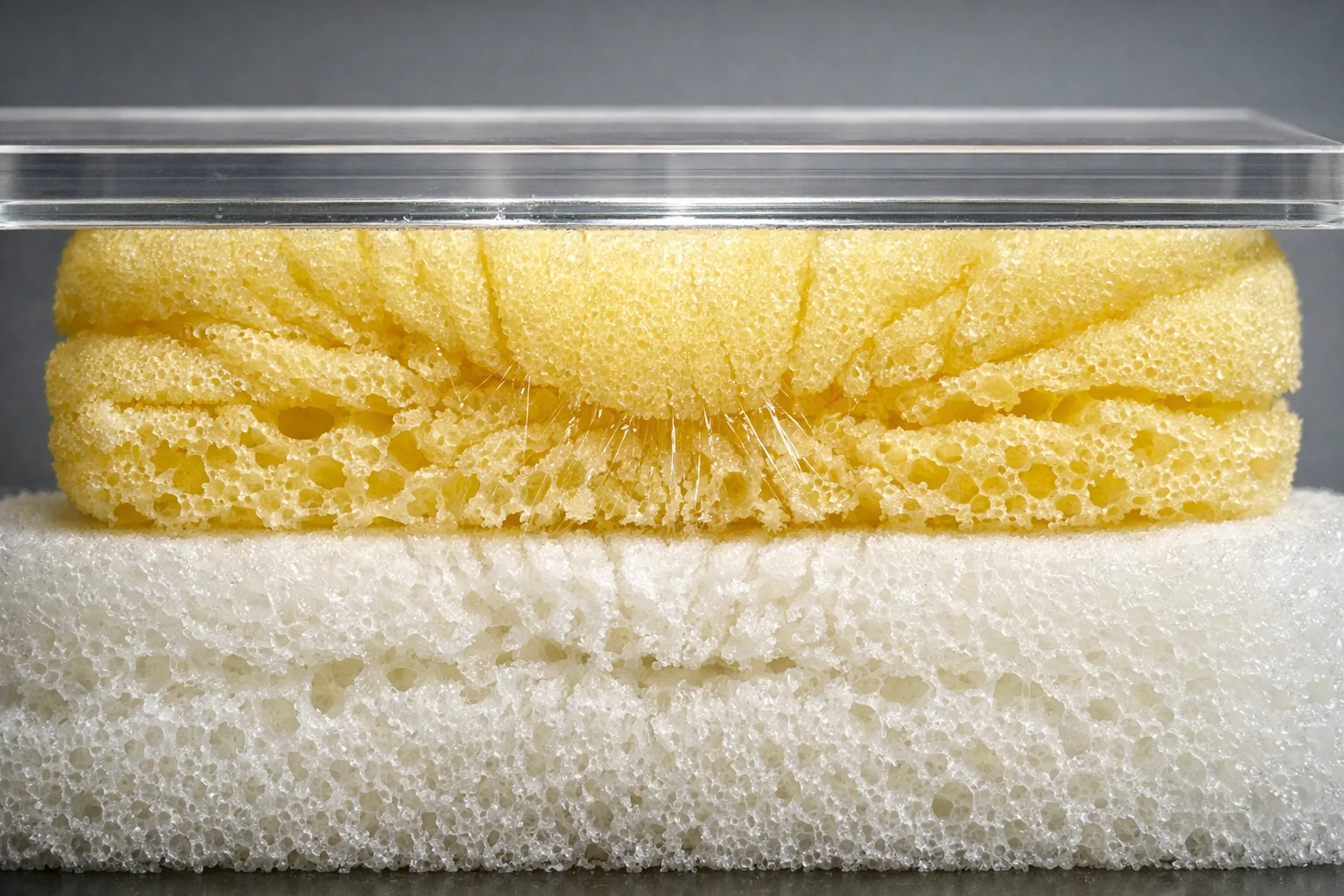
Layered Foam: Why "Sandwiches" Beat "Slabs"
Understanding how laminated foam with different properties prevents bottoming out and extends cushion life. The physics of separated comfort and support functions.
Analyze Details →